




CBSE Class 12 Physics Syllabus is ever evolving. The board continuously reviews and updates CBSE Class 12 Physics curriculum to ensure that students receive the best education possible. CBSE deleted around 30% of the physics syllabus for Class 12 CBSE 2021-22. The reduction is continued for CBSE Class 12 Exam 2024 and 2025 as well.
- Topics like Electric Charges and Fields, Current Electricity, Magnetism and Matter, Alternating Current, Wave Optics, and others have been deleted.
- Some other topics from the CBSE class 12 Physics deleted syllabus include Electrical Resistance, Cyclotron, LC oscillations, Eddy Currents, Brewster's law, etc.
CBSE Class 12 Physics Syllabus contains a total of 9 units. The maximum marks for the theory paper are 70 and the practical exam carries 30 marks.

Also Read
CBSE Class 12 Physics Deleted Syllabus
As the students of class 12 are preparing for the board examination, they must follow their current syllabus thoroughly. Here is the list of topics that have been removed from the curriculum.
| CBSE Class 12 Physics Syllabus Unit | CBSE Class 12 Physics Syllabus Chapter Name | Deleted Exercises |
|---|---|---|
| Electric Charges and Fields | Electric Charge (delete only activity with paper strips and making an electroscope), Conductors and Insulators (delete only concept of earthing), Charging by Induction. | Deleted exercises: 1.13, 1.25–1.34 |
| Electrostatic Potential and Capacitance | Energy Stored in a Capacitor (delete only derivation) | Deleted Exercises 2.12 to 2.36 |
| Current Electricity | Resistivity of Various Materials, Carbon resistors, Colour code for carbon resistor, Combinations of Resistors – Series and Parallel, Meter Bridge, Potentiometer. | Deleted Exercises 3.3, 3.4, 3.10, 3.12, 3.14–3.23 |
| Moving Charges and Magnetism | Velocity Selector, Cyclotron, The Toroid, The Magnetic Dipole Moment of a Revolving Electron | Deleted Exercises for CBSE class 12 physics deleted syllabus 2024-25 are 4.14–4.28 |
| Magnetism and Matter | Bar Magnet as an Equivalent Solenoid (delete only mathematical treatment), The Dipole in a Uniform Magnetic Field (delete only mathematical treatment), Earth’s Magnetism, Magnetic Declination and Dip Table, Paramagnetism (delete only Curie’s Law), Ferromagnetism (delete only Curie’s temperature; and Hysteresis), Permanent Magnets and Electromagnets | Deleted Exercises 5.1, 5.2, 5.9–5.11, 5.13–5.25 |
| Electromagnetic Induction | Energy Consideration: A Quantitative Study, Eddy Currents | Deleted Exercises 6.6, 6.10-6.17 |
| Alternating Current | Magnetisation and Demagnetisation of an Inductor, Charging and Discharging of a Capacitor, Analytical Solution (of series LCR circuit), Resonance (delete only Sharpness of Resonance), LC Oscillations | Deleted Exercises 7.6, 7.8, 7.10, 7.12–7.26 |
| Electromagnetic Waves | Nature of Electromagnetic Waves (delete only about ether and page 277) | Deleted Exercises 8.11–8.15 |
| Ray Optics and Optical Instruments | Refraction (delete only advanced sunrise and delayed sunset), Mirage, Diamond, Some Natural Phenomena due to Sunlight, The Rainbow, Scattering of Light | Deleted Exercise 9.18 |
| Wave Optics | Doppler Effect, Interference of Light Waves and Young’s Experiment (retain the final expressions for dark and bright fringes but delete the derivation; delete expression for fringe width), Diffraction (retain only qualitative treatment), Resolving Power of Optical Instruments, Validity of Ray Optics, Polarisation by Scattering, Polarisation by Reflection | Deleted Exercises 10.7–10.21 |
| Dual Nature of Radiation and Matter | Wave Nature of Matter (delete only derivation for de Broglie wavelength of accelerated electron; and Heisenberg’s uncertainty principle), Davisson and Germer Experiment, The History of Wave-Particle Flip-Flop | Deleted Exercises 11.5, 11.7, 11.12 to 11.14, 11.16, 11.17, 11.19–11.37 |
| Atoms | Spectral Series, Bohr Model of the Hydrogen Atom (retain only the expression for radius of nth possible orbit but delete its derivation), the Line Spectra of the Hydrogen Atom (retain only qualitative treatment) | Deleted Exercises 12.3,12.11–12.17 |
| Nuclei | Law of Radioactive Decay, Alpha Decay, Beta Decay, Gamma Decay, Nuclear Reactor | Deleted Exercises 13.1, 13.2, 13.6–13.10, 13.12–13.14, 13.18, 13.22–13.31 |
| Semiconductor Electronics: Material Devices and Simple Circuits | Special Purpose p-n junction Diodes, Digital Electronics and Logic Gates | Deleted Exercises 14.7–14.15 |
Also Read
CBSE Class 12 Exam PatternCBSE Class 12 Physics Deleted Practical Syllabus
The following list of experiments and activities has been deleted from CBSE Class 12 Physics Practical:
| Deleted Experiments – Section A | Deleted Experiments – Section B | Deleted Activities | Deleted Suggested Investigatory Projects | Deleted List of Practical |
|---|---|---|---|---|
| Comparing the EMF of two given primary cells using the Potentiometer. Determining the internal resistance of a given primary cell using the potentiometer | Drawing the characteristic curve of a Zener diode and determining its reverse breakdown voltage. Determining the wavelength of a laser beam by diffraction | Observing the polarisation of light using two polarisers | Designing an appropriate logic gate combination for a given truth table | Understanding the principle of (1) a NOT gate, (2) an OR gate, and (3) an AND gate to make their equivalent circuits using a bell and cells/battery and keys/switches |
Why CBSE Class 12 Physics Deleted Syllabus 2025-26?
Authorities have decided to remove specific topics from the CBSE Class 12 Physics Syllabus for the 2025-26 academic year. This has been done as part of restructuring and streamlining the curriculum.
- The Physics Deleted Syllabus Class 12 CBSE 2025-26 aims to eliminate redundancy and enhance the curriculum’s efficiency.
- Certain subjects were redundant as they were covered in other classes within different subject areas.
- The decision to delete some parts of the Physics Syllabus Class 12 CBSE 2025-26 was prompted by a reassessment of the physics paper’s difficulty level.
- The changes ensure fairness in the examination process and accurate evaluation of students’ knowledge and skills.
- The updated CBSE Class 12 Physics syllabus emphasizes self-directed learning.
Also Read
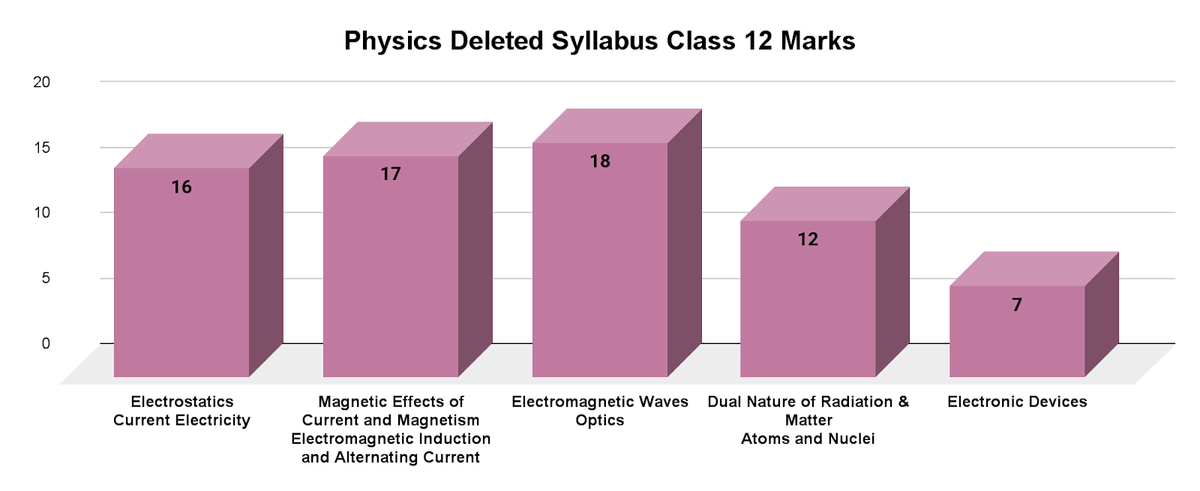
Physics Deleted Syllabus Class 12 Session 2025-26 Marks
Below is a table where students can examine the CBSE Physics Deleted Syllabus Class 12 marking scheme for the year 2025-26.
| Unit Name | Allocated Marks |
|---|---|
| ElectrostaticsCurrent Electricity | 16 |
| Magnetic Effects of Current and MagnetismElectromagnetic Induction and Alternating Current | 17 |
| Electromagnetic WavesOptics | 18 |
| Dual Nature of Radiation & MatterAtoms and Nuclei | 12 |
| Electronic Devices | 7 |
CBSE Class 12 Physics Updated Course Structure
After the deleted syllabus, you must be wondering what is the updated structure of the CBSE Class 12 Physics Syllabus. The table below shows the updated CBSE Physics syllabus 2025-26.
| S No. | Typology of Questions | TotalMarks | ApproximatePercentage |
|---|---|---|---|
| 1 | Remembering: Exhibit memory of previously learned material by recalling facts, terms, basic concepts, and answers.Understanding: Demonstrate understanding of facts and ideas by organizing, comparing, translating, interpreting, giving descriptions, and stating main ideas | 27 | 38 % |
| 2 | Applying: Solve problems in new situations by applying acquired knowledge, facts, techniques and rules in a different way. | 22 | 32% |
| 3 | Analysing: Examine and break information into parts by identifying motives or causes. Make inferences and find evidence to support generalizationsEvaluating:Present and defend opinions by making judgments about information, validity of ideas, or quality of work based on a set of criteria.Creating:Compile information together in a different way by combining elements in a new pattern or proposing alternative solutions. | 21 | 30% |
| Total Marks | 70 | 100 | |
| Practical | 30 | ||
| Gross Total | 100 | ||
Also Read
CBSE Class 12 Physics Most Repeated Questions
Students appearing for the Physics exam can check some important question types here. These types of questions are generally repeated in board exams.
- The figure shows three point charges, +2q, -q, and +3q. Two charges +2q and -q are enclosed within a surface ‘S’. What is the electric flux due to this configuration through the surface ‘S’. (Electric Charges and Fields)
- Two charges of magnitudes 2Q and + Q are located at points (a, 0) and (4a,0) respectively. What is the electric flux due to these charges through a sphere of radius ‘3a’ with its centre at the origin? (Electric Charges and Fields)
- Two point charges 20 x 10-6 C and -4 X 10⁻⁶ C are separated by a distance of 50 cm in air.
- Find the point on the line joining the charges, where the electric potential is zero.
- Also find the electrostatic potential energy of the system. (Electrostatic Potential and Capacitance)
- Two uniformly large parallel thin plates having charge densities + σ and – σ are kept in the X-Z plane at a distance ‘d’ apart. Sketch an equipotential surface due to the electric field between the plates. If a particle of mass m and charge q’ remains stationary between the plates, what is the magnitude and direction of this field? (Electrostatic Potential and Capacitance)
- Net capacitance of three identical capacitors in series is 3 pF. What will be their net capacitance if connected in parallel? Find the ratio of energy stored in the two configurations if they are both connected to the same source. (Electrostatic Potential and Capacitance)
- Two metallic wires of the same material have the same length but cross-sectional area is in the ratio 1:2. They are connected
- in series and
- in parallel. Compare the drift velocities of electrons in the two wires in both the cases. (Current Electricity)
- A battery of emf 12V and internal resistance 2 Ω is connected to a 4 Ω resistor as shown in the figure.
- Show that a voltmeter, when placed across the cell and across the resistor, in turn, gives the
- To record the voltage and the current in the circuit, why is the voltmeter placed in parallel and the ammeter in series in the circuit? (Current Electricity)
- A steady current (I1) flows through a long straight wire. Another wire carrying a steady current (I2) in the same direction is kept close and parallel to the first wire. Show with the help of a diagram how the magnetic field due to the current I1 exerts a magnetic force on the second wire. Write the expression for this force. (Moving Charges and Magnetism)
- A particle of mass 10-3 kg and charge 5 pC enters into a uniform electric field of 2 × 10⁵ NC-1, moving with a velocity of 20 ms-1 in a direction opposite to that of the field. Calculate the distance it would travel before coming to rest. (Moving Charges and Magnetism)
- A straight wire extending from east to west falls with a speed v at right angles to the horizontal component of the Earth’s magnetic field. Which end of the wire would be at the higher electrical potential and why? (Magnetism and Matter)
- A circular coil of N turns and diameter ‘d’ carries a current ‘I’. It is unwound and rewound to make another coil of diameter ‘2d’, current T remaining the same. Calculate the ratio of the magnetic moments of the new coil and the original coil. (Magnetism and Matter)
- Define self-inductance of a coil. Show that magnetic energy required to build up the current I in a coil of self-inductance L is given by – 1/2I2. (Electromagnetic Induction)
- A metallic rod of length ‘l’ is rotated with a frequency v with one end hinged at the centre and the other end at the circumference of a circular metallic ring of radius r, about an axis passing through the centre and perpendicular to the plane of the ring. A constant uniform magnetic field B parallel to the axis is present every where. Using Lorentz force, explain how emf is induced between the centre and the metallic ring and hence obtain the expression for it. (Electromagnetic Induction)
- A 15.0 µF capacitor is connected to 220 V, 50 Hz source. Find the capacitive reactance and the rms current. (Alternating Current)
- An inductor of unknown value, a capacitor of 100 μF and a resistor of 10 Ω are connected in series to a 200 V. 50 Hz a.c. source. It is found that the power factor of the circuit is unity. Calculate the inductance of the inductor and the current amplitude. (Alternating Current)
- How does Ampere-Maxwell law explain the flow of current through a capacitor when it is being charged by a battery? Write the expression for the displacement current in terms of the rate of change of electric flux. (Electromagnetic Waves)
- When an AC source is connected across a capacitor, current starts flowing through the circuit. Show how Ampere’s circuital law is generalized to explain the flow of current through the capacitor. Hence obtain the expression for the displacement current inside the capacitor. (Electromagnetic Waves)
- A biconvex lens made of a transparent material of refractive index 1.25 is immersed in water of refractive index 1.33. Will the lens behave as a converging or a diverging lens? Give reason. (Ray Optics and Optical Instruments)
- (a) Plane and convex mirrors are known to produce virtual images of the objects. Draw a ray diagram to show how, in the case of convex mirrors, virtual objects can produce real images.
(b) Why are convex mirrors used as side view mirrors in vehicles? (Ray Optics and Optical Instruments)
- Two monochromatic rays of light are incident normally on the face AB of an isosceles right-angled prism ABC. The refractive indices of the glass prism for the two rays ‘1’ and ‘2’ are respectively 1.35 and 1.45. Trace the path of these rays entering through the prism. (Ray Optics and Optical Instruments)
- Laser light of wavelength 640 nm incident on a pair of slits produces an interference pattern in which the bright fringes are separated by 7.2 mm. Calculate the wavelength of another source of light which produces interference fringes separated by 8.1 mm using same arrangement. Also find the minimum value of the order ‘n’ of bright fringe of shorter wavelength which coincides with that of the longer wavelength. (Wave Optics)
- (i) Monochromatic light of frequency 6.0 × 10¹⁴ Hz is produced by a laser. The power emitted is 2.0 × 10⁻³ W. Estimate the number of photons emitted per second on an average by the source.
(ii) Draw a plot showing the variation of photoelectric current versus the intensity of incident radiation on a given photosensitive surface. (Wave Optics)
- An electron is accelerated through a potential difference of 100 volts. What is the de-Broglie wavelength associated with it? To which part of the electromagnetic spectrum does this value of wavelength correspond? (Dual Nature of Radiation and Matter)
- An a-particle and a proton are accelerated through the same potential difference. Find the ratio of their de Broglie wavelengths. (Dual Nature of Radiation and Matter)
- When an electron in Hydrogen atom jumps from the third excited state to the ground state, how would the de Broglie wavelength associated with the electron change? Justify your answer. (Atoms)
- When an electron in Hydrogen atom jumps from the third excited state to the ground state, how would the de Broglie wavelength associated with the electron change? Justify your answer. (Nuclei)
CBSE Class 12 Physics Previous Years Papers
Check and download CBSE Class 12 Physics previous years papers from the links provided below:
| Year | Question Paper |
| 2025 | Download Physics Question Paper Here |
| 2024 | Download Physics Question Paper Here |
| 2023 | Download Physics Question Paper Here |
| 2022 | Download Physics Question Paper Here |
| 2021 | Exams Cancelled |
| 2020 | Download Physics Question Paper Here |
| 2019 | Download Physics Question Paper Here |
| 2018 | Download Physics Question Paper Here |
| 2017 | Download Physics Question Paper Here |
| 2016 | Download Physics Question Paper Here |
| 2015 | Download Physics Question Paper Here |
| 2014 | Download Physics Question Paper Here |
| 2013 | Download Physics Question Paper Here |
| 2012 | Download Physics Question Paper Here |



Comments