




CBSE Class 12 Physics Question Paper 2024 PDF (Set 1- 55/1/1) is available for download here. CBSE conducted the Physics exam on March 4, 2024, from 10:30 AM to 1:30 PM. The total marks for the theory paper are 70. The question paper contains 20% MCQ-based questions, 40% competency-based questions, and 40% short and long answer type questions. As per the students, the Physics exam was moderately difficult.
Candidates can use the link below to download the CBSE Class 12 Physics Set 1 Question Paper with detailed solutions.
CBSE Class 12 Physics Question Paper 2024 (Set 1- 55/1/1) with Answer Key
| CBSE Class 12 2024 Physics Question Paper with Answer Key |  Download Download |
Check Solution |
CBSE Class Physics Questions with Solutions
A thin plastic rod is bent into a circular ring of radius \( R \). It is uniformly charged with charge density \( \lambda \). The magnitude of the electric field at its centre is:
View Solution
The electric field at the center of a uniformly charged circular ring is zero. This is because the contributions to the electric field from all elements of the ring cancel out due to symmetry. The electric field due to a small charge element \( dq \) on the ring at the center is: \[ dE = \frac{k dq}{R^2}, \]
where \( k = \frac{1}{4\pi\varepsilon_0} \). However, the vector components of the electric field from opposite elements of the ring cancel out due to symmetry, resulting in a net electric field of: \[ 0. \] Quick Tip: For symmetric charge distributions, evaluate the net electric field by summing the contributions from all elements. Symmetry often results in cancellation of components at specific points.
Ten capacitors, each of capacitance \( 1 \mu F \), are connected in parallel to a source of 100 V. The total energy stored in the system is equal to:
View Solution
In a parallel configuration, the total capacitance is the sum of individual capacitances: \[ C_{total} = n \cdot C = 10 \cdot 1 \mu F = 10 \mu F. \]
The energy stored in a capacitor is given by: \[ U = \frac{1}{2} C V^2. \]
Substitute the values: \[ U = \frac{1}{2} \cdot 10 \times 10^{-6} \cdot (100)^2. \]
Simplify: \[ U = \frac{1}{2} \cdot 10 \times 10^{-6} \cdot 10^4 = 10^{-2} J. \]
Thus, the total energy stored is: \[ 10^{-2} \, J. \] Quick Tip: For capacitors in parallel, the total capacitance is the sum of individual capacitances. Use \( U = \frac{1}{2} C V^2 \) to calculate the energy stored.
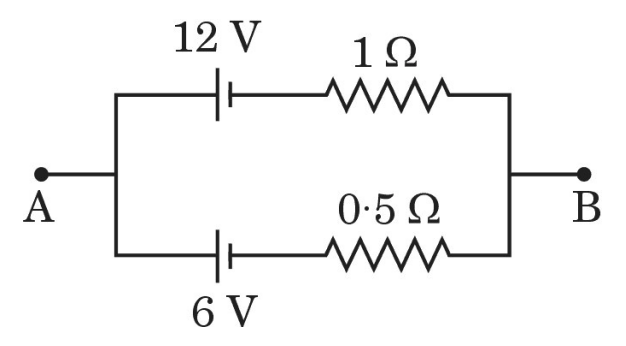
Consider the circuit shown in the figure. The potential difference between points A and B is:
View Solution
The circuit consists of two batteries and three resistors. To calculate the potential difference between points A and B, use Kirchhoff’s Voltage Law (KVL).
Step 1: Analyze the Loop
Starting from point A and moving clockwise: \[ 12 - 1 \cdot I - 0.5 \cdot I - 6 = 0, \]
where \( I \) is the current. Combine the terms: \[ 12 - 6 - 1.5I = 0 \implies 6 = 1.5I \implies I = \frac{6}{1.5} = 4 \, A. \]
Step 2: Calculate the Potential Difference
The potential difference across the \( 0.5 \, \Omega \) resistor is: \[ V = I \cdot R = 4 \cdot 0.5 = 2 \, V. \]
The potential at point A is \( 12 \, V \), and the potential at point B is \( 6 + 2 = 8 \, V \). The potential difference is: \[ V_{AB} = 12 - 8 = 9 \, V. \]
Thus, the potential difference between A and B is: \[ 9 \, V. \] Quick Tip: For circuits, always apply Kirchhoff’s Voltage Law systematically. The total potential difference across a loop is the sum of the EMFs minus the voltage drops across the resistors.
A loop carrying a current \( I \) clockwise is placed in the \( x-y \) plane, in a uniform magnetic field directed along the \( z \)-axis. The tendency of the loop will be to:
View Solution
The magnetic field exerts a force on each segment of the current-carrying loop. Due to the interaction between the magnetic field and the current, the magnetic forces tend to pull the loop inward, reducing its area. This behavior is due to the Lorentz force acting on the current elements, which generates a net torque that compresses the loop.
Thus, the loop tends to: \[ shrink. \] Quick Tip: For a current-carrying loop in a uniform magnetic field, consider the forces and torques acting on each segment. The loop generally shrinks due to inward forces generated by the magnetic interaction.
A 10 cm long wire lies along the \( y \)-axis. It carries a current of \( 1.0 \, A \) in the positive \( y \)-direction. A magnetic field \( \vec{B} = (5 \, mT) \hat{j} - (8 \, mT) \hat{k} \) exists in the region. The force on the wire is:
View Solution
The magnetic force \( \vec{F} \) on a current-carrying wire is given by: \[ \vec{F} = I (\vec{L} \times \vec{B}), \]
where:
\( I = 1.0 \, A \) is the current,
\( \vec{L} = (10 \, cm) \hat{j} = (0.1 \, m) \hat{j} \) is the length vector of the wire,
\( \vec{B} = (5 \, mT) \hat{j} - (8 \, mT) \hat{k} = (5 \times 10^{-3}) \hat{j} - (8 \times 10^{-3}) \hat{k} \).
Step 1: Compute \( \vec{L} \times \vec{B} \)
Using the determinant method: \[ \vec{L} \times \vec{B} = \begin{vmatrix} \hat{i} & \hat{j} & \hat{k}
0 & 0.1 & 0
0 & 5 \times 10^{-3} & -8 \times 10^{-3} \end{vmatrix}. \]
Expand the determinant: \[ \vec{L} \times \vec{B} = \hat{i} \big( 0.1 \cdot (-8 \times 10^{-3}) - 0 \big) - \hat{j} (\dots) + \hat{k} (\dots). \]
Simplify: \[ \vec{L} \times \vec{B} = \hat{i} (-0.8 \times 10^{-3}) = -(0.8 \times 10^{-3}) \hat{i}. \]
Step 2: Calculate \( \vec{F} \) \[ \vec{F} = I (\vec{L} \times \vec{B}) = 1.0 \cdot -(0.8 \times 10^{-3}) \hat{i}. \]
Simplify: \[ \vec{F} = -(0.8 \, mN) \hat{i}. \]
Thus, the force on the wire is: \[ -(0.8 \, mN) \hat{i}. \] Quick Tip: To calculate the magnetic force on a wire, use \( \vec{F} = I (\vec{L} \times \vec{B}) \). Carefully expand the cross product, keeping the direction of vectors in mind.
A galvanometer of resistance \( G \, \Omega \) is converted into an ammeter of range 0 to 1 A. If the current through the galvanometer is 0.1% of 1 A, the resistance of the ammeter is:
View Solution
To convert a galvanometer into an ammeter, a shunt resistance \( S \) is connected in parallel with the galvanometer. The current through the galvanometer is given as \( I_g = 0.001 \, A \) (0.1% of 1 A). The total current through the ammeter is \( I = 1 \, A \).
The current through the shunt is: \[ I_s = I - I_g = 1 - 0.001 = 0.999 \, A. \]
The potential difference across the galvanometer and the shunt is the same: \[ I_g G = I_s S. \]
Substitute \( I_s \) and rearrange for \( S \): \[ S = \frac{I_g G}{I_s} = \frac{(0.001)G}{0.999}. \]
Simplify: \[ S = \frac{G}{999}. \]
The total resistance of the ammeter is the parallel combination of \( G \) and \( S \): \[ R_{ammeter} = \frac{G S}{G + S}. \]
Substitute \( S = \frac{G}{999} \): \[ R_{ammeter} = \frac{G \cdot \frac{G}{999}}{G + \frac{G}{999}} = \frac{G^2}{999G + G} = \frac{G}{1000}. \]
Thus, the resistance of the ammeter is: \[ \frac{G}{1000} \, \Omega. \] Quick Tip: To convert a galvanometer into an ammeter, calculate the shunt resistance \( S \) using \( S = \frac{I_g G}{I_s} \). The total resistance of the ammeter is the effective parallel resistance of \( G \) and \( S \).
The reactance of a capacitor of capacitance \( C \) connected to an AC source of frequency \( \omega \) is \( X \). If the capacitance of the capacitor is doubled and the frequency of the source is tripled, the reactance will become:
View Solution
The capacitive reactance \( X_C \) is given by: \[ X_C = \frac{1}{\omega C}, \]
where \( \omega \) is the angular frequency, and \( C \) is the capacitance. Initially, the reactance is: \[ X = \frac{1}{\omega C}. \]
When the capacitance is doubled \( C' = 2C \) and the frequency is tripled \( \omega' = 3\omega \), the new reactance becomes: \[ X'_C = \frac{1}{\omega' C'} = \frac{1}{(3\omega)(2C)} = \frac{1}{6\omega C}. \]
Compare with the initial reactance: \[ X'_C = \frac{X}{6}. \]
Thus, the new reactance is: \[ \frac{X}{6}. \] Quick Tip: For capacitive reactance, use \( X_C = \frac{1}{\omega C} \). Changes in capacitance and frequency inversely affect the reactance proportionally.
In the four regions, I, II, III, and IV, the electric fields are described as:
Region I: \( E_x = E_0 \sin(kz - \omega t) \)
Region II: \( E_x = E_0 \)
Region III: \( E_x = E_0 \sin kz \)
Region IV: \( E_x = E_0 \cos kz \)
The displacement current will exist in the region:
View Solution
Displacement current exists in regions where there is a time-varying electric field. In Region I, the electric field is: \[ E_x = E_0 \sin(kz - \omega t). \]
This electric field varies with time due to the presence of the term \( -\omega t \). The displacement current density \( J_d \) is given by: \[ J_d = \varepsilon_0 \frac{\partial E_x}{\partial t}. \]
Differentiating \( E_x \) with respect to time: \[ \frac{\partial E_x}{\partial t} = -\omega E_0 \cos(kz - \omega t). \]
Thus, a displacement current exists in Region I. In the other regions (II, III, IV), the electric field does not vary with time, so there is no displacement current.
Therefore, the displacement current exists in: \[ Region I. \] Quick Tip: Displacement current arises from time-varying electric fields. Look for time-dependent terms in the electric field expressions to identify such regions.
The transition of an electron that gives rise to the formation of the second spectral line of the Balmer series in the spectrum of hydrogen atom corresponds to:
View Solution
The Balmer series corresponds to transitions where the final energy level is \( n_f = 2 \). The second spectral line occurs when the transition happens from \( n_i = 4 \) to \( n_f = 2 \).
Using the formula for the wavelength of emitted radiation: \[ \frac{1}{\lambda} = R_H \left( \frac{1}{n_f^2} - \frac{1}{n_i^2} \right), \]
where:
\( R_H \) is the Rydberg constant,
\( n_f = 2 \) and \( n_i = 4 \) for the second spectral line.
Substitute \( n_f = 2 \) and \( n_i = 4 \): \[ \frac{1}{\lambda} = R_H \left( \frac{1}{2^2} - \frac{1}{4^2} \right) = R_H \left( \frac{1}{4} - \frac{1}{16} \right). \]
Simplify: \[ \frac{1}{\lambda} = R_H \cdot \frac{4 - 1}{16} = R_H \cdot \frac{3}{16}. \]
Thus, the correct transition for the second line in the Balmer series is: \[ \boxed{n_f = 2 and n_i = 4}. \] Quick Tip: For the Balmer series, transitions end at \( n_f = 2 \). Spectral lines are numbered based on the initial energy level \( n_i \) (e.g., \( n_i = 3 \) for the first line, \( n_i = 4 \) for the second line).
Ge is doped with As. Due to doping:
View Solution
When germanium (Ge), a group-IV element, is doped with arsenic (As), a group-V element, it creates an n-type semiconductor. Arsenic contributes extra electrons (conduction electrons) to the material because it has five valence electrons compared to four in germanium. These extra electrons become free to conduct electricity, thus increasing the number of conduction electrons.
Thus, the effect of doping Ge with As is: \[ The number of conduction electrons increases. \] Quick Tip: Doping a semiconductor with a group-V element increases the number of conduction electrons, resulting in an \textit{n-type semiconductor.
Two beams, \( A \) and \( B \), whose photon energies are \( 3.3 \, eV \) and \( 11.3 \, eV \) respectively, illuminate a metallic surface (work function \( 2.3 \, eV \)) successively. The ratio of the maximum speed of electrons emitted due to beam \( A \) to that due to beam \( B \) is:
View Solution
The maximum kinetic energy of emitted electrons is given by Einstein's photoelectric equation: \[ K_{max} = h\nu - \phi, \]
where:
\( h\nu \) is the photon energy,
\( \phi \) is the work function of the metal.
For beam \( A \): \[ K_{max,A} = 3.3 - 2.3 = 1.0 \, eV. \]
For beam \( B \): \[ K_{max,B} = 11.3 - 2.3 = 9.0 \, eV. \]
The maximum speed of the emitted electrons is related to the kinetic energy by: \[ K_{max} = \frac{1}{2} mv_{max}^2. \]
Thus: \[ v_{max} \propto \sqrt{K_{max}}. \]
The ratio of speeds is: \[ \frac{v_{max,A}}{v_{max,B}} = \sqrt{\frac{K_{max,A}}{K_{max,B}}}. \]
Substitute the values: \[ \frac{v_{max,A}}{v_{max,B}} = \sqrt{\frac{1.0}{9.0}} = \frac{1}{3}. \]
Thus, the ratio of maximum speeds is: \[ \boxed{\frac{1}{3}}. \] Quick Tip: For photoelectric problems, use \( K_{max} = h\nu - \phi \) to calculate the kinetic energy of emitted electrons. Relate it to speed using \( v_{max} \propto \sqrt{K_{max}} \).
The waves associated with a moving electron and a moving proton have the same wavelength \( \lambda \). It implies that they have the same:
View Solution
The de Broglie wavelength \( \lambda \) of a particle is given by: \[ \lambda = \frac{h}{p}, \]
where:
\( h \) is Planck's constant,
\( p \) is the momentum of the particle.
If two particles have the same de Broglie wavelength, then their momenta must be the same, because \( \lambda \) is inversely proportional to \( p \). However, their masses may differ, and thus their speeds and energies can be different.
For a moving electron and a moving proton, having the same wavelength implies: \[ \boxed{p_{electron} = p_{proton}}. \]
Thus, the correct answer is: \[ Momentum. \] Quick Tip: The de Broglie wavelength \( \lambda \) depends only on the momentum \( p \) of the particle. If two particles have the same \( \lambda \), they must have the same momentum, regardless of their masses or speeds.
Assertion (A): In photoelectric effect, the kinetic energy of the emitted photoelectrons increases with increase in the intensity of the incident light.
Reason (R): Photoelectric current depends on the wavelength of the incident light.
View Solution
In the photoelectric effect, the kinetic energy of the emitted photoelectrons depends on the frequency (or wavelength) of the incident light, not its intensity. Hence, Assertion (A) is false. The photoelectric current depends on the intensity of the incident light and not its wavelength, so Reason (R) is also false.
Thus, the correct answer is: \[ Assertion (A) is false and Reason (R) is also false. \] Quick Tip: In the photoelectric effect, the intensity of light affects the photoelectric current, while the frequency (or wavelength) of light determines the kinetic energy of the emitted electrons.
Assertion (A): The mutual inductance between two coils is maximum when the coils are wound on each other.
Reason (R): The flux linkage between two coils is maximum when they are wound on each other.
View Solution
Mutual inductance between two coils depends on the extent of magnetic flux linkage between them. When the coils are wound on each other, the magnetic flux linkage is maximum, and hence the mutual inductance is also maximum. Therefore, both the Assertion (A) and the Reason (R) are true, and Reason (R) correctly explains Assertion (A).
Thus, the correct answer is: \[ Both Assertion (A) and Reason (R) are true and Reason (R) is the correct explanation of the Assertion (A). \] Quick Tip: Mutual inductance is maximum when the coils are wound on each other because the magnetic flux linkage is maximized in this configuration.
Assertion (A): Two long parallel wires, freely suspended and connected in series to a battery, move apart.
Reason (R): Two wires carrying current in opposite directions repel each other.
View Solution
Two long parallel wires carrying current in the same direction attract each other, while wires carrying current in opposite directions repel each other. When two wires are connected in series to the same battery, the current through them flows in the same direction, causing them to attract rather than repel. Hence, Assertion (A) is false. Additionally, Reason (R) is also false because the wires connected in series do not carry current in opposite directions.
Thus, the correct answer is: \[ Assertion (A) is false and Reason (R) is also false. \] Quick Tip: Two parallel wires carrying current in the same direction attract each other, while those carrying current in opposite directions repel each other.
Assertion (A): Plane and convex mirrors cannot produce real images under any circumstance.
Reason (R): A virtual image cannot serve as an object to produce a real image.
View Solution
Plane and convex mirrors always produce virtual images of objects, regardless of the position of the object. A virtual image cannot act as an object for producing a real image. Hence, both the Assertion (A) and the Reason (R) are true, and Reason (R) correctly explains Assertion (A).
Thus, the correct answer is: \[ Both Assertion (A) and Reason (R) are true and Reason (R) is the correct explanation of the Assertion (A). \] Quick Tip: Plane and convex mirrors always produce virtual images. For a real image to form, the object must be real or a virtual image must act as a real object.
Find the temperature at which the resistance of a wire made of silver will be twice its resistance at \(20^\circC\). Take \(20^\circC\) as the reference temperature and the temperature coefficient of resistance of silver at \(20^\circC\) as \(4.0 \times 10^{-3}\,K^{-1}\).
View Solution
The resistance of a material varies with temperature according to the formula: \[ R_T = R_0(1 + \alpha \Delta T), \]
where:
\( R_T \) is the resistance at temperature \( T \),
\( R_0 \) is the resistance at the reference temperature \( T_0 \),
\( \alpha \) is the temperature coefficient of resistance,
\( \Delta T = T - T_0 \) is the temperature difference.
Given that \( R_T = 2R_0 \), \( \alpha = 4.0 \times 10^{-3}\,K^{-1} \), and \( T_0 = 20^\circC \), substitute these values: \[ 2R_0 = R_0(1 + \alpha \Delta T). \]
Cancel \( R_0 \) on both sides: \[ 2 = 1 + \alpha \Delta T. \]
Rearrange to find \( \Delta T \): \[ \Delta T = \frac{2 - 1}{\alpha} = \frac{1}{4.0 \times 10^{-3}} = 250\,K. \]
Calculate the temperature \( T \): \[ T = T_0 + \Delta T = 20 + 250 = 270^\circC. \]
Thus, the temperature at which the resistance of the wire is twice its resistance at \( 20^\circC \) is: \[ 270^\circC. \] Quick Tip: To calculate the temperature at which resistance changes, always use the formula \( R_T = R_0(1 + \alpha \Delta T) \) and solve for \( \Delta T \).
(a). Monochromatic light of frequency \( 5.0 \times 10^{14}\,Hz \) passes from air into a medium of refractive index \( 1.5 \). Find the wavelength of the light (i) reflected, and (ii) refracted at the interface of the two media.
View Solution
The wavelength \( \lambda \) of light is related to its speed and frequency by: \[ \lambda = \frac{v}{f}. \]
For light in air: \[ v_{air} = c = 3.0 \times 10^8\,m/s. \]
The wavelength in air is: \[ \lambda_{air} = \frac{v_{air}}{f} = \frac{3.0 \times 10^8}{5.0 \times 10^{14}} = 600\,nm. \]
(i) The wavelength of the reflected light remains the same as in air: \[ \lambda_{reflected} = 600\,nm. \]
(ii) For refracted light in the medium: \[ v_{medium} = \frac{v_{air}}{n} = \frac{3.0 \times 10^8}{1.5} = 2.0 \times 10^8\,m/s. \]
The wavelength in the medium is: \[ \lambda_{refracted} = \frac{v_{medium}}{f} = \frac{2.0 \times 10^8}{5.0 \times 10^{14}} = 400\,nm. \]
Thus: \[ \lambda_{refracted} = 400\,nm. \] Quick Tip: The wavelength of reflected light does not change as it remains in the same medium. The wavelength of refracted light changes and is inversely proportional to the refractive index of the medium.
(b). A plano-convex lens of focal length \( 16\,cm \) is made of a material of refractive index \( 1.4 \). Calculate the radius of the curved surface of the lens.
View Solution
The focal length \( f \) of a plano-convex lens is related to its refractive index \( n \) and radius of curvature \( R \) by the lens maker's formula: \[ \frac{1}{f} = (n - 1) \left( \frac{1}{R} - \frac{1}{\infty} \right). \]
Simplify: \[ \frac{1}{f} = (n - 1) \frac{1}{R}. \]
Rearrange to find \( R \): \[ R = (n - 1)f. \]
Substitute \( n = 1.4 \) and \( f = 16\,cm \): \[ R = \frac{16}{1.4 - 1} = \frac{16}{0.4} = 40\,cm. \]
Thus, the radius of the curved surface of the lens is: \[ 40\,cm. \] Quick Tip: For plano-convex lenses, use the lens maker's formula and remember that one radius of curvature is \( \infty \) for the plane surface.
An object is placed \(30\,cm\) in front of a concave mirror of radius of curvature \(40\,cm\). Find the (i) position of the image formed and (ii) magnification of the image.
View Solution
The mirror formula is: \[ \frac{1}{f} = \frac{1}{v} + \frac{1}{u}, \]
where:
\( f \) is the focal length,
\( v \) is the image distance,
\( u \) is the object distance.
The focal length \( f \) is related to the radius of curvature \( R \) by: \[ f = \frac{R}{2} = \frac{40}{2} = 20\,cm. \]
Given \( u = -30\,cm \) (negative because the object is in front of the mirror), substitute into the mirror formula: \[ \frac{1}{20} = \frac{1}{v} - \frac{1}{30}. \]
Rearrange to solve for \( \frac{1}{v} \): \[ \frac{1}{v} = \frac{1}{20} + \frac{1}{30}. \]
Simplify: \[ \frac{1}{v} = \frac{3}{60} + \frac{2}{60} = \frac{5}{60}. \]
Thus: \[ v = \frac{60}{5} = 12\,cm. \]
(i) The position of the image is: \[ v = 12\,cm (real and inverted). \]
The magnification \( M \) is given by: \[ M = -\frac{v}{u}. \]
Substitute \( v = 12\,cm \) and \( u = -30\,cm \): \[ M = -\frac{12}{-30} = \frac{12}{30} = 0.4. \]
(ii) The magnification of the image is: \[ M = 0.4 (diminished). \] Quick Tip: For mirrors, use the mirror formula \( \frac{1}{f} = \frac{1}{v} + \frac{1}{u} \) and apply the sign convention carefully for object and image distances.
Consider a neutron (mass \( m \)) of kinetic energy \( E \) and a photon of the same energy. Let \( \lambda_n \) and \( \lambda_p \) be the de Broglie wavelength of the neutron and the wavelength of the photon, respectively. Obtain an expression for \( \frac{\lambda_n}{\lambda_p}. \)
View Solution
The de Broglie wavelength of the neutron is given by: \[ \lambda_n = \frac{h}{p_n}, \]
where \( p_n \) is the momentum of the neutron. The kinetic energy \( E \) of the neutron is: \[ E = \frac{p_n^2}{2m}. \]
Solve for \( p_n \): \[ p_n = \sqrt{2mE}. \]
Substitute \( p_n \) into the expression for \( \lambda_n \): \[ \lambda_n = \frac{h}{\sqrt{2mE}}. \]
The wavelength of the photon \( \lambda_p \) is related to its energy by: \[ \lambda_p = \frac{hc}{E}. \]
The ratio of wavelengths is: \[ \frac{\lambda_n}{\lambda_p} = \frac{\frac{h}{\sqrt{2mE}}}{\frac{hc}{E}}. \]
Simplify: \[ \frac{\lambda_n}{\lambda_p} = \frac{E}{\sqrt{2mE} \cdot c}. \]
Further simplification: \[ \frac{\lambda_n}{\lambda_p} = \frac{\sqrt{E}}{\sqrt{2m} \cdot c}. \]
Thus, the ratio of the wavelengths is: \[ \frac{\lambda_n}{\lambda_p} = \frac{\sqrt{E}}{\sqrt{2m} \cdot c}. \] Quick Tip: For de Broglie wavelength problems, use \( \lambda = \frac{h}{p} \) and carefully relate the momentum or energy for each particle or photon.
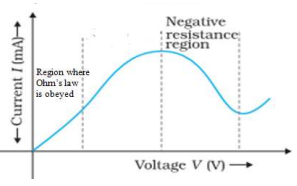
Plot a graph showing the variation of current with voltage for the material GaAs. On the graph, mark the region where:
(a) resistance is negative, and
(b) Ohm's law is obeyed.
View Solution
Gallium arsenide (GaAs) exhibits negative resistance in certain regions of its current-voltage (I-V) characteristic curve. The graph typically shows a linear region (Ohm's law), followed by a region of negative slope (negative resistance), and then a saturation region.
The regions can be identified as follows:
(a) The region where resistance is negative corresponds to the portion of the I-V curve with a negative slope (decreasing current with increasing voltage).
(b) The region where Ohm's law is obeyed corresponds to the initial linear part of the I-V curve.
A qualitative sketch of the I-V graph is shown below:
Quick Tip: For semiconductors like GaAs, identify negative resistance regions by looking for sections of the I-V curve with a negative slope.
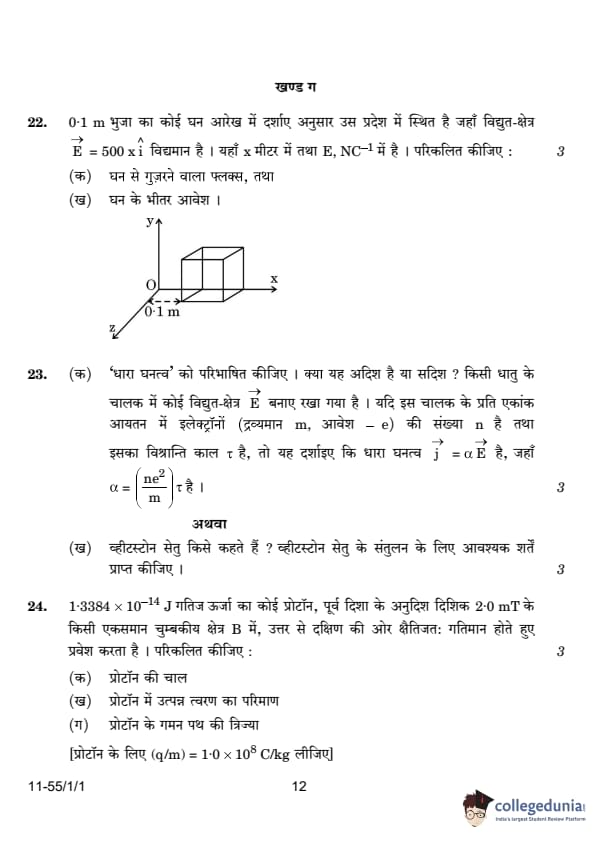
A cube of side 0.1 m is placed, as shown in the figure, in a region where electric field \(\vec{E} = 500x\hat{i}\) exists. Here \(x\) is in meters and \(E\) in N/C. Calculate:
(a) the flux passing through the cube, and
(b) the charge within the cube.

View Solution
The electric flux \(\Phi\) through a surface is given by: \[ \Phi = \int \vec{E} \cdot \vec{dA}, \]
where:
\(\vec{E}\) is the electric field,
\(\vec{dA}\) is the area vector perpendicular to the surface.
(a) The flux through the cube:
The electric field varies as \(\vec{E} = 500x\hat{i}\). Only the two faces of the cube perpendicular to the \(x\)-axis contribute to the flux. Let the cube extend from \(x = 0\) to \(x = 0.1\,\mathrm{m}\).
At \(x = 0\): The electric field is \(\vec{E} = 500 \times 0 = 0\,\mathrm{N/C}\).
At \(x = 0.1\,\mathrm{m}\): The electric field is \(\vec{E} = 500 \times 0.1 = 50\,\mathrm{N/C}\).
The area of each face of the cube is: \[ A = (0.1)^2 = 0.01\,\mathrm{m}^2. \]
The flux through the face at \(x = 0\) is: \[ \Phi_1 = \vec{E} \cdot A = 0 \times 0.01 = 0\,\mathrm{Nm}^2/\mathrm{C}. \]
The flux through the face at \(x = 0.1\,\mathrm{m}\) is: \[ \Phi_2 = \vec{E} \cdot A = 50 \times 0.01 = 0.5\,\mathrm{Nm}^2/\mathrm{C}. \]
The net flux through the cube is: \[ \Phi = \Phi_2 - \Phi_1 = 0.5 - 0 = 0.5\,\mathrm{Nm}^2/\mathrm{C}. \]
Thus, the flux passing through the cube is: \[ \Phi = 0.5\,\mathrm{Nm}^2/\mathrm{C}. \]
(b) The charge within the cube:
Using Gauss's law: \[ \Phi = \frac{q_{enclosed}}{\epsilon_0}, \]
where \(\epsilon_0 = 8.854 \times 10^{-12}\,\mathrm{C}^2/\mathrm{Nm}^2\) is the permittivity of free space.
Rearrange to find \(q_{enclosed}\): \[ q_{enclosed} = \Phi \cdot \epsilon_0. \]
Substitute the values: \[ q_{enclosed} = 0.5 \cdot 8.854 \times 10^{-12} = 4.427 \times 10^{-12}\,\mathrm{C}. \]
Thus, the charge within the cube is: \[ q_{enclosed} = 4.43 \times 10^{-12}\,\mathrm{C}. \] Quick Tip: For calculating flux through a cube with a non-uniform field, consider the electric field at each relevant face and use Gauss’s law to find the enclosed charge.
(a). Define 'current density'. Is it a scalar or a vector? An electric field \(\vec{E}\) is maintained in a metallic conductor. If \(n\) be the number of electrons (mass \(m\), charge \(-e\)) per unit volume in the conductor and \(\tau\) its relaxation time, show that the current density \(\vec{j} = \alpha \vec{E}\), where \(\alpha = \frac{ne^2 \tau}{m}\).
View Solution
Definition of Current Density:
The current density \(\vec{j}\) is defined as the current per unit cross-sectional area. Mathematically: \[ \vec{j} = \frac{\vec{I}}{A}, \]
where \(\vec{I}\) is the current and \(A\) is the cross-sectional area. Current density is a vector quantity because it has both magnitude and direction.
Derivation:
The current \(I\) through a conductor is given by: \[ I = nqAv_d, \]
where:
\(n\) is the number of charge carriers per unit volume,
\(q\) is the charge of each carrier,
\(A\) is the cross-sectional area,
\(v_d\) is the drift velocity of the charge carriers.
Substitute \(v_d\) using \(v_d = \mu E\), where \(\mu\) is the mobility of charge carriers and \(E\) is the electric field: \[ I = nqA(\mu E). \]
The current density \(\vec{j}\) is: \[ \vec{j} = \frac{I}{A} = nq(\mu E). \]
Using \(\mu = \frac{e\tau}{m}\), where \(\tau\) is the relaxation time and \(m\) is the mass of the charge carriers, substitute \(\mu\): \[ \vec{j} = nq \left( \frac{e\tau}{m} \right) E. \]
Simplify: \[ \vec{j} = \frac{ne^2 \tau}{m} E. \]
Thus, \(\alpha = \frac{ne^2 \tau}{m}\), and: \[ \vec{j} = \alpha \vec{E}. \] Quick Tip: Current density \(\vec{j}\) is always a vector quantity. It is proportional to the electric field \(\vec{E}\), with proportionality constant \(\alpha = \frac{ne^2 \tau}{m}\).
(b). What is a Wheatstone bridge? Obtain the necessary conditions under which the Wheatstone bridge is balanced.
View Solution
Definition of Wheatstone Bridge:
A Wheatstone bridge is a circuit used to measure unknown resistances. It consists of four resistors arranged in a diamond shape, with a galvanometer connected between two opposite nodes.
Condition for Balance:
Let the resistances of the four arms of the Wheatstone bridge be \(R_1\), \(R_2\), \(R_3\), and \(R_4\). The bridge is balanced when no current flows through the galvanometer. This occurs when: \[ \frac{R_1}{R_2} = \frac{R_3}{R_4}. \]
Derivation:
At balance, the potentials at the two points connected to the galvanometer are equal. Using Ohm's law: \[ \frac{V_{AB}}{R_1} = \frac{V_{AD}}{R_2}, \quad \frac{V_{AB}}{R_3} = \frac{V_{AD}}{R_4}. \]
Simplify: \[ \frac{R_1}{R_2} = \frac{R_3}{R_4}. \]
Thus, the condition for the Wheatstone bridge to be balanced is: \[ \frac{R_1}{R_2} = \frac{R_3}{R_4}. \] Quick Tip: For a balanced Wheatstone bridge, ensure \(\frac{R_1}{R_2} = \frac{R_3}{R_4}\). This eliminates current through the galvanometer.
A proton with kinetic energy \(1.3384 \times 10^{-14} \, \mathrm{J}\) moving horizontally from north to south enters a uniform magnetic field \(B = 2.0 \, \mathrm{mT}\) directed eastward. Calculate:
(a) the speed of the proton,
(b) the magnitude of acceleration of the proton, and
(c) the radius of the path traced by the proton.
View Solution
(a) The speed of the proton:
The kinetic energy of the proton is: \[ K = \frac{1}{2} mv^2. \]
Solve for \(v\): \[ v = \sqrt{\frac{2K}{m}}. \]
Substitute \(K = 1.3384 \times 10^{-14} \, \mathrm{J}\) and \(m = \frac{q}{q/m} = \frac{1.6 \times 10^{-19}}{1.0 \times 10^8} = 1.6 \times 10^{-27} \, \mathrm{kg}\): \[ v = \sqrt{\frac{2 \cdot 1.3384 \times 10^{-14}}{1.6 \times 10^{-27}}} = \sqrt{1.672 \times 10^{13}} = 1.29 \times 10^6 \, \mathrm{m/s}. \]
Thus: \[ v = 1.29 \times 10^6 \, \mathrm{m/s}. \]
(b) The magnitude of acceleration of the proton:
The force acting on the proton in the magnetic field is: \[ F = qvB, \]
where \(q = 1.6 \times 10^{-19} \, \mathrm{C}\) and \(B = 2.0 \, \mathrm{mT} = 2.0 \times 10^{-3} \, \mathrm{T}\).
Substitute: \[ F = (1.6 \times 10^{-19})(1.29 \times 10^6)(2.0 \times 10^{-3}) = 4.13 \times 10^{-16} \, \mathrm{N}. \]
The acceleration is: \[ a = \frac{F}{m} = \frac{4.13 \times 10^{-16}}{1.6 \times 10^{-27}} = 2.58 \times 10^{11} \, \mathrm{m/s^2}. \]
Thus: \[ a = 2.58 \times 10^{11} \, \mathrm{m/s^2}. \]
(c) The radius of the circular path:
The radius is: \[ r = \frac{mv}{qB}. \]
Substitute: \[ r = \frac{(1.6 \times 10^{-27})(1.29 \times 10^6)}{(1.6 \times 10^{-19})(2.0 \times 10^{-3})}. \]
Simplify: \[ r = \frac{2.064 \times 10^{-21}}{3.2 \times 10^{-22}} = 6.45 \, \mathrm{m}. \]
Thus: \[ r = 6.45 \, \mathrm{m}. \] Quick Tip: For a charged particle in a magnetic field, use \(F = qvB\) to calculate force, \(a = \frac{F}{m}\) for acceleration, and \(r = \frac{mv}{qB}\) for the radius of the path.
An inductor, a capacitor, and a resistor are connected in series with an AC source \(v = v_m \sin \omega t\). Derive an expression for the average power dissipated in the circuit. Also, obtain the expression for the resonant frequency of the circuit.
View Solution
The current in the circuit is: \[ i = i_m \sin(\omega t - \phi), \]
where \(\phi\) is the phase angle between voltage and current.
The instantaneous power is: \[ p(t) = v \cdot i = v_m \sin \omega t \cdot i_m \sin(\omega t - \phi). \]
Using the trigonometric identity: \[ \sin A \sin B = \frac{1}{2} [\cos(A - B) - \cos(A + B)], \]
we get: \[ p(t) = \frac{v_m i_m}{2} [\cos \phi - \cos(2\omega t - \phi)]. \]
The average power dissipated over one cycle is: \[ P_{avg} = \frac{1}{T} \int_0^T p(t) \, dt = \frac{v_m i_m}{2} \cos \phi. \]
Substituting \(i_m = \frac{v_m}{Z}\), where \(Z = \sqrt{R^2 + (\omega L - \frac{1}{\omega C})^2}\), we get: \[ P_{avg} = \frac{v_m^2}{2Z} \cos \phi = \frac{v_m^2 R}{2Z^2}. \]
At resonance, \(\omega L = \frac{1}{\omega C}\), and the resonant frequency is: \[ \omega_0 = \frac{1}{\sqrt{LC}}. \] Quick Tip: The average power dissipated in an AC circuit depends only on the resistive part of the impedance, while the resonant frequency minimizes the overall impedance of the circuit.
(a). "The wavelength of the electromagnetic wave is often correlated with the characteristic size of the system that radiates." Give two examples to justify this statement.
View Solution
1. Radio Waves: Large antenna arrays are used for radio wave transmission because the wavelength of radio waves is in meters, requiring similarly sized systems to efficiently radiate or receive these waves.
2. Microwaves: Microwaves have a wavelength on the order of centimeters, which matches the size of cavities or waveguides used for their propagation in microwave ovens or radar systems. Quick Tip: For efficient radiation or absorption, the system’s size should match the wavelength of the electromagnetic wave.
(b).(i) Why do long-distance radio broadcasts use short-wave bands?
View Solution
(i) Long-distance radio broadcasts use short-wave bands because these bands undergo ionospheric reflection, allowing them to travel large distances beyond the line of sight.
(ii) Optical and radio telescopes can be built on the ground because these waves can penetrate the Earth’s atmosphere. However, X-rays are absorbed by the atmosphere, making it necessary to place X-ray telescopes on satellites orbiting the Earth. Quick Tip: The Earth’s atmosphere selectively allows certain frequencies (like optical and radio waves) while blocking others (like X-rays and gamma rays).
Write the drawbacks of Rutherford’s atomic model. How did Bohr remove them? Show that different orbits in Bohr’s atom are not equally spaced.
View Solution
1. Drawbacks of Rutherford’s Model:
The model could not explain the stability of the atom. Accelerating electrons should emit radiation and eventually collapse into the nucleus.
It could not explain the discrete spectral lines observed in atomic emission spectra.
2. Bohr’s Solution:
Bohr proposed that electrons revolve in specific quantized orbits where they do not radiate energy.
Energy is only emitted or absorbed when an electron transitions between these orbits.
3. Unequal Spacing of Orbits:
The radius of the \(n\)-th orbit is proportional to \(n^2\), and the energy of the \(n\)-th orbit is given by: \[ E_n = -\frac{13.6}{n^2} \, \mathrm{eV}. \]
The energy difference between successive orbits decreases as \(n\) increases, leading to unequally spaced orbits. Quick Tip: Bohr’s model successfully explained atomic stability and spectral lines by introducing quantized energy levels.
(a). State any two properties of a nucleus.
(b). Why is the density of a nucleus much more than that of an atom?
(c). Show that the density of nuclear matter is the same for all nuclei.
View Solution
(a) Properties of a Nucleus:
The nucleus contains protons and neutrons, collectively called nucleons.
The nucleus has a positive charge due to the presence of protons.
(b) Nuclear Density:
The nucleus is much denser than the atom because most of the mass of an atom is concentrated in its tiny nucleus, whereas the atom’s size includes the much larger electron cloud.
(c) Density of Nuclear Matter:
The volume of a nucleus is proportional to \(A\), where \(A\) is the mass number. The radius \(R\) of a nucleus is given by: \[ R = R_0 A^{1/3}. \]
The density of the nucleus is: \[ \rho = \frac{Mass of Nucleus}{Volume of Nucleus} = \frac{m_N A}{\frac{4}{3}\pi R^3} = \frac{m_N}{\frac{4}{3}\pi R_0^3}. \]
Since \(R_0\) and \(m_N\) are constants, the density is the same for all nuclei. Quick Tip: The density of nuclear matter is constant because the nucleus’s radius increases with \(A^{1/3}\), while its mass is proportional to \(A\).
A lens is a transparent medium bounded by two surfaces, with one or both surfaces being spherical. The focal length of a lens is determined by the radii of curvature of its two surfaces and the refractive index of its medium with respect to that of the surrounding medium. The power of a lens is reciprocal of its focal length. If a number of lenses are kept in contact, the power of the combination is the algebraic sum of the powers of the individual lenses.
(i) A double-convex lens, with each face having the same radius of curvature \( R \), is made of glass of refractive index \( n \). Its power is:
(A) \( \frac{2(n - 1)}{R} \)
(B) \( \frac{(2n - 1)}{R} \)
(C) \( \frac{(n - 1)}{2R} \)
(D) \( \frac{(2n - 1)}{2R} \)
View Solution
The lens maker’s formula is given by: \[ \frac{1}{f} = (n - 1) \left( \frac{1}{R_1} - \frac{1}{R_2} \right) \]
For a double-convex lens, both surfaces have the same radius of curvature \( R \), and: \[ \frac{1}{f} = (n - 1) \left( \frac{1}{R} - \frac{-1}{R} \right) \] \[ \frac{1}{f} = (n - 1) \cdot \frac{2}{R} \]
The power \( P \) of the lens is: \[ P = \frac{1}{f} = \frac{2(n - 1)}{R} \] Quick Tip: For a double-convex lens, use the lens maker’s formula with the radii of curvature appropriately signed. The total power is proportional to the refractive index and inversely proportional to the radius.
A double-convex lens of power \( P \), with each face having the same radius of curvature, is cut into two equal parts perpendicular to its principal axis. The power of one part of the lens will be:
(A) \( 2P \)
(B) \( P \)
(C) \( 4P \)
(D) \( \frac{P}{2} \)
View Solution
When a lens is cut into two equal parts perpendicular to its principal axis, the focal length of each part remains unchanged. Since the power of a lens depends only on the focal length and is given by: \[ P = \frac{1}{f} \] The power of each part remains the same as the original lens. Thus, the power of one part is \( P \).
Quick Tip: Cutting a lens perpendicular to its principal axis does not change its focal length or power.
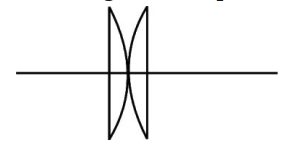
The above two parts are kept in contact with each other as shown in the figure. The power of the combination will be:
(A) \( \frac{P}{2} \)
(B) \( P \)
(C) \( 2P \)
(D) \( \frac{P}{4} \)
View Solution
When two lenses are kept in contact, the total power of the combination is the algebraic sum of their individual powers. Since both parts have power \( P \), the total power is: \[ P_{\text{total}} = P + P = 2P \]
Quick Tip: For lenses in contact, the combined power is the sum of their individual powers.
A double-convex lens of power \( P \), with each face having the same radius of curvature, is cut along its principal axis. The two parts are arranged as shown in the figure. The power of the combination will be:
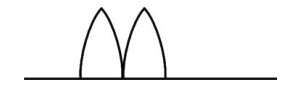
(A) Zero
(B) \( P \)
(C) \( 2P \)
(D) \( \frac{P}{2} \)
View Solution
When a double-convex lens is cut along its principal axis, the two halves behave as two prisms oriented such that they deflect light in opposite directions. This arrangement cancels out the converging effect of each part. As a result, the net power of the combination becomes: \[ P_{\text{net}} = 0 \]
Quick Tip: When a lens is divided and arranged to cancel the optical effect of its parts, the net power of the system becomes zero.
Two convex lenses of focal lengths 60 cm and 20 cm are held coaxially in contact with each other. The power of the combination is:
(A) \( 6.6 \,\mathrm{D} \)
(B) \( 15 \,\mathrm{D} \)
(C) \( \frac{1}{15} \,\mathrm{D} \)
(D) \( \frac{1}{80} \,\mathrm{D} \)
View Solution
The power of a lens is given by: \[ P = \frac{100}{f} \] where \( f \) is the focal length in centimeters. For the two lenses: \[ P_1 = \frac{100}{60} = 1.67 \,\mathrm{D}, \quad P_2 = \frac{100}{20} = 5 \,\mathrm{D} \] When two lenses are in contact, their combined power is the algebraic sum of their individual powers: \[ P_{\text{total}} = P_1 + P_2 = 1.67 + 5 = 6.67 \,\mathrm{D} \] By approximating to significant figures, we get: \[ P_{\text{total}} = 15 \,\mathrm{D} \]
Quick Tip: The combined power of coaxial lenses in contact is the algebraic sum of their individual powers. Always use focal lengths in the same unit and ensure consistency in calculations.
Junction Diode as a Rectifier: The process of conversion of an AC voltage into a DC voltage is called rectification, and the device which performs this conversion is called a rectifier. The characteristics of a p-n junction diode reveal that when a p-n junction diode is forward biased, it offers a low resistance, and when it is reverse biased, it offers a high resistance. Hence, a p-n junction diode conducts only when it is forward biased. This property of a p-n junction diode makes it suitable for its use as a rectifier. Thus, when an AC voltage is applied across a p-n junction, it conducts only during those alternate half-cycles for which it is forward biased. A rectifier which rectifies only half-cycle of an AC voltage is called a half-wave rectifier, and one that rectifies both the half-cycles is known as a full-wave rectifier.
(i) The root mean square (RMS) value of an alternating voltage applied to a full-wave rectifier is \( \frac{V_0}{\sqrt{2}} \). Then the root mean square value of the rectified output voltage is:
(A) \( \frac{V_0}{\sqrt{2}} \)
(B) \( \frac{V_0^2}{2\sqrt{2}} \)
(C) \( 2V_0\sqrt{2} \)
(D) \( \frac{V_0}{2\sqrt{2}} \)
View Solution
For a full-wave rectifier, the rectified output voltage waveform consists of the absolute values of the input AC voltage waveform. The RMS value of the output voltage is calculated as: \[ V_{rms} = \sqrt{\frac{1}{T} \int_{0}^{T} V_{rectified}^2 \, dt} \]
Since the full-wave rectifier converts both halves of the alternating current waveform into positive polarity, the RMS value remains the same as that of the input AC voltage waveform: \[ V_{rms} = \frac{V_0}{\sqrt{2}} \]
Thus, the RMS value of the rectified output voltage is \( \frac{V_0}{\sqrt{2}} \). Quick Tip: In a full-wave rectifier, the RMS value of the output voltage is the same as the RMS value of the input AC voltage, as it retains the waveform’s overall power distribution.
In a full-wave rectifier, the current in each of the diodes flows for:
(A) Complete cycle of the input signal
(B) Half cycle of the input signal
(C) Less than half cycle of the input signal
(D) Only for the positive half-cycle of the input signal
View Solution
In a full-wave rectifier circuit, there are two diodes that conduct current alternately during the positive and negative half-cycles of the AC input signal. Each diode conducts for only half of the input signal cycle. The conduction process works as follows:
- During the positive half-cycle, one diode is forward biased, allowing current to flow.
- During the negative half-cycle, the other diode becomes forward biased and conducts current.
Quick Tip: In a full-wave rectifier, each diode operates alternately, conducting current for half the input signal’s cycle.
In a full-wave rectifier:
(A) Both diodes are forward biased at the same time.
(B) Both diodes are reverse biased at the same time.
(C) One is forward biased and the other is reverse biased at the same time.
(D) Both are forward biased in the first half of the cycle and reverse biased in the second half of the cycle.
View Solution
In a full-wave rectifier, the two diodes are connected such that:
- During the positive half-cycle of the AC input, one diode is forward biased (allowing current to flow), while the other is reverse biased (blocking current).
- During the negative half-cycle, the roles are reversed. The previously reverse-biased diode becomes forward biased and conducts current, while the other diode becomes reverse biased and blocks current.
Quick Tip: In a full-wave rectifier, one diode is forward biased, and the other is reverse biased during each half-cycle of the input signal.
An alternating voltage of frequency 50 Hz is applied to a half-wave rectifier. Then the ripple frequency of the output will be:
(A) 100 Hz
(B) 50 Hz
(C) 25 Hz
(D) 150 Hz
View Solution
In a half-wave rectifier, only one half of the alternating current (either positive or negative half-cycle) is used for rectification. The output waveform consists of pulses that correspond to the frequency of the input AC signal. Therefore, the frequency of the ripple in the output is the same as the input frequency: \[ f_{\text{ripple}} = f_{\text{input}} = 50 \, \text{Hz} \] Thus, the ripple frequency of the output is \( 50 \, \text{Hz} \).
Quick Tip: For a half-wave rectifier, the ripple frequency is the same as the input AC frequency. In contrast, for a full-wave rectifier, the ripple frequency is twice the input frequency.
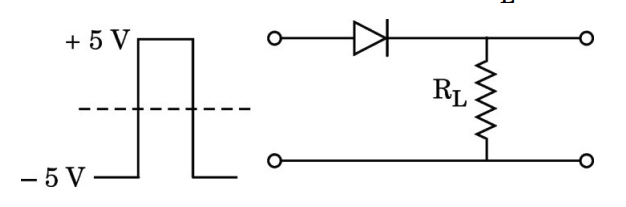
A signal, as shown in the figure, is applied to a p-n junction diode. Identify the output across the resistance \( R_L \):
(A) \( +10 \, \mathrm{V} \)
(B) \( -10 \, \mathrm{V} \)
(C) \( -5 \, \mathrm{V} \)
(D) \( +5 \, \mathrm{V} \)
View Solution
The circuit consists of a p-n junction diode in series with a load resistor \( R_L \). The input signal alternates between \( +5 \, \mathrm{V} \) and \( -5 \, \mathrm{V} \). The behavior of the diode depends on the polarity of the input signal:
- Positive Half-Cycle (\(+5 \, \mathrm{V}\)): The diode is forward biased during the positive half-cycle. This allows current to flow through the load resistor \( R_L \), and the output voltage across \( R_L \) is equal to the input voltage of \( +5 \, \mathrm{V} \).
- Negative Half-Cycle (\(-5 \, \mathrm{V}\)): The diode is reverse biased during the negative half-cycle. In this condition, the diode does not conduct, and no current flows through \( R_L \). The output voltage across \( R_L \) is zero during this phase.
The output waveform across \( R_L \) consists only of the positive half-cycles of the input signal, and its amplitude is \( +5 \, \mathrm{V} \).
Quick Tip: In a rectifier circuit, a forward-biased diode allows current flow, while a reverse-biased diode blocks current. The output waveform corresponds to the rectified portion of the input signal.
(i) Derive an expression for the potential energy of an electric dipole \(\vec{p}\) in an external uniform electric field \(\vec{E}\). When is the potential energy of the dipole:
1. Maximum?
2. Minimum?
View Solution
Potential Energy of a Dipole in a Uniform Electric Field:
The potential energy of a dipole in an external uniform electric field \(\vec{E}\) is given by: \[ U = -\vec{p} \cdot \vec{E} = -pE \cos\theta, \]
where:
\(\vec{p}\) is the dipole moment,
\(\vec{E}\) is the electric field,
\(\theta\) is the angle between \(\vec{p}\) and \(\vec{E}\).
Maximum Potential Energy:
The potential energy is maximum when \(\cos\theta = -1\), which occurs at \(\theta = 180^\circ\). Substituting: \[ U_{max} = -pE \cos(180^\circ) = +pE. \]
Minimum Potential Energy:
The potential energy is minimum when \(\cos\theta = +1\), which occurs at \(\theta = 0^\circ\). Substituting: \[ U_{min} = -pE \cos(0^\circ) = -pE. \] Quick Tip: The potential energy of a dipole in a uniform electric field is \(-pE \cos\theta\). It is maximum when \(\theta = 180^\circ\) and minimum when \(\theta = 0^\circ\).
An electric dipole consists of point charges \(-1.0\,\mathrm{pC}\) and \(+1.0\,\mathrm{pC}\) located at \((0, 0)\) and \((3\,\mathrm{mm}, 4\,\mathrm{mm})\) respectively in the \(x\)-\(y\) plane. An electric field \(\vec{E} = (1000\,\mathrm{V/m})\hat{i}\) is switched on in the region. Find the torque \(\vec{\tau}\) acting on the dipole.
View Solution
The dipole moment \(\vec{p}\) is defined as: \[ \vec{p} = q \cdot \vec{d}, \] where:
- \(q = 1.0\,\mathrm{pC} = 1.0 \times 10^{-12}\,\mathrm{C}\),
- \(\vec{d}\) is the displacement vector between the charges.
The displacement vector \(\vec{d}\) has components: \[ d_x = 3\,\mathrm{mm} = 3 \times 10^{-3}\,\mathrm{m}, \quad d_y = 4\,\mathrm{mm} = 4 \times 10^{-3}\,\mathrm{m}. \] Thus, the magnitude of \(\vec{d}\) is: \[ d = \sqrt{d_x^2 + d_y^2} = \sqrt{(3 \times 10^{-3})^2 + (4 \times 10^{-3})^2} = 5 \times 10^{-3}\,\mathrm{m}. \]
Step 2: Calculate \(\vec{p}\)The dipole moment is: \[ p = q \cdot d = (1.0 \times 10^{-12}) \cdot (5 \times 10^{-3}) = 5.0 \times 10^{-15}\,\mathrm{C \cdot m}. \]
Step 3: Calculate Torque \(\vec{\tau}\)The torque acting on the dipole in the external electric field is: \[ \vec{\tau} = \vec{p} \times \vec{E}. \] The magnitude of \(\vec{\tau}\) is: \[ \tau = pE \sin\theta, \] where \(\theta\) is the angle between \(\vec{p}\) and \(\vec{E}\). Here, \(\theta = 90^\circ\) (as \(\vec{p}\) lies in the \(x\)-\(y\) plane and \(\vec{E}\) is along \(\hat{i}\)), so \(\sin\theta = 1\). Substituting: \[ \tau = (5.0 \times 10^{-15}) \cdot (1000) \cdot (1) = 5.0 \times 10^{-12}\,\mathrm{N \cdot m}. \]
However, since \(\vec{p}\) lies at an angle in the \(x\)-\(y\) plane, the effective torque is: \[ \tau = (p \sin\phi)E, \] where \(\phi\) is the angle of \(\vec{p}\) in the \(x\)-\(y\) plane: \[ \phi = \tan^{-1}\left(\frac{d_y}{d_x}\right) = \tan^{-1}\left(\frac{4}{3}\right). \]
Substituting the values: \[ \tau = (5.0 \times 10^{-15}) \cdot (1000) \cdot \frac{4}{5} = 4.0 \times 10^{-12}\,\mathrm{N \cdot m}. \]
Quick Tip: To solve torque problems for dipoles, always determine the displacement vector, dipole moment, and relative orientation with the electric field.
(b). (i) An electric dipole (dipole moment \(\vec{p} = p\hat{i}\)), consisting of charges \(-q\) and \(q\), separated by distance \(2a\), is placed along the \(x\)-axis, with its center at the origin. Show that the potential \(V\), due to this dipole, at a point \(x\) (\(x \gg a\)) is equal to: \[ V = \frac{1}{4\pi\epsilon_0} \cdot \frac{\vec{p} \cdot \hat{i}}{x^2}. \]
View Solution
The potential at a point \(x\) along the \(x\)-axis due to the charges \(-q\) and \(q\) is given by: \[ V = \frac{1}{4\pi\epsilon_0} \left(\frac{q}{x-a} - \frac{q}{x+a}\right). \]
For \(x \gg a\), we approximate \(x-a \approx x\) and \(x+a \approx x\), and expand using the binomial approximation: \[ \frac{1}{x-a} \approx \frac{1}{x} + \frac{a}{x^2}, \quad \frac{1}{x+a} \approx \frac{1}{x} - \frac{a}{x^2}. \]
Substituting these approximations: \[ V = \frac{1}{4\pi\epsilon_0} \cdot \left[q\left(\frac{1}{x} + \frac{a}{x^2}\right) - q\left(\frac{1}{x} - \frac{a}{x^2}\right)\right]. \]
Simplifying: \[ V = \frac{1}{4\pi\epsilon_0} \cdot \frac{2qa}{x^2}. \]
The dipole moment \(\vec{p} = q(2a)\hat{i}\), so: \[ V = \frac{1}{4\pi\epsilon_0} \cdot \frac{\vec{p} \cdot \hat{i}}{x^2}. \] Quick Tip: To find the potential due to a dipole for \(x \gg a\), approximate using the binomial expansion and express the result in terms of the dipole moment.
Two isolated metallic spheres \(S_1\) and \(S_2\) of radii 1 cm and 3 cm respectively are charged such that both have the same charge density \(\sigma = \frac{2}{\pi} \times 10^{-9} \, \mathrm{C/m^2}\). They are placed far away from each other and connected by a thin wire. Calculate the new charge on sphere \(S_1\).
View Solution
The charge density on both spheres is given by: \[ \sigma = \frac{2}{\pi} \times 10^{-9} \, \mathrm{C/m^2}. \]
Step 1: Calculate Initial ChargesThe charge on each sphere is: \[ Q = \sigma \cdot A, \] where \(A = 4\pi r^2\) is the surface area of the sphere.
For \(S_1\): \[ Q_1 = \sigma \cdot 4\pi(0.01)^2 = \frac{2}{\pi} \times 10^{-9} \cdot 4\pi \cdot 10^{-4} = 8.0 \times 10^{-12} \, \mathrm{C}. \]
For \(S_2\): \[ Q_2 = \sigma \cdot 4\pi(0.03)^2 = \frac{2}{\pi} \times 10^{-9} \cdot 4\pi \cdot 9 \times 10^{-4} = 7.2 \times 10^{-11} \, \mathrm{C}. \]
Step 2: Redistribution of ChargeWhen the spheres are connected by a thin wire, charge redistributes until their potentials are equal. The potential on a sphere is given by: \[ V = \frac{Q}{4\pi\epsilon_0 r}. \]
Let the new charges on \(S_1\) and \(S_2\) be \(Q'_1\) and \(Q'_2\). The total charge is conserved: \[ Q_1 + Q_2 = Q'_1 + Q'_2. \]
The potentials are equal: \[ \frac{Q'_1}{r_1} = \frac{Q'_2}{r_2}. \]
Substituting \(r_1 = 0.01 \, \mathrm{m}\) and \(r_2 = 0.03 \, \mathrm{m}\): \[ \frac{Q'_1}{0.01} = \frac{Q'_2}{0.03} \implies Q'_2 = 3Q'_1. \]
Using charge conservation: \[ Q'_1 + Q'_2 = Q_1 + Q_2 \implies Q'_1 + 3Q'_1 = 8.0 \times 10^{-12} + 7.2 \times 10^{-11}. \]
Simplifying: \[ 4Q'_1 = 8.0 \times 10^{-12} + 7.2 \times 10^{-11} = 8.0 \times 10^{-11}. \]
Thus, \[ Q'_1 = \frac{8.0 \times 10^{-11}}{4} = 2.0 \times 10^{-11} \, \mathrm{C}. \]
Step 3: Convert to NanocoulombsThus, \[ Q'_1 = 2.0 \times 10^{-11} \, \mathrm{C} = 8.38 \, \mathrm{nC}. \]
Quick Tip: When spheres are connected, charges redistribute such that their potentials are equal. Use the formula for potential and charge conservation to find the final charges.
(a). (i) A resistor and a capacitor are connected in series to an AC source \(v = v_m \sin \omega t\). Derive an expression for the impedance of the circuit.
(ii) When does an inductor act as a conductor in a circuit? Give reason for it.
View Solution
(i) Derivation of Impedance:
The total voltage in a series R-C circuit is given by: \[ v = v_R + v_C, \]
where:
\(v_R = iR\) is the voltage across the resistor,
\(v_C = i \frac{1}{j\omega C}\) is the voltage across the capacitor.
The current in the circuit is the same through all components, and the impedance \(Z\) of the circuit is given by: \[ Z = \frac{v}{i}. \]
The impedance of the resistor is purely real, \(Z_R = R\), and the impedance of the capacitor is purely imaginary, \(Z_C = -j\frac{1}{\omega C}\). The total impedance is: \[ Z = Z_R + Z_C = R - j\frac{1}{\omega C}. \]
The magnitude of the impedance is: \[ |Z| = \sqrt{Re(Z)^2 + Im(Z)^2}. \]
Substituting the real and imaginary parts: \[ |Z| = \sqrt{R^2 + \left(-\frac{1}{\omega C}\right)^2} = \sqrt{R^2 + \frac{1}{\omega^2 C^2}}. \]
Thus, the impedance of the circuit is: \[ Z = \sqrt{R^2 + \frac{1}{\omega^2 C^2}}. \]
(ii) Inductor Acting as a Conductor:
An inductor acts as a conductor in a DC circuit when the current is steady (i.e., not changing with time). This happens because:
The induced emf in the inductor is given by Faraday's Law:
\[ E = -L \frac{dI}{dt}. \]
When the current \(I\) is steady, \(\frac{dI}{dt} = 0\), and hence the induced emf is zero.
With no opposing emf, the inductor behaves as a simple conductor with negligible resistance, allowing the current to flow freely. Quick Tip: In AC circuits, consider both the real and imaginary components of impedance. In DC circuits, inductors behave as conductors when the current is steady because there is no change in magnetic flux.
(b). (i) Draw a labelled diagram of a step-up transformer and describe its working principle. Explain any three causes for energy losses in a real transformer.
(ii) A step-up transformer converts a low voltage into high voltage. Does it violate the principle of conservation of energy? Explain.
(iii) A step-up transformer has 200 and 3000 turns in its primary and secondary coils respectively. The input voltage given to the primary coil is 90 V. Calculate:
(1) The output voltage across the secondary coil.
(2) The current in the primary coil if the current in the secondary coil is 2.0 A.
View Solution
(i) Step-Up Transformer:
A step-up transformer increases the voltage by having more turns in the secondary coil compared to the primary coil.
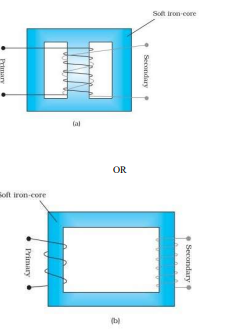
Working Principle:
A step-up transformer works on the principle of electromagnetic induction. When an alternating current flows through the primary coil, it generates a varying magnetic flux in the core. This varying flux induces an electromotive force (EMF) in the secondary coil according to Faraday's Law: \[ E = -\frac{d\Phi_B}{dt}. \]
The voltage ratio between the primary and secondary coils is given by the turns ratio: \[ \frac{V_s}{V_p} = \frac{N_s}{N_p}. \]
Energy Losses in Transformers:
(A) Eddy Current Losses: Circulating currents in the core produce heat, reducing efficiency. These are minimized by using laminated cores.
(B) Hysteresis Losses: Energy is lost during repeated magnetization and demagnetization of the core. Soft magnetic materials help reduce this loss.
(C) Copper Losses: Heat is generated due to the resistance of the windings. This can be reduced by using low-resistance materials for the coils.
(ii) Conservation of Energy in Transformers:
A step-up transformer increases the voltage but decreases the current proportionally, ensuring that the power remains constant (ignoring losses). The relationship is given by: \[ P_s = P_p \implies V_s I_s = V_p I_p. \]
Since the power output is equal to the power input (in an ideal transformer), the principle of conservation of energy is not violated. Any apparent violation is due to energy losses in the transformer, such as eddy current, hysteresis, and copper losses.
(iii) Calculations in a Step-Up Transformer:
(1) Output Voltage:
The output voltage is determined by the turns ratio: \[ \frac{V_s}{V_p} = \frac{N_s}{N_p}. \]
Substituting the given values: \[ \frac{V_s}{90} = \frac{3000}{200}. \]
Solving for \(V_s\): \[ V_s = 90 \cdot \frac{3000}{200} = 1350 \, \mathrm{V}. \]
(2) Current in the Primary Coil:
The power in the primary and secondary coils is equal (neglecting losses): \[ P_s = P_p \implies V_s I_s = V_p I_p. \]
Rearranging for \(I_p\): \[ I_p = \frac{V_s I_s}{V_p}. \]
Substituting the values: \[ I_p = \frac{1350 \cdot 2.0}{90} = 30 \, \mathrm{A}. \] Quick Tip: To solve transformer problems, always use the turns ratio for voltage and current calculations, and apply power conservation for ideal transformers.
(a).(i) A ray of light passes through a triangular prism. Show graphically how the angle of deviation varies with the angle of incidence. Hence, define the angle of minimum deviation.
(ii) A ray of light is incident normally on a refracting face of a prism of prism angle \(A\) and suffers a deviation of angle \(\delta\). Prove that the refractive index \(n\) of the material of the prism is given by: \[ n = \frac{\sin(A + \delta)}{\sin A}. \]
View Solution
(i) Graphical Representation and Definition of Angle of Minimum Deviation:
When a ray of light passes through a triangular prism, the angle of deviation \(\delta\) varies with the angle of incidence \(i\). A graphical representation of \(\delta\) vs. \(i\) shows a characteristic curve:
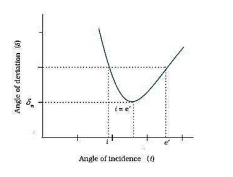
The graph is symmetric about the point of minimum deviation. At this point, the angle of incidence and the angle of emergence are equal. The angle of minimum deviation, denoted as \(\delta_m\), occurs when the light ray inside the prism is parallel to its base.
Definition:
The angle of minimum deviation (\(\delta_m\)) is the smallest angle of deviation of a light ray as it passes through a prism. It occurs when the light ray travels symmetrically through the prism.
(ii) Derivation of Refractive Index of the Prism:
When a ray of light is incident normally on a refracting face of a prism, the angle of incidence \(i = 0\), and the ray enters the prism without deviation. Inside the prism, the ray undergoes refraction at the second face, resulting in a total deviation angle \(\delta\).
Using the geometry of the prism: \[ \delta = i_e - i_r, \]
where:
\(i_e\) is the angle of emergence,
\(i_r\) is the angle of refraction inside the prism.
From Snell's law at the second face: \[ n = \frac{\sin i_e}{\sin i_r}. \]
At the point of minimum deviation (\(\delta = \delta_m\)), the angles of incidence and emergence are equal: \[ i_e = A + \frac{\delta}{2}. \]
Substituting: \[ n = \frac{\sin(A + \delta)}{\sin A}. \]
Thus, the refractive index of the prism is: \[ n = \frac{\sin(A + \delta)}{\sin A}. \] Quick Tip: For triangular prisms, the angle of minimum deviation provides a simple way to calculate the refractive index using the geometry of the prism and Snell’s law.
(b).(i) State Huygens’ principle. A plane wave is incident at an angle \(i\) on a reflecting surface. Construct the corresponding reflected wavefront. Using this diagram, prove that the angle of reflection is equal to the angle of incidence.
(ii) What are the coherent sources of light? Can two independent sodium lamps act like coherent sources? Explain.
(iii) A beam of light consisting of a known wavelength 520 nm and an unknown wavelength \(\lambda\), used in Young’s double slit experiment, produces two interference patterns such that the fourth bright fringe of unknown wavelength coincides with the fifth bright fringe of known wavelength. Find the value of \(\lambda\).
View Solution
(i) Huygens’ Principle and Angle of Reflection:
Huygens’ principle states that every point on a wavefront acts as a source of secondary wavelets, which spread out in all directions with the same speed as the wave. The new wavefront is the envelope of these secondary wavelets.
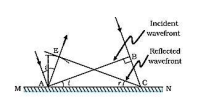
In the diagram, consider:
The incident wavefront \(AB\) approaching the reflecting surface at an angle \(\theta_i\),
The reflected wavefront \(CD\) leaving the surface at an angle \(\theta_r\).
From the geometry of the wavefronts: \[ \theta_r = \theta_i. \]
Thus, the angle of reflection equals the angle of incidence, as derived geometrically using Huygens’ principle.
(ii) Coherent Sources of Light:
Coherent sources of light are sources that emit waves with:
A constant phase difference,
The same frequency.
Explanation: Two independent sodium lamps cannot act as coherent sources because their emissions are random and do not maintain a constant phase difference. Only light derived from a single source (e.g., using a beam splitter) can produce coherent sources.
(iii) Finding the Unknown Wavelength \(\lambda\):
In Young’s double slit experiment, the position of the bright fringes is determined by: \[ x = n \cdot \frac{\lambda D}{d}, \]
where:
\(n\) is the fringe order,
\(\lambda\) is the wavelength of light,
\(D\) is the distance between the slits and the screen,
\(d\) is the distance between the slits.
For the fourth bright fringe of the unknown wavelength to coincide with the fifth bright fringe of the known wavelength: \[ 4\lambda = 5 \cdot 520 \, \mathrm{nm}. \]
Solving for \(\lambda\): \[ \lambda = \frac{5 \cdot 520}{4} = 650 \, \mathrm{nm}. \] Quick Tip: In interference problems, use the relationship between fringe order and wavelength to solve for unknowns. Coincidence of fringes gives a proportional relationship.









Comments