




The CBSE Class 12 Physics Question Paper 2026 Set 2 is available for download here of CBSE Board Exam 2026. This CBSE 12th Physics solved question paper includes detailed solutions, answer key, and the latest CBSE marking scheme to help students understand the exam pattern and important topics.
By practicing the CBSE Class 12 Physics 2026 board exam paper PDF, students can improve answer-writing strategy, time management, and overall exam performance.
| CBSE Class 12 Physics | Question PDF | Solution PDF |
|---|---|---|
| Set 1 55-1-1 | Download PDF | View Solution |
| Set 2 55 1 2 | Download PDF | View Solution |
| Set 3 55 1 3 | Download PDF | View Solution |
| Set 2 55 3 2 | Download PDF | View Solution |
| Set 1 55 4 1 | Download PDF | View Solution |
| Set 2 55 4 2 | Download PDF | View Solution |
CBSE Class 12 Physics Question Paper 2026 Set 2 55-5-2
| CBSE Class 12 Physics Question Paper 2026 Set 2 55-5-2 | Download PDF | Check Solutions |
The energy of an electron in an orbit in hydrogen atom is -3.4 eV. Its angular momentum in the orbit will be:
The momentum of a photon associated with a microwave of wavelength 4.00 cm is:
The radius of a nucleus of mass number 125 is:
The rms and the average value of an ac voltage \(V = V_0 \sin \omega t\) volt over a cycle respectively will be:
A good diode checked by a multimeter should indicate:
Two point charges -Q and Q are located at points (d, 0) and (0, d) respectively, in x-y plane. The electric field E at the origin will be:
An electron is moving with velocity \(v_0 \hat{i}\). If a uniform electric field \(\vec{E} = E_0 \hat{j}\) is set up in the region, the electron will:
A charged particle of mass m having kinetic energy K passes undeflected through a region with electric field \(\vec{E}\) and magnetic field \(\vec{B}\) acting perpendicular to each other. The mass m of the particle will be:
A rectangular loop of size 5 cm × 8 cm is lying in x-y plane in a uniform magnetic field \(\vec{B} = (2.0 T) \hat{k}\). The total magnetic flux linked with the loop is:
Which of the following statements is not true for electric energy in ac form compared to that in dc form?
The magnetic field in a plane electromagnetic wave travelling in glass (n = 1.5) is given by \(B_y = (2 \times 10^{-7} T) \sin (\alpha x + 1.5 \times 10^{11} t)\) where x is in metres and t is in seconds. The value of \(\alpha\) is:
The energy of an electron revolving in the nth orbit in Bohr model of hydrogen atom is proportional to:
Assertion (A): Energy is released when heavy nuclei undergo fission or light nuclei undergo fusion.
Reason (R): For heavy nuclei, binding energy per nucleon increases with increasing Z while for light nuclei, it decreases with increasing Z.
Assertion (A): Photoelectric effect is a spontaneous phenomenon.
Reason (R): According to the wave picture of radiation, an electron would take hours/days to absorb sufficient energy to overcome the work function and come out from a metal surface.
Assertion (A): Induced emf produced in a coil will be more when the magnetic flux linked with the coil is more.
Reason (R): Induced emf produced is directly proportional to the magnetic flux.
Assertion (A): In Young's double-slit experiment, the fringe width for dark and bright fringes is the same.
Reason (R): Fringe width is given by \(\beta = \frac{\lambda D}{d}\), where symbols have their usual meanings.
Suppose a pure Si crystal has \(5 \times 10^{28}\) atoms per m³. It is doped with \(5 \times 10^{22}\) atoms per m³ of Arsenic. Calculate the majority and minority carrier concentration in the doped silicon. (Given: \(n_i = 1.5 \times 10^{16}\) m⁻³)
In a Young's double-slit experiment, two waves each of intensity I superpose each other and produce an interference pattern. Prove that the resultant intensities at maxima and minima are 4I and zero respectively.
(a) An electric iron rated 2.2 kW, 220 V is operated at 110 V supply. Find: (i) its resistance, and (ii) heat produced by it in 10 minutes.
A square loop of side 10 cm, free to rotate about a vertical axis coinciding with its one arm, is initially held perpendicular to a uniform horizontal magnetic field of 0.2 T. If it is rotated at the uniform speed of 60 rpm, find the emf induced in the loop.
A point source, in air, is placed at a distance of 6 cm in front of a convex spherical surface (n = 1.5 and radius of curvature = 24 cm). Find the position and nature of the image formed.
(a) Differentiate between inductive reactance, capacitive reactance and impedance of an ac circuit.
(b) An ideal inductor and an ideal capacitor are connected in series across an ac voltage. Plot a graph showing variation of net reactance of the circuit with frequency of the applied ac voltage.
Two parallel plate capacitors X and Y are connected in series to a 6 V battery. They have the same plate area and same plate separation but capacitor Y contains a material of dielectric constant 4.
(a) Calculate the capacitances of X and Y, if the equivalent capacitance of the combination of X and Y is 4 µF.
(b) Calculate the potential difference across the plates of X and Y.
(a) (i) Write any two features of nuclear forces.
(ii) If both the number of protons and the neutrons are conserved in each nuclear reaction, in what way is mass converted into energy (or vice versa) in a nuclear reaction? Explain.
Photoemission of electrons occurs from a metal (\(\phi_0 = 1.96\) eV) when light of frequency \(6.4 \times 10^{14}\) Hz is incident on it. Calculate:
(a) Energy of a photon in the incident light,
(b) The maximum kinetic energy of the emitted electrons, and
(c) The stopping potential.
Write the expression for the magnetic field due to a current element in vector form. Consider a 1 cm segment of a wire, centered at the origin, carrying a current of 10 A in positive x-direction. Calculate the magnetic field B at a point (1 m, 1 m, 0).
Differentiate between conduction current and displacement current. A capacitor is connected across a source providing time-dependent current. Explain how the total current at an instant is the sum of conduction current and displacement current in the circuit at that instant.
What are de Broglie waves? Show that the wavelength of the electromagnetic radiation is equal to the de Broglie wavelength of its quantum (photon).
In a Young's double-slit experiment, the two slits behave as coherent sources. When coherent light waves superpose over each other they create an interference pattern of successive bright and dark regions due to constructive and destructive interference. Two slits 2 mm apart are illuminated by a source of monochromatic light and the interference pattern is observed on a screen 5.0 m away from the slits.
(i) What property of light does this interference experiment demonstrate?
(ii) (a) The wavelength of light used in this experiment is: (OR) (b) The fringe width in the interference pattern formed on the screen is:
(iii) The path difference between the two waves meeting at point P, where there is a minimum in the interference pattern is:
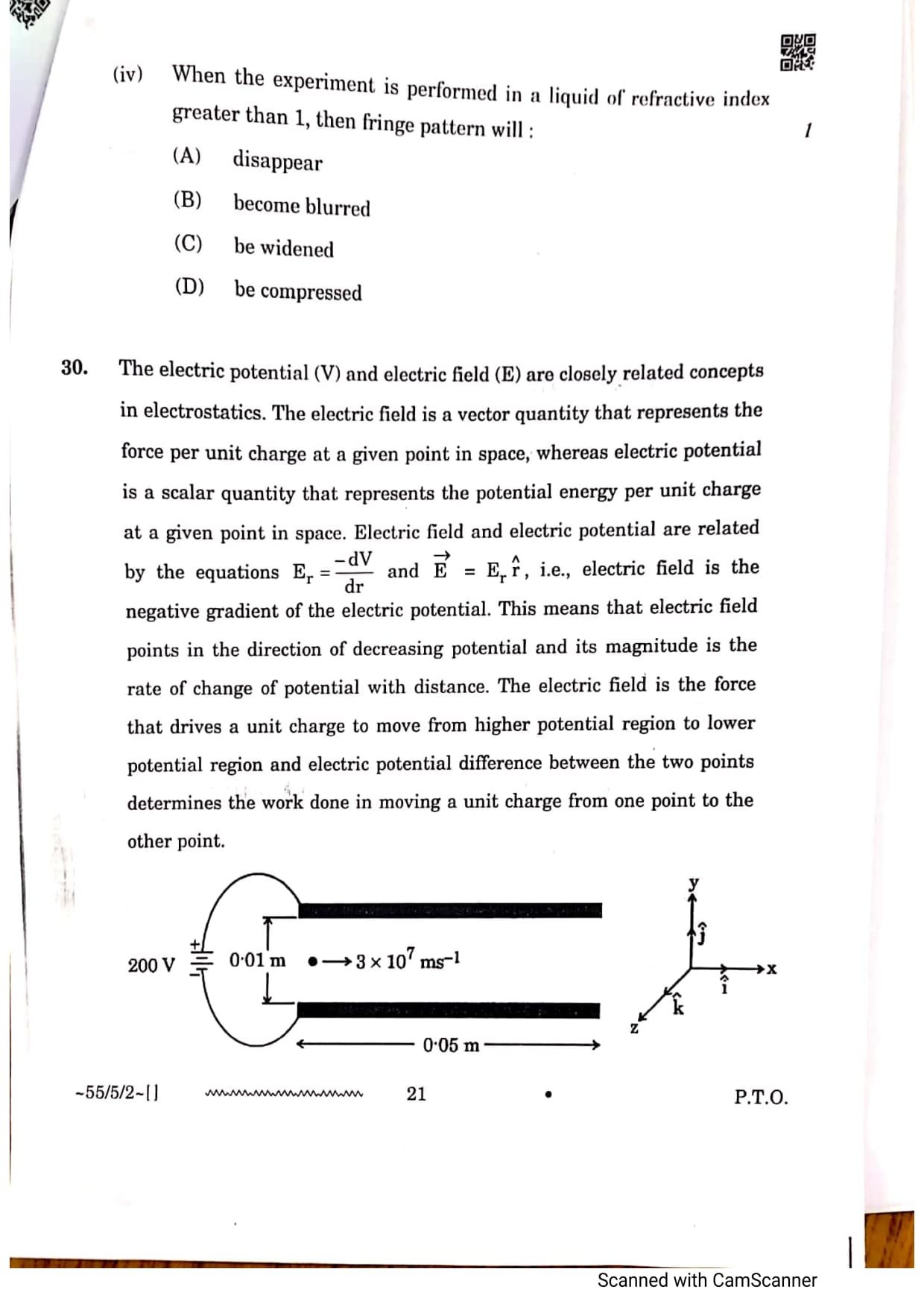
(iv) When the experiment is performed in a liquid of refractive index greater than 1, then fringe pattern will:
The electric potential \((V)\) and electric field \((E)\) are closely related concepts in electrostatics. The electric field is a vector quantity that represents the force per unit charge at a given point in space, whereas electric potential is a scalar quantity that represents the potential energy per unit charge at a given point in space. Electric field and electric potential are related by the equations
\[ E_r = -\frac{dV}{dr} \quad and \quad \vec{E} = E_r \hat{r}, \]
i.e., electric field is the negative gradient of the electric potential. This means that electric field points in the direction of decreasing potential and its magnitude is the rate of change of potential with distance. The electric field is the force that drives a unit charge to move from higher potential region to lower potential region and electric potential difference between the two points determines the work done in moving a unit charge from one point to the other point.
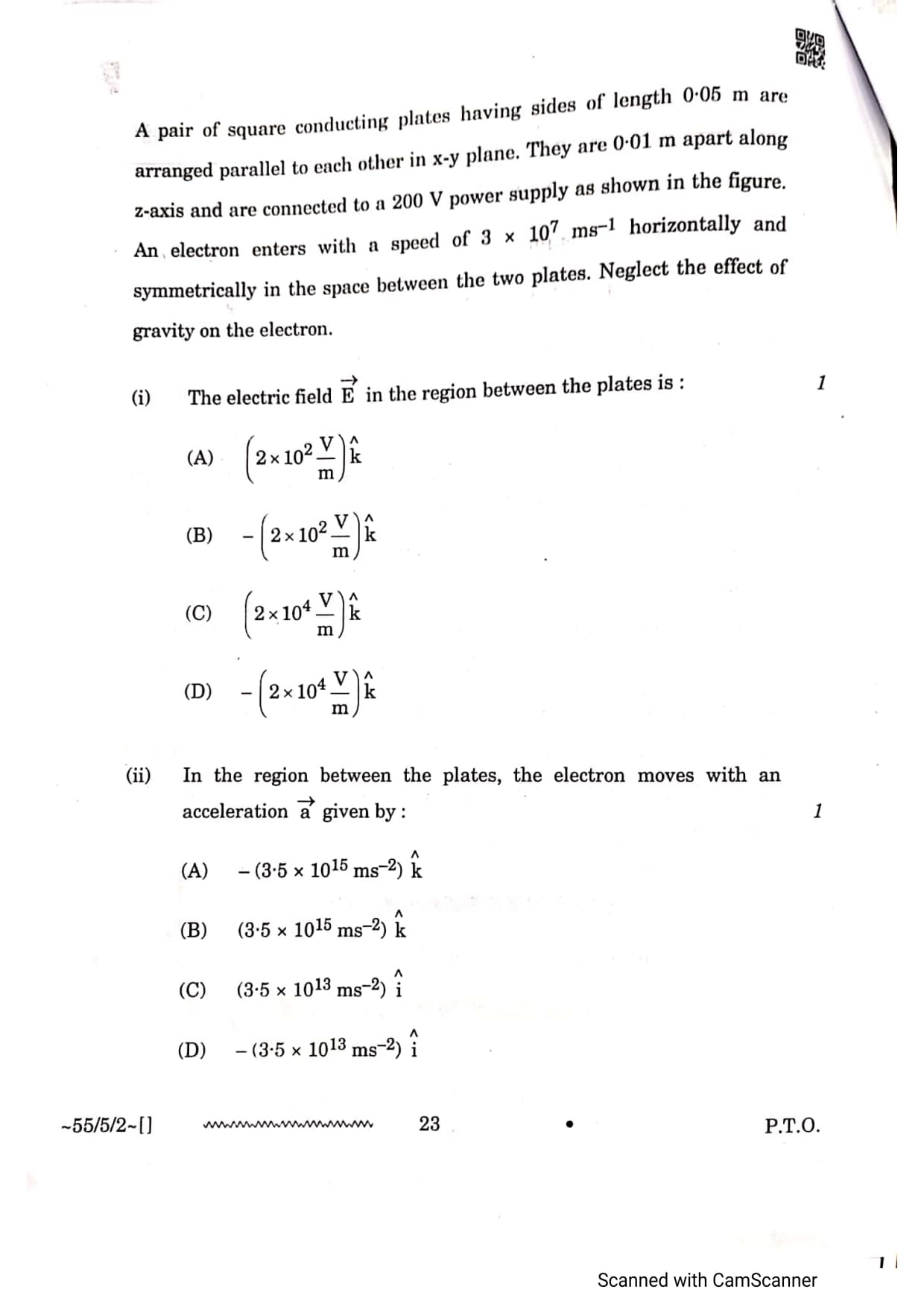
A pair of square conducting plates having sides of length 0.05 m are arranged parallel to each other in x-y plane. They are 0.01 m apart along z-axis and are connected to a 200 V power supply as shown in the figure. An electron enters with a speed of \(3 \times 10^7\) ms⁻¹ horizontally and symmetrically in the space between the two plates. Neglect the effect of gravity on the electron.
(i) The electric field \(\vec{E}\) in the region between the plates is:
(ii) In the region between the plates, the electron moves with an acceleration \(\vec{a}\) given by:
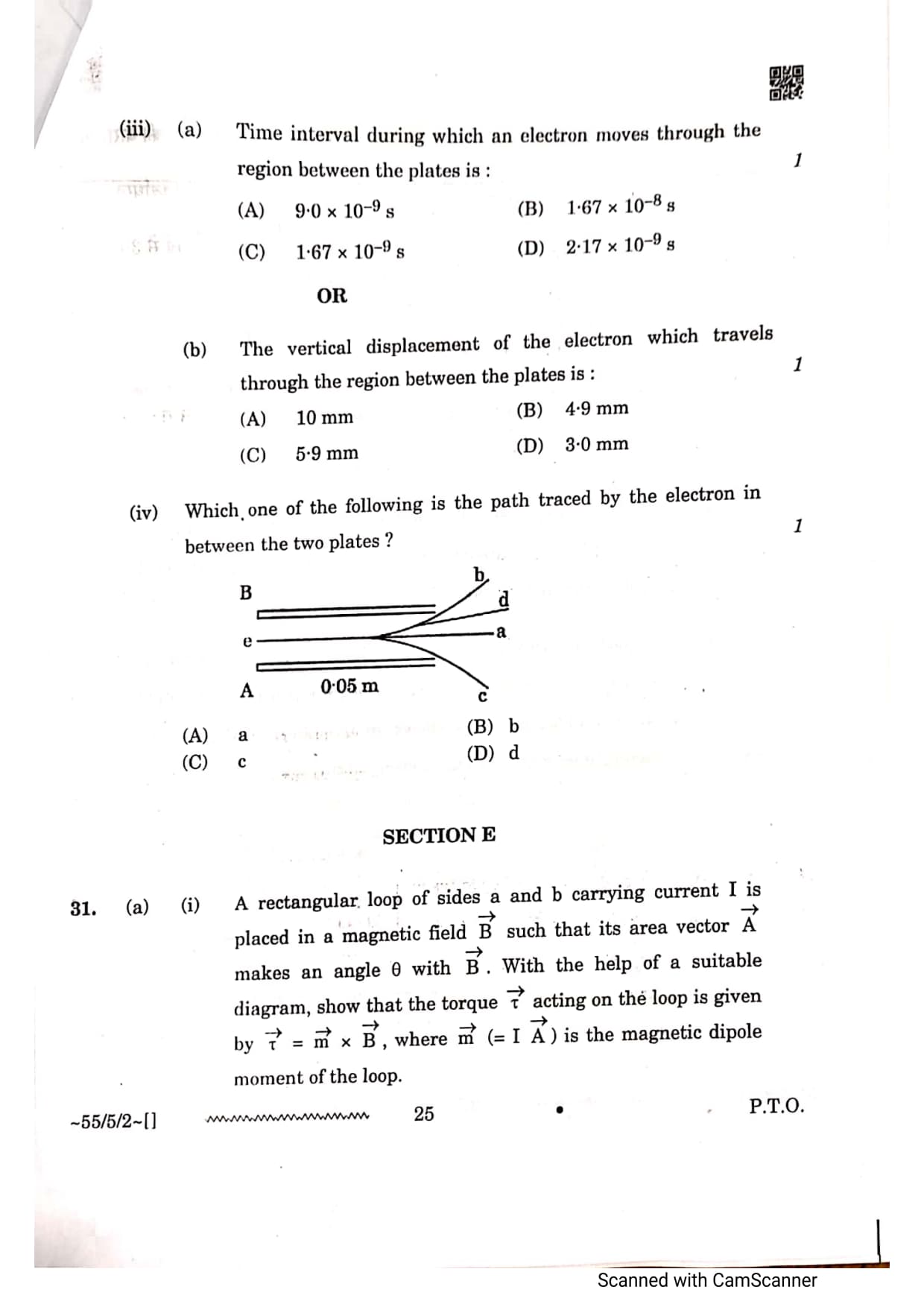
(iii) (a) Time interval during which an electron moves through the region between the plates is: (OR) (b) The vertical displacement of the electron which travels through the region between the plates is:
(iv) Which one of the following is the path traced by the electron in between the two plates?
(a) (i) A rectangular loop of sides a and b carrying current I is placed in a magnetic field B such that its area vector A makes an angle θ with B. With the help of a suitable diagram, show that the torque τ acting on the loop is given by τ = m × B, where m (= I A) is the magnetic dipole moment of the loop.
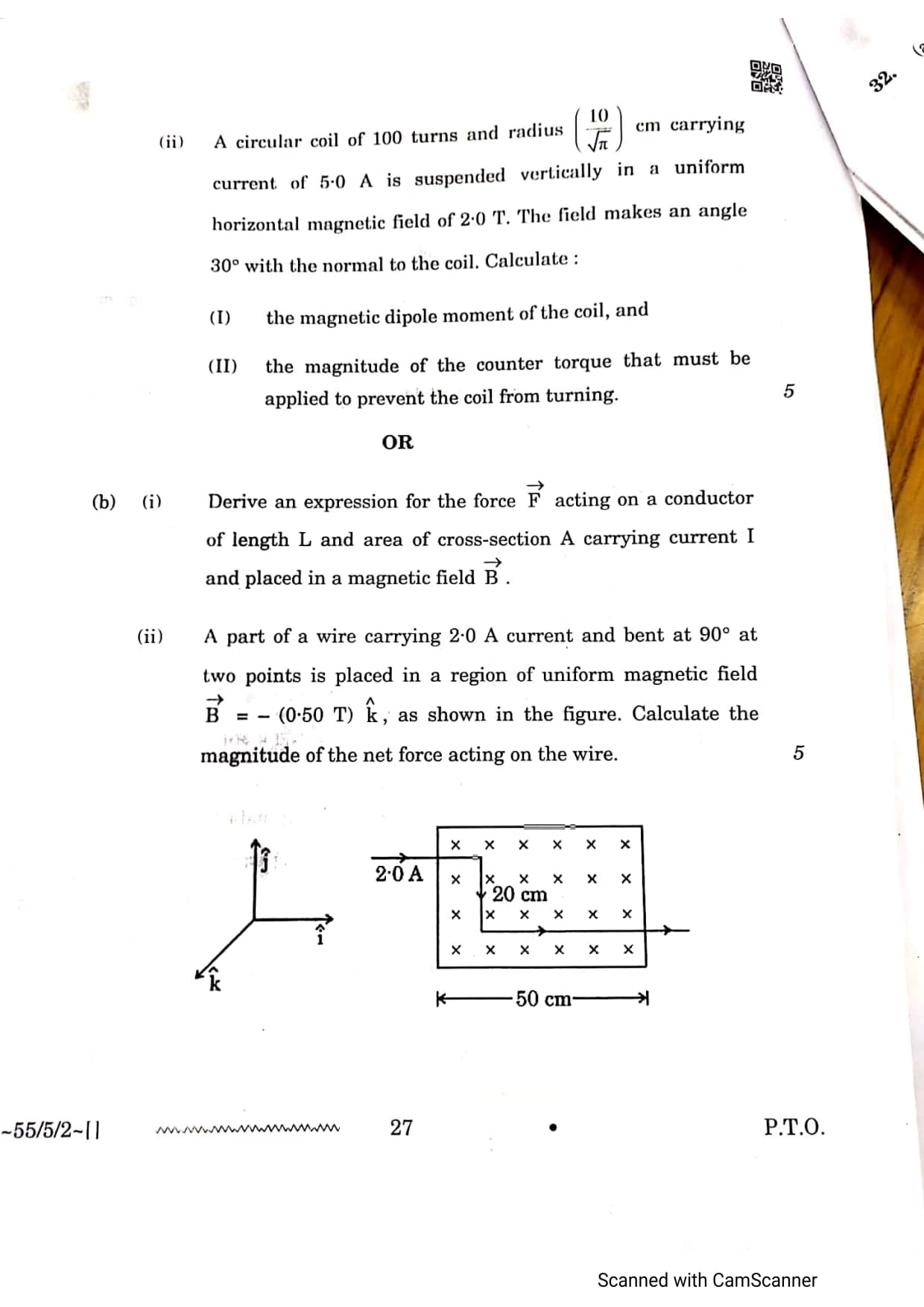
(ii) A circular coil of 100 turns and radius \(\left(\frac{10}{\sqrt{\pi}}\right)\) cm carrying current of 5.0 A is suspended vertically in a uniform horizontal magnetic field of 2.0 T. The field makes an angle 30° with the normal to the coil. Calculate: (I) the magnetic dipole moment of the coil, and (II) the magnitude of the counter torque that must be applied to prevent the coil from turning.
OR
(b) (i) Derive an expression for the force \(\vec{F}\) acting on a conductor of length L and area of cross-section A carrying current I and placed in a magnetic field \(\vec{B}\).
(ii) A part of a wire carrying 2.0 A current and bent at 90° at two points is placed in a region of uniform magnetic field \(\vec{B} = -(0.50 T) \hat{k}\), as shown in the figure. Calculate the magnitude of the net force acting on the wire.
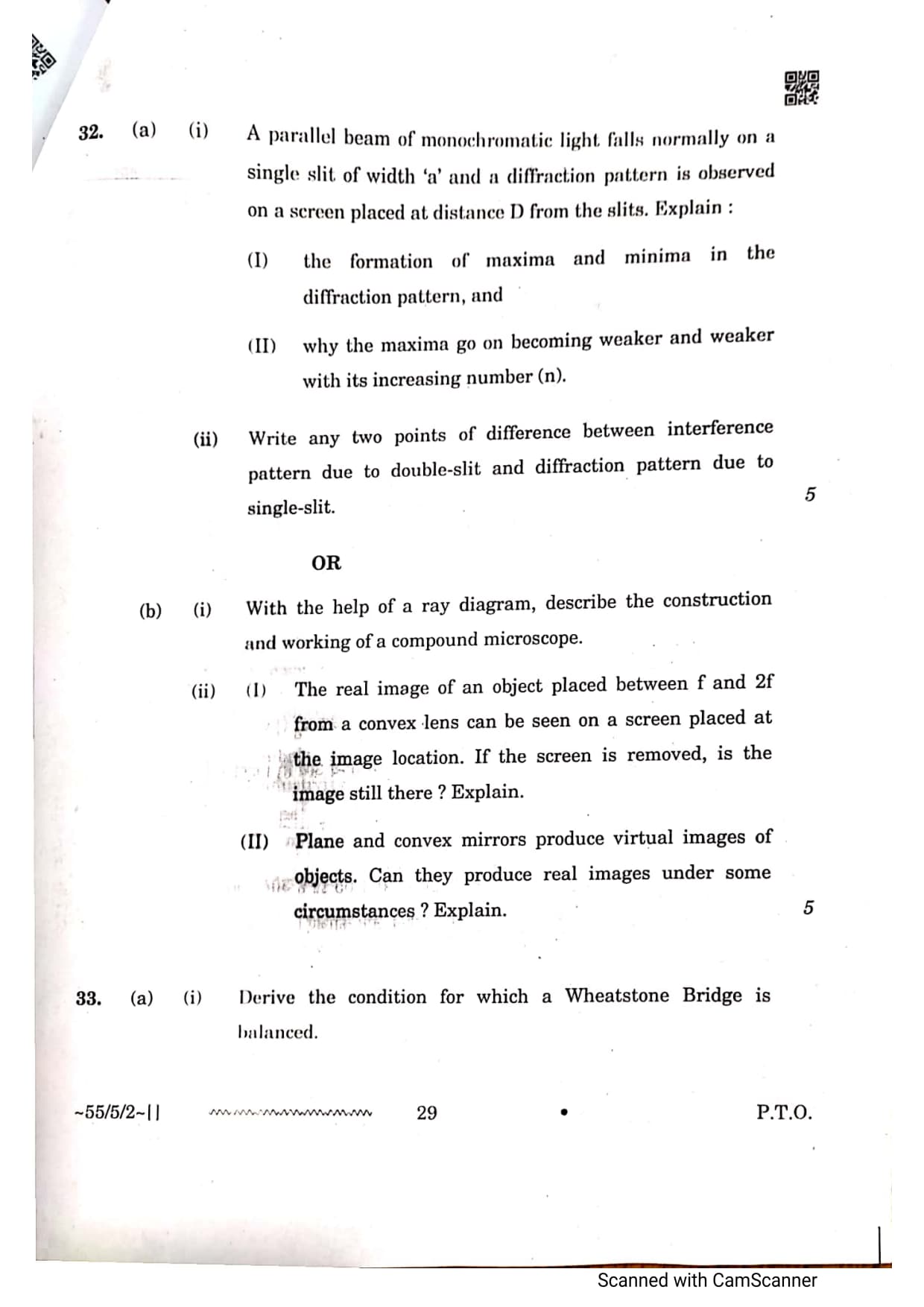
(a) (i) A parallel beam of monochromatic light falls normally on a single slit of width 'a' and a diffraction pattern is observed on a screen placed at distance D from the slits. Explain: (I) the formation of maxima and minima in the diffraction pattern, and (II) why the maxima go on becoming weaker and weaker with its increasing number (n). (ii) Write any two points of difference between interference pattern due to double-slit and diffraction pattern due to single-slit.
OR
(b) (i) With the help of a ray diagram, describe the construction and working of a compound microscope. (ii) (I) The real image of an object placed between f and 2f from a convex lens can be seen on a screen placed at the image location. If the screen is removed, is the image still there? Explain. (II) Plane and convex mirrors produce virtual images of objects. Can they produce real images under some circumstances? Explain.
(a) (i) Derive the condition for which a Wheatstone Bridge is balanced.
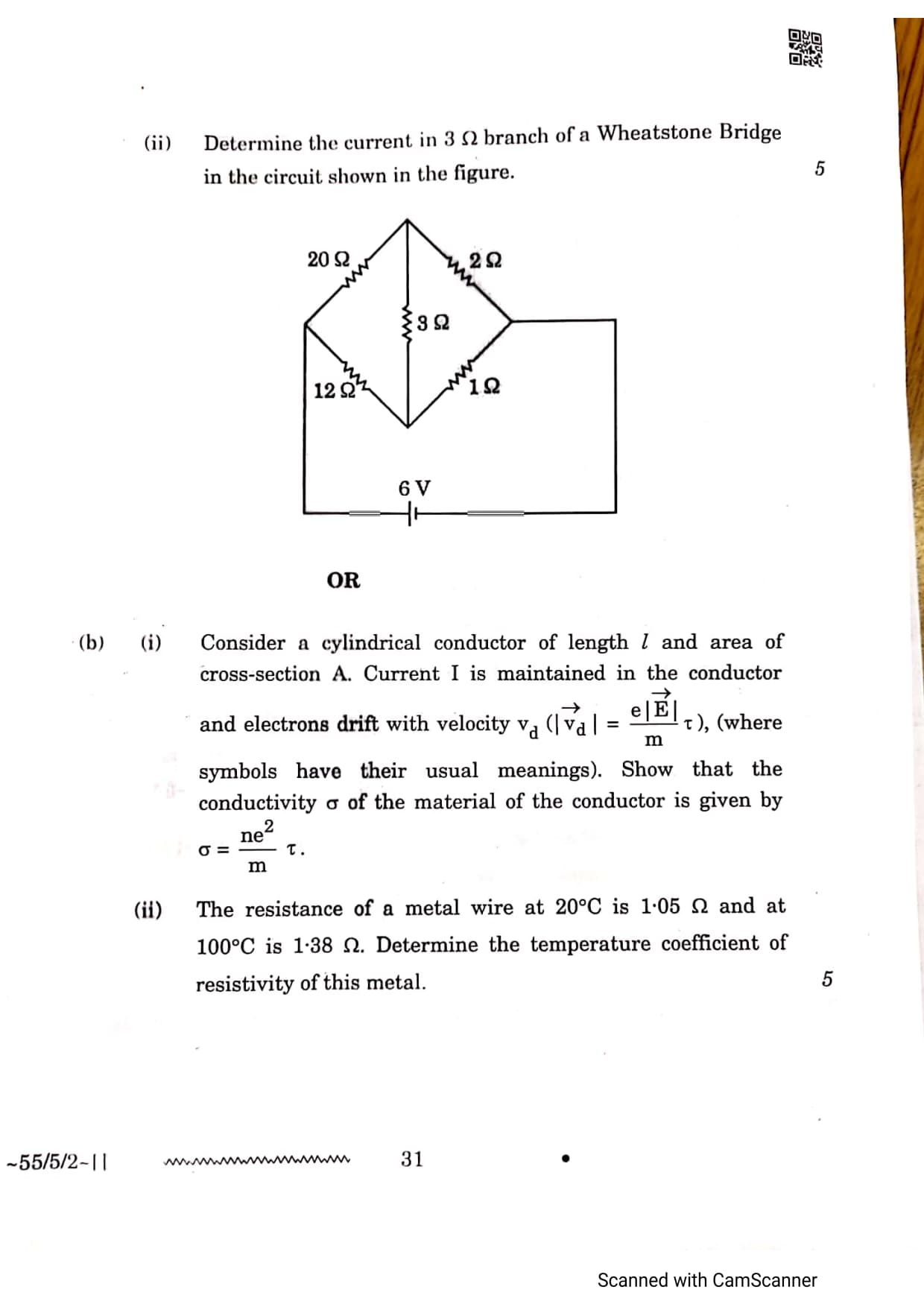
(ii) Determine the current in 3 Ω branch of a Wheatstone Bridge in the circuit shown in the figure.
OR
(b) (i) Consider a cylindrical conductor of length l and area of cross-section A. Current I is maintained in the conductor and electrons drift with velocity v_d (\(|v_d| = \frac{e|E|}{m} \tau\)), (where symbols have their usual meanings). Show that the conductivity \(\sigma\) of the material of the conductor is given by \(\sigma = \frac{ne^2}{m} \tau\).
(ii) The resistance of a metal wire at 20°C is 1.05 Ω and at 100°C is 1.38 Ω. Determine the temperature coefficient of resistivity of this metal.





Comments