




The CBSE Class 12 Physics Question Paper 2026 is available for download here of CBSE Board Exam 2026. This CBSE 12th Physics solved question paper includes detailed solutions, answer key, and the latest CBSE marking scheme to help students understand the exam pattern and important topics.
By practicing the CBSE Class 12 Physics 2026 board exam paper PDF, students can improve answer-writing strategy, time management, and overall exam performance.
Also Check: JEE Main 2026 Question Paper with Solution PDF
CBSE Class 12 Physics Question Paper 2026 with Solution PDF
| Subjects | Question Paper PDF (Available) | Solution PDF (Available) |
|---|---|---|
| Physics Set 1 55-5-1 | Download PDF | View Solution |
| Physics Set 2 55-5-2 | Download PDF | View Solution |
| Physics Set 3 55-5-3 | Download PDF | View Solution |
| Physics Question Paper | Download PDF | View Solution |
In a Young’s double-slit experiment, the fringe width is found to be \( \beta \). If the entire apparatus is immersed in a liquid of refractive index \( \mu \), the new fringe width will be:
View Solution
Concept:
In Young’s double-slit experiment (YDSE), the fringe width is given by: \[ \beta = \frac{\lambda D}{d} \]
where:
\( \lambda \) = wavelength of light
\( D \) = distance between slits and screen
\( d \) = slit separation
Effect of Medium:
When the apparatus is immersed in a liquid of refractive index \( \mu \), the wavelength of light changes.
Wavelength in medium: \[ \lambda' = \frac{\lambda}{\mu} \]
However, \( D \) and \( d \) remain unchanged.
New Fringe Width: \[ \beta' = \frac{\lambda' D}{d} = \frac{(\lambda/\mu) D}{d} \]
\[ \beta' = \frac{1}{\mu} \cdot \frac{\lambda D}{d} \]
\[ \boxed{\beta' = \frac{\beta}{\mu}} \]
Final Answer: \[ \boxed{\frac{\beta}{\mu}} \] Quick Tip: In YDSE, fringe width is directly proportional to wavelength. If refractive index increases, wavelength decreases, so fringe width decreases.
A light of frequency \( \nu \) is incident on a metal surface whose work function is \( W_0 \). The kinetic energy of emitted electron is \( K \). If the frequency of the incident light is doubled, then the kinetic energy of emitted electron will be:
View Solution
Concept:
From Einstein’s photoelectric equation: \[ K = h\nu - W_0 \]
where:
\( h\nu \) = energy of incident photon
\( W_0 \) = work function of metal
Initial Condition: \[ K = h\nu - W_0 \quad \cdots (1) \]
When Frequency is Doubled:
New frequency = \( 2\nu \)
New kinetic energy: \[ K' = h(2\nu) - W_0 = 2h\nu - W_0 \]
Rewrite using equation (1): \[ 2h\nu = 2(K + W_0) \]
\[ K' = 2K + 2W_0 - W_0 \]
\[ K' = 2K + W_0 \]
Comparison with \( 2K \):
Since \( W_0 > 0 \), \[ K' = 2K + W_0 > 2K \]
Final Answer: \[ \boxed{More than 2K} \] Quick Tip: In photoelectric effect: \[ K = h\nu - W_0 \] Doubling frequency increases kinetic energy by more than double because work function is subtracted only once.
Which of the following statements is not true for nuclear forces?
View Solution
Concept:
Nuclear forces are the strong forces that act between nucleons (protons and neutrons) inside the nucleus. They have unique properties different from electromagnetic or gravitational forces.
Key Properties of Nuclear Forces:
Very strong compared to Coulomb forces.
Short range (effective up to about 1--2 fm).
Charge independent (similar for p-p, n-n, and p-n interactions).
Saturation property (each nucleon interacts only with nearby nucleons).
Repulsive at very short distances and attractive at intermediate distances.
Checking Each Option:
(A) Stronger than Coulomb forces — True.
Nuclear forces overcome proton-proton repulsion inside nucleus.
(B) Same magnitude for nucleon pairs — True.
They are approximately charge independent.
(C) Always attractive — False.
At extremely small separations, nuclear forces become strongly repulsive (hard core repulsion).
(D) Saturation property — True.
Each nucleon interacts only with nearby neighbors.
Final Answer: \[ \boxed{They are always attractive.} \] Quick Tip: Nuclear force behavior: Attractive at intermediate distances Repulsive at very short distances This prevents nucleus from collapsing.
A particle of mass \( m \) and charge \( -q \) is moving with a uniform speed \( v \) in a circle of radius \( r \), with another charge \( q \) at the centre of the circle. The value of \( r \) is:
View Solution
Concept:
The particle moves in a circular path due to electrostatic attraction between opposite charges. The Coulomb force provides the necessary centripetal force.
Step 1: Coulomb Force
Electrostatic force between charges: \[ F = \frac{1}{4\pi \varepsilon_0} \frac{q^2}{r^2} \]
Step 2: Centripetal Force
For circular motion: \[ F = \frac{mv^2}{r} \]
Step 3: Equating Forces
\[ \frac{mv^2}{r} = \frac{1}{4\pi \varepsilon_0} \frac{q^2}{r^2} \]
Multiply both sides by \( r \): \[ mv^2 = \frac{1}{4\pi \varepsilon_0} \frac{q^2}{r} \]
Solve for \( r \): \[ r = \frac{1}{4\pi \varepsilon_0} \frac{q^2}{mv^2} \]
Rewriting: \[ r = \frac{m}{4\pi \varepsilon_0} \left(\frac{q}{v}\right)^2 \]
Final Answer: \[ \boxed{\dfrac{m}{4\pi \varepsilon_0}\left(\dfrac{q}{v}\right)^2} \] Quick Tip: Whenever a charged particle moves in a circular path due to electrostatic force: \[ Coulomb force = Centripetal force \] A standard electrostatics + circular motion problem.
Photons of energy \( 3.2 \, eV \) are incident on a photosensitive surface. If the stopping potential for the emitted electrons is \( 1.5 \, V \), the work function for the surface is:
View Solution
Concept:
From Einstein’s photoelectric equation: \[ E_{photon} = \phi + K_{max} \]
Where:
\( \phi \) = work function
\( K_{max} = eV_0 \) (stopping potential in eV equals kinetic energy)
Given: \[ E_{photon} = 3.2 \, eV, \quad V_0 = 1.5 \, V \]
Since \( 1 \, eV = e \times 1 \, V \), \[ K_{max} = 1.5 \, eV \]
Using Photoelectric Equation: \[ \phi = E_{photon} - K_{max} \]
\[ \phi = 3.2 - 1.5 = 1.7 \, eV \]
Final Answer: \[ \boxed{1.7 \, eV} \] Quick Tip: In photoelectric problems: \[ \phi = E_{photon} - eV_0 \] If energy is in eV, you can subtract stopping potential directly.
Which one of the following has relative magnetic permeability between 0 and 1?
View Solution
Concept:
Relative magnetic permeability (\( \mu_r \)) indicates how a material responds to a magnetic field.
Types of materials based on \( \mu_r \):
Diamagnetic: \( 0 < \mu_r < 1 \)
Paramagnetic: \( \mu_r > 1 \) (slightly)
Ferromagnetic: \( \mu_r \gg 1 \)
Checking Each Option:
(A) Aluminium:
Paramagnetic material → \( \mu_r > 1 \)
(B) Alnico:
Ferromagnetic alloy → very high \( \mu_r \)
(C) Water:
Diamagnetic substance → \( \mu_r < 1 \)
(D) Sodium:
Paramagnetic → \( \mu_r > 1 \)
Final Answer: \[ \boxed{Water} \] Quick Tip: Remember: Diamagnetic → \( \mu_r < 1 \) (e.g., water, bismuth) Paramagnetic → slightly \( >1 \) Ferromagnetic → \( \gg 1 \)
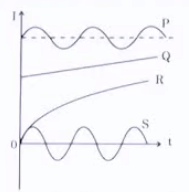
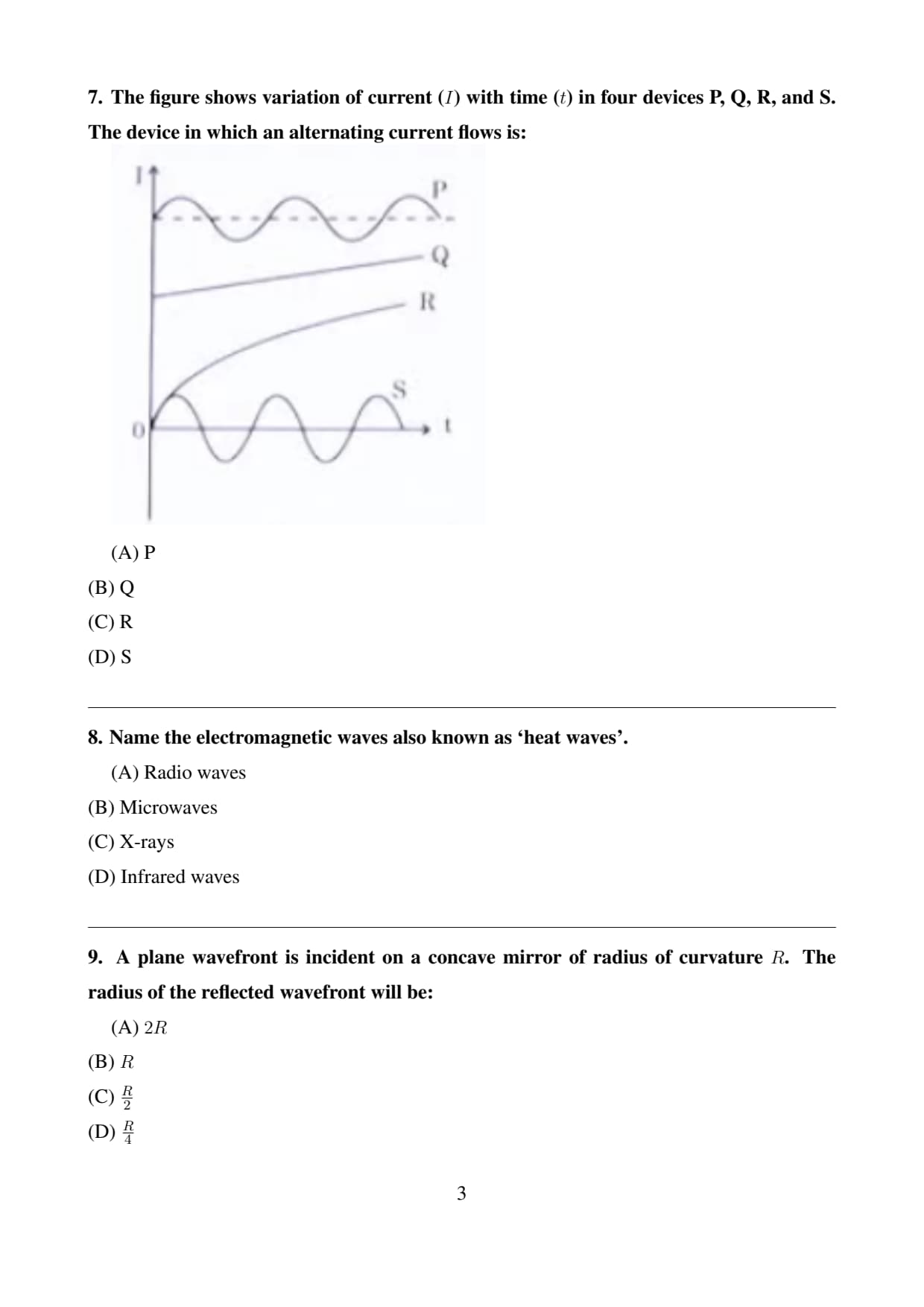
The figure shows variation of current (\( I \)) with time (\( t \)) in four devices P, Q, R, and S. The device in which an alternating current flows is:
View Solution
Concept:
An alternating current (AC) is defined as a current that:
Changes magnitude with time
Reverses direction periodically
Alternates about the zero axis
A graph representing AC must cross the time axis repeatedly.
Analysis of Graphs:
P:
Current varies with time but remains entirely above the axis → does not reverse direction (pulsating DC).
Q:
Current increases linearly with time → direct current (DC).
R:
Current rises and saturates → unidirectional current (not AC).
S:
Sinusoidal wave alternating above and below zero → direction reverses periodically → true alternating current.
Final Answer: \[ \boxed{S} \] Quick Tip: AC must cross the time axis. If the graph never goes below zero, it is not true alternating current.
Name the electromagnetic waves also known as `heat waves'.
View Solution
Concept:
Electromagnetic waves cover a wide spectrum including radio waves, microwaves, infrared, visible light, ultraviolet, X-rays, and gamma rays.
Explanation:
Infrared radiation is commonly referred to as heat waves because:
They are emitted by hot bodies.
They produce a heating effect when absorbed by matter.
We feel warmth from sunlight mainly due to infrared radiation.
Why Other Options Are Incorrect:
(A) Radio waves — Used in communication, not heat waves.
(B) Microwaves — Used in cooking but not commonly called heat waves.
(C) X-rays — High-energy radiation used in medical imaging.
Final Answer: \[ \boxed{Infrared waves \] Quick Tip: Infrared = heat radiation. All hot objects emit infrared waves, even at room temperature.
A plane wavefront is incident on a concave mirror of radius of curvature \( R \). The radius of the reflected wavefront will be:
View Solution
Concept:
A plane wavefront corresponds to parallel rays incident on a mirror. After reflection from a concave mirror, parallel rays converge at the principal focus.
Key Relation:
For a concave mirror: \[ f = \frac{R}{2} \]
where:
\( f \) = focal length
\( R \) = radius of curvature
Wavefront Interpretation:
Incident plane wavefront → reflected spherical wavefront.
The reflected wavefront converges toward the focus.
Radius of curvature of reflected wavefront = focal length.
Thus, \[ Radius of reflected wavefront = f = \frac{R}{2} \]
Final Answer: \[ \boxed{\frac{R}{2}} \] Quick Tip: Plane wavefront + concave mirror → spherical wavefront with radius equal to focal length \( f = R/2 \).
A proton and an alpha particle have the same kinetic energy. The ratio of de Broglie wavelengths associated with the proton to that with the alpha particle is:
View Solution
Concept:
The de Broglie wavelength is given by: \[ \lambda = \frac{h}{p} \]
Using kinetic energy relation: \[ K = \frac{p^2}{2m} \Rightarrow p = \sqrt{2mK} \]
Thus, \[ \lambda = \frac{h}{\sqrt{2mK}} \]
So, \[ \lambda \propto \frac{1}{\sqrt{m}} \quad (for same K) \]
Given:
Same kinetic energy
Mass of alpha particle = \( 4m_p \)
Ratio of Wavelengths: \[ \frac{\lambda_p}{\lambda_\alpha} = \sqrt{\frac{m_\alpha}{m_p}} \]
\[ = \sqrt{\frac{4m_p}{m_p}} = \sqrt{4} = 2 \]
Final Answer: \[ \boxed{2} \] Quick Tip: For equal kinetic energy: \[ \lambda \propto \frac{1}{\sqrt{m}} \] Heavier particle → smaller wavelength.
State the law and derive the electric field due to an infinitely long straight charged wire.
View Solution
Concept:
To find the electric field due to an infinitely long straight charged wire, we use Gauss's Law, which is one of Maxwell’s fundamental equations in electrostatics.
Gauss’s Law:
The total electric flux through any closed surface is equal to \( \frac{1}{\varepsilon_0} \) times the total charge enclosed within that surface. \[ \oint \vec{E} \cdot d\vec{A} = \frac{Q_{enc}}{\varepsilon_0} \]
This law is especially useful when the charge distribution has high symmetry (spherical, cylindrical, or planar).
Step 1: Charge Distribution and Symmetry
Consider an infinitely long straight wire carrying a uniform linear charge density \( \lambda \) (charge per unit length).
Due to symmetry:
The electric field is radial and perpendicular to the wire.
The magnitude of the electric field depends only on the radial distance \( r \) from the wire.
Step 2: Choosing Gaussian Surface
Choose a cylindrical Gaussian surface:
Radius = \( r \)
Length = \( L \)
Axis coincides with the charged wire
This surface is chosen because the electric field is constant over the curved surface and perpendicular to it.
Step 3: Electric Flux Through Gaussian Surface
The cylindrical surface has three parts:
Curved surface
Two flat circular ends
Flux through circular ends:
The electric field is parallel to these surfaces, so \[ \vec{E} \cdot d\vec{A} = 0 \]
Flux through curved surface:
Here, the electric field is perpendicular and uniform. \[ \Phi = E \times Curved surface area = E(2\pi r L) \]
Step 4: Charge Enclosed
If the linear charge density is \( \lambda \), then charge enclosed by the Gaussian surface: \[ Q_{enc} = \lambda L \]
Step 5: Applying Gauss’s Law
\[ E(2\pi r L) = \frac{\lambda L}{\varepsilon_0} \]
Cancel \( L \) from both sides: \[ E(2\pi r) = \frac{\lambda}{\varepsilon_0} \]
\[ \boxed{E = \frac{\lambda}{2\pi \varepsilon_0 r}} \]
Final Result:
The magnitude of electric field at a distance \( r \) from an infinitely long straight charged wire is: \[ \boxed{E = \frac{\lambda}{2\pi \varepsilon_0 r}} \]
Direction: Radially outward if the wire is positively charged and radially inward if negatively charged. Quick Tip: For infinite line charges, always use Gauss’s Law with a cylindrical Gaussian surface. Remember: Field varies as \( \frac{1}{r} \), unlike point charges where it varies as \( \frac{1}{r^2} \).
Derive the electric field at axial and equatorial points of an electric dipole.
View Solution
Concept:
An electric dipole consists of two equal and opposite charges \( +q \) and \( -q \) separated by a small distance \( 2a \). The dipole moment is defined as: \[ \vec{p} = q(2a)\,\hat{p} \]
where \( \hat{p} \) is directed from negative to positive charge.
We derive the electric field at:
Axial point (along dipole axis)
Equatorial point (perpendicular bisector of dipole)
\hrule
Part 1: Electric Field at Axial Point
Step 1: Geometry
Consider a point \( P \) on the axis at a distance \( r \) from the center of the dipole.
Distances from charges: \[ r_+ = r - a, \quad r_- = r + a \]
Step 2: Fields due to individual charges
Electric field due to \( +q \): \[ E_+ = \frac{1}{4\pi \varepsilon_0} \frac{q}{(r-a)^2} \]
Electric field due to \( -q \): \[ E_- = \frac{1}{4\pi \varepsilon_0} \frac{q}{(r+a)^2} \]
Both fields are along the same line, so net field: \[ E_{axial} = \frac{1}{4\pi \varepsilon_0} \left[ \frac{q}{(r-a)^2} - \frac{q}{(r+a)^2} \right] \]
Step 3: Simplification
\[ E_{axial} = \frac{q}{4\pi \varepsilon_0} \frac{(r+a)^2 - (r-a)^2}{(r^2 - a^2)^2} \]
\[ (r+a)^2 - (r-a)^2 = 4ar \]
\[ E_{axial} = \frac{1}{4\pi \varepsilon_0} \frac{4qar}{(r^2 - a^2)^2} \]
Since \( p = 2aq \): \[ \boxed{ E_{axial} = \frac{1}{4\pi \varepsilon_0} \frac{2pr}{(r^2 - a^2)^2} } \]
For large distance \( (r \gg a) \): \[ \boxed{ E_{axial} = \frac{1}{4\pi \varepsilon_0} \frac{2p}{r^3} } \]
Direction: Along dipole moment.
\hrule
Part 2: Electric Field at Equatorial Point
Step 1: Geometry
Consider point \( P \) at distance \( r \) from center on perpendicular bisector.
Distance from each charge: \[ d = \sqrt{r^2 + a^2} \]
Step 2: Fields due to charges
Magnitude of each field: \[ E = \frac{1}{4\pi \varepsilon_0} \frac{q}{r^2 + a^2} \]
Resolve components:
Perpendicular components cancel
Axial components add
Component along axis: \[ E_{component} = E \cos\theta = \frac{1}{4\pi \varepsilon_0} \frac{q}{r^2 + a^2} \cdot \frac{a}{\sqrt{r^2 + a^2}} \]
Total field (two charges): \[ E_{equatorial} = 2 \times \frac{1}{4\pi \varepsilon_0} \frac{qa}{(r^2 + a^2)^{3/2}} \]
Using \( p = 2aq \): \[ \boxed{ E_{equatorial} = \frac{1}{4\pi \varepsilon_0} \frac{p}{(r^2 + a^2)^{3/2}} } \]
For large distance \( (r \gg a) \): \[ \boxed{ E_{equatorial} = \frac{1}{4\pi \varepsilon_0} \frac{p}{r^3} } \]
Direction: Opposite to dipole moment.
Final Results:
Axial field: \( \displaystyle E = \frac{1}{4\pi \varepsilon_0} \frac{2p}{r^3} \)
Equatorial field: \( \displaystyle E = \frac{1}{4\pi \varepsilon_0} \frac{p}{r^3} \) Quick Tip: For dipoles at large distances: Axial field is twice the equatorial field. Both vary as \( \frac{1}{r^3} \), unlike point charges which vary as \( \frac{1}{r^2} \).
Derive the relation between current and drift velocity \( (I = nAe v_d) \).
View Solution
Concept:
Electric current in a conductor is the rate of flow of charge. When an electric field is applied across a conductor, free electrons acquire a small average velocity called drift velocity \( v_d \). The macroscopic current can be expressed in terms of microscopic charge motion.
Key quantities:
\( n \) = number of charge carriers per unit volume
\( e \) = charge of each carrier
\( A \) = cross-sectional area of conductor
\( v_d \) = drift velocity
Step 1: Definition of Current
Electric current is defined as the rate of flow of charge: \[ I = \frac{Q}{t} \]
So we need to find the charge crossing a cross-section in time \( t \).
Step 2: Volume of Charge Flowing
In time \( t \), charge carriers move a distance: \[ distance = v_d t \]
The volume of conductor from which charges cross the cross-section: \[ Volume = A \cdot v_d t \]
Step 3: Total Number of Charge Carriers
If \( n \) is number of carriers per unit volume, then total carriers in this volume: \[ Number of carriers = n A v_d t \]
Step 4: Total Charge Passing
Each carrier has charge \( e \), so total charge: \[ Q = n A v_d t \cdot e \]
Step 5: Substitute in Current Formula
\[ I = \frac{Q}{t} = \frac{n A v_d t \cdot e}{t} \]
Cancel \( t \): \[ \boxed{I = n A e v_d} \]
Final Result: \[ \boxed{I = n A e v_d} \]
This equation relates macroscopic current with microscopic motion of charge carriers.
Physical Meaning:
Current increases with more charge carriers.
Larger area allows more charge flow.
Higher drift velocity produces more current. Quick Tip: Remember the microscopic form of current: \[ I = n A e v_d \] This is useful in problems involving mobility, relaxation time, and Ohm’s law derivations.
State the principle of Wheatstone bridge and derive the balancing condition.
View Solution
Concept:
A Wheatstone bridge is an electrical circuit used to measure an unknown resistance accurately by balancing two arms of a bridge circuit.
It consists of four resistances arranged in a diamond shape with a galvanometer connected between two junctions.
Principle:
When no current flows through the galvanometer, the bridge is said to be balanced. At this condition, the ratio of resistances in one pair of opposite arms equals the ratio in the other pair.
Step 1: Arrangement of Wheatstone Bridge
Let the four resistances be:
\( P \) and \( Q \) in one branch
\( R \) and \( S \) in the other branch
A battery is connected across points \( A \) and \( C \), and a galvanometer between \( B \) and \( D \).
Step 2: Balanced Condition
When the bridge is balanced:
No current flows through the galvanometer
Potential at points \( B \) and \( D \) becomes equal
So, \[ V_B = V_D \]
Step 3: Current Distribution
Let current \( I_1 \) flow through branch \( P \) and \( Q \), and current \( I_2 \) through branch \( R \) and \( S \).
Since no current flows through the galvanometer, currents in each branch remain separate.
Step 4: Applying Ohm’s Law
Potential drop from \( A \) to \( B \): \[ V_{AB} = I_1 P \]
Potential drop from \( A \) to \( D \): \[ V_{AD} = I_2 R \]
Since \( V_B = V_D \), \[ I_1 P = I_2 R \quad \cdots (1) \]
Similarly, from \( B \) to \( C \) and \( D \) to \( C \):
\[ I_1 Q = I_2 S \quad \cdots (2) \]
\vspace{0.3 cm
Step 5: Balancing Condition
Dividing equation (1) by (2):
\[ \frac{I_1 P}{I_1 Q} = \frac{I_2 R}{I_2 S} \]
Cancel currents:
\[ \boxed{ \frac{P}{Q} = \frac{R}{S} } \]
Final Result:
The Wheatstone bridge is balanced when: \[ \boxed{\frac{P}{Q} = \frac{R}{S}} \]
If three resistances are known, the fourth can be determined using this relation.
Applications:
Measuring unknown resistance
Meter bridge (practical form)
Strain gauges and sensors Quick Tip: In Wheatstone bridge problems, remember: \[ \frac{P}{Q} = \frac{R}{S} \] At balance point, galvanometer current is zero and potentials of junctions are equal.
Derive the expression for the force per unit length between two parallel current-carrying wires.
View Solution
Concept:
When two parallel conductors carry electric currents, they exert magnetic forces on each other due to the magnetic fields produced by the currents.
This phenomenon is based on:
Magnetic field due to a straight current-carrying conductor
Lorentz force on a current-carrying conductor
Step 1: Magnetic Field due to First Wire
Consider two long parallel wires separated by distance \( d \).
Let currents be:
\( I_1 \) in wire 1
\( I_2 \) in wire 2
Magnetic field at distance \( d \) from wire 1: \[ B_1 = \frac{\mu_0 I_1}{2\pi d} \]
This field acts at the location of the second wire.
Step 2: Force on Second Wire
A current-carrying conductor in a magnetic field experiences a force: \[ F = I L B \sin\theta \]
Here:
\( \theta = 90^\circ \) (field is perpendicular to current)
\( \sin\theta = 1 \)
So force on length \( L \) of wire 2: \[ F = I_2 L B_1 \]
Substitute \( B_1 \): \[ F = I_2 L \cdot \frac{\mu_0 I_1}{2\pi d} \]
\[ F = \frac{\mu_0 I_1 I_2 L}{2\pi d} \]
Step 3: Force per Unit Length
Divide both sides by \( L \):
\[ \boxed{ \frac{F}{L} = \frac{\mu_0 I_1 I_2}{2\pi d} } \]
Final Result:
Force per unit length between two long parallel current-carrying wires separated by distance \( d \): \[ \boxed{ \frac{F}{L} = \frac{\mu_0 I_1 I_2}{2\pi d} } \]
Nature of Force:
Same direction currents → Attractive force
Opposite direction currents → Repulsive force
Special Note:
This formula is used to define the SI unit of current (Ampere). Quick Tip: Remember: \[ \frac{F}{L} = \frac{\mu_0 I_1 I_2}{2\pi d} \] Parallel currents attract, antiparallel currents repel — a common conceptual question.
State the laws of electromagnetic induction.
View Solution
Concept:
Electromagnetic induction is the phenomenon in which an emf is induced in a conductor when the magnetic flux linked with it changes. This fundamental concept was discovered by Michael Faraday.
There are two main laws of electromagnetic induction known as Faraday’s Laws.
First Law of Electromagnetic Induction:
Whenever the magnetic flux linked with a conductor or circuit changes, an emf is induced in the circuit.
The change in magnetic flux can occur due to:
Relative motion between magnet and conductor
Change in magnetic field strength
Change in area of the loop
Change in orientation of the loop
If the circuit is closed, an induced current also flows.
Second Law of Electromagnetic Induction:
The magnitude of the induced emf is directly proportional to the rate of change of magnetic flux linked with the circuit.
Mathematically: \[ e \propto \frac{d\Phi}{dt} \]
Including proportionality constant: \[ \boxed{e = -\frac{d\Phi}{dt}} \]
For a coil of \( N \) turns: \[ \boxed{e = -N \frac{d\Phi}{dt}} \]
Negative Sign (Lenz’s Law):
The negative sign indicates the direction of induced emf and is explained by Lenz’s Law:
The induced emf always opposes the change in magnetic flux that produces it.
This ensures conservation of energy.
Magnetic Flux: \[ \Phi = B A \cos\theta \]
where:
\( B \) = magnetic field
\( A \) = area of loop
\( \theta \) = angle between field and normal to the surface
Summary:
Changing magnetic flux induces emf.
Induced emf is proportional to rate of change of flux.
Direction is given by Lenz’s Law. Quick Tip: Remember Faraday’s law in compact form: \[ e = -N \frac{d\Phi}{dt} \] The negative sign represents Lenz’s Law — a common theory question in exams.
Explain the working of a step-up/step-down transformer and causes of energy loss.
View Solution
Concept:
A transformer is an electrical device used to increase or decrease alternating voltage using the principle of electromagnetic induction. It works only with alternating current (AC) and transfers electrical energy from one circuit to another without direct electrical contact.
It consists of:
Primary coil (input)
Secondary coil (output)
Soft iron core (to enhance magnetic flux linkage)
Principle:
A transformer works on the principle of mutual induction. When alternating current flows through the primary coil, it produces a changing magnetic flux in the core, which induces an emf in the secondary coil.
Working of Transformer:
Let:
\( N_p \) = number of turns in primary coil
\( N_s \) = number of turns in secondary coil
\( V_p \) = primary voltage
\( V_s \) = secondary voltage
From Faraday’s law: \[ \frac{V_s}{V_p} = \frac{N_s}{N_p} \]
\hrule
Step-Up Transformer:
A transformer that increases voltage.
Condition: \[ N_s > N_p \quad \Rightarrow \quad V_s > V_p \]
Features:
Secondary coil has more turns
Voltage increases
Current decreases (since power is nearly conserved)
Used in:
Power transmission lines
Power stations
\hrule
Step-Down Transformer:
A transformer that decreases voltage.
Condition: \[ N_s < N_p \quad \Rightarrow \quad V_s < V_p \]
Features:
Secondary coil has fewer turns
Voltage decreases
Current increases
Used in:
Domestic appliances
Chargers and adapters
Ideal Transformer: \[ V_p I_p = V_s I_s \]
Power input equals power output (no losses).
\hrule
Causes of Energy Loss in Transformer:
In practical transformers, some energy is lost due to the following reasons:
1. Copper Loss (Joule Heating):
Due to resistance of windings
Energy lost as heat (\( I^2R \) loss)
2. Eddy Current Loss:
Circulating currents induced in the iron core
Produce heat and waste energy
Reduced using laminated cores
3. Hysteresis Loss:
Due to repeated magnetization of the core
Energy lost in magnetizing and demagnetizing
Reduced using soft iron or silicon steel cores
4. Flux Leakage:
Not all magnetic flux links both coils
Some flux escapes into air
Final Summary:
Transformer works on mutual induction.
Step-up transformer increases voltage.
Step-down transformer decreases voltage.
Energy losses occur due to copper loss, eddy currents, hysteresis, and flux leakage. Quick Tip: Key transformer relations: \[ \frac{V_s}{V_p} = \frac{N_s}{N_p}, \quad V_p I_p \approx V_s I_s \] Remember the four losses: copper, eddy current, hysteresis, and flux leakage.
State Einstein's photoelectric equation and its significance.
View Solution
Concept:
The photoelectric effect is the phenomenon in which electrons are emitted from a metal surface when light of suitable frequency falls on it. Einstein explained this effect using the quantum theory of light, proposing that light consists of discrete packets of energy called photons.
Einstein’s Photoelectric Equation:
According to Einstein, when a photon of energy \( h\nu \) strikes a metal surface, its energy is used in two ways:
Part of the energy is used to overcome the work function \( \phi \) of the metal.
The remaining energy appears as the kinetic energy of the emitted electron.
Mathematically: \[ h\nu = \phi + K_{max} \]
Where:
\( h \) = Planck’s constant
\( \nu \) = frequency of incident radiation
\( \phi \) = work function of the metal
\( K_{max} \) = maximum kinetic energy of emitted electrons
Since \( \phi = h\nu_0 \) (threshold frequency), \[ \boxed{h\nu = h\nu_0 + K_{max}} \]
Also, \[ K_{max} = \frac{1}{2}mv_{max}^2 = eV_0 \]
So another form: \[ \boxed{h\nu = \phi + eV_0} \]
Significance of Einstein’s Photoelectric Equation:
1. Explains Threshold Frequency:
No photoelectric emission occurs if \( \nu < \nu_0 \), regardless of intensity.
2. Particle Nature of Light:
It proved that light behaves as particles (photons), supporting quantum theory.
3. Linear Relation Between Frequency and Kinetic Energy: \[ K_{max} \propto \nu \]
This explains experimental observations of a straight-line graph.
4. Independence from Intensity:
Kinetic energy depends only on frequency, not intensity of light.
5. Determination of Planck’s Constant:
The equation allows experimental determination of \( h \).
6. Basis of Quantum Physics:
Einstein’s explanation marked the beginning of modern quantum mechanics and earned him the Nobel Prize (1921).
Final Summary:
Photon energy is shared between work function and kinetic energy.
Validates quantum nature of light.
Explains key features of photoelectric effect. Quick Tip: Remember the core equation: \[ h\nu = \phi + K_{max} \] Frequency controls energy of emitted electrons, while intensity controls their number.



Comments