



.png?h=35&w=35&mode=stretch)
CBSE Class 12 Political Science Question Paper 2024 PDF (Set 1- 59/1/1) is available for download here. CBSE conducted the Political Science exam on March 22, 2024 from 10:30 AM to 1:30 PM. The total marks for the theory paper are 80. The question paper contains 20% MCQ-based questions, 40% competency-based questions, and 40% short and long answer type questions.
Candidates can use the link below to download the CBSE Class 12 History Set 3 Question Paper with detailed solutions.
CBSE Class 12 Political Science Question Paper 2024 (Set 1- 59/1/1) with Answer Key
| CBSE Class 12 2024 History Question Paper with Answer Key |  Download Download |
Check Solution |
CBSE Class 12 History Questions with Solutions
SECTION A
Questions number 1 to 12 are Multiple Choice type questions, carrying 1 mark each.
Question 1:
The `ASEAN Way' is a form of interaction that is:
View Solution
Step 1: Understanding the `ASEAN Way'
The `ASEAN Way' refers to the diplomatic approach of the Association of Southeast Asian Nations (ASEAN). It emphasizes consensus-building, non-interference, and a cooperative style of interaction among member states.
Step 2: Analyzing the Options
- Option (A) formal: The ASEAN Way is not strictly formal; it prioritizes flexibility and informality.
- Option (B) confrontationist: This is incorrect as the ASEAN Way avoids confrontation and focuses on consensus.
- Option (C) cooperative: This aligns with the ASEAN Way’s emphasis on collaboration and mutual respect.
- Option (D) provocative: The ASEAN Way is not provocative; it seeks harmony and stability.
Step 3: Conclusion
The correct answer is: \[ (C) cooperative \] Quick Tip: The `ASEAN Way' is a key concept in international relations, often associated with ASEAN’s principles of non-interference, consensus, and regional cooperation.
Which one of the following countries is NOT a founder-member of ASEAN?
View Solution
Step 1: Identify the Founder-Members of ASEAN
ASEAN was founded on August 8, 1967, by five countries: Indonesia, Malaysia, the Philippines, Singapore, and Thailand. These are the founder-members of ASEAN.
Step 2: Analyze the Options
- Option (A) Singapore: Singapore is a founder-member of ASEAN.
- Option (B) Thailand: Thailand is a founder-member of ASEAN.
- Option (C) Myanmar: Myanmar joined ASEAN in 1997 and is not a founder-member.
- Option (D) Indonesia: Indonesia is a founder-member of ASEAN.
Step 3: Conclusion
The correct answer is: \[ (C) Myanmar \] Quick Tip: ASEAN’s founder-members are Indonesia, Malaysia, the Philippines, Singapore, and Thailand. Other members, like Myanmar, joined later.
Which one of the following countries is NOT included in `South Asia'?
View Solution
Step 1: Define South Asia
South Asia typically includes countries in the Indian subcontinent and surrounding areas, such as India, Pakistan, Bangladesh, Sri Lanka, Nepal, Bhutan, and the Maldives.
Step 2: Analyze the Options
- Option (A) Bangladesh: Bangladesh is in South Asia.
- Option (B) China: China is in East Asia, not South Asia.
- Option (C) Bhutan: Bhutan is in South Asia.
- Option (D) Maldives: The Maldives is considered part of South Asia.
Step 3: Conclusion
The correct answer is: \[ (B) China \] Quick Tip: South Asia includes countries like India, Pakistan, Bangladesh, Sri Lanka, Nepal, Bhutan, and the Maldives. China is part of East Asia.
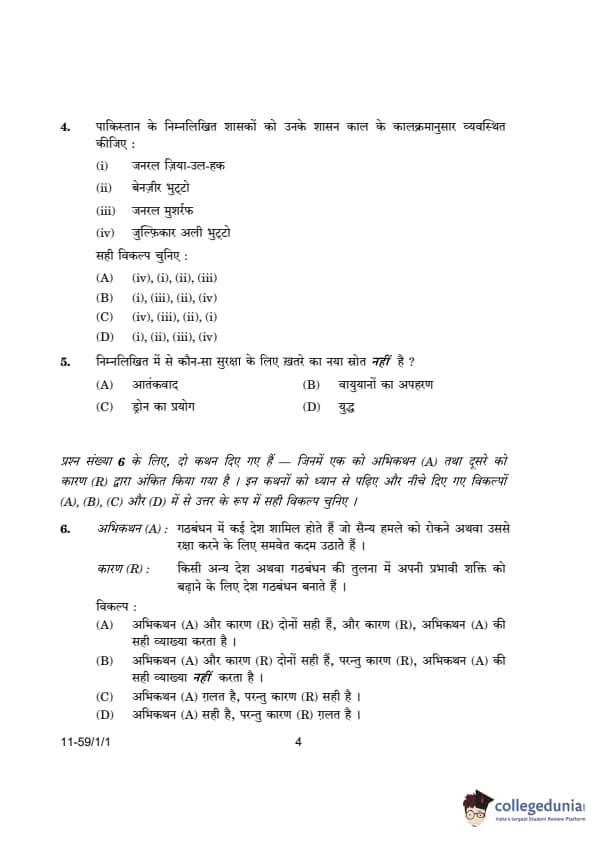
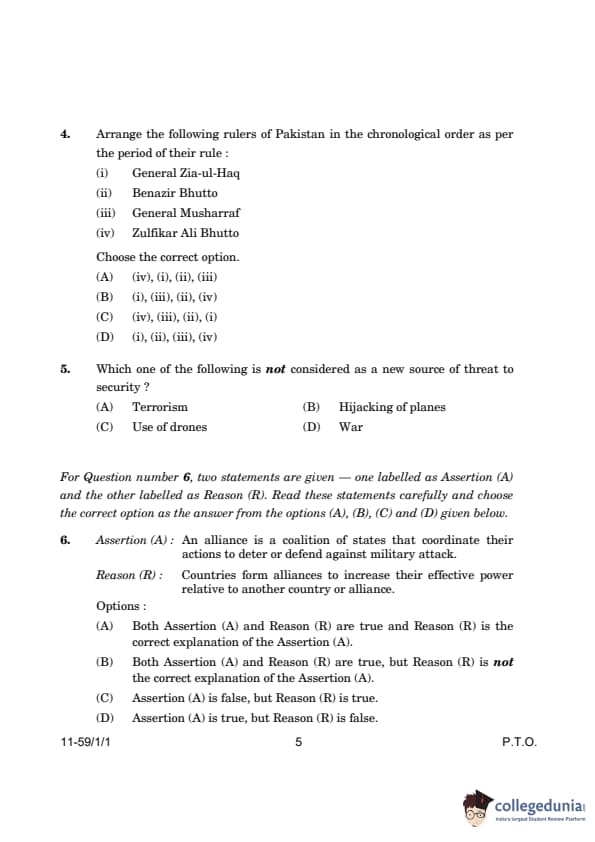
Arrange the following rulers of Pakistan in the chronological order as per the period of their rule:
View Solution
Step 1: Identify the Periods of Rule for Each Leader
- Zulfiqar Ali Bhutto: He served as Prime Minister of Pakistan from 1973 to 1977.
- General Zia-ul-Haq: He ruled as President from 1978 to 1988 after deposing Zulfiqar Ali Bhutto.
- Benazir Bhutto: She served as Prime Minister in two non-consecutive terms, first from 1988 to 1990 and then from 1993 to 1996.
- General Musharraf: He took power in a coup in 1999 and ruled as President from 2001 to 2008.
Step 2: Arrange in Chronological Order
- Zulfiqar Ali Bhutto (1973–1977) comes first.
- General Zia-ul-Haq (1978–1988) comes next.
- Benazir Bhutto (1988–1990, 1993–1996) follows.
- General Musharraf (1999–2008) is the last in this list.
Thus, the order is: (iv) Zulfiqar Ali Bhutto, (i) General Zia-ul-Haq, (ii) Benazir Bhutto, (iii) General Musharraf.
Step 3: Match with the Options
- Option (A): (iv), (i), (ii), (iii) – This matches the chronological order.
- Option (B): (i), (iii), (ii), (iv) – Incorrect, as Zia-ul-Haq did not rule before Zulfiqar Ali Bhutto.
- Option (C): (iv), (iii), (i), (ii) – Incorrect, as Musharraf ruled after Zia-ul-Haq and Benazir Bhutto.
- Option (D): (i), (ii), (iii), (iv) – Incorrect, as Zulfiqar Ali Bhutto ruled before Zia-ul-Haq.
The correct answer is: \[ (A) (iv), (i), (ii), (iii) \] Quick Tip: To solve chronological order questions, note the exact years of rule for each leader and arrange them from earliest to latest.
Which one of the following is not considered as a new source of threat to security?
View Solution
Step 1: Define New Sources of Threat to Security
New sources of threat to security refer to emerging or non-traditional threats that have become more prominent in recent times, often involving modern technology or unconventional methods.
Step 2: Analyze the Options
- Option (A) Terrorism: Terrorism, especially in its modern forms like cyber-terrorism, is considered a new source of threat.
- Option (B) Hijacking of planes: Hijacking, particularly after events like 9/11, is seen as a modern security threat.
- Option (C) Use of drones: The use of drones in warfare and surveillance is a relatively new and emerging threat to security.
- Option (D) War: War is a traditional source of threat to security and has been a concern for centuries, not a "new" source.
Step 3: Conclusion
The correct answer is: \[ (D) War \] Quick Tip: When identifying new sources of threat, focus on emerging or non-traditional issues like technology-driven threats, rather than conventional ones like war.
For Question number 6, two statements are given — one labelled as Assertion (A) and the other labelled as Reason (R). Read these statements carefully and choose the correct option as the answer from the options (A), (B), (C) and (D) given below.
Assertion (A): An alliance is a coalition of states that coordinate their actions to deter or defend against military attack.
Reason (R): Countries form alliances to increase their effective power relative to another country or alliance.
View Solution
Step 1: Evaluate the Assertion (A)
The Assertion states: "An alliance is a coalition of states that coordinate their actions to deter or defend against military attack." This is true, as alliances, such as NATO, are formed for collective defense and deterrence against military threats.
Step 2: Evaluate the Reason (R)
The Reason states: "Countries form alliances to increase their effective power relative to another country or alliance." This is also true, as one of the motivations for forming alliances is to enhance a country’s power and influence through collective strength.
Step 3: Determine if Reason (R) Explains Assertion (A)
While both statements are true, the Reason does not directly explain the Assertion. The Assertion defines what an alliance is (a coalition for defense or deterrence), while the Reason explains a motivation for forming alliances (to increase power). However, increasing power is not the only or primary purpose of an alliance as defined in the Assertion—alliances are specifically about coordinating for defense or deterrence, not just power enhancement.
Step 4: Match with the Options
- Option (A): Incorrect, as Reason (R) is not the correct explanation of Assertion (A).
- Option (B): Correct, as both statements are true, but Reason (R) does not explain Assertion (A).
- Option (C): Incorrect, as Assertion (A) is true.
- Option (D): Incorrect, as Reason (R) is true.
The correct answer is: \[ (B) Both Assertion (A) and Reason (R) are true, but Reason (R) is not the correct explanation of the Assertion (A). \] Quick Tip: In Assertion-Reason questions, ensure that the Reason directly explains the Assertion, not just a related concept.
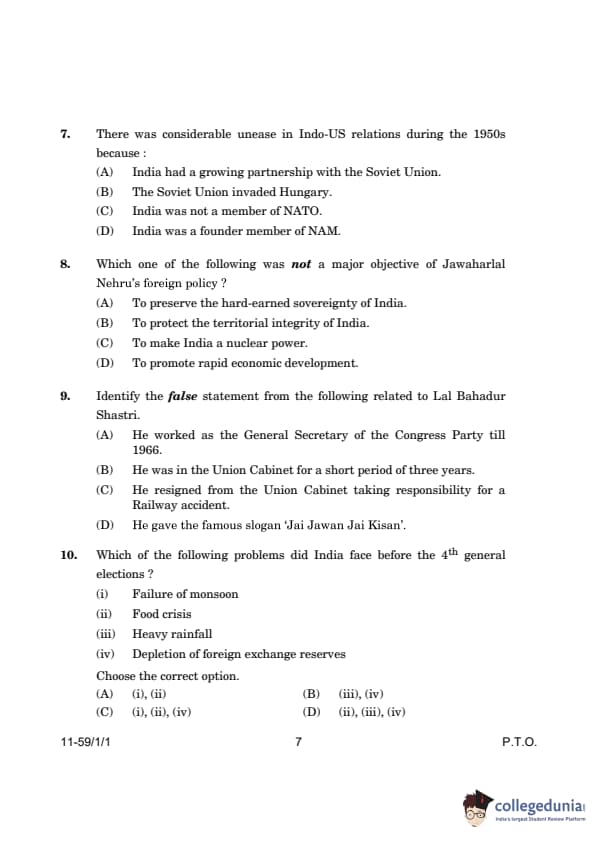
There was considerable unease in Indo-US relations during the 1950s because:
View Solution
Step 1: Understand the Context of Indo-US Relations in the 1950s
During the 1950s, the Cold War was at its peak, with the US and the Soviet Union as rival superpowers. The US sought to build alliances to counter Soviet influence, while India, under Jawaharlal Nehru, pursued a policy of non-alignment.
Step 2: Analyze the Options
- Option (A) India had a growing partnership with the Soviet Union: This is correct. India’s growing ties with the Soviet Union, including economic and military cooperation, caused unease in the US, which saw India as leaning toward the Soviet bloc.
- Option (B) The Soviet Union invaded Hungary: The Soviet invasion of Hungary in 1956 was a global event, but it did not directly impact Indo-US relations.
- Option (C) India was not a member of NATO: While true, India’s non-membership in NATO was not a primary reason for unease, as India’s non-alignment policy was broader than just NATO.
- Option (D) India was a founder member of NAM: India’s role in the Non-Aligned Movement (NAM) did create some tension, but the primary concern for the US was India’s specific partnership with the Soviet Union, not just its non-alignment.
Step 3: Conclusion
The correct answer is: \[ (A) India had a growing partnership with the Soviet Union. \] Quick Tip: During the Cold War, the US viewed any partnership with the Soviet Union as a challenge to its global influence, which often strained relations with non-aligned countries like India.
Which one of the following was not a major objective of Jawaharlal Nehru’s foreign policy?
View Solution
Step 1: Understand Nehru’s Foreign Policy Objectives
Jawaharlal Nehru, India’s first Prime Minister, focused on non-alignment, sovereignty, territorial integrity, and economic development as key pillars of his foreign policy. He also advocated for global peace and disarmament.
Step 2: Analyze the Options
- Option (A) To preserve the hard-earned sovereignty of India: This was a major objective, as Nehru emphasized India’s independence and non-alignment to avoid foreign domination.
- Option (B) To protect the territorial integrity of India: This was also a key objective, as seen in India’s response to border issues with China and Pakistan.
- Option (C) To make India a nuclear power: This was not a major objective under Nehru. While India developed nuclear technology for peaceful purposes, Nehru was a strong advocate for global nuclear disarmament and did not prioritize making India a nuclear power. India’s nuclear tests happened later, in 1974, after Nehru’s time.
- Option (D) To promote rapid economic development: This was a major objective, as Nehru linked foreign policy with economic self-reliance through initiatives like the Five-Year Plans.
Step 3: Conclusion
The correct answer is: \[ (C) To make India a nuclear power. \] Quick Tip: Nehru’s foreign policy focused on non-alignment, sovereignty, and economic development, while advocating for global peace and nuclear disarmament.
Identify the false statement from the following related to Lal Bahadur Shastri.
View Solution
Step 1: Review Lal Bahadur Shastri’s Career
Lal Bahadur Shastri was India’s second Prime Minister (1964–1966) and a prominent leader in the Indian National Congress. Let’s evaluate each statement.
Step 2: Analyze the Statements
- Option (A) He worked as the General Secretary of the Congress Party till 1966: This is false. Shastri was the General Secretary of the Congress Party in the 1950s, but he became Prime Minister in 1964 and died in 1966. He was not the General Secretary until 1966.
- Option (B) He was in the Union Cabinet for a short period of three years: This is true. Shastri served in the Union Cabinet under Nehru from 1957 to 1961, roughly three years, before resigning.
- Option (C) He resigned from the Union Cabinet taking responsibility for a Railway accident: This is true. Shastri resigned as Railway Minister in 1956 after the Ariyalur train accident, taking moral responsibility.
- Option (D) He gave the famous slogan `Jai Jawan Jai Kisan': This is true. Shastri gave this slogan during the 1965 Indo-Pak War to emphasize the importance of soldiers and farmers.
Step 3: Conclusion
The false statement is: \[ (A) He worked as the General Secretary of the Congress Party till 1966. \] Quick Tip: Lal Bahadur Shastri is known for his simplicity, leadership during the 1965 war, and the slogan `Jai Jawan Jai Kisan'. Verify timelines when evaluating historical statements.
Which of the following problems did India face before the 4th general elections?
View Solution
Step 1: Identify the Context of the 4th General Elections
The 4th general elections in India were held in 1967. This period was marked by significant challenges following the 1965 Indo-Pak War, the death of Lal Bahadur Shastri in 1966, and economic difficulties under Indira Gandhi’s early leadership.
Step 2: Analyze the Problems
- (i) Failure of monsoon: True. India faced severe droughts in 1965 and 1966 due to monsoon failures, leading to agricultural decline.
- (ii) Food crisis: True. The monsoon failures caused a food crisis, with India relying on food imports, including under the US PL-480 program.
- (iii) Heavy rainfall: False. The period was marked by drought, not heavy rainfall.
- (iv) Depletion of foreign exchange reserves: True. India’s foreign exchange reserves were depleted due to the costs of the 1965 war and food imports.
Step 3: Match with the Options
- Option (A) (i), (ii): Incomplete, as it misses (iv).
- Option (B) (iii), (iv): Incorrect, as (iii) is false.
- Option (C) (i), (ii), (iv): Correct, as all three were major issues.
- Option (D) (ii), (iii), (iv): Incorrect, as (iii) is false.
The correct answer is: \[ (C) (i), (ii), (iv) \] Quick Tip: The mid-1960s were a challenging period for India, with droughts, food shortages, and economic strain due to war and import dependency.
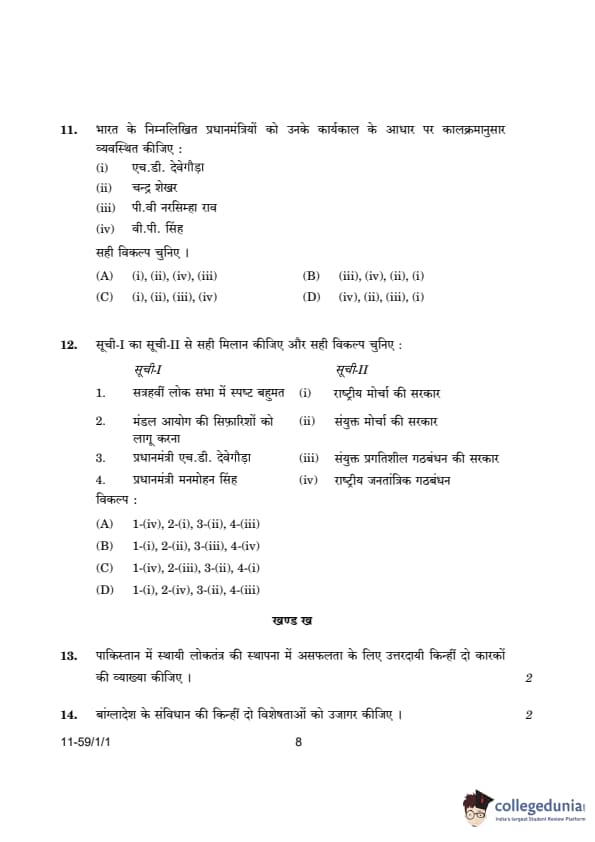
Arrange the following Prime Ministers of India in the chronological order as per their period of rule:
View Solution
Step 1: Identify the Periods of Rule for Each Prime Minister
- V.P. Singh: He served as Prime Minister from December 1989 to November 1990.
- Chandra Shekhar: He served as Prime Minister from November 1990 to June 1991.
- P.V. Narasimha Rao: He served as Prime Minister from June 1991 to May 1996.
- H.D. Deve Gowda: He served as Prime Minister from June 1996 to April 1997.
Step 2: Arrange in Chronological Order
- V.P. Singh (1989–1990) comes first.
- Chandra Shekhar (1990–1991) comes next.
- P.V. Narasimha Rao (1991–1996) follows.
- H.D. Deve Gowda (1996–1997) is the last in this list.
Thus, the order is: (iv) V.P. Singh, (ii) Chandra Shekhar, (iii) P.V. Narasimha Rao, (i) H.D. Deve Gowda.
Step 3: Match with the Options
- Option (A): (i), (ii), (iv), (iii) – Incorrect, as H.D. Deve Gowda was the last, not the first.
- Option (B): (iii), (iv), (ii), (i) – Incorrect, as P.V. Narasimha Rao was not the first.
- Option (C): (i), (ii), (iii), (iv) – Incorrect, as H.D. Deve Gowda was not the first.
- Option (D): (iv), (ii), (iii), (i) – Correct, as it matches the chronological order.
The correct answer is: \[ (D) (iv), (ii), (iii), (i) \] Quick Tip: To arrange leaders chronologically, note their exact years of tenure and order them from earliest to latest.
Match List-I with the List-II and choose the correct option:
List-I List-II
1. Clear majority in the 17th Lok Sabha (i) National Front Government
2. Implementation of the Mandal Commission (ii) United Front Government
3. Prime Minister H.D. Deve Gowda (iii) United Progressive Alliance Government
4. Prime Minister Manmohan Singh (iv) National Democratic Alliance
Choose the correct option.
View Solution
Step 1: Understand the Items in List-I and List-II
- List-I includes events or leaders, and List-II includes governments or coalitions associated with them. Let’s match each item.
Step 2: Match Each Item
- 1. Clear majority in the 17th Lok Sabha: The 17th Lok Sabha elections (2019) resulted in a clear majority for the National Democratic Alliance (NDA), led by the BJP. So, 1 matches with (iv) National Democratic Alliance.
- 2. Implementation of the Mandal Commission: The Mandal Commission recommendations (on reservations for OBCs) were implemented in 1990 under the United Progressive Alliance Government, led by V.P. Singh. So, 2 matches with (iii) United Progressive Alliance Government.
- 3. Prime Minister H.D. Deve Gowda: H.D. Deve Gowda was Prime Minister from 1996 to 1997 under the United Front Government. So, 3 matches with (ii) United Front Government.
- 4. Prime Minister Manmohan Singh: Manmohan Singh was Prime Minister from 2004 to 2014 under the National Front Government. So, 4 matches with (i) National Front Government.
Step 3: Match with the Options
- Option (A): 1-(iv), 2-(i), 3-(iii), 4-(iii) – Incorrect, as 2 and 4 are mismatched.
- Option (B): 1-(i), 2-(ii), 3-(iii), 4-(iv) – Incorrect, as 1, 2, and 4 are mismatched.
- Option (C): 1-(iv), 2-(iii), 3-(ii), 4-(i) – Correct, as all matches are accurate.
- Option (D): 1-(i), 2-(iv), 3-(iii), 4-(iii) – Incorrect, as 1, 2, and 3 are mismatched.
The correct answer is: \[ (C) 1-(iv), 2-(iii), 3-(ii), 4-(i) \] Quick Tip: For matching questions, recall the historical context of events and leaders, and associate them with the correct political associations.
SECTION B
Question 13:
Explain any two factors that are responsible for Pakistan’s failure in building a stable democracy.
View Solution
Step 1: Understand the Context of Pakistan’s Political History
Pakistan has struggled to maintain a stable democracy since its independence in 1947, facing multiple challenges that have undermined democratic governance.
Step 2: Explain Two Factors
- Factor 1: Frequent Military Interventions – Pakistan has experienced several military coups, with leaders like Ayub Khan (1958), Zia-ul-Haq (1977), and Pervez Musharraf (1999) overthrowing civilian governments. These interventions disrupted democratic processes and established a pattern of military dominance in politics.
- Factor 2: Weak Political Institutions and Lack of Democratic Culture – Political parties in Pakistan have often been personality-driven rather than ideology-based, leading to weak institutions. Additionally, a lack of democratic culture, including issues like feudalism, corruption, and political violence, has hindered the growth of stable democratic governance.
Step 3: Conclusion
The two factors are:
1. Frequent military interventions in politics.
2. Weak political institutions and lack of democratic culture. Quick Tip: Pakistan’s democratic challenges stem from a history of military rule and systemic issues like weak institutions and political instability.
Highlight any two features of the Constitution of Bangladesh.
View Solution
Step 1: Understand the Constitution of Bangladesh
The Constitution of Bangladesh was adopted on November 4, 1972, after the country’s independence in 1971. It has undergone several amendments but retains core features that define its governance structure.
Step 2: Highlight Two Features
- Feature 1: Unitary Parliamentary Democracy – The Constitution establishes Bangladesh as a unitary state with a parliamentary system, where the Prime Minister is the head of government, and the President is a ceremonial head. The Parliament (Jatiya Sangsad) is the legislative body, elected through universal suffrage.
- Feature 2: Secularism with State Religion – The original Constitution declared Bangladesh a secular state, ensuring equality of all religions. However, a 1988 amendment declared Islam as the state religion, while still upholding secular principles, reflecting a balance between religious identity and secular governance.
Step 3: Conclusion
The two features are:
1. It establishes a unitary parliamentary democracy with a Prime Minister as the head of government.
2. It declares Bangladesh as a secular state while recognising Islam as the state religion. Quick Tip: The Constitution of Bangladesh balances secularism with cultural identity, reflecting the country’s history and societal values.
State any two advantages of international organisations like the UNO.
View Solution
Step 1: Understand the Role of International Organisations like the UNO
The United Nations Organisation (UNO) was established in 1945 to promote global peace, security, and cooperation among nations. It addresses a wide range of issues, from conflict resolution to sustainable development.
Step 2: Identify Two Advantages
- Advantage 1: The UNO promotes global peace and security by mediating conflicts, deploying peacekeeping missions, and preventing wars through diplomacy. For example, it has played a role in resolving conflicts like the Suez Crisis (1956).
- Advantage 2: The UNO facilitates international cooperation on global challenges, such as climate change (e.g., Paris Agreement), poverty reduction (e.g., Sustainable Development Goals), and health crises (e.g., WHO’s role in pandemics).
Step 3: Conclusion
The two advantages are:
1. Promoting global peace and security through conflict resolution and peacekeeping missions.
2. Facilitating international cooperation on global issues like climate change, poverty, and health. Quick Tip: The UNO’s key roles include peacekeeping, humanitarian aid, and fostering global cooperation on pressing issues.
Who was the main architect of the Second Five Year Plan? What did the Second Five Year Plan stress upon?
View Solution
Step 1: Identify the Architect of the Second Five Year Plan
The Second Five Year Plan (1956–1961) was formulated under the leadership of P.C. Mahalanobis, a renowned statistician and economist who developed the Mahalanobis Model, emphasizing industrial growth.
Step 2: Determine the Focus of the Second Five Year Plan
The Second Five Year Plan focused on rapid industrialisation, particularly the development of heavy industries like steel, machinery, and chemicals. It aimed to build a strong industrial base for India’s economic self-reliance, following a socialist pattern of development.
Step 3: Conclusion
The main architect was P.C. Mahalanobis, and the plan stressed rapid industrialisation, particularly in heavy industries. Quick Tip: The Second Five Year Plan is often called the Mahalanobis Plan due to its focus on industrialisation and economic self-reliance.
Explain the meaning of the term `defection' in politics.
View Solution
Step 1: Define Defection in the Political Context
Defection occurs when a politician, after being elected as a representative of a particular political party, switches allegiance to another party during their term. This often happens for personal gain, ideological differences, or political opportunism.
Step 2: Explain Its Implications
Defection can destabilise governments, especially in coalition setups, and undermine the mandate given by voters. In India, the Anti-Defection Law (1985) under the 10th Schedule of the Constitution was introduced to curb this practice by disqualifying defectors.
Step 3: Conclusion
Defection in politics refers to the act of an elected representative abandoning their allegiance to the political party under which they were elected and joining another party. Quick Tip: In India, the Anti-Defection Law aims to prevent defection by disqualifying elected members who switch parties without meeting specific conditions.
Explain any two changes that came in Indian politics after 2014 as compared to the period 1989 to 2014.
View Solution
Step 1: Understand the Political Context of 1989–2014 and Post-2014
The period from 1989 to 2014 in Indian politics was marked by coalition governments, with no single party securing a clear majority. After 2014, significant shifts occurred with the rise of the Bharatiya Janata Party (BJP) under Narendra Modi.
Step 2: Identify Two Changes Post-2014
- Change 1: The 2014 and 2019 elections saw the BJP secure a clear majority, ending the coalition era that dominated 1989–2014. This led to more decisive governance and a shift from fragmented coalition politics.
- Change 2: Post-2014, there was a significant increase in the use of digital and social media for political campaigns, voter outreach, and governance. The BJP effectively used platforms like Twitter and WhatsApp to mobilise support and communicate policies.
Step 3: Conclusion
The two changes are:
1. The rise of a single-party majority government led by the BJP, ending the era of coalition politics.
2. Increased use of digital and social media in political campaigns and governance. Quick Tip: Post-2014, Indian politics saw a shift toward single-party dominance and the integration of technology in political strategies.
SECTION C
Question 19:
(a) Assess the economic importance of the European Union.
View Solution
Step 1: Understand the Economic Role of the European Union
The European Union (EU) is a political and economic union of 27 European countries, established to foster economic cooperation and integration among member states.
Step 2: Assess Its Economic Importance
- Single Market: The EU’s single market allows the free movement of goods, services, capital, and people, creating one of the largest economic zones in the world.
- Common Currency: The Euro, used by 19 EU countries, facilitates trade and economic stability by eliminating exchange rate fluctuations.
- Global Trade Power: The EU negotiates trade agreements as a bloc, giving it significant influence in global markets. For example, it has trade deals with countries like Canada and Japan.
- Economic Growth: The EU promotes economic growth through funding, infrastructure development, and policies like the Common Agricultural Policy (CAP).
Step 3: Conclusion
The EU is economically significant due to its single market, common currency (Euro), and trade policies, which promote economic integration, growth, and global influence. Quick Tip: The EU’s economic importance lies in its ability to create a unified market and act as a major player in global trade.
Question 19:
OR
(b) Analyse the role of the European Union as a supranational organisation with the help of examples.
View Solution
Step 1: Define a Supranational Organisation
A supranational organisation is one where member states delegate some decision-making powers to a higher authority, allowing it to make binding decisions that override national laws in specific areas.
Step 2: Analyse the EU’s Role as a Supranational Organisation
- Trade and Economic Policies: The EU negotiates trade agreements on behalf of all member states, such as the EU-Japan Economic Partnership Agreement (2019), demonstrating its authority over national trade policies.
- Environmental Regulations: The EU sets binding environmental standards, like the 2030 Climate Target Plan, which mandates member states to reduce emissions, showing its supranational control over climate policies.
- Human Rights: The EU enforces human rights standards through the European Court of Justice, which can overrule national laws, as seen in cases involving data privacy laws.
- Schengen Agreement: The Schengen Area allows passport-free travel across member states, a supranational decision that overrides national border controls.
Step 3: Conclusion
The EU functions as a supranational organisation by making decisions that override national sovereignty in areas like trade, environmental policies, and human rights, as seen in examples like the EU’s climate policies and the Schengen Agreement. Quick Tip: The EU’s supranational nature is evident in its ability to enforce common policies across member states, often prioritising collective goals over national interests.
Describe any four criteria proposed in 1997 for new permanent and non-permanent members of the UN Security Council.
View Solution
Step 1: Understand the Context of UN Security Council Membership
The UN Security Council (UNSC) consists of 5 permanent members (P5) and 10 non-permanent members. In 1997, discussions on UNSC reform proposed criteria for expanding membership to make the council more representative.
Step 2: Describe Four Criteria Proposed in 1997
- Criterion 1: Population size – A country’s population was considered to ensure representation of large populations, such as India or Brazil.
- Criterion 2: Economic capacity – Measured by GDP and contributions to the UN budget, to include economically strong nations like Germany or Japan.
- Criterion 3: Military capacity – Including a country’s military strength and contributions to UN peacekeeping missions, to ensure capability in maintaining global security.
- Criterion 4: Commitment to global issues – A country’s dedication to human rights, sustainable development, and global peace, to align with the UN’s goals.
Step 3: Conclusion
The four criteria are:
1. A country’s population size.
2. Economic capacity, such as GDP and contribution to the UN budget.
3. Military capacity and contribution to peacekeeping missions.
4. Commitment to global issues like human rights and sustainable development. Quick Tip: UNSC reform discussions focus on making the council more representative by considering factors like population, economic power, and global contributions.
(a) What is the primary goal of human security? Explain the difference between the narrow and broad concepts of human security.
View Solution
Step 1: Define the Primary Goal of Human Security
Human security shifts the focus from state security to individual well-being, aiming to protect people from threats to their survival, dignity, and livelihoods, ensuring freedom from fear and want.
Step 2: Explain the Narrow Concept of Human Security
The narrow concept of human security focuses on protection from physical violence, such as war, genocide, or terrorism. It prioritises safety from direct threats to life, often addressed through conflict resolution and peacekeeping.
Step 3: Explain the Broad Concept of Human Security
The broad concept includes a wider range of threats, such as economic insecurity (poverty), environmental degradation (climate change), health crises (pandemics), and social issues (inequality). It aims for comprehensive well-being and sustainable development.
Step 4: Conclusion
The primary goal of human security is to protect individuals from threats to their survival, dignity, and livelihoods. The narrow concept focuses on protection from violence, while the broad concept includes economic, environmental, and social threats. Quick Tip: Human security expands traditional security by focusing on individual well-being, covering both immediate threats (narrow) and systemic issues (broad).
Question 21:
OR
(b) Explain the security challenges faced by the newly independent countries of Asia and Africa.
View Solution
Step 1: Understand the Context of Newly Independent Countries
Many Asian and African countries gained independence in the mid-20th century, inheriting challenges from colonial rule and facing new threats during the Cold War era.
Step 2: Explain Security Challenges
- Internal Conflicts: Ethnic and religious tensions, often exacerbated by colonial divide-and-rule policies, led to civil wars, such as in Nigeria (Biafra War, 1967–1970).
- Border Disputes: Arbitrary colonial borders caused conflicts, like the India-Pakistan dispute over Kashmir after 1947.
- Economic Instability: Lack of infrastructure and resources led to poverty and unrest, making countries vulnerable to internal dissent, as seen in many African nations.
- External Interference: Cold War rivalries led to superpowers supporting rival factions, such as in Angola, where the US and Soviet Union backed opposing groups.
Step 3: Conclusion
Newly independent countries of Asia and Africa faced security challenges like internal conflicts, border disputes, economic instability, and external interference, often due to colonial legacies and Cold War dynamics. Quick Tip: Colonial legacies and Cold War politics significantly shaped the security challenges of newly independent Asian and African countries.
Keeping in mind the crucial role of politics in a democracy, which route did our national leaders decide to take in the newly independent India? Explain any two points.
View Solution
Step 1: Understand the Context of Newly Independent India
After gaining independence in 1947, India’s leaders, including Jawaharlal Nehru and B.R. Ambedkar, recognised the importance of politics in shaping a democratic nation amidst diversity and colonial legacies.
Step 2: Identify the Route Taken
India’s leaders chose the route of democracy, aiming to establish a system that ensures participation, equality, and justice for all citizens.
Step 3: Explain Two Points
- Point 1: Adopting a Democratic Constitution – The Constitution of India, adopted in 1950, established a democratic framework with universal adult suffrage, ensuring equal representation and rights for all citizens, regardless of caste, religion, or gender.
- Point 2: Promoting Secularism and Inclusivity – Leaders chose a secular state to manage India’s religious and cultural diversity, ensuring that no single religion dominates and all communities are included in the political process, as reflected in policies like reservations for marginalised groups.
Step 4: Conclusion
India’s leaders chose democracy, focusing on:
1. Adopting a democratic constitution to ensure equality and representation.
2. Promoting secularism and inclusivity to manage India’s diverse society. Quick Tip: India’s democratic route was shaped by the need to balance diversity with unity, ensuring equal participation through constitutional guarantees.
Highlight the role of Jawaharlal Nehru in the foreign policy of India.
View Solution
Step 1: Understand Nehru’s Role in India’s Foreign Policy
Jawaharlal Nehru, India’s first Prime Minister (1947–1964), played a pivotal role in defining India’s foreign policy during the early years of independence, focusing on independence, peace, and global cooperation.
Step 2: Highlight Key Contributions
- Non-Alignment: Nehru pioneered the Non-Aligned Movement (NAM), keeping India neutral during the Cold War and avoiding alignment with either the US or the Soviet Union, as seen at the 1955 Bandung Conference.
- Promoting Global Peace: Nehru advocated for disarmament and peaceful coexistence, playing a key role in mediating conflicts like the Korean War (1950–1953) through the UN.
- Afro-Asian Solidarity: He fostered unity among newly independent nations of Asia and Africa, strengthening India’s leadership in the Global South through initiatives like the Asian Relations Conference (1947).
- Support for Decolonisation: Nehru supported anti-colonial movements worldwide, such as in Indonesia and Algeria, reinforcing India’s commitment to global justice.
Step 3: Conclusion
Nehru shaped India’s foreign policy through non-alignment, promoting global peace, and fostering Afro-Asian solidarity, laying the foundation for India’s independent stance in international relations. Quick Tip: Nehru’s foreign policy focused on non-alignment and global peace, making India a voice for the Global South during the Cold War.
SECTION D
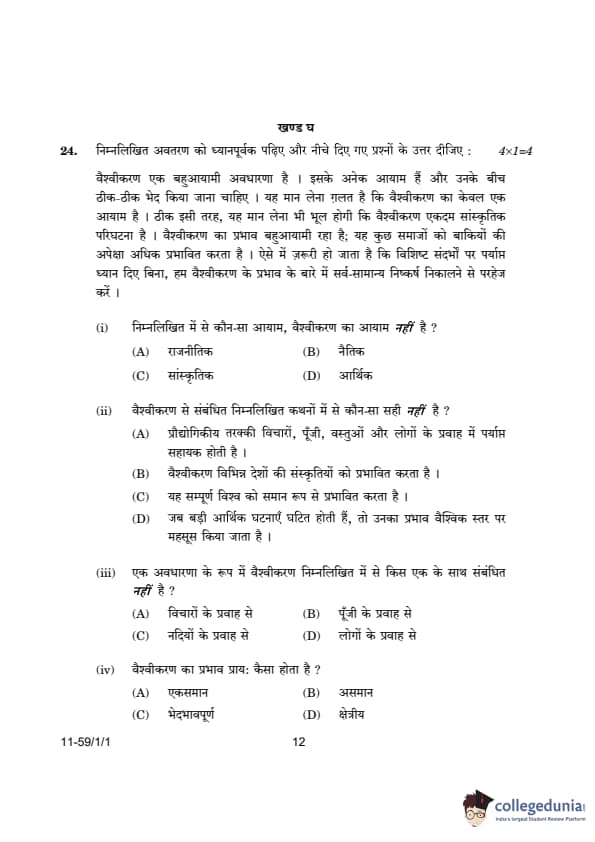
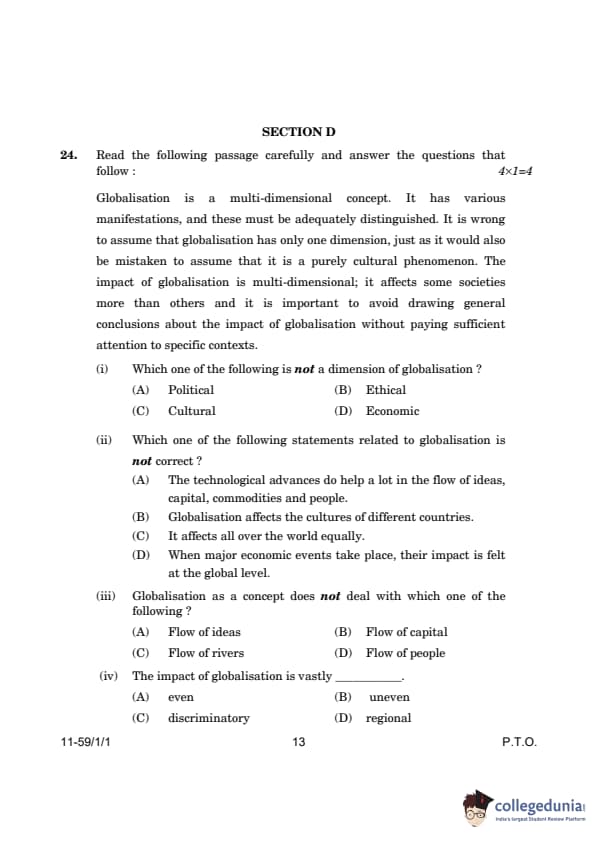
Question 24:Read the following passage carefully and answer the questions that follow : Globalisation is a multi-dimensional concept. It has various manifestations, and these must be adequately distinguished. It is wrong to assume that globalisation has only one dimension, just as it would also be mistaken to assume that it is a purely cultural phenomenon. The impact of globalisation is multi-dimensional; it affects some societies more than others and it is important to avoid drawing general conclusions about the impact of globalisation without paying sufficient attention to specific contexts.
(i) Which one of the following is not a dimension of globalisation ?
View Solution
Solution: The passage mentions political, cultural, and economic dimensions. Ethical considerations, while related, are not presented as a core dimension of globalization itself.
Quick Tip: Pay close attention to the specific dimensions listed in the text to identify which one is NOT included.
Question 24(ii):
Which one of the following statements related to globalisation is not correct ?
View Solution
Solution: The passage explicitly states that globalization "affects some societies more than others," directly contradicting the statement that it affects all equally.
Quick Tip: Look for qualifiers like "more than others" or "some...more than others" that indicate unequal impact.
Question 24(iii):
Globalisation as a concept does not deal with which one of the following ?
View Solution
Solution: The passage discusses flows of ideas, capital, and people. "Flow of rivers" is a geographical concept not directly related to the human-driven processes of globalization.
Quick Tip: Focus on the elements of human interaction and exchange discussed in the context of globalization.
Question 24(iv):
The impact of globalisation is vastly ___________.
View Solution
Solution: The passage emphasizes that globalization's impact is "multi-dimensional" and affects "some societies more than others," highlighting its uneven distribution.
Quick Tip: The word "uneven" directly reflects the passage's emphasis on the varying impact of globalization.
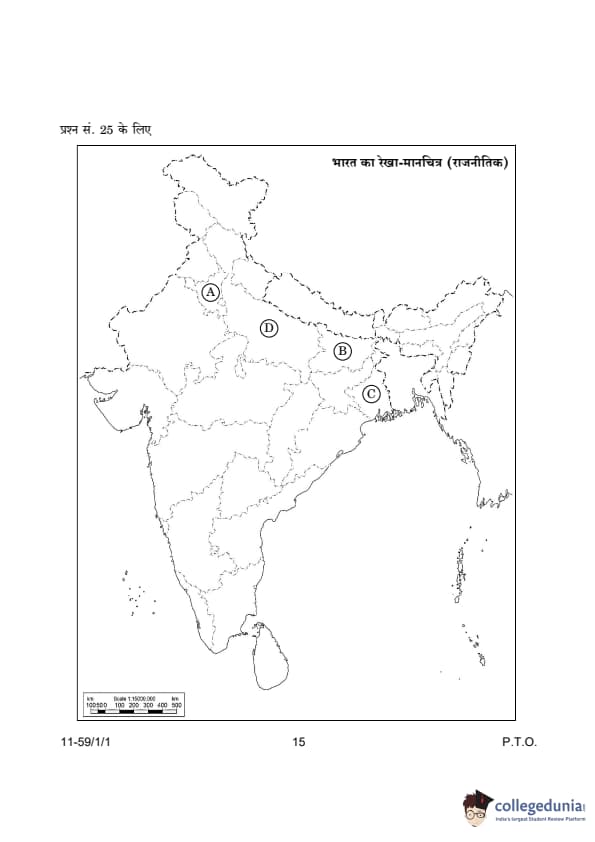
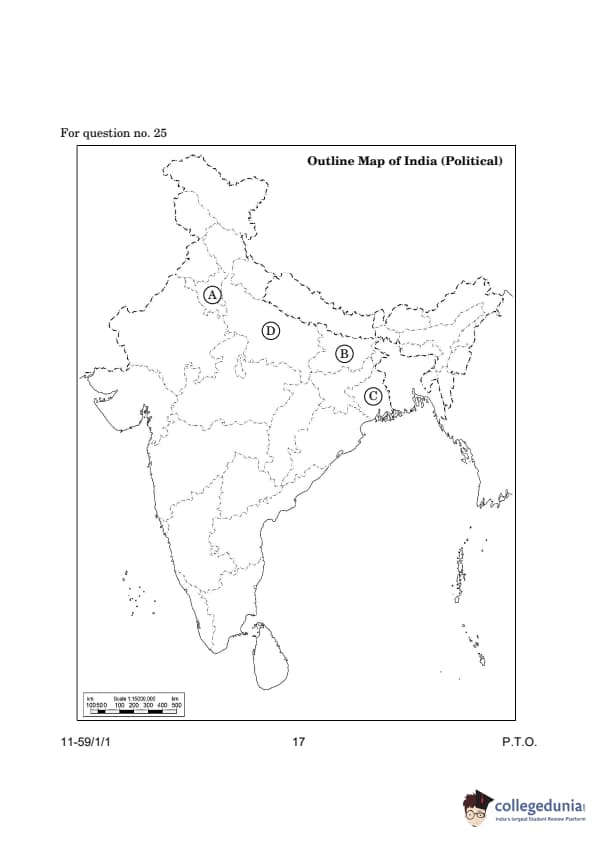
Question 25:
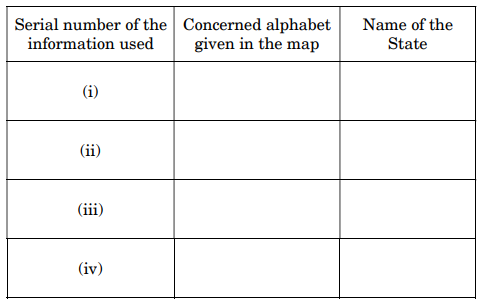
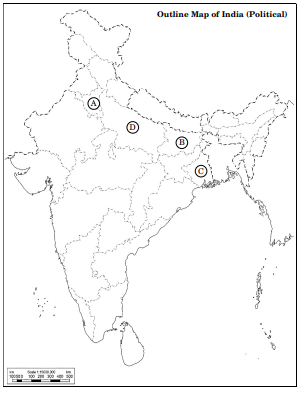
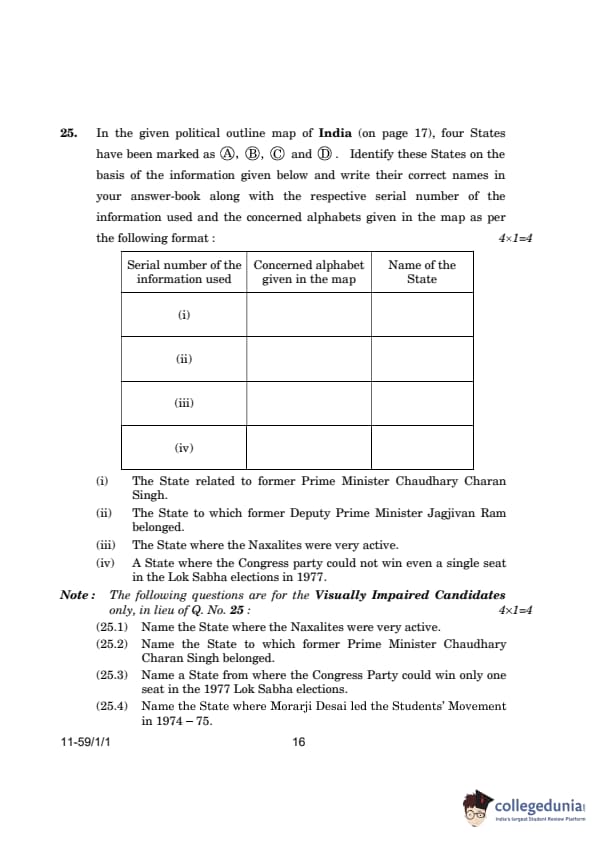
In the given political outline map of India (on page 17), four States have been marked as (A), (B), (C) and (D). Identify these States on the basis of the information given below and write their correct names in your answer-book along with the respective serial number of the information used and the concerned alphabets given in the map as per the following format:
(A) Uttar Pradesh
(B) Bihar
(C) West Bengal
(D) Tamil Nadu
View Solution
Step 1: Analyze the Information Provided for Each State
We need to identify the states based on the given clues and match them with the alphabets (A), (B), (C), and (D) on the map. Let’s evaluate each clue.
Step 2: Identify Each State Based on the Clues
- (i) The State related to former Prime Minister Chaudhary Charan Singh: Chaudhary Charan Singh, a former Prime Minister of India (1979–1980), was from Uttar Pradesh, where he was a prominent leader of the farmer community. So, (i) corresponds to Uttar Pradesh.
- (ii) The State to which former Deputy Prime Minister Jagjivan Ram belonged: Jagjivan Ram, a prominent Dalit leader and Deputy Prime Minister (1977–1979), was born in Bihar and represented the Sasaram constituency. So, (ii) corresponds to Bihar.
- (iii) The State where the Naxalites were very active: The Naxalite movement began in 1967 in Naxalbari, West Bengal, and the state has historically been a stronghold of Naxalite activity. So, (iii) corresponds to West Bengal.
- (iv) A State where the Congress party could not win even a single seat in the Lok Sabha elections in 1977: In the 1977 Lok Sabha elections, after the Emergency, the Congress party faced a major defeat in several states. In Tamil Nadu, the Congress won zero seats, as the state was dominated by regional parties like the DMK and AIADMK. So, (iv) corresponds to Tamil Nadu.
Step 3: Assign the Alphabets Based on Typical Map Positions
Since the map is not provided, we assume a standard political map of India:
- Uttar Pradesh is typically in the northern part of India, so it may be marked as (A).
- Bihar is in the eastern part, below Uttar Pradesh, so it may be marked as (B).
- West Bengal is further east, so it may be marked as (C).
- Tamil Nadu is in the southern part, so it may be marked as (D).
Step 4: Conclusion
The states are identified as follows: \[ \begin{tabular}{|c|c|c|} \hline Serial number of the information used & Concerned alphabet given in the map & Name of the State
\hline % Option (i) & (A) & Uttar Pradesh
\hline % Option (ii) & (B) & Bihar
\hline % Option (iii) & (C) & West Bengal
\hline % Option (iv) & (D) & Tamil Nadu
\hline \end{tabular} \] Quick Tip: When identifying states on a map, use historical and political knowledge to match clues with states, and consider their typical geographical positions on a standard map of India.
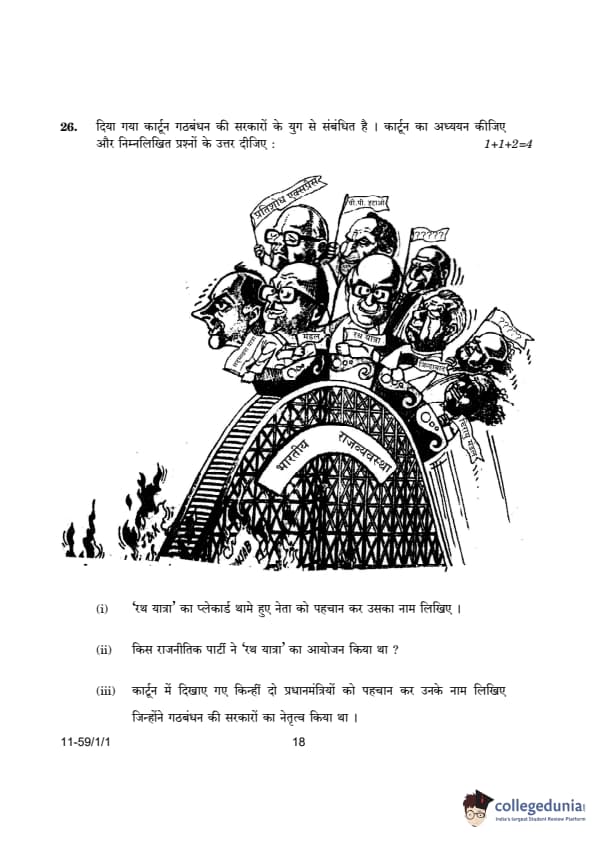
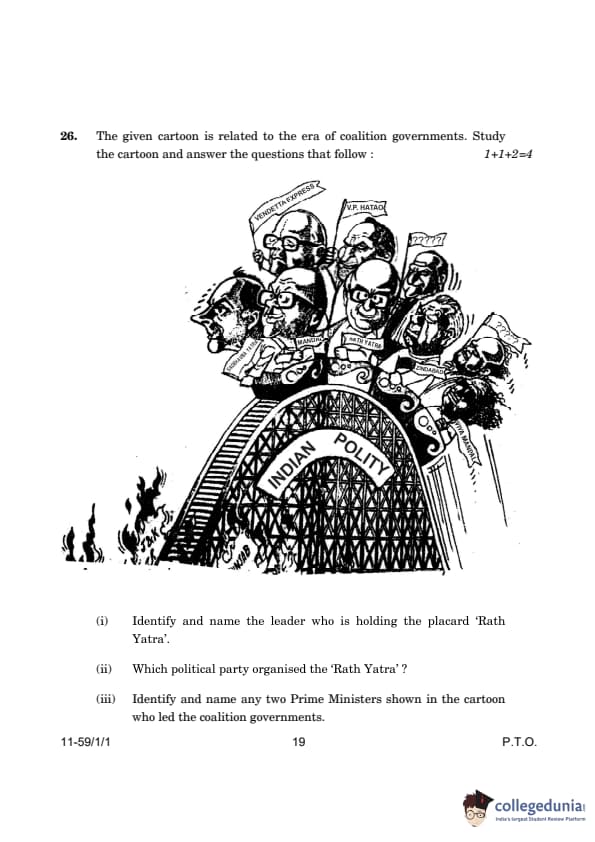
The given cartoon is related to the era of coalition governments. Study the cartoon and answer the questions that follow:

View Solution
Step 1: Understand the Context of the Cartoon
The cartoon depicts the era of coalition governments in India, specifically during the late 1980s and early 1990s, a period marked by political instability and the rise of coalition politics. The placards and labels like `Rath Yatra', `Mandal', and `Zindabad' provide clues about the events and leaders involved.
Step 2: Answer Each Question
- (i) Identify and name the leader who is holding the placard `Rath Yatra': The `Rath Yatra' was a significant political event in 1990, led by L.K. Advani to mobilise support for the construction of the Ram Temple in Ayodhya. So, the leader holding the placard is L.K. Advani.
- (ii) Which political party organised the `Rath Yatra'?: The `Rath Yatra' was organised by the Bharatiya Janata Party (BJP), which used the event to gain political momentum during the early 1990s.
- (iii) Identify and name any two Prime Ministers shown in the cartoon who led the coalition governments: The cartoon represents the coalition era (1989–1991). V.P. Singh, who led the National Front government (1989–1990), is associated with the `Mandal' placard (Mandal Commission implementation). Chandra Shekhar, who led a minority government (1990–1991) with Congress support, is also depicted. So, the two Prime Ministers are V.P. Singh and Chandra Shekhar.
Step 3: Conclusion
The answers are:
% Option
(i) The leader holding the placard `Rath Yatra' is L.K. Advani.
% Option
(ii) The political party that organised the `Rath Yatra' is the Bharatiya Janata Party (BJP).
% Option
(iii) Two Prime Ministers shown in the cartoon who led coalition governments are V.P. Singh and Chandra Shekhar. Quick Tip: The era of coalition governments in India (1989–2014) involved multiple parties and leaders, with events like the Rath Yatra and Mandal Commission shaping political dynamics.
SECTION E
Question 27:
(a) “India’s relations with Russia are embedded in a history of trust and common interests.'' Support the statement with any three appropriate arguments.
View Solution
Step 1: Understand the Context of India-Russia Relations
India and Russia (formerly the Soviet Union) have maintained a strong bilateral relationship since India’s independence, rooted in mutual trust and shared interests, particularly during the Cold War and beyond.
Step 2: Provide Three Arguments
- Argument 1: Historical Support During the Cold War – The Soviet Union supported India on key issues, such as during the 1971 Indo-Pak War, through the 1971 Indo-Soviet Treaty of Peace, Friendship, and Cooperation, which ensured diplomatic and military backing.
- Argument 2: Defence Cooperation – Russia has been a major supplier of military equipment to India, including fighter jets (MiG and Sukhoi), tanks, and the S-400 missile defence system, reflecting deep trust in defence ties.
- Argument 3: Economic and Energy Partnerships – India and Russia collaborate in energy sectors, such as nuclear power (e.g., Kudankulam Nuclear Power Plant) and oil projects (e.g., India’s investment in Russia’s Rosneft), showcasing shared economic interests.
Step 3: Conclusion
The three arguments are:
1. Historical support during the Cold War, including the 1971 Indo-Soviet Treaty.
2. Strong defence cooperation, with Russia being a major supplier of military equipment to India.
3. Economic and energy partnerships, such as collaboration in nuclear energy and oil projects. Quick Tip: India-Russia relations are built on a foundation of historical, strategic, and economic ties, especially evident during the Cold War and in defence cooperation.
Question 27:
OR
(b) Analyse any three effects of shock therapy after the disintegration of the Soviet Union.
View Solution
Step 1: Understand Shock Therapy and the Disintegration of the Soviet Union
The Soviet Union disintegrated in 1991, and many successor states, particularly Russia, adopted shock therapy—a rapid transition from a planned economy to a market economy through privatisation, deregulation, and liberalisation.
Step 2: Analyse Three Effects
- Effect 1: Economic Hardship and Inequality – Shock therapy led to rapid privatisation, causing massive unemployment, hyperinflation, and poverty. For example, Russia’s GDP fell by nearly 50% in the 1990s, and wealth became concentrated among a few oligarchs.
- Effect 2: Political Instability and Rise of Oligarchs – The sudden economic reforms weakened state control, leading to political chaos and the rise of powerful oligarchs who gained control of key industries, influencing politics, as seen during Boris Yeltsin’s presidency.
- Effect 3: Decline in Living Standards and Social Services – The dismantling of the Soviet welfare system resulted in reduced access to healthcare, education, and pensions, leading to a sharp decline in life expectancy and living standards in the 1990s.
Step 3: Conclusion
The three effects are:
1. Economic hardship and inequality due to rapid privatisation.
2. Political instability and the rise of oligarchs.
3. Decline in living standards and social services. Quick Tip: Shock therapy aimed for a quick transition to a market economy but often resulted in severe economic and social challenges for post-Soviet states.
9a) Explain any three environmental concerns in global politics which no single government can address.
View Solution
Step 1: Understand Environmental Concerns in Global Politics
Environmental issues in global politics are transboundary in nature, requiring international cooperation because they affect multiple countries and cannot be solved by a single government.
Step 2: Explain Three Concerns
- Concern 1: Climate Change and Global Warming – Rising global temperatures due to greenhouse gas emissions (e.g., CO2) cause melting ice caps, rising sea levels, and extreme weather. No single country can address this, as emissions from one country affect the entire planet, necessitating agreements like the Paris Agreement (2015).
- Concern 2: Deforestation and Biodiversity Loss – Deforestation in regions like the Amazon affects global climate regulation and biodiversity. Species extinction impacts ecosystems worldwide, requiring global efforts like the Convention on Biological Diversity (CBD).
- Concern 3: Ocean Pollution and Marine Ecosystem Degradation – Plastic pollution and overfishing in international waters harm marine life and ecosystems globally. This requires international cooperation, such as through the UN Convention on the Law of the Sea (UNCLOS).
Step 3: Conclusion
The three concerns are:
1. Climate change and global warming.
2. Deforestation and biodiversity loss.
3. Ocean pollution and marine ecosystem degradation. Quick Tip: Global environmental issues require collective action through international agreements, as their impacts transcend national borders.
OR
(b) Explain the principle of `common but differentiated responsibilities'.
View Solution
Step 1: Define the Principle of CBDR
The principle of `common but differentiated responsibilities' (CBDR) emerged in international environmental law, notably during the 1992 Earth Summit in Rio de Janeiro, to address global issues like climate change.
Step 2: Explain the Principle
- Common Responsibility: All countries have a shared responsibility to protect the environment, as issues like climate change affect the entire planet. For example, every nation must work to reduce greenhouse gas emissions.
- Differentiated Responsibilities: Developed countries, which historically contributed more to environmental degradation (e.g., through industrialisation), and have greater financial and technological capacity, should take on more responsibility. For instance, under the Kyoto Protocol (1997), developed countries had binding emission reduction targets, while developing countries did not.
- Equity and Capacity: The principle ensures fairness by recognising that developing countries need to prioritise economic growth and poverty reduction, so they receive support (e.g., technology transfer, funding) from developed nations, as seen in the Paris Agreement (2015).
Step 3: Conclusion
The principle of CBDR means that all countries share the responsibility to address global environmental issues, but developed countries bear a greater burden due to their historical contributions to environmental degradation and greater capacity to act. Quick Tip: CBDR balances global responsibility with equity, ensuring that developed nations lead in addressing environmental challenges while supporting developing countries.
(a) Describe any three major challenges that independent India faced immediately after independence.
View Solution
Step 1: Understand the Context of Independent India in 1947
India gained independence on August 15, 1947, but faced significant challenges due to the partition, colonial legacy, and the need to build a unified nation.
Step 2: Describe Three Challenges
- Challenge 1: Communal Violence and Refugee Rehabilitation – The partition of India into India and Pakistan led to widespread communal violence, with millions killed or displaced. Over 15 million refugees needed rehabilitation, straining resources and social harmony.
- Challenge 2: Integration of Princely States – India had over 560 princely states that needed to be integrated into the Indian Union. Leaders like Sardar Vallabhbhai Patel used diplomacy and force (e.g., in Hyderabad and Junagadh) to unify the country.
- Challenge 3: Economic Instability and Poverty – India inherited a weak economy from colonial rule, with widespread poverty, low industrialisation, and food shortages. The government had to address these through policies like the First Five-Year Plan (1951).
Step 3: Conclusion
The three challenges are:
1. Communal violence and refugee rehabilitation due to partition.
2. Integration of princely states into the Indian Union.
3. Economic instability and poverty. Quick Tip: Independent India faced immediate challenges of unity, social stability, and economic recovery, which shaped its early policies and governance.
OR
(b) Describe the role played by Mahatma Gandhi to reduce communal violence that erupted in many parts of India at the time of the partition in 1947.
View Solution
Step 1: Understand the Context of Communal Violence During Partition
The partition of India in 1947 led to widespread communal violence between Hindus, Muslims, and Sikhs, resulting in massacres, displacement, and deep mistrust across regions like Punjab, Bengal, and Delhi.
Step 2: Describe Gandhi’s Role
- Role 1: Peace Missions and Fasting – Gandhi travelled to violence-affected areas like Noakhali (Bengal) and Calcutta in 1946–1947, urging communities to stop the violence. In Calcutta, he undertook a fast unto death in August 1947, which helped restore peace by pressuring leaders and communities to reconcile.
- Role 2: Engaging with Communities – Gandhi held prayer meetings and dialogues with Hindus and Muslims, promoting unity and non-violence. In Delhi, he visited refugee camps, consoling victims and encouraging trust, which earned him the title of a one-man peace army.
Step 3: Conclusion
Gandhi’s role included:
1. Undertaking peace missions and fasting to promote harmony.
2. Engaging with communities to foster trust and reconciliation. Quick Tip: Gandhi’s non-violent approach and moral authority were instrumental in reducing communal tensions during the partition, though he could not prevent all violence.
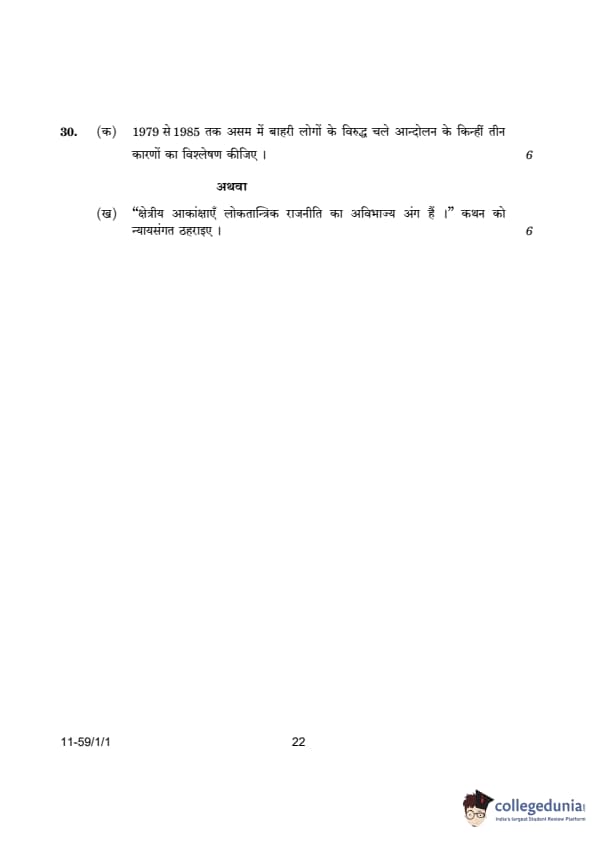
(a) Analyse any three reasons for the movement against outsiders in Assam from 1979 to 1985.
View Solution
Three reasons for the movement against outsiders in Assam from 1979 to 1985 are: 1. Fear of demographic change due to illegal immigration from Bangladesh. 2. Economic competition and strain on resources caused by immigrants. 3. Cultural and linguistic identity concerns among the Assamese population.
Question 30:
OR
(b) “Regional aspirations are very much a part of democratic politics.” Justify the statement.
View Solution
Solution: In a democratic system, regions or states within a larger nation often have unique needs, priorities, and cultural identities. These distinct characteristics can lead to regional aspirations, which encompass desires for greater autonomy, control over resources, or recognition of cultural distinctiveness. Since democratic politics ideally involves representing and addressing the interests of all citizens, including those at the regional level, these aspirations become a significant part of the political discourse and policy-making process. Accommodating and balancing regional aspirations within a democratic framework is crucial for maintaining national unity and stability.
Quick Tip: Consider how regional interests are expressed (e.g., through regional political parties, demands for greater autonomy), and how these demands are integrated into the broader national political landscape.










Comments