




CBSE Class 12 Political Science Question Paper 2025 PDF (Set 1- 59/1/1) is available for download here. CBSE conducted the Political Science exam on March 22, 2025 from 10:30 AM to 1:30 PM. The total marks for the theory paper are 80. The question paper contains 20% MCQ-based questions, 40% competency-based questions, and 40% short and long answer type questions.
Candidates can use the link below to download the CBSE Class 12 History Set 3 Question Paper with detailed solutions.
CBSE Class 12 Political Science Question Paper 2025 (Set 1- 59/1/1) with Answer Key
| CBSE Class 12 2025 History Question Paper with Answer Key |  Download Download |
Check Solution |
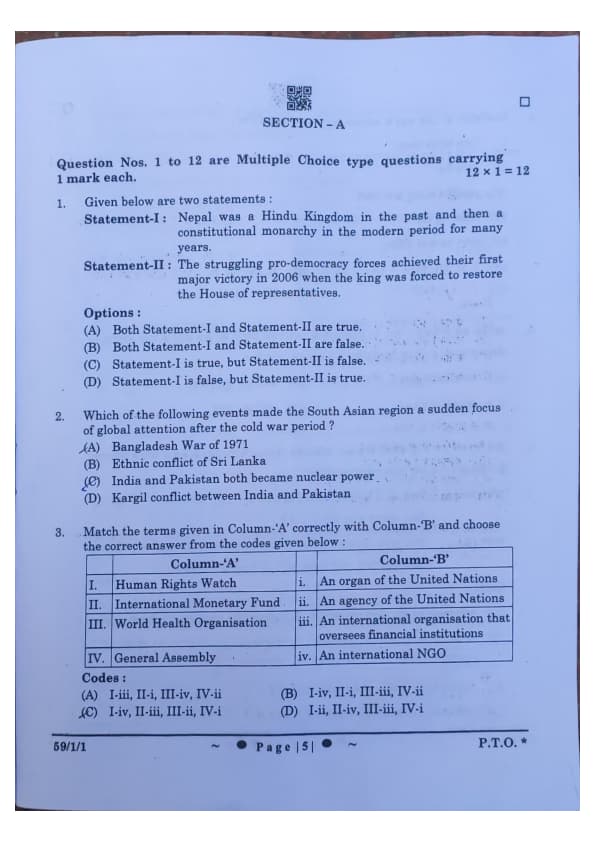
Given below are two statements:
Statement-I: Nepal was a Hindu Kingdom in the past and then a constitutional monarchy in the modern period for many years.
Statement-II: The struggling pro-democracy forces achieved their first major victory in 2006 when the king was forced to restore the House of Representatives.
Which of the following events made the South Asian region a sudden focus of global attention after the cold war period?
Match the terms given in Column-A correctly with Column-B and choose the correct answer from the codes given below:
Column-A Column-B
I. Human Rights Watch i. An organ of the United Nations
II. International Monetary Fund ii. An agency of the United Nations
III. World Health Organisation iii. An international organisation that oversees financial institutions
IV. General Assembly iv. An international NGO
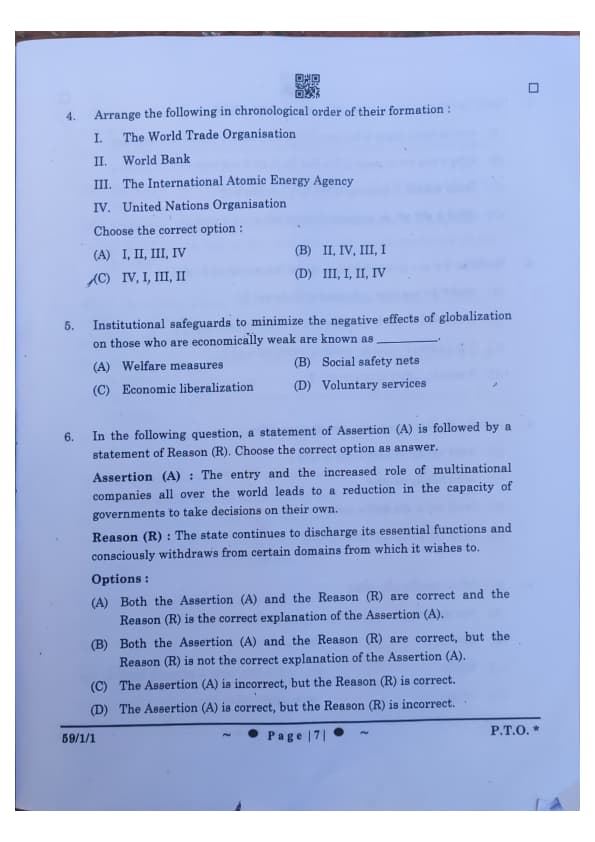
Arrange the following in chronological order of their formation:
I. The World Trade Organisation
II. World Bank
III. The International Atomic Energy Agency
IV. United Nations Organisation
Choose the correct option:
Institutional safeguards to minimize the negative effects of globalization on those who are economically weak are known as ________
In the following question, a statement of Assertion (A) is followed by a statement of Reason (R). Choose the correct option as the answer.
Assertion (A): The entry and the increased role of multinational companies all over the world leads to a reduction in the capacity of governments to take decisions on their own.
Reason (R): The state continues to discharge its essential functions and consciously withdraws from certain domains from which it wishes to.
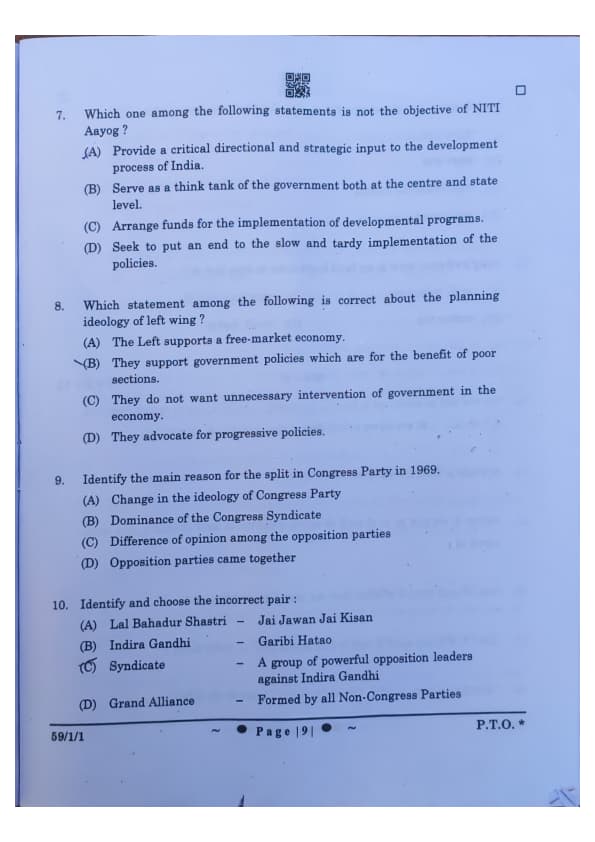
Which one among the following statements is not the objective of NITI Aayog?
Which statement among the following is correct about the planning ideology of left wing?
Identify the main reason for the split in Congress Party in 1969.
Identify and choose the incorrect pair:
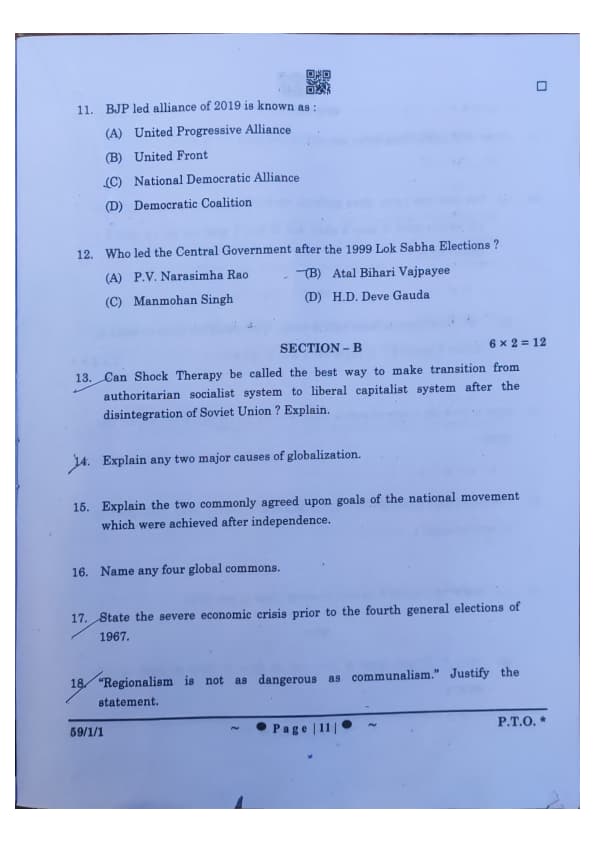
BJP led alliance of 2019 is known as:
Who led the Central Government after the 1999 Lok Sabha Elections?
Can Shock Therapy be called the best way to make transition from authoritarian socialist system to liberal capitalist system after the disintegration of Soviet Union? Explain.
Explain any two major causes of globalization.
Explain the two commonly agreed upon goals of the national movement which were achieved after independence.
Name any four global commons.
State the severe economic crisis prior to the fourth general elections of 1967.
"Regionalism is not as dangerous as communalism." Justify the statement.
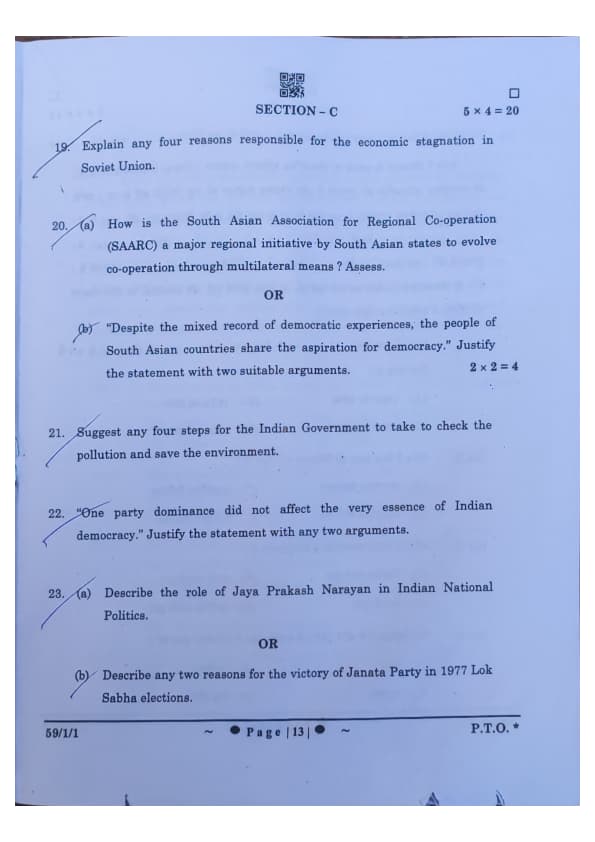
Explain any four reasons responsible for the economic stagnation in Soviet Union.
(a) How is the South Asian Association for Regional Co-operation (SAARC) a major regional initiative by South Asian states to evolve co-operation through multilateral means? Assess.
Question 20:
(b) "Despite the mixed record of democratic experiences, the people of South Asian countries share the aspiration for democracy." Justify the statement with two suitable arguments.
Suggest any four steps for the Indian Government to take to check the pollution and save the environment.
"One party dominance did not affect the very essence of Indian democracy." Justify the statement with any two arguments.
(a) Describe the role of Jaya Prakash Narayan in Indian National Politics.
Question 23:
(b)Describe any two reasons for the victory of Janata Party in 1977 Lok Sabha elections.
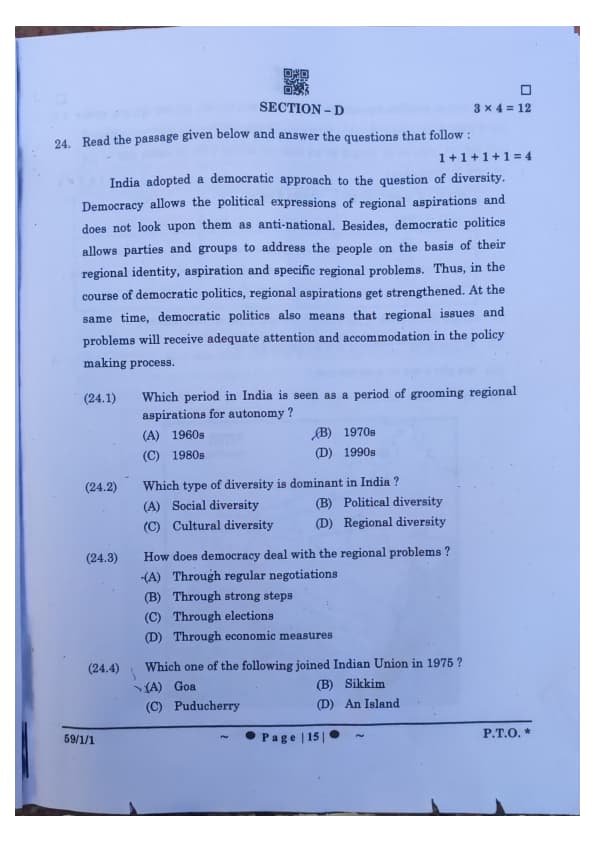
(24.1)Which period in India is seen as a period of grooming regional aspirations for autonomy?
(24.2) Which type of diversity is dominant in India?
(24.3) How does democracy deal with regional problems?
(24.4) Which one of the following joined Indian Union in 1975?
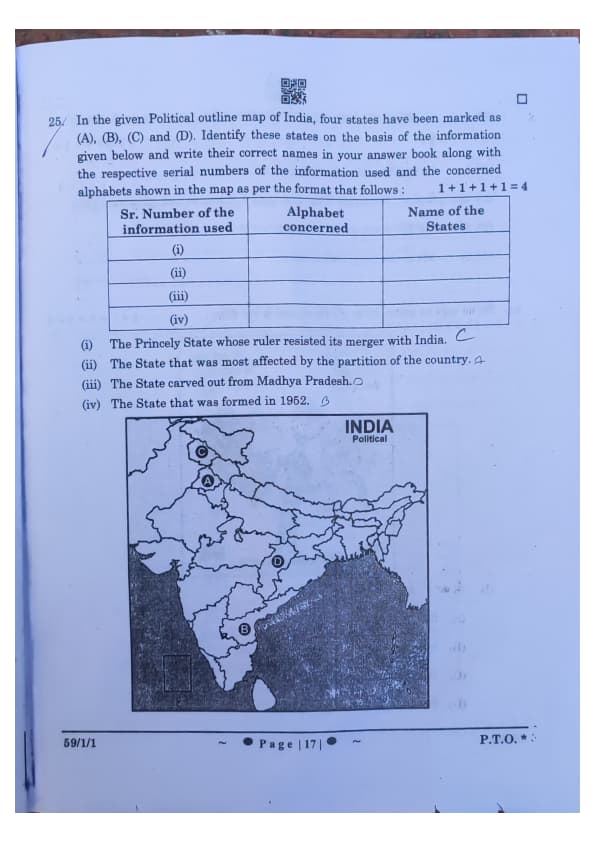
In the given Political outline map of India, four states have been marked as (A), (B), (C), and (D). Identify these states on the basis of the information given below and write their correct names in your answer book along with the respective serial numbers of the information used and the concerned alphabets shown in the map as per the format that follows:
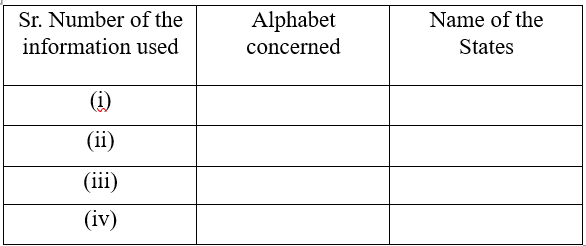
- (i) The Princely State whose ruler resisted its merger with India.
(ii) The State that was most affected by the partition of the country.
(iii) The State carved out from Madhya Pradesh.
(iv) The State that was formed in 1952. ![map]()
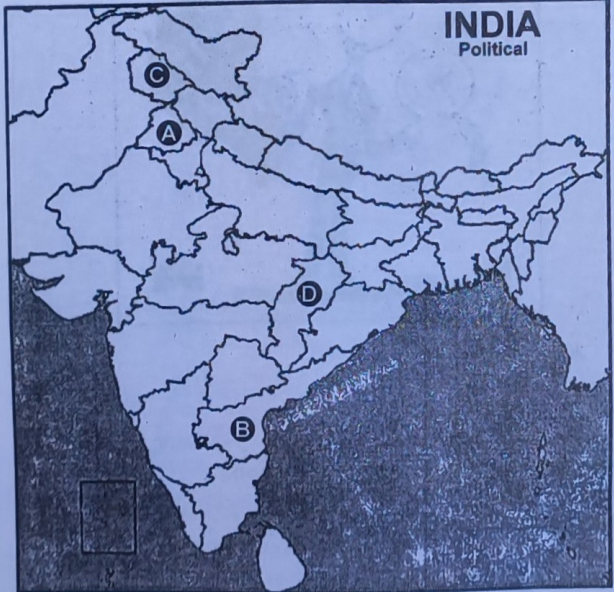
25.1 Name the Union Territory which earlier was a state.
25.2 Name any one state that was most affected by the partition of the country.
25.3 Which state was carved out from Madhya Pradesh?
25.4 Which state was formed in 1952?
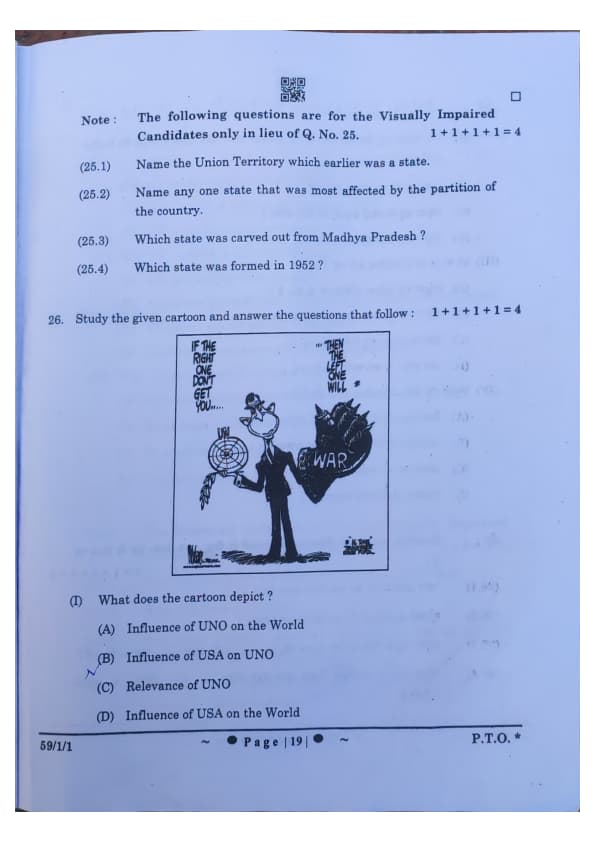
Question 26:
Study the given cartoon and answer the questions that follow:
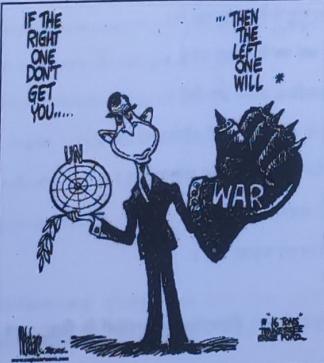
(I) What does the cartoon depict?
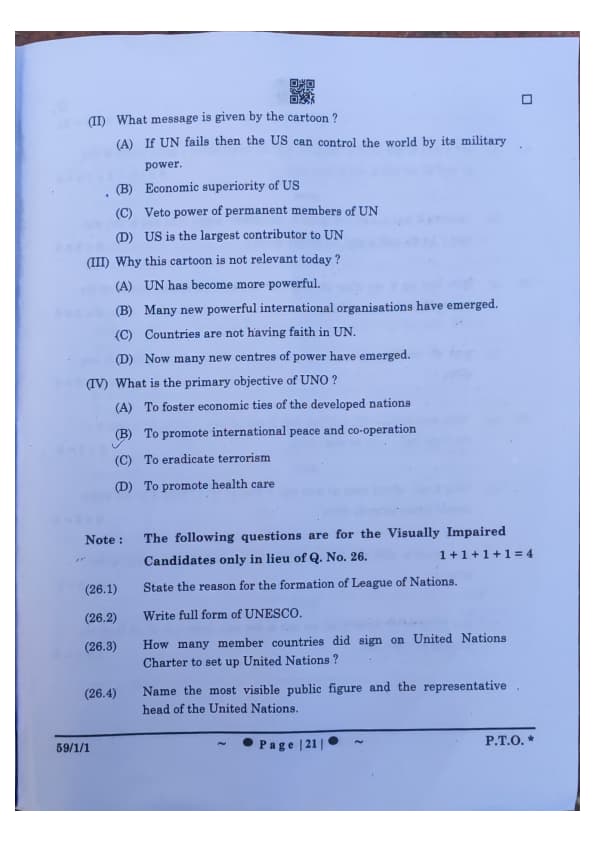
(II) What message is given by the cartoon?
(III) Why this cartoon is not relevant today?
(IV) What is the primary objective of UNO?
Note: The following questions are for the Visually Impaired Candidates only in lieu of Q. No. 26.
(26.1) State the reason for the formation of League of Nations.
(26.2) Write the full form of UNESCO.
(26.3) How many member countries did sign on United Nations Charter to set up United Nations?
(26.4) Name the most visible public figure and the representative head of the United Nations.
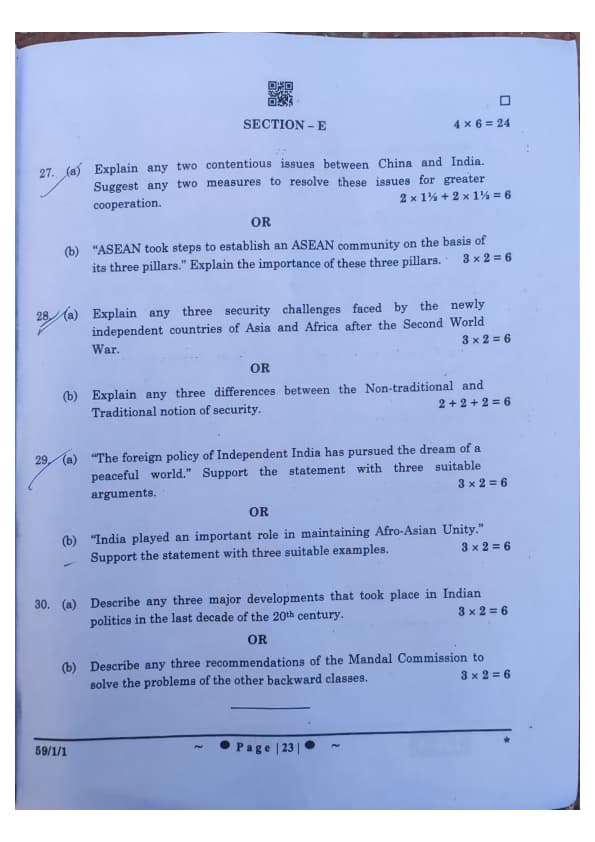
(a) Explain any two contentious issues between China and India. Suggest any two measures to resolve these issues for greater cooperation.
Question 27:
(b) "ASEAN took steps to establish an ASEAN community on the basis of its three pillars." Explain the importance of these three pillars.
(a) Explain any three security challenges faced by the newly independent countries of Asia and Africa after the Second World War.
Question 28:
(b) Explain any three differences between the Non-traditional and Traditional notion of security.
(a) "The foreign policy of Independent India has pursued the dream of a peaceful world." Support the statement with three suitable arguments.
Question 48:
(b) "India played an important role in maintaining Afro-Asian Unity." Support the statement with three suitable examples.
(a) Describe any three major developments that took place in Indian politics in the last decade of the 20th century.
Question 30:
(b) Describe any three recommendations of the Mandal Commission to solve the problems of the other backward classes.



Comments