




The CBSE Board conducted Class 12 Political Science Exam 2026 on March 23, 2026. Class 12 Political Science Question Paper 2026 – Set 2 with Solution PDF is available here for download.
The CBSE Class 12 Political Science Set 2 paper covers key topics from Indian Politics, Comparative Politics, and Political Theory and considered moderately difficult. The exam is marked out of 100, with 80 marks for the theory paper and 20 for internal assessment.
CBSE Class 12 Political Science Question Paper 2026 with Solution PDF – Set 2
| CBSE Class 12 Political Science Question Paper 2026 – Set 2 | Download PDF | Check Solutions |
The alliance that has formed the government at the centre the maximum number of times:
Which statement is the best description of ‘Veto Power’?
Which one of the following is NOT a consequence of ‘Shock Therapy’?
Arrange the following events in chronological order:
(i) Declaration of National Emergency on the basis of internal disturbances.
(ii) Railway strike by government employees under the leadership of George Fernandes.
(iii) Sixth General Election held in India.
(iv) Declaration of the doctrine of 'basic structure' of the Constitution in the 'Keshavananda Bharti' case by the Supreme Court.
Choose the correct option:
View Solution
Concept:
Chronological order means arranging events according to the year in which they occurred. Understanding the historical timeline of political events in India helps determine the correct order.
Keshavananda Bharti Case (1973): The Supreme Court declared the Basic Structure Doctrine, stating that Parliament cannot alter the basic structure of the Constitution.
Railway Strike (1974): A massive railway strike led by George Fernandes demanding better working conditions for railway employees.
National Emergency (1975): Prime Minister Indira Gandhi declared a national emergency on the basis of internal disturbances.
Sixth General Election (1977): Elections were held after the Emergency period ended.
Step 1: Identify the earliest event.
The Basic Structure doctrine was declared in the Keshavananda Bharti case in 1973. Hence, (iv) comes first.
Step 2: Find the next event.
The nationwide railway strike led by George Fernandes occurred in 1974. Hence, (ii) comes next.
Step 3: Identify the following event.
The National Emergency was declared in 1975. Hence, (i) follows.
Step 4: Determine the last event.
The Sixth General Election took place in 1977. Hence, (iii) comes last.
Step 5: Final chronological order: \[ (iv) \rightarrow (ii) \rightarrow (i) \rightarrow (iii) \] Quick Tip: Remember the timeline: Basic Structure (1973) → Railway Strike (1974) → Emergency (1975) → Sixth General Election (1977).
Given below are two statements marked as Assertion (A) and Reason (R). Read these statements and choose the correct answer from the given options:
Assertion (A): The idea of Five Year Plans (FYP) in India was inspired by the USSR.
Reason (R): Due to acute economic crisis, the Indian Government started 'Plan Holiday' in 1966.
Options:
View Solution
Concept:
After independence, India adopted a planned development strategy for economic growth. The model of Five Year Plans was inspired by the planning system of the Soviet Union (USSR).
However, during the mid-1960s India faced serious economic problems due to droughts, wars with China (1962) and Pakistan (1965), and inflation. As a result, the government temporarily suspended Five Year Plans from 1966 to 1969. This period is known as the Plan Holiday.
The Assertion (A) is true because India’s planning model was influenced by the USSR.
The Reason (R) is also true because the Plan Holiday began in 1966 due to economic crisis.
However, the reason does not explain why India adopted the Five Year Plans.
Step 1: Evaluate Assertion (A).
India’s Five Year Plans were indeed inspired by the planning system of the Soviet Union. Hence, Assertion (A) is true.
Step 2: Evaluate Reason (R).
The Plan Holiday began in 1966 because of severe economic crisis. Hence, Reason (R) is true.
Step 3: Check the relationship between A and R.
The reason does not explain the inspiration behind Five Year Plans; it only explains why planning was temporarily suspended.
Step 4: Conclusion.
Both statements are true, but the reason is not the correct explanation of the assertion. Quick Tip: India adopted the Five Year Plan model from the Soviet Union, but the Plan Holiday (1966–1969) occurred due to economic crisis and wars.
Which one of the following statements is NOT correct about the first two Five Year Plans?
Which one of the following is related to the traditional notion of security?
Match List-I with List-II correctly and choose the correct answer from the codes given below:
\begin{tabular{|p{7cm|p{4cm|
\hline
List-I & List-II
\hline
(a) Congress for democracy & (i) Gujarat
(b) Garibi Hatao & (ii) Jay Prakash Narayan
(c) Student movement led by Morarji Desai & (iii) Jagjeevan Ram
(d) Total Revolution & (iv) Indira Gandhi
\hline
\end{tabular
Codes:
Which was the last state toured by Rajiv Gandhi for his election campaign in May 1991?
Which one of the following statements is True about the concept of ‘Co-operative Security’?
Identify the correct trio of Baltic Republics:
Given below are two statements:
Statement I: The International Monetary Fund (IMF) is an international organization that oversees those financial institutions and regulations that act at the international level.
Statement II: All the 189 members of IMF organization have equal say.
In the light of above statements, choose the correct answer from the options given below:
View Solution
Concept:
The International Monetary Fund (IMF) is a global financial institution established in 1944 to promote international monetary cooperation, ensure financial stability, facilitate international trade, and reduce poverty.
The IMF monitors the global financial system and provides financial assistance and policy advice to member countries.
However, voting power in the IMF is not equal for all members. It is based on the financial contributions (quotas) of member countries.
Countries that contribute more financially to the IMF have greater voting power.
Step 1: Evaluate Statement I.
The IMF oversees international financial regulations and institutions, so Statement I is true.
Step 2: Evaluate Statement II.
All 189 member countries do not have equal voting power; voting rights depend on their financial contribution.
Step 3: Conclusion.
Thus, Statement I is true but Statement II is false. Quick Tip: In the IMF, voting power is based on financial contribution (quota), so larger economies have more influence than smaller countries.
Highlight any four threats of traditional security.
View Solution
Concept:
Traditional security mainly refers to the protection of a nation’s sovereignty, territorial integrity, and political independence from external military threats. It focuses largely on the use of military power and defence strategies to safeguard a state from attacks by other states.
Four major threats of traditional security are:
War:
War between two or more countries poses a major threat to national security as it can lead to destruction of life, property, and territorial loss.
Military attack or invasion:
When one country attacks or invades another country’s territory, it threatens the sovereignty and independence of the affected nation.
Nuclear weapons and arms race:
The development and possession of nuclear weapons by countries increases the risk of large-scale destruction and global conflict.
Terrorism supported by other states:
Some states support terrorist groups that carry out attacks in other countries, which threatens national security and stability.
Conclusion:
Traditional security threats mainly arise from military conflicts, external aggression, nuclear weapons, and state-supported terrorism. Quick Tip: Traditional security focuses mainly on military threats such as war, invasion, nuclear weapons, and terrorism supported by states.
Explain any two differences between the refugees and the migrants.
Analyse the main reason responsible for the formation of Coalition Governments after 1989.
How does the geographical location of the North-East region has affected the expression of its regional demands? Explain.
View Solution
Concept:
The North-East region of India includes states such as Assam, Arunachal Pradesh, Meghalaya, Manipur, Mizoram, Nagaland, Tripura and Sikkim. This region has a unique geographical location which has greatly influenced the development of regional demands and political movements.
Impact of geographical location on regional demands:
Physical Isolation from the Rest of India:
The North-East is connected to the rest of India only through a narrow corridor called the Siliguri Corridor (Chicken's Neck). This geographical isolation has created a sense of distance and neglect, leading to demands for greater autonomy and development.
International Borders with Several Countries:
The region shares borders with countries such as China, Myanmar, Bangladesh, Bhutan and Nepal. Due to these international borders, cross-border migration and cultural influences have increased, which has sometimes intensified ethnic tensions and regional demands.
Diverse Ethnic and Cultural Groups:
The region is home to many tribes and ethnic communities with distinct languages and cultures. Because of this diversity and geographical separation, many groups demanded recognition of their identity and creation of separate states.
Difficult Terrain and Development Issues:
The mountainous terrain, dense forests and poor connectivity have slowed economic development. As a result, people in the region have raised demands for better infrastructure, economic opportunities and political autonomy.
Conclusion:
Thus, the geographical isolation, international borders, ethnic diversity and difficult terrain of the North-East region have significantly influenced the expression of its regional demands. Quick Tip: The North-East region's isolation, difficult terrain, international borders and ethnic diversity have strongly shaped its regional movements and demands.
State any two reasons for the Students' Movement in Gujarat in 1974.
Assess the impact of outside powers on the South Asian Countries.
Explain any four differences between the governments formed in the first three General Elections held in India after independence and the coalition governments formed after the year 1989.
Explain any four advantages of coalition governments with reference to Indian politics.
Explain any two reasons responsible for the strong relation between Russia and India.
The ideology of 'Bharatiya Jana Sangh' party was to make India a progressive and strong nation. Do you agree with the statement? Support your answer with any four suitable arguments.
Describe any two areas of co-operation and any two reasons for conflicts between India and Pakistan.
Describe any two areas of co-operation and any two reasons for conflicts between India and Nepal.
Explain the concept of non-Congressism with the help of any one example.
In the given political outline map of India, four states have been marked as A, B, C and D. Identify these on the basis of the information given below and write their correct names in your answer-book along with their respective serial number of the information used and the concerned alphabet as per the format that follows:
(i) The state related to the leader of Dravidian Movement E.V. Ramasami Naicker.
(ii) The state whose formation was supported by Master Tara Singh.
(iii) The state where the movement against outsiders was started by students.
(iv) The state for which Rajiv Gandhi and Laldenga signed an agreement for peace.
Read the passage given below carefully and answer the questions that follow:
On the reform of structures and processes, the biggest discussion has been on the functioning of the Security Council. Related to this has been the demand for an increase in the UN Security Council's permanent and non-permanent membership so that the realities of contemporary world politics are better reflected in the structure of the organisation. In particular, there are proposals to increase membership from Asia, Africa and South America. Beyond this, the US and other Western countries want improvements in the UN's budgetary procedures and its administration.
(i) Which organ of the United Nations has five permanent members?
Which country contributes the most in the budget of United Nations Organisation?
In which year was the strength of non-permanent members of Security Council increased?
Which of the following statements is NOT correct about the reforms in Security Council?
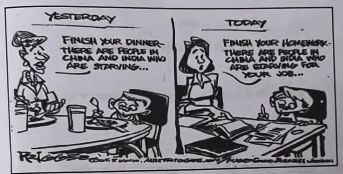
Study the given cartoon carefully and answer the questions that follow:
(i)
Which change does the cartoon reflect?
Question 26(ii):
What kind of shift is shown in America's attitude towards developing countries?
View Solution
Concept:
The cartoon highlights the changing attitude of developed countries like the USA towards developing nations.
Step 1: Earlier attitude.
Earlier, America showed concern for poverty and hunger in developing countries.
Step 2: Present attitude.
Now, it is more concerned about economic competition and job losses due to outsourcing.
Step 3: Conclusion.
There is a shift from a humanitarian approach to a self-interested economic approach. Quick Tip: America's attitude has shifted from helping developing countries to protecting its own economic interests.
Mention any one positive and any one negative impact of globalization in reference to the cartoon.
Explain any four factors that led Japan to emerge as a new centre of power even after the destruction caused by Atom Bombs.
Explain any four policies adopted by China to accelerate its economic growth.
How did Princely States pose a threat to the National Security of India? Explain.
Explain any four problems faced during the process of partition of India.
Assess the role of Jawaharlal Nehru, the first Prime Minister of India in the formation of India's Foreign Policy.
Analyse any three main causes of conflict between India and China.
Explain the meaning of “Indigenous People” and assess the threats which they face for their survival.
In what ways are the environmental concerns of Global North different from the Global South? Explain with the help of three examples.





Comments