




The CBSE Class 12 Political Science Question Paper 2024 PDF is available for download here. CBSE conducted the Political Science exam on March 12, 2024, from 10:30 AM to 1:30 PM. The total marks for the theory paper are 70. The question paper contains 20% MCQ-based questions, 40% competency-based questions, and 40% short and long answer type questions. Students reported the exam to be of moderate difficulty level.
CBSE Class 12 Political Science (59/1/3) Question Paper 2024 with Answer Key
| CBSE Class 12 2024 Political Science Question Paper with Answer Key |  Download Download |
Check Solution |
CBSE Class 12 Political Science Question Paper 2024 with Answer Key
SECTION-A
Question 1:
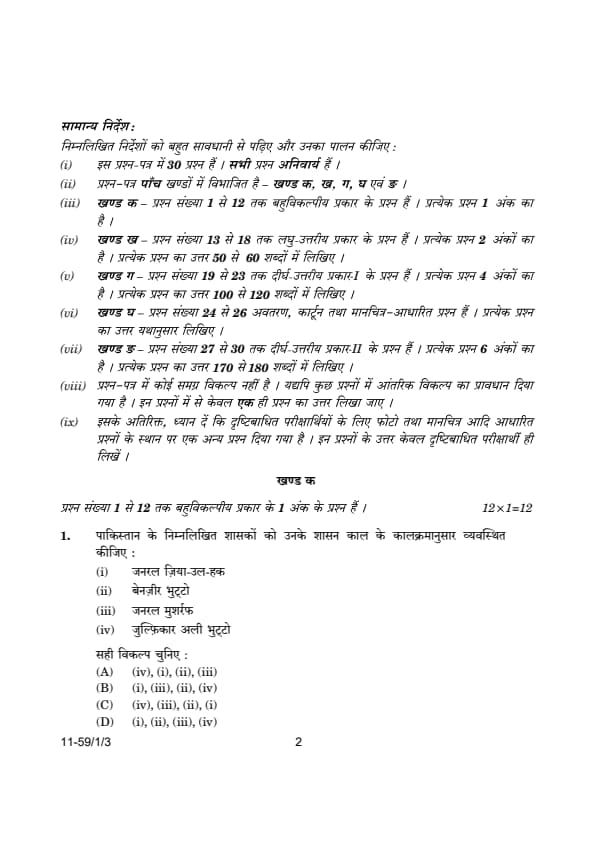
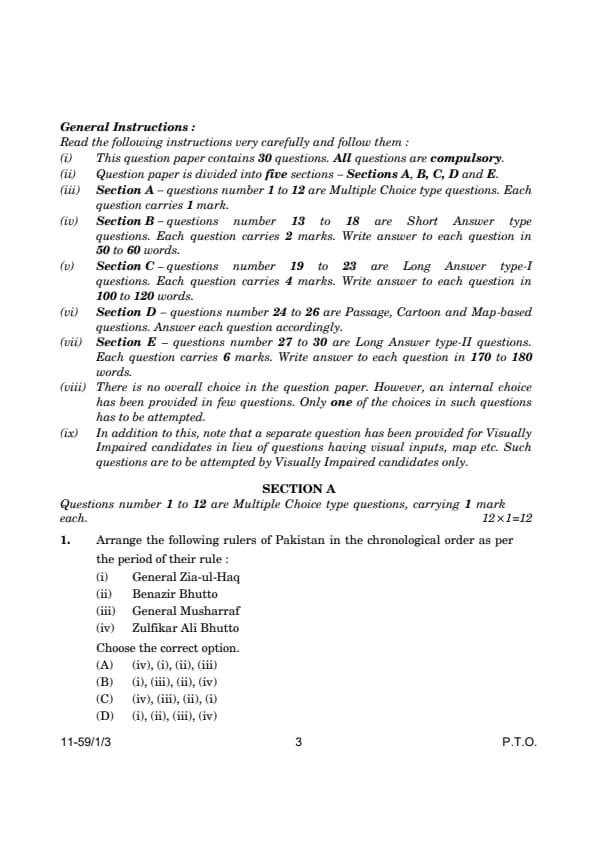
Arrange the following rulers of Pakistan in the chronological order as per the period of their rule:
(i) General Zia-ul-Haq
(ii) Benazir Bhutto
(iii) General Musharraf
(iv) Zulfiqar Ali Bhutto
Choose the correct option.
View Solution
Step 1: Identify the Periods of Rule for Each Leader
Zulfiqar Ali Bhutto: He served as Prime Minister of Pakistan from 1973 to 1977.
General Zia-ul-Haq: He ruled as President from 1978 to 1988 after deposing Zulfiqar Ali Bhutto.
Benazir Bhutto: She served as Prime Minister in two non-consecutive terms, first from 1988 to 1990 and then from 1993 to 1996.
General Musharraf: He took power in a coup in 1999 and ruled as President from 2001 to 2008.
Step 2: Arrange in Chronological Order
Zulfiqar Ali Bhutto (1973–1977) comes first.
General Zia-ul-Haq (1978–1988) comes next.
Benazir Bhutto (1988–1990, 1993–1996) follows.
General Musharraf (1999–2008) is the last in this list.
Thus, the order is: (iv) Zulfiqar Ali Bhutto, (i) General Zia-ul-Haq, (ii) Benazir Bhutto, (iii) General Musharraf.
Step 3: Match with the Options
Option (A): (iv), (i), (ii), (iii) – This matches the chronological order.
Option (B): (i), (iii), (ii), (iv) – Incorrect, as Zia-ul-Haq did not rule before Zulfiqar Ali Bhutto.
Option (C): (iv), (iii), (i), (ii) – Incorrect, as Musharraf ruled after
ia-ul-Haq and Benazir Bhutto.
Option (D): (i), (ii), (iii), (iv) – Incorrect, as Zulfiqar Ali Bhutto ruled before Zia-ul-Haq.
The correct answer is: \[ (A) (iv), (i), (ii), (iii) \] Quick Tip: To solve chronological order questions, note the exact years of rule for each leader and arrange them from earliest to latest.
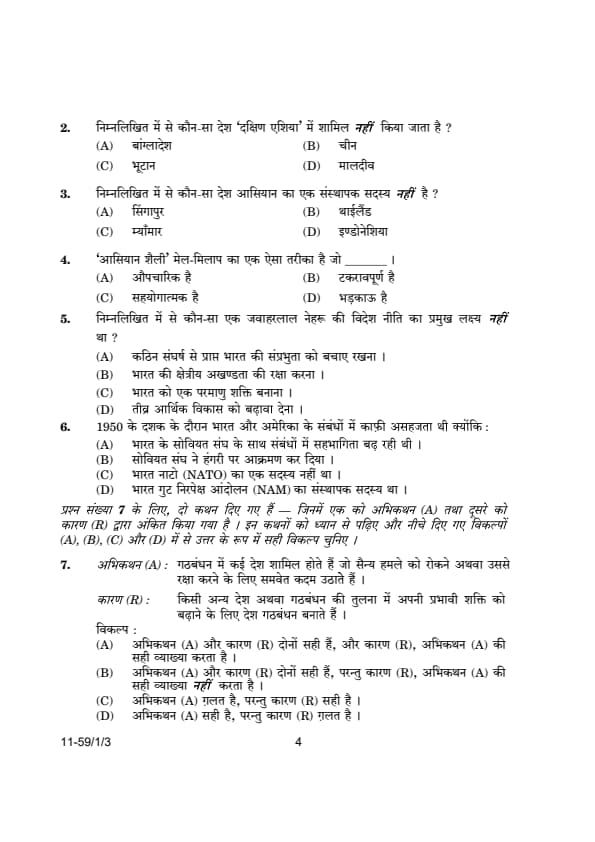
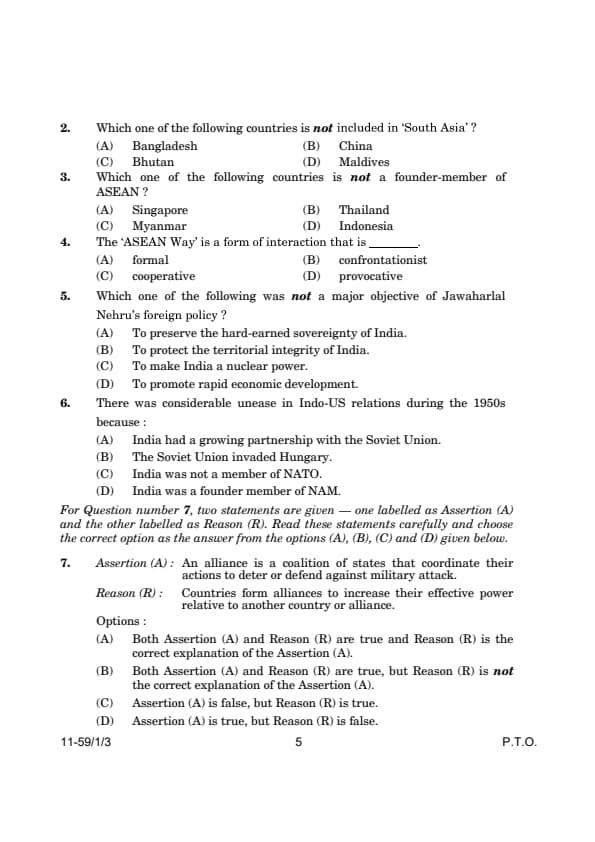
Which one of the following countries is NOT included in `South Asia'?
View Solution
Step 1: Define South Asia
South Asia typically includes countries in the Indian subcontinent and surrounding areas, such as India, Pakistan, Bangladesh, Sri Lanka, Nepal, Bhutan, and the Maldives.
Step 2: Analyze the Options
Option (A) Bangladesh: Bangladesh is in South Asia.
Option (B) China: China is in East Asia, not South Asia.
Option (C) Bhutan: Bhutan is in South Asia.
Option (D) Maldives: The Maldives is considered part of South Asia.
Step 3: Conclusion
The correct answer is: \[ (B) China \] Quick Tip: South Asia includes countries like India, Pakistan, Bangladesh, Sri Lanka, Nepal, Bhutan, and the Maldives. China is part of East Asia.
Which one of the following countries is NOT a founder-member of ASEAN?
View Solution
Step 1: Identify the Founder-Members of ASEAN
ASEAN was founded on August 8, 1967, by five countries: Indonesia, Malaysia, the Philippines, Singapore, and Thailand. These are the founder-members of ASEAN.
Step 2: Analyze the Options
Option (A) Singapore: Singapore is a founder-member of ASEAN.
Option (B) Thailand: Thailand is a founder-member of ASEAN.
Option (C) Myanmar: Myanmar joined ASEAN in 1997 and is not a founder-member.
Option (D) Indonesia: Indonesia is a founder-member of ASEAN.
Step 3: Conclusion
The correct answer is: \[ (C) Myanmar \] Quick Tip: ASEAN’s founder-members are Indonesia, Malaysia, the Philippines, Singapore, and Thailand. Other members, like Myanmar, joined later.
The `ASEAN Way' is a form of interaction that is:
View Solution
Step 1: Understanding the `ASEAN Way'
The `ASEAN Way' refers to the diplomatic approach of the Association of Southeast Asian Nations (ASEAN). It emphasizes consensus-building, non-interference, and a cooperative style of interaction among member states.
Step 2: Analyzing the Options
Option (A) formal: The ASEAN Way is not strictly formal; it prioritizes flexibility and informality.
Option (B) confrontationist: This is incorrect as the ASEAN Way avoids confrontation and focuses on consensus.
Option (C) cooperative: This aligns with the ASEAN Way’s emphasis on collaboration and mutual respect.
Option (D) provocative: The ASEAN Way is not provocative; it seeks harmony and stability.
Step 3: Conclusion
The correct answer is: \[ (C) cooperative \] Quick Tip: The `ASEAN Way' is a key concept in international relations, often associated with ASEAN’s principles of non-interference, consensus, and regional cooperation.
Which one of the following was not a major objective of Jawaharlal Nehru’s foreign policy?
View Solution
Step 1: Understand Nehru’s Foreign Policy Objectives
Jawaharlal Nehru, India’s first Prime Minister, focused on non-alignment, sovereignty, territorial integrity, and economic development as key pillars of his foreign policy. He also advocated for global peace and disarmament.
Step 2: Analyze the Options
Option (A) To preserve the hard-earned sovereignty of India: This was a major objective, as Nehru emphasized India’s independence and non-alignment to avoid foreign domination.
Option (B) To protect the territorial integrity of India: This was also a key objective, as seen in India’s response to border issues with China and Pakistan.
Option (C) To make India a nuclear power: This was not a major objective under Nehru. While India developed nuclear technology for peaceful purposes, Nehru was a strong advocate for global nuclear disarmament and did not prioritize making India a nuclear power. India’s nuclear tests happened later, in 1974, after Nehru’s time.
Option (D) To promote rapid economic development: This was a major objective, as Nehru linked foreign policy with economic self-reliance through initiatives like the Five-Year Plans.
Step 3: Conclusion
The correct answer is: \[ (C) To make India a nuclear power. \] Quick Tip: Nehru’s foreign policy focused on non-alignment, sovereignty, and economic development, while advocating for global peace and nuclear disarmament.
There was considerable unease in Indo-US relations during the 1950s because:
View Solution
Step 1: Understand the Context of Indo-US Relations in the 1950s
During the 1950s, the Cold War was at its peak, with the US and the Soviet Union as rival superpowers. The US sought to build alliances to counter Soviet influence, while India, under Jawaharlal Nehru, pursued a policy of non-alignment.
Step 2: Analyze the Options
Option (A) India had a growing partnership with the Soviet Union: This is correct. India’s growing ties with the Soviet Union, including economic and military cooperation, caused unease in the US, which saw India as leaning toward the Soviet bloc.
Option (B) The Soviet Union invaded Hungary: The Soviet invasion of Hungary in 1956 was a global event, but it did not directly impact Indo-US relations.
Option (C) India was not a member of NATO: While true, India’s non-membership in NATO was not a primary reason for unease, as India’s non-alignment policy was broader than just NATO.
Option (D) India was a founder member of NAM: India’s role in the Non-Aligned Movement (NAM) did create some tension, but the primary concern for the US was India’s specific partnership with the Soviet Union, not just its non-alignment.
Step 3: Conclusion
The correct answer is: \[ (A) India had a growing partnership with the Soviet Union. \] Quick Tip: During the Cold War, the US viewed any partnership with the Soviet Union as a challenge to its global influence, which often strained relations with non-aligned countries like India.
For Question number 6, two statements are given — one labelled as Assertion (A) and the other labelled as Reason (R). Read these statements carefully and choose the correct option as the answer from the options (A), (B), (C) and (D) given below.
Assertion (A): An alliance is a coalition of states that coordinate their actions to deter or defend against military attack.
Reason (R): Countries form alliances to increase their effective power relative to another country or alliance.
View Solution
Step 1: Evaluate the Assertion (A)
The Assertion states: "An alliance is a coalition of states that coordinate their actions to deter or defend against military attack." This is true, as alliances, such as NATO, are formed for collective defense and deterrence against military threats.
Step 2: Evaluate the Reason (R)
The Reason states: "Countries form alliances to increase their effective power relative to another country or alliance." This is also true, as one of the motivations for forming alliances is to enhance a country’s power and influence through collective strength.
Step 3: Determine if Reason (R) Explains Assertion (A)
While both statements are true, the Reason does not directly explain the Assertion. The Assertion defines what an alliance is (a coalition for defense or deterrence), while the Reason explains a motivation for forming alliances (to increase power). However, increasing power is not the only or primary purpose of an alliance as defined in the Assertion—alliances are specifically about coordinating for defense or deterrence, not just power enhancement.
Step 4: Match with the Options
Option (A): Incorrect, as Reason (R) is not the correct explanation of Assertion (A).
Option (B): Correct, as both statements are true, but Reason (R) does not explain Assertion (A).
Option (C): Incorrect, as Assertion (A) is true.
Option (D): Incorrect, as Reason (R) is true.
The correct answer is: \[ (B) Both Assertion (A) and Reason (R) are true, but Reason (R) is not the correct explanation of the Assertion (A). \] Quick Tip: In Assertion-Reason questions, ensure that the Reason directly explains the Assertion, not just a related concept.
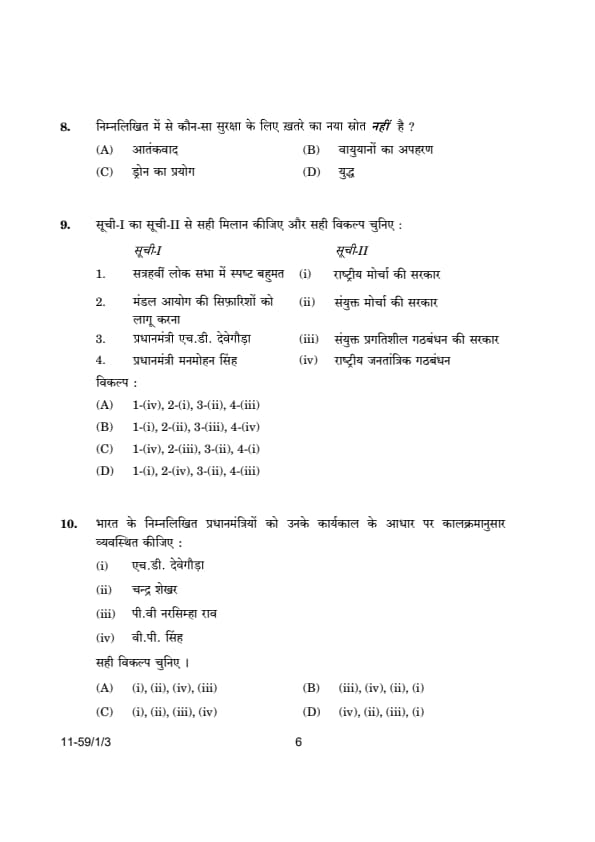
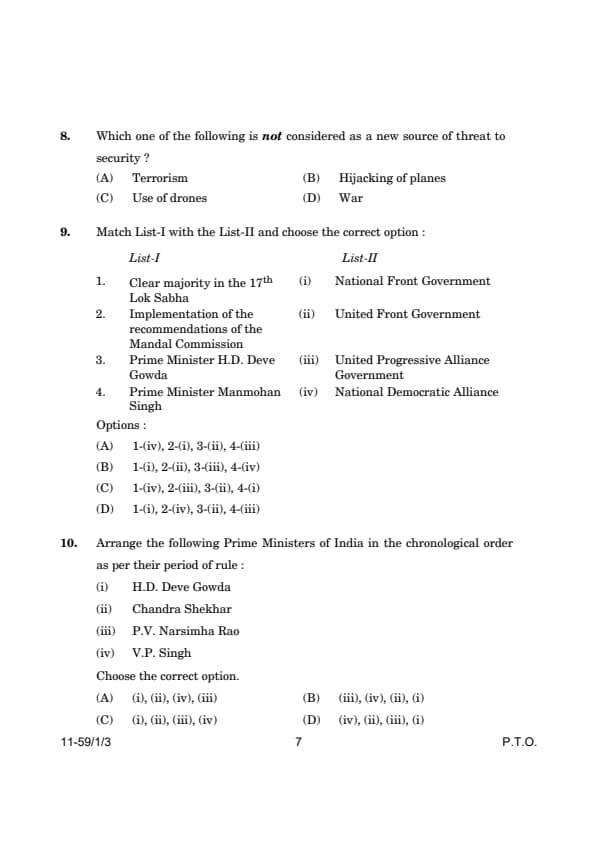
Which one of the following is not considered as a new source of threat to security?
View Solution
Step 1: Define New Sources of Threat to Security
New sources of threat to security refer to emerging or non-traditional threats that have become more prominent in recent times, often involving modern technology or unconventional methods.
Step 2: Analyze the Options
Option (A) Terrorism: Terrorism, especially in its modern forms like cyber-terrorism, is considered a new source of threat.
Option (B) Hijacking of planes: Hijacking, particularly after events like 9/11, is seen as a modern security threat.
Option (C) Use of drones: The use of drones in warfare and surveillance is a relatively new and emerging threat to security.
Option (D) War: War is a traditional source of threat to security and has been a concern for centuries, not a "new" source.
Step 3: Conclusion
The correct answer is: \[ (D) War \] Quick Tip: When identifying new sources of threat, focus on emerging or non-traditional issues like technology-driven threats, rather than conventional ones like war.
Match List-I with the List-II and choose the correct option:
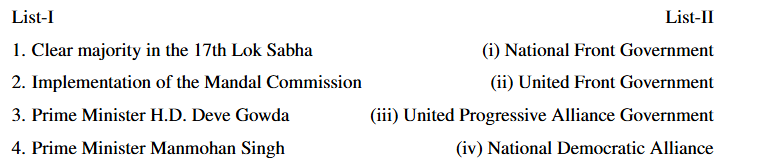
Options:
View Solution
Step 1: Understand the Items in List-I and List-II
List-I includes events or leaders, and List-II includes governments or coalitions associated with them. Let’s match each item.
Step 2: Match Each Item
1. Clear majority in the 17th Lok Sabha: The 17th Lok Sabha elections (2019) resulted in a clear majority for the National Democratic Alliance (NDA), led by the BJP. So, 1 matches with (iv) National Democratic Alliance.
2. Implementation of the Mandal Commission: The Mandal Commission recommendations (on reservations for OBCs) were implemented in 1990 under the United Progressive Alliance Government, led by V.P. Singh. So, 2 matches with (iii) United Progressive Alliance Government.
3. Prime Minister H.D. Deve Gowda: H.D. Deve Gowda was Prime Minister from 1996 to 1997 under the United Front Government. So, 3 matches with (ii) United Front Government.
4. Prime Minister Manmohan Singh: Manmohan Singh was Prime Minister from 2004 to 2014 under the National Front Government. So, 4 matches with (i) National Front Government.
Step 3: Match with the Options
Option (A): 1-(iv), 2-(i), 3-(iii), 4-(iii) – Incorrect, as 2 and 4 are mismatched.
Option (B): 1-(i), 2-(ii), 3-(iii), 4-(iv) – Incorrect, as 1, 2, and 4 are mismatched.
Option (C): 1-(iv), 2-(iii), 3-(ii), 4-(i) – Correct, as all matches are accurate.
Option (D): 1-(i), 2-(iv), 3-(iii), 4-(iii) – Incorrect, as 1, 2, and 3 are mismatched.
The correct answer is: \[ (C) 1-(iv), 2-(iii), 3-(ii), 4-(i) \] Quick Tip: For matching questions, recall the historical context of events and leaders, and associate them with the correct political associations.
Arrange the following Prime Ministers of India in the chronological order as per their period of rule:
(i) H.D. Deve Gowda
(ii) Chandra Shekhar
(iii) P.V. Narasimha Rao
(iv) V.P. Singh
Choose the correct option.
View Solution
Step 1: Identify the Periods of Rule for Each Prime Minister
V.P. Singh: He served as Prime Minister from December 1989 to November 1990.
Chandra Shekhar: He served as Prime Minister from November 1990 to June 1991.
P.V. Narasimha Rao: He served as Prime Minister from June 1991 to May 1996.
H.D. Deve Gowda: He served as Prime Minister from June 1996 to April 1997.
Step 2: Arrange in Chronological Order
V.P. Singh (1989–1990) comes first.
Chandra Shekhar (1990–1991) comes next.
P.V. Narasimha Rao (1991–1996) follows.
H.D. Deve Gowda (1996–1997) is the last in this list.
Thus, the order is: (iv) V.P. Singh, (ii) Chandra Shekhar, (iii) P.V. Narasimha Rao, (i) H.D. Deve Gowda.
Step 3: Match with the Options
Option (A): (i), (ii), (iv), (iii) – Incorrect, as H.D. Deve Gowda was the last, not the first.
Option (B): (iii), (iv), (ii), (i) – Incorrect, as P.V. Narasimha Rao was not the first.
Option (C): (i), (ii), (iii), (iv) – Incorrect, as H.D. Deve Gowda was not the first.
Option (D): (iv), (ii), (iii), (i) – Correct, as it matches the chronological order.
The correct answer is: \[ (D) (iv), (ii), (iii), (i) \] Quick Tip: To arrange leaders chronologically, note their exact years of tenure and order them from earliest to latest.
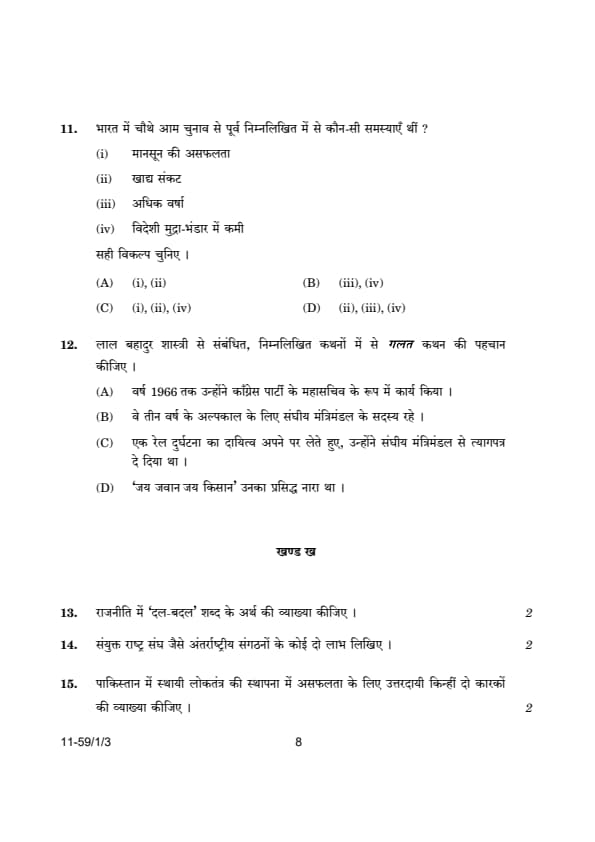
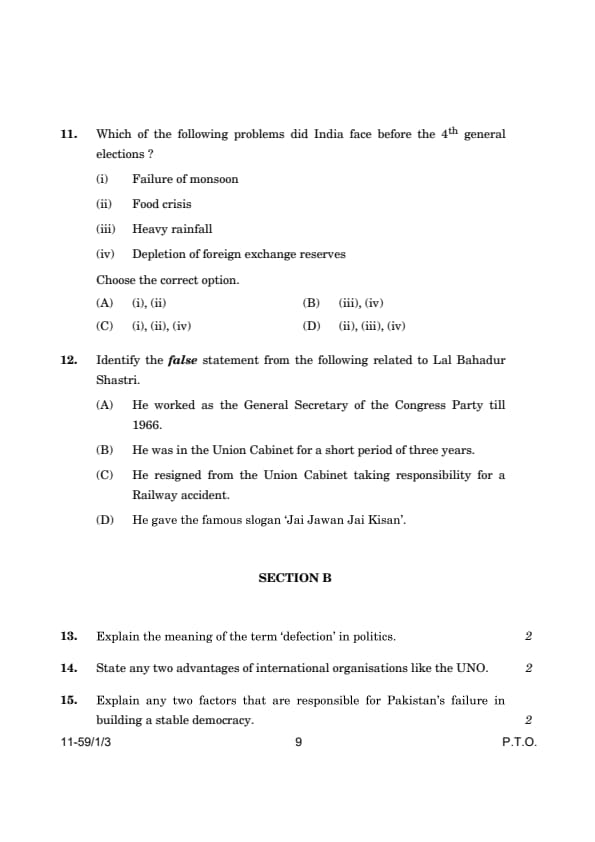
Which of the following problems did India face before the 4th general elections?
(i) Failure of monsoon
(ii) Food crisis
(iii) Heavy rainfall
(iv) Depletion of foreign exchange reserves
Choose the correct option.
View Solution
Step 1: Identify the Context of the 4th General Elections
The 4th general elections in India were held in 1967. This period was marked by significant challenges following the 1965 Indo-Pak War, the death of Lal Bahadur Shastri in 1966, and economic difficulties under Indira Gandhi’s early leadership.
Step 2: Analyze the Problems
(i) Failure of monsoon: True. India faced severe droughts in 1965 and 1966 due to monsoon failures, leading to agricultural decline.
(ii) Food crisis: True. The monsoon failures caused a food crisis, with India relying on food imports, including under the US PL-480 program.
(iii) Heavy rainfall: False. The period was marked by drought, not heavy rainfall.
(iv) Depletion of foreign exchange reserves: True. India’s foreign exchange reserves were depleted due to the costs of the 1965 war and food imports.
Step 3: Match with the Options
Option (A) (i), (ii): Incomplete, as it misses (iv).
Option (B) (iii), (iv): Incorrect, as (iii) is false.
Option (C) (i), (ii), (iv): Correct, as all three were major issues.
Option (D) (ii), (iii), (iv): Incorrect, as (iii) is false.
The correct answer is: \[ (C) (i), (ii), (iv) \] Quick Tip: The mid-1960s were a challenging period for India, with droughts, food shortages, and economic strain due to war and import dependency.
Identify the false statement from the following related to Lal Bahadur Shastri.
View Solution
Step 1: Review Lal Bahadur Shastri’s Career
Lal Bahadur Shastri was India’s second Prime Minister (1964–1966) and a prominent leader in the Indian National Congress. Let’s evaluate each statement.
Step 2: Analyze the Statements
- Option (A) He worked as the General Secretary of the Congress Party till 1966: This is false. Shastri was the General Secretary of the Congress Party in the 1950s, but he became Prime Minister in 1964 and died in 1966. He was not the General Secretary until 1966.
- Option (B) He was in the Union Cabinet for a short period of three years: This is true. Shastri served in the Union Cabinet under Nehru from 1957 to 1961, roughly three years, before resigning.
- Option (C) He resigned from the Union Cabinet taking responsibility for a Railway accident: This is true. Shastri resigned as Railway Minister in 1956 after the Ariyalur train accident, taking moral responsibility.
- Option (D) He gave the famous slogan `Jai Jawan Jai Kisan': This is true. Shastri gave this slogan during the 1965 Indo-Pak War to emphasize the importance of soldiers and farmers.
Step 3: Conclusion
The false statement is: \[ (A) He worked as the General Secretary of the Congress Party till 1966. \] Quick Tip: Lal Bahadur Shastri is known for his simplicity, leadership during the 1965 war, and the slogan `Jai Jawan Jai Kisan'. Verify timelines when evaluating historical statements.
SECTION-B
Question 13:
Explain the meaning of the term `defection' in politics.
View Solution
Step 1: Define Defection in the Political Context
Defection occurs when a politician, after being elected as a representative of a particular political party, switches allegiance to another party during their term. This often happens for personal gain, ideological differences, or political opportunism.
Step 2: Explain Its Implications
Defection can destabilise governments, especially in coalition setups, and undermine the mandate given by voters. In India, the Anti-Defection Law (1985) under the 10th Schedule of the Constitution was introduced to curb this practice by disqualifying defectors.
Step 3: Conclusion
Defection in politics refers to the act of an elected representative abandoning their allegiance to the political party under which they were elected and joining another party. Quick Tip: In India, the Anti-Defection Law aims to prevent defection by disqualifying elected members who switch parties without meeting specific conditions.
State any two advantages of international organisations like the UNO.
1. Promoting global peace and security through conflict resolution and peacekeeping missions.
2. Facilitating international cooperation on global issues like climate change, poverty, and health.
View Solution
Step 1: Understand the Role of International Organisations like the UNO
The United Nations Organisation (UNO) was established in 1945 to promote global peace, security, and cooperation among nations. It addresses a wide range of issues, from conflict resolution to sustainable development.
Step 2: Identify Two Advantages
Advantage 1: The UNO promotes global peace and security by mediating conflicts, deploying peacekeeping missions, and preventing wars through diplomacy. For example, it has played a role in resolving conflicts like the Suez Crisis (1956).
Advantage 2: The UNO facilitates international cooperation on global challenges, such as climate change (e.g., Paris Agreement), poverty reduction (e.g., Sustainable Development Goals), and health crises (e.g., WHO’s role in pandemics).
Step 3: Conclusion
The two advantages are:
1. Promoting global peace and security through conflict resolution and peacekeeping missions.
2. Facilitating international cooperation on global issues like climate change, poverty, and health. Quick Tip: The UNO’s key roles include peacekeeping, humanitarian aid, and fostering global cooperation on pressing issues.
Explain any two factors that are responsible for Pakistan’s failure in building a stable democracy.
1. Frequent military interventions in politics.
2. Weak political institutions and lack of democratic culture.
View Solution
Step 1: Understand the Context of Pakistan’s Political History
Pakistan has struggled to maintain a stable democracy since its independence in 1947, facing multiple challenges that have undermined democratic governance.
Step 2: Explain Two Factors
Factor 1: Frequent Military Interventions – Pakistan has experienced several military coups, with leaders like Ayub Khan (1958), Zia-ul-Haq (1977), and Pervez Musharraf (1999) overthrowing civilian governments. These interventions disrupted democratic processes and established a pattern of military dominance in politics.
Factor 2: Weak Political Institutions and Lack of Democratic Culture – Political parties in Pakistan have often been personality-driven rather than ideology-based, leading to weak institutions. Additionally, a lack of democratic culture, including issues like feudalism, corruption, and political violence, has hindered the growth of stable democratic governance.
Step 3: Conclusion
The two factors are:
1. Frequent military interventions in politics.
2. Weak political institutions and lack of democratic culture. Quick Tip: Pakistan’s democratic challenges stem from a history of military rule and systemic issues like weak institutions and political instability.
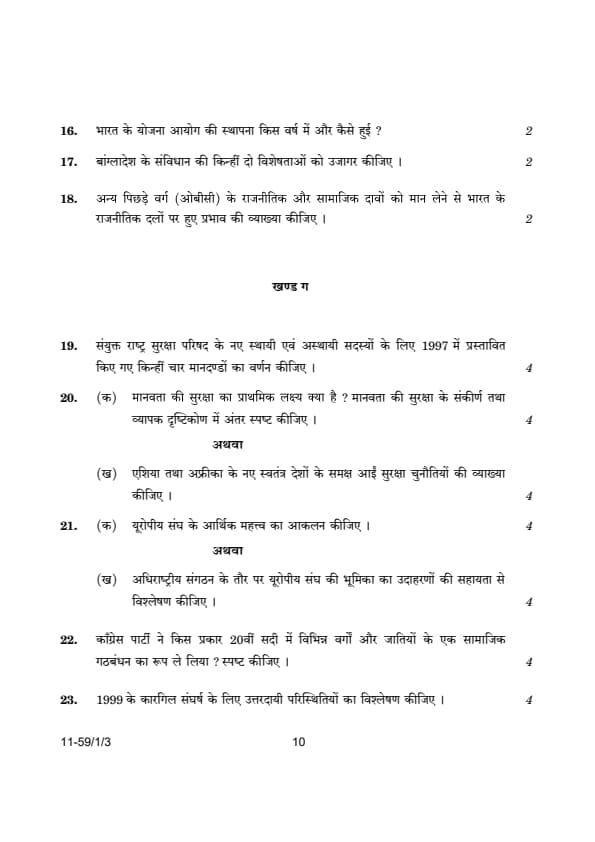
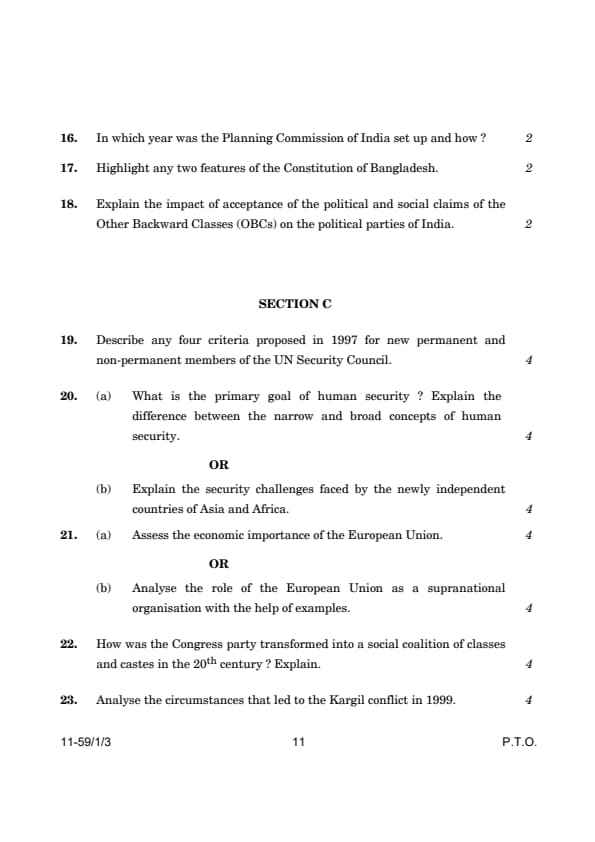
In which year was the Planning Commission of India set up and how?
View Solution
Step 1: Understanding the context
The Planning Commission of India was an institution formed to guide the country’s economic planning and development after independence. The idea was to create a centralized body that would formulate plans to balance resources and economic growth for the nation.
Step 2: Identifying the year
The Planning Commission was set up in the year 1951 by a Presidential Order. This decision was taken by Jawaharlal Nehru, the first Prime Minister of India, as part of his vision to promote planned development for the country.
Step 3: Understanding the purpose
The main objective of the Planning Commission was to formulate and implement Five-Year Plans to drive economic and social development. It aimed at addressing the uneven distribution of wealth and resources, promoting industrialization, and ensuring that the fruits of development reached the rural population.
Step 4: Transition to NITI Aayog
In 2015, the Planning Commission was replaced by NITI Aayog, which emphasized cooperative federalism and a more decentralized approach to development planning.
\begin{quicktipbox
The Planning Commission was replaced by the NITI Aayog in 2015, which focuses more on cooperative federalism and the active participation of states in the planning process.
\end{quicktipbox Quick Tip: The Planning Commission was replaced by the NITI Aayog in 2015, which focuses more on cooperative federalism and the active participation of states in the planning process.
Highlight any two features of the Constitution of Bangladesh.
1. It establishes a unitary parliamentary democracy with a Prime Minister as the head of government.
2. It declares Bangladesh as a secular state while recognising Islam as the state religion.
View Solution
Step 1: Understand the Constitution of Bangladesh
The Constitution of Bangladesh was adopted on November 4, 1972, after the country’s independence in 1971. It has undergone several amendments but retains core features that define its governance structure.
Step 2: Highlight Two Features
Feature 1: Unitary Parliamentary Democracy – The Constitution establishes Bangladesh as a unitary state with a parliamentary system, where the Prime Minister is the head of government, and the President is a ceremonial head. The Parliament (Jatiya Sangsad) is the legislative body, elected through universal suffrage.
Feature 2: Secularism with State Religion – The original Constitution declared Bangladesh a secular state, ensuring equality of all religions. However, a 1988 amendment declared Islam as the state religion, while still upholding secular principles, reflecting a balance between religious identity and secular governance.
Step 3: Conclusion
The two features are:
1. It establishes a unitary parliamentary democracy with a Prime Minister as the head of government.
2. It declares Bangladesh as a secular state while recognising Islam as the state religion. Quick Tip: The Constitution of Bangladesh balances secularism with cultural identity, reflecting the country’s history and societal values.
Explain the impact of acceptance of the political and social claims of the Other Backward Classes (OBCs) on the political parties of India.
View Solution
Step 1: Understanding the context
The Other Backward Classes (OBCs) are a group of people in India who are socially and educationally disadvantaged but not part of the Scheduled Castes or Scheduled Tribes. For decades, the OBCs struggled for social justice and political representation.
Step 2: Recognition and acceptance of OBC demands
The political and social claims of the OBCs gained recognition especially after the Mandal Commission Report in 1980, which recommended that reservations be provided for OBCs in education and government jobs. This led to greater awareness and activism surrounding the rights of OBCs.
Step 3: Impact on political parties
The acceptance of these claims had a profound impact on Indian political parties:
Increased political competition: With the demands of OBCs gaining traction, political parties realized that they could no longer ignore the OBC vote. This created a more competitive political environment, especially in regions where the OBCs formed a significant portion of the electorate.
Formation of OBC-centric parties: Several regional parties began to form that specifically advocated for the rights of OBCs, such as the Samajwadi Party (SP), the Rashtriya Janata Dal (RJD), and the Bahujan Samaj Party (BSP). These parties played a crucial role in shaping the political discourse in states like Uttar Pradesh, Bihar, and Tamil Nadu.
Electoral influence: Political parties began to tailor their manifestos to include OBC-friendly policies, making reservations in education and jobs a central issue. This contributed to a shift in political power towards parties that were more inclusive of the OBCs.
Step 4: Societal changes
The acceptance of OBC claims led to a broader social justice movement and the empowerment of historically marginalized groups.
The rise of OBC leaders such as Lalu Prasad Yadav, Mulayam Singh Yadav, and Kanshi Ram brought attention to the socio-political importance of OBCs. These leaders played pivotal roles in securing political representation for these groups.
Step 5: Conclusion
The impact on political parties was significant. They began to form alliances and adopt policies aimed at satisfying the demands of the OBCs, which shifted the political dynamics in India and increased the representation of these communities in political power.
\begin{quicktipbox
The rise of regional parties and the prominence of OBC leaders like Lalu Prasad Yadav and Mulayam Singh Yadav is a direct result of these political shifts.
\end{quicktipbox Quick Tip: The rise of regional parties and the prominence of OBC leaders like Lalu Prasad Yadav and Mulayam Singh Yadav is a direct result of these political shifts.
Describe any four criteria proposed in 1997 for new permanent and non-permanent members of the UN Security Council.
1. A country’s population size.
2. Economic capacity, such as GDP and contribution to the UN budget.
3. Military capacity and contribution to peacekeeping missions.
4. Commitment to global issues like human rights and sustainable development.
View Solution
Step 1: Understand the Context of UN Security Council Membership
The UN Security Council (UNSC) consists of 5 permanent members (P5) and 10 non-permanent members. In 1997, discussions on UNSC reform proposed criteria for expanding membership to make the council more representative.
Step 2: Describe Four Criteria Proposed in 1997
Criterion 1: Population size – A country’s population was considered to ensure representation of large populations, such as India or Brazil.
Criterion 2: Economic capacity – Measured by GDP and contributions to the UN budget, to include economically strong nations like Germany or Japan.
Criterion 3: Military capacity – Including a country’s military strength and contributions to UN peacekeeping missions, to ensure capability in maintaining global security.
Criterion 4: Commitment to global issues – A country’s dedication to human rights, sustainable development, and global peace, to align with the UN’s goals.
Step 3: Conclusion
The four criteria are:
1. A country’s population size.
2. Economic capacity, such as GDP and contribution to the UN budget.
3. Military capacity and contribution to peacekeeping missions.
4. Commitment to global issues like human rights and sustainable development.
Quick Tip: UNSC reform discussions focus on making the council more representative by considering factors like population, economic power, and global contributions.
What is the primary goal of human security? Explain the difference between the narrow and broad concepts of human security.
View Solution
Step 1: Define the Primary Goal of Human Security
Human security shifts the focus from state security to individual well-being, aiming to protect people from threats to their survival, dignity, and livelihoods, ensuring freedom from fear and want.
Step 2: Explain the Narrow Concept of Human Security
The narrow concept of human security focuses on protection from physical violence, such as war, genocide, or terrorism. It prioritises safety from direct threats to life, often addressed through conflict resolution and peacekeeping.
Step 3: Explain the Broad Concept of Human Security
The broad concept includes a wider range of threats, such as economic insecurity (poverty), environmental degradation (climate change), health crises (pandemics), and social issues (inequality). It aims for comprehensive well-being and sustainable development.
Step 4: Conclusion
The primary goal of human security is to protect individuals from threats to their survival, dignity, and livelihoods. The narrow concept focuses on protection from violence, while the broad concept includes economic, environmental, and social threats.
Quick Tip: Human security expands traditional security by focusing on individual well-being, covering both immediate threats (narrow) and systemic issues (broad).
Explain the security challenges faced by the newly independent countries of Asia and Africa.
View Solution
Step 1: Understand the Context of Newly Independent Countries
Many Asian and African countries gained independence in the mid-20th century, inheriting challenges from colonial rule and facing new threats during the Cold War era.
Step 2: Explain Security Challenges
Internal Conflicts: Ethnic and religious tensions, often exacerbated by colonial divide-and-rule policies, led to civil wars, such as in Nigeria (Biafra War, 1967–1970).
Border Disputes: Arbitrary colonial borders caused conflicts, like the India-Pakistan dispute over Kashmir after 1947.
Economic Instability: Lack of infrastructure and resources led to poverty and unrest, making countries vulnerable to internal dissent, as seen in many African nations.
External Interference: Cold War rivalries led to superpowers supporting rival factions, such as in Angola, where the US and Soviet Union backed opposing groups.
Step 3: Conclusion
Newly independent countries of Asia and Africa faced security challenges like internal conflicts, border disputes, economic instability, and external interference, often due to colonial legacies and Cold War dynamics. Quick Tip: Colonial legacies and Cold War politics significantly shaped the security challenges of newly independent Asian and African countries.
Assess the economic importance of the European Union.
View Solution
Step 1: Understand the Economic Role of the European Union
The European Union (EU) is a political and economic union of 27 European countries, established to foster economic cooperation and integration among member states.
Step 2: Assess Its Economic Importance
Single Market: The EU’s single market allows the free movement of goods, services, capital, and people, creating one of the largest economic zones in the world.
Common Currency: The Euro, used by 19 EU countries, facilitates trade and economic stability by eliminating exchange rate fluctuations.
Global Trade Power: The EU negotiates trade agreements as a bloc, giving it significant influence in global markets. For example, it has trade deals with countries like Canada and Japan.
Economic Growth: The EU promotes economic growth through funding, infrastructure development, and policies like the Common Agricultural Policy (CAP).
Step 3: Conclusion
The EU is economically significant due to its single market, common currency (Euro), and trade policies, which promote economic integration, growth, and global influence. Quick Tip: The EU’s economic importance lies in its ability to create a unified market and act as a major player in global trade.
Analyse the role of the European Union as a supranational organisation with the help of examples.
View Solution
Step 1: Define a Supranational Organisation
A supranational organisation is one where member states delegate some decision-making powers to a higher authority, allowing it to make binding decisions that override national laws in specific areas.
Step 2: Analyse the EU’s Role as a Supranational Organisation
Trade and Economic Policies: The EU negotiates trade agreements on behalf of all member states, such as the EU-Japan Economic Partnership Agreement (2019), demonstrating its authority over national trade policies.
Environmental Regulations: The EU sets binding environmental standards, like the 2030 Climate Target Plan, which mandates member states to reduce emissions, showing its supranational control over climate policies.
Human Rights: The EU enforces human rights standards through the European Court of Justice, which can overrule national laws, as seen in cases involving data privacy laws.
Schengen Agreement: The Schengen Area allows passport-free travel across member states, a supranational decision that overrides national border controls.
Step 3: Conclusion
The EU functions as a supranational organisation by making decisions that override national sovereignty in areas like trade, environmental policies, and human rights, as seen in examples like the EU’s climate policies and the Schengen Agreement. Quick Tip: The EU’s supranational nature is evident in its ability to enforce common policies across member states, often prioritising collective goals over national interests.
How was the Congress party transformed into a social coalition of classes and castes in the 20th century?
View Solution
Step 1: Pre-independence Congress
Before independence, the Congress party primarily represented the interests of the elite and urban middle class, focusing on the demand for political rights, freedom, and the independence movement.
Step 2: Incorporation of rural and marginalized groups
Post-independence, the Congress sought to expand its base by incorporating different social groups, including the rural population, lower castes, and religious minorities. This was mainly done through the implementation of pro-poor policies, land reforms, and social justice measures.
Step 3: Policies of social justice
The Congress embraced policies like reservations for Scheduled Castes, Scheduled Tribes, and Other Backward Classes (OBCs) to ensure representation and upliftment in government jobs, education, and political positions. This attracted the support of backward and marginalized communities, transforming the Congress into a broad-based social coalition.
Step 4: Leadership of Nehru and Indira Gandhi
Nehru's inclusive policies, focusing on industrialization, land reforms, and the empowerment of backward classes, played a crucial role in the party's expansion. Indira Gandhi continued this by focusing on agrarian reforms and nationalization of key industries, thus gaining the support of the rural and working-class populace.
Step 5: Coalition of castes and classes
By the 20th century, the Congress had evolved into a multi-class and multi-caste party, successfully combining the interests of various segments of society – from the urban elite to the rural poor, and from high castes to lower castes. This transformed the Congress into a broad social coalition capable of maintaining political dominance for much of the 20th century.
\begin{quicktipbox
The Congress Party's ability to adapt to the changing political and social landscape by incorporating various social and caste groups was crucial in maintaining its dominance in Indian politics.
\end{quicktipbox Quick Tip: The Congress Party's ability to adapt to the changing political and social landscape by incorporating various social and caste groups was crucial in maintaining its dominance in Indian politics.
Analyse the circumstances that led to the Kargil conflict in 1999.
View Solution
Step 1: Background of the Kargil area
The Kargil region, located in the northernmost part of Jammu and Kashmir, had been a point of territorial dispute between India and Pakistan since their independence in 1947. Both countries claimed the region, and the Line of Control (LoC) had been established as a de facto border, but it remained a volatile and contested area.
Step 2: Infiltration by Pakistani forces
In 1999, Pakistan, under the leadership of then-General Pervez Musharraf, planned an operation to infiltrate and occupy strategic peaks along the Kargil sector. Pakistani soldiers, disguised as militants, infiltrated Indian territory and occupied the high-altitude positions on the Indian side of the LoC. The aim was to cut off the link between Kashmir and Ladakh, create a diversion, and internationalize the Kashmir issue.
Step 3: Indian response
India discovered the infiltration in May 1999 when Indian military forces began encountering Pakistani soldiers in Kargil. The Indian Army, under the leadership of then-Prime Minister Atal Bihari Vajpayee, launched Operation Vijay to push back the infiltrators. The operation saw intense fighting in the high-altitude terrain, with significant casualties on both sides.
Step 4: Internationalization and diplomatic response
The Kargil conflict escalated tensions between the two countries, and the international community, particularly the United States, exerted pressure on Pakistan to withdraw its forces from Indian territory. Pakistan, facing military and diplomatic isolation, agreed to pull back its troops by July 1999.
Step 5: Conclusion
The Kargil conflict ended with India reclaiming its territory, but it left a legacy of mistrust between the two nations and highlighted the vulnerability of the region to military conflicts. The conflict also led to increased international concern over the potential for nuclear escalation, as both India and Pakistan had nuclear capabilities by that time.
\begin{quicktipbox
The Kargil War was a significant event in the post-Cold War era, marking the first full-scale conflict between nuclear-armed states since the nuclear age began.
\end{quicktipbox Quick Tip: The Kargil War was a significant event in the post-Cold War era, marking the first full-scale conflict between nuclear-armed states since the nuclear age began.
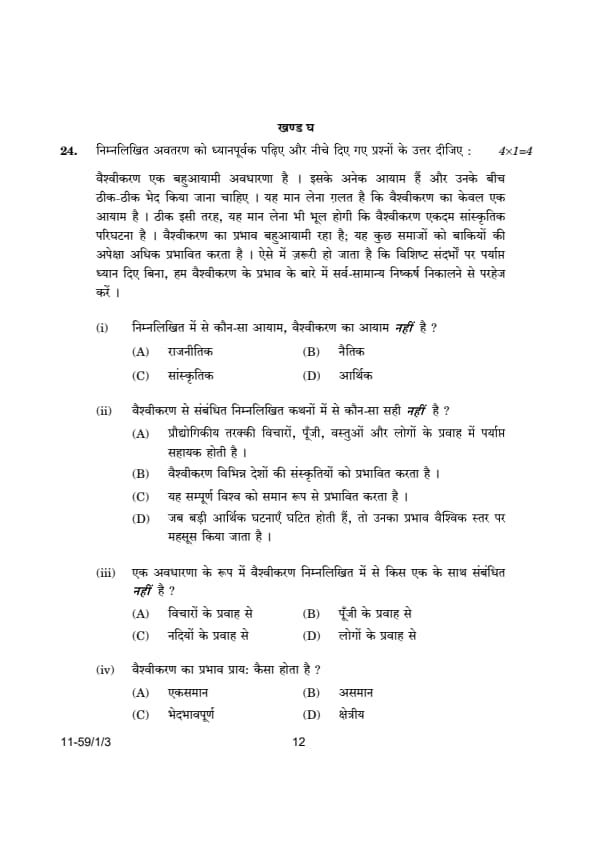
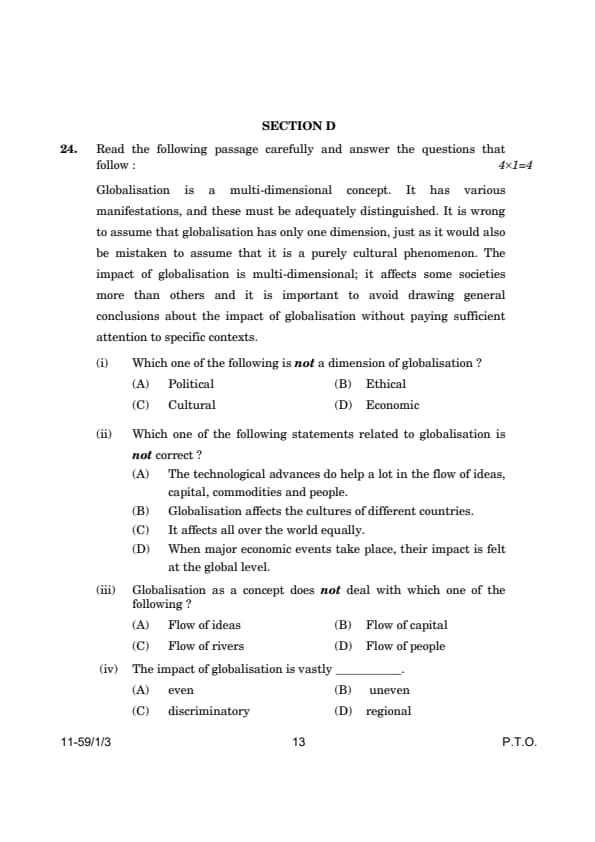
Read the following passage carefully and answer the questions that follow:
Globalisation is a multi-dimensional concept. It has various manifestations, and these must be adequately distinguished. It is wrong to assume that globalisation has only one dimension, just as it would also be mistaken to assume that it is a purely cultural phenomenon. The impact of globalisation is multi-dimensional; it affects some societies more than others and it is important to avoid drawing general conclusions about the impact of globalisation without paying sufficient attention to specific contexts.
(i) Which one of the following is not a dimension of globalisation?
View Solution
The passage does not mention ethics as one of the dimensions of globalisation. It highlights political, cultural, and economic dimensions but does not focus on ethical considerations. Therefore, the correct answer is option (B). Quick Tip: When answering questions about dimensions of globalisation, focus on the aspects discussed in the passage and avoid adding dimensions that are not explicitly mentioned.
(ii) Which one of the following statements related to globalisation is not correct?
View Solution
The passage mentions that the impact of globalisation varies from one society to another. It is not true that globalisation affects the world equally. Some societies experience it more significantly than others. Therefore, option (C) is incorrect. Quick Tip: When reading statements related to globalisation, pay attention to the phrasing that suggests equal effects or universal impact. The passage stresses that globalisation affects societies differently.
(iii) Globalisation as a concept does not deal with which one of the following?
View Solution
The passage refers to the flow of ideas, capital, and people as part of the manifestations of globalisation. However, the flow of rivers is not related to globalisation. Therefore, the correct answer is option (C). Quick Tip: When answering questions about the scope of globalisation, remember that it deals with the flow of ideas, capital, and people, but not natural phenomena like rivers.
(iv) The impact of globalisation is vastly _________.
View Solution
The passage mentions that the impact of globalisation varies and is experienced differently by different societies. This indicates that its impact is uneven. Therefore, the correct answer is option (B). Quick Tip: When answering questions about the impact of globalisation, remember that it affects different societies in varied ways, making the impact uneven.
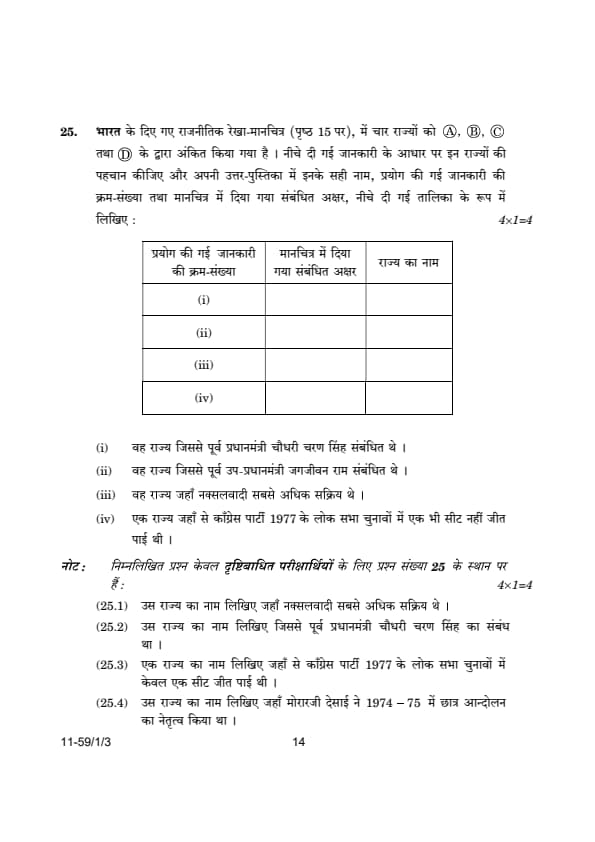
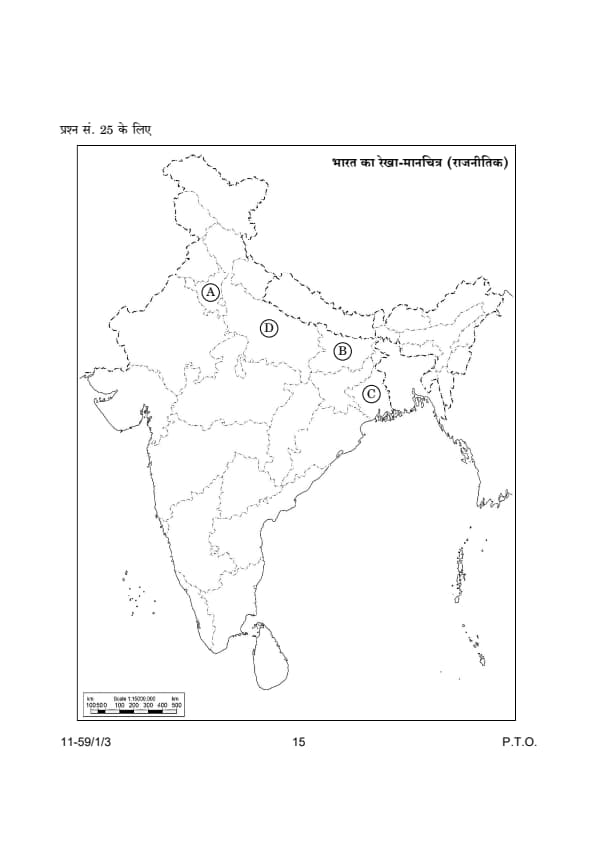
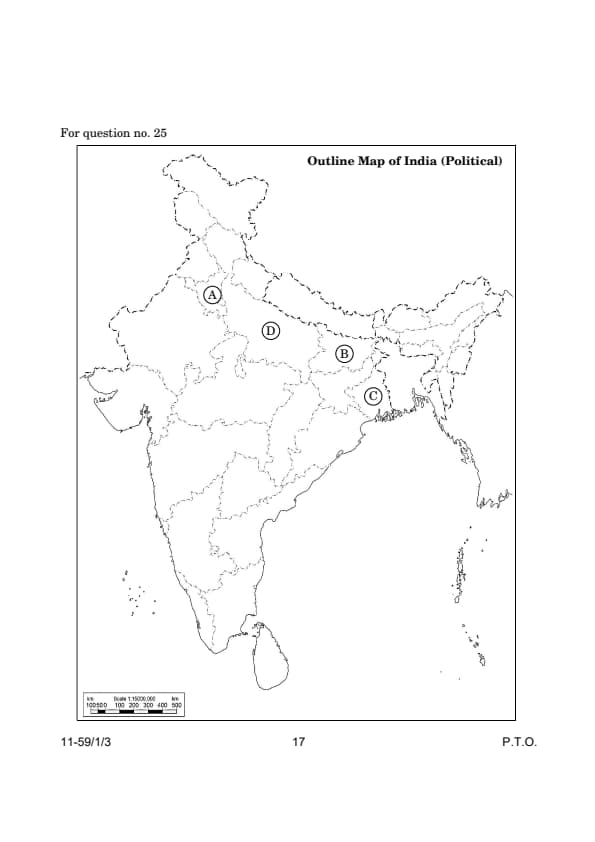
In the given political outline map of India (on page 17), four States have been marked as (A), (B), (C) and (D). Identify these States on the basis of the information given below and write their correct names in your answer-book along with the respective serial number of the information used and the concerned alphabets given in the map as per the following format:

(i) The State related to former Prime Minister Chaudhary Charan Singh.
(ii) The State to which former Deputy Prime Minister Jagjivan Ram belonged.
(iii) The State where the Naxalites were very active.
(iv) A State where the Congress party could not win even a single seat in the Lok Sabha elections in 1977.
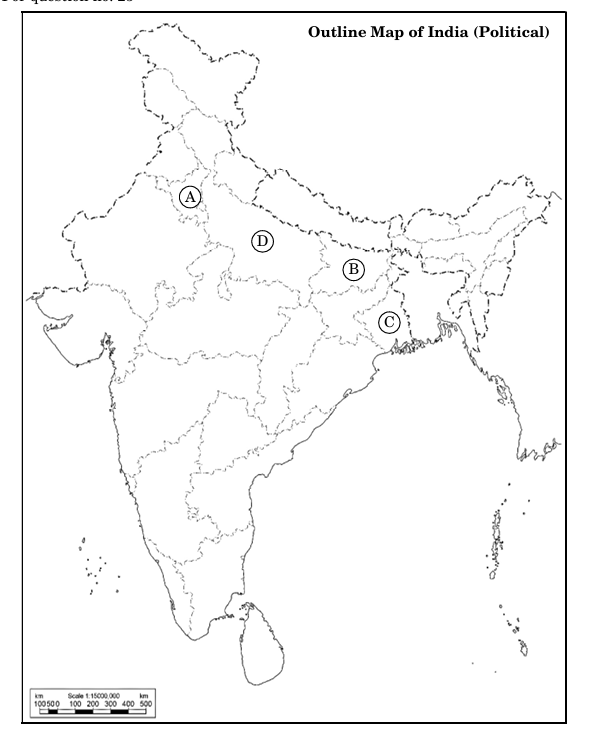

View Solution
Step 1: Analyze the Information Provided for Each State
We need to identify the states based on the given clues and match them with the alphabets (A), (B), (C), and (D) on the map. Let’s evaluate each clue.
Step 2: Identify Each State Based on the Clues
(i) The State related to former Prime Minister Chaudhary Charan Singh: Chaudhary Charan Singh, a former Prime Minister of India (1979–1980), was from Uttar Pradesh, where he was a prominent leader of the farmer community. So, (i) corresponds to Uttar Pradesh.
(ii) The State to which former Deputy Prime Minister Jagjivan Ram belonged: Jagjivan Ram, a prominent Dalit leader and Deputy Prime Minister (1977–1979), was born in Bihar and represented the Sasaram constituency. So, (ii) corresponds to Bihar.
(iii) The State where the Naxalites were very active: The Naxalite movement began in 1967 in Naxalbari, West Bengal, and the state has historically been a stronghold of Naxalite activity. So, (iii) corresponds to West Bengal.
(iv) A State where the Congress party could not win even a single seat in the Lok Sabha elections in 1977: In the 1977 Lok Sabha elections, after the Emergency, the Congress party faced a major defeat in several states. In Tamil Nadu, the Congress won zero seats, as the state was dominated by regional parties like the DMK and AIADMK. So, (iv) corresponds to Tamil Nadu.
Step 3: Assign the Alphabets Based on Typical Map Positions
Since the map is not provided, we assume a standard political map of India:
Uttar Pradesh is typically in the northern part of India, so it may be marked as (A).
Bihar is in the eastern part, below Uttar Pradesh, so it may be marked as (B).
West Bengal is further east, so it may be marked as (C).
Tamil Nadu is in the southern part, so it may be marked as (D).
Step 4: Conclusion
The states are identified as follows:

Quick Tip: When identifying states on a map, use historical and political knowledge to match clues with states, and consider their typical geographical positions on a standard map of India.
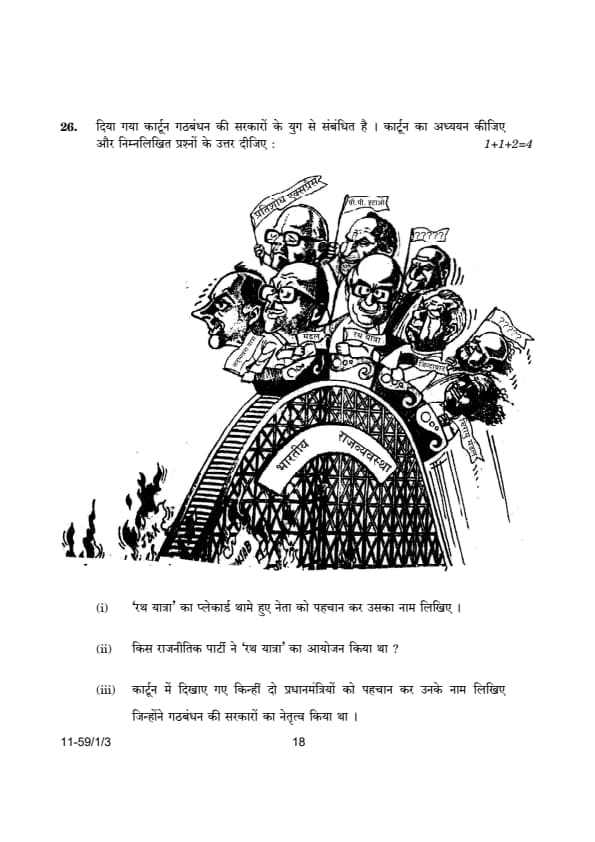
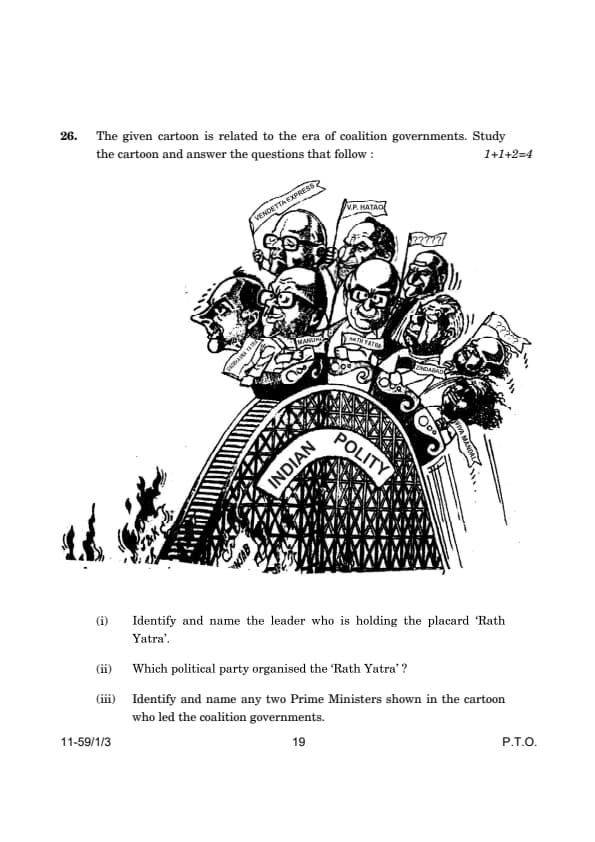
The given cartoon is related to the era of coalition governments. Study the cartoon and answer the questions that follow:

(i) Identify and name the leader who is holding the placard `Rath Yatra'.
(ii) Which political party organised the `Rath Yatra'?
(iii) Identify and name any two Prime Ministers shown in the cartoon who led the coalition governments.
(ii) The political party that organised the `Rath Yatra' is the Bharatiya Janata Party (BJP).
(iii) Two Prime Ministers shown in the cartoon who led coalition governments are V.P. Singh and Chandra Shekhar.
View Solution
Step 1: Understand the Context of the Cartoon
The cartoon depicts the era of coalition governments in India, specifically during the late 1980s and early 1990s, a period marked by political instability and the rise of coalition politics. The placards and labels like `Rath Yatra', `Mandal', and `Zindabad' provide clues about the events and leaders involved.
Step 2: Answer Each Question
(i) Identify and name the leader who is holding the placard `Rath Yatra': The `Rath Yatra' was a significant political event in 1990, led by L.K. Advani to mobilise support for the construction of the Ram Temple in Ayodhya. So, the leader holding the placard is L.K. Advani.
(ii) Which political party organised the `Rath Yatra'?: The `Rath Yatra' was organised by the Bharatiya Janata Party (BJP), which used the event to gain political momentum during the early 1990s.
(iii) Identify and name any two Prime Ministers shown in the cartoon who led the coalition governments: The cartoon represents the coalition era (1989–1991). V.P. Singh, who led the National Front government (1989–1990), is associated with the `Mandal' placard (Mandal Commission implementation). Chandra Shekhar, who led a minority government (1990–1991) with Congress support, is also depicted. So, the two Prime Ministers are V.P. Singh and Chandra Shekhar.
Step 3: Conclusion
The answers are:
(i) The leader holding the placard `Rath Yatra' is L.K. Advani.
(ii) The political party that organised the `Rath Yatra' is the Bharatiya Janata Party (BJP).
(iii) Two Prime Ministers shown in the cartoon who led coalition governments are V.P. Singh and Chandra Shekhar. Quick Tip: The era of coalition governments in India (1989–2014) involved multiple parties and leaders, with events like the Rath Yatra and Mandal Commission shaping political dynamics.
SECRTION-E
Question 27(a):
Analyse any three reasons for the movement against outsiders in Assam from 1979 to 1985.
1. Fear of demographic change due to illegal immigration from Bangladesh.
2. Economic competition and strain on resources caused by immigrants.
3. Cultural and linguistic identity concerns among the Assamese population.
View Solution
Step 1: Understand the Context of the Assam Movement
The Assam Movement (1979–1985), led by the All Assam Students Union (AASU) and the All Assam Gana Sangram Parishad (AAGSP), was a protest against illegal immigration, primarily from Bangladesh, and its impact on Assam’s society, economy, and culture.
Step 2: Analyse Three Reasons
Reason 1: Fear of Demographic Change – Large-scale illegal immigration from Bangladesh, especially after the 1971 Bangladesh Liberation War, led to fears among Assamese people that they would become a minority in their own state. The influx altered the demographic balance, raising concerns about political representation.
Reason 2: Economic Competition and Strain on Resources – Immigrants competed with locals for jobs, land, and resources, leading to economic insecurity. The strain on infrastructure, such as schools and healthcare, further fueled resentment among the Assamese population.
Reason 3: Cultural and Linguistic Identity Concerns – The Assamese feared that the influx of Bengali-speaking immigrants would threaten their cultural and linguistic identity. This led to demands for the protection of Assamese language and culture, as the immigrants were seen as diluting the state’s indigenous identity.
Step 3: Conclusion
The three reasons are:
Fear of demographic change due to illegal immigration from Bangladesh.
Quick Tip: The Assam movement was driven by concerns over identity, economics, and political power. Understanding the historical context of immigration and its social impact is crucial in analyzing the reasons behind the protests.
“Regional aspirations are very much a part of democratic politics.” Justify the statement.
Regional aspirations are an integral part of democratic politics because they reflect the diverse needs, concerns, and identities of different regions within a country. In a democracy, it is essential to acknowledge and address the aspirations of all regions to ensure inclusive growth and equitable political representation.
View Solution
Step 1: Understanding Regional Aspirations in a Democracy
In democratic systems, the voices of all sections of society must be heard and respected, including those of regional groups. Regional aspirations reflect the desire of people in specific regions for political, economic, and cultural autonomy or recognition. Acknowledging these aspirations helps in the promotion of regional development and self-expression.
Step 2: The Role of Regional Aspirations
Cultural Identity: Many regional groups have distinct cultural identities that they wish to preserve. In a democracy, it is crucial to support the protection of these identities and ensure that regional cultures are not marginalized.
Economic Development: Regions may have unique economic needs based on their geographical and social contexts. For example, states or regions rich in natural resources may demand better compensation for the exploitation of those resources or fair distribution of wealth generated.
Political Representation: Regional aspirations often manifest as demands for greater political representation. This is seen in the formation of regional parties that focus on issues specific to their region, ensuring that their voice is heard in national politics. For example, the rise of regional parties in India such as the DMK, Trinamool Congress, and Shiv Sena reflects the regional aspirations of their respective states.
Step 3: Conclusion
In a democratic political system, regional aspirations must be considered to create a just and balanced society. Failure to address regional concerns can lead to alienation and political instability. Therefore, regional aspirations are not just a part of democratic politics but a vital element in achieving comprehensive and inclusive governance. Quick Tip: In democratic politics, acknowledging regional aspirations is key to ensuring that all regions feel included and represented. This helps in the overall political stability and development of the country.
Explain any three common demands of the indigenous people at the global level.
View Solution
Step 1: Recognition of Land Rights
Indigenous communities across the globe demand the recognition and protection of their ancestral land rights. These people often face the threat of displacement due to industrial projects, mining, or land grabbing. They call for legal recognition of their right to the land they have traditionally inhabited and utilized.
Step 2: Preservation of Culture and Language
Another major demand is the preservation of their cultural heritage and languages. Indigenous peoples have unique customs, traditions, and languages, and they seek the protection of these cultural aspects from the forces of globalization and assimilation. They demand support for cultural revitalization programs to ensure the survival of their heritage.
Step 3: Right to Self-Determination
Indigenous people globally demand the right to self-determination, meaning the right to govern themselves and make decisions regarding their land, resources, and social systems. They seek greater autonomy and political rights, allowing them to maintain their traditional ways of life and governance structures.
\begin{quicktipbox
The demands of indigenous people have gained more attention in recent decades, especially with the establishment of international frameworks like the UN Declaration on the Rights of Indigenous Peoples (UNDRIP).
\end{quicktipbox Quick Tip: The demands of indigenous people have gained more attention in recent decades, especially with the establishment of international frameworks like the UN Declaration on the Rights of Indigenous Peoples (UNDRIP).
Explain any four steps taken by the Government of India to protect the environment.
View Solution
Step 1: Environmental Protection Laws
The Government of India has enacted several environmental laws to protect natural resources. One of the significant laws is the Environment Protection Act, 1986, which provides a framework for the protection and improvement of the environment. Other key regulations include the Air (Prevention and Control of Pollution) Act and the Water (Prevention and Control of Pollution) Act.
Step 2: Afforestation Programs
India has launched large-scale afforestation and reforestation programs to conserve biodiversity and combat deforestation. The Green India Mission, part of the National Action Plan on Climate Change, aims to increase forest cover and restore degraded ecosystems.
Step 3: Promotion of Renewable Energy
India is focusing on the promotion of renewable energy sources like solar, wind, and hydroelectric power. The National Solar Mission aims to increase solar energy generation capacity significantly. This is a part of the government's broader effort to reduce dependency on fossil fuels and lower greenhouse gas emissions.
Step 4: Pollution Control Measures
The government has implemented various pollution control measures, including stricter emissions standards for industries and vehicles. The introduction of the National Clean Energy Fund, initiatives like the Swachh Bharat Mission (Clean India Mission), and the establishment of air quality monitoring systems in cities are part of these efforts.
\begin{quicktipbox
The government has also been encouraging the use of electric vehicles, promoting waste management techniques, and engaging in international agreements like the Paris Climate Accord to tackle environmental issues globally.
\end{quicktipbox Quick Tip: The government has also been encouraging the use of electric vehicles, promoting waste management techniques, and engaging in international agreements like the Paris Climate Accord to tackle environmental issues globally.
Describe the circumstances and events that led to Hyderabad's accession to India in 1948.
View Solution
Step 1: Background
Hyderabad was a princely state with a large Muslim population, ruled by the Nizam, who was initially reluctant to join either India or Pakistan after independence in 1947. The Nizam wished to maintain Hyderabad's independence and sought to form an alliance with Pakistan.
Step 2: Rising tensions
The situation in Hyderabad grew tense as the Nizam's rule faced increasing opposition from the local population. The demand for integration with India was growing, particularly from the population of the Hyderabad State, which included Hindus who were in a majority. Meanwhile, the Razakars, a militia loyal to the Nizam, created unrest, leading to communal violence.
Step 3: Political and diplomatic pressure
The Indian government, under Prime Minister Jawaharlal Nehru, used diplomatic channels to pressurize the Nizam into acceding to India. The Indian government also worked to quell the violence and sought peaceful negotiations, but the Nizam continued to resist.
Step 4: Military intervention
In September 1948, the Indian government decided to take military action, known as "Operation Polo," to integrate Hyderabad into India. Indian forces swiftly defeated the Nizam’s forces and took control of the state, forcing the Nizam to surrender. The Nizam signed an instrument of accession to India on September 17, 1948.
\begin{quicktipbox
Hyderabad's integration into India was a critical moment in the early years of post-independence India, marking the consolidation of the Indian Union.
\end{quicktipbox Quick Tip: Hyderabad's integration into India was a critical moment in the early years of post-independence India, marking the consolidation of the Indian Union.
Describe any four consequences of the partition of British India.
View Solution
Step 1: Mass Displacement
The partition of British India led to the largest mass migration in human history. Millions of people were displaced as they moved across the newly drawn borders to either India or Pakistan based on their religion. Hindus and Sikhs migrated to India, while Muslims moved to Pakistan.
Step 2: Communal Violence
The partition triggered widespread communal violence, leading to the deaths of hundreds of thousands of people. The violence was particularly severe in areas where religious communities lived in close proximity, and it resulted in large-scale atrocities against civilians.
Step 3: Formation of Two Nations
The partition led to the creation of two independent nations, India and Pakistan, based on religious lines. India became a secular state with a Hindu majority, while Pakistan was formed as a Muslim-majority state. The partition also led to the division of assets, including military equipment, resources, and infrastructure.
Step 4: Kashmir Conflict
The partition left the princely state of Kashmir in a precarious situation, with the Hindu Maharaja Hari Singh ruling over a Muslim-majority population. The issue of whether Kashmir should join India or Pakistan became a major conflict, leading to the first war between India and Pakistan in 1947-48. The Kashmir dispute continues to be a source of tension between the two countries.
\begin{quicktipbox
The aftermath of the partition still resonates in the form of ongoing border disputes, refugee issues, and the long-standing hostility between India and Pakistan.
\end{quicktipbox Quick Tip: The aftermath of the partition still resonates in the form of ongoing border disputes, refugee issues, and the long-standing hostility between India and Pakistan.
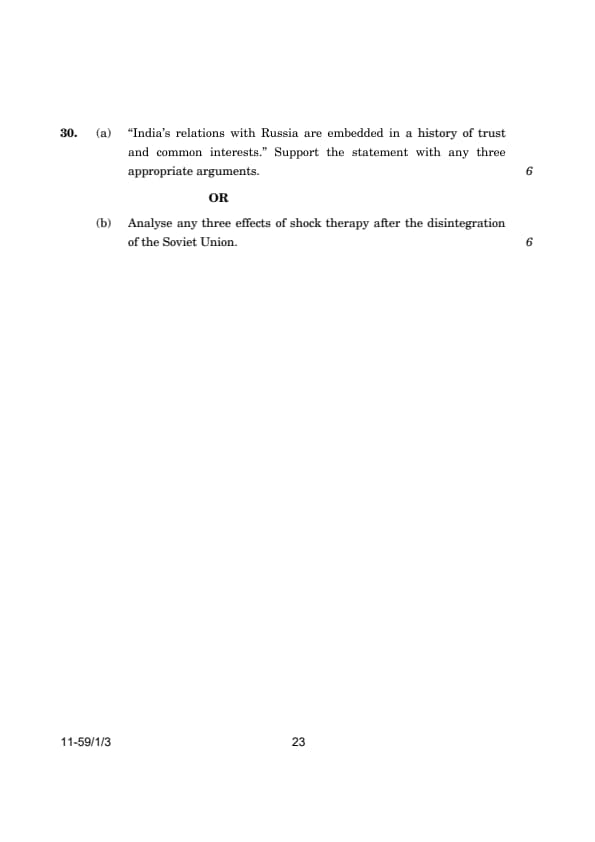
“India’s relations with Russia are embedded in a history of trust and common interests.” Support the statement with any three appropriate arguments.
View Solution
Step 1: Historical Cooperation during the Cold War
India and the Soviet Union shared a close relationship during the Cold War. The Soviet Union provided diplomatic and political support to India during critical moments, especially when India faced pressure from Western powers and Pakistan.
Step 2: Economic and Military Ties
Soviet Russia has been a key partner in defense collaborations with India, supplying advanced military technology and equipment. The economic ties have extended to sectors like energy, space exploration, and trade, which have further strengthened bilateral relations.
Step 3: Shared Geopolitical Interests
India and Russia have common interests in promoting stability in their respective regions and supporting a multi-polar international system. They share mutual concerns about the security environment in South Asia and Central Asia, aligning on various diplomatic issues. Quick Tip: India and Russia’s relationship has been built over decades, with common interests in defense, economic cooperation, and global diplomacy. Their mutual trust has played a key role in their long-standing partnership.
Analyse any three effects of shock therapy after the disintegration of the Soviet Union.
View Solution
Step 1: Economic Instability
Shock therapy, which involved rapid privatization and liberalization, led to economic chaos. The removal of price controls and the transition to a market-driven economy resulted in skyrocketing inflation, shortages of goods, and a deep recession. This period of economic instability severely impacted the population.
Step 2: Rise in Inequality
The transition to capitalism, while benefiting a few, exacerbated inequality. Wealth was concentrated in the hands of a few individuals, who gained control over state assets during privatization. Meanwhile, millions of people were left unemployed or impoverished, leading to sharp social divisions.
Step 3: Political and Social Discontent
The implementation of shock therapy led to widespread social unrest, with protests against the government’s economic policies. The public’s frustration with economic hardships, rising unemployment, and social instability created a fertile ground for populist and nationalist political movements. Quick Tip: Shock therapy was intended to quickly transition former Soviet states to market economies, but its rapid implementation resulted in economic chaos, inequality, and social unrest, making it a controversial reform.



Comments