




The CBSE Class 12 Political Science Question Paper 2024 PDF is available for download here. CBSE conducted the Political Science exam on March 22, 2024, from 10:30 AM to 1:30 PM. The total marks for the theory paper are 80. The question paper contains 20% MCQ-based questions, 40% competency-based questions, and 40% short and long answer type questions. Students reported the exam to be of moderate difficulty level.
CBSE Class 12 Political Science (59/2/2) Question Paper 2024 with Answer Key
| CBSE Class 12 2024 Political Science Question Paper with Answer Key |  Download Download |
Check Solution |
CBSE Class 12 Political Science Question Paper 2024 with Answer Key
SECTION-A
Question 1:
In which state of India are the ‘Khasi Hills’ located?
View Solution
Step 1: Understanding the geographical location.
The Khasi Hills are a mountainous region that forms part of the larger Meghalaya Plateau in the northeastern state of Meghalaya, India. This region is primarily inhabited by the Khasi tribe, one of the major indigenous communities of the state.
Step 2: Key facts.
The Khasi Hills are divided into the East Khasi Hills and West Khasi Hills districts. The capital city of Meghalaya, Shillong, is located in the East Khasi Hills.
Step 3: Eliminate incorrect options.
Manipur, Mizoram, and Tripura are neighboring northeastern states but do not contain the Khasi Hills.
Therefore, the only correct option is Meghalaya. Quick Tip: Remember the tribal and geographical identities of Northeast India. Khasi Hills and Shillong are both associated with Meghalaya, which is known for high rainfall and scenic landscapes.
The first summit of NAM was held in:
View Solution
Step 1: Understand what NAM is.
NAM stands for Non-Aligned Movement. It was formed during the Cold War to represent countries that chose not to align with either the United States or the Soviet Union.
Step 2: Historical Background
The first summit of the Non-Aligned Movement was held in Belgrade, Yugoslavia in 1961. This summit was hosted by President Josip Broz Tito of Yugoslavia. The key founding leaders included:
Jawaharlal Nehru (India)
Gamal Abdel Nasser (Egypt)
Josip Broz Tito (Yugoslavia)
Kwame Nkrumah (Ghana)
Sukarno (Indonesia)
Step 3: Eliminate incorrect options
(A) Cairo hosted the second NAM summit in 1964.
(C) India was a founding member but not the host of the first summit.
(D) Indonesia, though a key founder, did not host the first summit.
Hence, the correct answer is option (B) Belgrade. Quick Tip: The first NAM summit was in 1961, hosted by Yugoslavia in Belgrade. Remember the five key founders: Nehru, Tito, Nasser, Nkrumah, and Sukarno.
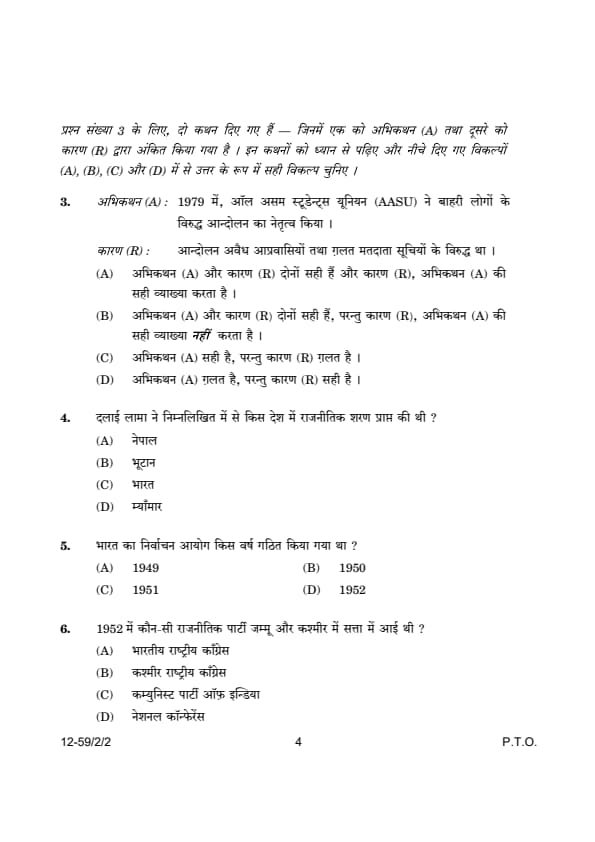
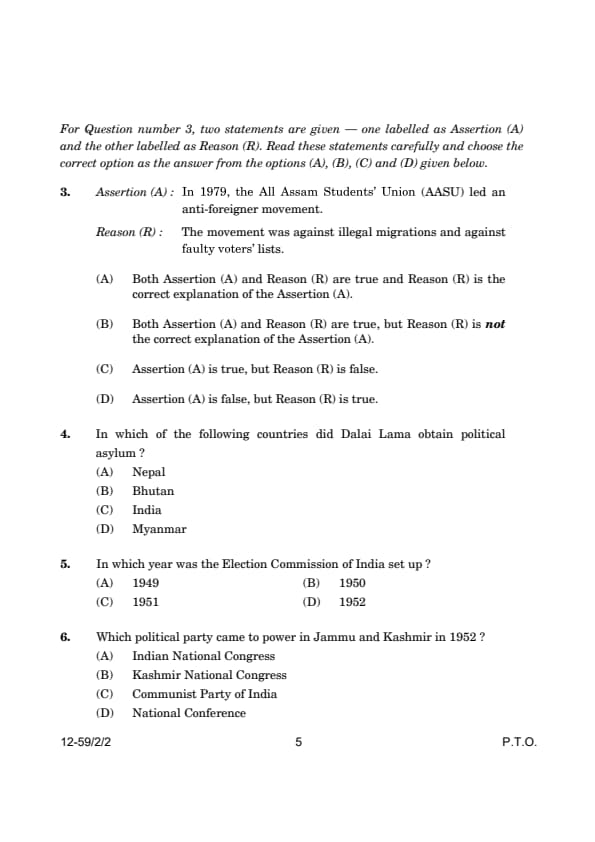
For Question number 3, two statements are given
one labelled as Assertion (A) and the other labelled as Reason (R). Read these statements carefully and choose the correct option as the answer from the options (A), (B), (C) and (D) given below.
Assertion (A): In 1979, the All Assam Students’ Union (AASU) led an anti-foreigner movement.
Reason (R): The movement was against illegal migrations and against faulty voters’ lists.
In light of the above statements, choose the correct answer from the options given below.
View Solution
Step 1: Analyze Assertion (A)
The All Assam Students’ Union (AASU) launched a significant anti-foreigner movement in 1979. This was in response to concerns over the large number of illegal immigrants from Bangladesh (then East Pakistan) entering Assam, which significantly altered the demographic composition of the region.
Step 2: Analyze Reason (R)
The primary demand of the movement was to detect, delete, and deport illegal immigrants. The movement also focused on the faulty voters’ lists that included the names of illegal immigrants, which was seen as a threat to the rights of indigenous Assamese people.
Step 3: Relationship between Assertion and Reason
The Reason given (R) correctly explains why the anti-foreigner movement was initiated by AASU. Hence, both the Assertion and Reason are true, and the Reason is the correct explanation of the Assertion. Quick Tip: The Assam Movement (1979–1985) was led by AASU to address illegal immigration and protect native political rights—focus on both historical context and specific causes.
In which of the following countries did Dalai Lama obtain political asylum?
View Solution
Step 1: Historical background.
In 1959, following the failed Tibetan uprising against the People’s Republic of China, the 14th Dalai Lama fled from Lhasa, Tibet, fearing for his life.
Step 2: Political asylum in India.
India granted him political asylum. He crossed over into India through the Tawang region of Arunachal Pradesh. Since then, he has lived in Dharamshala, Himachal Pradesh, which is now the headquarters of the Tibetan government-in-exile.
Step 3: Diplomatic significance.
Granting asylum to the Dalai Lama has been a significant diplomatic move by India and continues to be a sensitive issue in India-China relations. Quick Tip: Remember major global personalities who have taken asylum in India. Dalai Lama’s presence in India is symbolic of India’s support for human rights and humanitarian causes.
In which year was the Election Commission of India set up?
View Solution
Step 1: Constitutional Provision.
The Election Commission of India is established under Article 324 of the Constitution of India. It was officially set up on 25th January 1950.
Step 2: Importance of the Election Commission.
The Election Commission is an autonomous constitutional authority responsible for administering election processes to the Lok Sabha, Rajya Sabha, and State Legislative Assemblies, as well as the offices of the President and Vice-President in India.
Step 3: Key Milestone.
The first Chief Election Commissioner of India was Sukumar Sen, who conducted the first general elections in 1951–52. Quick Tip: 25th January is celebrated as National Voters’ Day in India to mark the foundation of the Election Commission. Remember this date and its constitutional significance.
Which political party came to power in Jammu and Kashmir in 1952?
View Solution
Step 1: Understanding the political history of Jammu and Kashmir.
After India’s independence, the princely state of Jammu and Kashmir acceded to India. In the 1952 Constituent Assembly elections of Jammu and Kashmir, the National Conference emerged as the dominant party. This party, led by Sheikh Abdullah, had a strong political base in the region and was instrumental in framing the Constitution of Jammu and Kashmir under Article 370.
Step 2: Role of Sheikh Abdullah and the party’s vision.
Sheikh Abdullah was a prominent leader and founder of the National Conference. His party played a key role in implementing land reforms and promoting secular democratic governance in the state. Quick Tip: Remember regional leaders and their political parties when studying post-independence Indian political history. Sheikh Abdullah and the National Conference are central to Jammu and Kashmir’s early political landscape.
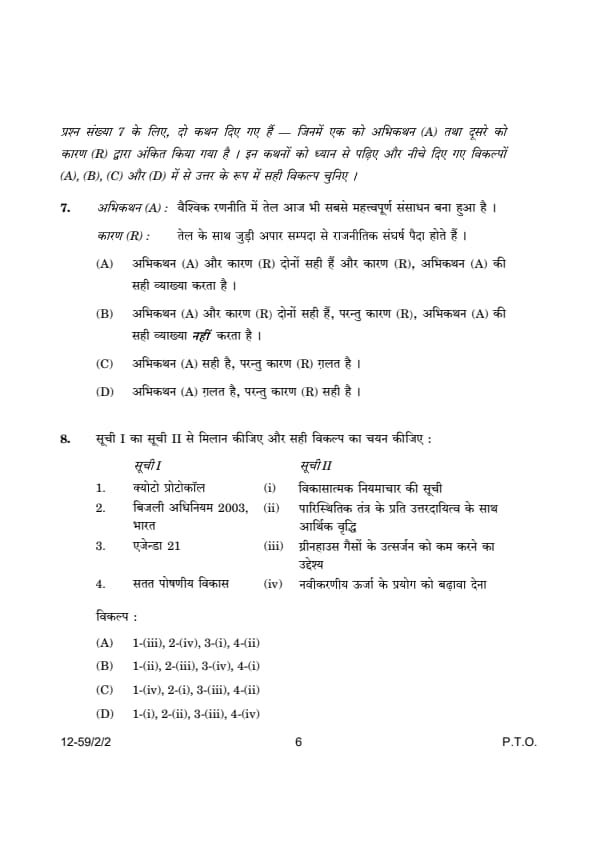
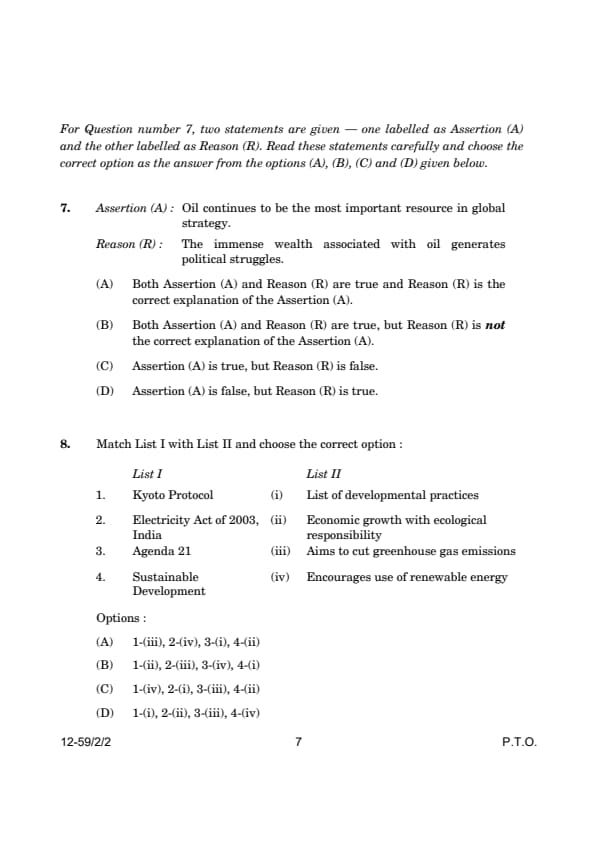
For Question number 7, two statements are given
one labelled as Assertion (A) and the other labelled as Reason (R). Read these statements carefully and choose the correct option as the answer from the options (A), (B), (C) and (D) given below.
Assertion (A) : Oil continues to be the most important resource in global strategy.
Reason (R) : The immense wealth associated with oil generates political struggles.
In light of the above statements, choose the correct answer from the options given below.
View Solution
Assertion (A) is true because oil remains a critical energy resource and influences global political and economic strategies.
Reason (R) is also true since countries rich in oil often face political tensions due to the immense wealth generated.
Furthermore, Reason (R) correctly explains Assertion (A) as the strategic importance of oil is directly tied to the political struggles arising from the wealth it brings. Quick Tip: For Assertion and Reason questions, always check if both statements are individually true and whether the Reason directly explains the Assertion.
Match List I with List II and choose the correct option:

Options:
View Solution
Match each item in List I with the correct explanation from List II.
Kyoto Protocol – It is an international treaty that aims to cut greenhouse gas emissions. So, 1 → (iii).
Electricity Act of 2003, India – This Act encourages use of renewable energy. So, 2 → (iv).
Agenda 21 – This is a non-binding action plan of the United Nations that outlines a list of developmental practices. So, 3 → (i).
Sustainable Development – It refers to economic growth with ecological responsibility. So, 4 → (ii).
Hence, the correct matching is: 1-(iii), 2-(iv), 3-(i), 4-(ii) Quick Tip: For match-the-following questions, identify keywords from each item in List I and find the closest concept match in List II. Focus on the purpose or theme of each policy or document.
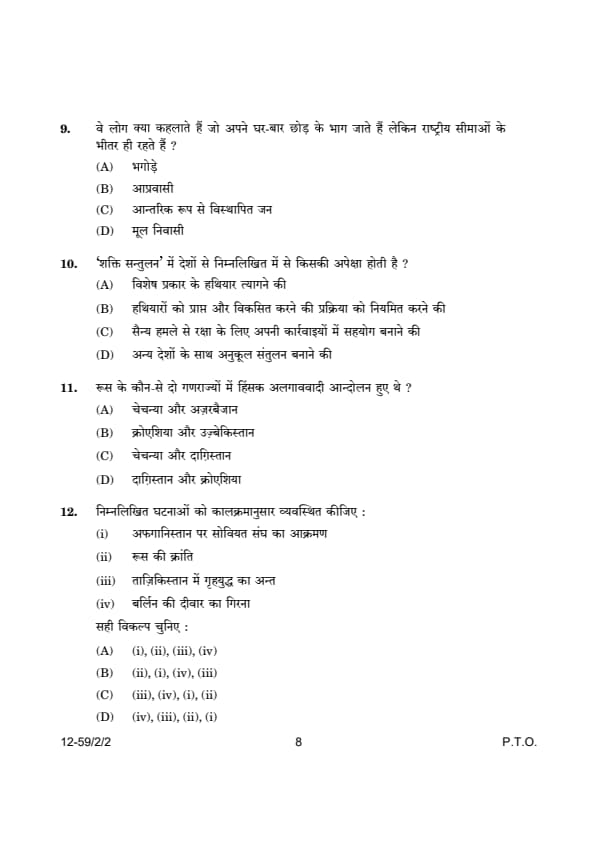
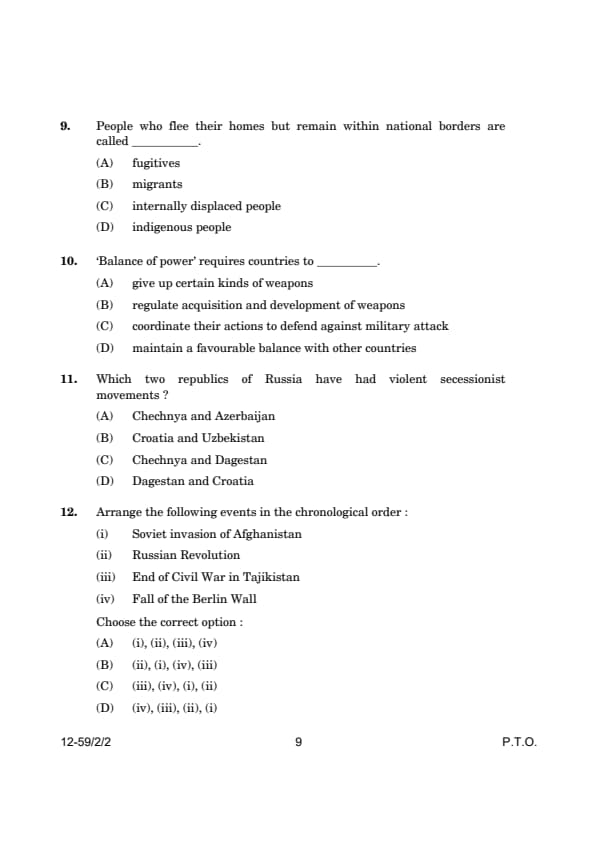
People who flee their homes but remain within national borders are called _______.
View Solution
Step 1: Define the term.
Internally displaced people (IDPs) are individuals who are forced to flee their homes but do not cross international borders.
Step 2: Eliminate wrong choices.
(A) Fugitives refers to people avoiding arrest or persecution.
(B) Migrants may move for economic or other voluntary reasons.
(D) Indigenous people are native to a region, not necessarily displaced.
Hence, (C) is the accurate term. Quick Tip: Remember, IDPs are displaced within their country, while refugees cross international borders.
‘Balance of power’ requires countries to _______.
View Solution
Step 1: Understand the concept of 'Balance of Power'.
The 'Balance of Power' in international politics refers to the distribution of power among nations so that no single country or alliance can dominate others.
Step 2: Apply the definition.
Maintaining a favourable balance with other countries is central to this concept. It involves strategic partnerships, military preparedness, and diplomacy to ensure equilibrium in global affairs.
Hence, option (D) is correct. Quick Tip: In international relations, 'balance of power' refers to strategic alliances and defense coordination to prevent dominance by any single state.
Which two republics of Russia have had violent secessionist movements?
View Solution
Step 1: Identify regions with secessionist movements.
Chechnya and Dagestan are republics within the Russian Federation that have experienced violent separatist movements, especially during the 1990s and early 2000s.
Step 2: Eliminate incorrect options.
Azerbaijan, Croatia, and Uzbekistan are independent nations, not republics of Russia.
Only Chechnya and Dagestan qualify both geographically and politically.
Thus, the correct answer is option (C). Quick Tip: Focus on republics *within* Russia when asked about internal secessionist movements—avoid picking already independent nations.
Arrange the following events in the chronological order :
(i) Soviet invasion of Afghanistan
(ii) Russian Revolution
(iii) End of Civil War in Tajikistan
(iv) Fall of the Berlin Wall
Choose the correct option:
View Solution
Step 1: Arrange the events by year.
Russian Revolution – 1917
Soviet invasion of Afghanistan – 1979
Fall of the Berlin Wall – 1989
End of Civil War in Tajikistan – 1997
Step 2: Write in chronological order:
(ii) Russian Revolution
(i) Soviet invasion of Afghanistan
(iv) Fall of the Berlin Wall
(iii) End of Civil War in Tajikistan
Thus, the correct chronological order is option (B). Quick Tip: When asked to arrange events chronologically, always recall or look up the specific years to verify the sequence.
SECTION-B
Question 13:
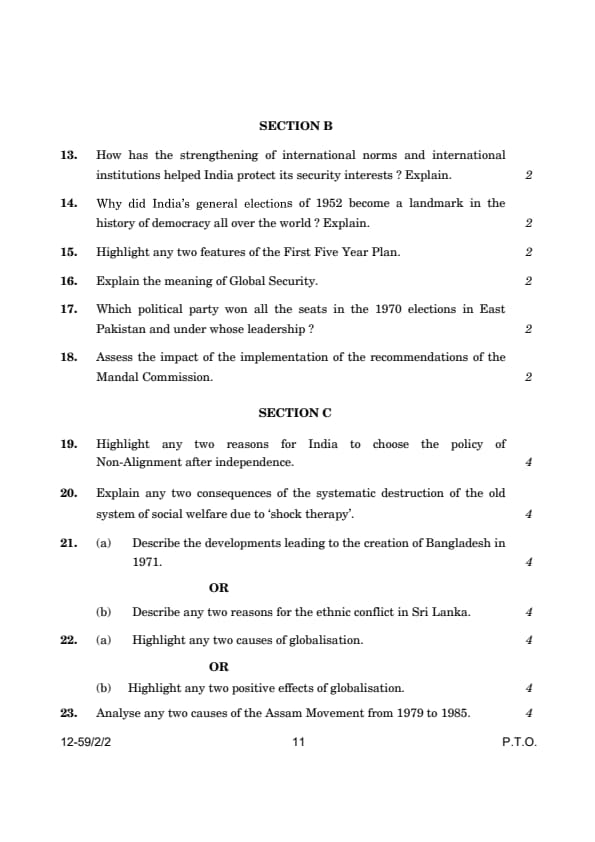
How has the strengthening of international norms and international institutions helped India protect its security interests? Explain.
View Solution
Step 1: Understanding international norms and institutions.
International norms refer to accepted standards of behavior among countries, while international institutions include organizations such as the United Nations (UN), International Atomic Energy Agency (IAEA), and the World Trade Organization (WTO).
Step 2: Role in India’s security.
These norms and institutions provide a framework that helps India address threats like terrorism, cross-border conflicts, and nuclear proliferation through dialogue and cooperation.
India has leveraged platforms like the UN to raise issues related to cross-border terrorism, thereby gaining international support.
Through adherence to non-proliferation norms and active participation in international bodies, India has gained recognition as a responsible nuclear power.
India's association with global institutions has also improved intelligence-sharing, maritime security, and cyber defense through strategic partnerships. Quick Tip: Always link international cooperation with national interest. India uses international platforms to gain diplomatic support, legitimacy, and global alliances for its security.
Why did India’s general elections of 1952 become a landmark in the history of democracy all over the world? Explain.
View Solution
Step 1: Historic importance
India’s general elections of 1952 were the first held after the adoption of the Constitution in 1950. It was the world’s largest democratic event involving over 17 crore eligible voters.
Step 2: Key highlights
Universal Adult Franchise: Every citizen above the age of 21, regardless of caste, religion, or literacy, had the right to vote.
Massive scale and peaceful conduct: Despite being a poor, largely illiterate country, India successfully conducted elections in a free and fair manner.
Set a global precedent: India became the first large country to prove that democracy could work even under difficult conditions.
Step 3: Legacy
The successful execution of the elections established faith in democratic institutions and made India the world’s largest democracy. Quick Tip: The 1952 elections were a democratic milestone, showing that a newly independent nation with vast diversity could uphold electoral values.
Highlight any two features of the First Five Year Plan.
2. Implementation of land reforms to improve rural economy
View Solution
Step 1: Context
India’s First Five Year Plan was launched in 1951 and covered the period from 1951 to 1956. It was based on the Harrod-Domar model and aimed to build the foundation of the Indian economy.
Step 2: Key Features
Agricultural focus: The plan allocated a major portion of the budget to agriculture, irrigation, and power generation. Projects like Bhakra Nangal and Hirakud dams were initiated.
Land Reforms: The plan emphasized abolishing zamindari, implementing tenancy reforms, and redistributing surplus land to ensure equity.
Step 3: Outcome
The plan successfully increased food production and established rural infrastructure. Quick Tip: The First Plan was rural-focused, aiming at self-sufficiency in food and addressing agrarian issues post-independence.
Explain the meaning of Global Security.
View Solution
Step 1: Definition
Global security is the concept of providing safety to all nations and people of the world through cooperative actions, international laws, treaties, and institutions.
Step 2: Major components
Military security: Preventing wars and arms races through disarmament and defense agreements.
Economic security: Ensuring stable economies, preventing trade wars, and reducing global poverty.
Human security: Addressing threats like pandemics, human rights violations, and refugee crises.
Environmental security: Tackling climate change, pollution, and resource depletion through global cooperation.
Step 3: Role of institutions
Organizations like the United Nations, NATO, WHO, and others play vital roles in maintaining global security. Quick Tip: Global security includes military, economic, human, and environmental aspects—not just protection from war.
Which political party won all the seats in the 1970 elections in East Pakistan and under whose leadership?
View Solution
Step 1: Background of the 1970 elections
In December 1970, Pakistan held its first general elections based on direct voting. The country was divided into two wings: West Pakistan and East Pakistan (now Bangladesh).
Step 2: Results of the elections
In East Pakistan, the Awami League, under the leadership of Sheikh Mujibur Rahman, won all 160 out of 162 seats allocated to the region in the National Assembly of Pakistan. This gave the Awami League a majority in the 300-member assembly, allowing them to form the central government.
Step 3: Significance
Despite the Awami League’s clear mandate, the ruling elite in West Pakistan denied power transfer to Mujib. This sparked widespread protests in East Pakistan, eventually leading to the Liberation War and the formation of Bangladesh in 1971. Quick Tip: Sheikh Mujibur Rahman’s landslide victory in 1970 and the denial of power transfer by West Pakistan were key triggers for Bangladesh’s independence.
Assess the impact of the implementation of the recommendations of the Mandal Commission.
View Solution
Step 1: Background of the Mandal Commission
The Mandal Commission was established in 1979 by the Government of India under the chairmanship of B.P. Mandal. The commission's main objective was to assess the status and needs of socially and economically backward classes (OBCs) and recommend measures for their upliftment.
Step 2: Key Recommendations
The Mandal Commission recommended that 27% of government jobs be reserved for OBCs, in addition to the existing 22.5% reservation for Scheduled Castes (SCs) and Scheduled Tribes (STs).
It recommended affirmative action in educational institutions for OBCs.
The Commission also recommended the identification of OBCs based on social and educational criteria.
Step 3: Impact of Implementation
Social Impact: The implementation of the recommendations created a major shift in the socio-political landscape, as it addressed long-standing demands for social justice and empowerment for backward classes.
Political Impact: The decision to implement the Mandal Commission recommendations in 1990 under Prime Minister V.P. Singh led to widespread protests, especially in urban areas, and fueled a political realignment, strengthening support for parties advocating for social justice.
Economic Impact: The reservation policy aimed at improving access to education and government jobs for OBCs, but critics argue that it created a divide between merit and reservation, leading to debates on its effectiveness in addressing poverty.
Step 4: Controversies and Challenges
The implementation also sparked protests from upper-caste groups, leading to debates on merit, equality, and the scope of reservations. The issue remains contentious, with discussions on its long-term effectiveness continuing. Quick Tip: While the Mandal Commission aimed at rectifying historical inequalities, its implementation sparked debates that continue to shape India’s social policies today.
SECTION-C
Question 19:
Highlight any two reasons for India to choose the policy of Non-Alignment after independence.
2. To avoid entanglement in the Cold War power blocs.
View Solution
Step 1: Understand the Context
At the time of India’s independence in 1947, the world was divided into two major blocs—the Western bloc led by the United States and the Eastern bloc led by the Soviet Union, due to the Cold War tensions.
Step 2: Key Reasons for Choosing Non-Alignment
Independence in Foreign Policy: India, under the leadership of Jawaharlal Nehru, sought to retain its freedom to make independent decisions in international relations, without being forced to align with either of the superpowers. Non-Alignment allowed India to maintain diplomatic relations with both blocs.
Avoiding Cold War Entanglements: India aimed to stay clear of the Cold War rivalry between the US and the Soviet Union. By choosing non-alignment, India focused on national development, peace, and cooperation without being drawn into military alliances.
Step 3: Benefits of Non-Alignment
The policy helped India build relationships with a diverse range of countries, including the United States, the Soviet Union, China, and newly independent nations in Asia and Africa. It also allowed India to assert leadership in global issues like decolonization and peace. Quick Tip: Non-alignment allowed India to have a flexible and independent foreign policy, especially during the tense Cold War period.
Explain any two consequences of the systematic destruction of the old system of social welfare due to shock therapy.
2. Erosion of social safety nets and increased vulnerability of the population.
View Solution
Step 1: Understanding Shock Therapy
Shock therapy refers to the rapid transition from a centrally planned economy to a free-market economy. It involves abrupt economic reforms, including privatization, deregulation, and the removal of state subsidies. This approach was applied in former socialist economies, including Russia and Eastern Europe, during the 1990s.
Step 2: Consequences of Social Welfare Destruction
Increase in Poverty and Social Inequality: The immediate result of shock therapy was a sharp increase in unemployment and inflation, pushing many people into poverty. The rich benefitted from privatization, while the poor suffered from the erosion of welfare programs.
Erosion of Social Safety Nets: Shock therapy dismantled the existing state-run healthcare, education, and social welfare programs that had provided basic support for citizens. As a result, large segments of the population became vulnerable, particularly the elderly, children, and marginalized groups.
Step 3: Long-term Effects
While shock therapy aimed to quickly establish market economies, the social consequences were severe and led to public dissatisfaction, protests, and political instability. Quick Tip: Shock therapy can bring economic reforms, but it also leads to social hardship and inequality if not carefully managed.
Describe the developments leading to the creation of Bangladesh in 1971.
View Solution
Step 1: Background to the Bangladesh Liberation War.
The creation of Bangladesh in 1971 was the culmination of decades of political, cultural, and economic differences between East and West Pakistan. The partition of India in 1947 created Pakistan as a separate state, but tensions arose between the Bengali-majority East Pakistan and the Punjabi-majority West Pakistan.
Step 2: Key Developments Leading to the Creation of Bangladesh.
Language Movement (1948-1952): The imposition of Urdu as the sole national language by West Pakistan angered Bengalis who spoke Bengali, leading to protests and the deaths of several students in 1952. This movement laid the foundation for Bengali nationalism.
Six-Point Movement (1970): Led by Sheikh Mujibur Rahman, this movement demanded greater autonomy for East Pakistan. It gained massive support and won the 1970 general elections, with Mujib’s Awami League winning a majority.
Operation Searchlight (1971): The Pakistani military launched a brutal crackdown on East Pakistan after Mujib's refusal to transfer power. This operation aimed to suppress the Bengali nationalist movement and led to widespread atrocities, including mass killings and rapes.
Indian Intervention (December 1971): With millions of refugees fleeing to India and the situation worsening, India intervened militarily in support of the Bengali independence movement, resulting in the defeat of Pakistani forces and the creation of Bangladesh on December 16, 1971.
Conclusion: The liberation of Bangladesh was the result of a combination of historical grievances, political demands, and the intervention of India in 1971. Quick Tip: Understand the role of both regional movements (like the Language Movement) and international interventions (like India's military support) in the creation of Bangladesh.
Describe any two reasons for the ethnic conflict in Sri Lanka.
View Solution
Step 1: Background to the Sri Lankan Ethnic Conflict.
Sri Lanka’s ethnic conflict, primarily between the Sinhalese majority and the Tamil minority, has its roots in political, cultural, and social differences that have persisted for decades. The conflict led to a brutal civil war from 1983 to 2009.
Step 2: Two Main Reasons for the Ethnic Conflict in Sri Lanka.
Discrimination Against Tamils: The Tamils, who primarily follow Hinduism, felt politically and economically marginalized by the Sinhalese-dominated government. They were excluded from key positions and faced discrimination in education and employment, leading to feelings of alienation.
Sinhala Nationalism: The adoption of Sinhala as the official language and the preferential treatment given to Sinhala speakers in government jobs and education fueled resentment among Tamils. The establishment of the Sinhala-majority government alienated the Tamil minority, leading to demands for an independent Tamil Eelam.
Conclusion: These socio-political factors, coupled with the suppression of Tamil cultural and political rights, led to the rise of Tamil militancy and the prolonged civil war in Sri Lanka. Quick Tip: The Sri Lankan conflict is a key example of ethnic tensions exacerbated by political exclusion and state-sponsored nationalism. Make sure to link ethnicity, language issues, and economic marginalization when discussing such conflicts.
Highlight any two causes of globalisation.
2. Liberalisation of trade policies
View Solution
Step 1: Define globalisation
Globalisation refers to the growing interdependence and connectivity among countries through increased trade, investment, technology, and cultural exchange.
Step 2: Causes of globalisation
Technological advancement: Innovations in communication (internet, mobile) and transportation (air travel, shipping) have made cross-border interaction faster and more efficient.
Liberalisation of trade policies: Many countries have reduced tariffs and opened up their economies to foreign investment, leading to a surge in global trade and capital flow. Quick Tip: Think of globalisation as a result of faster technology and freer markets — two key driving forces in today’s world.
Highlight any two positive effects of globalisation.
2. Access to global products and technology
View Solution
Step 1: Understand globalisation’s impact
Globalisation connects local economies with the global market, resulting in several benefits, especially for developing countries.
Step 2: Positive effects
Increased employment and economic growth: Global companies invest in countries with cheaper labour, leading to job creation and higher GDP.
Access to global products and technology: Consumers enjoy a wider variety of goods, and nations benefit from advanced technologies in fields like healthcare, communication, and education. Quick Tip: Globalisation boosts jobs, access to products, and technological progress—but benefits vary by country and sector.
Analyse any two causes of the Assam Movement from 1979 to 1985.
2. Discrepancies in the voters' list and fear of losing political and cultural identity.
View Solution
Step 1: Understand the context of the Assam Movement
The Assam Movement was a political and social movement that took place between 1979 and 1985, primarily led by the All Assam Students' Union (AASU). It aimed to address the issues of illegal immigration, demographic changes, and the preservation of Assamese identity.
Step 2: Key Causes of the Assam Movement
Large-Scale Illegal Immigration from Bangladesh: One of the primary causes of the movement was the influx of illegal immigrants, mainly from Bangladesh. This migration altered the demographic composition of Assam, creating fears of Assamese people losing political power, resources, and cultural identity.
Discrepancies in the Voters' List: The movement was also sparked by the inclusion of the names of illegal immigrants in the electoral rolls. The people of Assam feared that these illegal immigrants would dominate local elections and reduce the influence of the native Assamese population.
Step 3: Outcome and Impact
The movement culminated in the Assam Accord of 1985, which resulted in an agreement to detect and deport illegal immigrants, rectify the voters' list, and preserve the cultural identity of the Assamese people. Quick Tip: The Assam Movement was rooted in fears of losing cultural and political autonomy due to illegal immigration and voter manipulation.
SECTION-D
Question 26:
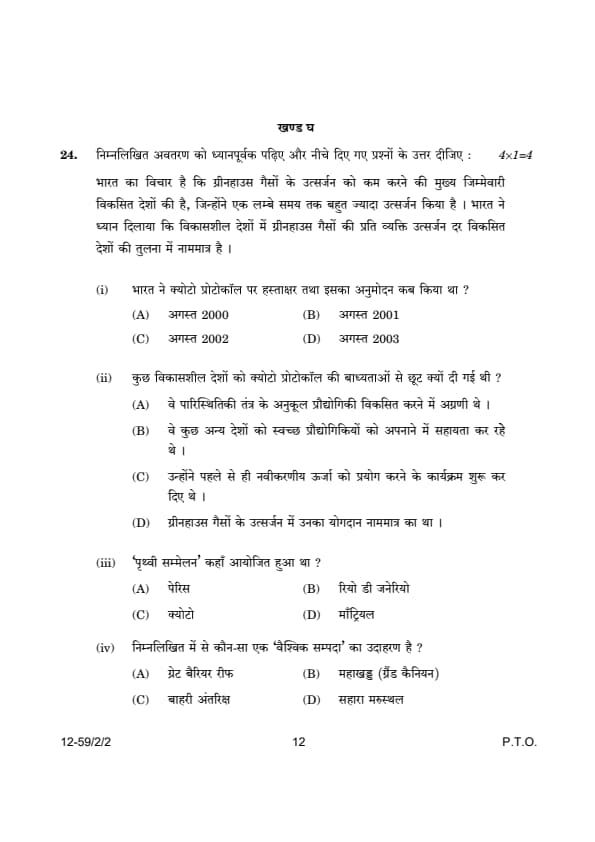
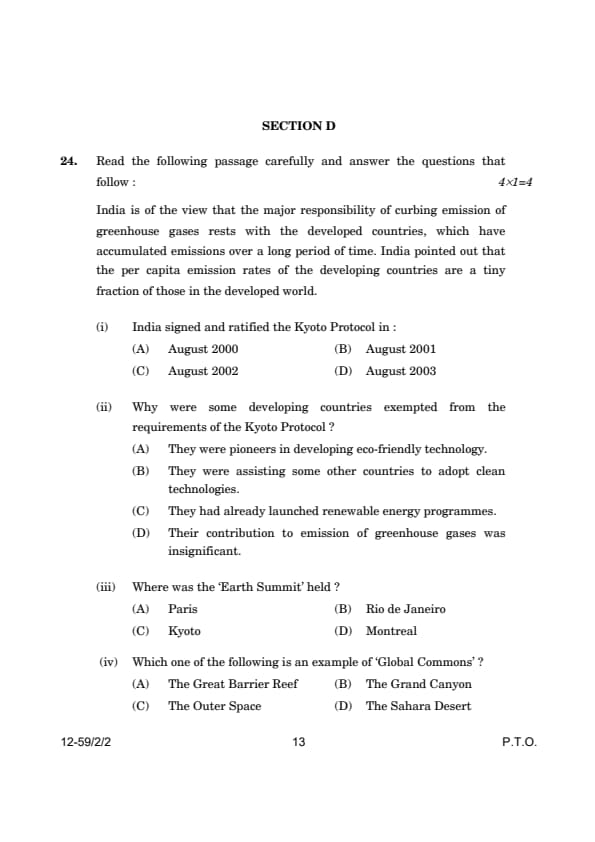
Read the following passage carefully and answer the questions that follow :
India is of the view that the major responsibility of curbing emission of greenhouse gases rests with the developed countries, which have accumulated emissions over a long period of time. India pointed out that
the per capita emission rates of the developing countries are a tiny fraction of those in the developed world.
24(i). India signed and ratified the Kyoto Protocol in:
View Solution
Step 1: Understand the timeline of Kyoto Protocol.
The Kyoto Protocol was adopted in 1997 and came into force in 2005. India signed and ratified the protocol on August 26, 2002, joining other nations to reduce greenhouse gas emissions.
Step 2: India’s stance.
India supported the principle of "common but differentiated responsibilities," arguing that developed countries were historically responsible for most emissions. Quick Tip: Remember: India ratified the Kyoto Protocol in August 2002 to support global efforts while emphasizing equity for developing nations.
Why were some developing countries exempted from the requirements of the Kyoto Protocol?
View Solution
Step 1: Link to passage
According to the passage, India pointed out that the per capita emissions of developing countries were very low compared to developed nations.
Step 2: Kyoto Protocol’s principle
The Kyoto Protocol recognized the historical responsibility of developed nations for emissions and allowed exemptions for developing countries with insignificant contributions. Quick Tip: Developing countries had low emissions per capita—this justified their exemption under the Kyoto Protocol.
Where was the ‘Earth Summit’ held?
View Solution
Step 1: Identify the correct summit
The Earth Summit, also known as the United Nations Conference on Environment and Development (UNCED), was held in 1992 at Rio de Janeiro, Brazil.
Step 2: Outcome of the summit
It produced key environmental agreements such as Agenda 21 and laid the foundation for future climate protocols like Kyoto. Quick Tip: The 1992 Earth Summit in Rio was a landmark for global environmental policy—remember it as “Rio Summit”.
Which one of the following is an example of ‘Global Commons’?
View Solution
Step 1: Define Global Commons
Global commons are natural resource domains that lie outside the jurisdiction of any one nation and are shared by all.
Step 2: Identify examples
Examples include the high seas, atmosphere, Antarctica, and outer space. These are collectively managed by international laws.
Step 3: Eliminate options
The Great Barrier Reef, Grand Canyon, and Sahara Desert fall within national boundaries and are not global commons. Quick Tip: Global Commons = Shared global resources like Outer Space, Antarctica, and High Seas—not located within one country’s borders.
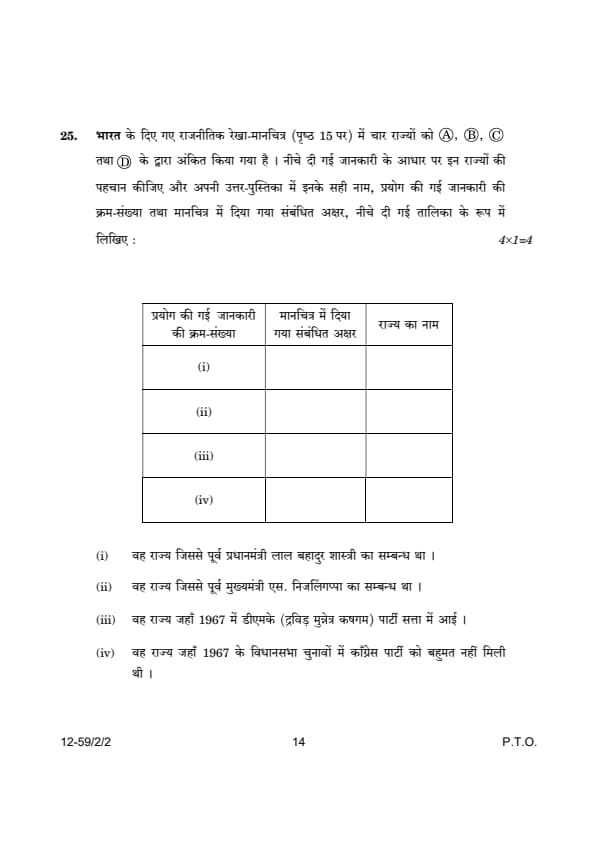
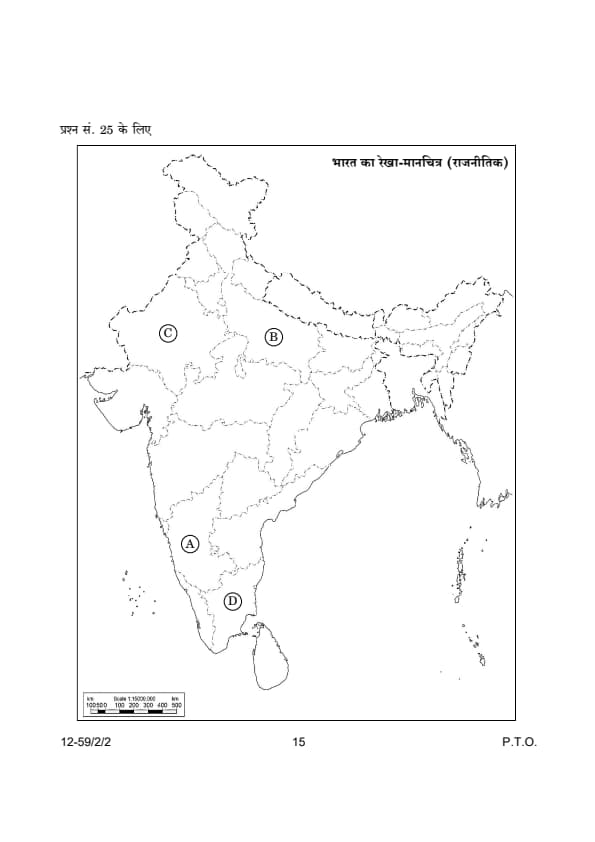
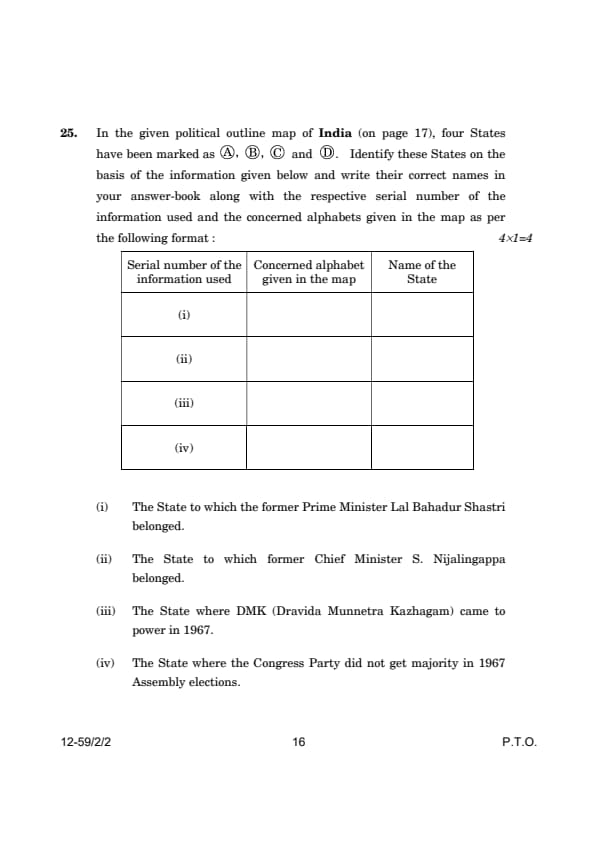
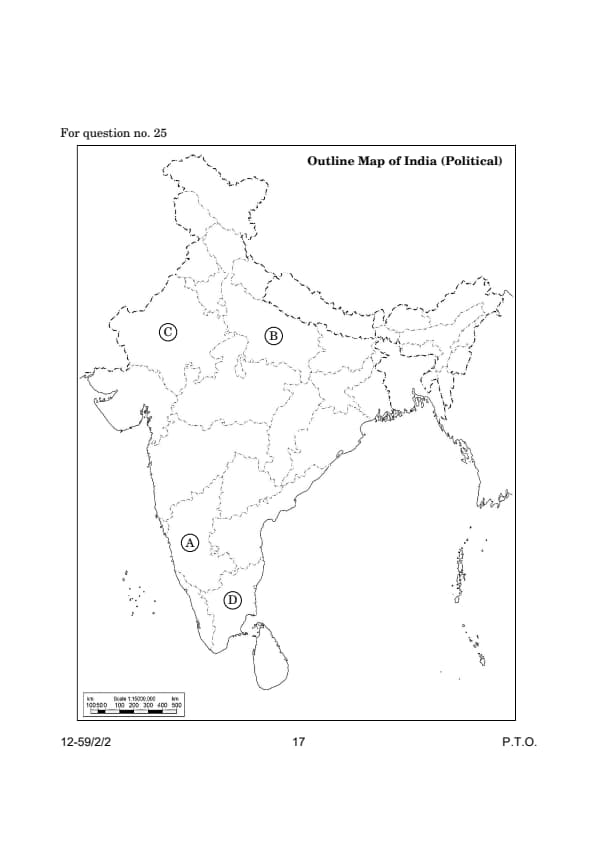
In the given political outline map of India, four States have been marked as A, B, C and D. Identify these States on the basis of the information given below and write their correct names along with the concerned alphabet given in the map as per the following format :

(i). The State to which the former Prime Minister Lal Bahadur Shastri belonged.
(ii). The State to which former Chief Minister S. Nijalingappa belonged.
(iii). The State where DMK (Dravida Munnetra Kazhagam) came to power in 1967.
(iv). The State where the Congress Party did not get majority in 1967 Assembly elections.

Note: The following questions are for the \textit{Visually Impaired Candidates only, in lieu of Q. No. 25:
(25.1) Name the state to which the former Chief Minister Karpoori Thakur belonged.
(25.2) Name the state to which the political party DMK (Dravida Munnetra Kazhagam) belongs.
(25.3) Name the state to which the former Prime Minister Lal Bahadur Shastri belonged.
(25.4) Name the state to which the former President of India V.V. Giri belonged.
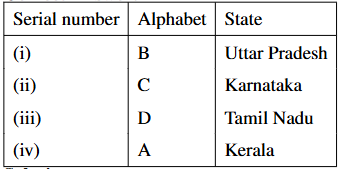
View Solution
Step 1: Interpreting the locations on the political map of India.
We are given four states marked with alphabets A, B, C, and D. We need to match them with political facts related to Indian leaders and events.
Step 2: Match the information with the correct state and alphabet.
(i) The State to which former Prime Minister Lal Bahadur Shastri belonged.
Lal Bahadur Shastri was born in Mughalsarai, which is located in present-day Uttar Pradesh. On the map, this corresponds to the region marked as B.
(ii) The State to which former Chief Minister S. Nijalingappa belonged.
S. Nijalingappa was the Chief Minister of the erstwhile Mysore State, now known as Karnataka. The region marked as C on the map corresponds to Karnataka.
(iii) The State where DMK came to power in 1967.
The Dravida Munnetra Kazhagam (DMK) won the 1967 assembly elections in Tamil Nadu, becoming the first non-Congress party to form the government in the state. The region marked as D on the map is Tamil Nadu.
(iv) The State where the Congress Party did not get a majority in 1967 Assembly elections.
In 1967, the Congress Party lost its majority in several states including Kerala, where a coalition government came to power. The region marked as A corresponds to Kerala. Quick Tip: To solve map-based polity questions, combine your understanding of political history with state geography. Knowing where key leaders belonged and where significant elections took place helps match the map points accurately.
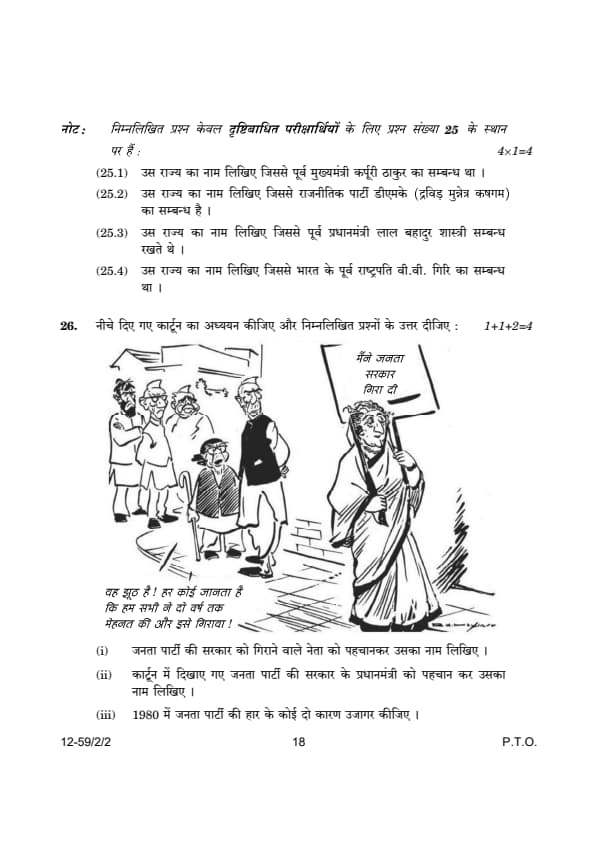
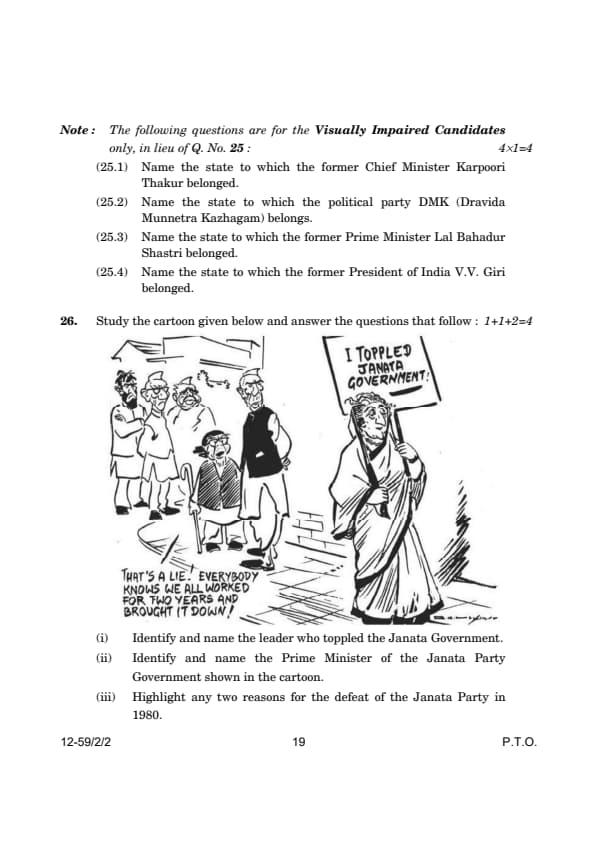
Study the cartoon given below and answer the questions that follow:

Note: The following questions are for the \textit{Visually Impaired Candidates only, in lieu of Q. No. 26 :
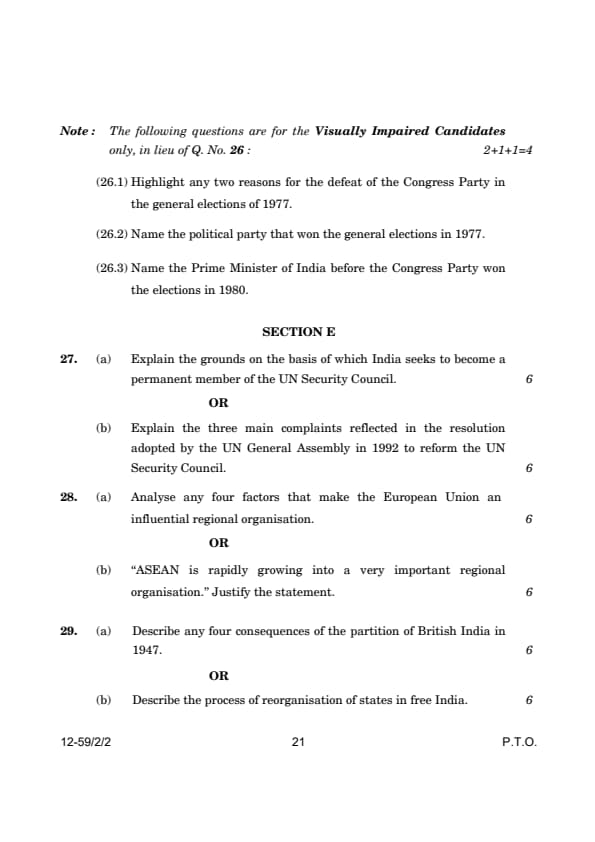
(26.1) Highlight any two reasons for the defeat of the Congress Party in the general elections of 1977.
(26.2) Name the political party that won the general elections in 1977.
(26.3) Name the Prime Minister of India before the Congress Party won the elections in 1980.
26.
(i) Identify and name the leader who toppled the Janata Government.
View Solution
The cartoon shows Indira Gandhi holding a placard that reads “I toppled the Janata Government!” symbolizing her political comeback and active role in defeating the Janata Party in the 1980 elections. Quick Tip: Indira Gandhi’s strategic political moves and Congress revival led to the fall of the Janata coalition.
(ii) Identify and name the Prime Minister of the Janata Party Government shown in the cartoon.
View Solution
The cartoon features Morarji Desai, the first non-Congress Prime Minister of India, leading the Janata Party Government after the Emergency in 1977. Quick Tip: Morarji Desai became PM in 1977, but internal conflicts weakened the Janata Party.
(iii) Highlight any two reasons for the defeat of the Janata Party in 1980.
2. Failure to provide a stable and effective governance.
View Solution
Reason 1: The Janata Party was a coalition of various opposition groups with differing ideologies. Constant infighting and lack of coordination led to political instability.
Reason 2: The government failed to meet public expectations, leading to disappointment among the masses. This paved the way for the Congress's return under Indira Gandhi in 1980. Quick Tip: The Janata Party lacked ideological cohesion and leadership unity, which led to its collapse within three years.
SECTION-E
Question 27(a):
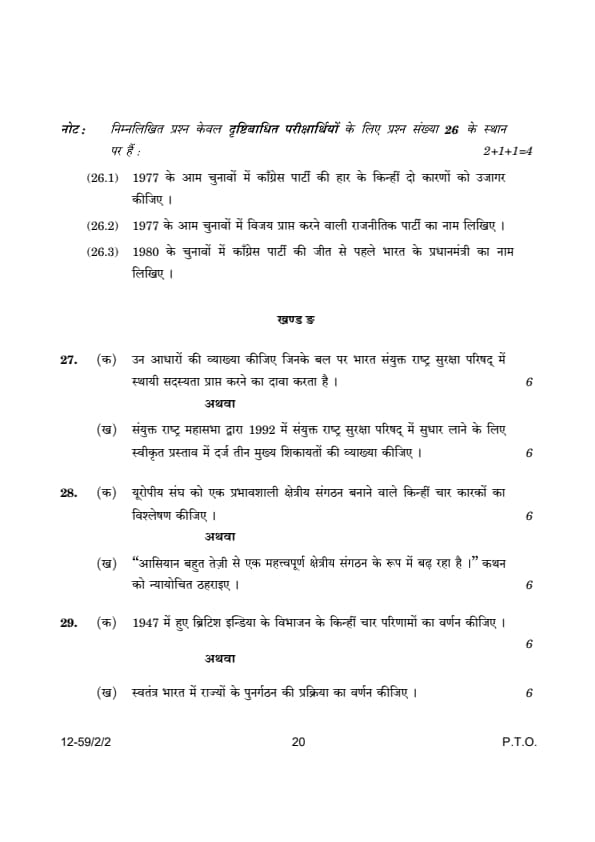
Explain the grounds on the basis of which India seeks to become a permanent member of the UN Security Council.
View Solution
India's claim for permanent membership.
India has been demanding a permanent seat in the United Nations Security Council (UNSC) based on several justifiable grounds:
Largest Democracy: India is the world’s largest democratic country, representing over 1.4 billion people. Its governance model reflects the values upheld by the UN Charter.
Consistent Contributor to UN Missions: India has been one of the top contributors to UN Peacekeeping Missions, showing its commitment to global peace and security.
Strong Economic Growth: India is one of the fastest-growing major economies and plays a significant role in global trade and economic forums like G20, BRICS, and WTO.
Responsible Nuclear Power: India is a responsible nuclear state and adheres to non-proliferation principles despite being outside the NPT framework.
Moral Authority and Global Support: India has never invaded another country and commands respect in the Global South. It has received wide support from major countries including the USA, Russia, France, and the UK. Quick Tip: To justify India's claim to a permanent seat, always highlight its democratic values, peacekeeping record, global influence, and international support.
Explain the three main complaints reflected in the resolution adopted by the UN General Assembly in 1992 to reform the UN Security Council.
View Solution
Understanding the 1992 UNGA resolution.
In 1992, the United Nations General Assembly adopted a resolution highlighting the need to reform the UNSC. It reflected several key criticisms of the existing structure:
Lack of Representation: The Security Council does not adequately represent developing countries, especially from Africa, Latin America, and Asia. This limits the global inclusivity of the body.
Outdated Power Structure: The five permanent members reflect the power structure of 1945. The post-Cold War world has changed, with emerging powers playing a greater role, yet not represented adequately.
Undemocratic Veto Power: The veto power of the five permanent members is seen as undemocratic and misused, often blocking consensus on major issues like humanitarian interventions or global security threats.
Conclusion: These criticisms called for expansion in both permanent and non-permanent categories and a more democratic structure. Quick Tip: When writing about UNSC reform, remember to mention representation, outdated power dynamics, and the problematic use of veto power as key issues.
Analyse any four factors that make the European Union an influential regional organisation.
View Solution
Step 1: Define the EU’s role
The European Union is a political and economic union of 27 European countries that promotes integration, peace, and prosperity.
Step 2: Key factors contributing to its influence
Economic Power: The EU has the world’s second-largest economy and acts as a single market for trade among member states.
Political Integration: EU institutions such as the European Parliament and European Commission work together to create common policies.
Military and Peacekeeping: Though not a military alliance like NATO, the EU engages in peacekeeping missions and regional security efforts.
Global Diplomacy: The EU plays an active role in global negotiations on climate change, trade, and human rights. Quick Tip: The EU’s combined economic, political, and diplomatic strength allows it to act as a major power on the global stage.
“ASEAN is rapidly growing into a very important regional organisation.” Justify the statement.
View Solution
Step 1: Introduction to ASEAN
ASEAN (Association of Southeast Asian Nations) was established in 1967 to promote regional cooperation and peace among its 10 member countries.
Step 2: Justifying the statement
Economic Integration: ASEAN has become one of the fastest-growing economic regions, attracting global investment and increasing intra-regional trade.
Political Cooperation: It facilitates dialogue among member states and prevents conflicts through consensus-building and diplomacy.
Strategic Relevance: Located between India and China, ASEAN holds significant geopolitical value.
Non-Interference Policy: Its principle of non-interference maintains mutual respect among diverse political systems, fostering unity. Quick Tip: ASEAN’s success lies in peaceful cooperation, mutual respect, and balancing regional interests with economic growth.
Describe any four consequences of the partition of British India in 1947.
View Solution
Step 1: Understanding the partition of 1947.
The partition of British India in 1947 led to the creation of two separate nations, India and Pakistan. This event had profound and far-reaching consequences, some of which are outlined below.
Step 2: Four major consequences of the partition.
Mass Migration and Displacement: The partition led to one of the largest mass migrations in history, with millions of Hindus and Sikhs migrating to India and Muslims moving to Pakistan. This led to widespread displacement, loss of property, and instability.
Communal Violence: The partition triggered intense communal violence between Hindus, Sikhs, and Muslims. Thousands of people were killed, and the violence continued for months, creating deep divisions between communities that lingered for decades.
Creation of Pakistan: Pakistan was created as a separate Muslim-majority state, which split the region into two countries, with a significant impact on the political, cultural, and social dynamics of both countries.
Economic and Resource Division: The partition led to the division of resources, including territories, industries, and agriculture. This division, especially the control over the Kashmir region, has remained a point of contention between India and Pakistan ever since. Quick Tip: When discussing the consequences of the partition, focus on the humanitarian aspects (migration, violence) and long-term political issues (Kashmir, economic division).
Describe the process of reorganisation of states in free India.
View Solution
Step 1: Background to State Reorganisation.
After India gained independence in 1947, the need for reorganising the states arose due to linguistic and cultural differences. The existing boundaries, drawn by the British, were not reflective of India’s diverse linguistic and cultural makeup.
Step 2: Key developments in the reorganisation process.
The States Reorganisation Act (1956): The Government of India appointed the States Reorganisation Commission (SRC) under Fazl Ali in 1953 to address the issue of state boundaries. The Commission recommended the creation of new states based on linguistic factors, leading to the formation of states like Andhra Pradesh (1953).
Creation of Linguistic States: Based on the SRC recommendations, several new states were formed, such as Gujarat, Maharashtra, Karnataka, and Kerala, along linguistic lines. This aimed to reduce regional disparities and promote administrative efficiency.
Creation of New States: Over the years, the reorganisation process continued, leading to the creation of states like Nagaland (1963), Haryana (1966), Himachal Pradesh (1971), and Uttarakhand, Chhattisgarh, and Jharkhand in the early 21st century. These states were formed to address regional aspirations and ensure better governance.
Conclusion: The process of reorganisation has helped reduce tensions, foster regional identities, and improve the administration of local resources and development. Quick Tip: The reorganisation of states in India is an ongoing process. It highlights the importance of addressing regional and linguistic demands within a unified political framework.
Describe any four major developments in Indian politics since 1989.
View Solution
Understanding the post-1989 political landscape.
The year 1989 marked a turning point in Indian politics with the decline of single-party dominance and the rise of coalition politics. Several major developments followed:
End of Congress Dominance: The 1989 general elections ended the uninterrupted rule of the Congress Party at the Centre. This gave rise to coalition governments led by parties like Janata Dal and BJP.
Mandal Commission Implementation (1990): The V.P. Singh government implemented the Mandal Commission’s recommendation, granting 27% reservation to OBCs in central government jobs and educational institutions. It triggered nationwide protests and redefined caste politics.
Economic Liberalisation (1991): The Congress government under P.V. Narasimha Rao, with Dr. Manmohan Singh as Finance Minister, introduced economic reforms, moving from a controlled economy to liberalisation, privatisation, and globalisation (LPG).
Rise of Hindutva Politics: The Ram Janmabhoomi movement led by BJP and its allies brought religious issues to the forefront, culminating in the demolition of Babri Masjid in 1992, which had a long-lasting impact on Indian politics. Quick Tip: Link each political development to its social and economic consequences. Focus on themes like coalition era, social justice, economic reforms, and identity politics.
Describe any three issues on which a general consensus has emerged among most of the political parties of India.
View Solution
Understanding the meaning of political consensus.
Despite ideological differences, most Indian political parties agree on certain core issues that are seen as national priorities.
Democracy and Elections: All major political parties accept the legitimacy of democratic elections and the role of the Election Commission. They agree to follow constitutional procedures for transfer of power.
Economic Reforms and Liberalisation: Since 1991, regardless of which party is in power, there has been continuity in economic liberalisation, promotion of foreign investment, and market-oriented reforms.
Support for Welfare Schemes: There is broad agreement on the need for poverty alleviation, employment schemes (like MGNREGA), and food security initiatives. Parties often expand or rename existing welfare schemes rather than abolishing them. Quick Tip: To answer consensus-based questions, identify national priorities that transcend party politics—like democracy, economic growth, and social welfare.



Comments