




The CBSE Class 12 Political Science Question Paper 2025 PDF is available for download here. CBSE conducted the Political Science exam on March 22, 2025, from 10:30 AM to 1:30 PM. The total marks for the theory paper are 80. The question paper contains 20% MCQ-based questions, 40% competency-based questions, and 40% short and long answer type questions. Students reported the exam to be of moderate difficulty level.
CBSE Class 12 Political Science (59/2/2) Question Paper 2025 with Answer Key
| CBSE Class 12 2025 Political Science Question Paper with Answer Key |  Download Download |
Check Solution |
Given below are two statements:
Statement-I: The collapse of the 'Second World' of the Soviet Union and the socialist system in Eastern Europe had no profound consequences for world politics.
Statement-II: The end of the Soviet bloc meant the emergence of many new countries. All these countries had their own independent aspirations and choices.
Which one of the following republics was a party to declare that 'Soviet Union was disbanded'?
Choose the correct statement about India's nuclear policy from the statements given below:
Which political party won 16 Lok Sabha seats and was at second place in the first General Election of India?
Choose the correct full form of the EVM.
Match the terms given in Column-A correctly with Column-B and choose the correct answer from the codes given below:
Column-A Column-B
On which one of the following basis was emergency declared in 1975?
Who among the following believed that India should be more friendly with the bloc led by the US at the time of formulation of India's foreign policy?
Arrange the following in chronological order of their happening:
Which one among the following agreements was to cut the greenhouse gas emissions?
In the following question, a statement of Assertion (A) is followed by a statement of Reason (R). Choose the appropriate option as correct answer:
Assertion (A): The government suspended the freedom of press and implemented press censorship during emergency in 1975.
Reason (R): Newspapers protested against censorship by showing the cartoons only.
The book "Limits to Growth" deals with which one of the following problems?
State any two limitations of the European Union.
View Solution
1. Limited Political Integration: The European Union, although economically integrated, has limited political integration. Member states maintain their own political autonomy, and decisions on foreign policy and defense are often made independently rather than as a collective entity.
2. Economic Disparities: The EU, while promoting economic cooperation, faces significant economic disparities between its member countries. Countries in Southern and Eastern Europe face higher unemployment rates and lower income levels compared to Western and Northern European countries. Quick Tip: Political and economic disparities remain challenges for the EU, despite its efforts at integration.
Analyse the Congress Party as a social coalition.
View Solution
The Congress Party in India can be seen as a social coalition because it has historically brought together various social groups, communities, and classes under its broad umbrella.
1. Social Inclusion: The Congress Party's ideologies of secularism and social justice allowed it to accommodate a wide range of castes, religious groups, and regions.
2. Coalition of Interests: The party often accommodated both urban and rural interests, balancing the demands of the peasantry, working class, business elites, and regional leaders.
3. Post-Independence Role: Following independence, the Congress was the dominant political force, representing a diverse array of interests, from the middle class to marginalized communities, which made it a social coalition in the Indian political landscape. Quick Tip: The Congress Party’s ability to form a coalition of diverse social groups was key to its dominance in Indian politics for much of the 20th century.
Suggest any two ways to reduce economic disparity between the poor and the rich countries at the global level.
View Solution
1. Debt Relief for Poor Nations: Wealthier countries can offer debt relief or forgiveness to poorer countries, allowing them to invest in domestic infrastructure, education, and healthcare rather than spending large portions of their GDP on servicing foreign debt.
2. Fair Trade Agreements: Developing fair trade agreements that ensure poor countries are paid fair prices for their exports, especially for commodities like coffee, cocoa, and textiles, can help reduce economic disparities by increasing their national income and promoting sustainable development. Quick Tip: Debt relief and fair trade are practical ways to empower poorer countries economically and create more equitable global growth.
Explain any two differences between the First Five Year Plan and Second Five Year Plan.
Explain any two reasons for the split in the Janta Party in 1979.
State any two components of Traditional notions of external security.
View Solution
1. Military Power: Traditional security emphasizes the role of military strength and defense in protecting a nation’s sovereignty and territorial integrity. This includes maintaining armed forces, defense systems, and preparing for potential conflicts with other states.
2. Territorial Integrity: This component focuses on protecting the physical boundaries of the state. Traditional security views territorial integrity as essential for maintaining the state's independence and ensuring its security against external threats. Quick Tip: Traditional notions of security are primarily state-centric and focus on military power and territorial defense.
Describe the impact of globalisation on the Indian culture.
View Solution
Globalisation has had a profound impact on Indian culture, particularly in the following ways:
1. Cultural Exchange: With the advent of globalisation, there has been increased interaction between different cultures, leading to the fusion of ideas, food, fashion, and language. Indian cinema, music, and fashion have gained popularity worldwide, while Western cultural elements have become prominent in Indian urban centers.
2. Consumerism and Changing Lifestyles: Globalisation has brought in multinational companies and fast food chains, changing the consumption patterns in India. There has been a shift towards western-style consumer goods, entertainment, and food, which has influenced the lifestyle of urban populations, particularly among the youth.
3. Influence on Traditions and Values: While globalisation has led to the spread of individualistic values, it has also challenged traditional values, leading to generational divides. In rural and traditional communities, there is a concern that the younger generation may lose touch with their cultural roots.
4. Technology and Digital Media: The rise of the internet and social media platforms has enabled the Indian youth to access a wide variety of global content, leading to the blending of cultural practices and a rise in global awareness, but also creating concerns about the erosion of indigenous cultural practices. Quick Tip: While globalisation offers cultural diversification, it also requires balancing modern influences with traditional values to preserve cultural identity.
Analyse any four factors that enhanced the popularity of Indira Gandhi in the early 1970s.
(a) Explain any two reasons for the beginning of a long phase of coalition politics in India since 1989.
View Solution
The rise of coalition politics in India since 1989 can be attributed to the following reasons:
1. Fragmentation of the Congress Party: After the decline of Congress Party's dominance in the 1980s, the political landscape became more fragmented. Regional parties began to gain more significance, and no single party could secure a majority in the Lok Sabha, leading to the rise of coalition governments.
2. Rise of Regional Parties: The increasing influence of regional parties, which often represent state-specific issues, has played a key role in the emergence of coalition governments. These parties became crucial players in forming government coalitions, leading to a political system characterized by coalition politics. Quick Tip: The decline of Congress dominance and the rise of regional parties in the 1980s created an environment conducive to coalition politics.
Question 21:
(b) Explain the role of ‘Other Backward Classes’ in Indian politics.
View Solution
The role of Other Backward Classes (OBCs) in Indian politics is significant for the following reasons:
1. Political Mobilisation: OBCs have become an important political force in India since the Mandal Commission report of 1980, which recommended reservations in education and employment for them. Political parties began to cater to OBC issues, and several regional OBC-based parties emerged, enhancing their influence in national and state politics.
2. Empowerment and Social Justice: The reservation policy has enabled OBCs to gain greater access to education, government jobs, and political representation. This has empowered OBC communities, which were historically marginalized, and given them a voice in the political sphere.
3. Impact on Electoral Politics: OBCs form a substantial portion of India’s electorate, especially in states like Uttar Pradesh, Bihar, and Tamil Nadu. Political parties now rely on OBC votes for electoral success, and OBC leaders have risen to prominence in national politics. Quick Tip: OBCs have become key players in Indian politics, both as a voting bloc and as a source of political leadership.
(a) Analyse the basis of projecting China to overtake the US America to become the world’s largest economy.
View Solution
China is projected to overtake the US as the world’s largest economy for the following reasons:
1. Rapid Economic Growth: Over the past few decades, China’s economy has grown at an exceptional rate, driven by manufacturing, exports, and infrastructure development. This growth rate has significantly outpaced that of the US, putting China on track to surpass the US economy in terms of GDP.
2. Large Population and Labor Force: China has the largest population in the world, which provides it with a massive labor force. This demographic advantage, combined with urbanization and industrialization, has allowed China to maintain strong economic growth and attract foreign investment.
3. Technological Advancements: China has made significant investments in high-tech industries, such as AI, 5G technology, and renewable energy. These advancements will help China maintain its competitive edge in the global economy, further accelerating its growth. Quick Tip: China’s combination of rapid economic growth, demographic advantages, and technological advancements positions it to become the world’s largest economy.
Question 22:
(b) “While the Chinese economy has improved, not everyone in China has received the benefits of the reforms.” Analyse any two reasons for this.
View Solution
Despite the overall improvement in China’s economy, not everyone has benefited equally due to the following reasons:
1. Income Inequality: China has experienced significant economic growth, but the wealth generated has been unevenly distributed. Urban areas, particularly the coastal regions, have seen much greater economic benefits than rural areas. This has created a growing wealth gap between the rich and poor.
2. Rural-Urban Divide: The rural population, although contributing to China’s manufacturing and agricultural output, has seen slower improvements in living standards compared to urban residents. Rural areas continue to face issues like poverty, limited access to education, and healthcare, which have prevented equitable development. Quick Tip: Despite China’s economic growth, addressing income inequality and bridging the rural-urban divide remain key challenges for inclusive development.
Highlight any four features of India’s foreign policy.
In the given political outline map of India, four states have been marked as (A), (B), (C), and (D). Identify these states on the basis of the information given below and write their correct names in your answer-book along with the respective serial numbers of the information used and the concerned alphabets as per the format that follows:
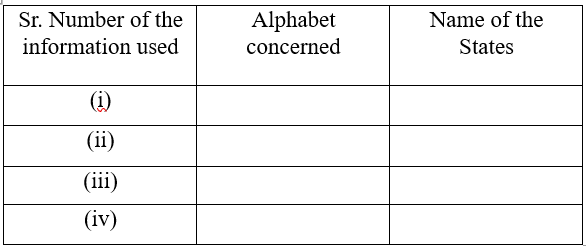
- (i) The state, where the assassination of Rajiv Gandhi took place.
(ii) The state where Karpoori Thakur was a Chief Minister.
(iii) The state where UPA won the majority of seats in Lok Sabha elections in 2004.
(iv) The state where Bahujan Samaj Party (BSP) achieved a breakthrough in 1989 & 1991 elections. ![map]()
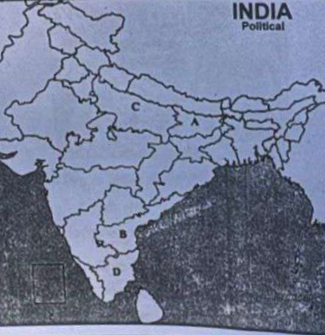
24.1 Name the state where Rajiv Gandhi was assassinated.
View Solution
Rajiv Gandhi was assassinated in Tamil Nadu on May 21, 1991, by a suicide bomber affiliated with the Liberation Tigers of Tamil Eelam (LTTE). Quick Tip: When studying major political events, focus on the specific locations and their significance to the national context.
24.2 Name the state where Karpoori Thakur was a Chief Minister.
View Solution
Karpoori Thakur served as the Chief Minister of Bihar, particularly known for implementing the "Backwards First" policy. He was a key figure in Bihar's politics during the 1970s. Quick Tip: Understanding regional politics is crucial when studying state-level leadership and the impact of such leaders.
24.3 Name the state where Bahujan Samaj Party (BSP) achieved a breakthrough in 1989 & 1991 elections.
View Solution
The Bahujan Samaj Party (BSP), under the leadership of Mayawati, saw a significant rise in Uttar Pradesh in the 1989 and 1991 general elections. The BSP's breakthrough was a crucial moment in the state’s political history, especially for Dalit empowerment. Quick Tip: Regional political parties, like the BSP, have often impacted the political landscape by focusing on the social and economic concerns of marginalized groups.
24.4 Name the alliance that formed government at the centre in 1989.
View Solution
The National Front, a coalition of several regional parties, formed the government in 1989 at the centre, with V.P. Singh becoming the Prime Minister. This coalition came to power after the defeat of the Congress party. Quick Tip: Coalition politics, especially in the 1980s and 1990s, changed the Indian political landscape, with regional parties playing a crucial role at the national level.
Question 25:
Study the given picture and answer the questions that follow:
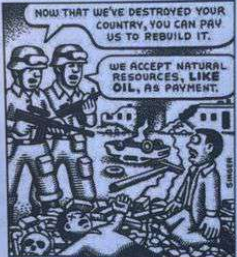
(25.1) Which one of the following is the most important resource in global strategy?
(25.2) Which of the following regions accounts for about 30% of global oil production?
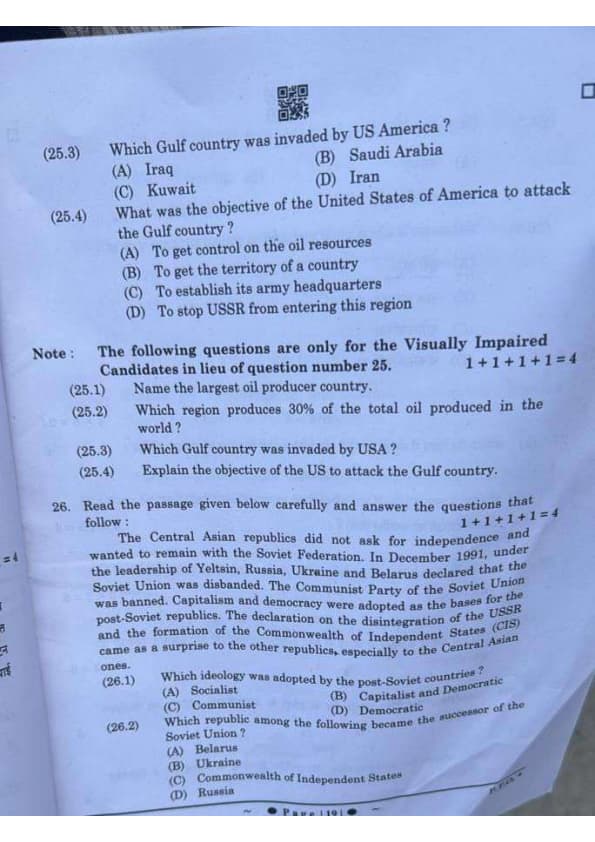
(25.3) Which Gulf country was invaded by the USA?
(25.4) What was the objective of the United States of America to attack the Gulf country?
Note: The following questions are for the Visually Impaired Candidates only in lieu of question number 25.
(25.1) Name the largest oil producer country.
(25.2) Which region produces 30% of the total oil produced in the world?
(25.3) Which Gulf country was invaded by the USA?
Read the passage given below carefully and answer the questions that follow:
The Central Asian republics did not ask for independence and wanted to remain with the Soviet Federation. In December 1991, under the leadership of Yeltsin, Russia, Ukraine, and Belarus declared that the Soviet Union was disbanded. The Communist Party of the Soviet Union was banned. Capitalism and democracy were adopted as the bases for the post-Soviet republics. The declaration on the disintegration of the USSR and the formation of the Commonwealth of Independent States (CIS) came as a surprise to the other republics, especially to the Central Asian ones.
(26.1) Which ideology was adopted by the post-Soviet countries?
(26.2) Which republic among the following became the successor of the Soviet Union?
View Solution
Russia, as the largest and most powerful republic within the Soviet Union, became the successor state after the USSR's dissolution in 1991. Russia inherited most of the Soviet Union's international responsibilities, including its seat at the United Nations Security Council.
Thus, the correct answer is (D) Russia. Quick Tip: Understand the key role Russia played in the disintegration of the Soviet Union and its emergence as the main successor state.
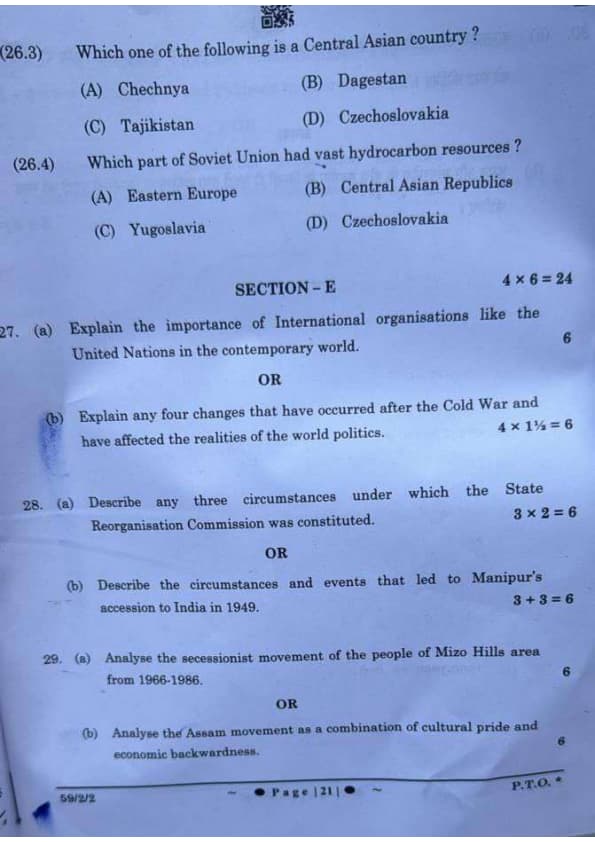
(26.3) Which one of the following is a Central Asian country?
View Solution
Tajikistan is a Central Asian country that was part of the Soviet Union. After the dissolution of the USSR, Tajikistan became an independent republic.
Thus, the correct answer is (C) Tajikistan. Quick Tip: Central Asia consists of several republics, including Tajikistan, Uzbekistan, Kazakhstan, Kyrgyzstan, and Turkmenistan.
(26.4) Which part of Soviet Union had vast hydrocarbon resources?
View Solution
The Central Asian republics, such as Kazakhstan, Turkmenistan, and Uzbekistan, were rich in hydrocarbon resources, including natural gas and oil. These resources became crucial for the post-Soviet economies of these republics.
Thus, the correct answer is (B) Central Asian Republics. Quick Tip: Hydrocarbons, particularly oil and natural gas, were vital to the economy of many former Soviet republics, especially in Central Asia.
(a) Explain the importance of International organizations like the United Nations in the contemporary world.
View Solution
International organizations like the United Nations (UN) play a crucial role in promoting peace, security, and cooperation among nations. The UN provides a platform for dialogue, conflict resolution, and collective action on global challenges such as climate change, human rights, and poverty alleviation. The UN also deploys peacekeeping missions and offers humanitarian assistance in conflict areas.
Thus, the correct answer is (a). Quick Tip: The UN’s main mission is to foster global cooperation, maintain peace, and address international problems.
Question 27:
(b) Explain any four changes that have occurred after the Cold War and have affected the realities of world politics.
View Solution
Four significant changes after the Cold War that have affected world politics are:
1. End of Bipolarity: The Cold War ended the division of the world into two rival blocs (USA and USSR). The collapse of the Soviet Union led to the emergence of the USA as the sole superpower, reshaping global power dynamics.
2. Emergence of New Powers: Countries like China and India have emerged as significant global players, influencing international trade, security, and global governance.
3. Rise of Regionalism and Multilateralism: With the decline of superpower rivalry, regional organizations like the European Union and ASEAN gained prominence, promoting cooperation and integration among neighboring countries.
4. Globalization: The end of the Cold War facilitated increased economic and cultural exchanges, leading to deeper interdependence among nations. This has led to rapid advancements in trade, technology, and communication.
Thus, the correct answer is (b). Quick Tip: After the Cold War, the global order shifted towards multipolarity, where regional organizations and new powers gained prominence.
(a) Describe any three circumstances under which the State Reorganisation Commission was constituted.
View Solution
The State Reorganisation Commission was constituted in 1953 to address the following circumstances:
1. Language-based Demands for States: Post-independence, there were demands for the formation of states based on linguistic identities. The reorganization aimed to create states that aligned with linguistic and cultural boundaries.
2. Administrative Efficiency: The need to improve administrative efficiency led to the reorganization, as smaller, more manageable states would help in better governance and resource management.
3. Avoiding Regional Imbalances: To reduce regional inequalities, the commission aimed to ensure that areas with similar socio-economic and cultural characteristics were grouped together.
Thus, the correct answer is (a). Quick Tip: The formation of states based on linguistic and cultural factors was a significant step towards social justice and better governance.
Question 28:
(b) Describe the circumstances and events that led to Manipur's accession to India in 1949.
View Solution
Manipur’s accession to India in 1949 was the result of the following events:
1. British Colonial Rule: Manipur was a princely state under British India, and after India’s independence in 1947, princely states were given the option to join either India or Pakistan.
2. Political and Military Pressure: The Maharaja of Manipur was pressured by India to accede to the Indian Union, and after a period of political uncertainty, the Maharaja signed the Instrument of Accession in 1949.
3. Strategic Importance: Manipur’s location, bordering Myanmar, made it strategically important for India, particularly during the early years post-independence.
Thus, the correct answer is (b). Quick Tip: Understanding the role of political and military pressure in integrating princely states into India is key to understanding the nation’s post-independence history.
(a) Analyse the secessionist movement of the people of Mizo Hills area from 1966-1986.
Question 29:
(b) Analyse the Assam movement as a combination of cultural pride and economic backwardness.
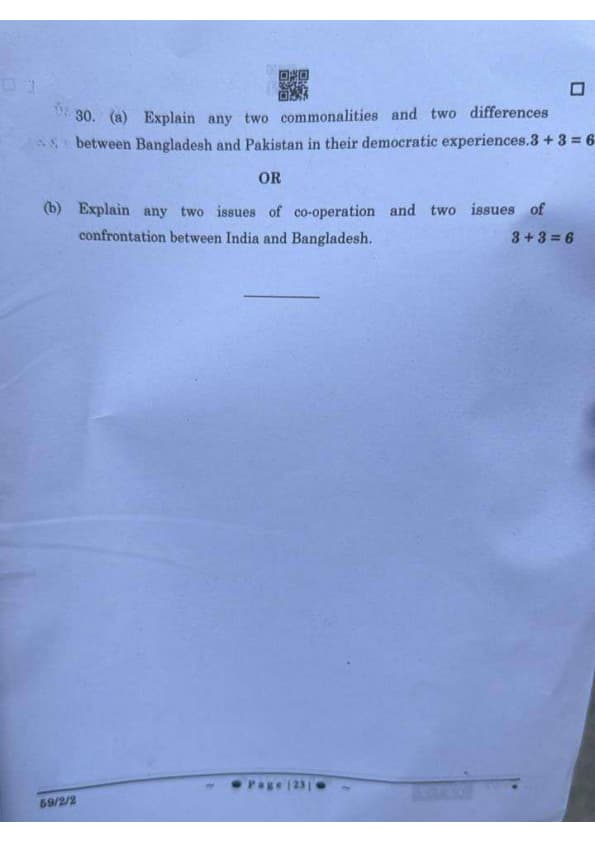
(a) Explain any two commonalities and two differences between Bangladesh and Pakistan in their democratic experiences.
View Solution
Commonalities between Bangladesh and Pakistan in their democratic experiences:
1. Military Intervention: Both countries have experienced frequent military interventions in their political systems. Pakistan has had several military coups, leading to military rule for extended periods, while Bangladesh has also witnessed military coups and military rule at different times.
2. Struggles for Democracy: Both nations have faced struggles for democracy, with political instability and alternating periods of military and civilian rule. The people of both countries have fought for democratic governance, particularly against military dictatorship.
Differences between Bangladesh and Pakistan in their democratic experiences:
1. Separation of East and West Pakistan: One of the key differences is that Bangladesh was once part of Pakistan, but it separated in 1971 after the Bangladesh Liberation War. This led to a significant difference in their democratic development paths.
2. Civilian Rule in Bangladesh: Bangladesh has had a greater history of civilian governments alternating between different political parties, such as the Awami League and the BNP. In contrast, Pakistan has experienced longer spells of military rule compared to Bangladesh.
Thus, the correct answer is (a). Quick Tip: Bangladesh and Pakistan share similar struggles with military rule, but Bangladesh has had a more consistent path toward democratic governance in recent years.
Question 30:
(b) Explain any two issues of co-operation and two issues of confrontation between India and Bangladesh.
View Solution
Two issues of co-operation between India and Bangladesh:
1. Water Sharing Agreements: India and Bangladesh have cooperated on several water-sharing issues, most notably the agreement on sharing the waters of the Ganges (Ganga) river, which helps both countries manage the river’s flow for agriculture and power generation.
2. Trade and Economic Relations: Both countries have enhanced their trade and economic cooperation. India is one of Bangladesh’s largest trading partners, and bilateral trade has grown significantly in recent years, with both countries working on economic integration.
Two issues of confrontation between India and Bangladesh:
1. Teesta Water Dispute: A major issue of confrontation between India and Bangladesh is the Teesta river water-sharing dispute. Bangladesh has demanded a larger share of the water, but India has been unable to reach a satisfactory agreement.
2. Illegal Migration: India has raised concerns over the influx of illegal immigrants from Bangladesh, particularly in the northeastern states of India, where this has led to tensions. Bangladesh, on the other hand, views this issue differently.
Thus, the correct answer is (b). Quick Tip: Understanding the geopolitical and environmental issues affecting India-Bangladesh relations is crucial in identifying the key areas of cooperation and confrontation.





Comments