




The CBSE Class 12 Political Science Question Paper 2025 PDF is available for download here. CBSE conducted the Political Science exam on March 22, 2025, from 10:30 AM to 1:30 PM. The total marks for the theory paper are 80. The question paper contains 20% MCQ-based questions, 40% competency-based questions, and 40% short and long answer type questions. Students reported the exam to be of moderate difficulty level.
CBSE Class 12 Political Science (59/2/3) Question Paper 2025 with Answer Key
| CBSE Class 12 2025 Political Science Question Paper with Answer Key |  Download Download |
Check Solution |
SECTION-A
Given below are two statements:
Statement-I: There were sections of Soviet society which felt that Gorbachev should have moved much faster and were disappointed and impatient with his methods.
Statement-II: Communist Party and those who were served by the system felt that their power and privileges were eroding and Gorbachev was moving too quickly.
Which leader played an important role in the disintegration and coup against Soviet Union?
In the following question, a statement of Assertion (A) is followed by a statement of Reason (R). Choose the appropriate option as correct answer:
Assertion (A): The government suspended the freedom of press and implemented press censorship during emergency in 1975.
Reason (R): Newspapers protested against censorship by showing the cartoons only.
On which one of the following basis was emergency declared in 1975?
Choose the correct statement about India's nuclear policy from the statements given below:
Which political party won 16 Lok Sabha seats and was at second place in the first General Election of India?
Choose the correct full form of the EVM.
Choose the correct option to fill in the blanks:
\textit{Indira Gandhi and Z.A. Bhutto signed _______ agreement in the year
Match the terms given in Column-A correctly with Column-B and choose the correct answer from the codes given below:
Column-A Column-B
Arrange the following in chronological order of their happening:
Which one among the following agreements was to cut the greenhouse gas emissions?
Agenda-21 contains a list of ________.
SECTION - B
Question 13:
State any two major policy decisions taken by the Chinese leadership in the 1970s.
Analyse the Congress Party as an ideological coalition.
View Solution
The Congress Party, since its inception, has been an ideological coalition of various political and social groups, including liberals, socialists, and conservatives, each with their respective interests. It has attempted to unite these diverse ideologies to form a broad-based political entity that could represent the interests of all sections of society.
1. Liberalism: In its early years, the Congress Party focused on liberal democracy, advocating for civil rights, the protection of individual freedoms, and constitutional governance.
2. Socialism: Later, under leaders like Jawaharlal Nehru, Congress adopted a socialist stance, focusing on public ownership, social welfare programs, and reducing economic disparities.
3. Conservatism: In some phases, Congress has also been aligned with conservative ideologies, emphasizing traditional values and social harmony.
Thus, Congress can be seen as an ideological coalition, constantly shifting its policies to accommodate a wide range of views, in response to changing socio-political contexts.
Thus, the correct answer is (b). Quick Tip: Congress' ideological flexibility has allowed it to be a broad-based party, appealing to different sections of society over time.
Explain any two reasons for the split in the Janta Party in 1979.
Suggest any two ways to reduce economic disparity between the poor and the rich countries at the global level.
View Solution
To reduce the economic disparity between the poor and the rich countries, the following measures can be taken:
1. Debt Relief and Economic Aid: Wealthy nations and international financial institutions should offer debt relief to developing countries, enabling them to invest in education, healthcare, and infrastructure, thereby reducing poverty and promoting sustainable development.
2. Fair Trade and Economic Partnerships: Developed countries should enter into fair trade agreements with developing countries that ensure equitable pricing for commodities, better market access, and the promotion of local industries. This would help uplift the economies of poorer nations by boosting their exports and providing better income opportunities.
Thus, the correct answer is (a). Quick Tip: Global economic equity requires international cooperation and fair policies that promote sustainable growth and development for all countries.
Explain any two differences between the First Five Year Plan and Second Five Year Plan.
State any two methods of Traditional Security.
SECTION - C
Question 19:
(a) Explain any two reasons for the beginning of a long phase of coalition politics in India since 1989.
OR
(b) Explain the role of ’Other Backward Classes’ in the Indian politics.
Analyse any four reasons for the split in the Congress Party in 1969.
(a) Analyse the basis of projecting China to overtake the US to become the world's largest economy.
OR
(b) “While the Chinese economy has improved, not everyone in China received the benefits of the reforms.” Analyse any two reasons for this.
View Solution
21(a)
The basis for projecting China to overtake the US as the world's largest economy includes:
1. Rapid Economic Growth: China's economy has been growing at an unprecedented rate since the 1980s, with an average annual growth rate of over 9%. This rapid growth has allowed China to close the economic gap with the US in terms of GDP.
2. Manufacturing Dominance: China has become the "world's factory" due to its low production costs, extensive infrastructure, and strong industrial base. This has made China the global leader in manufacturing and exports.
3. Large Consumer Market: China’s population, the largest in the world, has created an enormous domestic market that is rapidly increasing in terms of purchasing power, which further drives its economic growth.
Quick Tip: China's growth is driven by both manufacturing exports and the expansion of its domestic consumer market, making it a formidable global economic force.
21(b)
Solution: While the Chinese economy has seen substantial growth, the benefits of economic
reforms have not been evenly distributed. Two reasons for this are:
1. Regional Disparities: The coastal regions of China, particularly in cities like Shanghai and
Beijing, have benefited the most from the economic reforms, while rural areas and western
provinces have seen slower economic growth, resulting in significant income inequality.
2. Urban vs. Rural Divide: The migration from rural to urban areas has led to urbanization
and an increase in the standard of living in cities. However, the rural population, especially
farmers, has not experienced the same level of prosperity, and poverty remains a challenge in
these areas.
Quick Tip
Economic reforms in China have lifted many people out of poverty, but the benefits
have been uneven, especially between urban and rural areas.
Describe the impact of globalization on the Indian culture.
View Solution
Globalization has had a significant impact on Indian culture:
1. Cultural Exchange: The exchange of ideas, values, and practices between India and the rest of the world has led to the spread of Indian culture globally, particularly through Bollywood, cuisine, and art. However, it has also led to the introduction of foreign cultural elements like fast food, Hollywood films, and fashion.
2. Cultural Homogenization: While globalization has allowed for cultural exchange, it has also led to the dominance of Western culture, particularly in urban areas. This has resulted in the erosion of traditional practices, languages, and values in some parts of India, leading to concerns over cultural homogenization.
Thus, the correct answer is (a). Quick Tip: Globalization has brought both cultural enrichment and challenges, leading to the blending of traditional and modern influences in India.
Highlight any four Directive Principles of State Policy that have been included in the Constitution of India for International peace and security.
SECTION - D
Question 24:
Study the given picture and answer the questions that follow:
The given Cartoon is about USA’s invasion on a Gulf Country.
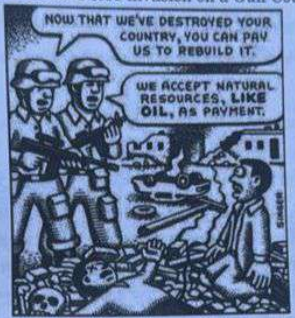
(24.1) Which one of the following is the most important resource in global strategy?
- Water
- Oil
- Land
- Automobile
(24.2) Which of the following regions accounts for about 30% of global oil production?
(24.3) Which Gulf country was invaded by US America?
(A) Iraq
(B) Saudi Arabia
(C) Kuwait
(D) Iran
(24.4) What was the objective of the United States of America to attack the Gulf country?
(A) To get control on the oil resources
(B) To get the territory of a country
(C) To establish its army headquarters
(D) To stop USSR from entering this region
The following questions are for the Visually Impaired Candidates in lieu of question number 24. Name the following:
(24.1) Name the largest oil producer country.
(24.2) Which region produces 30 % of the total oil produced in the world?
(24.3) Which Gulf country was invaded by USA?
(24.4) Explain the objective of the US to attack the Gulf country.
Read the passage given below carefully and answer the questions that follow:
The Central Asian republics did not ask for independence and wanted to remain with the Soviet Federation. In December 1991, under the leadership of Yeltsin, Russia, Ukraine, and Belarus declared that the Soviet Union was disbanded. The Communist Party of the Soviet Union was banned. Capitalism and democracy were adopted as the bases for the post-Soviet republics. The declaration on the disintegration of the USSR and the formation of the Commonwealth of Independent States (CIS) came as a surprise to the other republics, especially to the Central Asian ones.
(25.1) Which ideology was adopted by the post-Soviet countries?
- Socialist
- Capitalist and Democratic
- Communist
- Democratic
(25.2) Which republic among the following became the successor of the Soviet Union?
- Belarus
- Ukraine
- Commonwealth of Independent States
- Russia
(25.3) Which one of the following is a Central Asian country?
- Chechnya
- Dagestan
- Tajikistan
- Czechoslovakia
(25.4) Which part of Soviet Union had vast hydrocarbon resources?
- Eastern Europe
- Central Asian Republics
- Yugoslavia
- Czechoslovakia
In the given political outline map of India, four states have been marked as (A), (B), (C), and (D). Identify these states on the basis of the information given below and write their correct names in your answer-book along with the respective serial numbers of the information used and the concerned alphabets as per the format that follows:
| St. Number of the information used | Alphabet concerned | Name of the States |
|---|---|---|
| (i) | ||
| (ii) | ||
| (iii) | ||
| (iv) |
(i) The state, where the assassination of Rajiv Gandhi took place.
(ii) The state where Karpoori Thakur was a Chief Minister.
(iii) The state where UPA won the majority of seats in Lok Sabha elections in 2004.
(iv) The state where Bahujan Samaj Party (BSP) achieved a breakthrough in 1989 & 1991 elections.
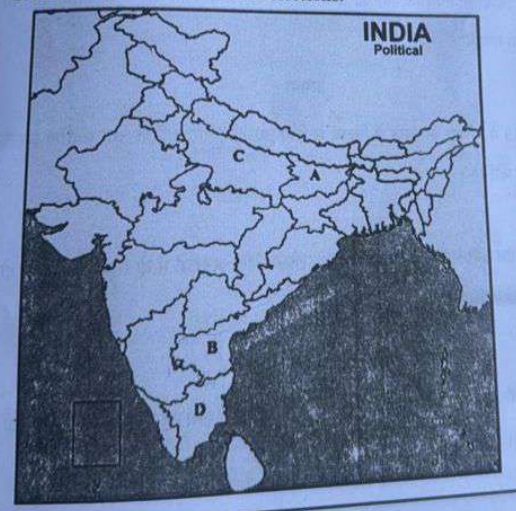
The following questions are for the Visually Impaired Candidates only in lieu of question number 26. Name the following:
26.1 Name the state where Rajiv Gandhi was assassinated.
View Solution
Rajiv Gandhi was assassinated in Tamil Nadu on May 21, 1991, by a suicide bomber affiliated with the Liberation Tigers of Tamil Eelam (LTTE). Quick Tip: When studying major political events, focus on the specific locations and their significance to the national context.
26.2 Name the state where Karpoori Thakur was a Chief Minister.
View Solution
Karpoori Thakur served as the Chief Minister of Bihar, particularly known for implementing the "Backwards First" policy. He was a key figure in Bihar's politics during the 1970s. Quick Tip: Understanding regional politics is crucial when studying state-level leadership and the impact of such leaders.
26.3 Name the state where Bahujan Samaj Party (BSP) achieved a breakthrough in 1989 \& 1991 elections.
View Solution
The Bahujan Samaj Party (BSP), under the leadership of Mayawati, saw a significant rise in Uttar Pradesh in the 1989 and 1991 general elections. The BSP's breakthrough was a crucial moment in the state’s political history, especially for Dalit empowerment. Quick Tip: Regional political parties, like the BSP, have often impacted the political landscape by focusing on the social and economic concerns of marginalized groups.
26.4 Name the alliance that formed government at the centre in 1989.
View Solution
The National Front, a coalition of several regional parties, formed the government in 1989 at the centre, with V.P. Singh becoming the Prime Minister. This coalition came to power after the defeat of the Congress party. Quick Tip: Coalition politics, especially in the 1980s and 1990s, changed the Indian political landscape, with regional parties playing a crucial role at the national level.
SECTION - E
Question 27:
(a) Describe any three circumstances under which the State Reorganisation Commission was constituted.
OR
(b) Describe the circumstances and events that led to Manipur’s accession to India in 1949.
(a) Explain any two commonalities and two differences between Bangladesh and Pakistan in their democratic experiences.
OR
(b) Explain any two issues of co-operation and two issues of confrontation between India and Bangladesh.
View Solution
(a)
Commonalities:
1. Historical British Colonial Legacy: Both Bangladesh and Pakistan share a colonial past under British rule, which shaped their political systems and democratic struggles.
2. Struggles with Military Rule: Both countries have faced periods of military rule that undermined democratic governance and resulted in political instability.
Differences:
1. Path to Independence: Pakistan’s creation in 1947 was based on religious grounds, while Bangladesh was formed in 1971 after a bloody war of independence, leading to different nationalist movements.
2. Democratic Stability: Pakistan has had more instances of military rule, whereas Bangladesh, after overcoming its early political instability, has experienced a relatively longer period of civilian rule in recent years.
Quick Tip: The political paths of Bangladesh and Pakistan offer valuable insights into the impact of colonial legacies and military rule on democracy in South Asia.
(b)
Solution: Co-operation Issues: 1. Water Sharing: India and Bangladesh have cooperated on
the sharing of river waters, particularly the Ganges and Teesta rivers, through agreements
like the Ganges Water Sharing Treaty. 2. Trade and Connectivity: India and Bangladesh have
enhanced bilateral trade and connectivity, including land and rail links, and fostering
economic collaboration.
Confrontation Issues: 1. Border Disputes: Both countries have faced disputes over border
areas, particularly regarding the sharing of river waters and land borders. 2. Illegal
Immigration: Bangladesh has expressed concerns over illegal immigration across the border
into India, leading to tensions between the two countries.
Thus, the correct answer is (b).
Quick Tip
International cooperation in South Asia often revolves around shared resources like rivers, but border disputes and migration remain significant challenges.
(a) Analyse any three reasons for the disturbance and unrest in Kashmir.
OR
(b) Suggest any three measures to maintain peace in Jammu and Kashmir.
(a) Explain the importance of International organisations like the United Nations in the contemporary world.
OR
(b) Explain any four changes that have occurred after the Cold War and have affected the realities of the world politics.
View Solution
(a)
The United Nations (UN) plays a critical role in global peacekeeping, humanitarian efforts, and conflict resolution. Its importance lies in:
1. Conflict Resolution: The UN provides a forum for member states to resolve disputes peacefully, avoiding the escalation of conflicts.
2. Human Rights Advocacy: The UN promotes human rights globally, setting international standards and overseeing their enforcement.
3. International Cooperation: It serves as a platform for global cooperation on issues like climate change, poverty, and health.
Quick Tip: International organizations like the UN help mediate global conflicts and foster collective action on pressing global challenges.
(b)
Solution: 1. End of Bipolarity: The end of the Cold War shifted the world from a bipolar
system dominated by the USA and the USSR to a unipolar world led by the United States. 2.
Emergence of New Powers: New powers like China and India have risen economically and
militarily, influencing global geopolitics. 3. Globalization: The post-Cold War period saw
increased global interconnectedness through trade, technology, and communication. 4.
Regional Conflicts and Terrorism: The collapse of the Soviet Union led to the rise of regional
conflicts, ethnic struggles, and the emergence of non-state actors like terrorist groups.
Quick Tip
The post-Cold War world has seen a shift from ideological rivalry to new challenges like terrorism, regional conflicts, and globalization.





Comments