




The CBSE Class 12 Political Science Question Paper 2024 PDF is available for download here. CBSE conducted the Political Science exam on March 22, 2024, from 10:30 AM to 1:30 PM. The total marks for the theory paper are 80. The question paper contains 20% MCQ-based questions, 40% competency-based questions, and 40% short and long answer type questions. Students reported the exam to be of moderate difficulty level.
CBSE Class 12 Political Science (59/3/1) Question Paper 2024 with Answer Key
| CBSE Class 12 2024 Political Science Question Paper with Answer Key |  Download Download |
Check Solution |
CBSE Class 12 Political Science Question Paper 2024 with Answer Key
SECTION-A
Question 1:
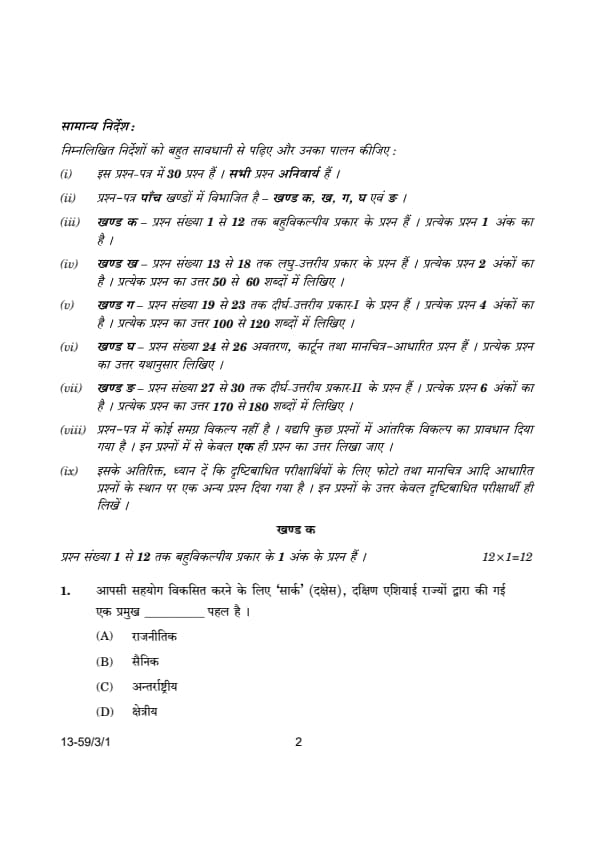
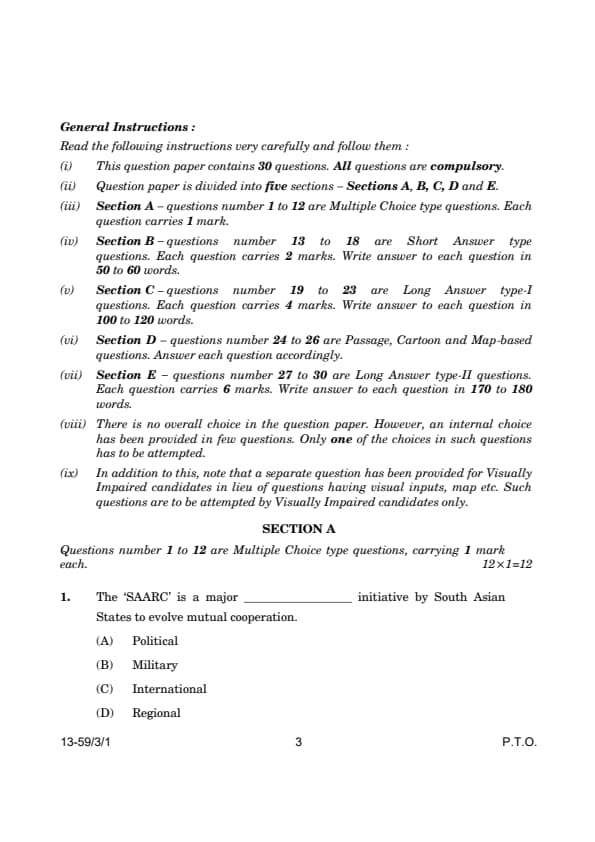
The ‘SAARC’ is a major __________ initiative by South Asian States to evolve mutual cooperation.
View Solution
Step 1: Understanding SAARC.
The South Asian Association for Regional Cooperation (SAARC) is a regional intergovernmental organization and geopolitical union in South Asia. It was founded in 1985 and consists of eight member states: Afghanistan, Bangladesh, Bhutan, India, Maldives, Nepal, Pakistan, and Sri Lanka.
Step 2: Purpose of SAARC.
SAARC aims to promote regional cooperation in various fields such as economic development, cultural exchanges, and mutual collaboration. It focuses on addressing regional issues rather than international or military concerns.
Step 3: Identifying the Correct Option.
SAARC is primarily a regional initiative, not political or military. It works on strengthening cooperation within the South Asian region, particularly among the member countries. Quick Tip: SAARC stands for Regional cooperation and focuses on economic, cultural, and social issues. It is distinct from international or military alliances.
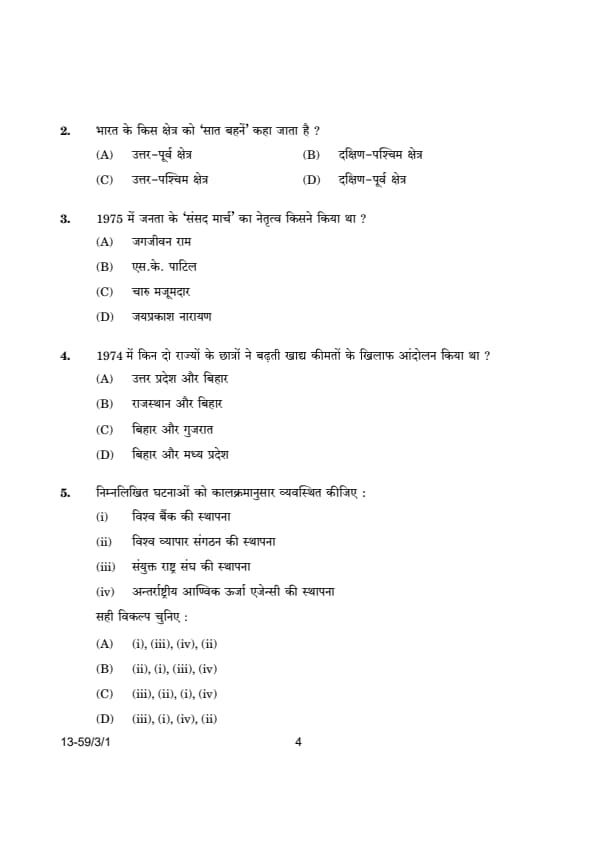
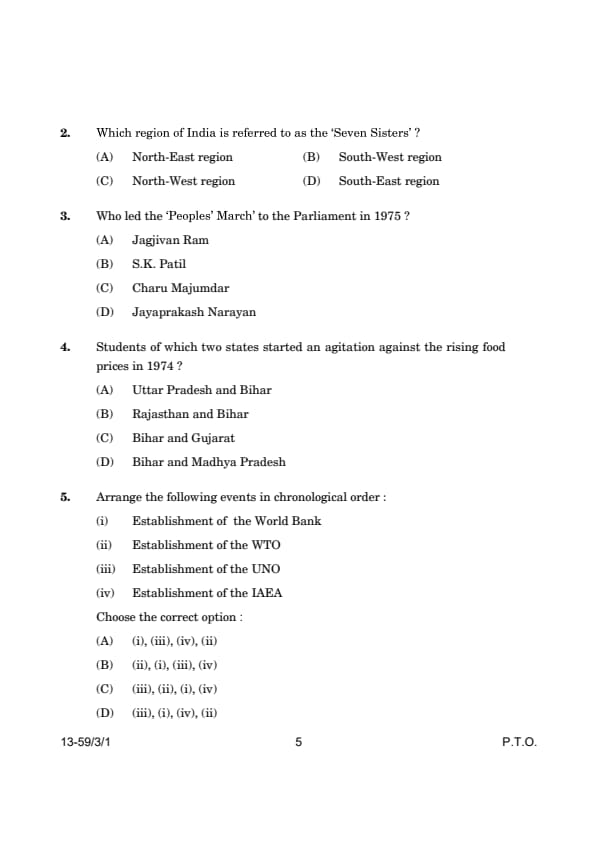
Which region of India is referred to as the ‘Seven Sisters’?
View Solution
Step 1: Understanding the 'Seven Sisters'.
The term ‘Seven Sisters’ refers to the seven northeastern states of India: Arunachal Pradesh, Assam, Meghalaya, Manipur, Mizoram, Nagaland, and Tripura. These states are often grouped together due to their geographic proximity and shared challenges.
Step 2: Identifying the Region.
These states are known for their diverse cultures, languages, and significant natural resources. They share borders with countries like China, Bangladesh, and Myanmar, and have a distinct cultural identity from the rest of India.
Step 3: Correct Answer Identification.
The ‘Seven Sisters’ are located in the northeastern part of India, making Option (A) North-East region the correct choice. Quick Tip: The 'Seven Sisters' are located in the North-East of India and are known for their unique cultural heritage and geographic significance.
Who led the ‘Peoples’ March’ to the Parliament in 1975?
View Solution
Step 1: Understanding the 'Peoples' March'.
The ‘Peoples’ March’ to the Parliament in 1975 was part of the larger movement against the Emergency imposed by Prime Minister Indira Gandhi. The Emergency was declared in response to internal political instability, and Jayaprakash Narayan (JP), a prominent leader, opposed the move.
Step 2: Leadership of the Movement.
Jayaprakash Narayan, also known as JP, led the 'Peoples' March' in 1975 to demand the restoration of democratic rights and an end to the Emergency. JP was a key leader in the opposition against the autocratic rule.
Step 3: Correct Answer Identification.
JP’s leadership in the 1975 movement for democracy and his role in the subsequent 'Total Revolution' makes Option (D) Jayaprakash Narayan the correct answer. Quick Tip: Jayaprakash Narayan, a prominent leader in post-independence India, played a pivotal role in advocating for democracy during the Emergency period of 1975.
Students of which two states started an agitation against the rising food prices in 1974?
View Solution
Step 1: Understanding the 1974 Agitation.
In 1974, there was widespread discontent over rising food prices and economic hardship in India. Students from Bihar and Gujarat started agitations and protests against the government's handling of these issues.
Step 2: Leaders and Key Participants.
The protests were led by student leaders, and Jayaprakash Narayan (JP) played a key role in mobilizing the youth for these agitations. The protests eventually contributed to the political climate that led to the Emergency in 1975.
Step 3: Correct Answer Identification.
The agitation against rising food prices in 1974 was most prominent in Bihar and Gujarat, making Option (C) Bihar and Gujarat the correct answer. Quick Tip: The 1974 student agitation in Bihar and Gujarat was a key event leading to political unrest, with food price hikes as one of the primary causes of discontent.
Arrange the following events in chronological order :
(i) Establishment of the World Bank
(ii) Establishment of the WTO
(iii) Establishment of the UNO
(iv) Establishment of the IAEA
Choose the correct option:
View Solution
Let's analyze each of the events and their respective establishment years:
Step 1: Establishment of the World Bank (i)
The World Bank was established in 1944 during the Bretton Woods Conference. It was created to provide financial and technical assistance to developing countries for development projects.
Step 2: Establishment of the UNO (iii)
The United Nations Organization (UNO) was established in 1945, following the end of World War II. The UNO was created to maintain international peace and security, promote human rights, and foster social and economic development.
Step 3: Establishment of the IAEA (iv)
The International Atomic Energy Agency (IAEA) was established in 1957 by the United Nations as an autonomous organization to promote the peaceful use of nuclear energy and prevent its use for military purposes.
Step 4: Establishment of the WTO (ii)
The World Trade Organization (WTO) was established in 1995 to regulate international trade and ensure that trade flows smoothly, predictably, and freely.
Thus, the correct chronological order is:
(i) Establishment of the World Bank in 1944
(iii) Establishment of the UNO in 1945
(iv) Establishment of the IAEA in 1957
(ii) Establishment of the WTO in 1995
Therefore, the correct option is: (A) (i), (iii), (iv), (ii). Quick Tip: When solving chronological order questions, it's helpful to memorize key years when major international organizations were established, as this can help in faster and more accurate answers.
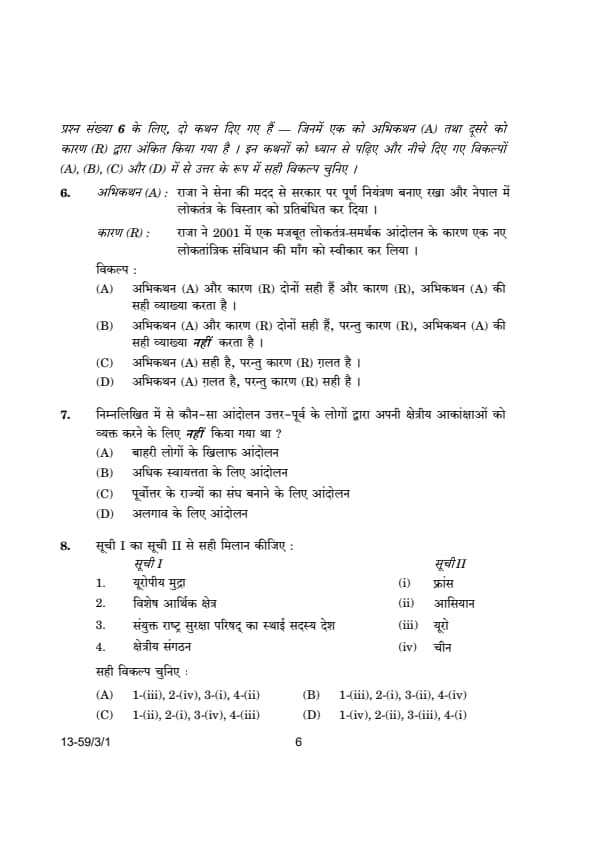
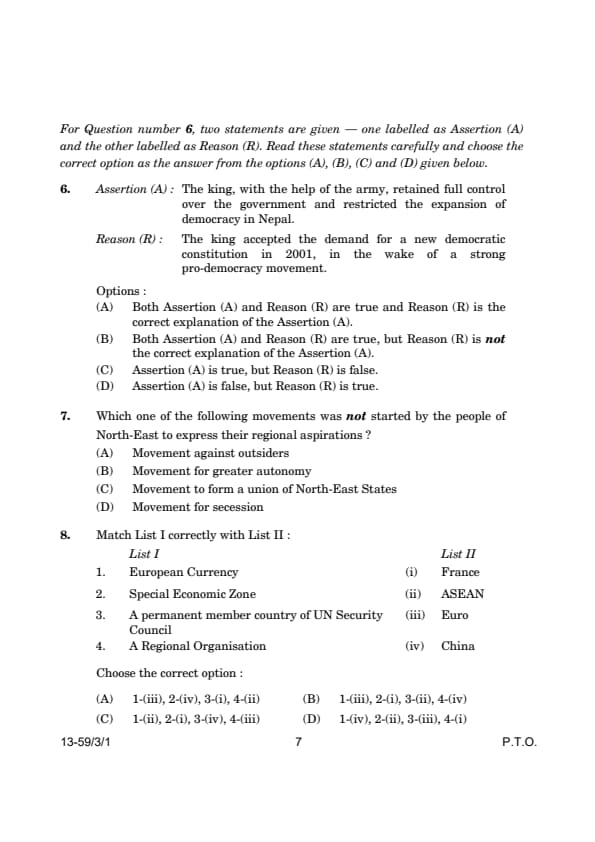
For Question number 6, two statements are given one labelled as Assertion (A) and the other labelled as Reason (R). Read these statements carefully and choose the correct option as the answer from the options (A), (B), (C) and (D) given below.
Assertion (A): The king, with the help of the army, retained full control over the government and restricted the expansion of democracy in Nepal.
Reason (R): The king accepted the demand for a new democratic constitution in 2001, in the wake of a strong pro-democracy movement.
Choose the correct option:
View Solution
Assertion (A): The king, with the help of the army, did indeed retain full control over the government in Nepal and restricted the expansion of democracy. This assertion is correct.
Reason (R): The king did not immediately accept the demand for a new democratic constitution in 2001. The king's regime faced significant resistance, and the pro-democracy movement had already been growing in strength for a while. It was only after several years of struggle, including mass protests, that the king had to accept the demand for a democratic constitution. Therefore, Reason (R) is false, as it does not accurately describe the timeline or the context of the king's actions.
Thus, Assertion (A) is true, but Reason (R) is false. Quick Tip: In Assertion-Reason questions, make sure to check the factual correctness of both the assertion and reason before choosing the answer.
Which one of the following movements was not started by the people of North-East to express their regional aspirations?
Choose the correct option:
View Solution
The movements in the North-East India have largely been for greater autonomy, resistance against outsiders, and secession from the rest of India. However, there has been no prominent movement aimed at forming a union of North-East states.
Thus, the correct answer is: (C) Movement to form a union of North-East States. Quick Tip: When studying regional movements, it's essential to focus on the specific demands of the region, whether they pertain to autonomy, resistance, or secession.
Match List I correctly with List II :

Choose the correct option:
View Solution
Step 1: Understanding the items in List I.
1. European Currency is the currency used by many countries in Europe, and it is specifically referred to as the Euro. Hence, 1 matches with (iii).
2. Special Economic Zone (SEZ) refers to a specific area where businesses can operate with favorable conditions such as tax breaks, and it is an initiative that is commonly found in countries like China. Hence, 2 matches with (iv).
3. A permanent member country of the UN Security Council refers to France, which is one of the five permanent members of the United Nations Security Council. Hence, 3 matches with (i).
4. A Regional Organisation refers to an organization like ASEAN, which stands for the Association of Southeast Asian Nations. ASEAN is a regional intergovernmental organization comprising ten Southeast Asian countries. Hence, 4 matches with (ii).
Step 2: Correct matching.
Thus, the correct matches are:
1-(iii): European Currency is the Euro.
2-(iv): Special Economic Zone is most commonly associated with China.
3-(i): France is a permanent member of the UN Security Council.
4-(ii): ASEAN is a Regional Organisation.
Conclusion: The correct matching is: 1-(iii), 2-(iv), 3-(i), 4-(ii). Quick Tip: When matching items related to international relations and economic zones, focus on the key roles countries play in specific organizations or systems (e.g., Euro for European currency, China for SEZ, France in the UN Security Council, ASEAN as a regional body).
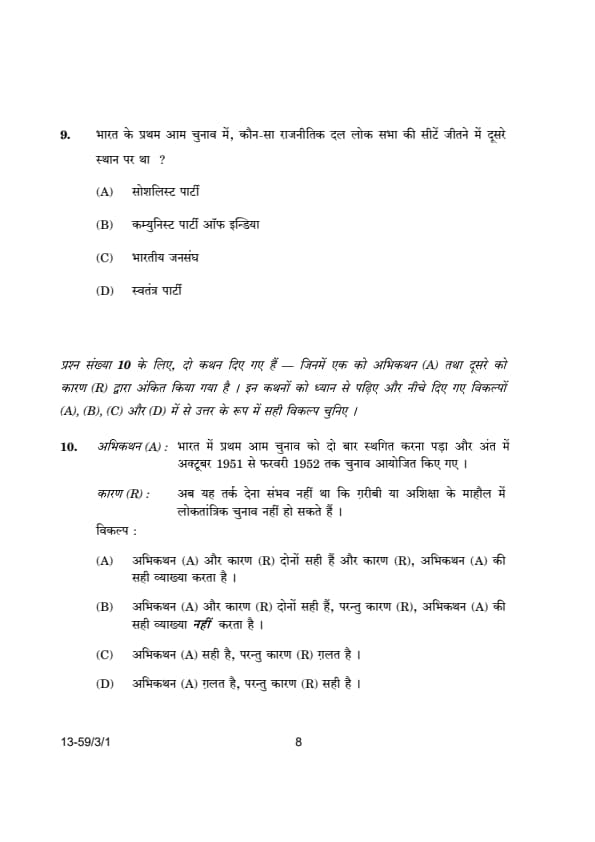
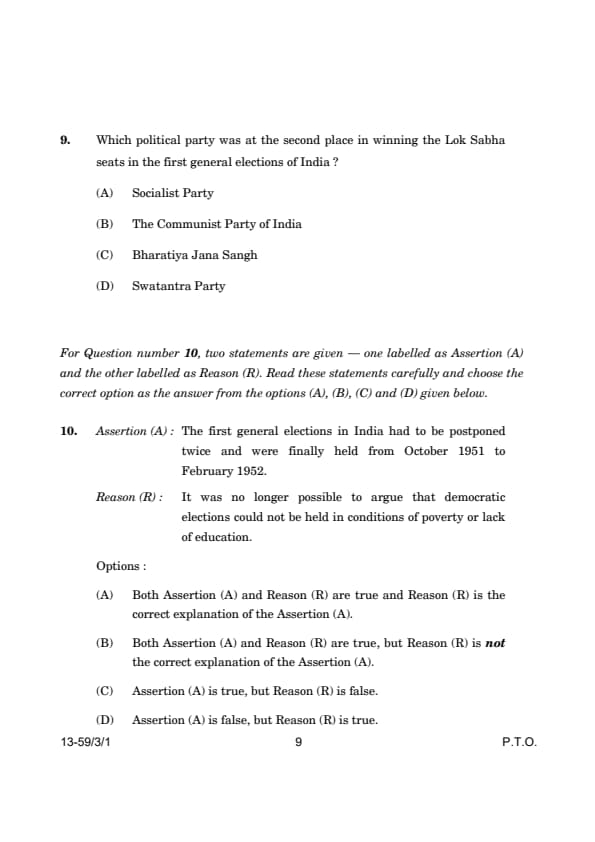
Which political party was at the second place in winning the Lok Sabha seats in the first general elections of India?
Choose the correct option:
View Solution
Step 1: Understand the political landscape of the first general elections in India.
The first general elections in India were held in 1952. The Indian National Congress (INC) was the largest and most dominant party, winning a significant majority of the seats in the Lok Sabha.
Step 2: Analyze the second-largest party.
The second-largest party in the first general elections was the Communist Party of India (CPI). The CPI had a strong presence in certain states, particularly in West Bengal and Kerala, where they won a notable number of seats.
Step 3: Examine the options.
The Socialist Party (Option A) had a limited presence and was not the second-largest party.
The Communist Party of India (Option B) was indeed the second-largest party.
Bharatiya Jana Sangh (Option C) was a smaller party and did not come second in terms of seats.
The Swatantra Party (Option D) was formed later and did not play a significant role in the first elections.
Thus, the correct answer is: (B) The Communist Party of India. Quick Tip: In the first general elections, the Congress Party dominated, and the Communist Party of India had significant support in key regions.
For Question number 10, two statements are given one labelled as Assertion (A) and the other labelled as Reason (R). Read these statements carefully and choose the correct option as the answer from the options (A), (B), (C) and (D) given below.
Assertion (A): The first general elections in India had to be postponed twice and were finally held from October 1951 to February 1952.
Reason (R): It was no longer possible to argue that democratic elections could not be held in conditions of poverty or lack of education.
Choose the correct option:
View Solution
Step 1: Understand Assertion (A).
Assertion (A) states that the first general elections in India were postponed twice and were finally held from October 1951 to February 1952. This is true because the elections were initially planned for 1951 but had to be postponed twice due to several factors, including the preparation of electoral rolls and the need for logistical arrangements. The elections were eventually held over several months, from October 1951 to February 1952.
Step 2: Analyze Reason (R).
Reason (R) states that it was no longer possible to argue that democratic elections could not be held in conditions of poverty or lack of education. This is also true, as India overcame many challenges to hold elections in the face of poverty, illiteracy, and other obstacles. The argument that elections could not be held due to these conditions was refuted by the success of the first general elections, which involved millions of people voting in a democratic process despite these challenges.
Step 3: Evaluate the relationship between Assertion (A) and Reason (R).
While both Assertion (A) and Reason (R) are true, Reason (R) does not directly explain the postponement of the elections. The postponement was primarily due to logistical and administrative challenges, not directly related to the argument about poverty or education. Therefore, Reason (R) does not provide the correct explanation for the delay in elections.
Thus, the correct answer is: (B) Both Assertion (A) and Reason (R) are true, but Reason (R) is not the correct explanation of Assertion (A). Quick Tip: In Assertion-Reason questions, focus on whether the reason directly explains the assertion or if both are true but unrelated.
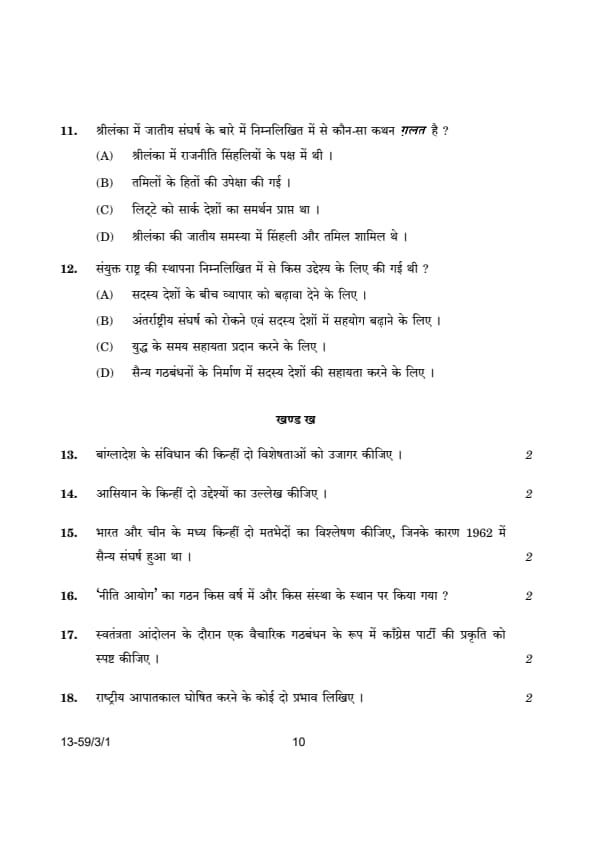
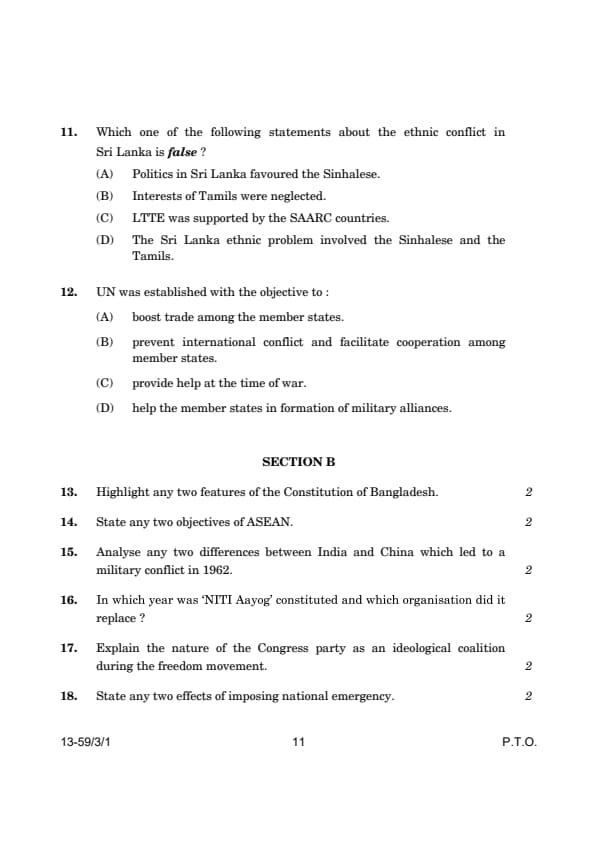
Which one of the following statements about the ethnic conflict in Sri Lanka is \textbf{false}?
View Solution
Step 1: Analyzing the Ethnic Conflict in Sri Lanka.
Sri Lanka's ethnic conflict primarily involved two groups: the Sinhalese majority and the Tamil minority. The Tamils faced discrimination, especially in terms of language, culture, and employment opportunities, leading to tensions and eventually the rise of the Liberation Tigers of Tamil Eelam (LTTE).
Step 2: Evaluating the Options.
(A) Politics in Sri Lanka favoured the Sinhalese.
This is true. The Sri Lankan government was predominantly Sinhalese, which marginalized the Tamil population politically.
(B) Interests of Tamils were neglected.
This is true. The Tamils faced socio-political exclusion, leading to demands for a separate Tamil Eelam.
(C) LTTE was supported by the SAARC countries.
This is false. The LTTE was not supported by SAARC countries. In fact, the LTTE was a separatist militant group that was condemned internationally, including by SAARC members.
(D) The Sri Lanka ethnic problem involved the Sinhalese and the Tamils.
This is true. The ethnic conflict involved the Sinhalese majority and the Tamil minority, particularly in the context of the civil war.
Conclusion: The false statement is (C) because LTTE was not supported by SAARC countries. Quick Tip: SAARC countries, including Sri Lanka, did not support the LTTE, which was a terrorist organization. The ethnic conflict was a result of historical political and social disparities.
UN was established with the objective to:
View Solution
Step 1: Understanding the Objectives of the UN.
The United Nations (UN) was established in 1945 after World War II with the primary goal of maintaining international peace and security. It also aims to promote social progress, better living standards, and human rights among nations.
Step 2: Evaluating the Options.
(A) Boost trade among the member states.
This is incorrect. While the UN supports economic development, its main focus is not directly on boosting trade.
(B) Prevent international conflict and facilitate cooperation among member states.
This is correct. The main objectives of the UN include maintaining peace and security, and promoting cooperation among member countries on various issues.
(C) Provide help at the time of war.
This is incorrect. While the UN does provide humanitarian aid during conflicts, its primary aim is to prevent war and conflict, not just help during them.
(D) Help the member states in formation of military alliances.
This is incorrect. The UN does not support military alliances; its focus is on peacekeeping and conflict resolution, not promoting military alliances.
Conclusion: The correct answer is (B), as the UN was founded to prevent conflict and foster cooperation. Quick Tip: The UN’s core mission is to ensure peace and cooperation among nations through diplomacy, conflict resolution, and humanitarian aid, not military alliances or trade promotion.
SECTION-B
Question 13:
Highlight any two features of the Constitution of Bangladesh.
View Solution
Step 1: Understanding the Constitution of Bangladesh.
The Constitution of Bangladesh, adopted on December 16, 1972, lays the foundation for the governance and legal framework of the country. It defines the structure of government, fundamental rights, and responsibilities.
Step 2: Two Features of the Constitution of Bangladesh.
Secularism and Fundamental Rights: The Constitution of Bangladesh establishes secularism as a guiding principle, ensuring that the government does not favor any religion. It also guarantees fundamental rights to all citizens, such as freedom of speech, religion, and equality before the law.
Parliamentary System of Government: The Constitution adopts a parliamentary system of government, where the Prime Minister is the head of government and holds executive powers, while the President is the ceremonial head of state. The legislative authority rests with the Jatiya Sangsad (National Parliament).
Conclusion: The Constitution of Bangladesh emphasizes secularism, fundamental rights, and a parliamentary system, providing the legal structure for governance and citizens' rights. Quick Tip: The Constitution of Bangladesh is deeply rooted in secularism and democracy, ensuring the protection of civil liberties and a system of governance based on elected representatives.
State any two objectives of ASEAN.
View Solution
Step 1: Understanding ASEAN.
The Association of Southeast Asian Nations (ASEAN) was established in 1967 to promote political and economic cooperation and regional stability among Southeast Asian countries.
Step 2: Two Objectives of ASEAN.
Promote Regional Peace and Stability: One of ASEAN’s primary objectives is to promote peace and stability in Southeast Asia through dialogue and cooperation. The organization focuses on preventing conflicts and resolving disputes through peaceful means.
Economic Cooperation and Development: ASEAN aims to foster economic cooperation among member states to accelerate economic growth, promote regional trade, and improve the living standards of its people. The ASEAN Economic Community (AEC) focuses on establishing a single market and production base.
Conclusion: ASEAN strives to ensure regional peace and stability while advancing economic cooperation and development among its member countries. Quick Tip: ASEAN is a powerful example of regional integration focused on both security and economic cooperation, with an emphasis on peace, prosperity, and mutual respect among nations.
Analyse any two differences between India and China which led to a military conflict in 1962.
View Solution
Step 1: Background to the India-China Conflict.
The military conflict between India and China in 1962 was largely rooted in territorial disputes, particularly over the regions of Aksai Chin and the North-East Frontier Agency (NEFA). These disputes, combined with political tensions, led to the war.
Step 2: Two Differences Leading to the 1962 Conflict.
Territorial Disputes: The main issue that led to the India-China war was the dispute over the Aksai Chin region, located in the western sector of the India-China border. India claimed it as part of Jammu and Kashmir, while China considered it part of its Xinjiang region. Similarly, the border demarcation along NEFA (now Arunachal Pradesh) also remained a contentious issue.
Differing Political Ideologies: Another difference was the political ideologies of the two countries. India, a democratic republic, and China, a communist state, had divergent political systems. The Chinese leadership viewed India's alignment with the West and its support for Tibet as threats to its national security, fueling further distrust between the two nations.
Conclusion: The 1962 military conflict between India and China was a result of territorial disputes and ideological differences, exacerbated by military skirmishes and a lack of effective diplomatic communication. Quick Tip: Territorial disputes and political differences are often at the heart of military conflicts. Understanding these underlying issues is essential when analyzing historical wars and conflicts.
In which year was 'NITI Aayog' constituted and which organization did it replace?
View Solution
Step 1: Understanding NITI Aayog's constitution
NITI Aayog (National Institution for Transforming India) was constituted in the year 2015. It was created to serve as a think tank for the Government of India with a focus on improving policy formulation and enhancing cooperative federalism.
Step 2: Replacing the Planning Commission
NITI Aayog replaced the Planning Commission, which had been established in 1950 by the first Prime Minister of India, Jawaharlal Nehru. The Planning Commission played a central role in India's planning and economic development but was considered increasingly ineffective and outdated.
Step 3: Objectives of NITI Aayog
NITI Aayog was designed to promote a more decentralized approach to policymaking, providing states a greater role in shaping India's economic and social policies. The organization aims to foster inclusive development, address regional disparities, and support sustainable growth.
Thus, NITI Aayog was constituted in 2015 and replaced the Planning Commission. Quick Tip: NITI Aayog’s establishment marked a shift towards cooperative federalism and decentralization, allowing greater input from states in national policymaking.
Explain the nature of the Congress party as an ideological coalition during the freedom movement.
View Solution
Step 1: Ideological Diversity in the Congress Party
The Indian National Congress (INC) during the freedom movement was a coalition of diverse ideological groups. It brought together individuals with different political views, such as moderates, radicals, and conservatives, under the common objective of achieving independence from British colonial rule.
Step 2: Moderates and their Role
The moderates, led by leaders like Gopal Krishna Gokhale and Dadabhai Naoroji, advocated for constitutional reforms, gradual change, and dialogue with the British authorities. They believed that political engagement, rather than confrontation, would lead to reforms and eventual self-rule.
Step 3: Radicals and their Role
In contrast, the radicals, including leaders like Bal Gangadhar Tilak, Lala Lajpat Rai, and Bipin Chandra Pal, called for more aggressive methods of resistance. They believed in mass mobilization, protests, and boycotts to force the British out of India.
Step 4: Gandhian Influence
With the rise of Mahatma Gandhi, the Congress Party transformed into a more cohesive force. Gandhi's leadership and his emphasis on non-violent resistance brought together moderates, radicals, and others, allowing for a more unified approach to the struggle for independence.
Step 5: Conclusion
Thus, the Congress party was an ideological coalition of various political ideologies, unified by the common goal of gaining independence from British rule. This diversity in ideology helped the party represent a broad section of Indian society. Quick Tip: The Congress Party's ability to unite diverse ideological groups under a single cause was a crucial factor in its success in leading the independence movement.
State any two effects of imposing national emergency.
View Solution
Step 1: Effect on Fundamental Rights
One of the primary effects of imposing a national emergency is the suspension of certain fundamental rights. Specifically, under Article 19, the rights to freedom of speech, assembly, and movement may be restricted. Additionally, the right to life and personal liberty (Article 21) can also be curtailed during an emergency. This leads to a more centralized control by the government, with limited checks and balances on its power.
Step 2: Increased Power of the Executive
A national emergency also enhances the powers of the executive branch of the government. The President of India gains the authority to rule through ordinances, and the central government can take control over the functioning of state governments. This leads to a greater concentration of power at the central level, diminishing the autonomy of state governments. Additionally, Parliament gains the power to make laws on matters under the state list, further consolidating central authority.
Thus, the two main effects of imposing national emergency are:
1. Suspension of Fundamental Rights - Rights like freedom of speech and movement can be suspended.
2. Increased Power of the Executive - Central government gains enhanced powers over states and greater control over the functioning of the nation. Quick Tip: Imposing a national emergency is a drastic step with far-reaching consequences, and it alters the balance of power between the executive, legislature, and judiciary.
SECTION-C
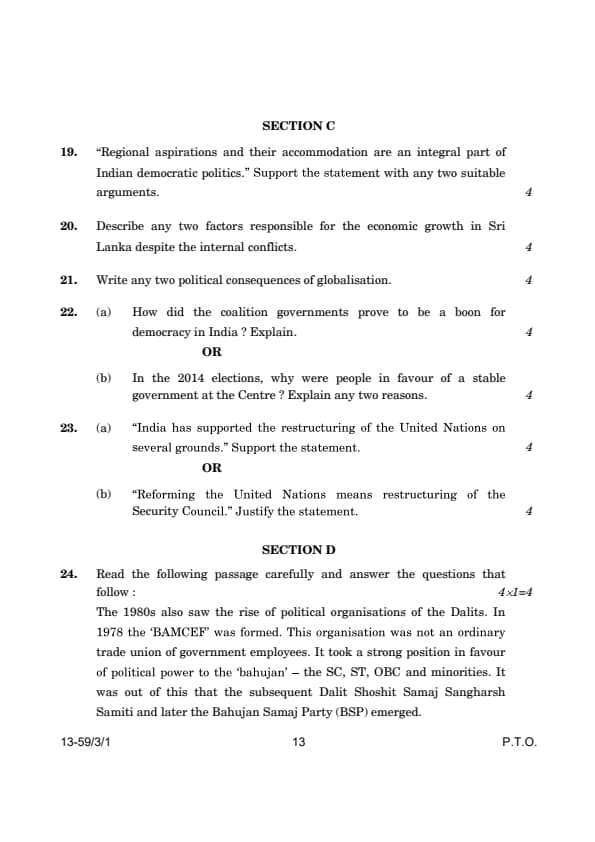
Question 19:
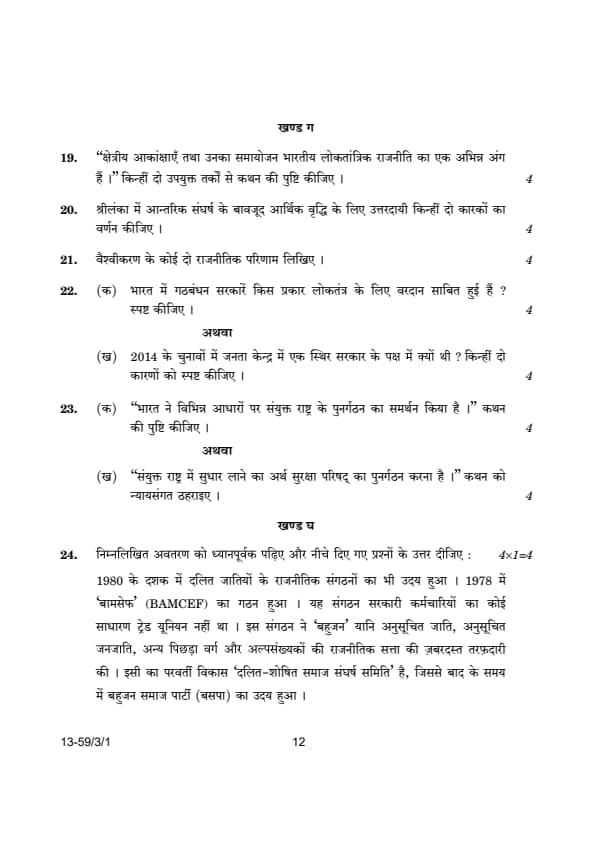
"Regional aspirations and their accommodation are an integral part of Indian democratic politics." Support the statement with any two suitable arguments.
View Solution
Step 1: Understanding Regional Aspirations in India.
India, being a vast and diverse country, has several regions with unique cultural, linguistic, and economic identities. Over time, these regional aspirations have become an important feature of its democratic process.
Step 2: Two Arguments Supporting the Statement.
Decentralization through Federalism: India’s political system is federal in nature, and the accommodation of regional aspirations is facilitated through the creation of states based on linguistic, cultural, and ethnic lines. For example, the reorganization of states in 1956 and 2000 addressed regional demands, providing greater autonomy and addressing specific regional needs, thus supporting the principle of regional aspirations.
Role of Regional Political Parties: Regional political parties have played a crucial role in Indian democracy. They represent regional issues and aspirations, ensuring their concerns are voiced at the national level. For example, parties like the DMK (Dravida Munnetra Kazhagam) in Tamil Nadu or the Shiv Sena in Maharashtra have influenced national policies, ensuring that regional aspirations are incorporated into the mainstream political discourse.
Conclusion: The accommodation of regional aspirations through federalism and the involvement of regional parties in the national discourse demonstrates the importance of regional aspirations in Indian democratic politics. Quick Tip: In India, regional aspirations are addressed through federalism, linguistic reorganization, and the active participation of regional political parties in national governance.
Describe any two factors responsible for the economic growth in Sri Lanka despite the internal conflicts.
View Solution
Step 1: Understanding Sri Lanka’s Economic Growth Despite Conflicts.
Sri Lanka faced prolonged internal conflicts, especially during the civil war with the Tamil Tigers (LTTE), but it has managed to achieve notable economic growth in recent years.
Step 2: Two Factors Responsible for Economic Growth.
Tourism and Export Growth: Sri Lanka’s tourism industry has been one of the primary drivers of economic growth. The country’s rich cultural heritage, beaches, and wildlife attract millions of tourists annually. Additionally, exports such as tea, textiles, and garments contribute significantly to the economy, providing foreign exchange and employment.
Foreign Investment and Infrastructure Development: Despite political instability, Sri Lanka has managed to attract foreign investments, especially from countries like China, India, and Japan. The government has invested heavily in infrastructure development, including ports, highways, and energy sectors, which has helped boost economic growth and create jobs.
Conclusion: Despite internal conflicts, Sri Lanka has seen growth through a thriving tourism sector, export-led industries, and substantial foreign investment in infrastructure. Quick Tip: Economic growth in Sri Lanka has been fueled by diversification into tourism, export sectors, and substantial foreign investment in infrastructure, helping the country recover from internal conflicts.
Write any two political consequences of globalization.
View Solution
Step 1: Understanding the Impact of Globalization.
Globalization refers to the process of increased interconnectedness and interdependence of the world’s markets and businesses. It has significant political implications for countries and their governments.
Step 2: Two Political Consequences of Globalization.
Enhanced International Cooperation: Globalization has led to increased political cooperation among countries, especially in international organizations such as the United Nations, World Trade Organization (WTO), and International Monetary Fund (IMF). These organizations foster collaboration on global issues like climate change, trade, and security.
Sovereignty Erosion and Policy Shifts: As countries become more interconnected, their political sovereignty can be challenged, particularly with regard to trade and economic policies. Countries are often pressured to align their domestic policies with global norms, leading to changes in labor laws, environmental standards, and economic policies, sometimes at the cost of local autonomy.
Conclusion: Globalization has led to both enhanced international cooperation and a shift in national sovereignty, as countries adopt global norms in response to interconnected markets and international pressures. Quick Tip: Globalization affects political sovereignty, but also brings countries closer in terms of international collaboration, especially in areas like trade and environmental issues.
(a) How did the coalition governments prove to be a boon for democracy in India? Explain.
View Solution
Step 1: Definition of Coalition Government
A coalition government is formed when no single political party has a clear majority and multiple smaller parties come together to form a majority. In India, coalition governments have often been the result of a multi-party system.
Step 2: Representation of Diverse Interests
Coalition governments have proved to be a boon for democracy by ensuring that a wider range of interests and regional aspirations are represented in the government. Since coalition partners often represent diverse communities and regions, their inclusion ensures that no section of society is marginalized.
Step 3: Promotion of Consensus Politics
Coalition governments require negotiation, compromise, and consensus-building, which helps in promoting democratic values. Political parties with different ideologies and programs come together to form a government, which encourages cooperation and dialogue, instead of confrontation.
Step 4: Strengthening Federalism
In a country like India, with a strong federal structure, coalition governments often help strengthen federalism. Regional parties have a greater role in national governance, which promotes decentralization and ensures that local issues are addressed at the national level.
Thus, coalition governments have promoted inclusivity, consensus, and federalism, making them a boon for Indian democracy. Quick Tip: Coalition governments have led to a more inclusive and representative form of governance, especially in a diverse country like India.
(b) In the 2014 elections, why were people in favour of a stable government at the Centre? Explain any two reasons.
View Solution
Step 1: Desire for Economic Growth and Development
In the 2014 general elections, people were looking for stability in the government because they believed that a stable government could efficiently handle economic reforms and policies that would promote growth. A stable government could ensure continuity in policies and attract foreign investment, which would ultimately lead to job creation and infrastructure development.
Step 2: Dissatisfaction with Previous Governments
There was widespread dissatisfaction with the performance of the previous coalition government, which was seen as ineffective and unable to address key issues like corruption, inflation, and unemployment. People felt that a stable government would be able to address these issues more decisively and restore public faith in the political system.
Thus, the desire for economic growth and dissatisfaction with the previous government led to the people’s preference for a stable government at the Centre during the 2014 elections. Quick Tip: A stable government is often associated with effective decision-making, which can lead to greater economic development and better governance.
"India has supported the restructuring of the United Nations on several grounds." Support the statement.
View Solution
Step 1: Understanding India’s Stance on UN Restructuring.
India has been a strong advocate for the restructuring of the United Nations (UN) primarily to make the organization more democratic, inclusive, and reflective of the global power dynamics of the modern world. India’s support for UN restructuring is rooted in several key factors.
Step 2: Two Grounds Supporting India’s Stance.
Need for Reforms in the Security Council: One of the major reasons India supports UN restructuring is the need for reforms in the UN Security Council. The Security Council, in its current form, is dominated by the five permanent members (the P5), which are not representative of the current geopolitical realities. India advocates for the inclusion of more permanent members, especially from underrepresented regions like Asia, Africa, and Latin America, to reflect the changing global power structure.
Representation of Developing Nations: India supports UN restructuring to ensure that the interests of developing countries are better represented. India, being a leader in the developing world, has consistently called for reforms to address the imbalance in global decision-making and to give more voice to the Global South in international affairs.
Conclusion: India’s support for restructuring the UN, particularly the Security Council, is grounded in its desire for more equitable representation and to ensure that the UN reflects the current global balance of power. Quick Tip: India has long advocated for reforms in the UN, especially focusing on the need for a more representative and democratic Security Council to address contemporary geopolitical realities.
"Reforming the United Nations means restructuring of the Security Council." Justify the statement.
View Solution
Step 1: Understanding the Role of the Security Council in the UN.
The UN Security Council (UNSC) is the body primarily responsible for maintaining international peace and security. It has 15 members, of which five are permanent members (the P5) with veto power, and 10 are elected non-permanent members. The P5 includes the United States, Russia, China, France, and the United Kingdom, who were the victorious powers in World War II.
Step 2: Justifying the Statement.
Central Role of the Security Council in Global Governance: The Security Council has significant authority in the UN system, especially when it comes to decisions related to war, peace, and international conflict. Since the Security Council is the most influential body in the UN, any reform of the UN is often equated with reforming the UNSC. Without restructuring the Security Council to include more representative members, any attempt to reform the UN would be incomplete.
Imbalance in Representation: The current composition of the UNSC, with the P5 holding disproportionate power, is increasingly seen as anachronistic and unreflective of the modern world order. This has led to calls for restructuring the Security Council to include more countries as permanent members, including India, Brazil, Germany, and Japan, who are seen as deserving based on their contributions to global peace and security. Restructuring the Security Council would be the first step in reforming the entire UN system to reflect contemporary global realities.
Conclusion: Since the Security Council holds the most power within the UN, restructuring it is a critical aspect of any comprehensive UN reform. Without this restructuring, the UN will remain limited in its ability to address global challenges effectively. Quick Tip: The restructuring of the UN is often synonymous with reforming the Security Council due to its central role in decision-making regarding global peace and security. A more representative Security Council would strengthen the legitimacy of the UN.
Read the following passage carefully and answer the questions that follow :
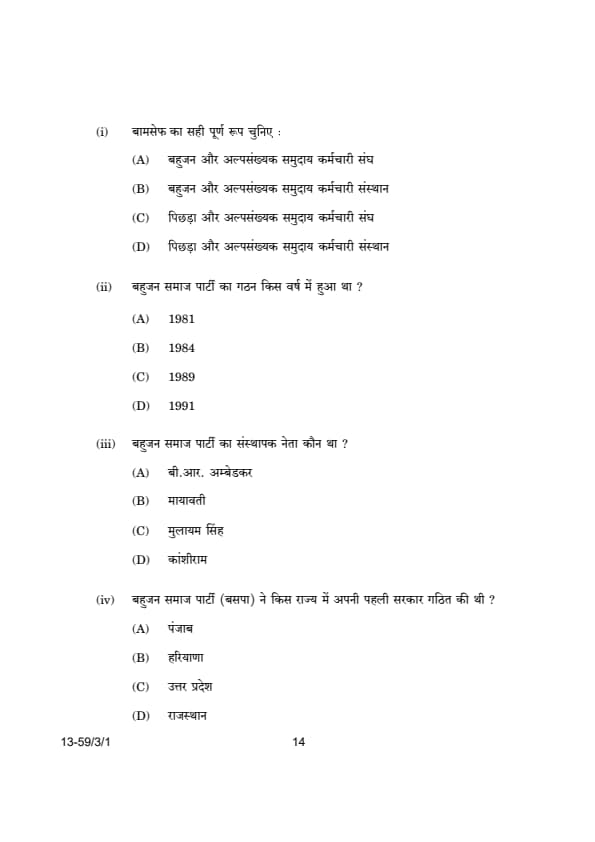
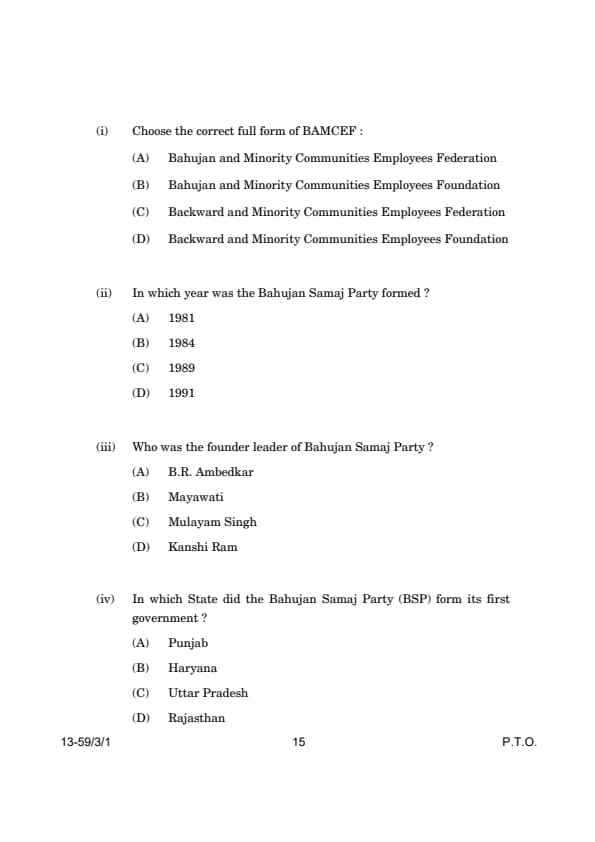
The 1980s also saw the rise of political organisations of the Dalits. In 1978 the ‘BAMCEF’ was formed. This organisation was not an ordinary trade union of government employees. It took a strong position in favour of political power to the ‘bahujan’ – the SC, ST, OBC and minorities. It was out of this that the subsequent Dalit Shoshit Samaj Sangharsh Samiti and later the Bahujan Samaj Party (BSP) emerged.
(i). Choose the correct full form of BAMCEF:
View Solution
Step 1: Understanding BAMCEF.
BAMCEF, formed in 1978, stands for the Backward and Minority Communities Employees Federation. It was an organization that worked to represent the interests of the SC, ST, OBC, and minority groups, especially in government employment.
Step 2: Eliminating Other Options.
Option (A) and (B) are incorrect because they refer to "Bahujan" instead of "Backward," and the term "Employees Foundation" is not used.
Option (D) is also incorrect for similar reasons.
Conclusion: Therefore, the correct answer is (C) Backward and Minority Communities Employees Federation. Quick Tip: BAMCEF was focused on representing the backward and minority communities, especially in government employment.
In which year was the Bahujan Samaj Party formed?
View Solution
Step 1: Understanding the Formation of BSP.
The Bahujan Samaj Party (BSP) was formed in 1984 by Kanshi Ram, following the efforts of the Dalit Shoshit Samaj Sangharsh Samiti. It was created to represent the interests of the Dalits, OBCs, and other marginalized groups.
Step 2: Reviewing Other Options.
Option (A), (C), and (D) are incorrect as the BSP was not formed in these years.
Conclusion: The correct year of formation is 1984 (Option B). Quick Tip: The Bahujan Samaj Party (BSP) was founded in 1984 to address the political and social needs of Dalits and other marginalized communities.
Who was the founder leader of Bahujan Samaj Party?
View Solution
Step 1: Understanding the Leadership of BSP.
The Bahujan Samaj Party (BSP) was founded by Kanshi Ram in 1984. He was the leader of the Dalit Shoshit Samaj Sangharsh Samiti, which later transformed into the BSP.
Step 2: Reviewing Other Options.
Option (A), (B), and (C) are incorrect because they refer to leaders not involved in the founding of the BSP.
Conclusion: The founder leader of BSP is Kanshi Ram (Option D). Quick Tip: Kanshi Ram is the founder of the Bahujan Samaj Party, which emerged as a political force to represent the marginalized communities in India.
In which State did the Bahujan Samaj Party (BSP) form its first government?
View Solution
Step 1: Understanding BSP’s First Government.
The Bahujan Samaj Party (BSP) formed its first government in Uttar Pradesh, under the leadership of Mayawati, in the late 1990s.
Step 2: Reviewing Other Options.
- Option (A), (B), and (D) are incorrect as the BSP's first government was in Uttar Pradesh.
Conclusion: The BSP formed its first government in Uttar Pradesh (Option C). Quick Tip: The BSP, under Mayawati’s leadership, formed its first government in Uttar Pradesh, marking a significant achievement for Dalit-led political parties in India.
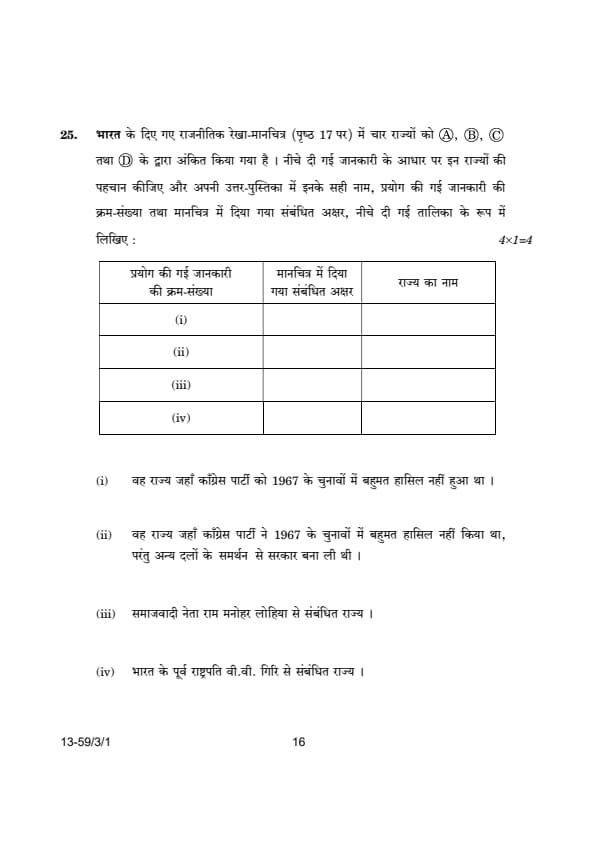
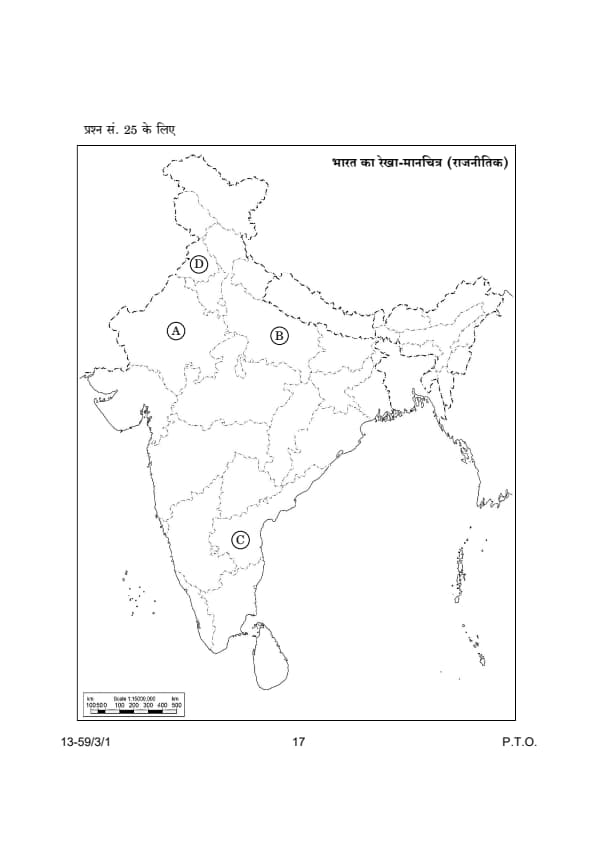
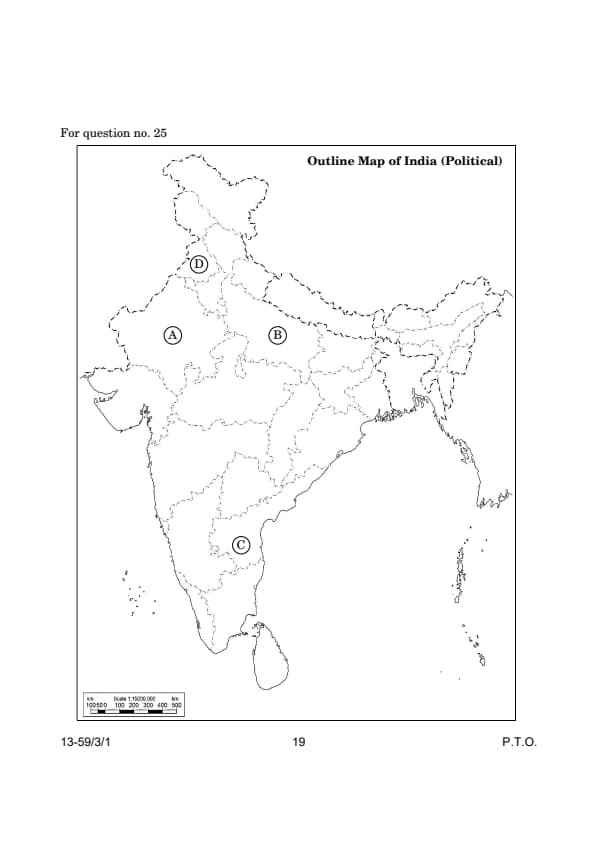
In the given political outline map of India (on page 19), four States have been marked as A, B, C, and D. Identify these States on the basis of the information given below and write their correct names in your answer-book along with the respective serial number of the information used and the concerned alphabets given in the map as per the following format:

(i). The State where the Congress party did not secure majority in 1967 elections.
(ii). The State where Congress party did not secure majority in 1967 elections but formed the government with the support of other parties.
(iii). The State related to Samajwadi leader, Ram Manohar Lohia.
(iv). The State related to the former President of India, V.V. Giri.

View Solution
Step 1: Identification of States based on the given information:
(i) The State where the Congress party did not secure majority in 1967 elections:
This refers to the state where Congress faced strong opposition and could not achieve a majority in the elections. The state marked as "A" in the map is Punjab.
(ii) The State where Congress party did not secure majority in 1967 elections but formed the government with the support of other parties:
This refers to a state where the Congress, despite not securing a majority, managed to form a coalition government. The state marked as "B" in the map is Rajasthan.
(iii) The State related to Samajwadi leader, Ram Manohar Lohia:
Ram Manohar Lohia was a prominent socialist leader and his influence was strongest in certain regions. The state marked as "C" in the map is Uttar Pradesh.
(iv) The State related to the former President of India, V.V. Giri:
V.V. Giri, the former President of India, was associated with the state marked as "D" in the map, which is Andhra Pradesh.
Thus, the States identified are:
(i) A = Punjab
(ii) B = Rajasthan
(iii) C = Uttar Pradesh
(iv) D = Andhra Pradesh
Quick Tip: In map-based questions, always check the location and historical significance of the state mentioned in the information to make accurate identifications.
Which popular slogan was given by Lal Bahadur Shastri?
View Solution
Lal Bahadur Shastri, the second Prime Minister of India, is best known for the slogan "Jai Jawan Jai Kisan" (Hail the soldier, Hail the farmer). This slogan was given during the 1965 India-Pakistan war to encourage both the Indian military and the farming community.
Conclusion: The popular slogan given by Lal Bahadur Shastri was "Jai Jawan Jai Kisan". Quick Tip: The slogan "Jai Jawan Jai Kisan" was meant to inspire both the Indian military and the farmers, who were vital during the war and for the economy.
Which decade of Indian politics has been referred to as the ‘dangerous decade’?
View Solution
The 1960s in Indian politics has been referred to as the 'dangerous decade'. During this period, India faced significant challenges, including the 1962 Sino-Indian war, the 1965 India-Pakistan war, and economic difficulties such as food shortages. These events led to political and social instability, making the 1960s a volatile time for the country.
Conclusion: The decade referred to as the 'dangerous decade' in Indian politics is the 1960s. Quick Tip: The 1960s in India were marked by wars with China and Pakistan, as well as economic crises, contributing to the term 'dangerous decade.'
Which candidate was supported by Indira Gandhi for the post of President in 1969?
View Solution
In the 1969 presidential elections, Indira Gandhi supported V. V. Giri for the post of President of India. This was a critical moment in Indian politics as Indira Gandhi's support for Giri went against the Congress party's official candidate, N. Sanjiva Reddy.
Conclusion: The candidate supported by Indira Gandhi for the post of President in 1969 was V. V. Giri. Quick Tip: The 1969 presidential elections were a turning point in Indian politics, with Indira Gandhi supporting V. V. Giri against the Congress official candidate.
Which State is related to the phrase ‘Aya Ram, Gaya Ram’?
View Solution
The phrase "Aya Ram, Gaya Ram" refers to the State of Haryana. It originated from the frequent defections of elected representatives in Haryana in the 1960s. The phrase reflects the instability and frequent switching of political allegiances by members of the legislative assembly at the time.
Conclusion: The State related to the phrase "Aya Ram, Gaya Ram" is Haryana. Quick Tip: "Aya Ram, Gaya Ram" refers to political instability, especially in Haryana during the 1960s, when many elected representatives frequently changed parties.
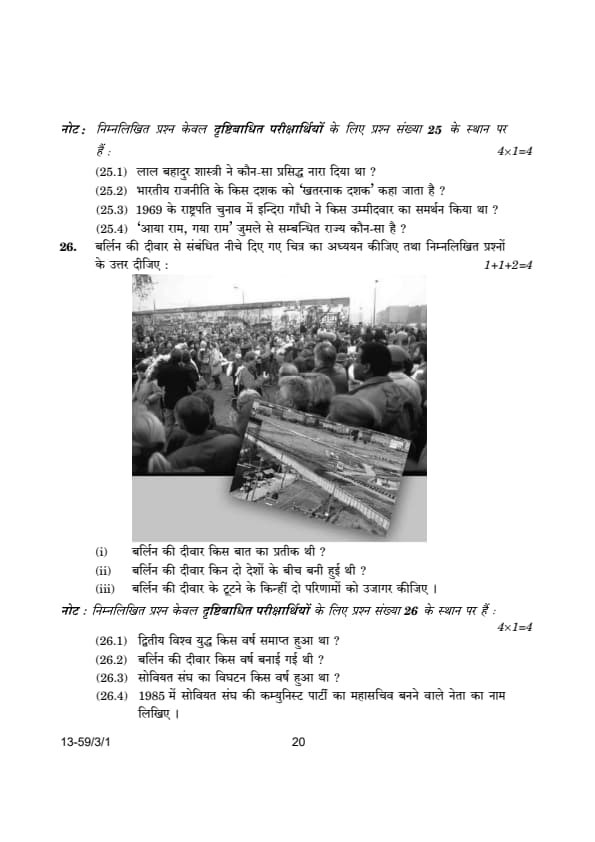
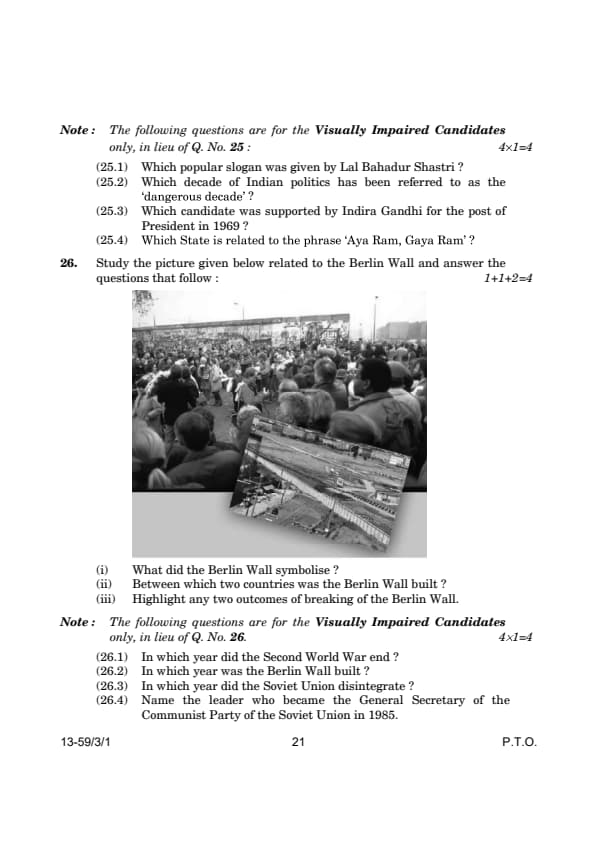
Study the picture given below related to the Berlin Wall and answer the questions that follow :

(i). What did the Berlin Wall symbolise?
View Solution
Step 1: The Berlin Wall as a Symbol.
The Berlin Wall symbolised the division between the communist East Germany (under Soviet influence) and the democratic West Germany (under Western influence), particularly during the Cold War. It represented the physical and ideological divide between the Eastern Bloc (led by the Soviet Union) and the Western Bloc (led by the United States).
Step 2: The Wall as a Barrier.
It was constructed to prevent East Germans from fleeing to West Berlin and symbolised the broader Cold War conflict between the superpowers, the United States and the Soviet Union.
Conclusion: Therefore, the Berlin Wall symbolised the division between communism and democracy during the Cold War. Quick Tip: The Berlin Wall was a symbol of the ideological conflict between the Soviet-led Eastern Bloc and the Western democratic world during the Cold War.
Between which two countries was the Berlin Wall built?
View Solution
Step 1: Identifying the Countries.
The Berlin Wall was built between East Germany (German Democratic Republic) and West Germany (Federal Republic of Germany). It physically divided the city of Berlin into two parts, with East Berlin controlled by the communist government of East Germany and West Berlin controlled by the Western Allies.
Conclusion: Therefore, the Berlin Wall was built between East Germany and West Germany. Quick Tip: The Berlin Wall divided East and West Germany, marking the physical and ideological divide between the Eastern Bloc and the Western Bloc during the Cold War.
Highlight any two outcomes of breaking the Berlin Wall.
View Solution
Step 1: Reunification of Germany.
The breaking of the Berlin Wall led to the reunification of Germany in 1990. This allowed East Germany and West Germany to become one unified country, marking the end of the division between East and West.
Step 2: End of the Cold War.
The fall of the Berlin Wall is also seen as a symbol of the end of the Cold War between the Soviet Union and the United States. It led to the collapse of communist regimes in Eastern Europe and signalled a shift towards democratic governance in the region.
Conclusion: The two major outcomes were the reunification of Germany and the end of the Cold War. Quick Tip: The fall of the Berlin Wall had significant geopolitical implications, leading to the reunification of Germany and marking the symbolic end of the Cold War.
In which year did the Second World War end?
View Solution
The Second World War ended in 1945. This marked the conclusion of the war with the surrender of Germany in May 1945 (V-E Day) and the surrender of Japan in September 1945 (V-J Day).
Conclusion: The Second World War ended in 1945. Quick Tip: The Second World War ended with the unconditional surrender of Germany and Japan in 1945, bringing an end to the deadliest conflict in human history.
In which year was the Berlin Wall built?
View Solution
The Berlin Wall was built in 1961. It was erected by the German Democratic Republic (East Germany) to stop the mass emigration from East Berlin to West Berlin, which had become a focal point of the Cold War division between East and West.
Conclusion: The Berlin Wall was built in 1961. Quick Tip: The Berlin Wall was built in 1961 to prevent East Germans from fleeing to West Berlin, marking the division of Germany during the Cold War.
In which year did the Soviet Union disintegrate?
View Solution
The Soviet Union disintegrated in 1991. The dissolution of the Soviet Union was a result of various factors, including economic stagnation, political instability, and the increasing demands for independence by the Soviet republics.
Conclusion: The Soviet Union disintegrated in 1991. Quick Tip: The Soviet Union disintegrated in 1991, leading to the independence of 15 republics and the end of the Cold War.
Name the leader who became the General Secretary of the Communist Party of the Soviet Union in 1985.
View Solution
The leader who became the General Secretary of the Communist Party of the Soviet Union in 1985 was Mikhail Gorbachev. He introduced reforms like Glasnost (openness) and Perestroika (restructuring) to address the economic and political challenges faced by the Soviet Union.
Conclusion: Mikhail Gorbachev became the General Secretary in 1985. Quick Tip: Mikhail Gorbachev, who became the General Secretary of the Soviet Union in 1985, initiated significant reforms that eventually led to the end of the Cold War and the dissolution of the Soviet Union.
SECTION-E
Question 27:
(a) In what ways has the principle of 'common but differentiated responsibilities' helped in addressing and overcoming the differences between the 'Global North' and 'Global South' over environmental issues? Explain.
View Solution
Step 1: Definition of Common But Differentiated Responsibilities (CBDR)
The principle of 'common but differentiated responsibilities' (CBDR) was first introduced in the 1992 Rio Earth Summit and is a critical concept in international environmental law. It recognizes that while all nations share the responsibility for addressing global environmental problems, such as climate change, the level of responsibility should vary depending on each country’s historical contribution to the problem and its capacity to deal with it.
Step 2: Global North vs. Global South
The 'Global North' refers to the developed nations, which have historically contributed the most to environmental degradation, especially in terms of carbon emissions. The 'Global South' refers to the developing countries that are less responsible for environmental damage but are more vulnerable to its impacts. These differences have often caused tensions in international climate negotiations.
Step 3: Addressing and Overcoming Differences
The principle of CBDR helps bridge these differences by acknowledging that while the Global North has a greater historical responsibility, the Global South faces more immediate threats from environmental degradation. As a result, the principle allows for the developed countries to take the lead in reducing emissions, while the developing nations are given flexibility in their developmental pursuits. This has led to various international agreements, including the Kyoto Protocol and the Paris Agreement, where developed countries commit to higher reduction targets and provide financial and technological assistance to developing countries.
Thus, CBDR fosters cooperation by recognizing the varied levels of responsibility and capacity among countries, making global agreements more equitable. Quick Tip: The principle of CBDR is key to balancing global environmental efforts with fairness, ensuring that developing countries are not unfairly burdened.
(b) Explain any three programmes initiated by the Government of India to protect and conserve the environment.
View Solution
Step 1: National Action Plan on Climate Change (NAPCC)
The National Action Plan on Climate Change (NAPCC) was launched in 2008 to address climate change in a holistic manner. It includes eight national missions that focus on key areas like solar energy, energy efficiency, sustainable agriculture, and water conservation. NAPCC emphasizes the importance of adapting to climate change while also mitigating its effects.
Step 2: Swachh Bharat Abhiyan (Clean India Mission)
The Swachh Bharat Abhiyan, launched in 2014, aims to clean up the streets, roads, and infrastructure of cities, towns, and rural areas. It focuses on waste management, promoting sanitation, and eliminating open defecation. The mission has contributed to improving public health and reducing environmental pollution by promoting cleanliness and waste disposal practices.
Step 3: Green India Mission
The Green India Mission, one of the eight national missions of the NAPCC, aims to increase the forest cover and enhance carbon sequestration. The mission focuses on afforestation, reducing deforestation, and ensuring the health of ecosystems. It also aims to strengthen the forest-based livelihoods of local communities.
Thus, these three programs — NAPCC, Swachh Bharat Abhiyan, and Green India Mission — play vital roles in India's efforts to conserve the environment and combat climate change. Quick Tip: India’s environmental policies are becoming more comprehensive, integrating both mitigation and adaptation strategies to protect its natural resources and combat climate change.
(a) Explain any three security challenges faced by the newly independent countries of Asia and Africa after the Second World War.
View Solution
Step 1: Threat of Colonialism and Neo-Colonialism
After gaining independence, many countries in Asia and Africa faced the challenge of neo-colonialism. Former colonial powers often retained significant influence through economic, political, and military means. Countries like India, Algeria, and several others had to deal with the lingering effects of colonial control, which hindered their political autonomy and security.
Step 2: Border Disputes and Ethnic Conflicts
Many newly independent countries inherited arbitrary borders drawn by colonial powers. These borders often did not align with ethnic, cultural, or religious boundaries, leading to numerous border disputes and internal conflicts. For instance, the partition of India and Pakistan in 1947 led to widespread violence and a prolonged conflict over Kashmir. Similarly, African countries such as Sudan faced ethnic divisions that resulted in prolonged conflicts.
Step 3: Cold War Rivalries and Proxy Wars
The newly independent countries also faced the challenge of being caught in the Cold War rivalry between the United States and the Soviet Union. Many of these nations were forced to align themselves with one of the superpowers, which often led to internal instability. Proxy wars, such as in Vietnam, Korea, and several African countries, were the result of this global struggle, destabilizing the regions further.
Thus, these newly independent nations faced colonial legacy, border issues, and Cold War politics as major security challenges. Quick Tip: Post-independence, countries in Asia and Africa faced a multitude of security threats that were largely a result of their colonial past and the emerging global order.
(b) Explain any three components of the Indian security strategy.
View Solution
Step 1: Military Power and Defense Readiness
India’s security strategy is grounded in maintaining a strong military capability. The country has invested in a robust defense infrastructure to safeguard its territorial integrity. The Indian Army, Navy, and Air Force are well-equipped, and India has also developed nuclear weapons as part of its deterrence strategy. The emphasis on defense readiness ensures that India can respond effectively to any external threats.
Step 2: Diplomatic Engagement and Regional Alliances
India’s security strategy includes diplomatic engagement to build strong ties with its neighbors and the international community. India has been a proponent of regional peace and has actively participated in organizations like SAARC (South Asian Association for Regional Cooperation) and ASEAN (Association of Southeast Asian Nations). Strategic partnerships with countries like the United States, Russia, and Japan are also key components of its security framework.
Step 3: Counterterrorism and Internal Security
Given the persistent threat of terrorism, India has developed an extensive counterterrorism strategy. This includes intelligence gathering, surveillance, and cooperation with international agencies to combat cross-border terrorism, particularly from its neighbor Pakistan. Additionally, India’s internal security measures focus on maintaining law and order, managing insurgencies, and countering extremism, particularly in regions like Jammu and Kashmir, and the North-East.
Thus, India’s security strategy combines military strength, diplomacy, and counterterrorism measures to address external and internal security threats. Quick Tip: A balanced approach combining military preparedness, diplomatic efforts, and internal security measures forms the backbone of India's security strategy.
Justify the ‘policy of Non-Alignment’ adopted by India, by giving any three arguments.
View Solution
Step 1: Independent Foreign Policy.
The policy of Non-Alignment was formulated to ensure that India maintained an independent foreign policy, free from the influence of both the United States and the Soviet Union during the Cold War. This allowed India to make decisions based on its national interests rather than aligning with any superpower.
Step 2: Peaceful Coexistence.
Non-Alignment was also seen as a commitment to **peaceful coexistence** and the avoidance of military alliances. India aimed to promote peace and stability by staying out of conflicts and supporting diplomatic solutions to international issues.
Step 3: Support for Third World Countries.
India's Non-Alignment policy also gave it the flexibility to support the **aspirations of newly independent countries** in Africa, Asia, and Latin America. India actively supported decolonization efforts and advocated for the rights of smaller nations in the international arena.
Conclusion: India’s Non-Alignment policy was a strategic decision to ensure its sovereignty, promote peace, and support the Third World. Quick Tip: Non-Alignment allowed India to maintain its independence in foreign policy while promoting peaceful coexistence and supporting the rights of emerging nations.
"Foreign policy of independent India has pursued the dream of a peaceful world." Support the statement with three suitable arguments.
View Solution
Step 1: Promotion of Peaceful Coexistence.
India’s foreign policy has consistently advocated for **peaceful coexistence** and global cooperation. This principle was central to India's stance during the Cold War, as it sought to avoid military confrontations and supported peaceful negotiations between nations.
Step 2: Support for Disarmament.
India has been a staunch proponent of **nuclear disarmament** and the peaceful resolution of conflicts. It has called for the elimination of nuclear weapons and has consistently worked towards building a world free from the threat of war.
Step 3: Advocacy for Multilateralism.
India's foreign policy has also emphasized **multilateralism** and the importance of international institutions like the United Nations in addressing global issues. India has played an active role in promoting the peaceful settlement of disputes through dialogue, including its involvement in peacekeeping missions worldwide.
Conclusion: India’s foreign policy has indeed pursued the dream of a peaceful world by promoting peaceful coexistence, disarmament, and multilateralism. Quick Tip: India's foreign policy has been focused on building a peaceful world through diplomatic engagement, disarmament, and active participation in international peace efforts.
(a) Describe any three major challenges faced by India at the time of independence in 1947.
View Solution
Step 1: Partition and its Consequences
The partition of British India in 1947 into India and Pakistan created severe political and social challenges. It resulted in massive violence, the displacement of millions of people, and a deep division between Hindus and Muslims. The boundary demarcation led to large-scale riots, loss of life, and widespread migration, particularly in Punjab and Bengal.
Step 2: Integration of Princely States
At the time of independence, India was not a fully unified country. It was composed of several princely states that were under the indirect control of the British Crown. The integration of these states into the Indian Union was a major challenge. Some princely states, such as Kashmir, Hyderabad, and Junagadh, had to be persuaded or even forcefully integrated into India, requiring significant diplomatic and military efforts.
Step 3: Economic Challenges and Poverty
India's economy at the time of independence was deeply underdeveloped, with widespread poverty, a poor industrial base, and agricultural backwardness. The country had to focus on building its economy from scratch, which was a difficult task given the limited resources and infrastructure. The new government had to focus on alleviating poverty, promoting industrialization, and ensuring food security.
Thus, the three major challenges faced by India at the time of independence were the partition and its aftermath, the integration of princely states, and the economic challenges faced by the newly independent nation. Quick Tip: The challenges of partition, integration of states, and economic underdevelopment were the major hurdles for India in the early years after independence.
(b) Describe any three major difficulties that came in the way of the partition of British India in 1947.
View Solution
Step 1: Religious and Communal Tensions
One of the major difficulties in the partition of British India was the growing religious and communal tensions between Hindus and Muslims. The demand for a separate Muslim state (Pakistan) led to deep divisions between the two communities, which resulted in violence, fear, and mistrust. This made the task of drawing a clear boundary between India and Pakistan challenging.
Step 2: Boundary and Territorial Disputes
The partition of India created several boundary disputes, particularly over the regions of Punjab and Bengal. These regions had mixed populations of Hindus, Muslims, and Sikhs, making the partition process highly complex. The process of demarcating the borders, especially the Radcliffe Line, led to confusion, violence, and a massive displacement of populations.
Step 3: Political and Administrative Hurdles
The British had planned the partition in a rushed manner, leaving very little time for proper administration and planning. The decision to divide India was taken hastily, without much regard for the existing social fabric, administrative systems, and local power dynamics. This lack of planning led to chaos during the partition, with issues such as refugee resettlement, law and order, and resource allocation causing severe difficulties.
Thus, the three major difficulties faced during the partition of British India were religious and communal tensions, boundary disputes, and political and administrative challenges. Quick Tip: The partition of India was not only a political process but also a social and humanitarian crisis, with far-reaching consequences for millions of people.



Comments