




The CBSE Class 12 Political Science Question Paper 2024 PDF is available for download here. CBSE conducted the Political Science exam on March 22, 2024, from 10:30 AM to 1:30 PM. The total marks for the theory paper are 80. The question paper contains 20% MCQ-based questions, 40% competency-based questions, and 40% short and long answer type questions. Students reported the exam to be of moderate difficulty level.
CBSE Class 12 Political Science (59/4/1) Question Paper 2024 with Answer Key
| CBSE Class 12 2024 Political Science Question Paper with Answer Key |  Download Download |
Check Solution |
CBSE Class 12 Political Science Question Paper 2024 with Answer Key
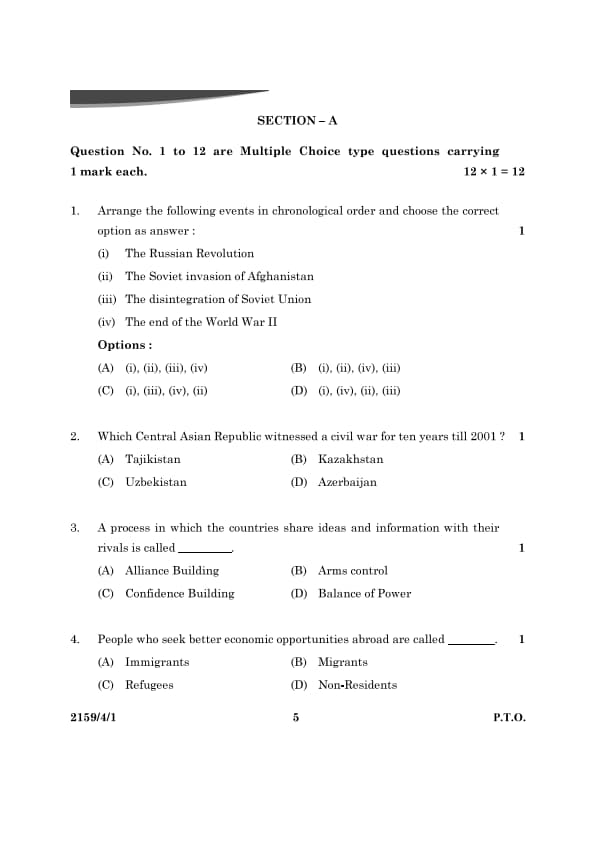
SECTION-A
Question 1:
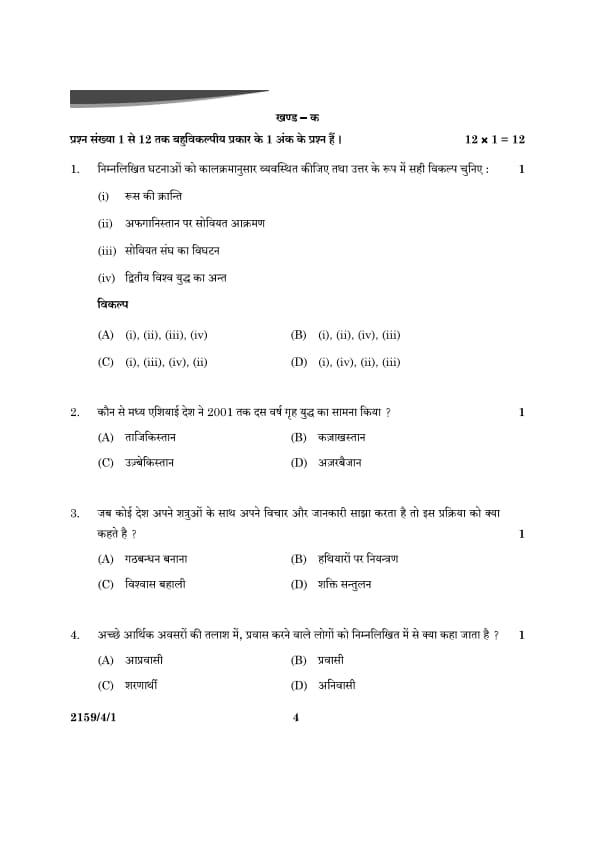
Arrange the following events in chronological order and choose the correct option as answer:
(i) The Russian Revolution
(ii) The Soviet invasion of Afghanistan
(iii) The disintegration of Soviet Union
(iv) The end of the World War II
View Solution
Step 1: Understand the events and recall the actual years.
The Russian Revolution (i) took place in 1917. It led to the rise of the Soviet Union.
The end of World War II (iv) occurred in 1945.
The Soviet invasion of Afghanistan (ii) began in 1979 and lasted till 1989.
The disintegration of the Soviet Union (iii) happened in 1991, marking the end of the USSR.
Step 2: Arrange them in chronological order based on their dates. \[ (i) \rightarrow 1917, \quad (iv) \rightarrow 1945, \quad (ii) \rightarrow 1979, \quad (iii) \rightarrow 1991 \]
So, the correct chronological order is: \[ (i), (iv), (ii), (iii) \] Quick Tip: Always associate major events with dates. Remember: Russian Revolution (1917), WWII ends (1945), Soviet-Afghan War (1979), USSR Disintegration (1991).
Which Central Asian Republic witnessed a civil war for ten years till 2001?
View Solution
Step 1: Identify the key timeline in the question.
The question mentions a civil war lasting ten years, ending in 2001. That means the conflict started around 1991.
Step 2: Match this information with the history of Central Asian republics.
Tajikistan went through a violent civil war starting in 1992, soon after the collapse of the Soviet Union. The conflict was fought between pro-government forces and the United Tajik Opposition, and was rooted in regional, ethnic, and political rivalries.
The war officially ended with a peace agreement in 1997, but violence and instability continued until 2001.
Kazakhstan, Uzbekistan, and Azerbaijan did not experience civil wars of such length or intensity during that period.
Therefore, the correct answer is Tajikistan. Quick Tip: Tajikistan is the only Central Asian nation that had a long-running civil war after the USSR's fall. Remember: Civil war (1992–2001), ended with peace efforts but took years to stabilize.
A process in which the countries share ideas and information with their rivals is called _______.
View Solution
Step 1: Understanding the context of international relations.
In international relations, countries often engage in various diplomatic practices to avoid conflict and build mutual trust, especially when tensions are high. One such method is the exchange of information and transparency about military movements, defense policies, or intentions.
Step 2: Evaluating the options.
(A) Alliance Building: This refers to forming strategic partnerships, often through formal agreements like NATO. However, it doesn't necessarily involve sharing ideas with rivals.
(B) Arms Control: This refers to agreements between countries to limit or regulate the number and type of weapons, not the sharing of ideas or information in general.
(C) Confidence Building: This involves transparency and communication between nations, including rivals, to build trust and avoid misunderstandings that might lead to conflict.
(D) Balance of Power: This is a strategic concept where power is distributed to prevent any one nation from dominating, and does not refer to mutual communication.
Step 3: Conclusion.
The process of sharing ideas and information with rivals to reduce suspicion and build trust is best described by Confidence Building. Quick Tip: In diplomacy, confidence-building measures (CBMs) include transparency in military affairs, prior notification of exercises, and communication hotlines to prevent accidental escalation.
People who seek better economic opportunities abroad are called ______.
View Solution
Step 1: Understanding the definitions.
Migrants: Individuals who move from one place to another, especially across borders, in search of better living conditions or economic opportunities. This movement can be temporary or permanent.
Immigrants: People who move into a new country with the intention of settling there permanently. This term is often used legally in immigration contexts.
Refugees: Individuals who are forced to flee their home country due to conflict, persecution, or disaster.
Non-Residents: Typically refers to individuals who reside outside their native country, often for legal or taxation purposes, but the term is broader and not specific to economic migration.
Step 2: Applying to the context.
Since the question mentions "people who seek better economic opportunities," it implies voluntary movement motivated by employment or improved living standards. This is the definition of a migrant.
Step 3: Conclusion.
Thus, the most appropriate and inclusive term for people moving abroad for better economic prospects is migrants. Quick Tip: “Migrant” is the broadest term that includes all people moving for economic, social, or environmental reasons — not necessarily forced like refugees.
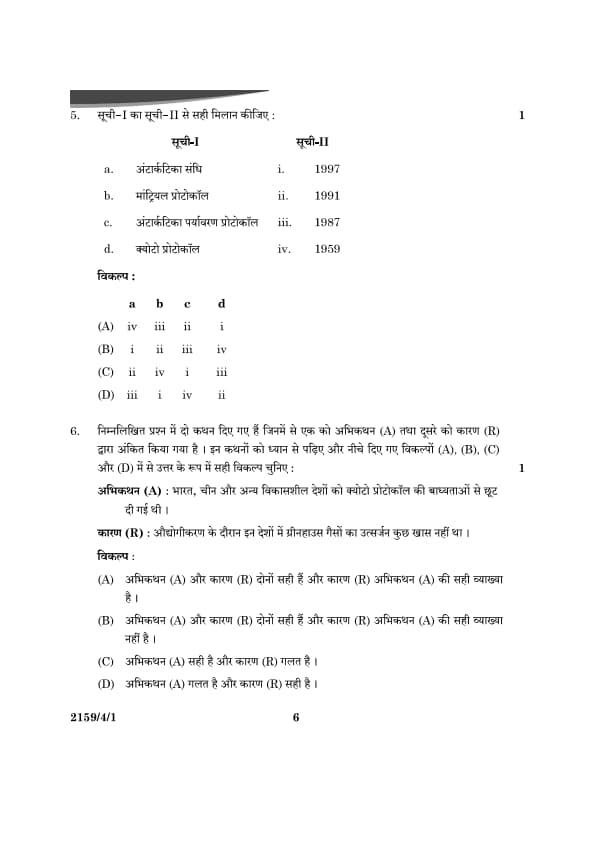
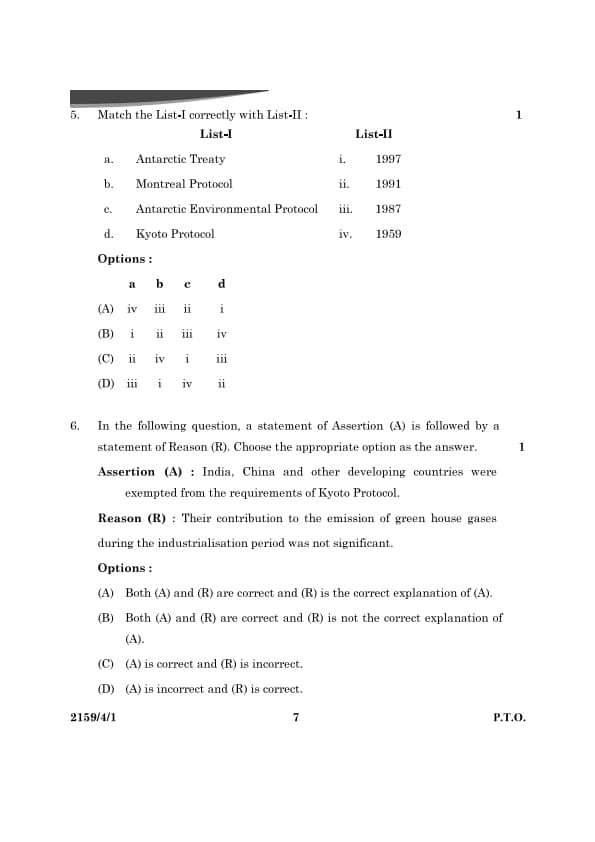
Match the List-I correctly with List-II :

View Solution
Step 1: Understand the dates of these protocols and treaties.
Antarctic Treaty (a) was signed in 1959 to regulate international relations with respect to Antarctica.
Montreal Protocol (b) was signed in 1987 to phase out substances responsible for ozone depletion.
Antarctic Environmental Protocol (c) was adopted in 1991 to protect the Antarctic environment.
Kyoto Protocol (d) was adopted in 1997 as an international treaty that commits state parties to reduce greenhouse gases.
Step 2: Match the events with their respective years.
From the given information, the correct matching is: \[ a \rightarrow iv (1959), \quad b \rightarrow iii (1987), \quad c \rightarrow ii (1991), \quad d \rightarrow i (1997). \]
Thus, the correct answer is (A). Quick Tip: When matching treaties and protocols with years, remember key environmental treaties like the Antarctic Treaty (1959), Montreal Protocol (1987), and Kyoto Protocol (1997). These are pivotal in international environmental law.
In the following question, a statement of Assertion (A) is followed by a statement of Reason (R). Choose the appropriate option as the answer.
View Solution
Step 1: Understanding the Kyoto Protocol.
The Kyoto Protocol is an international treaty that commits its parties to reducing greenhouse gas emissions, based on the premise that industrialized nations are primarily responsible for the high levels of greenhouse gases in the atmosphere. As a result, developing countries, including India and China, were exempted from certain obligations under the treaty.
Step 2: Evaluating the Reason.
The reason provided states that India, China, and other developing countries were exempt because their contribution to greenhouse gas emissions during industrialization was not significant. This is indeed the reason why these countries were granted exemptions under the Kyoto Protocol. Their historical contribution to emissions was much lower compared to developed nations, which had industrialized earlier and were major contributors to global greenhouse gases.
Step 3: Conclusion.
Both the assertion and the reason are correct, and the reason directly explains why the developing countries were exempt from the Kyoto Protocol’s requirements. Quick Tip: When studying international agreements like the Kyoto Protocol, remember that developing countries were exempt due to their lesser historical contribution to global emissions.
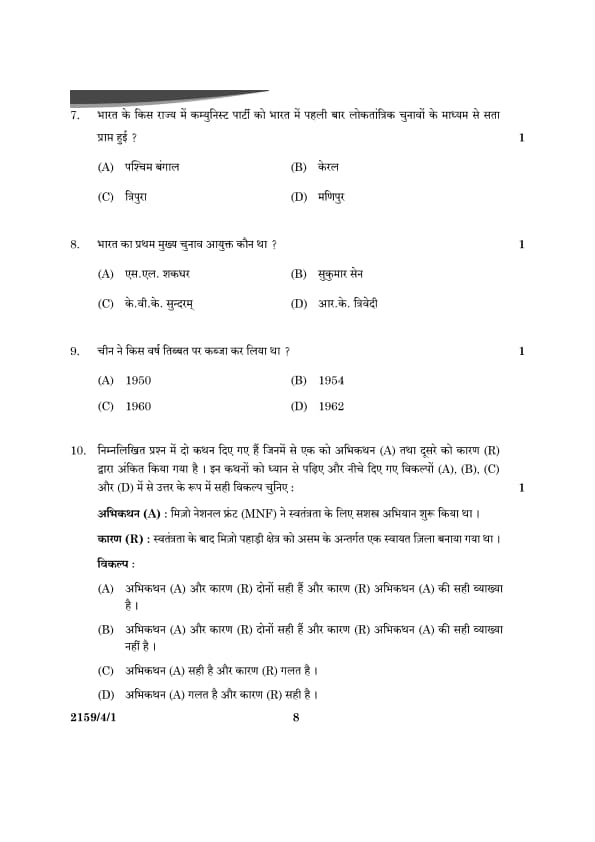
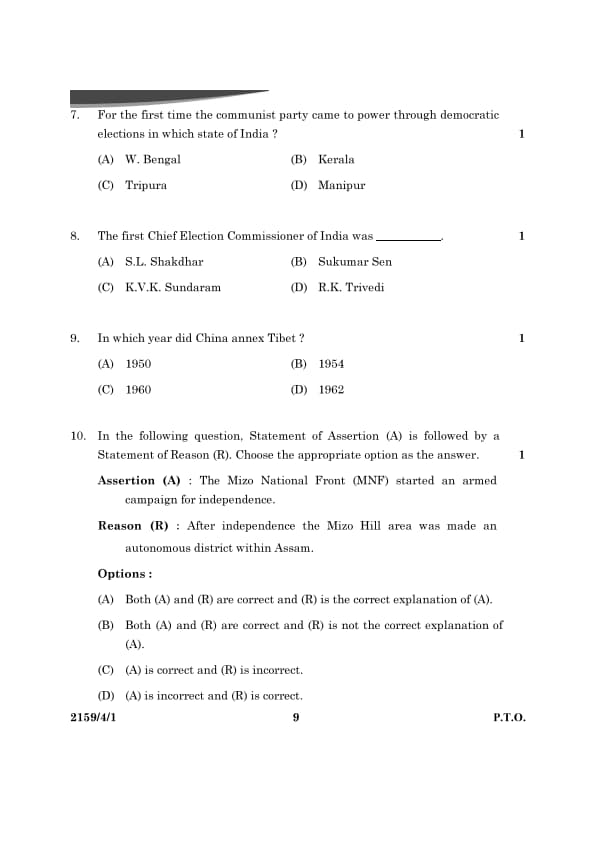
For the first time the communist party came to power through democratic elections in which state of India?
View Solution
Step 1: Historical context.
The first time a communist party came to power through democratic elections in India was in Kerala in 1957. This was a major event in Indian political history as it marked the rise of communism in a democratic context, with E.M.S. Namboodiripad becoming the Chief Minister of Kerala.
Step 2: Conclusion.
Hence, the correct answer is Kerala, as it was the first state where the Communist Party came to power through free and fair elections. Quick Tip: The election of 1957 in Kerala was a historic event in India, where the first democratically elected communist government took office.
The first Chief Election Commissioner of India was __________.
View Solution
Step 1: Understanding the role of Chief Election Commissioner.
Sukumar Sen was the first Chief Election Commissioner of India. He served from 1950 to 1958 and was instrumental in overseeing the first general elections in independent India in 1952.
Step 2: Conclusion.
Hence, the correct answer is Sukumar Sen, as he was the first to hold the post of Chief Election Commissioner in India. Quick Tip: Sukumar Sen's tenure as the first Chief Election Commissioner of India is notable for overseeing the first general elections in 1952.
In which year did China annex Tibet?
View Solution
Step 1: Understanding the historical event.
China annexed Tibet in 1950. This event is often referred to as the "Chinese invasion of Tibet." The People's Liberation Army (PLA) of China entered Tibet and took control, leading to the establishment of Chinese sovereignty over the region. Tibet was officially incorporated into China in 1951 under the "Seventeen Point Agreement."
Step 2: Conclusion.
Thus, the correct answer is 1950, the year China annexed Tibet. Quick Tip: The annexation of Tibet by China in 1950 was a critical moment in Sino-Tibetan relations and remains a controversial issue in international politics today.
In the following question, Statement of Assertion (A) is followed by Statement of Reason (R). Choose the appropriate option as the answer.
Assertion (A): The Mizo National Front (MNF) started an armed campaign for independence.
Reason (R): After independence the Mizo Hill area was made an autonomous district within Assam.
View Solution
Step 1: Understanding the assertion.
The Mizo National Front (MNF) indeed started an armed campaign for independence in the Mizo Hills (then part of Assam). This movement was a result of the Mizo people's desire for autonomy, and later it culminated in the formation of Mizoram in 1987.
Step 2: Understanding the reason.
After independence, the Mizo Hill area was indeed made an autonomous district within Assam, but the MNF’s armed campaign was not directly because of this. The creation of an autonomous district did not fully resolve the issues, and the MNF continued its struggle for full independence.
Thus, while both statements are true, the reason does not explain the assertion. Hence, the correct answer is (B). Quick Tip: Assertion and Reason questions often require understanding of historical context. Here, note the difference between the Mizo struggle for independence and the creation of the autonomous district.
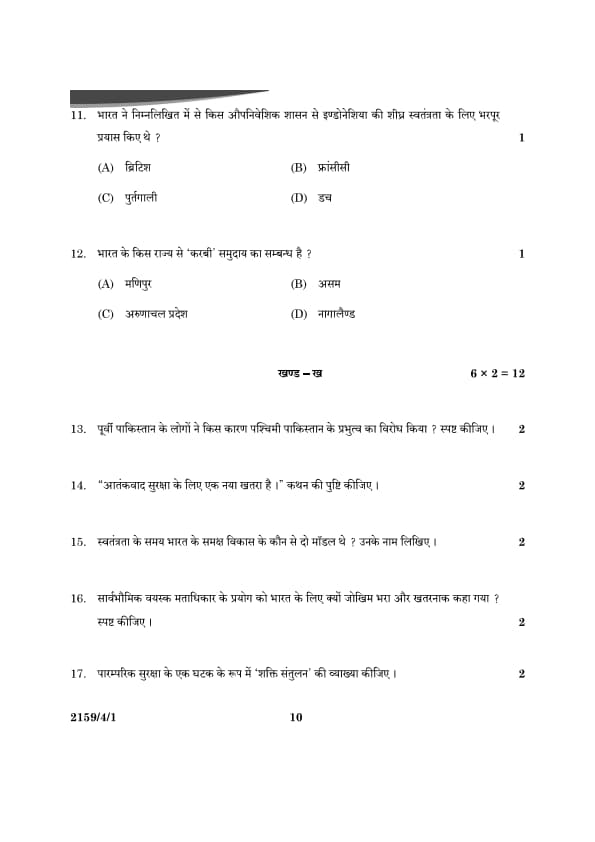
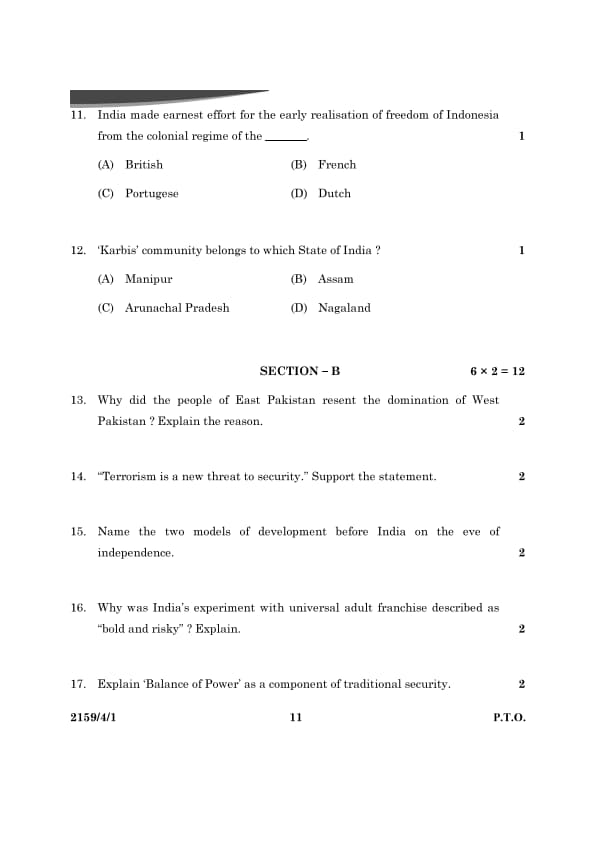
India made earnest effort for the early realisation of freedom of Indonesia from the colonial regime of the ______.
View Solution
India played a crucial role in supporting Indonesia's struggle for independence from colonial rule. At the time, Indonesia was under Dutch colonial control. India’s efforts were particularly significant after World War II, when the Dutch were forced to relinquish their control over Indonesia, leading to its independence in 1949.
Thus, the correct answer is (D) Dutch. Quick Tip: India’s foreign policy during the 1940s and 1950s focused on supporting anti-colonial movements in Asia, especially in Indonesia, which was under Dutch rule.
‘Karbis’ community belongs to which State of India?
View Solution
The Karbi community is primarily located in the Karbi Anglong district of Assam. This tribe is recognized as one of the indigenous communities in Assam. They speak the Karbi language and have a rich cultural heritage linked to the region.
Thus, the correct answer is (B) Assam. Quick Tip: The Karbi people are indigenous to Assam. It’s useful to remember their geographical location, which is central to Assam.
SECTION-B
Question 13:
Why did the people of East Pakistan resent the domination of West Pakistan? Explain the reason.
View Solution
Step 1: Understanding the issue of East Pakistan.
The people of East Pakistan (now Bangladesh) resented the domination of West Pakistan due to several reasons, primarily related to political, economic, and cultural disparities. East Pakistan was geographically separated from West Pakistan by about 1,600 kilometers of Indian territory. Despite contributing significantly to the economy, especially in terms of exports from agriculture (like jute), the people of East Pakistan were politically underrepresented. The central government in West Pakistan controlled all the major political decisions, and the resources were unfairly allocated, leaving East Pakistan economically underdeveloped.
Step 2: Additional factors of resentment.
Furthermore, the language issue also fueled the resentment. The majority in East Pakistan spoke Bengali, while Urdu was the official language imposed by West Pakistan. The lack of political autonomy, the imposition of policies favoring West Pakistan, and the feeling of being treated as second-class citizens led to widespread discontent and eventually culminated in the Bangladesh Liberation War, which resulted in the independence of Bangladesh in 1971. Quick Tip: The tension between East and West Pakistan is a classic example of regional imbalances and the importance of political representation in a federal system.
"Terrorism is a new threat to security." Support the statement.
View Solution
Step 1: Understanding terrorism as a threat.
Terrorism is considered a new threat to security in the modern world due to the evolving nature of global conflicts. Unlike traditional military warfare, terrorism involves non-state actors or groups using violence, fear, and intimidation to achieve political or ideological goals. The advent of technology, particularly the internet and social media, has allowed terrorist organizations to recruit, plan, and execute attacks globally.
Step 2: The global reach and impact.
Terrorism has no boundaries and can affect any nation, irrespective of its military strength or geographical location. High-profile incidents like the 9/11 attacks in the United States and recent terrorist activities across Europe and Asia demonstrate that terrorism poses a threat not only to national security but also to global peace and stability. The global nature of terrorism makes it a complex challenge for security forces worldwide.
Step 3: Conclusion.
Thus, terrorism, with its increasing sophistication and far-reaching impact, presents a modern and unique challenge to traditional security measures, which were designed to counter conventional threats from other nations. Quick Tip: Terrorism’s global reach and its use of unconventional tactics make it a significant and emerging threat to both national and international security.
Name the two models of development before India on the eve of independence.
View Solution
Step 1: Two models of development.
Before India gained independence in 1947, there were two primary models of development that were discussed for the country’s future. The first model was the industrialization model, which emphasized the development of industries, the establishment of factories, and the promotion of urbanization. The second model was the agrarian-based model, which focused on improving agricultural productivity and the welfare of rural areas, which made up the majority of India’s population.
Step 2: Explanation of both models.
The industrialization model was promoted by leaders like Jawaharlal Nehru and was based on the idea that industrialization would create jobs, foster economic growth, and reduce poverty. However, the agrarian model, championed by leaders like Mahatma Gandhi, emphasized the importance of improving the condition of rural India and saw agriculture as the backbone of India’s economy.
Step 3: Conclusion.
These two models of development were in stark contrast, with one focusing on industrial growth and the other on rural development, shaping the policy debates in India leading up to independence. Quick Tip: Both industrialization and agrarian development were crucial to India’s post-independence growth, but the balance between them continues to be a key challenge.
Why was India’s experiment with universal adult franchise described as "bold and risky"? Explain.
View Solution
Step 1: Context of universal adult franchise.
India’s decision to implement universal adult franchise immediately after independence in 1947 was described as "bold and risky" because it was unprecedented for a newly independent country with a large illiterate and rural population. Universal adult franchise means granting voting rights to every adult citizen, irrespective of their education, gender, or socioeconomic status.
Step 2: The risks involved.
At the time, India had a massive population of around 350 million, and the majority were illiterate and lived in rural areas. There was also a history of caste, religious, and regional divisions, which made it uncertain whether the masses could effectively use their voting rights. Furthermore, the country had limited administrative experience and infrastructure to conduct elections on such a large scale.
Step 3: Conclusion.
Despite these challenges, India’s leadership took the bold step of introducing universal adult franchise, believing it would strengthen the democratic fabric of the nation. Over time, this experiment proved successful and laid the foundation for India’s robust democratic processes. Quick Tip: India’s experiment with universal adult franchise is an example of how democracy can thrive even in a country with challenges such as illiteracy and poverty.
Explain ‘Balance of Power’ as a component of traditional security.
View Solution
Step 1: Understanding the balance of power concept.
The "balance of power" is a concept in international relations that refers to the distribution of military and economic power among states to prevent any one state from becoming dominant over others. In traditional security terms, the balance of power theory suggests that national security is best maintained when no single nation is strong enough to impose its will on others.
Step 2: Application in traditional security.
In the context of traditional security, the balance of power helps prevent war and conflicts by ensuring that no nation or group of nations can become so powerful that it can dictate the terms of international relations. This principle was particularly significant in Europe during the 19th century and early 20th century, where the balance between great powers like Britain, France, and Germany was seen as crucial to maintaining peace.
Step 3: Conclusion.
Thus, the balance of power plays a crucial role in traditional security by promoting stability and deterring aggression through a fair distribution of power among states. Quick Tip: The balance of power is a key idea in traditional security that works to prevent any one state from becoming too powerful, ensuring global stability.
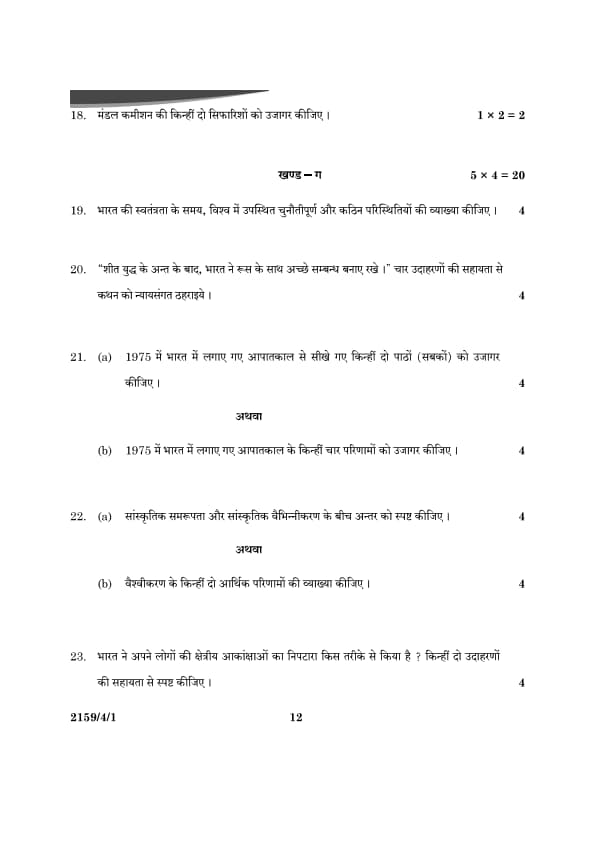
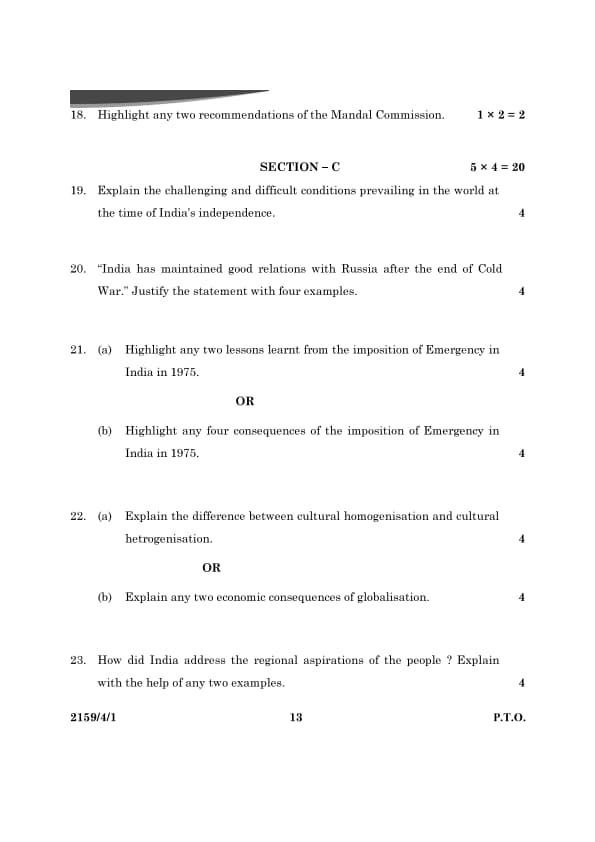
Highlight any two recommendations of the Mandal Commission.
View Solution
The Mandal Commission, established in 1979 under the leadership of B.P. Mandal, aimed at identifying the social and educational status of backward classes in India. The two key recommendations of the Mandal Commission were:
Reservation in Government Jobs: The Mandal Commission recommended that 27% of government jobs should be reserved for the Other Backward Classes (OBCs) in addition to the 22.5% reservation already available for Scheduled Castes (SCs) and Scheduled Tribes (STs). This recommendation was later implemented in 1990 by the government.
Reservation in Educational Institutions: The Commission also recommended that 27% of seats in educational institutions (including public universities) should be reserved for OBCs, thereby promoting the educational and social upliftment of these communities.
Step 1: Review the Recommendations
The primary aim of these recommendations was to address the economic and social disparities faced by the backward classes and to ensure their representation in government institutions.
Step 2: Impact of the Recommendations
The Mandal Commission’s recommendations, especially the reservation of 27% for OBCs, sparked intense political and social debates. While they aimed at bringing social justice, they also led to widespread protests in several parts of India, particularly by the youth. Despite the protests, the recommendations were eventually implemented, which significantly increased the representation of OBCs in government services and educational institutions. Quick Tip: The Mandal Commission’s focus was on uplifting the OBCs by providing them with more opportunities in both public jobs and education, promoting greater social equality.
SECTION-C
Question 19:
Explain the challenging and difficult conditions prevailing in the world at the time of India’s independence.
View Solution
At the time of India’s independence in 1947, several challenging and difficult conditions prevailed both globally and domestically. Some of the major challenges were:
Partition and Communal Tensions: The partition of British India into two independent nations, India and Pakistan, led to mass violence, displacement, and loss of lives. The country was divided along religious lines, resulting in one of the largest human migrations in history. This created long-lasting communal tensions.
Economic Disparities: India was left with a weak economy after 200 years of British colonial rule. The country’s economy was heavily dependent on agriculture, with widespread poverty, illiteracy, and a lack of industrialization. The agrarian sector was also suffering from British policies.
Political Instability: India faced significant political instability due to the diverse nature of its population. The country had to address the demands of multiple ethnic, cultural, and linguistic groups while dealing with the princely states that were still not integrated.
Global Power Shifts: The global situation was marked by the end of the Second World War and the onset of the Cold War. Countries were aligned with either the U.S. or the Soviet Union, which made India’s foreign policy decisions challenging, as it had to navigate these new global alignments while maintaining neutrality.
These conditions made India’s path to independence both challenging and tumultuous, requiring strong leadership and statesmanship to overcome. Quick Tip: When analyzing India’s independence, focus on the internal factors like partition and the economic condition as well as the external geopolitical shifts occurring at that time, such as the Cold War.
“India has maintained good relations with Russia after the end of Cold War.” Justify the statement with four examples.
View Solution
India has indeed maintained strong and cordial relations with Russia after the end of the Cold War. Some key examples of these sustained ties are:
Defense Cooperation: India and Russia have long been strategic defense partners. Post-Cold War, Russia continued to be India’s largest defense supplier, providing advanced military technology, including fighter jets, missiles, and naval systems. The cooperation has been significant in strengthening India’s defense capabilities.
Energy Partnership: Russia has been a critical partner for India in the energy sector. The two countries have collaborated in civil nuclear energy development. Russia has assisted India in the construction of nuclear reactors, and they have also worked on other energy-related projects like oil and gas exploration.
Diplomatic Support: Russia has consistently supported India on several diplomatic fronts, including the issue of Kashmir. Russia has been one of the few countries to back India’s stance on various international forums and has played an important role in maintaining India’s position in the United Nations.
Cultural and Educational Exchanges: India and Russia share strong cultural ties, with numerous cultural exchange programs, scholarships, and academic cooperation between the two countries. Russia has been a popular destination for Indian students, especially in the fields of engineering and medicine.
These examples illustrate that despite the dissolution of the Soviet Union and the changing global order, India and Russia have continued to maintain a close relationship based on mutual interests. Quick Tip: When discussing India-Russia relations, focus on strategic defense, energy, diplomacy, and cultural ties. These pillars continue to define the enduring friendship between the two nations.
Highlight any two lessons learnt from the imposition of Emergency in India in 1975.
View Solution
Step 1: Understanding the context of the Emergency in 1975.
The Emergency in India was declared by Prime Minister Indira Gandhi on the grounds of internal disturbances. It lasted from 1975 to 1977, during which civil liberties were suspended, elections were postponed, and political opposition was suppressed.
Step 2: Lessons Learned.
Lesson 1: Importance of safeguarding democratic institutions. The imposition of Emergency showed how fragile democratic institutions can be in a country, especially when executive powers are misused. The importance of maintaining checks and balances to ensure that any power doesn't become autocratic was highlighted.
Lesson 2: Need for the protection of civil liberties. The Emergency demonstrated the critical need to protect individual rights and freedoms, as these were suspended during the Emergency. The experience reinforced the need for legal safeguards against arbitrary actions by the state.
Step 3: Conclusion.
The imposition of the Emergency taught India the importance of preserving democracy and the necessity of maintaining constitutional safeguards against abuses of power. Quick Tip: The Emergency of 1975 is a stark reminder of the potential for authoritarianism in democracies, emphasizing the need for constant vigilance.
Highlight any four consequences of the imposition of Emergency in India in 1975.
View Solution
Step 1: Understanding the consequences of the Emergency.
The Emergency in India had far-reaching political, social, and economic consequences, many of which still affect Indian politics today.
Step 2: Four Consequences.
Consequences 1: Suspension of civil liberties. The most immediate effect was the suspension of fundamental rights, including freedom of speech, assembly, and the press. Political opponents were arrested, and censorship was imposed on the media.
Consequences 2: Centralization of power. The Emergency saw a dramatic shift in power towards the Prime Minister’s office. The executive exercised unchecked power, bypassing the legislative and judicial branches of the government.
Consequences 3: Political opposition was suppressed. Opposition leaders and activists were either arrested or forced into hiding. Political parties and groups that opposed the ruling party were not allowed to function freely during this time.
Consequences 4: The 1977 General Elections. Following the end of the Emergency, a general election was held in 1977, which resulted in a massive defeat for Indira Gandhi and her party, the Congress. This marked a significant shift in Indian politics, with the Janata Party coming to power.
Step 3: Conclusion.
The imposition of the Emergency had a profound impact on Indian politics and governance. It led to the erosion of democratic norms and civil liberties but also sparked a political awakening that later led to greater political accountability. Quick Tip: The Emergency of 1975 serves as a reminder of the potential dangers of unchecked political power and the importance of democratic institutions.
Explain the difference between cultural homogenisation and cultural heterogenisation.
View Solution
Cultural homogenisation and cultural heterogenisation are two opposing processes that occur in the context of globalization and cultural exchange.
Cultural Homogenisation: This process refers to the tendency of cultures becoming more similar or uniform due to the influence of global media, communication, and trade. It leads to the adoption of similar cultural norms, values, and practices across different societies, often resulting in the loss of distinct cultural identities. For example, the widespread influence of Western culture through movies, fashion, and food can lead to the homogenisation of local cultures.
Cultural Heterogenisation: In contrast, cultural heterogenisation refers to the process where global influences lead to the diversification and enrichment of cultures rather than their homogenisation. It emphasizes the idea that cultural exchange can result in the blending of different cultural practices, traditions, and identities. Rather than erasing differences, heterogenisation promotes the coexistence and enhancement of diverse cultures. An example of this is the global spread of cuisines where local flavors are merged with international influences, creating unique fusions.
Thus, the key difference lies in the impact on cultural diversity: homogenisation leads to cultural uniformity, while heterogenisation leads to cultural diversity and interaction. Quick Tip: When discussing cultural processes, remember that homogenisation tends to erase diversity, whereas heterogenisation encourages the mixing and preservation of cultural distinctiveness.
Explain any two economic consequences of globalization.
View Solution
Globalisation has had several significant economic consequences, some of which are:
Increased Trade and Investment: Globalisation has led to an increase in international trade and foreign direct investment (FDI). Countries are now more interconnected than ever, with multinational corporations establishing their presence across borders. This has opened up markets for goods, services, and capital, leading to economic growth and greater competition. For example, countries that were previously isolated or had protectionist policies are now integrated into the global economy.
Income Inequality: While globalisation has increased wealth in many countries, it has also contributed to growing income inequality. Developed countries have seen significant economic gains, while many developing nations have faced challenges in benefiting equally from global economic processes. The wealth generated from globalisation tends to be unevenly distributed, with a small percentage of the population controlling the majority of the resources, exacerbating the wealth gap.
These economic consequences highlight both the positive and negative effects of globalisation, which have created new opportunities as well as new challenges for countries and individuals. Quick Tip: When discussing economic consequences, focus on both the benefits (e.g., increased trade and investment) and the drawbacks (e.g., income inequality) of globalisation.
How did India address the regional aspirations of the people? Explain with the help of any two examples.
View Solution
Step 1: Understanding regional aspirations.
India is a vast country with diverse linguistic, cultural, and ethnic groups. After independence, it was crucial to address the regional aspirations of different groups in order to maintain unity and ensure equitable development. This was achieved through political, administrative, and constitutional measures.
Step 2: Two examples.
Example 1: Reorganization of states. One of the primary ways India addressed regional aspirations was through the reorganization of states based on linguistic lines. The States Reorganization Act of 1956 led to the creation of states like Andhra Pradesh for Telugu speakers, Maharashtra for Marathi speakers, and so on. This reorganization helped address the demands of linguistic minorities for greater representation and autonomy in governance.
Example 2: The creation of Jammu and Kashmir as a special state. Jammu and Kashmir was given special status under Article 370 of the Indian Constitution. This was a way to respect the unique cultural and political aspirations of the people of the region. It allowed the state a high degree of autonomy, while still maintaining its connection to the rest of India. The special status was a way of recognizing the historical and political context of the region.
Step 3: Conclusion.
India's efforts to address regional aspirations were essential for maintaining peace, stability, and unity in a diverse and vast nation. These measures, although not without challenges, helped prevent regional fragmentation and allowed the central government to engage with local needs effectively. Quick Tip: The reorganization of states based on language and the special status given to Jammu and Kashmir are key examples of India's approach to managing regional aspirations.
SECTION-D
Question 24:
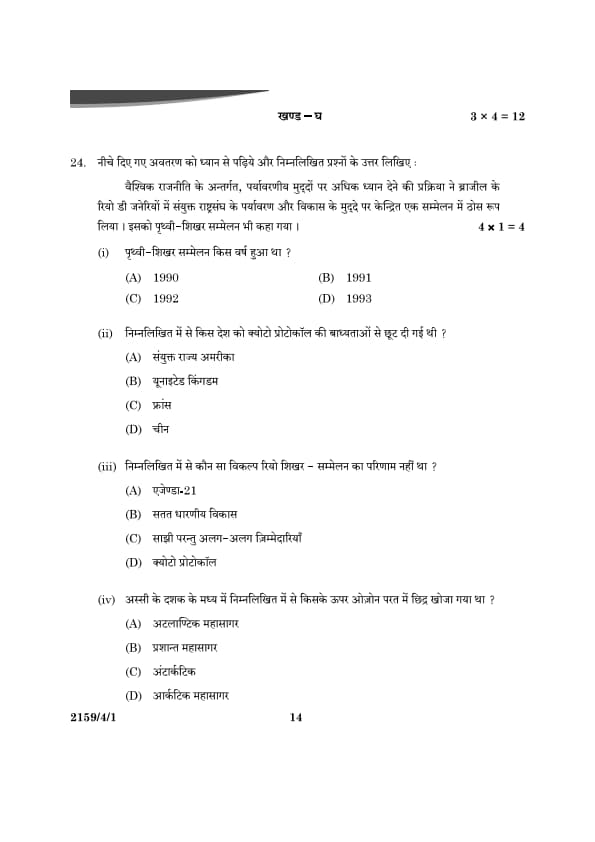
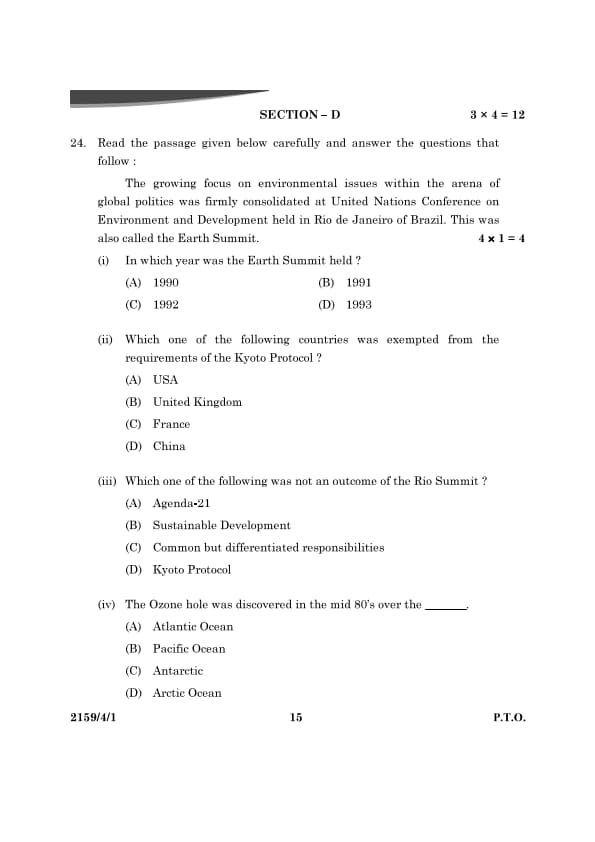
Read the passage given below carefully and answer the questions that follow:
The growing focus on environmental issues within the arena of global politics was firmly consolidated at United Nations Conference on Environment and Development held in Rio de Janeiro of Brazil. This was also called the Earth Summit.
(i). In which year was the Earth Summit held?
View Solution
The Earth Summit, formally known as the United Nations Conference on Environment and Development (UNCED), was held in Rio de Janeiro, Brazil, in 1992. This conference was a landmark event in global environmental policy. Quick Tip: The 1992 Earth Summit led to important environmental agreements such as Agenda 21, the Rio Declaration, and the Convention on Biological Diversity.
Which one of the following countries was exempted from the requirements of the Kyoto Protocol?
View Solution
The Kyoto Protocol, adopted in 1997, imposed binding emission reduction targets on developed countries. However, China, being a developing country at the time, was exempted from these obligations. Quick Tip: The Kyoto Protocol categorized countries into developed and developing nations, with only developed nations having binding emission reduction targets.
Which one of the following was not an outcome of the Rio Summit?
View Solution
The Rio Summit in 1992 led to Agenda 21, the principle of sustainable development, and the concept of "common but differentiated responsibilities." The Kyoto Protocol, however, was adopted later in 1997 as part of the UNFCCC process. Quick Tip: The Rio Summit focused on sustainable development, while the Kyoto Protocol (1997) specifically addressed climate change by setting emission targets.
The Ozone hole was discovered in the mid-80s over the ______.
View Solution
The ozone hole was first discovered over Antarctica in the mid-1980s. It was attributed to chlorofluorocarbon (CFC) emissions, leading to the 1987 Montreal Protocol, which aimed to phase out ozone-depleting substances. Quick Tip: The Montreal Protocol is a landmark agreement to protect the ozone layer by phasing out substances that cause ozone depletion.
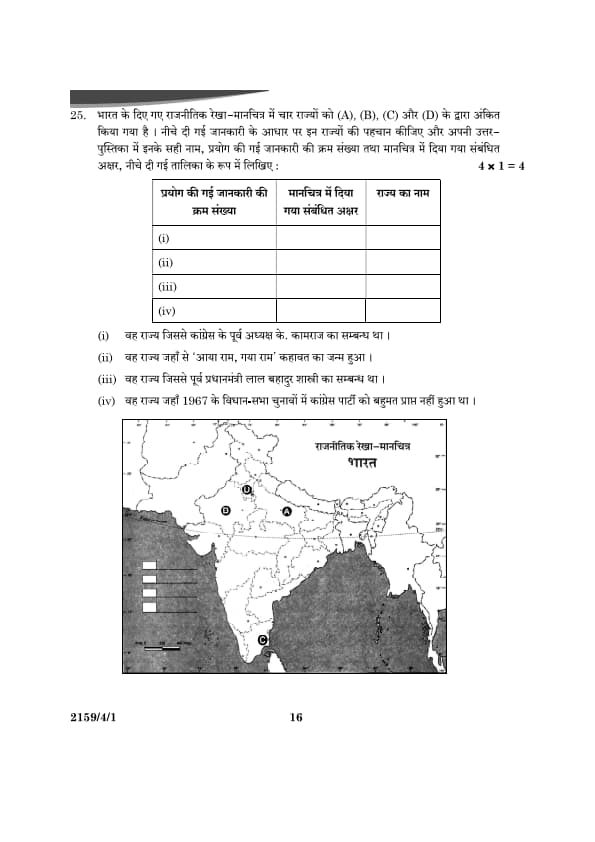
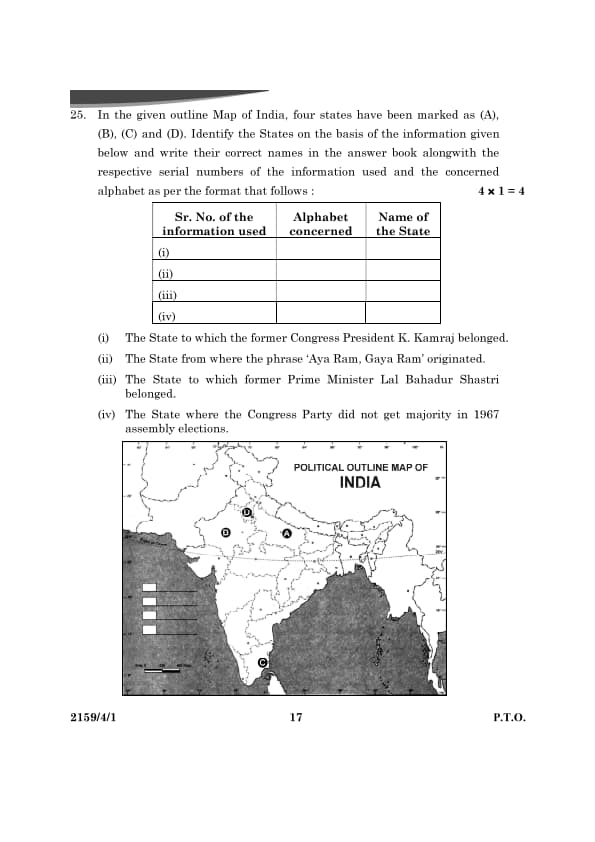
In the given outline Map of India, four states have been marked as (A), (B), (C), and (D). Identify the States on the basis of the information given below and write their correct names in the answer book along with the respective serial numbers of the information used and the concerned alphabet as per the format that follows :

(i) The State to which the former Congress President K. Kamraj belonged.
(ii) The State from where the phrase 'Aya Ram, Gaya Ram' originated.
(iii) The State to which former Prime Minister Lal Bahadur Shastri belonged.
(iv) The State where the Congress Party did not get majority in 1967 assembly elections.

View Solution
Step 1: (i) The State to which the former Congress President K. Kamraj belonged.
K. Kamraj was a senior Congress leader and served as the Chief Minister of Madras State (now Tamil Nadu). He was instrumental in implementing the mid-day meal scheme and later became the President of the Indian National Congress.
Answer: C – Tamil Nadu
Step 2: (ii) The State from where the phrase ‘Aya Ram, Gaya Ram’ originated.
The phrase ‘Aya Ram, Gaya Ram’ originated in Haryana in 1967 when MLA Gaya Lal switched parties multiple times within the same day. It became symbolic of political defections in India.
Answer: D – Haryana
Step 3: (iii) The State to which former Prime Minister Lal Bahadur Shastri belonged.
Lal Bahadur Shastri, the second Prime Minister of India, was born in Mughalsarai, which is located in present-day Uttar Pradesh. He is known for his slogan “Jai Jawan, Jai Kisan.”
Answer: A – Uttar Pradesh
Step 4: (iv) The State where the Congress Party did not get majority in 1967 assembly elections.
In the 1967 state assembly elections, the Congress Party failed to secure a majority in several states including Rajasthan. It was a landmark election that challenged Congress dominance at the state level.
Answer: B – Rajasthan Quick Tip: When identifying the states, remember the historical figures associated with them. K. Kamraj was a prominent leader from Tamil Nadu, and Lal Bahadur Shastri hailed from Uttar Pradesh.
Name the State where the Congress Party did not get majority in the 1967 assembly elections.
View Solution
The Congress Party did not get a majority in the 1967 assembly elections in Punjab. Quick Tip: The 1967 election saw a significant shift, particularly in Punjab, where the Congress Party faced its first defeat after independence.
Name the State to which the former Prime Minister Lal Bahadur Shastri belonged.
View Solution
Lal Bahadur Shastri belonged to the State of Uttar Pradesh. Quick Tip: Lal Bahadur Shastri, India’s second Prime Minister, hailed from Uttar Pradesh. He played a key role during the 1965 India-Pakistan war.
The phrase ‘Aya Ram, Gaya Ram’ originated from which State?
View Solution
The phrase \textit{‘Aya Ram, Gaya Ram’ originated in Haryana. Quick Tip: This phrase originated in Haryana and symbolizes the frequent defections of politicians in the 1960s.
The former Congress President K. Kamraj belonged to which State?
View Solution
K. Kamraj, the former Congress President, belonged to Tamil Nadu. Quick Tip: K. Kamraj was a prominent leader from Tamil Nadu who played a significant role in the Congress party during the 1960s.
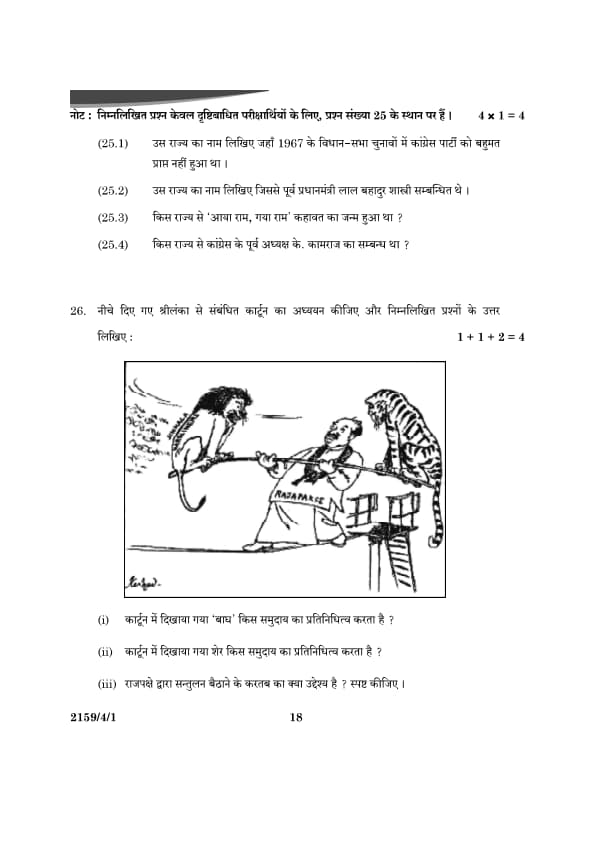
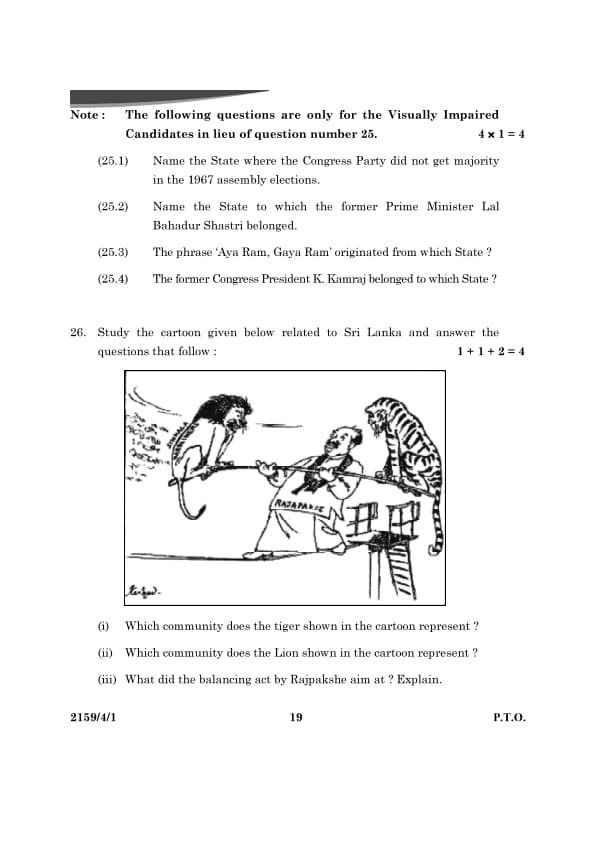
Study the cartoon given below related to Sri Lanka and answer the questions that follow :

26 (i). Which community does the tiger shown in the cartoon represent?
View Solution
Step 1: Understanding the symbol of the tiger.
In the context of Sri Lankan politics, the tiger represents the Tamil community, specifically the militant group known as LTTE (Liberation Tigers of Tamil Eelam).
Step 2: Conclusion.
Thus, the tiger shown in the cartoon represents the Tamil community of Sri Lanka. Quick Tip: The LTTE used the tiger symbol to represent Tamil nationalism and the demand for a separate Tamil state.
Which community does the lion shown in the cartoon represent?
View Solution
Step 1: Understanding the symbol of the lion.
The lion is a national symbol of Sri Lanka and is associated with the Sinhalese ethnic group, which forms the majority population in the country.
Step 2: Conclusion.
Hence, the lion shown in the cartoon represents the Sinhalese community. Quick Tip: The lion on the Sri Lankan national flag symbolizes the strength and identity of the Sinhalese majority.
What did the balancing act by Rajpakshe aim at? Explain.
View Solution
Step 1: Analyzing the cartoon.
The cartoon shows Mahinda Rajapaksa trying to balance a stick between a lion (Sinhalese) and a tiger (Tamil), which symbolizes the difficulty in managing the demands of both communities.
Step 2: Aim of the balancing act.
Rajapaksa’s balancing act aimed at maintaining national unity and political stability by dealing with the Tamil demands for autonomy and the Sinhalese majority’s demand for a strong, united Sri Lanka. It also reflected the efforts to manage civil unrest and ethnic violence.
Step 3: Conclusion.
The balancing act symbolized efforts to avoid civil war, manage ethnic tensions, and maintain control amidst rising separatist sentiments. Quick Tip: Balancing ethnic interests in a multi-community country like Sri Lanka requires careful negotiation and inclusive governance.
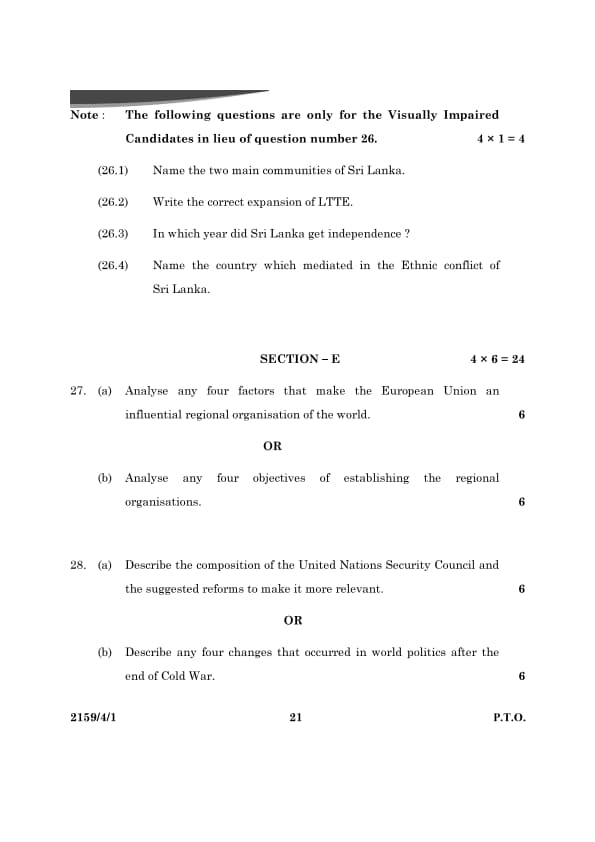
Name the two main communities of Sri Lanka.
View Solution
The two main communities of Sri Lanka are:
Sinhalese – The majority community.
Tamils – The minority community. Quick Tip: Ethnic tension between these two communities led to prolonged civil conflict in Sri Lanka.
Write the correct expansion of LTTE.
View Solution
LTTE stands for: Liberation Tigers of Tamil Eelam Quick Tip: The LTTE was a militant organization that demanded a separate Tamil state in Sri Lanka.
In which year did Sri Lanka get independence?
View Solution
Sri Lanka gained independence from British rule in the year 1948. Quick Tip: Sri Lanka was formerly known as Ceylon under British colonial rule.
Name the country which mediated in the Ethnic conflict of Sri Lanka.
View Solution
The country that mediated in the ethnic conflict of Sri Lanka was Norway. Quick Tip: Norway played a key role as a peace mediator during the early 2000s in the Sri Lankan civil conflict.
SECTION-E
Question 27(a):
Analyse any four factors that make the European Union an influential regional organisation of the world.
View Solution
The European Union (EU) is one of the most powerful and influential regional organisations in the world due to the following factors:
Economic Power: The EU forms the world’s largest economy when counted as a bloc. It accounts for a significant portion of the world’s GDP and international trade. Its economic strength allows it to exert influence in global financial institutions like the IMF and WTO.
Single Currency – Euro: The introduction of a common currency, the Euro, used by many EU countries, has enhanced economic integration, facilitated trade, and made the EU a strong monetary union.
Political Integration: The EU functions through various political institutions like the European Parliament and the European Commission. It plays a unified role in global political issues, including diplomacy, environmental agreements, and human rights advocacy.
Diplomatic and Military Influence: Although it does not have a unified military, the EU exercises considerable soft power through diplomacy, aid, and peacekeeping missions. Some EU member countries are also part of NATO, increasing their strategic global influence. Quick Tip: Remember the EU’s influence comes from its economic size, common currency, political unity, and strategic diplomatic power.
Analyse any four objectives of establishing the regional organisations.
View Solution
Regional organisations are established by countries within a geographical area to achieve common goals. The four main objectives include:
Promoting Peace and Security: Regional organisations aim to reduce tensions, prevent conflicts, and promote political stability among member states through dialogue, diplomacy, and cooperative frameworks.
Enhancing Economic Cooperation: They foster trade, investment, and economic integration among member countries. Common markets and free trade agreements increase regional development and competitiveness.
Addressing Common Issues: Regional organisations work together to solve shared challenges such as climate change, health crises, terrorism, and transnational crimes, which require collective responses.
Strengthening Regional Identity: Such organisations promote a sense of unity and regional identity among culturally or historically connected nations, encouraging solidarity and cooperation beyond national interests. Quick Tip: Regional organisations aim to maintain peace, boost economic ties, tackle common issues, and create a sense of shared identity.
Describe the composition of the United Nations Security Council and the suggested reforms to make it more relevant.
View Solution
Step 1: Composition of the United Nations Security Council (UNSC).
The United Nations Security Council (UNSC) is one of the six principal organs of the UN and is responsible for maintaining international peace and security. It has:
15 members in total.
5 permanent members (P5): China, France, Russia, the United Kingdom, and the United States. Each has the power of veto.
10 non-permanent members elected for two-year terms by the General Assembly. These seats are distributed based on geographical representation.
Step 2: Suggested reforms to make the UNSC more relevant.
Expansion of permanent membership: Countries like India, Germany, Japan, and Brazil have demanded permanent seats to reflect the contemporary global order.
Regional representation: Greater inclusion of developing nations from Africa, Latin America, and Asia.
Veto power reform: Calls to limit or abolish veto power to ensure more democratic decision-making.
Transparency and accountability: Making UNSC decisions more open and accountable to the UN General Assembly.
Step 3: Conclusion.
The current composition reflects the post-World War II power structure. Reforms are essential to enhance the UNSC’s legitimacy and effectiveness in addressing today’s global challenges. Quick Tip: India supports UNSC reforms through its association with the G4 nations — India, Germany, Japan, and Brazil — advocating for permanent membership.
Describe any four changes that occurred in world politics after the end of Cold War.
View Solution
Step 1: Understanding the post-Cold War world.
The Cold War ended in 1991 with the disintegration of the Soviet Union. This marked a major turning point in international politics and led to significant global changes.
Step 2: Four major changes in world politics after the Cold War.
Unipolar world order: The United States emerged as the sole superpower, ending the bipolar power structure of the Cold War era.
Emergence of new independent states: With the fall of the USSR, 15 new independent republics emerged in Eastern Europe and Central Asia.
Rise of globalisation: There was an increase in international trade, communication, and cultural exchange, promoting economic interdependence.
Shift from military to economic power: Global influence began to depend more on economic strength, technological advancement, and soft power.
Step 3: Conclusion.
The post-Cold War era brought about a significant transformation in international relations, focusing more on cooperation, economic development, and global security challenges. Quick Tip: The end of the Cold War led to the rise of regional organizations like the EU, ASEAN, and SAARC, promoting cooperation over confrontation.
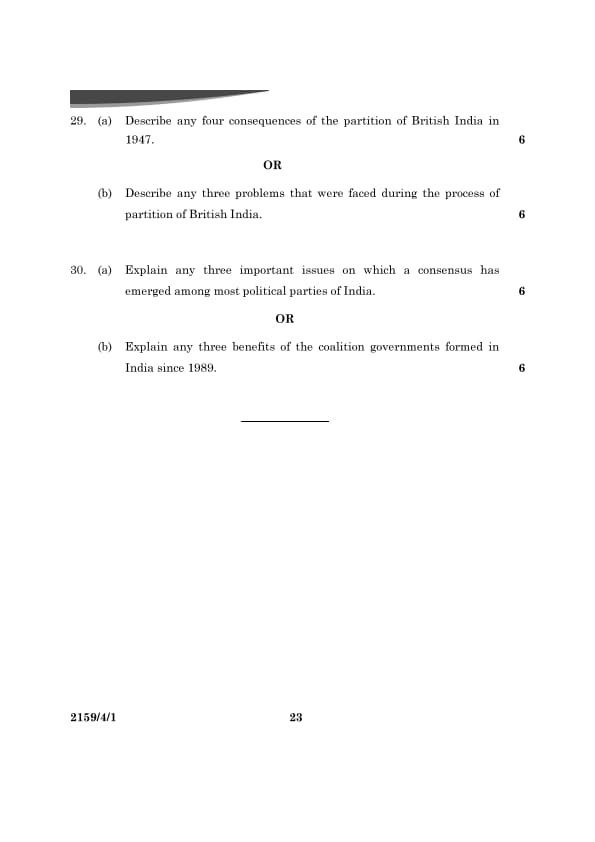
Describe any four consequences of the partition of British India in 1947.
View Solution
The partition of British India in 1947 into India and Pakistan had several long-lasting and painful consequences. Four major consequences include:
Mass Migration: One of the largest and most tragic mass migrations in human history took place. Nearly 10 to 15 million people crossed borders—Muslims moved to Pakistan, while Hindus and Sikhs moved to India—leading to chaos and hardship.
Communal Violence: Partition triggered horrific communal riots, massacres, and violence. It is estimated that nearly one to two million people lost their lives, and many women were abducted or raped.
Refugee Crisis: Both countries faced an enormous refugee crisis. India had to accommodate millions of displaced people, which strained its resources and led to social and economic tensions in many regions.
Political and Administrative Challenges: Partition disrupted the functioning of the government, divided civil services, military, railways, and even treasury reserves. It also created tensions over unresolved issues like Kashmir, which continue till today. Quick Tip: Link the consequences of Partition to human loss, refugee migration, political breakdown, and long-term India-Pakistan tensions.
Describe any three problems that were faced during the process of partition of British India.
View Solution
The partition of British India was not just sudden but also poorly planned and executed, leading to several challenges. Three key problems during the process were:
Boundary Demarcation: The Radcliffe Line, which divided India and Pakistan, was drawn hastily without proper field surveys. This led to confusion in the division of villages, districts, and properties, especially in Punjab and Bengal.
Division of Assets: The division of administrative machinery, military, and financial assets created logistical chaos. For instance, India had to transfer a share of Rs.75 crore to Pakistan, even amid rising hostilities.
Communal Tensions and Violence: As soon as the Partition was announced, large-scale communal violence broke out, especially in Punjab and Bengal. Law and order completely broke down, and both governments were unprepared to handle such bloodshed. Quick Tip: Focus on the Radcliffe Line, division of institutions, and communal tensions while explaining Partition-related challenges.
Explain any three important issues on which a consensus has emerged among most political parties of India.
View Solution
Step 1: Understanding political consensus in India.
Despite ideological differences, most Indian political parties have shown agreement on certain national issues over the past few decades. This consensus reflects the maturity and stability of Indian democracy.
Step 2: Three important issues of consensus.
1. Democracy and electoral system: All major parties agree that India should remain a democratic, secular republic with regular elections, a free press, and independent judiciary.
2. Economic liberalization: Since the 1990s, there has been a general agreement on the path of economic reforms, market liberalization, and integration with the global economy.
3. Respect for federalism: Political parties across states recognize the importance of maintaining India's federal structure and empowering state governments in governance.
Step 3: Conclusion.
Such agreements have helped India maintain political stability and implement long-term reforms, even in times of political competition. Quick Tip: Issues like national security, economic growth, and democratic governance usually enjoy broad support across Indian political parties.
Explain any three benefits of the coalition governments formed in India since 1989.
View Solution
Step 1: Understanding coalition governments in India.
Since 1989, India has experienced coalition governments at the Centre. These governments are formed when no single party secures a majority, requiring alliances among multiple parties.
Step 2: Three major benefits of coalition governments.
1. Representation of diverse interests: Coalition governments include regional parties, allowing a broader representation of regional aspirations and diverse social groups.
2. Promotion of consensus-based decision-making: In coalition setups, policies are generally formed through dialogue and negotiation, reducing the chances of unilateral decision-making.
3. Strengthening of federalism: Coalition politics has empowered regional leaders and made Centre-State relations more balanced, giving states a greater voice in national politics.
Step 3: Conclusion.
Though challenging to manage, coalition governments have enriched Indian democracy by encouraging inclusiveness and dialogue-driven governance. Quick Tip: Coalition politics gave rise to stronger regional parties and made the central government more responsive to state-level concerns.





Comments