




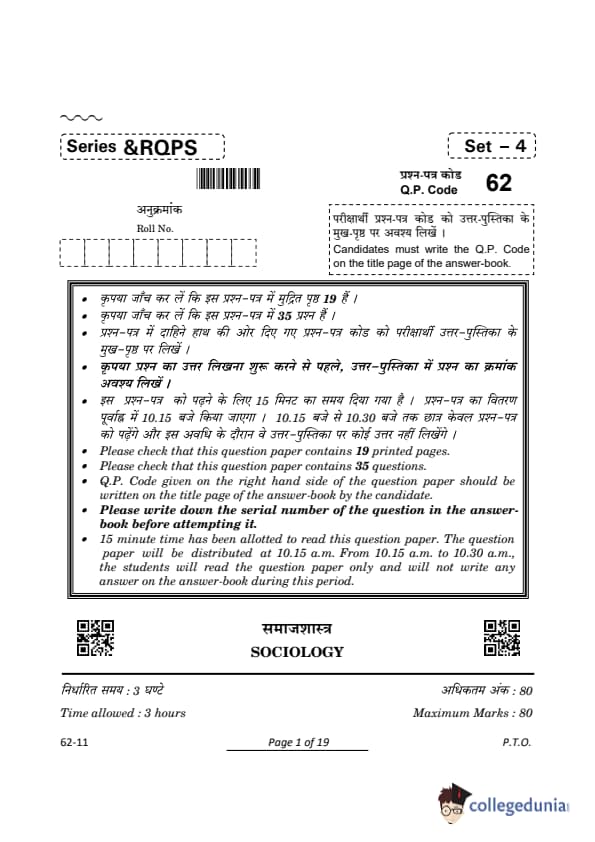
CBSE Class 12 Sociology Question Paper 2024 with Answer Key pdf is available for download here. The exam was conducted by Central Board of Secondary Education on April 1, 2024 in the Morning Session 10:30 AM to 1:30 PM. The question paper consists a total of 35 questions divided among 4 sections. Candidates can use the link below to download the CBSE Class 12 Biology Set 3 Question Paper with detailed solutions.
CBSE Class 12 Sociology Question Paper 2024 with Answer Key
| CBSE Class 12 2024 Sociology Question Paper with Answer Key |  Download Download |
Check Solution |
CBSE Class 12 2024 Sociology Questions with Solutions
SECTION A
Question 1:
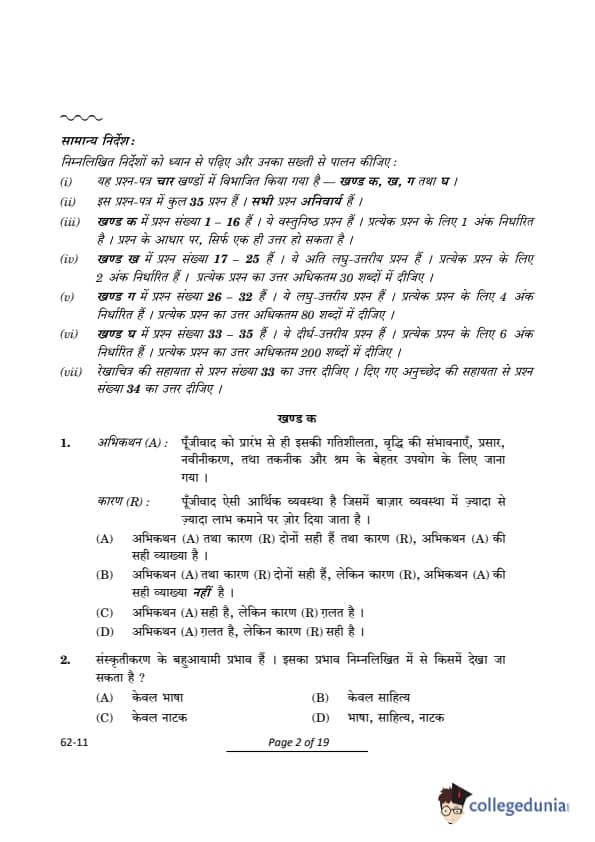
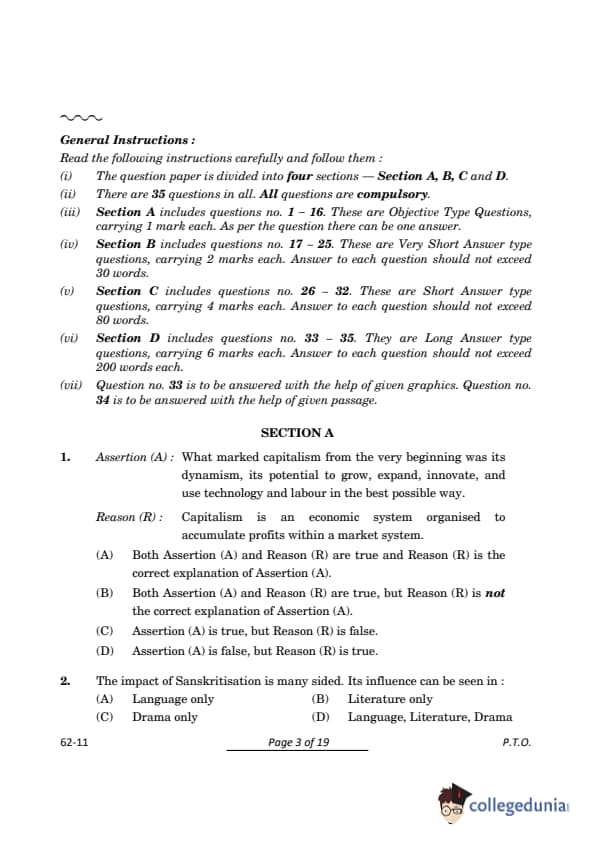
Assertion (A): What marked capitalism from the very beginning was its dynamism, its potential to grow, expand, innovate, and use technology and labour in the best possible way.
Reason (R): Capitalism is an economic system organised to accumulate profits within a market system.
View Solution
Solution:
• Assertion (A): The assertion accurately describes the core characteristics of capitalism. From its inception, capitalism has been marked by its inherent dynamism, capacity for growth, expansion, constant innovation, and the use of technology and labor to increase productivity and profitability. This inherent dynamism is a foundational aspect of capitalism.
• Reason (R): The reason provides the underlying mechanism of capitalism. It is indeed an economic system that is primarily structured around the accumulation of profit within a market framework. The pursuit of profit drives the entire system and incentivizes innovation, growth, and expansion.
• Connection: The reason directly explains the assertion. Capitalism's dynamism comes from its structural need to accumulate profit. Innovation, expansion and better use of labour are simply strategies employed to achieve higher profits. Thus R is the correct explanation of A.
Question 2:
The impact of Sanskritisation is many sided. Its influence can be seen in:
View Solution
Solution:
• Sanskritisation's Multifaceted Impact: Sanskritisation, as a sociological process, involves lower or middle castes adopting the rituals, practices, and values of higher castes (often Brahmin). This adoption has an impact on various aspects of their lives.
• Influence on Language: Sanskritisation often influences the language, making local languages adopt vocabulary and grammar of Sanskrit origin.
• Influence on Literature: It also influences literary traditions, by incorporating themes and styles from Sanskrit literature.
• Influence on Drama: The impact can also be seen in performing arts like drama and folk forms, with changes in scripts, characters and storylines.
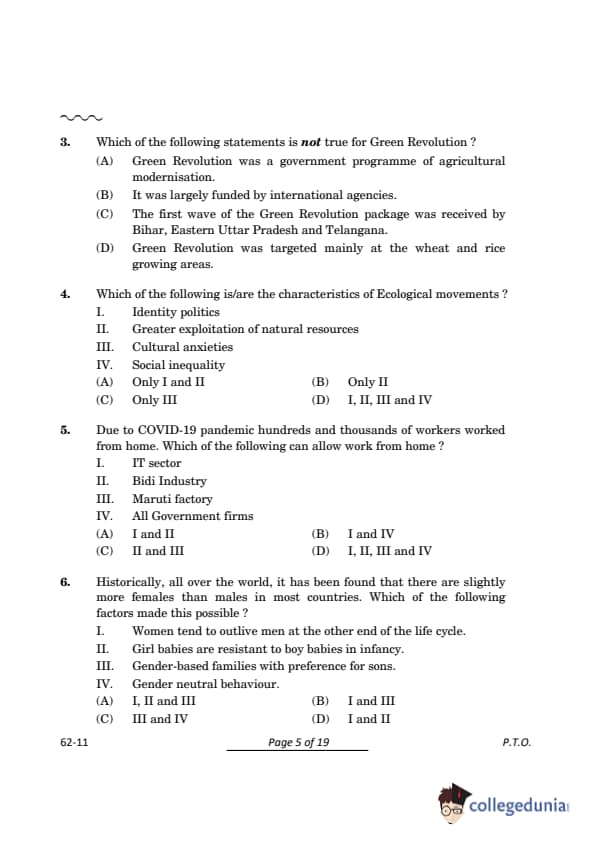
Question 3:
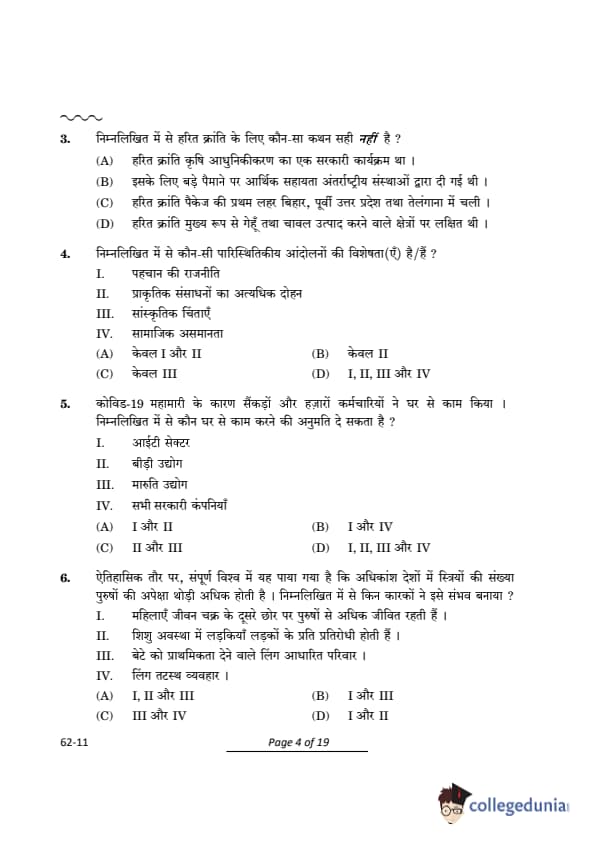
Which of the following statements is not true for Green Revolution?
View Solution
Solution:
• Green Revolution as a Government Program: The Green Revolution was indeed a government-led initiative aimed at modernizing agriculture by using new technologies and methods.
• Funding by International Agencies: It received funding from various international agencies such as the World Bank and the FAO, due to its importance in producing food for a growing population.
• Areas of Focus: The Green Revolution primarily targeted the wheat and rice growing areas in India, because these were the major food crops.
• First Wave: The initial regions to benefit from the Green Revolution were Punjab, Haryana and Western Uttar Pradesh. Therefore statement (C) is the incorrect statement. The initial focus was on a limited set of crops and regions.
Question 4:
Which of the following is/are the characteristics of Ecological movements?
I. Identity politics
II. Greater exploitation of natural resources
III. Cultural anxieties
IV. Social inequality
View Solution
Solution: Ecological movements are characterized by a complex interplay of factors:
Identity Politics (I): Many ecological movements are deeply intertwined with identity politics. Indigenous communities, for example, often lead environmental struggles because their livelihoods and cultural identities are directly threatened by deforestation, mining, or dam construction. Their claims to resources and their right to self-determination become central to the movement.
Resource Exploitation (II): Ecological movements fundamentally challenge the greater exploitation of natural resources. This exploitation, driven by industrialization, consumerism, and often colonial legacies, is seen as the root cause of environmental degradation. Movements aim to limit resource extraction, promote sustainable practices, and challenge the economic systems that prioritize profit over ecological health.
Cultural Anxieties (III): Cultural anxieties about the loss of traditional ways of life, the disruption of natural rhythms, and the destruction of sacred spaces are frequent motivators in ecological movements. These anxieties can be spiritual, aesthetic, or practical, reflecting concerns about food security, water access, or the health of future generations.
Social Inequality (IV): Environmental problems disproportionately affect marginalized communities, exacerbating existing social inequalities. Ecological movements often address issues of environmental justice, highlighting how pollution, resource depletion, and climate change impact the poor and vulnerable more severely. This focus on social inequality links environmental concerns to broader struggles for social and economic equity.
Question 5:
Due to COVID-19 pandemic hundreds and thousands of workers worked from home. Which of the following can allow work from home?
I. IT sector
II. Bidi Industry
III. Maruti factory
IV. All Government firms
View Solution
Solution:
• IT Sector: The IT sector is one of the most prominent examples of work that can be done from home. The entire industry depends on the use of internet and software technologies.
• Bidi Industry: Bidi making is a cottage industry, which does not require a large factory setting, and is often done in a household, thus making it suitable to work from home.
• Maruti Factory: A Maruti factory cannot operate from home due to its reliance on heavy machinery, and specialized production line.
• Government Firms: While some governmental jobs can be done remotely, not all government jobs can be done from home because of the bureaucratic and procedural nature of many governmental tasks.
Question 6:
Historically, all over the world, it has been found that there are slightly more females than males in most countries. Which of the following factors made this possible?
I. Women tend to outlive men at the other end of the life cycle.
II. Girl babies are resistant to boy babies in infancy.
III. Gender-based families with preference for sons.
IV. Gender-neutral behaviour.
View Solution
Solution:
• Women tend to outlive men: It has been found that women tend to have higher life expectancy compared to men, which is a biological factor.
• Girl babies are resistant to boy babies: Studies have indicated that girl babies have a lower mortality rate as they are more resistant to infections and diseases during infancy, which contributes to a slightly higher overall female population.
• Preference for Sons: Gender based families prefer to have sons and often use technologies to ensure birth of more boys which results in an imbalance in sex ratio. Therefore, this is not a factor contributing to a greater female population.
• Gender-neutral behaviour: Gender neutral behavior, if present, would not result in such a condition. Also, gender-neutral behavior is largely absent in the world, thus it is not a valid reason for having more females.
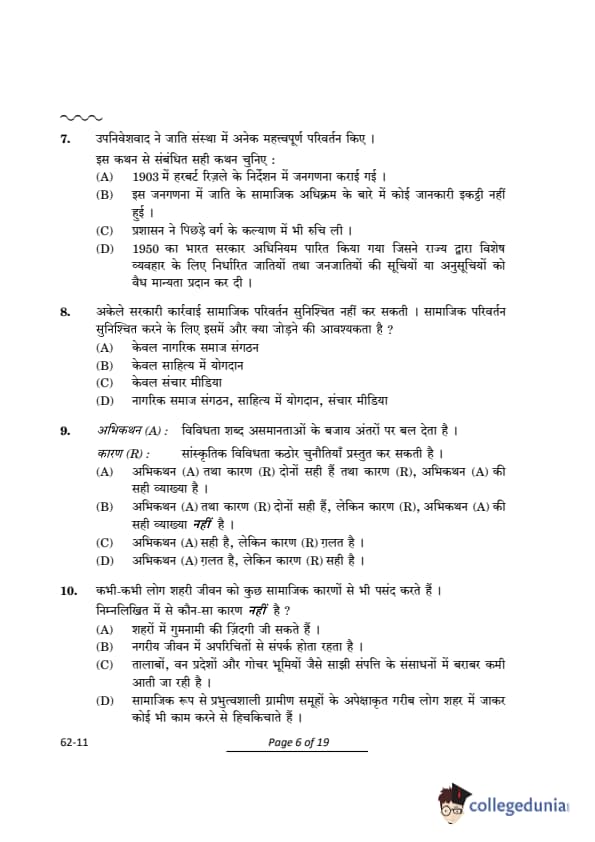
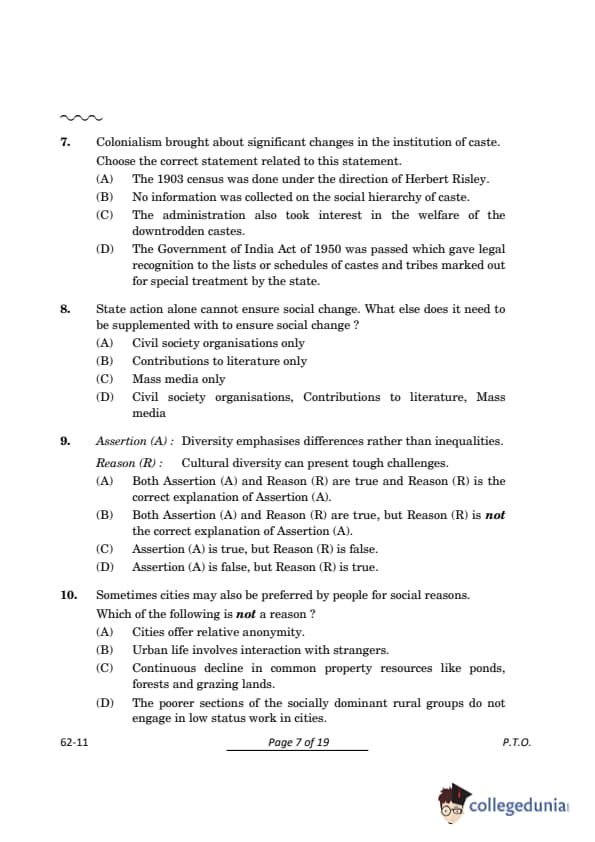
Question 7:
Colonialism brought about significant changes in the institution of caste. Choose the correct statement related to this statement.
View Solution
Solution: (A) Correct: The 1901 Census of India, headed by Herbert Risley, was a crucial moment in the colonial construction of caste. Risley attempted to scientifically classify and rank castes based on anthropometric measurements, solidifying caste hierarchies and furthering colonial administrative aims. While the question mentions the 1903 census, which didn't occur, the intent is to refer to Risley's influential role in the 1901 census. The 1911 census was also done under his supervision.
(B) Incorrect: Extensive information on caste, including social hierarchy, was collected in colonial censuses. This data was used to categorize and control populations, allocate resources, and reinforce existing power structures.
(C) Incorrect: While the colonial administration sometimes implemented policies seemingly aimed at the welfare of lower castes, these were often driven by political motives like divide and rule rather than genuine concern. The focus was not really on uplifting these castes.
(D) Incorrect: The Government of India Act of 1935, not 1950, introduced separate electorates and reservations for certain castes and tribes. The Constitution of India, adopted in 1950, continued and modified these provisions, recognizing Scheduled Castes and Scheduled Tribes and providing affirmative action policies.
Question 8:
State action alone cannot ensure social change. What else does it need to be supplemented with to ensure social change?
View Solution
Solution:
• Limitations of State Action: State action, through legislation and policies, can be a catalyst for social change, but it is not enough to create societal transformation. Social transformation requires changes in people's consciousness and behaviour.
• Role of Civil Society Organisations: Civil society organizations can play an important role in mobilizing people, creating awareness, and challenging unjust practices, thus supplementing the role of the state.
• Influence of Literature: Contributions to literature, through narratives, plays and poems help in reflecting on social realities and promotes critical thinking, thereby influencing people's mindsets and values.
• Impact of Mass Media: Mass media helps in disseminating information and also in shaping public opinion. It helps in propagating a more progressive outlook and promoting inclusive values.
• Combined Influence: Therefore, state action needs the support of civil society groups, literature and mass media to be more effective for social change.
Question 9:
Assertion (A): Diversity emphasises differences rather than inequalities.
Reason (R): Cultural diversity can present tough challenges.
View Solution
Solution:
• Assertion (A): Diversity highlights the fact that societies have various differences between them in terms of culture, religion etc. This does not necessarily mean inequalities, which are linked to power differences and access to resources.
• Reason (R): The reason is also correct. Cultural diversity can be a challenge. Different cultural norms and values can often lead to conflicts, misunderstandings, and social tensions, particularly if there is a lack of tolerance and empathy.
• Connection: Both the statements are true, however, cultural diversity poses challenges and does not explain what diversity means. Therefore R is not the explanation of A.
Question 10:
Sometimes cities may also be preferred by people for social reasons. Which of the following is not a reason?
View Solution
Solution:
• (A) Cities offer relative anonymity: Cities often provide a greater sense of anonymity, which is important for some people. This can provide people freedom from rigid social control.
• (B) Urban life involves interaction with strangers: In cities, there is a constant interaction with strangers from various backgrounds, which highlights the diversity and dynamism of urban life.
• (C) Continuous decline in common property resources: The decline in common property resources in rural areas leads to a loss of livelihood options, which makes the city a more viable option for many rural people.
• (D) The poorer sections of the socially dominant rural groups do not engage in low status work in cities: While some people from dominant rural groups may avoid low-status work in cities, most poorer people are compelled to engage in any kind of work to earn a living, irrespective of social status. Therefore, this is an incorrect reason.
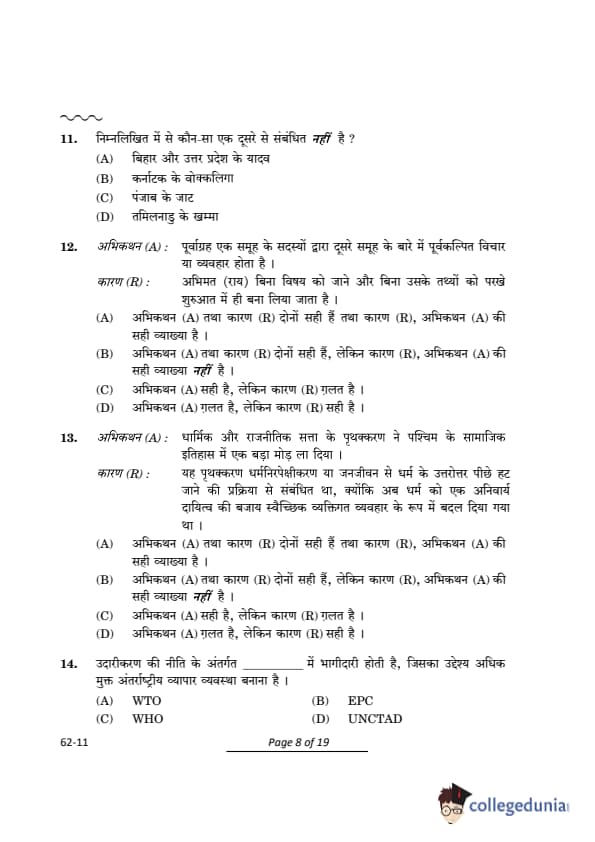
Question 11:
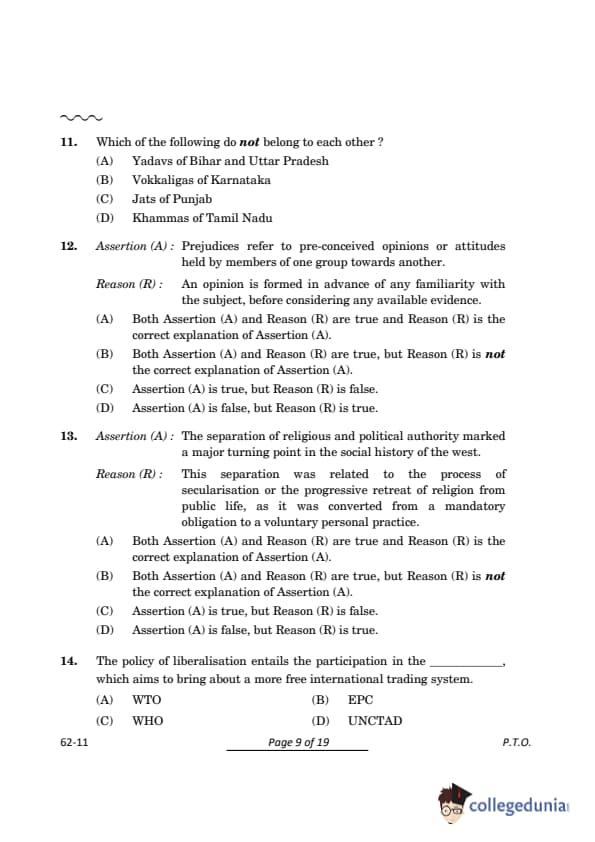
Which of the following do not belong to each other?
View Solution
Solution:
• (A) Yadavs of Bihar and Uttar Pradesh: The Yadav community is present in both states, and forms a large population group.
• (B) Vokkaligas of Karnataka: The Vokkaligas are a dominant agricultural community in Karnataka.
• (C) Jats of Punjab: The Jats are a significant agricultural community in the Punjab region, known for their dominance in land ownership.
• (D) Khammas of Tamil Nadu: The Khammas are a dominant agricultural community in Andhra Pradesh, not Tamil Nadu.
Question 12:
Assertion (A): Prejudices refer to pre-conceived opinions or attitudes held by members of one group towards another.
Reason (R): An opinion is formed in advance of any familiarity with the subject, before considering any available evidence.
View Solution
Solution:
• Assertion (A): The assertion correctly defines prejudice. Prejudices are preconceived, usually negative opinions or attitudes that members of one group hold about members of another group.
• Reason (R): The reason is also correct and highlights the formation of prejudice, which is usually done even before a person knows the facts and figures about the said subject.
• Explanation: The reason provides an accurate explanation for the formation of prejudice, which happens before actually trying to know about the subject. Thus R is the correct explanation of A.
Question 13:
Assertion (A): The separation of religious and political authority marked a major turning point in the social history of the west.
Reason (R): This separation was related to the process of secularisation or the progressive retreat of religion from public life, as it was converted from a mandatory obligation to a voluntary personal practice.
View Solution
Solution:
• Assertion (A): The Assertion is correct. In the social history of the West, a major transition was the separation of religious and political authority, moving away from the idea of a unified system, where both religious and political authorities had power over the same people.
• Reason (R): The reason correctly describes the process of secularisation, where religion was separated from the state and became a private matter. Earlier, religious practices were seen as mandatory for citizens, which transformed into matters of personal choice, and became a practice undertaken by individuals and communities.
• Connection: The process of secularisation mentioned in the reason was linked to this separation of religious and political authority, thus the reason correctly explains the assertion.
Question 14:
The policy of liberalisation entails the participation in the __________ which aims to bring about a more free international trading system.
View Solution
Solution:
• WTO (World Trade Organization): The World Trade Organization is a global body that aims to bring about a more free and open system of international trade between countries. It also plays an important role in implementing policies that facilitate trade and investment among nations.
• EPC (Export Promotion Council): Export Promotion Councils are specific trade bodies in each country, focused on promoting exports of particular goods and commodities.
• WHO (World Health Organization): The WHO's role is in health policy making, standards setting, and other aspects related to health, not in trade policies.
• UNCTAD (United Nations Conference on Trade and Development): UNCTAD works towards the development and integration of developing countries into the global economy, and not a policy that promotes liberalization by itself.
Question 15:
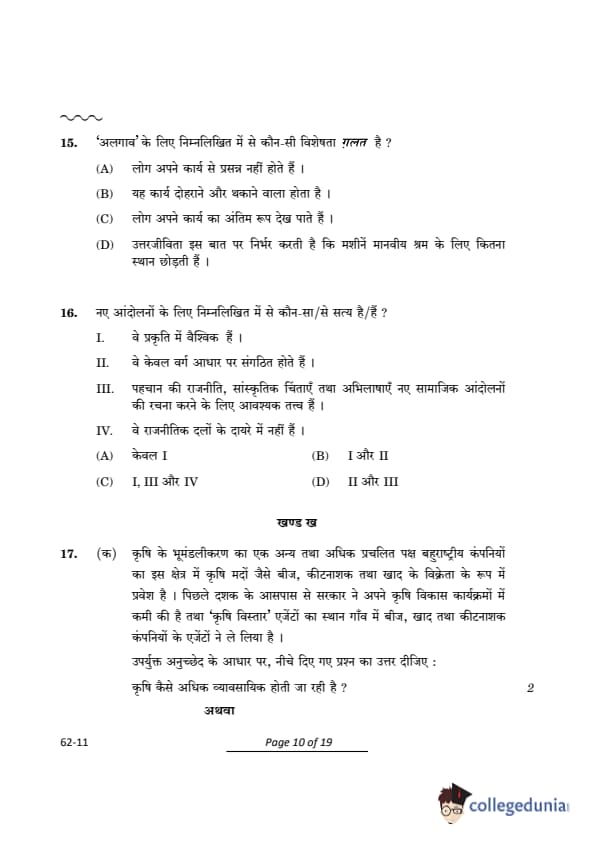
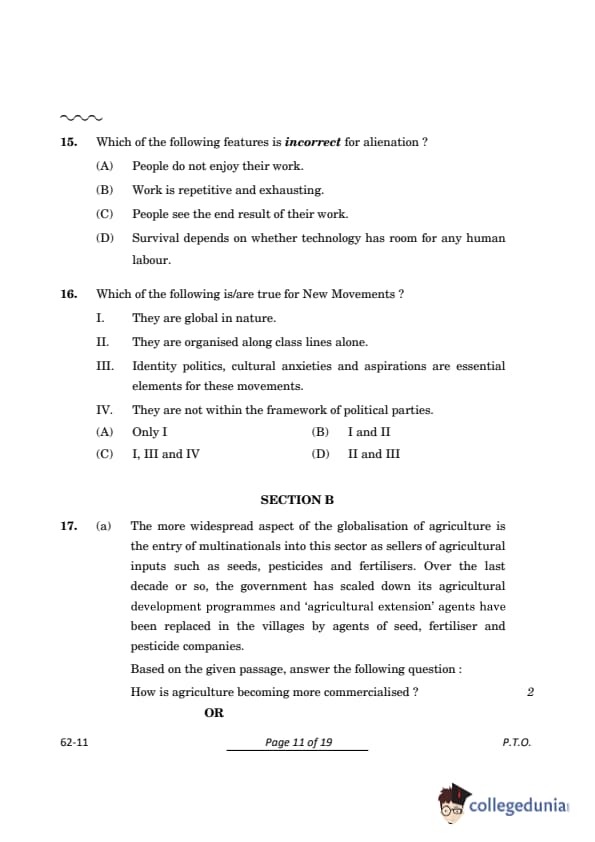
Which of the following features is incorrect for alienation?
View Solution
Solution:
• (A) People do not enjoy their work: Alienation often makes people feel that their work is meaningless and that they do not enjoy their work. This is a very common feature of alienated labour.
• (B) Work is repetitive and exhausting: Alienation makes the work repetitive, monotonous and exhausting, thereby making work very frustrating.
• (C) People see the end result of their work: In an alienated setting, people do not feel connected to the end results of the work, as it is often broken into smaller pieces and is done by a collective. This is the main feature which is absent in alienation.
• (D) Survival depends on whether technology has room for any human labour: In settings where technology takes over the work done by humans, the fear of being replaced leads to alienation. This also forms a core component of alienation.
Question 16:
Which of the following is/are true for New Movements?
I. They are global in nature.
II. They are organised along class lines alone.
III. Identity politics, cultural anxieties and aspirations are essential elements for these movements.
IV. They are not within the framework of political parties.
View Solution
Solution:
• I. They are global in nature: Modern social movements are often global in nature, as they address issues that are relevant across boundaries.
• II. They are organised along class lines alone: New movements often go beyond class lines and attract people from various social backgrounds.
• III. Identity politics, cultural anxieties and aspirations are essential elements: New social movements are often driven by the identity politics, cultural anxieties and aspirations of different sections of society.
• IV. They are not within the framework of political parties: New social movements often operate outside formal political structures, highlighting their autonomy and their focus on people's participation, rather than traditional political channels.
SECTION B
Question 17(a):
The more widespread aspect of the globalisation of agriculture is the entry of multinationals into this sector as sellers of agricultural inputs such as seeds, pesticides and fertilisers. Over the last decade or so, the government has scaled down its 'agricultural development programmes and agricultural extension' agents have been replaced in the villages by agents of seed, fertiliser and pesticide companies.
Based on the given passage, answer the following question:
(a) How is agriculture becoming more commercialised?
View Solution
Solution:
• The passage indicates that agricultural extension agents have been replaced by the agents of multinational companies. These agents now work as the primary source of information for farmers regarding seeds, fertilizers and pesticides.
• These agents are interested in selling more of their products, which indicates that the agricultural system is now being driven more and more by profit.
Question 17(b):
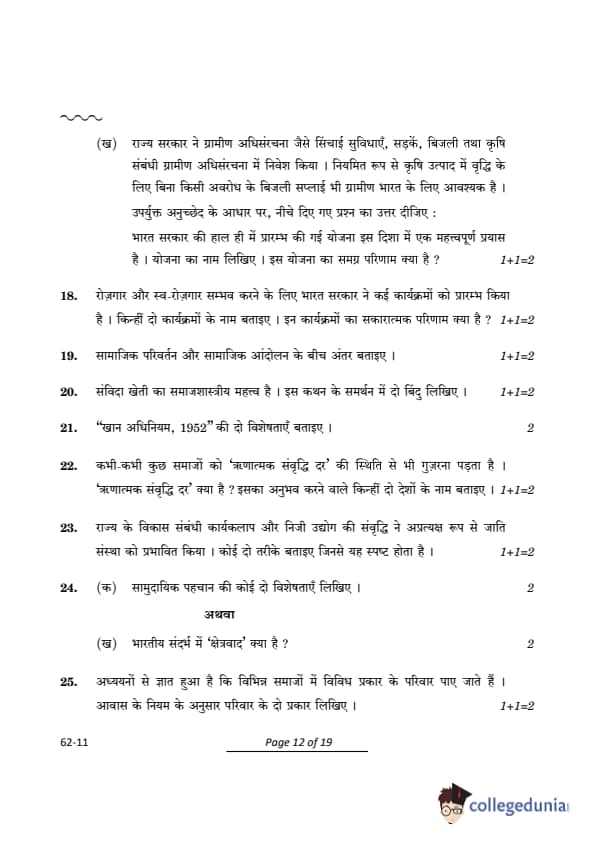
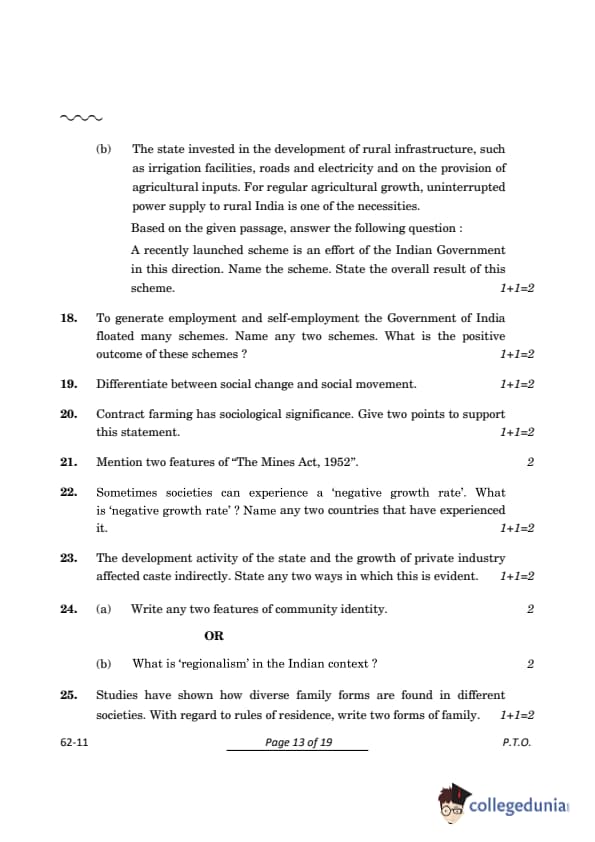
The state invested in the development of rural infrastructure, such as irrigation facilities, roads and electricity and on the provision of agricultural inputs. For regular agricultural growth, uninterrupted power supply to rural India is one of the necessities.
Based on the given passage, answer the following question:
(b) A recently launched scheme is an effort of the Indian Government in this direction. Name the scheme. What is the positive outcome of these schemes?
View Solution
Solution:
• The scheme mentioned in the passage is the Deen Dayal Upadhyaya Gram Jyoti Yojana (DDUGJY).
• This scheme aimed not only to transform the rural economy and agriculture but also the agrarian structure and the rural society itself.
Question 18:
To generate employment and self-employment the Government of India floated many schemes. Name any two schemes. What is the positive outcome of these schemes?
View Solution
Solution:
• Two important schemes to generate employment and self-employment are MUDRA and Atmanirbhar Bharat, and Make in India.
• These schemes aim to generate economic potential amongst the demographic dividend of India, and are helpful to people of the marginalized sections of society like SC, ST, and OBCs.
Question 19:
Differentiate between social change and social movement.
View Solution
Solution:
• Social Change: Social change is a continuous and ongoing process of transformation within a society, which may occur due to multiple factors like the state, economy or other social institutions.
• Social Movement: A social movement is a directed effort towards a specific goal or set of goals, by collective mobilization, usually with a focus on social reform or revolutionary change.
Question 20:
Contract farming has sociological significance. Give two points to support this statement.
View Solution
Solution:
• Contract farming disengages many people from the production process by making them dependent on corporate contracts.
• It also makes their own indigenous knowledge of agriculture irrelevant by shifting the control to corporations.
• It can also be noted that it caters primarily to the production of elite items like flowers, fruits, etc. Also, it is not ecologically sustainable.
Question 21:
Mention two features of “The Mines Act, 1952”.
View Solution
Solution:
• The Mines Act, 1952, specifies the maximum number of hours that a person can be made to work in a week, highlighting a labor regulation.
• It also mandates the need to pay overtime for any extra hours worked beyond the maximum limit, thus indicating an increased worker's protection.
• It also contains safety rules for the workers, signifying concern for their safety and well-being.
Question 22:
Sometimes societies can experience a ‘negative growth rate’. What is ‘negative growth rate’? Name two countries that have experienced it.
View Solution
Solution:
• A negative growth rate implies that fertility levels are below the replacement level.
• Examples of countries that have experienced negative growth rates are Japan, Russia, Italy and Eastern Europe.
Question 23:
The development activity of the states and the growth of private industry affected caste indirectly. State any two ways in which this is evident.
View Solution
Solution:
• The development activities of the state and the growth of private industries have sped up the process of economic change, making the traditional caste system obsolete in many ways.
• They have also created new jobs for which there were no caste rules, resulting in social change, and economic mobility.
• Additionally, the process of urbanization and collective living in cities made it difficult for the caste-segregated patterns of social interaction to survive.
• Also, Modern educated Indians attracted to the liberal ideas of individualism and meritocracy abandoned the more extreme caste practices.
• Industrialization also leads to greater equality, at least in some spheres. For example, caste distinctions do not matter anymore on trains, buses or in cyber cafes.
• Finally, Even as social inequalities are reducing, economic or income inequality is growing in the world, highlighting a complex intersection of caste and class.
Question 24(a):
Write any two features of community identity.
View Solution
Solution:
• Community identity is usually ascriptive, or based on birth and belonging, rather than on achieved qualities or accomplishments.
• It also provides a deep sense of security and satisfaction to its members.
• Community identity is also considered to be universal, or present in most cultures.
• It is also accidental and unconditional.
Question 24(b):
What is 'regionalism' in the Indian context?
View Solution
Solution:
• Regionalism in India is rooted in the country's immense diversity of languages, cultures, tribes, and religions.
• It is often encouraged by the geographical concentration of these identity markers in particular regions.
• It can also be fueled by a sense of regional deprivation or a feeling of neglect.
Question 25:
Studies have shown how diverse family forms are found in different societies. With regard to rules of residence, write two forms of family.
View Solution
Solution:
• Matrilocal:
In matrilocal families, the newly married couple stays with the woman's parents.
• Patrilocal:
In patrilocal families, the newly married couple stays with the man's parents.
SECTION C
Question 26:
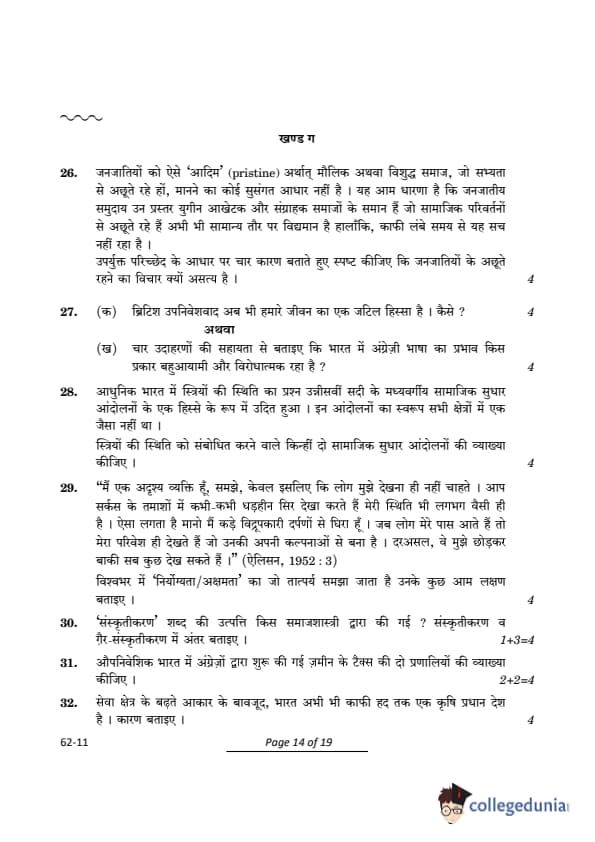
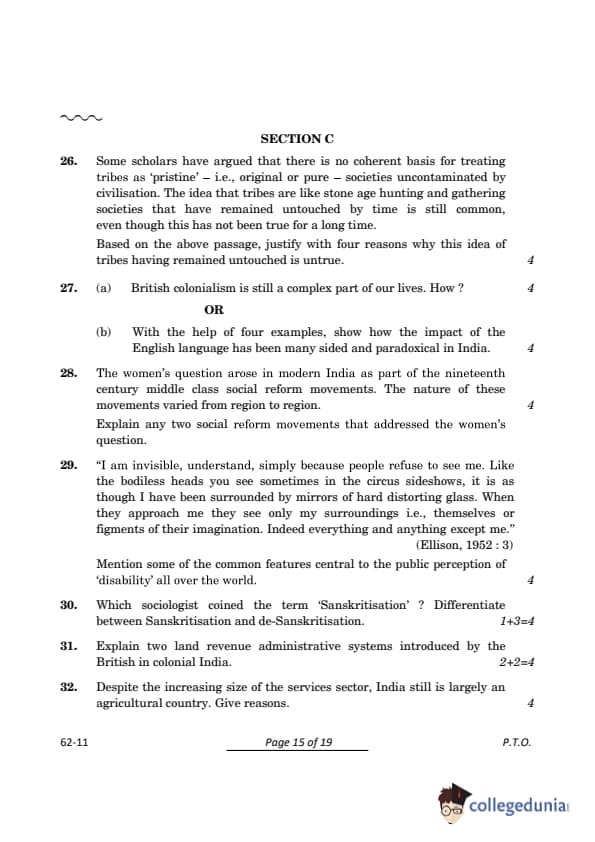
Some scholars have argued that there is no coherent basis for treating tribes as 'pristine' – i.e., original or pure – societies uncontaminated by civilization. The idea that tribes are like stone age hunting and gathering societies that have remained untouched by time is still common, even though this has not been true for a long time. Based on the above passage, justify with four reasons why this idea of tribes having remained untouched is untrue.
View Solution
Solution:
• Tribes Were Not Always Oppressed Groups:
Contrary to the stereotype, many tribal groups had established kingdoms. The Gond kingdom in Central India is a very good example of this, and highlights that they were not always isolated, oppressed groups but they also held political power.
• Emergence of Rajput Kingdoms:
Many so-called Rajput kingdoms in Central and Western India actually emerged through a process of social stratification among adivasi communities. This demonstrates that many of the dominant groups had a tribal ancestry.
• Dominance Over Plains People:
Tribal groups often exercised dominance over the plains people through their capacity to raid them, and through their services as local militias, indicating that they were very active in political life.
• Trade:
They also occupied a special trade niche, trading forest produce, salt, and elephants. This indicates that they had economic links with the wider society.
• Capitalist Economy and Tribes:
The capitalist economy's drive to exploit forest resources and minerals brought tribal societies in contact with mainstream society a long time ago. Thus, tribes were actively involved in wider economy.
Question 27(a):
British colonialism is still a complex part of our lives. How?
View Solution
Solution:
• Parliamentary and Legal System: India's parliamentary and legal systems are primarily based on the models introduced by the British during their colonial rule.
• Police and Educational System: The police force, educational system and other such public institutions were also introduced by the British, and they continue to shape our lives today.
• Driving on the Left: India still follows many British conventions, like driving on the left side of the road.
• Food and Culture: Many aspects of Indian culture are related to colonial-era practices like the availability of foods like bread-omlette and cutlets on roadside stalls and many cultural practices like the school uniform which includes ties.
• Other Relevant Point: Any other relevant point from the chapter.
Question 27(b):
With the help of four examples, show how the impact of English language has been many sided and paradoxical in India.
View Solution
Solution:
• Wide Use and Literary Writings: English is not just widely used in India, but Indians also use it to create an impressive body of literary writings.
• Global Market Access: Knowledge of English has given Indians a competitive advantage in the global market, creating better opportunities.
• English as a Symbol of Privilege: English continues to be seen as a marker of privilege and status in Indian society.
• Disadvantage in the Job Market: A disadvantage is created for those who do not know English, which makes it an important factor in social and economic inequality.
• New Opportunities: Knowledge of English has opened new doors of opportunities for previously deprived communities like the Dalits.
• Other Relevant Point: Any other relevant point from the chapter.
Question 28:
The women's question arose in modern India as part of the nineteenth century middle class social reform movements. The nature of these movements varied from region to region. Explain any two social reform movements that addressed the women's question.
View Solution
Solution:
• Raja Ram Mohan Roy and the Anti-Sati Campaign:
Raja Ram Mohan Roy led the anti-Sati campaign in Bengal. He was one of the most important social reformers who worked against the practice of Sati. He established the Brahmo Samaj in 1828 to promote reform in society and challenged many aspects of the tradition. His campaign against Sati was the first large-scale social reform movement, that focused on the rights and the lives of women. His ideas showed a mix of western rationality and an assertion of Indian traditionality. He had a nuanced approach to social reform.
• Ranade and the Widow Remarriage Movement:
Justice Ranade led the Widow Remarriage movement in the Bombay Presidency. Ranade's writings, like ‘The Texts of Hindu Law on the Lawfulness of the Remarriage of Widows,' and 'Vedic Authorities for Widow Marriage,' elaborated the shastric sanction for the remarriage of widows.
• Other Relevant Point: Other important reformers also include Jyotiba Phule, and Sir Syed Ahmed Khan, whose views can be described.
Question 29:
“I am invisible, understand, simply because people refuse to see me. Like the bodiless heads you see sometimes in the circus sideshows, it is as though I have been surrounded by mirrors of hard distorting glass. When they approach me they see only my surroundings i.e., themselves or figments of their imagination. Indeed everything and anything except me." (Ellison, 1952 : 3) Mention some of the common features central to the public perception of ‘disability' all over the world.
View Solution
Solution:
• Disability as a Biological Given: Disability is primarily seen as a biological problem by most people, highlighting the medical model of disability.
• Problems as Originating from Impairment: When a disabled person faces any kind of problem, the problem is often seen as originating from their impairment, highlighting a lack of social awareness.
• The Disabled Person as a Victim: Disabled persons are seen as victims of their circumstances.
• Linking it with Self-Perception: The problems of disabled people are often linked with their self-perception, further marginalizing them.
• Need for Help: They are perceived as needing help and support, and incapable of autonomy and agency.
Question 30:
Which sociologist coined the term ‘Sanskritisation’? Differentiate between Sanskritisation and de-Sanskritisation.
View Solution
Solution:
• The term 'Sanskritisation' was coined by the sociologist, M.N. Srinivas.
• Sanskritisation: Sanskritisation refers to a process whereby members of an usually middle or lower caste attempt to raise their own social status by adopting the ritual, domestic and social practices of a caste of higher status.
• De-Sanskritisation: De-Sanskritisation refers to the situation when people from usually middle or lower castes, are seen to distance themselves from the practices of higher castes, and start adopting more localized cultural or religious practices.
Question 31:
Explain two land revenue administrative systems introduced by the British in colonial India.
View Solution
Solution:
• Zamindari System: Under the Zamindari system, the British granted property rights to the Zamindars. They were now responsible for collecting taxes from the cultivators. This system made the zamindars very powerful. As a result of this system, agricultural production stagnated, and large revenues were collected from cultivators.
• Ryotwari System: Under the Ryotwari system, the cultivators or ‘raiyats’ were directly responsible for paying taxes. It also gave cultivators more incentive to invest in agriculture. This removed the zamindars as the middle-men.
• Other relevant system: Other important land revenue systems were the Mahalwari system, and the Taluqdari system.
Question 32:
Despite the increasing size of the services sector, India still is largely an agricultural country. Give reasons.
View Solution
Solution:
• Insecure Jobs: Very few people in India have access to secure jobs in the service and manufacturing sectors. Most work in the unorganized sector without any secure job.
• Insecure Employment: Even those with regular salaried employment are often insecure due to the rise in contract labour and lack of job security.
• Decline in Government Jobs: Government jobs are also declining, due to the privatization policies adopted by the government.
• Majority in Rural Areas: A majority of India’s population (69%) lives in rural areas.
• Agricultural Livelihood: These people primarily earn a living from agriculture or related occupations, making it the backbone of the rural economy.
• Importance of Agricultural Land: Agricultural land is still the most important productive resource for a great many Indians, as it is linked to their way of life and not just their livelihood.
• Culture and Agriculture: Indian cultural practices and patterns can be traced to our agrarian backgrounds, which highlights the important role of agriculture in our society.
• Other Relevant Point: Any other relevant point from the chapter.
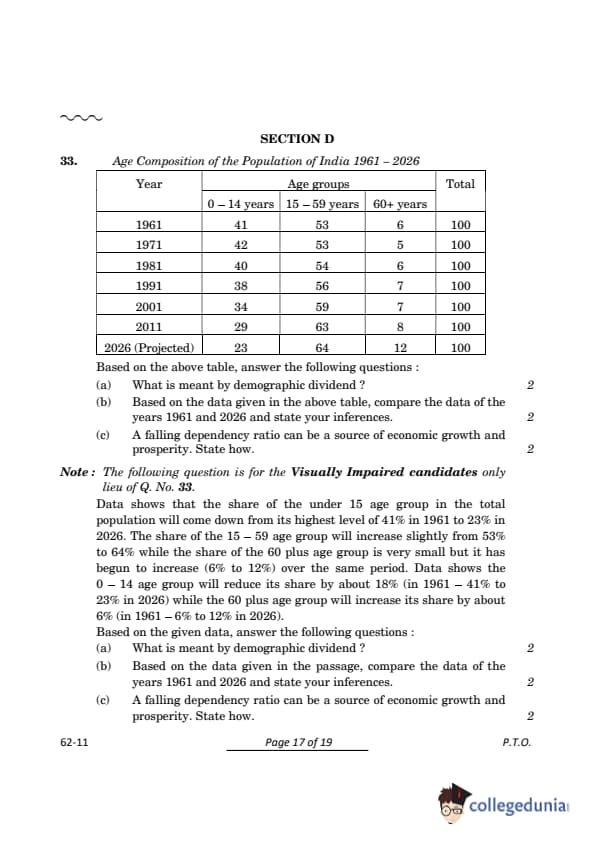
Question 33:
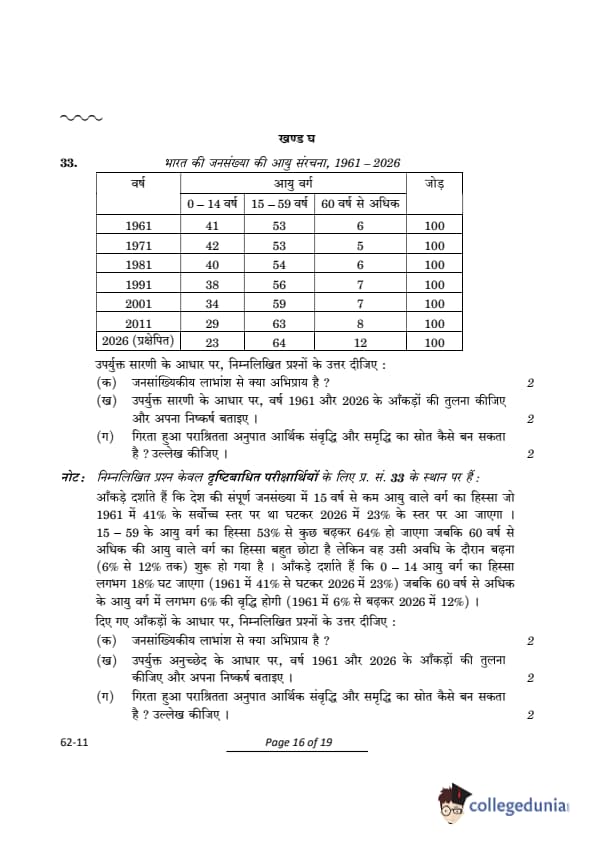
Age Composition of the Population of India 1961 – 2026
| Year | 0-14 years | 15-59 years | 60+ years | Total |
|---|---|---|---|---|
| 1961 | 41 | 53 | 6 | 100 |
| 1971 | 42 | 53 | 5 | 100 |
| 1981 | 40 | 54 | 6 | 100 |
| 1991 | 38 | 56 | 6 | 100 |
| 2001 | 34 | 59 | 7 | 100 |
| 2011 | 29 | 63 | 8 | 100 |
| 2026 (Projected) | 23 | 64 | 12 | 100 |
Based on the above table, answer the following questions:
(a) What is meant by demographic dividend?
(b) Based on the data given in the above table, compare the data of the years 1961 and 2026 and state your inferences.
(c) A falling dependency ratio can be a source of economic growth and prosperity. State how.
View Solution
Solution (a):
• Demographic dividend implies an increase in the proportion of working-age individuals (15-59 years) relative to non-working individuals (0-14 and 60+ years) in a population. It can also be called a demographic bonus, where the population has more workers as compared to dependents.
Solution (b):
• 1961: In 1961, the population had a large proportion of young dependents (0-14 years) with 41%.
• 2026 (Projected): By 2026, the population is projected to have a significantly smaller proportion of young dependents at 23%.
• Inference: This shows a decrease in young dependents and an increase in working age population, which indicates that India can potentially make good use of its working population. However, India needs to generate enough jobs to absorb this growing population.
Solution (c):
• A falling dependency ratio, which means a larger working-age population relative to young and elderly dependents, can be a source of economic growth and prosperity. This is because it will create a larger pool of individuals who are capable of working and contributing towards the economy.
• With a larger working population, there is more potential for higher tax revenues which can help in funding welfare schemes and investment in infrastructure.
• A larger working population also leads to greater savings and investment, which also contributes to economic growth and prosperity.
SECTION D
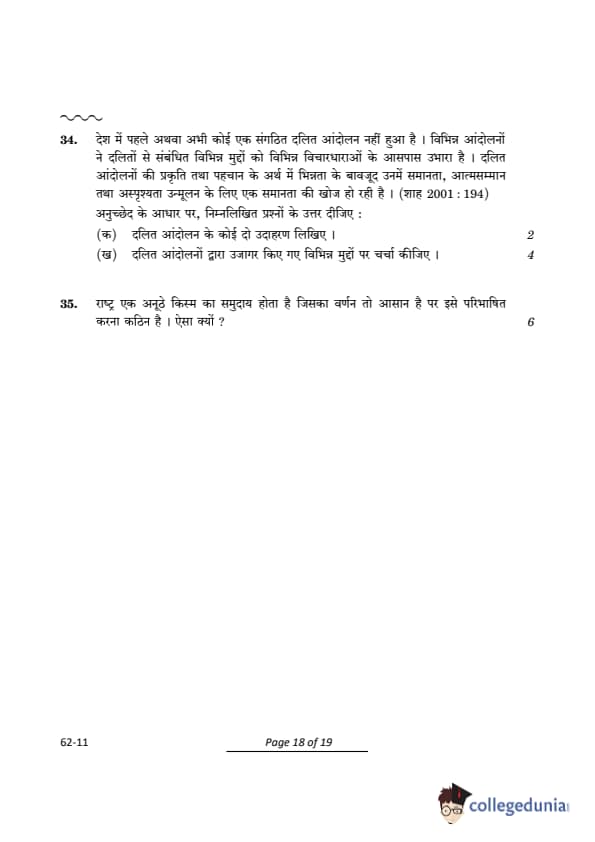
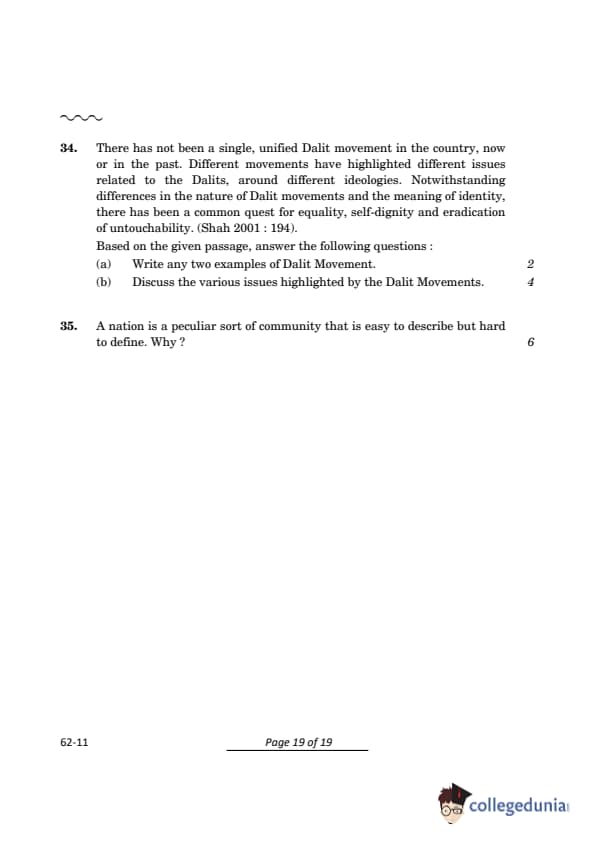
Question 34:
There has not been a single, unified Dalit movement in the country, now or in the past. Different movements have highlighted different issues related to the Dalits, around different ideologies. Notwithstanding differences in the nature of Dalit movements and the meaning of identity, there has been a common quest for equality, self-dignity and eradication of untouchability. (Shah 2001 : 194) Based on the given passage, answer the following questions:
(a) Write any two examples of Dalit Movement.
(b) Discuss the various issues highlighted by the Dalit Movements.
View Solution
Solution (a):
• Two examples of the Dalit movement are: the Satnami Movement, and the Adi Dharma Movement.
• Other important Dalit movements are Mahar Movement, and Anti-Brahmin movement.
Solution (b):
• Economic Exploitation: Dalit movements have always highlighted the economic exploitation and the deprivation which they faced because of their lower caste status.
• Political Oppression: The movements also addressed their political oppression and the denial of basic rights that they faced.
• Struggle for Recognition as Fellow Human Beings: The key demand of the movements was to be recognized as equal human beings.
• Struggle for Self-Confidence: The movements also played a vital role in creating a sense of self-confidence and assertion among the Dalits.
• Space for Self-Determination: The movements also demand space for self-determination and to be free from the imposition of caste.
• Struggle against Stigmatization: They also focused on fighting against social stigmatization that they face.
• Struggle to be touched: They fought for a right to be treated equally, where they were not denied the touch of other people.
Question 35:
A nation is a peculiar sort of community that is easy to describe but hard to define. Why?
View Solution
Solution:
• Common Characteristics: Many nations are founded on a basis of shared cultural, historical, and political institutions, which gives them a shared community feeling.
• No Defining Features: However, it is often hard to come up with any defining features that all nations must possess, as different nations have varied histories, languages and cultures.
• Exceptions to Every Criterion: For every possible criterion, there are exceptions and counter-examples which indicate the diverse nature of these ‘communities’ called nations.
• Lack of Shared Elements: Many nations do not share a single common language, religion, ethnicity, etc. These commonalities are not enough to define the notion of a nation.
• Shared Across Nations: There are many languages, religions or ethnicities that are shared across nations, which further highlights the difficulty in defining nations based on shared attributes.
• Formation of Nation: While such shared cultural, historical, and political factors play an important role in creating a sense of community, they do not explain why a group of people who share such factors end up forming a nation. For example, the English language is spoken in many countries, but that does not make them into one nation. Also, people of various religions and cultures exist in many different nations.



Comments