




UP Board Class 10 Science Question Paper 2023 PDF (Code 824 EN) with Answer Key and Solutions PDF is available for download here. UP Board Class 10 exams were conducted between February 24th to March 12th 2023. The total marks for the theory paper were 70. Students reported the paper to be easy to moderate.
UP Board Class 10 Science Question Paper 2023 (Code 824 EN) with Solutions PDF
| UP Board Class 10 Science (824 EN) Question Paper with Solutions PDF |  Download Download |
Check Solutions |
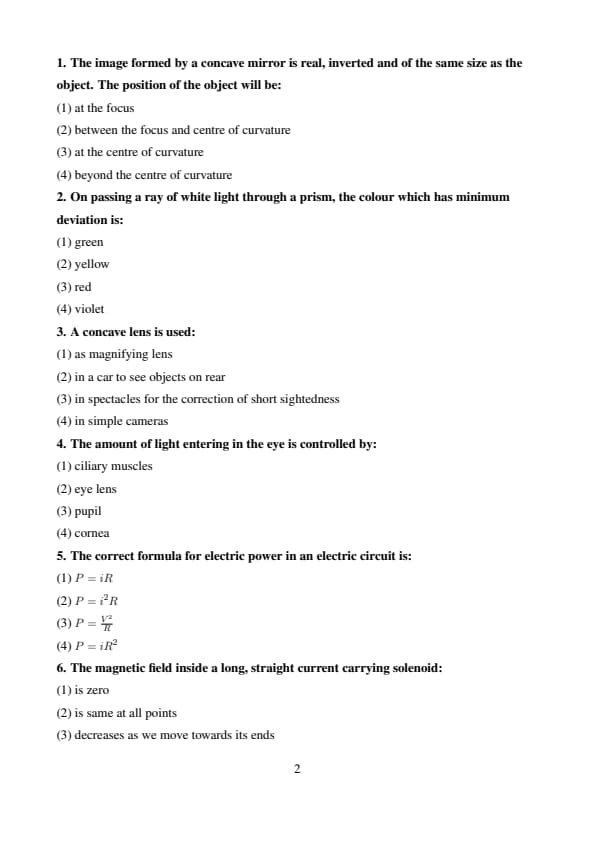
The image formed by a concave mirror is real, inverted and of the same size as the object. The position of the object will be:
View Solution
For a concave mirror, the nature of the image formed depends on the position of the object relative to the mirror. When the object is placed at the centre of curvature (denoted as \( C \)) of the concave mirror, several key properties of the image can be determined using the mirror equation and ray diagrams.
\smallskip
1. Object Position at Centre of Curvature:
The centre of curvature is a point located at a distance \( R \) (the radius of curvature) from the mirror's pole. When the object is placed at this position, it lies exactly at the same distance from the mirror as the image that forms. This is a key characteristic of concave mirrors, where specific object placements yield images with unique properties.
\smallskip
2. Image Properties:
Real Image:
In this case, the rays of light converge after reflecting off the concave mirror, forming a real image. The image is formed in front of the mirror and can be captured on a screen.
Inverted Image:
Since the object is placed at the centre of curvature, the reflected rays meet at the same position on the opposite side of the mirror (inverted), resulting in an inverted image.
Same Size as Object:
The distance of the object from the mirror is equal to the distance of the image from the mirror. This results in an image that is the same size as the object. The magnification \( m \) for this case is given by:
\[ m = \frac{Image Height}{Object Height} = -1 \]
This means the image is of the same size as the object but inverted.
\smallskip
3. Ray Diagram:
A ray diagram can be used to visually demonstrate the formation of the image. In this case, the incident rays parallel to the principal axis reflect off the mirror and converge at the centre of curvature, where the object and image are symmetrically placed.
\smallskip
In conclusion, when the object is positioned at the centre of curvature of a concave mirror, the image formed is real, inverted, and of the same size as the object, as both the object and the image lie at the same distance from the mirror. Quick Tip: For concave mirrors, when the object is at the centre of curvature, the image formed is real, inverted, and of the same size as the object.
On passing a ray of white light through a prism, the colour which has minimum deviation is:
View Solution
When white light passes through a prism, it undergoes a process known as dispersion. Dispersion occurs because different colors of light have different wavelengths and, consequently, they interact with the prism in different ways. The key principle is that the amount of deviation or bending of light depends on its wavelength.
\smallskip
1. Wavelength and Deviation:
The prism bends light because of the change in speed as light enters and exits the prism. This bending is governed by the refractive index of the material of the prism. The refractive index is wavelength-dependent, meaning it varies for different colors of light.
The refractive index is higher for shorter wavelengths (violet), meaning violet light bends more than longer wavelengths (red). Conversely, red light, having the longest wavelength, is least affected by the prism’s refraction.
\smallskip
2. Deviations for Different Colors:
The amount of deviation of light through the prism is related to the wavelength of the light. Red light, with its longer wavelength, experiences the least deviation because it is refracted less.
Violet light, on the other hand, with its shorter wavelength, is refracted more and therefore deviates the most.
\smallskip
3. Minimum Deviation for Red Light:
The color red, being the least refracted, experiences the smallest angular deviation from its original path after passing through the prism. This is why red light is said to have the minimum deviation, as it deviates the least compared to all other colors.
\smallskip
In conclusion, when white light passes through a prism, the different colors are separated, with red light experiencing the least deviation and violet light experiencing the most. Thus, red light has the minimum deviation, and this phenomenon is a consequence of the varying refractive indices for different wavelengths of light. Quick Tip: In a prism, red light deviates the least, while violet light deviates the most due to their respective wavelengths.
A concave lens is used:
View Solution
A concave lens is a type of diverging lens that is thinner at the center than at the edges. It is commonly used in the correction of short-sightedness, or myopia, and has several important optical properties that make it suitable for this purpose.
\smallskip
1. Correcting Short-Sightedness (Myopia):
Short-sightedness, or myopia, occurs when the image of a distant object is focused in front of the retina, making it appear blurry. This happens because the eye's lens focuses light rays too strongly.
A concave lens diverges the incoming light rays before they enter the eye. This diverging effect causes the rays to spread out, and as a result, the image is focused further back onto the retina, allowing the person to see distant objects clearly.
\smallskip
2. Diverging Light Rays:
The concave lens works by spreading the light rays apart. This divergence of light reduces the focal length of the lens, thus correcting the over-convergence of light that causes blurred vision in myopic individuals.
The diverging rays from a concave lens appear to originate from a virtual focus on the same side of the lens as the object, which aids in focusing the image directly onto the retina.
\smallskip
3. Why Concave Lenses are Not Used as Magnifying Lenses:
Concave lenses are not used for magnification because they produce virtual, diminished, and upright images. A magnifying lens typically needs to produce a larger, upright, and virtual image, which is achieved using convex lenses (which converge light).
Since concave lenses cause light rays to diverge, they would not provide the magnification effect needed to enlarge objects.
\smallskip
4. Concave Lenses in Rear-View Mirrors and Cameras:
Concave lenses are not used in rear-view mirrors in cars because they would cause the image to appear smaller and inverted. Convex mirrors are preferred for rear-view mirrors because they provide a wider field of view and produce smaller, upright images.
In simple cameras, concave lenses are not commonly used because they do not produce sharp images. Cameras require lenses that converge light to focus it accurately onto a film or digital sensor, which is typically achieved using convex lenses.
\smallskip
In summary, concave lenses are primarily used to correct myopia by diverging light rays before they reach the eye, helping individuals with short-sightedness see distant objects clearly. However, they are not suitable for magnification, rear-view mirrors, or simple cameras due to their divergent nature and the types of images they produce. Quick Tip: Concave lenses are used in spectacles for myopia correction, as they diverge light to bring distant objects into focus.
The amount of light entering in the eye is controlled by:
View Solution
The pupil is a vital part of the human eye that controls the amount of light entering the eye. It appears as the black circular opening in the center of the iris and functions similarly to the aperture of a camera. The size of the pupil is automatically adjusted by the iris, which is the colored part of the eye surrounding the pupil.
\smallskip
1. Role of the Iris:
The iris contains muscles that contract or relax to change the size of the pupil depending on the lighting conditions.
In bright light, the iris contracts, making the pupil smaller to reduce the amount of light entering the eye and protect the sensitive retina from excessive light.
In dim light, the iris relaxes, causing the pupil to enlarge (dilate) and allow more light to enter, helping improve vision in low-light conditions.
\smallskip
2. Distinction from Other Eye Structures:
While the ciliary muscles play a crucial role in adjusting the shape of the eye's lens for focusing on near or distant objects (a process called \textit{accommodation), they are not responsible for controlling light entry.
The cornea is the transparent, curved front surface of the eye that helps in refracting (bending) incoming light toward the lens, but it does not regulate the amount of light.
The pupil, therefore, has the specific role of regulating how much light enters the eye, ensuring that the retina receives an appropriate amount for clear vision without damage.
\smallskip
In conclusion, the pupil, by changing its size with the help of the iris, specifically controls the entry of light into the eye. This function is distinct from other parts like the ciliary muscles and cornea, which have different roles in vision. Quick Tip: Remember: The pupil controls light entry, the lens focuses the image, and the ciliary muscles adjust the lens shape.
The correct formula for electric power in an electric circuit is:
View Solution
The electric power \( P \) consumed in an electrical circuit refers to the rate at which electrical energy is converted into other forms of energy such as heat, light, or mechanical work. The expression for electric power can take different forms depending on the quantities available:
\[ P = VI, \quad P = I^2R, \quad or \quad P = \frac{V^2}{R} \]
These three equations are derived from Ohm’s Law, which states that \( V = IR \), where:
\( V \) is the potential difference (voltage),
\( I \) is the current,
\( R \) is the resistance.
\smallskip
1. First Formula: \( P = VI \)
This is the basic definition of electric power — the product of voltage and current. It is used when both voltage across and current through a component are known.
\smallskip
2. Second Formula: \( P = I^2R \)
By substituting \( V = IR \) into the power formula \( P = VI \), we get:
\[ P = I(IR) = I^2R \]
This expression is useful when current and resistance are known. It shows that power is directly proportional to the square of the current, making it particularly important in analyzing energy loss due to resistance (e.g., in transmission lines).
\smallskip
3. Third Formula: \( P = \frac{V^2}{R} \)
Similarly, by substituting \( I = \frac{V}{R} \) into \( P = VI \), we get:
\[ P = V\left( \frac{V}{R} \right) = \frac{V^2}{R} \]
This form is used when voltage and resistance are known.
\smallskip
In the given question, option (2) \( P = I^2R \) is correct. It is one of the standard and widely used formulas for calculating electric power, especially when current and resistance are the known quantities. Quick Tip: Use \( P = VI \), \( P = I^2R \), or \( P = \frac{V^2}{R} \) depending on what's given in the problem (voltage, current, or resistance).
The magnetic field inside a long, straight current carrying solenoid:
View Solution
Inside a long, straight current-carrying solenoid, the magnetic field exhibits several important characteristics that make it unique compared to other magnetic field configurations.
\smallskip
1. Uniform Magnetic Field:
The magnetic field inside the solenoid is nearly uniform throughout the length of the solenoid, except near the ends where edge effects cause slight variations.
This means the magnetic field lines inside are equally spaced and parallel to each other, indicating a constant magnitude and direction at every point along the interior.
\smallskip
2. Direction of the Magnetic Field:
The magnetic field inside the solenoid is directed parallel to the axis of the solenoid. This direction can be determined using the right-hand rule, where if the fingers curl in the direction of current in the coil, the thumb points along the magnetic field inside.
\smallskip
3. Cause of Uniformity:
The uniform magnetic field results from the closely spaced, symmetric windings of the solenoid coil. Each turn of the coil produces a magnetic field, and the superposition of fields from all turns leads to a strong, uniform field inside.
Because the coil is long, the magnetic fields at the ends do not significantly affect the field in the central region, leading to a nearly uniform field in the interior.
\smallskip
4. Practical Importance:
This property of uniform magnetic field inside a solenoid is utilized in many applications, such as electromagnets, inductors, and devices requiring a controlled magnetic environment.
\smallskip
In summary, the magnetic field inside a long, straight current-carrying solenoid is uniform in magnitude and direction, aligned parallel to the solenoid’s axis, due to the symmetric and close winding of the coil turns. Quick Tip: A long solenoid produces a uniform magnetic field inside it: \( B = \mu_0 n I \), where \( n \) is the number of turns per unit length.
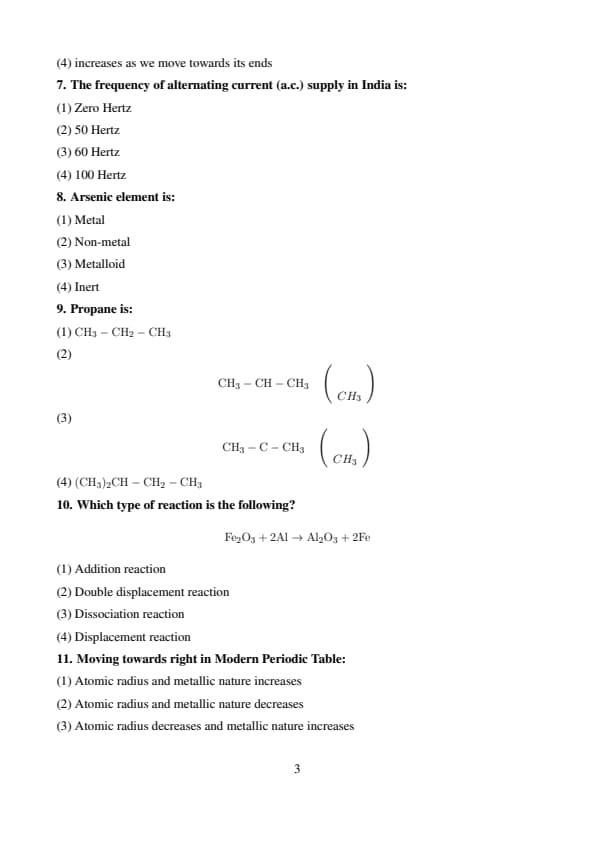
The frequency of alternating current (a.c.) supply in India is:
View Solution
In India, the standard frequency of the alternating current (a.c.) supply is fixed at 50 Hertz (Hz). The frequency of an alternating current refers to the number of complete cycles of the current waveform that occur in one second.
\smallskip
1. Meaning of 50 Hz Frequency:
A frequency of 50 Hz means that the current changes its direction 50 times every second. More specifically, the current completes 50 full cycles (each cycle consisting of a positive and negative half) per second.
This rapid change in direction is a fundamental characteristic of alternating current, which distinguishes it from direct current (d.c.), where the flow of electrons is unidirectional.
\smallskip
2. Reason for Standardization:
The standard frequency of 50 Hz is maintained uniformly throughout India to ensure compatibility and proper functioning of electrical appliances, equipment, and infrastructure.
Maintaining a consistent frequency is crucial for the synchronization of power generation, transmission, and distribution systems across the country.
\smallskip
3. Global Context:
Different countries use different standard frequencies (for example, 60 Hz in the USA). The choice of frequency affects the design of electrical devices and systems.
\smallskip
In conclusion, the alternating current supply in India operates at a standard frequency of 50 Hz, meaning the current reverses direction 50 times every second, which helps in achieving uniformity and compatibility in the country's electrical power system. Quick Tip: Remember: In India, a.c. frequency is 50 Hz, while in some countries like the USA, it's 60 Hz.
Arsenic element is:
View Solution
Arsenic is classified as a metalloid, which means it exhibits properties that are intermediate between those of metals and non-metals. This unique classification arises because metalloids possess a mix of metallic and non-metallic characteristics.
\smallskip
1. Properties of Metalloids:
Metalloids like arsenic can conduct electricity better than non-metals but not as well as metals, which is why many of them behave as semiconductors.
They may be brittle like non-metals but can have a metallic luster or appearance.
Chemically, metalloids can exhibit behavior typical of both metals and non-metals depending on the reaction conditions.
\smallskip
2. Position in the Periodic Table:
Metalloids are typically found along the "stair-step" line or zig-zag boundary on the periodic table that separates metals on the left and non-metals on the right.
Arsenic is located near this boundary, which explains its intermediate properties.
\smallskip
3. Significance:
The semiconductor behavior of arsenic and other metalloids makes them valuable in electronic devices and industry.
Understanding arsenic’s metalloid nature helps in predicting its chemical reactivity and physical characteristics.
\smallskip
In summary, arsenic’s classification as a metalloid reflects its intermediate physical and chemical properties, placing it between metals and non-metals both in behavior and position on the periodic table. Quick Tip: Metalloids have both metallic and non-metallic properties. Examples include arsenic, silicon, and boron.
Propane is:
View Solution
Propane is a member of the alkane family, which are saturated hydrocarbons containing only single bonds between carbon atoms. Alkanes follow the general molecular formula \( \mathrm{C_nH_{2n+2}} \), where \( n \) is the number of carbon atoms. For propane, \( n = 3 \), so its molecular formula is:
\[ \mathrm{C_3H_8} \]
\smallskip
1. Molecular Structure of Propane:
Propane consists of three carbon atoms connected in a straight, unbranched chain.
Each carbon atom forms four covalent bonds to satisfy the octet rule. In propane:
The two end carbon atoms are bonded to three hydrogen atoms each.
The middle carbon atom is bonded to two hydrogen atoms.
The structural formula can be written as:
\[ \mathrm{CH_3 - CH_2 - CH_3} \]
This represents a continuous chain with all carbon atoms bonded by single bonds (sigma bonds).
\smallskip
2. Properties of Propane:
Being a saturated hydrocarbon, propane is relatively chemically stable but will undergo combustion to produce carbon dioxide and water.
Propane is a gas at room temperature and pressure but can be easily liquefied under moderate pressure, making it a convenient fuel source.
It is widely used as a fuel for heating, cooking, and as an energy source in engines (for example, in LPG—liquefied petroleum gas).
\smallskip
3. Comparison with Other Options:
Other given options might include branched alkanes, such as isobutane (\( \mathrm{C_4H_{10}} \)), where the carbon atoms form a branched structure instead of a straight chain.
Branched alkanes differ in physical properties such as boiling points and melting points due to the shape and surface area differences.
The straight-chain structure of propane is the simplest form of alkane with three carbon atoms, without any branches.
\smallskip
4. Significance of the Straight-Chain Structure:
The linear structure leads to predictable physical properties such as boiling and melting points, which are important for industrial applications.
The shape and bonding also influence reactivity patterns; for example, straight-chain alkanes generally undergo substitution reactions under specific conditions.
\smallskip
In conclusion, propane is a simple, straight-chain alkane with three carbon atoms and the molecular formula \( \mathrm{C_3H_8} \). Its structure \( \mathrm{CH_3 - CH_2 - CH_3} \) distinguishes it from branched alkanes or other hydrocarbons, and it plays an important role as a commonly used fuel due to its physical and chemical properties. Quick Tip: Straight-chain alkanes follow the general formula \( \mathrm{C_nH_{2n+2}} \). Propane is the third member with 3 carbon atoms: \( \mathrm{CH_3 - CH_2 - CH_3} \).
Which type of reaction is the following? \[ \mathrm{Fe_2O_3 + 2Al \rightarrow Al_2O_3 + 2Fe} \]
View Solution
The given reaction is a displacement reaction and a classic example of a redox (reduction-oxidation) process. In this reaction, aluminum (\( \mathrm{Al} \)) displaces iron (\( \mathrm{Fe} \)) from iron oxide (\( \mathrm{Fe_2O_3} \)) because aluminum is more reactive. The balanced chemical equation is:
\[ \mathrm{2Al + Fe_2O_3 \rightarrow Al_2O_3 + 2Fe} \]
\smallskip
1. Nature of the Reaction:
Aluminum replaces iron in iron oxide, displacing it as elemental iron.
Aluminum is oxidized while iron ions are reduced.
\smallskip
2. Redox Process:
Oxidation (Aluminum):
\[ \mathrm{4Al \rightarrow 4Al^{3+} + 12e^-} \]
Reduction (Iron):
\[ \mathrm{2Fe^{3+} + 6e^- \rightarrow 2Fe} \]
\smallskip
3. Thermite Reaction:
This reaction is called the thermite reaction.
It is highly exothermic, generating intense heat and molten iron.
Used extensively in welding (e.g., railway tracks) and metal extraction.
\smallskip
4. Applications:
Producing pure iron without external heating.
Demonstrates the reactivity series, where a more reactive metal displaces a less reactive metal from its compound.
\smallskip
In summary, aluminum reduces iron oxide to iron while oxidizing to aluminum oxide in a displacement redox reaction known as the thermite reaction. Quick Tip: Displacement reactions involve one element replacing another in a compound, often accompanied by electron transfer (redox).
Moving towards right in Modern Periodic Table:
View Solution
In the modern periodic table, several important trends occur as we move from left to right across a period (row), primarily involving changes in atomic radius and metallic character.
\medskip
1. Decrease in Atomic Radius:
As we move across a period from left to right, the atomic number of each successive element increases by one. This means that each element has one more proton in its nucleus than the previous element.
The increase in the number of protons results in a higher nuclear charge, which is the total positive charge exerted by the nucleus.
Although electrons are also added with each step, they enter the same principal energy level (shell) across a period. Because these added electrons do not significantly increase electron shielding within the same shell, the increasing nuclear charge exerts a stronger electrostatic pull on the electrons.
This stronger attraction pulls the electrons closer to the nucleus, leading to a gradual decrease in atomic radius from left to right.
For example, in Period 2, the atomic radius decreases from lithium (Li) to neon (Ne):
\[ \mathrm{Li} > \mathrm{Be} > \mathrm{B} > \mathrm{C} > \mathrm{N} > \mathrm{O} > \mathrm{F} > \mathrm{Ne} \]
2. Decrease in Metallic Nature:
Metals are generally found on the left side of the periodic table and tend to lose electrons easily to form positive ions (cations).
Moving from left to right across a period, elements become less inclined to lose electrons. Instead, they tend to gain or share electrons in chemical reactions.
This change corresponds to a gradual shift from metallic behavior to non-metallic behavior.
The tendency to gain electrons and form negative ions (anions) increases across the period.
For example, sodium (Na) on the far left of Period 3 is a highly metallic element that readily loses one electron, whereas chlorine (Cl) near the right side is a non-metal that readily gains one electron.
This results in a decrease in metallic character and a corresponding increase in non-metallic character as we move from left to right.
3. Underlying Cause and Effect:
These trends are fundamentally due to the effective nuclear charge felt by the outermost electrons.
Because electrons added across the same period do not significantly shield each other from the increasing positive charge of the nucleus, the effective nuclear charge increases.
Consequently, electrons are held more tightly, resulting in smaller atomic sizes and a decreased tendency to lose electrons (which characterizes metals).
4. Additional Trends:
Along with atomic radius and metallic character, other properties such as ionization energy (energy required to remove an electron) and electronegativity (tendency to attract electrons) also change across a period.
Ionization energy generally increases across a period due to the stronger hold of the nucleus on electrons.
Electronegativity also increases, reflecting the growing tendency of atoms to attract electrons in a bond.
\medskip
In summary, across a period in the modern periodic table, the atomic radius decreases and metallic character diminishes from left to right. These changes are due to the increasing nuclear charge pulling electrons closer, thereby increasing the attraction between the nucleus and electrons and altering the chemical behavior of the elements. Quick Tip: Across a period (left to right), atomic radius and metallic character both decrease, while electronegativity increases.
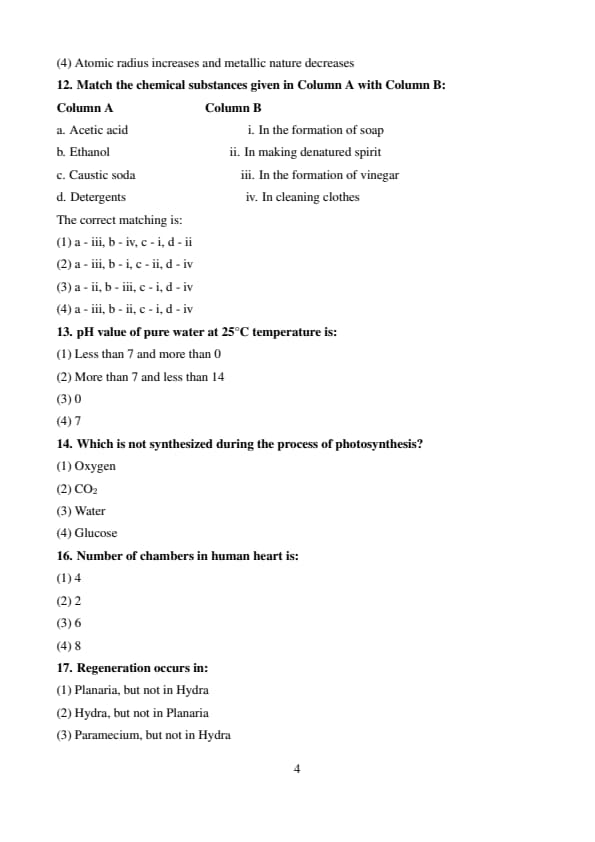
Match the chemical substances given in Column A with Column B:
Column A Column B
a. Acetic acid i. In the formation of soap
b. Ethanol ii. In making denatured spirit
c. Caustic soda iii. In the formation of vinegar
d. Detergents iv. In cleaning clothes
The correct matching is:
View Solution
Acetic acid is the main component responsible for the sour taste of vinegar and is therefore used in the formation of vinegar (iii). It is a weak organic acid with the formula \( \mathrm{CH_3COOH} \).
Ethanol is commonly used as a solvent and disinfectant. It is used in denatured spirit (ii), which is ethanol mixed with additives to make it unfit for consumption. Although ethanol can help in cleaning clothes, its primary industrial use in this context is as denatured spirit rather than detergents.
Caustic soda (sodium hydroxide, \( \mathrm{NaOH} \)) is a strong alkali used extensively in the formation of soap (i) through the process of saponification, where fats or oils react with caustic soda to produce soap and glycerol.
Detergents are synthetic cleansing agents used primarily for cleaning clothes (iv). They are effective in removing dirt and grease, especially in hard water, where soaps are less effective.
The best matching between the substances and their common uses based on the options given is:
\[ (1) \quad Acetic acid \rightarrow Vinegar (iii), \quad Ethanol \rightarrow Denatured spirit (ii), \quad Caustic soda \rightarrow Soap (i), \quad Detergents \rightarrow Cleaning clothes (iv). \]
Thus, option (1) fits best with the given descriptions. Quick Tip: Remember: - Acetic acid → vinegar, - Ethanol → denatured spirit, - Caustic soda → soap making, - Detergents → cleaning clothes.
pH value of pure water at 25°C temperature is:
View Solution
At \( 25^\circ \mathrm{C} \), pure water is considered neutral, which means it is neither acidic nor basic. This neutrality is quantitatively represented by its pH value of exactly 7, which is the midpoint on the pH scale.
\medskip
1. Understanding pH:
The pH of a solution is a logarithmic measure of the concentration of hydrogen ions (\( \mathrm{H^+} \)) or more accurately hydronium ions (\( \mathrm{H_3O^+} \)) in that solution.
It is mathematically defined as:
\[ \mathrm{pH} = -\log_{10} [\mathrm{H^+}] \]
For pure water at \( 25^\circ \mathrm{C} \), the concentration of hydrogen ions is:
\[ [\mathrm{H^+}] = 1 \times 10^{-7} \, \mathrm{mol/L} \]
Substituting this value gives:
\[ \mathrm{pH} = -\log_{10}(1 \times 10^{-7}) = 7 \]
2. Ionization of Water:
Water undergoes a process called self-ionization or auto-ionization, where a very small fraction of water molecules dissociate into hydrogen ions and hydroxide ions:
\[ \mathrm{H_2O (l)} \rightleftharpoons \mathrm{H^+ (aq)} + \mathrm{OH^- (aq)} \]
At \( 25^\circ \mathrm{C} \), the concentration of both \( \mathrm{H^+} \) and \( \mathrm{OH^-} \) ions is equal, each being \( 1 \times 10^{-7} \, \mathrm{mol/L} \).
Because the concentrations of \( \mathrm{H^+} \) and \( \mathrm{OH^-} \) ions are equal, the solution is neutral.
3. Neutrality and the pH Scale:
The pH scale generally ranges from 0 to 14, where:
pH less than 7 indicates an acidic solution (more \( \mathrm{H^+} \) ions).
pH greater than 7 indicates a basic or alkaline solution (more \( \mathrm{OH^-} \) ions).
pH exactly 7 corresponds to a neutral solution.
Pure water is the standard for neutrality, making pH 7 the reference point.
4. Effect of Temperature on pH:
The ionization of water is an endothermic process, meaning it depends on temperature.
At temperatures higher or lower than \( 25^\circ \mathrm{C} \), the ionization constant of water changes, leading to a shift in the concentrations of \( \mathrm{H^+} \) and \( \mathrm{OH^-} \).
As a result, the pH of pure water is not always exactly 7; it may be slightly lower or higher depending on the temperature.
However, at any temperature, pure water remains neutral because the concentrations of \( \mathrm{H^+} \) and \( \mathrm{OH^-} \) remain equal.
5. Importance of Neutral pH in Nature and Industry:
Neutral pH is critical for many biological systems and chemical reactions, as extreme acidity or alkalinity can denature enzymes or disrupt chemical equilibria.
Water with a pH close to 7 is safe for most plants, animals, and human use.
Monitoring and adjusting pH is essential in water treatment, agriculture, and various industrial processes to maintain proper conditions.
\medskip
In conclusion, at \( 25^\circ \mathrm{C} \), pure water has equal concentrations of hydrogen and hydroxide ions due to self-ionization, resulting in a neutral pH value of exactly 7. This neutrality is fundamental to many chemical, biological, and environmental processes. Quick Tip: pH less than 7 indicates acidic solution, pH equal to 7 indicates neutral, and pH greater than 7 indicates basic solution.
Which is not synthesized during the process of photosynthesis?
View Solution
During photosynthesis, plants convert carbon dioxide (\( \mathrm{CO_2} \)) and water (\( \mathrm{H_2O} \)) into glucose (\( \mathrm{C_6H_{12}O_6} \)) and oxygen (\( \mathrm{O_2} \)) using energy from sunlight. This process is summarized by the equation:
\[ 6\, \mathrm{CO_2} + 6\, \mathrm{H_2O} \xrightarrow{sunlight} \mathrm{C_6H_{12}O_6} + 6\, \mathrm{O_2} \]
1. Raw Materials and Products:
Carbon dioxide and water act as the raw materials (reactants) in the process.
Glucose and oxygen are the products formed during photosynthesis.
Therefore, carbon dioxide is consumed and not synthesized by the plant.
2. Role of Sunlight:
Sunlight provides the energy required to drive the endothermic reactions involved in photosynthesis.
Chlorophyll, the green pigment in leaves, absorbs this light energy.
3. Significance:
Photosynthesis is crucial as it provides organic compounds and oxygen necessary for life on Earth.
It also removes carbon dioxide from the atmosphere, helping regulate greenhouse gases.
In summary, carbon dioxide is a reactant used by plants during photosynthesis to synthesize glucose and oxygen; it is not synthesized during the process. Quick Tip: Photosynthesis reaction: \[ 6CO_2 + 6H_2O \xrightarrow{light} C_6H_{12}O_6 + 6O_2 \]
Number of chambers in human heart is:
View Solution
The human heart is a muscular organ composed of four chambers: two upper chambers called atria (left atrium and right atrium) and two lower chambers called ventricles (left ventricle and right ventricle).
1. Structure and Function of the Chambers:
The right atrium receives deoxygenated blood from the body through large veins called the superior and inferior vena cava.
This blood then flows into the right ventricle, which pumps it to the lungs via the pulmonary artery for oxygenation.
Oxygen-rich blood from the lungs returns to the left atrium through the pulmonary veins.
The left ventricle receives this oxygenated blood and pumps it through the aorta to the entire body.
2. Importance of Four Chambers:
Having separate atria and ventricles on both sides allows the heart to act as a double pump — one pump (right side) sends blood to the lungs, while the other pump (left side) circulates blood to the rest of the body.
This separation ensures that oxygenated and deoxygenated blood do not mix, allowing efficient oxygen transport.
The thick muscular walls of the left ventricle enable it to generate the high pressure required to deliver blood throughout the body.
3. Overall Significance:
The four-chambered structure supports the high metabolic demands of humans by ensuring continuous and efficient circulation of blood.
This design is a key adaptation for warm-blooded animals to maintain their body temperature and metabolic activity.
In summary, the four-chambered heart structure — two atria and two ventricles — plays a crucial role in maintaining separate pulmonary and systemic circulation, enabling efficient oxygenation and delivery of blood throughout the body. Quick Tip: Remember: Mammalian hearts, including humans, have four chambers for effective separation of oxygenated and deoxygenated blood.
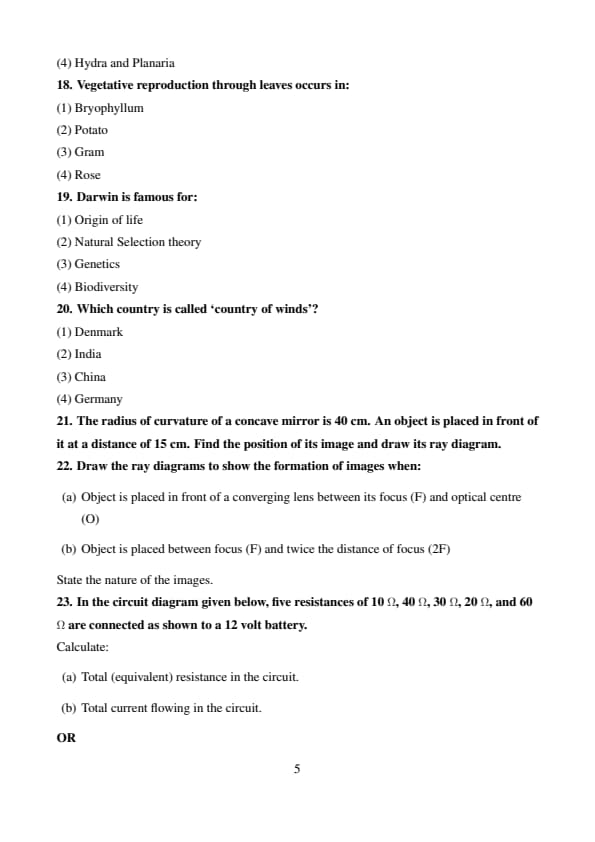
Regeneration occurs in:
View Solution
Both Hydra and Planaria possess remarkable regenerative abilities that enable them to regrow lost or damaged body parts.
1. Hydra:
Hydra is a simple freshwater organism belonging to the phylum Cnidaria.
It can regenerate its entire body from a small piece of tissue due to the presence of specialized stem cells.
This regeneration process includes the formation of new tentacles, mouth, and body structure, essentially allowing the organism to develop into a fully functional new Hydra.
2. Planaria:
Planaria is a flatworm from the phylum Platyhelminthes, well known for its exceptional regeneration capabilities.
If a Planaria is cut into several fragments, each fragment has the ability to regenerate into a complete organism.
This is possible because of the presence of pluripotent stem cells called neoblasts distributed throughout its body, which can differentiate into various cell types.
3. Paramecium:
Paramecium is a unicellular protozoan and does not exhibit regeneration in the same sense.
While Paramecium can repair minor cellular damage and reproduce asexually by binary fission, it cannot regenerate lost parts or grow into a new organism from fragments.
In summary, Hydra and Planaria demonstrate impressive regenerative abilities, allowing complete body regeneration from small pieces, whereas Paramecium does not show such regenerative capacity. Quick Tip: Hydra and Planaria are model organisms commonly studied for their strong regenerative powers.
Vegetative reproduction through leaves occurs in:
View Solution
Bryophyllum is a well-known example of a plant that reproduces vegetatively through its leaves. This process occurs when small buds or plantlets develop from the notches or edges of the leaf margins. These plantlets contain miniature roots and shoots, and once they grow to a certain size, they detach from the parent leaf and fall to the ground where they can develop into independent plants. This form of reproduction is called vegetative propagation through leaves and allows the plant to reproduce rapidly without the need for seeds or sexual reproduction.
This method has several advantages:
It ensures the offspring are genetically identical to the parent plant.
It enables the plant to colonize an area quickly.
It does not require pollination or seed germination, which can be limiting under certain environmental conditions.
On the other hand, potato reproduces vegetatively through specialized underground structures called tubers. Tubers are swollen portions of the stem that store nutrients and energy in the form of starch. Each tuber has several "eyes," which are actually buds capable of sprouting new shoots. When planted, these buds grow into new potato plants. It is important to note that tubers are modified stem structures, not leaves, distinguishing this mode of propagation from that of Bryophyllum.
The key differences between these two methods of vegetative propagation are:
Bryophyllum propagates via leaves, producing plantlets at the leaf margins.
Potato propagates via stem tubers, which serve as storage organs and also as means for asexual reproduction.
This diversity in vegetative propagation methods illustrates how plants have evolved various strategies to reproduce asexually and ensure survival in different environments.
In summary, while Bryophyllum reproduces vegetatively through leaf-borne plantlets, potatoes reproduce through stem tubers. Both methods bypass sexual reproduction, allowing plants to multiply efficiently. Quick Tip: Vegetative reproduction via leaves is characteristic of Bryophyllum due to the presence of adventitious buds on its leaf margins.
Darwin is famous for:
View Solution
Charles Darwin is renowned for proposing the theory of Natural Selection, which provides a scientific explanation for the mechanism of evolution. According to this theory, species evolve over time through a process in which individuals with traits better suited to their environment have a higher chance of surviving and reproducing. These advantageous traits are then passed on to future generations, gradually leading to adaptation and the emergence of new species.
Key points about Darwin’s theory include:
Variation: Within a population, individuals exhibit variations in their traits, such as size, color, or speed.
Inheritance: Some of these traits are heritable and can be passed on to offspring.
Struggle for Existence: Due to limited resources, organisms compete for survival.
Survival of the Fittest: Individuals with traits that confer an advantage in their environment are more likely to survive and reproduce.
Adaptation: Over many generations, these advantageous traits become more common, enabling the species to better adapt to their environment.
Darwin’s theory revolutionized biology by providing a natural explanation for the diversity of life on Earth and forming the foundation of modern evolutionary biology. Quick Tip: Natural Selection theory forms the foundation of modern evolutionary biology.
Which country is called ‘country of winds’?
View Solution
Denmark is often referred to as the ‘country of winds’ because of its unique geographical location and climatic conditions that result in consistent and strong winds throughout much of the year. Situated in Northern Europe, Denmark lies on a peninsula and several islands surrounded by the North Sea and the Baltic Sea, which contribute to its windy climate.
Geographical Factors:
The surrounding seas create pressure differences that generate steady winds.
Denmark’s flat terrain also allows winds to flow unobstructed over large areas.
Wind Energy Production:
These consistent wind conditions make Denmark one of the world leaders in wind energy.
The country has invested heavily in wind turbine technology and infrastructure.
Wind power contributes a significant portion of Denmark’s electricity supply, promoting renewable energy use and reducing reliance on fossil fuels.
Economic and Environmental Impact:
Denmark’s wind energy industry supports innovation, job creation, and export opportunities.
It also helps reduce greenhouse gas emissions, contributing to global efforts to combat climate change.
In summary, Denmark’s designation as the ‘country of winds’ reflects its favorable wind conditions, which have been harnessed effectively for sustainable energy production. Quick Tip: Denmark leads in wind energy usage and has many wind turbines due to its windy climate.
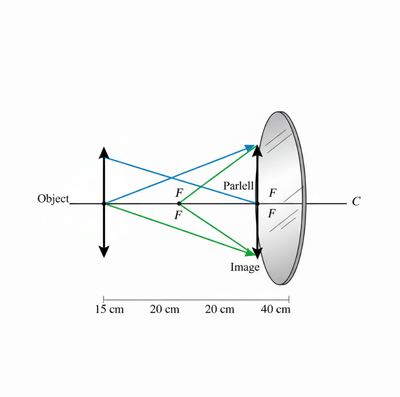
The radius of curvature of a concave mirror is 40 cm. An object is placed in front of it at a distance of 15 cm. Find the position of its image and draw its ray diagram.
View Solution
Given:
Radius of curvature, \( R = 40 \, cm \)
Object distance, \( u = -15 \, cm \) (object is in front of mirror, so negative)
Step 1: Calculate the focal length \( f \): \[ f = \frac{R}{2} = \frac{40}{2} = 20 \, cm \]
Step 2: Use the mirror formula: \[ \frac{1}{f} = \frac{1}{v} + \frac{1}{u} \]
where \( v \) is the image distance.
\[ \frac{1}{v} = \frac{1}{f} - \frac{1}{u} = \frac{1}{20} - \frac{1}{-15} = \frac{1}{20} + \frac{1}{15} = \frac{3 + 4}{60} = \frac{7}{60} \]
\[ v = \frac{60}{7} \approx 8.57 \, cm \]
So, the image is formed at \( v = +8.57 \, cm \) in front of the mirror (real side).
Step 3: Nature of image: Since \( v \) is positive, the image is real and formed on the same side as the object. It is also smaller than the object since \( |v| < |u| \).
% Ray diagram instructions (to be drawn by student):
Draw the principal axis and concave mirror with center of curvature \( C \) at 40 cm.
Mark the focal point \( F \) at 20 cm.
Place the object at 15 cm in front of the mirror.
Draw at least two rays:
A ray parallel to the principal axis, reflected through the focal point.
A ray passing through the focal point, reflected parallel to the principal axis.
The point where the reflected rays intersect in front of the mirror gives the position of the real image.
Quick Tip: Use the mirror formula \( \frac{1}{f} = \frac{1}{v} + \frac{1}{u} \) and sign conventions carefully to locate images in concave mirrors.
Draw the ray diagrams to show the formation of images when:
(a) Object is placed in front of a converging lens between its focus (F) and optical centre (O)
(b) Object is placed between focus (F) and twice the distance of focus (2F)
State the nature of the images.
View Solution
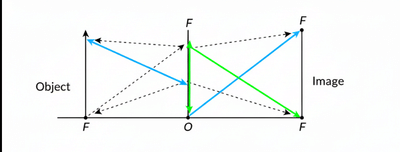
(a) Object between optical centre (O) and focus (F):
% Ray diagram instructions for (a)
Draw a convex lens with principal axis.
Mark the optical centre \( O \), focus \( F \), and twice the focal length \( 2F \) on both sides.
Place the object between \( O \) and \( F \).
Draw:
A ray parallel to the principal axis → refracted through the far focus.
A ray passing through the optical centre \( O \) → goes undeviated.
The two refracted rays diverge, so extend them backward to meet behind the object.
Nature of image:
Virtual
Erect
Magnified
Formed on the same side as the object
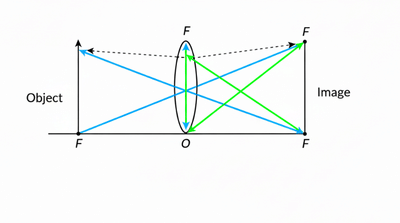
(b) Object between \( F \) and \( 2F \):
% Ray diagram instructions for (b)
Place the object between \( F \) and \( 2F \) in front of a convex lens.
Draw:
A ray parallel to the principal axis → refracted through far focus.
A ray through the optical centre \( O \) → goes undeviated.
The rays meet on the other side of the lens to form the image.
Nature of image:
Real
Inverted
Magnified
Formed beyond \( 2F \) on the opposite side Quick Tip: For convex lenses: Object between \( O \) and \( F \) → Virtual, erect, magnified image. Object between \( F \) and \( 2F \) → Real, inverted, magnified image beyond \( 2F \).
In the circuit diagram given below, five resistances of 10 \(\Omega\), 40 \(\Omega\), 30 \(\Omega\), 20 \(\Omega\), and 60 \(\Omega\) are connected as shown to a 12 volt battery.
Calculate:
(a) Total (equivalent) resistance in the circuit.
(b) Total current flowing in the circuit.
View Solution
(a) Total Equivalent Resistance
Step 1: Calculate equivalent resistance of the left parallel branch: \[ \frac{1}{R_1} = \frac{1}{10} + \frac{1}{40} = \frac{4 + 1}{40} = \frac{5}{40} = \frac{1}{8} \Rightarrow R_1 = 8\,\Omega \]
Step 2: Calculate equivalent resistance of the right parallel branch: \[ \frac{1}{R_2} = \frac{1}{30} + \frac{1}{20} + \frac{1}{60} = \frac{2 + 3 + 1}{60} = \frac{6}{60} = \frac{1}{10} \Rightarrow R_2 = 10\,\Omega \]
Step 3: Total equivalent resistance in series: \[ R_{total} = R_1 + R_2 = 8 + 10 = 18\,\Omega \]
(b) Total Current Using Ohm’s Law: \[ I = \frac{V}{R} = \frac{12\,V}{18\,\Omega} = \frac{2}{3}\,A \approx 0.67\,A \] Quick Tip: For parallel resistors: \[ \frac{1}{R} = \frac{1}{R_1} + \frac{1}{R_2} + \ldots \] Add series resistances directly: \[ R_{total} = R_1 + R_2 + \ldots \]
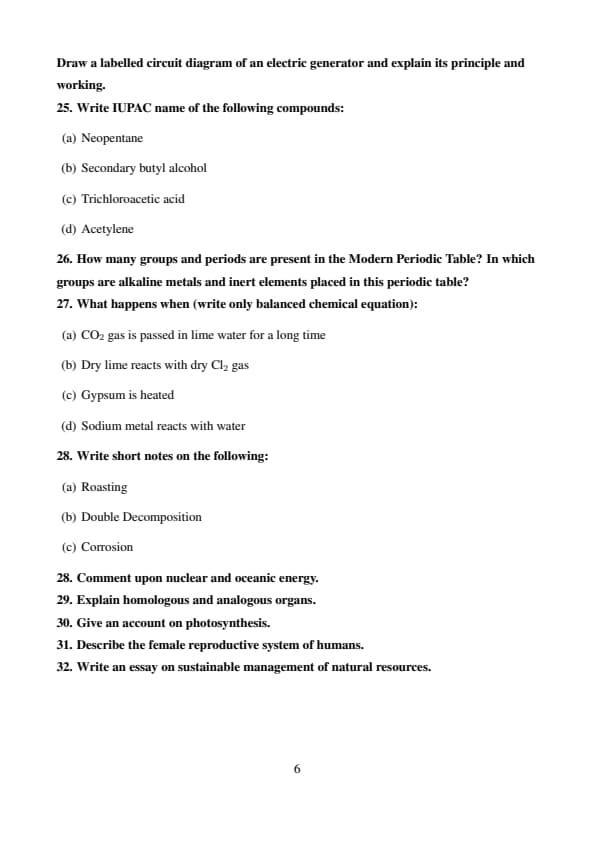
What do you mean by electromagnetic induction? On what factors does the value of induced current in a circuit depend? Name and state the rule used for determination of direction of induced current. State the practical application of this phenomenon in everyday life.
OR
Draw a labelled circuit diagram of an electric generator and explain its principle and working.
View Solution
Electromagnetic Induction:
Electromagnetic induction is the phenomenon of generating an electric current in a conductor when it is placed in a changing magnetic field.
Factors affecting the induced current:
Magnitude of the change in magnetic field
Speed of motion of the conductor or the magnet
Number of turns in the coil
Area of the coil
Rule used to find direction of induced current:
Name: Fleming’s Right-Hand Rule
Statement: If the thumb, forefinger and middle finger of the right hand are stretched mutually perpendicular to each other, and the forefinger points in the direction of the magnetic field and the thumb in the direction of motion of the conductor, then the middle finger gives the direction of the induced current.
Practical Application:
The most common application is in electric generators, where mechanical energy is converted into electrical energy using electromagnetic induction.
OR
% Electric generator solution
Electric Generator: Principle and Working
Principle: It works on the principle of electromagnetic induction — when a coil rotates in a magnetic field, an induced current is produced in it.
Working:
A rectangular coil is rotated rapidly between the poles of a magnet.
The rotation changes the magnetic flux through the coil with time.
This induces current in the coil according to Faraday’s Law of Electromagnetic Induction.
The direction of current is given by Fleming’s Right-Hand Rule and changes every half rotation (in case of AC generator).
% Diagram note
\textit{Note: Add a labelled diagram of an electric generator with key components — coil, magnet, slip rings/commutator, brushes, etc. Quick Tip: Fleming’s Right-Hand Rule helps determine the direction of induced current in generators, while the Left-Hand Rule is used for motors.
Write IUPAC name of the following compounds:
(a) Neopentane
(b) Secondary butyl alcohol
(c) Trichloroacetic acid
(d) Acetylene
View Solution
[(a)] Neopentane — 2,2-Dimethylpropane
[(b)] Secondary butyl alcohol — Butan-2-ol
[(c)] Trichloroacetic acid — 2,2,2-Trichloroethanoic acid
[(d)] Acetylene — Ethyne Quick Tip: In IUPAC naming: Count the longest carbon chain. Identify and number substituents or functional groups based on priority. Use prefixes (di-, tri-, etc.) and correct suffixes (-ane, -ene, -yne, -ol, -oic acid).
How many groups and periods are present in the Modern Periodic Table? In which groups are alkaline metals and inert elements placed in this periodic table?
View Solution
The Modern Periodic Table consists of:
18 groups
7 periods
Alkali metals (like Lithium, Sodium, Potassium) are placed in:
Group 1
Inert elements or noble gases (like Helium, Neon, Argon) are placed in:
Group 18 Quick Tip: Group number indicates the number of valence electrons, while period number indicates the number of shells. Group 1 contains the most reactive metals (alkali metals), and Group 18 contains inert gases with fully filled outer shells.
What happens when (write only balanced chemical equation):
(a) CO\(_2\) gas is passed in lime water for a long time
(b) Dry lime reacts with dry Cl\(_2\) gas
(c) Gypsum is heated
(d) Sodium metal reacts with water
View Solution
[(a)] \(Ca(OH)_2 + CO_2 \rightarrow CaCO_3 \downarrow + H_2O\)
\(CaCO_3 + CO_2 + H_2O \rightarrow Ca(HCO_3)_2\)
[(b)] \(CaO + Cl_2 \rightarrow CaOCl_2\)
[(c)] \(CaSO_4 \cdot 2H_2O \xrightarrow{heat} CaSO_4 \cdot \tfrac{1}{2}H_2O + \tfrac{3}{2}H_2O\)
[(d)] \(2Na + 2H_2O \rightarrow 2NaOH + H_2 \uparrow\) Quick Tip: Write balanced equations by ensuring equal number of atoms of each element on both sides. Always include physical states (s, l, g, aq) in detailed answers if required.
Write short notes on the following:
(a) Roasting
(b) Double Decomposition
(c) Corrosion
View Solution
(a) Roasting:
Roasting is a process in metallurgy in which a sulphide ore is strongly heated in the presence of excess air to convert it into its oxide form. \[ Example: 2ZnS + 3O_2 \rightarrow 2ZnO + 2SO_2 \]
It helps in removing volatile impurities and prepares the ore for reduction.
(b) Double Decomposition:
Double decomposition is a type of chemical reaction in which two compounds react by exchanging ions to form two new compounds. It often occurs in aqueous solution and may result in a precipitate, gas, or water. \[ Example: Na_2SO_4 + BaCl_2 \rightarrow BaSO_4 \downarrow + 2NaCl \]
(c) Corrosion:
Corrosion is a slow process where metals are gradually destroyed by reaction with atmospheric moisture, acids, or gases. For example, iron reacts with oxygen and water to form rust. \[ 4Fe + 3O_2 + 6H_2O \rightarrow 4Fe(OH)_3 (rust) \]
It leads to weakening and damage of metal objects over time. Quick Tip: Roasting is used in metallurgy, double decomposition in salt reactions, and corrosion prevention is important for protecting metal structures.
Comment upon nuclear and oceanic energy.
View Solution
Nuclear Energy:
Nuclear energy is the energy released during nuclear reactions such as fission (splitting of heavy nuclei like uranium) or fusion (combining of light nuclei like hydrogen). In nuclear power plants, fission is used to produce heat, which generates electricity. It is a powerful, efficient, and clean source of energy, but it also poses risks of radiation, waste disposal, and accidents (e.g., Chernobyl, Fukushima).
Oceanic Energy:
Oceanic energy refers to energy derived from the sea, which includes:
Tidal energy – Generated by the rise and fall of ocean tides.
Wave energy – Generated from surface waves of the sea.
Ocean thermal energy – Generated from the temperature difference between surface water and deeper water.
Oceanic energy is renewable and eco-friendly but still underdeveloped due to high costs and technological limitations. Quick Tip: Nuclear energy offers high output with low greenhouse emissions but involves risk. Oceanic energy is renewable and abundant but needs more research and infrastructure to be widely used.
Explain homologous and analogous organs.
View Solution
Homologous Organs:
Homologous organs are organs that have the **same basic structure and origin** but may perform **different functions** in different organisms. These organs provide evidence of **divergent evolution** (common ancestry).
Example:
Forelimbs of humans, whales, birds, and bats – all have the same structural pattern but are used for different purposes (grasping, swimming, flying).
Analogous Organs:
Analogous organs are organs that have **similar functions** but **different structures and origins**. These organs arise due to **convergent evolution** (different ancestry, similar environmental adaptation).
Example:
Wings of birds and insects – both used for flying but structurally different. Quick Tip: Remember: Homologous = same structure, different function (common origin).
Analogous = same function, different structure (different origin).
Give an account on photosynthesis.
View Solution
Photosynthesis is the process by which green plants, algae, and some bacteria convert light energy into chemical energy in the form of glucose, using carbon dioxide and water. It occurs mainly in the chloroplasts of plant cells containing the pigment chlorophyll.
The general equation for photosynthesis is: \[ 6CO_2 + 6H_2O \xrightarrow{light, chlorophyll} C_6H_{12}O_6 + 6O_2 \]
Photosynthesis consists of two main stages:
Light-dependent reactions: Light energy is absorbed by chlorophyll, producing ATP and NADPH, and splitting water molecules to release oxygen.
Light-independent reactions (Calvin cycle): ATP and NADPH are used to convert carbon dioxide into glucose.
Photosynthesis is crucial as it provides oxygen and organic food for most living organisms. Quick Tip: Remember the photosynthesis equation and the two stages: light-dependent and light-independent reactions for better understanding.
Describe the female reproductive system of humans.
View Solution
The female reproductive system in humans consists of the following main parts:
Ovaries: Two small almond-shaped organs that produce eggs (ova) and hormones like estrogen and progesterone.
Fallopian Tubes (Oviducts): Tubes connecting the ovaries to the uterus where fertilization usually occurs.
Uterus (Womb): A hollow, muscular organ where the fertilized egg implants and develops into a fetus.
Cervix: The narrow lower end of the uterus opening into the vagina.
Vagina: A muscular canal that connects the cervix to the outside of the body, serves as the birth canal and receives the male sperm during intercourse.
The female reproductive system is responsible for producing eggs, providing the environment for fertilization, supporting fetal development, and childbirth. Quick Tip: Focus on the function and structure of each part: ovaries produce eggs, fallopian tubes are the site of fertilization, uterus supports fetal growth, cervix acts as a gateway, and vagina serves multiple reproductive roles.
Write an essay on sustainable management of natural resources.
View Solution
Sustainable management of natural resources refers to the responsible use and conservation of natural resources such that they meet present needs without compromising the ability of future generations to meet theirs. It involves managing resources like water, soil, forests, minerals, and wildlife in a way that balances environmental, economic, and social objectives.
Key principles of sustainable management include:
Conservation: Protecting natural habitats and biodiversity to maintain ecological balance.
Efficient Use: Using resources optimally to reduce waste and avoid depletion.
Renewable Resource Management: Ensuring renewable resources like forests and water are replenished naturally.
Pollution Control: Minimizing pollution to protect ecosystems and human health.
Community Involvement: Engaging local communities in resource management for sustainable livelihoods.
Examples of sustainable practices include afforestation, rainwater harvesting, soil conservation techniques, and use of clean energy. Sustainable management is crucial for environmental protection, combating climate change, and ensuring long-term availability of resources. Quick Tip: Remember: Sustainability means meeting today's needs without harming the future. Balance conservation, use, and regeneration.



Comments