




UP Board Class 12 Accountancy Question Paper 2024 PDF is available for download here. The Accountancy exam was conducted on February 29, 2024 in the Morning Shift from 8:30 AM to 11:45 AM. The total marks for the theory paper are 100. Students reported the paper to be easy to moderate.
UP Board Class 12 Accountancy Question Paper 2024 with Solutions
| UP Board Class 12 Accountancy Question Paper 2024 PDF | UP Board Class 12 Accountancy Solutions 2024 PDF |
|---|---|
| Download PDF | Download Now |
Which is not an essential element of a partnership firm?
View Solution
Step 1: Understanding the essential elements of a partnership.
A partnership firm must satisfy the following essential elements:
1. There must be at least two partners.
2. There should be an agreement between all partners.
3. The partnership agreement must be for some business.
4. Sharing profits and losses may vary as per the agreement; equal sharing is not mandatory.
Step 2: Identifying the incorrect statement.
Option (3), "Equal share of profit and loss," is incorrect because the share of profit and loss depends on the agreement between partners. Equal sharing is not essential. Quick Tip: In partnership firms, the terms and conditions, including the share of profits and losses, are defined by mutual agreement among the partners.
Sacrifice ratio means:
View Solution
Step 1: Understanding the sacrifice ratio.
The sacrifice ratio indicates the proportion of profit sacrificed by the existing partners in favor of the new partner. It is calculated as: \[ Sacrifice Ratio = Old Ratio - New Ratio \]
Step 2: Identifying the correct formula.
From the options provided, the correct definition matches \( Old Ratio - New Ratio \), which is option (2). Other options do not represent the correct formula for the sacrifice ratio. Quick Tip: The sacrifice ratio is crucial in partnership accounting to adjust the new partner's share and calculate compensation for the existing partners.
A new partner may be admitted into a partnership:
View Solution
Step 1: Understanding the requirement for admitting a new partner.
To admit a new partner in a partnership, all the existing partners must agree unanimously. This ensures that the rights and interests of all existing partners are protected.
Step 2: Identifying the correct condition.
The admission of a new partner cannot be decided by a majority or a subset of the partners. It must be with the consent of all old partners, as partnership agreements typically emphasize unanimity for such critical decisions. Quick Tip: When admitting a new partner, ensure the unanimous consent of all existing partners to avoid conflicts and disputes in the partnership.
On retirement of a partner, goodwill will be credited to the capital account of:
View Solution
Step 1: Understanding the treatment of goodwill.
On the retirement of a partner, goodwill is credited to the retiring partner's capital account because it represents the retiring partner's share of the firm's reputation and intangible value accumulated during their tenure.
Step 2: Identifying the correct account to credit.
The retiring partner is entitled to their share of goodwill as per the partnership agreement or mutual understanding among the partners. This amount is credited directly to their capital account.
Quick Tip: In partnership accounting, always allocate goodwill to the retiring partner to ensure fair compensation for their contributions to the firm's reputation.
On disSolutions of a partnership firm, profit or loss on realization is distributed among the partners:
View Solution
Step 1: Understanding the distribution of profit or loss on realization.
On disSolutions, any profit or loss arising from the realization of assets is distributed among the partners in their agreed profit sharing ratio. This ensures that all partners bear the results of disSolutions equitably as per their contributions and entitlements.
Step 2: Identifying the correct ratio.
The profit sharing ratio is used because it reflects the partners' original agreement regarding the distribution of profits and losses during the partnership.
Quick Tip: During disSolutions, always distribute realization profits or losses in the profit sharing ratio unless specified otherwise in the partnership agreement.
Who are the real owners of a company?
View Solution
Step 1: Understanding ownership in a company.
The real owners of a company are its equity shareholders. They invest in the company and have a residual claim on its assets and profits after all liabilities, including payments to debenture holders and creditors, are settled.
Step 2: Identifying the role of equity shareholders.
Equity shareholders have voting rights in the company, allowing them to influence major decisions. This ownership stake makes them the real owners of the company. Other entities, such as the Board of Directors or debenture holders, do not possess ownership rights.
Quick Tip: Equity shareholders are considered the real owners of a company because they bear the risks and enjoy the rewards of the business.
A debenture holder is entitled to:
View Solution
Step 1: Understanding the entitlement of debenture holders.
Debenture holders are creditors of the company and are entitled to receive interest at a fixed rate, irrespective of the company’s profit or loss. They do not have voting rights or any ownership stake in the company.
Step 2: Differentiating between debenture holders and shareholders.
Unlike equity shareholders, debenture holders are not entitled to a share in the company’s profits or decision-making rights. Their primary benefit is the fixed interest payment as agreed upon in the terms of the debenture.
Quick Tip: Debenture holders are creditors of the company, and their entitlement is limited to fixed interest payments, not ownership or profits.
Which statement provides information about the profitability of the company?
View Solution
Step 1: Understanding profitability statements.
The income statement, also known as the profit and loss statement, provides detailed information about a company's revenues, expenses, and profits during a specific period. It is the primary document for evaluating profitability.
Step 2: Differentiating between financial statements.
Other statements, such as the financial position statement or retained earnings statement, provide information on the company's assets, liabilities, and equity but not on profitability. The statement of cost focuses on costs, not profits.
Quick Tip: To evaluate a company's profitability, always refer to the income statement, as it summarizes revenue and expenses.
Current ratio is used to find:
View Solution
Step 1: Understanding the current ratio.
The current ratio is calculated as: \[ Current Ratio = \frac{Current Assets}{Current Liabilities} \]
It measures a company's ability to meet its short-term obligations using its short-term assets.
Step 2: Identifying the purpose of the ratio.
The current ratio focuses on short-term solvency, not long-term solvency or profitability. It helps assess the liquidity of a company.
Quick Tip: Use the current ratio to assess a company's ability to meet short-term liabilities, ensuring financial stability in the near term.
Which accounting standard is related to cash flow statement?
View Solution
Step 1: Identifying the relevant accounting standard.
Accounting Standard (AS) - 03 specifies the guidelines for preparing and presenting a cash flow statement. It outlines the classification of cash flows into operating, investing, and financing activities.
Step 2: Differentiating between accounting standards.
Other standards, such as AS-13 (Investments) and AS-23 (Associates in Consolidated Financial Statements), are unrelated to the cash flow statement. AS-33 deals with earnings per share.
Quick Tip: For cash flow statements, always refer to Accounting Standard - 03, which provides clear guidelines for its preparation.
What is meant by "Unlimited liability of a partner"?
View Solution
Unlimited liability of a partner means that if the partnership firm's assets are insufficient to pay off its debts, the partners are personally liable to cover the shortfall. This liability extends to their personal assets, ensuring that creditors can recover their dues even if the firm's resources are inadequate. Quick Tip: Unlimited liability in partnerships emphasizes the importance of careful decision-making and monitoring financial risks, as personal assets can be at stake.
State any two occasions when reconstitution of a partnership firm takes place.
View Solution
Reconstitution of a partnership firm takes place in the following situations:
1. Admission of a new partner: When a new partner joins the partnership firm, the agreement between the partners is reconstituted.
2. Retirement or death of a partner: When an existing partner retires or passes away, the partnership is reconstituted to accommodate the new circumstances. Quick Tip: Reconstitution of a partnership firm typically occurs due to changes in its structure, such as the addition, removal, or replacement of partners.
Write two main rights acquired by the new partner.
View Solution
The two main rights acquired by a new partner in a partnership firm are:
1. Right to share profits: The new partner is entitled to a share in the firm's profits as per the agreement among the partners.
2. Right to participate in management: The new partner gains the right to take part in the decision-making and management of the firm. Quick Tip: When a new partner is admitted, their rights are defined in the partnership agreement, ensuring clarity and fairness among all partners.
State any two items of deduction that may have to be made from the amount payable to a retiring partner.
View Solution
Two items of deduction that may have to be made from the amount payable to a retiring partner are:
1. Outstanding liabilities: Any liabilities or debts owed by the retiring partner to the firm are deducted.
2. Losses or damages caused: If the retiring partner is responsible for any loss or damage to the firm's assets, the compensation amount is deducted. Quick Tip: Before finalizing the settlement amount for a retiring partner, ensure that all outstanding dues and liabilities are adjusted appropriately.
Write two circumstances under which a partnership firm is dissolved.
View Solution
Two circumstances under which a partnership firm is dissolved are:
1. Mutual agreement among partners: A firm can be dissolved if all partners agree to discontinue the business.
2. Insolvency of all partners except one: If all but one partner become insolvent, the partnership firm must be dissolved. Quick Tip: A partnership firm can also be dissolved due to court orders, expiry of the term, or completion of the specific objective for which it was formed.
What is meant by listed company?
View Solution
A listed company is a public company whose shares are traded on a recognized stock exchange. These companies must comply with the rules and regulations of the stock exchange and disclose their financial and operational information to the public. Quick Tip: Listed companies provide transparency by adhering to disclosure norms, making it easier for investors to make informed decisions.
What do you mean by participating preference shares?
View Solution
Participating preference shares are a type of preference shares that provide shareholders with the right to participate in the surplus profits of the company, in addition to receiving a fixed dividend. These shareholders may also have a claim on surplus assets during liquidation after other liabilities are settled. Quick Tip: Participating preference shares offer both stability (fixed dividends) and an opportunity to benefit from additional profits, making them attractive to certain investors.
Classify debentures from the point of view of security.
View Solution
Debentures can be classified from the point of view of security into:
1. Secured or mortgage debentures: These debentures are backed by specific assets of the company as security. If the company defaults, the debenture holders can claim the secured assets.
2. Unsecured or naked debentures: These debentures are not backed by any specific assets. The holders are treated as general creditors of the company. Quick Tip: Secured debentures provide lower risk to investors, while unsecured debentures often offer higher interest rates to compensate for the increased risk.
Give any two examples of non-current assets.
View Solution
Two examples of non-current assets are:
1. Land and Buildings: These are long-term assets used for business operations and not intended for sale.
2. Machinery: Equipment used in the production process, which has a useful life extending beyond the current financial year. Quick Tip: Non-current assets are long-term investments that help generate revenue over multiple financial periods and are not easily converted into cash.
State any two objectives of a cash flow statement.
View Solution
Two objectives of a cash flow statement are:
1. Assessing liquidity and cash position: It provides information about the inflows and outflows of cash and cash equivalents, helping to evaluate the company's liquidity.
2. Evaluating cash-based performance: It helps stakeholders understand how the company generates and uses cash through operating, investing, and financing activities. Quick Tip: A cash flow statement is a vital tool for understanding a company's ability to manage cash and meet its short-term obligations.
State any five important points which must be incorporated in a partnership deed.
View Solution
A partnership deed must incorporate the following points:
1. Name and address of the firm and partners: Clearly state the firm's name and the details of all partners.
2. Nature of business: Specify the type of business the firm intends to carry out.
3. Capital contribution: Mention the amount of capital contributed by each partner.
4. Profit-sharing ratio: Define how profits and losses will be shared among the partners.
5. Rights and duties of partners: Outline the responsibilities and entitlements of each partner. Quick Tip: A well-drafted partnership deed ensures transparency and prevents disputes by clearly defining the terms agreed upon by the partners.
What is hidden goodwill? How is it adjusted on the admission of a partner?
View Solution
Hidden Goodwill refers to the goodwill that is not explicitly mentioned or agreed upon but is derived indirectly from the valuation of the firm. It is calculated by comparing the total value of the firm (based on the capital brought in by the new partner) with the net tangible assets of the firm.
Adjustment on Admission of a Partner:
1. The hidden goodwill is calculated using the formula:
\[ Hidden Goodwill = Total Capital of the Firm - Net Tangible Assets \]
2. The goodwill is then credited to the existing partners' capital accounts in their old profit-sharing ratio.
3. If the new partner pays their share of goodwill in cash, it is recorded as a premium for goodwill and distributed among the existing partners.
This ensures fair compensation to the existing partners for the firm's goodwill value before admitting the new partner. Quick Tip: Hidden goodwill must be carefully calculated and adjusted to maintain transparency and fairness during a partner's admission.
Clarify the difference between disSolutions of a firm and disSolutions of a partnership.
View Solution
The key differences between the disSolutions of a firm and the disSolutions of a partnership are as follows:
1. Meaning:
- DisSolutions of a partnership refers to the reconstitution of the partnership firm due to the change in the relationship between the partners, such as the admission, retirement, or death of a partner.
- DisSolutions of a firm involves the complete closure of the business and cessation of operations.
2. Continuity:
- In the disSolutions of a partnership, the firm continues with the remaining partners under a new agreement.
- In the disSolutions of a firm, the firm's existence comes to an end.
3. Scope:
- DisSolutions of a partnership affects only the terms of the agreement and profit-sharing ratio.
- DisSolutions of a firm affects all business activities, and assets are liquidated to settle liabilities.
4. Settlement of Accounts:
- In the disSolutions of a partnership, accounts are adjusted, and a new agreement is created.
- In the disSolutions of a firm, accounts are completely settled, and the business is closed. Quick Tip: DisSolutions of a partnership does not end the firm's operations, while the disSolutions of a firm terminates the business entirely.
What is Reserve Capital? Does it differ from Capital Reserve?
View Solution
Reserve Capital refers to the portion of the uncalled share capital of a company that can only be called up in the event of the company’s liquidation. It is created through a special reSolutions and provides a financial safety net for creditors.
Difference from Capital Reserve:
1. Nature: Reserve Capital is uncalled capital, whereas Capital Reserve is a reserve created from capital profits, such as profits from the sale of fixed assets or revaluation of assets.
2. Utilization: Reserve Capital can only be used to settle liabilities during liquidation, whereas Capital Reserve is used for specific purposes like issuing bonus shares or writing off capital losses.
3. Requirement: Reserve Capital is mandatory only if specified, while Capital Reserve arises from the normal operations of the company. Quick Tip: Reserve Capital strengthens a company’s ability to meet obligations during liquidation, while Capital Reserve enhances financial stability and supports long-term growth.
What is meant by issue of debentures for consideration other than cash?
View Solution
When a company issues debentures for consideration other than cash, it means the debentures are issued in exchange for acquiring assets or settling liabilities instead of receiving cash payment. For instance, a company may issue debentures to purchase machinery, land, or to settle creditors.
This method allows the company to procure resources or settle obligations without impacting its cash flow. Quick Tip: Issuing debentures for consideration other than cash is a strategic way to acquire assets or settle liabilities while preserving liquidity.
What is Comparative Balance Sheet? Mention any three objectives of it.
View Solution
A Comparative Balance Sheet presents financial data for multiple periods side by side, allowing stakeholders to compare and analyze the changes in the company's financial position over time.
Objectives of a Comparative Balance Sheet:
1. Identify trends: Helps analyze trends in assets, liabilities, and equity over different periods.
2. Evaluate financial performance: Provides a clear view of growth, profitability, and solvency changes.
3. Support decision-making: Assists management and stakeholders in making informed financial decisions based on historical data. Quick Tip: A Comparative Balance Sheet is a valuable tool for evaluating a company's financial progress and identifying strengths or weaknesses over time.
P, Q, and R are partners in a firm sharing profits in the ratio of \(2:2:1\). R retires, and the Balance Sheet of the firm as on that date was as under:
Balance Sheet as on the Date of Retirement

Adjustments:
1. Stock is to be reduced to Rs. 82,000.
2. Plant is to be reduced by Rs. 20,000.
3. Patents are found valueless.
4. There is no liability on account of the Workmen's Compensation Reserve.
Record the necessary journal entries at the time of retirement.
View Solution
Journal Entries:

Explanation:
1. Revaluation account is created to adjust the decrease in the value of assets and liabilities.
2. General Reserve and P&L account balances are transferred to the partners' capital accounts in their profit-sharing ratio.
3. The amount payable to the retiring partner (R) is settled in cash. Quick Tip: In retirement, always adjust reserves and revaluation gains/losses in the old profit-sharing ratio before settling the retiring partner's dues.
OR
Question 27:
What do you mean by Revaluation Account? Write reasons for the preparation of 'Revaluation Account' on the admission of a partner.
View Solution
Revaluation Account:
The revaluation account is prepared to record the changes in the value of assets and liabilities at the time of admission, retirement, or death of a partner. It ensures that the adjustments for these changes are made fairly, and the resulting profit or loss is shared among the existing partners in their old profit-sharing ratio.
Reasons for Preparing Revaluation Account on Admission of a Partner:
1. Fair valuation of assets and liabilities: The existing partners revalue the firm's assets and liabilities to ensure that the incoming partner gets a fair valuation of the firm's net worth.
2. Adjustment of hidden profits or losses: Any hidden profits or losses arising from undervaluation or overvaluation of assets/liabilities are adjusted through the revaluation account.
3. Accurate capital determination: The revaluation ensures that the partners' capital accounts reflect the true value of the firm's assets and liabilities.
4. Transparency: It promotes transparency by showing the correct financial position of the firm at the time of admission.
5. Equity among partners: The existing partners share the profits or losses arising due to revaluation in their old profit-sharing ratio, maintaining equity among them. Quick Tip: Prepare a revaluation account to reflect the true financial position of the firm and ensure a fair distribution of profits or losses among existing partners.
R Ltd. invited applications for 20,000 shares of Rs. 10 each payable as follows:
Rs. 3 on application, Rs. 2 on allotment, Rs. 2.50 on first call, and Rs. 2.50 on second call.
Public applied for 30,000 shares, and allotments were made as under:
1. To applicants for 8,000 shares: Full allotment.
2. To applicants for 16,000 shares: 12,000 shares allotted.
3. To applicants for 6,000 shares: Nil allotment.
All money was duly received. Pass journal entries.
View Solution
Journal Entries:

Explanation:
1. Money received on applications (Rs. 90,000) was adjusted towards the share capital (Rs. 60,000) and allotment (Rs. 30,000).
2. Subsequent calls for allotment, first call, and second call were received and adjusted against the share capital. Quick Tip: Always adjust oversubscription amounts against share allotment or refund the excess, ensuring proper accounting entries for all calls.
OR
Question 28:
What is meant by a company? Explain its characteristics.
View Solution
A company is a legal entity formed under the Companies Act to carry out business activities. It has a separate legal identity, perpetual succession, and limited liability for its members.
Characteristics of a Company:
1. Separate Legal Entity: A company is distinct from its owners and can own property, enter contracts, and sue or be sued in its name.
2. Perpetual Succession: A company continues to exist regardless of changes in ownership or management.
3. Limited Liability: The liability of shareholders is limited to the unpaid value of their shares.
4. Transferability of Shares: Shares of a public company can be freely transferred, ensuring liquidity for shareholders.
5. Common Seal: A company uses a common seal as its official signature, representing its authority. Quick Tip: A company combines ownership by shareholders and management by directors, ensuring professional governance and financial security for its members.
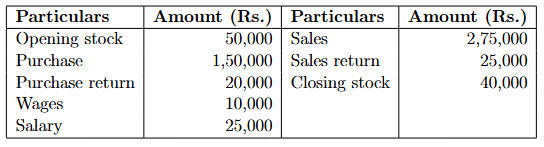
Calculate gross profit ratio and net profit ratio from the following:
View Solution
Step 1: Calculation of Gross Profit \[ Gross Profit = Net Sales - Cost of Goods Sold (COGS) \] \[ Net Sales = Sales - Sales Return = 2,75,000 - 25,000 = 2,50,000 \] \[ COGS = Opening Stock + Purchases - Purchase Return + Wages - Closing Stock \] \[ COGS = 50,000 + 1,50,000 - 20,000 + 10,000 - 40,000 = 1,50,000 \] \[ Gross Profit = 2,50,000 - 1,50,000 = 1,00,000 \]
Step 2: Calculation of Gross Profit Ratio \[ Gross Profit Ratio = \left(\frac{Gross Profit}{Net Sales}\right) \times 100 = \left(\frac{1,00,000}{2,50,000}\right) \times 100 = 40% \]
Step 3: Calculation of Net Profit
Net Profit is calculated by deducting operating expenses (Salary) from Gross Profit. \[ Net Profit = Gross Profit - Salary = 1,00,000 - 25,000 = 75,000 \]
Step 4: Calculation of Net Profit Ratio \[ Net Profit Ratio = \left(\frac{Net Profit}{Net Sales}\right) \times 100 = \left(\frac{75,000}{2,50,000}\right) \times 100 = 30% \]
Final Answer:
- Gross Profit Ratio = \(40%\)
- Net Profit Ratio = \(30%\) Quick Tip: Gross Profit Ratio measures the efficiency of production and sales, while Net Profit Ratio reflects overall profitability after expenses.
OR
Question 29:
What do you mean by debenture and share? Explain the difference between debenture and share.
View Solution
Debenture: A debenture is a debt instrument issued by a company to raise funds, promising fixed interest payments and repayment of the principal amount after a specified period. It does not provide ownership rights.
Share: A share represents ownership in a company, entitling the shareholder to a share of profits (dividends) and voting rights in decision-making processes.
Differences Between Debenture and Share:
1. Nature:
- Debentures are a loan taken by the company.
- Shares represent ownership in the company.
2. Return:
- Debenture holders receive fixed interest.
- Shareholders receive variable dividends based on profits.
3. Ownership:
- Debenture holders are creditors.
- Shareholders are owners of the company.
4. Repayment:
- Debentures are repaid after a specific period.
- Shares are not repaid during the company's lifetime. Quick Tip: Debentures provide fixed returns with low risk, while shares offer variable returns with potential ownership benefits.
The following is the position of current assets and current liabilities of Z Ltd.:
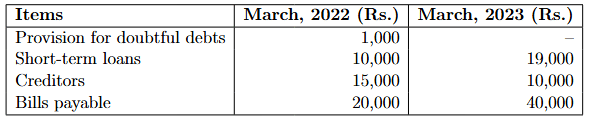
The company incurred a loss of Rs. 45,000 during the year. Calculate cash from operating activities.
View Solution
Step 1: Adjust Net Loss with Non-Cash Items \[ Net Loss = -45,000 \] \[ Add: Provision for Doubtful Debts (Non-Cash Item) = 1,000 \] \[ Adjusted Net Loss = -45,000 + 1,000 = -44,000 \]
Step 2: Adjust for Changes in Working Capital \[ Increase in Short-term Loans = - (19,000 - 10,000) = -9,000 \] \[ Decrease in Creditors = - (15,000 - 10,000) = -5,000 \] \[ Increase in Bills Payable = (40,000 - 20,000) = 20,000 \]
Step 3: Calculate Net Cash Flow from Operating Activities \[ Net Cash Flow from Operating Activities = -44,000 - 9,000 - 5,000 + 20,000 \] \[ Net Cash Flow = -38,000 \]
Final Answer: Cash from Operating Activities = \(-38,000\) Quick Tip: When calculating cash flows, always adjust non-cash items like provisions and account for changes in working capital (current assets and liabilities).
OR
Question 30:
What is comparative income statement? Give a specimen of comparative income statement with the help of imaginary figures.
View Solution
Comparative Income Statement:
A comparative income statement presents financial data for two or more periods side by side, enabling users to analyze the changes in revenue, expenses, and profits over time. It highlights trends and helps stakeholders make informed decisions.
Specimen of Comparative Income Statement:

Explanation:
- The comparative income statement helps identify changes in revenue, costs, and profits, enabling better analysis and decision-making. Quick Tip: Use comparative statements to evaluate performance trends and identify areas needing improvement over multiple periods.



Comments