




UP Board Class 12 Biology Question Paper 2024 PDF (Code 348 GG) is available for download here. The Biology exam was conducted on February 29, 2024 in the Evening Shift from 2 PM to 5:15 PM. The total marks for the theory paper are 70. Students reported the paper to be moderate. Candidates can use the link below to download the UP Board Class 12 Biology Question Paper with detailed solutions.
UP Board Class 12 Biology Question Paper 2024 (Code 348 GG) with Solutions
| UP Board Class 12 Biology Question Paper with Answer Key | Download | Check Solution |
The function of tapetum layer is to:
View Solution
The tapetum is the innermost layer of the anther wall that provides nourishment to the developing pollen grains. It plays a crucial role in the formation of pollen wall materials such as sporopollenin and also aids in the production of enzymes and proteins required for pollen development. Quick Tip: Remember: The tapetum provides essential nutrients to pollen grains and aids in their maturation.
(b) Which one of the following is a detritivore?
View Solution
Detritivores, such as earthworms, feed on decomposing organic matter and help in nutrient recycling by breaking down dead and decaying plant and animal material. Quick Tip: Remember: Detritivores consume decomposed organic material, aiding in decomposition.
(c) The vector of Dengue (Break bone) fever is:
View Solution
The Aedes mosquito, specifically Aedes aegypti, is the primary vector responsible for transmitting the Dengue virus, commonly known as break bone fever. Quick Tip: Remember: Aedes mosquitoes are responsible for transmitting Dengue, Chikungunya, and Zika viruses.
(d) Which enzyme cuts the DNA at specific site?
View Solution
Endonucleases are enzymes that cut DNA at specific recognition sites within the molecule, playing a key role in genetic engineering and DNA recombination processes. Quick Tip: Remember: Endonucleases cut DNA at internal sites, while exonucleases remove nucleotides from ends.
(a) Name the cells providing nutrition to the sperms.
View Solution
Sertoli cells, located within the seminiferous tubules of the testes, provide structural and nutritional support to developing ***** cells by secreting essential nutrients and hormones. Quick Tip: Remember: Sertoli cells are also called "nurse cells" because they nurture and support developing sperms.
(b) Write the full form of MTP and ZIFT.
View Solution
MTP - Medical Termination of Pregnancy, ZIFT - Zygote Intra-Fallopian Transfer
MTP is a procedure used to terminate an unwanted pregnancy, whereas ZIFT is an assisted reproductive technique where a fertilized zygote is transferred into the fallopian tube. Quick Tip: Remember: MTP deals with abortion, and ZIFT is a fertility treatment used in assisted reproduction.
(c) What is the unit of genetics?
View Solution
A gene is the fundamental unit of heredity that carries genetic information from one generation to the next, coding for specific traits. Quick Tip: Remember: Genes are located on chromosomes and contain DNA sequences responsible for inheritance.
(d) How many codons are there in genetic codes?
View Solution
There are 64 codons in the genetic code, which include 61 codons that code for amino acids and 3 stop codons that signal termination of protein synthesis. Quick Tip: Remember: Codons are triplet sequences of mRNA bases, and each codon codes for a specific amino acid.
(e) What is sewage?
View Solution
Sewage is the wastewater generated from households and industries, containing organic and inorganic waste. Sewage consists of wastewater from domestic and industrial sources, which may contain harmful pathogens, organic debris, and chemicals that require treatment before disposal. Quick Tip: Remember: Sewage includes liquid and solid waste, and proper treatment prevents water pollution and health hazards.
(a) What is opium? Which plant is it obtained from?
View Solution
Opium is a dried latex obtained from the seed capsules of the opium poppy plant (Papaver somniferum).Opium is a narcotic substance extracted from the latex of the opium poppy plant. It contains alkaloids like morphine and codeine, which are used for medicinal and recreational purposes. Quick Tip: Remember: Opium is obtained from the latex of Papaver somniferum, and its key components are used for pain relief and sedation.
(b) How many chromosomes are found in Klinefelter and Turner Syndromes?
View Solution
Klinefelter Syndrome - 47 chromosomes (XXY), Turner Syndrome - 45 chromosomes (XO). Klinefelter Syndrome is characterized by the presence of an extra X chromosome (XXY), leading to 47 chromosomes. Turner Syndrome results from the absence of one X chromosome, leading to 45 chromosomes (XO). Quick Tip: Remember: Klinefelter (XXY) has 47 chromosomes, and Turner (XO) has 45 chromosomes due to missing a sex chromosome.
(c) How many types of immunity occur in humans? Write their names.
View Solution
Two types of immunity occur in humans:
1. Innate Immunity
2. Acquired Immunity
Innate immunity is the natural defense present since birth, whereas acquired immunity is developed after exposure to pathogens through infections or vaccinations. Quick Tip: Remember: Innate immunity is inborn, while acquired immunity is developed over time through exposure to pathogens or vaccines.
(d) What are antibiotics? Name any two microbes which are used in the production of antibiotics.
View Solution
Antibiotics are chemical substances produced by microorganisms that inhibit the growth of or kill bacteria. Two microbes used for antibiotic production are:
1. Penicillium (produces Penicillin)
2. Streptomyces (produces Streptomycin)
Antibiotics are produced by fungi and bacteria to combat bacterial infections. Penicillium produces penicillin, while Streptomyces produces streptomycin. Quick Tip: Remember: Antibiotics are used to fight bacterial infections. Fungi (Penicillium) and bacteria (Streptomyces) are key sources.
(e) What steps have been taken by the Government to conserve wildlife?
View Solution
The Government has taken several measures to conserve wildlife, including:
1. Establishment of National Parks and Wildlife Sanctuaries
2. Implementation of Wildlife Protection Act, 1972
3. Launch of Project Tiger and Project Elephant
4. Banning poaching and illegal wildlife trade
5. Afforestation and habitat restoration programs
Wildlife conservation efforts focus on legal protection, habitat conservation, and awareness campaigns to ensure the survival of endangered species and biodiversity. Quick Tip: Remember: Wildlife conservation includes legal actions (Wildlife Protection Act), habitat conservation (National Parks), and special projects (Project Tiger, Project Elephant).
(a) Write short notes on Physical barrier and Cellular barrier.
View Solution
1.Physical barriers include skin and mucous membranes that prevent the entry of pathogens.
2.Cellular barriers include phagocytic cells like neutrophils and macrophages that engulf pathogens.
3.Physical barriers such as skin and mucous prevent pathogen entry by acting as the first line of defense. Cellular barriers include immune cells that identify and destroy pathogens by engulfing them.
Quick Tip: Remember: Physical barriers (skin, mucous) block entry; cellular barriers (WBCs) fight infections.
(b) Comment upon Law of Segregation.
View Solution
The Law of Segregation states that allele pairs separate during gamete formation, ensuring each gamete carries only one allele for each gene.
According to Mendel's Law of Segregation, the two alleles for a trait separate during gamete formation and reunite at fertilization, ensuring genetic diversity. Quick Tip: Remember: Each gamete gets one allele due to segregation; key to genetic variation. and Variation
(c) What is Cancer? Mention its prevention and cure.
View Solution
Cancer is uncontrolled cell division leading to tumor formation.
Prevention: Healthy lifestyle, regular screening, avoiding carcinogens.
Cure: Surgery, chemotherapy, radiation therapy.
Cancer occurs due to genetic mutations leading to uncontrolled cell proliferation. Preventive measures include a healthy lifestyle and early detection. Treatments include surgery, chemotherapy, and targeted therapy. Quick Tip: Remember: Prevention—healthy habits; Cure—medical interventions (surgery, chemo, radiation).
(d) Explain monohybrid and dihybrid test cross.
View Solution
A monohybrid test cross studies a single trait, while a dihybrid test cross examines two traits simultaneously.A monohybrid test cross involves crossing an individual showing a dominant phenotype with a homozygous recessive to determine the genotype.
A dihybrid test cross assesses inheritance of two traits simultaneously.
Quick Tip: Remember: Monohybrid – one trait; Dihybrid – two traits; both determine genotype. and Variation
(e) Comment upon homology.
View Solution
Homology refers to structural similarities between organisms due to a common ancestor. Homologous structures have similar anatomy but different functions, indicating evolutionary relationships, such as the human arm and whale flipper. Quick Tip: Remember: Homology shows common ancestry; similar structure, different function.
(f) Describe the Hardy-Weinberg principle.
View Solution
The Hardy-Weinberg principle states that allele frequencies in a population remain constant if no evolutionary influences act upon them.
The principle provides a mathematical model to study genetic equilibrium under no mutation, selection, or migration influences. The equation used is: \[ p^2 + 2pq + q^2 = 1 \] Quick Tip: Remember: No evolution occurs if allele frequencies remain constant; formula is key.
(g) Write any three differences between anther and ovule.
View Solution
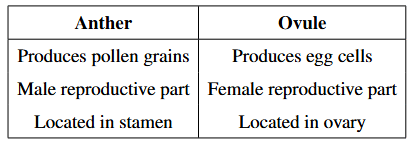 Quick Tip: Remember: Anther = Male, Ovule = Female; Anther produces pollen, Ovule produces eggs.
(h) Explain any three important characteristics of a population.
View Solution
Population characteristics help in studying population dynamics. Density gives the total count, natality measures birth rates, and mortality reflects loss of individuals.
1. Population density – number of individuals per unit area.
2. Natality – birth rate in a population.
3. Mortality – death rate in a population.
Quick Tip: Remember: Density (size), Natality (births), Mortality (deaths) – key population factors.
(a) What do you understand by the origin of life?
View Solution
The origin of life refers to the process by which living organisms developed from non-living matter through chemical and biological evolution.
The origin of life is explained by various theories such as the Oparin-Haldane hypothesis, which suggests that life arose from a "primordial soup" of organic molecules under favorable environmental conditions. The Miller-Urey experiment provided experimental support for this idea by synthesizing organic molecules under simulated early Earth conditions. Quick Tip: Remember: The origin of life theories include abiogenesis (life from non-living matter) and biogenesis (life from pre-existing life).
(b) What do you understand by Australopithecines?
View Solution
Australopithecines were early hominins that lived in Africa about 4 to 2 million years ago and are considered ancestors of modern humans.
Australopithecines had both ape-like and human-like characteristics, with a smaller brain size and an upright posture. They played a crucial role in human evolution, with notable species like Australopithecus afarensis, famously represented by "Lucy." Quick Tip: Remember: Australopithecines are early ancestors of humans, known for walking upright but having small brains. of Humans
(c) What do you understand by infectious diseases?
View Solution
Infectious diseases are disorders caused by pathogenic microorganisms such as bacteria, viruses, fungi, or parasites that can spread from one individual to another.Infectious diseases are transmitted through air, water, direct contact, or vectors like mosquitoes. Examples include tuberculosis (bacteria), influenza (virus), and ringworm (fungus). Quick Tip: Remember: Infectious diseases are caused by microbes (bacteria, viruses, fungi, parasites) and can spread through various modes.
(d) What do you understand by Darwinism?
View Solution
Darwinism refers to Charles Darwin's theory of evolution by natural selection, which states that organisms with favorable traits survive and reproduce better.
Darwin's theory of natural selection explains how species evolve over time based on variations, competition, survival of the fittest, and inheritance. Favorable traits are passed on to future generations, leading to evolution. Quick Tip: Remember: Darwinism emphasizes natural selection – survival of the fittest based on inherited traits.
Describe the human male reproductive system and explain the process of ***** formation.
View Solution
The human male reproductive system consists of primary and accessory organs that are responsible for ***** production and transport.
Parts of the male reproductive system:
(A) Testes: Produce ***** and male sex hormones like testosterone.
(B) Epididymis: Stores and matures *****.
(C) Vas deferens: Transports ***** to the urethra.
(D) Accessory glands: Seminal vesicles, prostate gland, and bulbourethral glands produce seminal fluid.
(E) *****: Organ for ***** delivery during ejaculation.
***** Formation (Spermatogenesis):
Occurs in the seminiferous tubules of the testes.
Involves three stages: spermatocytogenesis, meiosis, and spermiogenesis.
Results in the formation of mature spermatozoa from spermatogonial cells. Quick Tip: Remember: The testes produce *****, while accessory glands contribute fluids. Spermatogenesis involves cell division and differentiation into mature *****.
Differentiate between the following:
(i) Plasmid DNA and Chromosomal DNA
View Solution
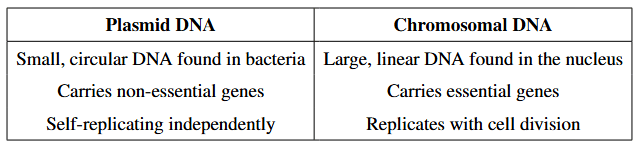 Quick Tip: Remember: Plasmid DNA is extra-chromosomal and circular, while chromosomal DNA carries essential genetic information.
(ii) Exonuclease and Endonuclease enzyme
View Solution
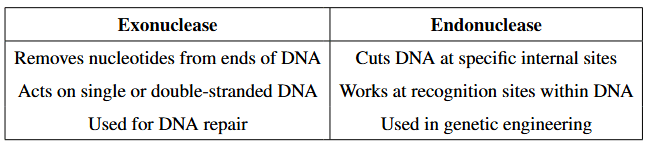
Quick Tip: Remember: Exonuclease removes nucleotides from the ends, while endonuclease cuts within the DNA sequence at specific sites.
What do you mean by sex-linked characters? Describe with the help of line sketches, the inheritance of two sex-linked characters in humans.
View Solution
Sex-linked characters are traits that are associated with genes located on the sex chromosomes (X or Y). They are inherited differently in males and females.
Examples of sex-linked inheritance:
Hemophilia: A disorder where blood does not clot properly.
Color blindness: An inability to distinguish certain colors, typically red and green. Quick Tip: Remember: Sex-linked traits are carried on sex chromosomes, and disorders like hemophilia and color blindness are more common in males due to their single X chromosome.
What do you mean by population? Describe population interactions.
View Solution
A population is a group of individuals of the same species living in a specific geographic area.
Population interactions include:
Predation: One organism (predator) kills and eats another (prey).
Competition: Individuals compete for the same resources.
Mutualism: Both species benefit from the relationship.
Parasitism: One species benefits at the expense of another. Quick Tip: Remember: Population interactions include relationships like predation (one benefits), mutualism (both benefit), and competition (both suffer).
Explain Mendel's law of dominance. Write a note on incomplete dominance.
View Solution
Mendel's Law of Dominance:
According to this law, when two contrasting alleles are present in an individual, the dominant allele is expressed while the recessive allele is masked.
Incomplete Dominance:
In incomplete dominance, neither allele is completely dominant, resulting in an intermediate phenotype, such as pink flowers in snapdragons (a mix of red and white). Quick Tip: Remember: Dominance means one allele masks another; incomplete dominance results in blending traits.
How does fertilization take place in angiosperms? Describe the post-fertilization structures.
View Solution
Fertilization in angiosperms occurs when pollen grains land on the stigma, germinate, and the pollen tube carries ***** to the ovule for fertilization.
Post-fertilization structures:
Zygote: Develops into an embryo.
Endosperm: Provides nourishment to the developing embryo.
Ovule: Becomes the seed.
Ovary: Matures into the fruit. Quick Tip: Remember: Fertilization forms seeds and fruits; ovule → seed, ovary → fruit, endosperm nourishes embryo.



Comments