




UP Board Class 12 Biology Question Paper 2024 PDF (Code 348 GL) is available for download here. The Biology exam was conducted on February 29, 2024 in the Evening Shift from 2 PM to 5:15 PM. The total marks for the theory paper are 70. Students reported the paper to be moderate. Candidates can use the link below to download the UP Board Class 12 Biology Question Paper with detailed solutions.
UP Board Class 12 Biology Question Paper 2024 (Code 348 GL) with Solutions
| UP Board Class 12 Biology Question Paper with Answer Key | Download | Check Solution |
Choose the correct option and write in your answer-book:
(a) Genetic engineering is useful in:
View Solution
Genetic engineering has applications in various fields such as:
Agriculture: Developing genetically modified crops with improved yield and resistance to pests.
Medical treatment: Producing insulin, growth hormones, and gene therapy.
Formation of vaccines: Development of recombinant vaccines such as the Hepatitis B vaccine. Quick Tip: Genetic engineering = Agriculture + Medicine + Vaccines.
(b) Which one of the following is not a false fruit?
View Solution
A false fruit is one that develops from parts of the flower other than the ovary, such as the receptacle. Examples include apple, strawberry, and cashew. Mango, however, is a true fruit as it develops solely from the ovary. Quick Tip: False fruits = Apple, Strawberry, Cashew (develop from parts other than ovary). Mango = True fruit.
(c) The vector of Dengue (Break bone) fever is:
View Solution
Dengue fever, also known as "breakbone fever," is transmitted by the bite of Aedes aegypti mosquitoes, which are active during the daytime and breed in stagnant water. Quick Tip: Dengue = Spread by Aedes aegypti, breeds in clean stagnant water, active in the daytime.
(d) The name of the plant pollinated by water is:
View Solution
Hydrophily is pollination that occurs through water. Plants like Hydrilla and Vallisneria are adapted to water pollination, whereas pea and citrus rely on insect or wind pollination. Quick Tip: Water pollinated plants = Hydrilla, Vallisneria (Hydrophily).
Answer the following questions briefly:
(a) Write the full form of IUD.
View Solution
IUDs are contraceptive devices inserted into the uterus to prevent pregnancy. They can be hormonal or non-hormonal (copper-based). Quick Tip: IUD = Intrauterine Device, used for long-term contraception.
(b) Who proposed the Chromosomal theory of Inheritance?
View Solution
Sutton and Boveri suggested that genes are located on chromosomes, and their behavior during meiosis explains Mendel’s laws of inheritance. Quick Tip: Sutton and Boveri linked genes to chromosomes, explaining Mendelian inheritance.
(c) How many pairs of contrasting traits were studied by Mendel in pea plants?
View Solution
The seven pairs of contrasting traits included characteristics such as seed shape (round/wrinkled), plant height (tall/dwarf), and flower color (purple/white). Quick Tip: Mendel studied 7 contrasting traits in pea plants like height, seed shape, and color.
(d) What are parthenocarpic fruits?
View Solution
These fruits develop without the formation of seeds. Examples include bananas and seedless grapes. Parthenocarpy can occur naturally or be induced artificially using hormones. Quick Tip: Parthenocarpic fruits = Seedless fruits (e.g., banana, seedless watermelon).
(e) What do you understand by patent?
View Solution
A patent provides protection to inventors against unauthorized use of their inventions and promotes innovation by granting commercial rights for a specified duration, usually 20 years. Quick Tip: Patent = Legal right to protect an invention, prevents unauthorized use.
Answer the following questions briefly:
(a) Draw only the diagram of the structure of an Antibody molecule.
View Solution
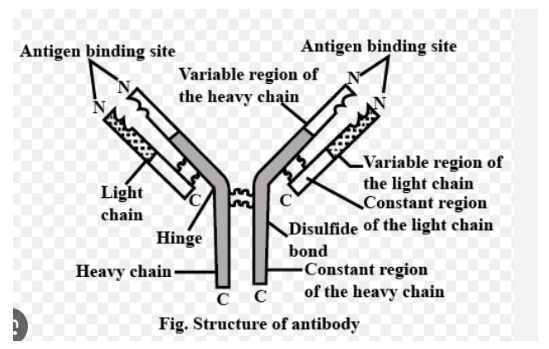
Quick Tip: Antibody = Y-shaped protein with heavy and light chains, binds to antigens.
(b) Differentiate between homozygosity and heterozygosity.
View Solution

Quick Tip: Homozygous = Identical alleles (TT, tt), Heterozygous = Different alleles (Tt).
(c) Write a short note on productivity.
View Solution
Productivity refers to the rate at which energy is accumulated in the form of biomass by producers in an ecosystem.
Productivity is of two types:
Primary Productivity: The rate at which autotrophs convert solar energy into chemical energy.
Secondary Productivity: The rate at which consumers assimilate energy from the organic matter they consume. Quick Tip: Productivity = Energy accumulation in biomass; Primary (plants), Secondary (herbivores).
(d) Explain Mendelian law of segregation.
View Solution
The law of segregation states that during gamete formation, the two alleles of a gene segregate independently, with each gamete receiving only one allele.
According to Mendel’s first law, each parent contributes one allele to the offspring. In heterozygous individuals (Tt), the two alleles segregate during gamete formation, resulting in 50% T and 50% t in the gametes. Quick Tip: Law of segregation = Alleles separate during gamete formation; each gamete gets one allele.
(e) Describe natural selection in brief.
View Solution
Natural selection is the process by which organisms with favorable traits survive and reproduce, while those with less favorable traits are eliminated.
Natural selection acts on variation within a population, leading to the survival of the fittest. Over generations, advantageous traits become more common, contributing to evolution. Example: Peppered moth adaptation during industrial revolution. Quick Tip: Natural selection = "Survival of the fittest," traits that help survival get passed on.
Answer the following questions briefly:
(a) Explain the back cross and test cross.
View Solution
Back Cross: A cross of an offspring with one of its parents to achieve desired traits. It helps in maintaining desirable characteristics in subsequent generations.
Test Cross: A cross between an individual with an unknown genotype and a homozygous recessive individual to determine the unknown genotype.
Solution:
Back Cross:
Ensures the inheritance of a desired trait.
Example: Crossing a hybrid pea plant (Tt) with its parent (TT or tt).
Test Cross:
Used to determine whether an individual is homozygous dominant or heterozygous.
Example: Crossing Tt (unknown) with tt (recessive). Quick Tip: Back cross = Offspring × Parent, ensures traits.
Test cross = Unknown genotype × Recessive, reveals genotype.
(b) Describe the structure of seminiferous tubule.
View Solution
Seminiferous tubules are coiled structures in the testes where spermatogenesis occurs.
Lined with germinal epithelium, which contains spermatogenic cells that develop into sperm.
Sertoli cells provide nutrition and support to developing sperm.
Interstitial cells (Leydig cells) present between the tubules secrete testosterone. Quick Tip: Seminiferous tubule = Sperm production site, contains spermatogenic and Sertoli cells.
(c) Describe infectious diseases with examples.
View Solution
Infectious diseases are caused by pathogenic microorganisms such as bacteria, viruses, fungi, and parasites.Infectious diseases are caused by pathogenic microorganisms such as bacteria, viruses, fungi, and parasites.
Examples of infectious diseases:
Bacterial: Tuberculosis (caused by Mycobacterium tuberculosis).
Viral: Influenza (caused by the influenza virus).
Fungal: Athlete's foot (caused by fungi).
Parasitic: Malaria (caused by Plasmodium parasite). Quick Tip: Infectious diseases = Caused by microbes, spread through contact, air, or vectors.
(d) Describe the importance of seed and fruit development.
View Solution
Seeds and fruits play a crucial role in plant reproduction, dispersal, and survival
Seed Importance:
Ensures the continuation of plant species.
Stores food for embryo development.
Facilitates dispersal to new locations.
Fruit Importance:
Protects the developing seeds.
Aids in seed dispersal through wind, water, and animals.
Provides food for humans and animals. Quick Tip: Seeds ensure survival; fruits protect and aid in dispersal.
Answer the following questions briefly:
(a) Describe the contribution of biotechnology in agriculture.
View Solution
Biotechnology has revolutionized agriculture by enhancing crop yield, improving resistance to pests, and reducing dependency on chemical inputs.
Contributions of biotechnology in agriculture include:
Genetically Modified Crops (GMOs): Crops such as Bt cotton and Golden Rice provide resistance to pests and improved nutrition.
Tissue Culture: Allows the production of disease-free plants and rapid multiplication.
Bio-fertilizers: Use of beneficial microbes to improve soil fertility and reduce chemical fertilizers.
Pest and Disease Resistance: Genetic engineering enables crops to resist harmful insects and pathogens.
Drought and Salinity Tolerance: Development of crops that can withstand environmental stress conditions. Quick Tip: Biotechnology in agriculture = GMOs + Tissue culture + Pest resistance + Bio-fertilizers.
(b) Write a short note on Mendelism.
View Solution
Mendelism refers to the principles of inheritance proposed by Gregor Mendel based on his experiments with pea plants.
Mendel formulated three laws of inheritance:
Law of Dominance: In a heterozygous individual, the dominant allele is expressed while the recessive allele remains hidden.
Law of Segregation: Alleles separate during gamete formation, ensuring each gamete carries only one allele.
Law of Independent Assortment: Genes for different traits assort independently during gamete formation.
His work laid the foundation for modern genetics. Quick Tip: Mendel's laws: Dominance, Segregation, Independent Assortment.
(c) Write notes on the following:
(i) Ringworm
View Solution
Ringworm appears as red, itchy, circular rashes on the skin. It spreads through direct contact with infected individuals, animals, or contaminated surfaces. Treatment involves antifungal medications such as creams and oral drugs. Quick Tip: Ringworm = Fungal skin infection, circular itchy rash, spreads by contact.
(ii) Amoebiasis
View Solution
It spreads through contaminated food and water, causing symptoms like diarrhea, abdominal pain, and fatigue. In severe cases, it may lead to liver abscesses. Prevention includes proper sanitation and hygiene. Quick Tip: Amoebiasis = Caused by E. histolytica, spreads via contaminated water, causes diarrhea.
(d) Explain symbiosis with suitable examples.
View Solution
Symbiosis is a close and long-term biological interaction between two different species. The term "symbiosis" encompasses a variety of relationships, which can be beneficial, harmful, or neutral to the organisms involved. Based on the nature of the interaction, symbiotic relationships are classified into three main types: mutualism , commensalism , and parasitism .
Types of symbiosis with examples:
Mutualism: Both species benefit. Example: Lichen (fungus and algae), where algae provide food, and fungi offer support.
Commensalism: One species benefits while the other is neither harmed nor benefited. Example: Barnacles on whales.
Parasitism: One species benefits at the expense of the other. Example: Tapeworm in the human intestine. Quick Tip: Symbiosis types: Mutualism = Both benefit.
Commensalism = One benefits, other unaffected.
Parasitism = One benefits, other harmed.
Answer the following questions briefly:
(a) Explain competition and parasitism with examples.
View Solution
Competition:
Occurs in populations of the same species (intraspecific) or different species (interspecific).
Leads to reduced availability of resources for both organisms.
Parasitism:
Parasites may cause harm but usually do not kill the host.
Examples include lice on humans and mistletoe on trees. Quick Tip: Competition = Struggle for resources.
Parasitism = Parasite benefits, host suffers.
(b) When a cross is made between a tall plant with yellow seed (TtYy) and a tall plant with green seed (Ttyy), in what proportion of the following phenotypes could be expected?
View Solution
\[ TtYy \times Ttyy \]
Phenotypes:
(A) Tall and green:
\[ T-Yy, T-yy \quad = \quad \frac{3}{4} \times \frac{1}{2} = \frac{3}{8} \]
(B) Dwarf and green:
\[ ttYy, ttyy \quad = \quad \frac{1}{4} \times \frac{1}{2} = \frac{1}{8} \] Quick Tip: Use the forked line method or Punnett square to determine phenotype ratios.
(c) Write a note on National Park.
View Solution
National Parks prohibit activities such as hunting, grazing, and deforestation.
They serve as tourist attractions and educational sites.
Examples in India: Jim Corbett National Park (Uttarakhand), Kaziranga National Park (Assam). Quick Tip: National Park = Protected area, no human interference, aims at wildlife conservation.
(d) Describe the development of the male gametophyte of an angiospermic plant with a suitable diagram.
View Solution
The microspore mother cell undergoes meiosis to form haploid microspores.
Each microspore undergoes mitosis to form a pollen grain with two cells:
(A) Vegetative cell: Responsible for pollen tube formation.
(B) Generative cell: Divides to form two male gametes.
The mature pollen grain is released for pollination.
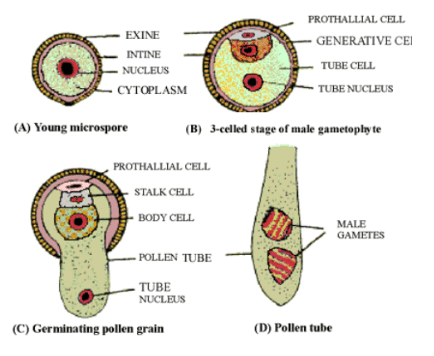
Quick Tip: Male gametophyte = Microspore → Pollen grain → Pollen tube + 2 male gametes.
How does fertilization take place in an angiospermic plant? Describe post-fertilization structures and events.
View Solution
Fertilization Process:
The pollen grain lands on the stigma and germinates, forming a pollen tube.
The pollen tube grows through the style and reaches the ovule in the ovary.
The generative cell divides to form two male gametes.
One male gamete fuses with the egg cell to form the diploid zygote (syngamy).
The other male gamete fuses with the two polar nuclei to form the triploid endosperm (triple fusion).
Post-fertilization structures and events:
Zygote formation: The fertilized egg develops into an embryo.
Endosperm development: Provides nourishment to the developing embryo.
Ovule transformation: The ovule develops into a seed.
Ovary transformation: The ovary matures into a fruit.
Other floral parts: Sepals, petals, and stamens usually wither away. Quick Tip: Fertilization in angiosperms = Pollen tube growth → Syngamy (zygote) + Triple fusion (endosperm) → Seed and fruit formation.
Write an essay on human evolution.
View Solution
Stages of human evolution:
Australopithecus (4–2 million years ago): Early bipedal hominins with small brain capacity.
Homo habilis (2.4–1.4 million years ago): First tool users, known as "handy man."
Homo erectus (1.9 million–110,000 years ago): First to use fire and migrate out of Africa.
Neanderthals (400,000–40,000 years ago): Lived in Europe and Asia, skilled hunters with complex social behavior.
Homo sapiens (300,000 years ago–present): Modern humans with advanced language, culture, and technological development.
Key evolutionary concepts:
Bipedalism: Walking on two legs, allowing hands to be free for tool use.
Brain development: Increased brain size leading to higher intelligence and social organization.
Cultural evolution: Development of language, agriculture, and civilization. Quick Tip: Human evolution = Australopithecus → Homo habilis → Homo erectus → Neanderthals → Homo sapiens.
Answer the following question in detail:
(i) Characteristic features of the structure of double-stranded DNA.
View Solution
The key features of the DNA double helix are:
Double helix structure: Two strands of nucleotides run in opposite directions (antiparallel).
Sugar-phosphate backbone: Provides structural support and is composed of deoxyribose sugar and phosphate groups.
Base pairing: Adenine (A) pairs with Thymine (T), and Guanine (G) pairs with Cytosine (C) via hydrogen bonds.
Helical structure: The two strands coil around an axis with a right-handed twist.
Uniform diameter: The structure has a constant diameter of 2 nm due to base-pair complementarity.
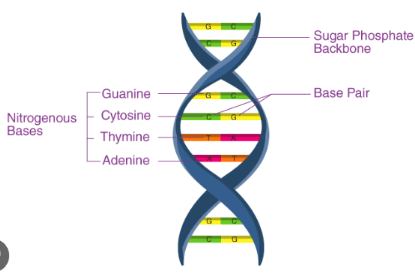
Quick Tip: DNA = Double helix, antiparallel strands, A-T and G-C base pairing.
(ii) Components of an ecosystem.
View Solution
The components of an ecosystem include:
Biotic Components (Living):
Producers: Autotrophs like plants that convert solar energy into food.
Consumers: Heterotrophs that consume producers (herbivores) or other consumers (carnivores).
Decomposers: Microorganisms like fungi and bacteria that break down organic matter.
Abiotic Components (Non-living):
Physical factors: Light, temperature, humidity, water, and soil.
Chemical factors: Nutrients such as nitrogen, phosphorus, and oxygen.
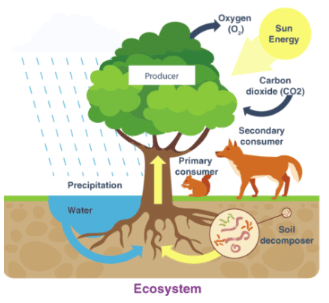
Quick Tip: Ecosystem = Biotic (producers, consumers, decomposers) + Abiotic (air, water, soil).
(iii) Human ovum.
View Solution
Key features of the human ovum:
Size: The ovum is one of the largest cells in the human body (about 0.1 mm in diameter).
Structure: It has a nucleus, cytoplasm, and protective layers such as the zona pellucida and corona radiata.
Function: Carries genetic material and nutrients for the early development of the embryo after fertilization.
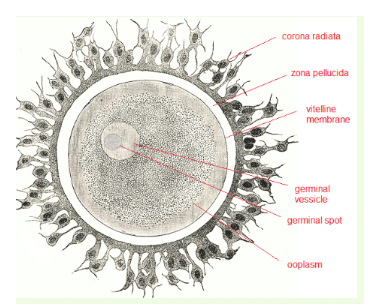
Quick Tip: Human ovum = Large, contains zona pellucida, corona radiata, supports early embryo development.
Describe the dihybrid cross with a diagram.
View Solution
Mendel's dihybrid cross involved pea plants with contrasting traits of seed shape (round/wrinkled) and seed color (yellow/green).
Steps in the dihybrid cross:
Parental generation (P): RRYY (round yellow) × rryy (wrinkled green).
First filial generation (F1): All RrYy (round yellow).
F2 generation (self-cross): Produces a phenotypic ratio of 9:3:3:1 (round yellow, round green, wrinkled yellow, wrinkled green).
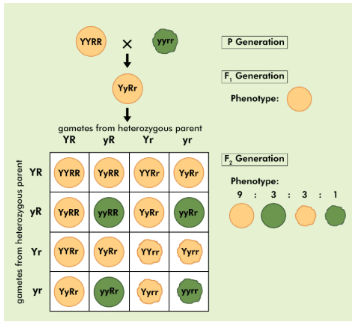
Quick Tip: Dihybrid cross ratio = 9:3:3:1 (round yellow, round green, wrinkled yellow, wrinkled green).
Answer the following questions briefly:
(i) Genetically Modified (GM) Crops
View Solution
Key characteristics of GM crops:
Increased Yield: GM crops produce higher yields compared to traditional crops.
Pest Resistance: Crops like Bt cotton produce their own insecticidal proteins.
Herbicide Tolerance: GM crops can survive the application of herbicides without damage.
Improved Nutritional Value: Crops like Golden Rice are enriched with essential vitamins. Quick Tip: GM crops = Higher yield, pest resistance, herbicide tolerance, improved nutrition.
(ii) Components of a Nucleotide
View Solution
Each nucleotide consists of three components:
Sugar: A five-carbon sugar (deoxyribose in DNA, ribose in RNA).
Phosphate Group: Provides a negative charge and links nucleotides together.
Nitrogenous Base: Includes adenine (A), thymine (T), guanine (G), cytosine (C), and uracil (U in RNA). Quick Tip: Nucleotide = Sugar + Phosphate + Nitrogenous base.
(iii) In-situ Conservation
View Solution
In-situ conservation methods include:
Biosphere Reserves: Large protected areas for conservation of biodiversity.
National Parks and Wildlife Sanctuaries: Areas designated to protect specific species.
Sacred Groves: Traditionally protected forest patches preserved by local communities.
This method allows organisms to continue evolving in their natural surroundings. Quick Tip: In-situ conservation = Protecting species in their natural habitat (e.g., national parks).
What is addiction? Write a note on its ill effects on the young generation and its control measures.
View Solution
Ill effects of addiction:
Physical health issues: Chronic diseases, weakened immunity, and neurological damage.
Mental health disorders: Anxiety, depression, and impaired cognitive function.
Social problems: Decline in academic performance, strained relationships, and financial loss.
Legal issues: Involvement in criminal activities and legal penalties.
Control measures for addiction:
Awareness programs: Educating youth on the dangers of addiction.
Rehabilitation centers: Providing medical and psychological support.
Parental guidance: Encouraging healthy habits and monitoring behavior.
Counseling services: Professional help to cope with addiction. Quick Tip: Addiction = Physical + Mental + Social issues; Prevent with awareness, counseling, rehab.



Comments