




UP Board Class 12 Chemistry Question Paper 2024 PDF (Code 347 FZ) is available for download here. The Chemistry exam was conducted on March 7, 2024 in the Evening Shift from 2 PM to 5:15 PM. The total marks for the theory paper are 70. Students reported the paper to be easy to moderate.
UP Board Class 12 Chemistry Question Paper 2024 (Code 347 FZ) with Solutions
| UP Board Class Chemistry Question Paper with Answer Key | Download | Check Solution |
Four alternatives are given in each part of this question. Write the correct alternative in your answer-book.
(a) 5 g NaOH is dissolved in 450 mL solution. Molarity of the solution is:
View Solution
Step 1: Calculate the molar mass of NaOH.
The molar mass of NaOH is: \[ Na: 23 \, g/mol, \quad O: 16 \, g/mol, \quad H: 1 \, g/mol. \] \[ Molar mass of NaOH = 23 + 16 + 1 = 40 \, g/mol. \]
Step 2: Calculate the number of moles of NaOH.
The number of moles is given by: \[ Moles of NaOH = \frac{Mass of NaOH}{Molar mass of NaOH} = \frac{5}{40} = 0.125 \, mol. \]
Step 3: Calculate the molarity of the solution.
The volume of the solution is 450 mL, which is: \[ 450 \, mL = 0.450 \, L. \]
Molarity is given by: \[ Molarity = \frac{Moles of solute}{Volume of solution in liters} = \frac{0.125}{0.450} = 0.125 \, mol \, L^{-1}. \] Quick Tip: When calculating molarity, ensure the volume is converted to liters. Always use the formula: \[ Molarity = \frac{Moles of solute}{Volume of solution in liters}. \]
(b) The oxidation number of Cobalt in \( K_3[Co(C_2O_4)_3] \) complex is:
View Solution
Step 1: The oxidation number of the oxalate ion \( C_2O_4^{2-} \) is \(-2\).
Step 2: Since the complex is neutral: \[ 3(+1) + x + 3(-2) = 0 \quad \Rightarrow \quad 3 + x - 6 = 0 \quad \Rightarrow \quad x = 3. \]
Thus, the oxidation number of cobalt is \( +3 \). Quick Tip: For coordination complexes, balance the charge using the known oxidation states of ligands.
(c)The transition element in which variable oxidation state is not found, is:
View Solution
Step 1: Scandium (\( Sc \)) shows only one stable oxidation state, which is \( +3 \).
Step 2: Other elements like \( Ti \), \( V \), and \( Cr \) show variable oxidation states due to their electron configurations. Quick Tip: Transition elements exhibit variable oxidation states due to the involvement of \( d \)-orbitals in bonding.
(d) The compound having the most basic strength is:
View Solution
Step 1: The basicity depends on the availability of the lone pair of electrons on nitrogen.
Step 2: \( (CH_3)_2 NH \) is the most basic due to the inductive effect of methyl groups, which increases electron density on nitrogen. Quick Tip: Electron-donating groups enhance the basicity of amines by increasing electron density on the nitrogen atom.
(e)The compound which is not a disaccharide is:
View Solution
Step 1: Disaccharides consist of two monosaccharide units. Examples include sucrose, lactose, and maltose.
Step 2: Cellulose is a polysaccharide and does not fall under the category of disaccharides. Quick Tip: Disaccharides are formed by the glycosidic linkage between two monosaccharide units.
(f) Which of the following compounds is identified by Tollen's reagent?
View Solution
Step 1: Tollen's reagent is specific for aldehydes and gives a silver mirror test.
Step 2: Alcohols, ketones, and carboxylic acids do not respond to Tollen's reagent. Quick Tip: Tollen's reagent is an oxidizing agent that reacts with aldehydes to form silver metal.
(a) 30 g Ethylene glycol (\(C_2H_6O_2\)) was mixed in 450 g water. Calculate the following:
(A) Depression in freezing point of solution.
(B) Freezing point of the solution.
View Solution
Step 1: Calculate the molality of the solution.
The molar mass of ethylene glycol (\(C_2H_6O_2\)) is: \[ C: 2 \times 12 = 24, \quad H: 6 \times 1 = 6, \quad O: 2 \times 16 = 32. \] \[ Molar mass = 24 + 6 + 32 = 62 \, g/mol. \]
The number of moles of ethylene glycol is: \[ Moles = \frac{Mass}{Molar mass} = \frac{30}{62} \approx 0.484 \, mol. \]
The mass of water is \(450 \, g = 0.450 \, kg\), so: \[ Molality = \frac{Moles of solute}{Mass of solvent in kg} = \frac{0.484}{0.450} \approx 1.075 \, mol/kg. \]
Step 2: Calculate the depression in freezing point.
The depression in freezing point is given by: \[ \Delta T_f = K_f \cdot m, \]
where \(K_f\) for water is \(1.86 \, K \, kg/mol\). \[ \Delta T_f = 1.86 \times 1.075 \approx 2.00 \, K. \]
Step 3: Calculate the freezing point of the solution.
The freezing point of pure water is \(0^\circ \, C\). Thus: \[ Freezing point of solution = 0 - 2.00 = -2.00^\circ \, C. \] Quick Tip: To calculate depression in freezing point, use the formula: \[ \Delta T_f = K_f \cdot m, \] where \(K_f\) is the cryoscopic constant and \(m\) is the molality of the solution.
(b) Define the following:
(A) Mole fraction
(B) Molality
View Solution
(A) Mole fraction: It is the ratio of the number of moles of a component to the total number of moles of all components in the solution.
\[ Mole fraction = \frac{Number of moles of component}{Total moles of solution}. \]
(B) Molality: It is defined as the number of moles of solute present in 1 kg of the solvent.
\[ Molality = \frac{Number of moles of solute}{Mass of solvent in kg}. \] Quick Tip: Mole fraction is unitless, while molality is expressed in \(mol/kg\).
(c)What is Lanthanoid Contraction? Discuss the effect of Lanthanoid Contraction.
View Solution
Definition: Lanthanoid Contraction refers to the steady decrease in the ionic radii of the lanthanoid elements (\(4f\)-block) as the atomic number increases.
Effect:
Leads to similar chemical properties of elements in the same group.
Causes increased hardness and higher melting points of transition elements.
Reduces the size difference between second and third-row transition metals. Quick Tip: Lanthanoid Contraction is caused by the imperfect shielding of \(4f\)-electrons.
(d)Show the structure of geometrical isomers of \( Fe(NH_3)_2(CN)_4 \)
View Solution
The complex \([Fe(NH_3)_2(CN)_4]^-\) exhibits cis and trans geometrical isomers.
Cis-isomer:
\( NH_3 \) ligands are adjacent to each other.
Trans-isomer:
\( NH_3 \) ligands are opposite to each other.
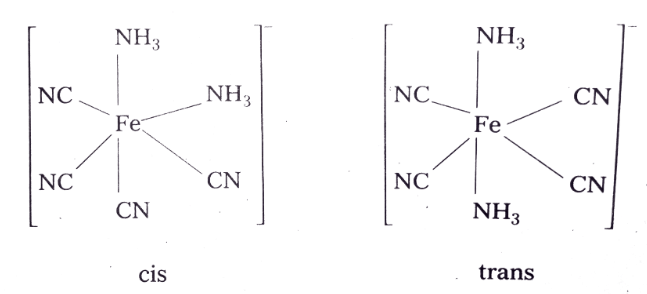
Quick Tip: Geometrical isomerism occurs in octahedral complexes when different ligands occupy adjacent or opposite positions.
(a)Recognize all the possible monochloro structural isomers formed by free radical chlorination of \( CH_3 - CH_2 - CH_2 - CH_3 \).
View Solution
Step 1: Free radical chlorination replaces a single hydrogen atom with chlorine in the molecule.
Step 2: Possible structural isomers: \[ 1-chlorobutane: CH_2Cl-CH_2-CH_2-CH_3 \] \[ 2-chlorobutane: CH_3-CHCl-CH_2-CH_3 \] \[ 3-chlorobutane: CH_3-CH_2-CHCl-CH_3 \] Quick Tip: In free radical chlorination, every unique hydrogen position in a molecule can yield a distinct monochloro product.
(b)Phenol shows acidic properties, but ethanol is almost neutral. Explain with reason.
View Solution
Step 1: Phenol (\(C_6H_5OH\)) is acidic because the phenoxide ion (\(C_6H_5O^-\)) formed after losing a proton is stabilized by resonance.
Step 2: Ethanol (\(C_2H_5OH\)) is neutral because the ethoxide ion (\(C_2H_5O^-\)) does not have any resonance stabilization.
Conclusion: Resonance stabilization in phenol makes it acidic, whereas ethanol lacks such stabilization. Quick Tip: The acidity of a compound depends on the stability of its conjugate base. Resonance plays a key role in stabilization.
(c)Differentiate between the following:
(A)Acetaldehyde and Acetone
(B)Acetophenone and Benzophenone
View Solution
(A) Acetaldehyde (\(CH_3CHO\)) vs. Acetone (\(CH_3COCH_3\)):
Acetaldehyde is an aldehyde with a terminal carbonyl group (\(-CHO\)).
Acetone is a ketone with a carbonyl group bonded to two alkyl groups.
(B) Acetophenone (\(C_6H_5COCH_3\)) vs. Benzophenone (\(C_6H_5COC_6H_5\)):
Acetophenone has one aromatic ring attached to the carbonyl group.
Benzophenone has two aromatic rings attached to the carbonyl group. Quick Tip: Aldehydes have a terminal carbonyl group, while ketones have a non-terminal carbonyl group. Aromatic ketones can have one or two rings attached to the carbonyl group.
(d)What is the difference between nucleoside and nucleotide? Explain.
View Solution
Definition:
A nucleoside consists of a nitrogenous base and a sugar molecule.
A nucleotide consists of a nitrogenous base, a sugar molecule, and a phosphate group.
Difference:
Nucleosides are precursors to nucleotides.
Nucleotides are building blocks of nucleic acids like DNA and RNA. Quick Tip: Nucleosides lack phosphate groups, while nucleotides contain phosphate groups and are involved in forming nucleic acids.
(a)Define solution. In how many different ways may the concentration of a solution be expressed? Explain.
View Solution
Definition of Solution: A solution is a homogeneous mixture of two or more substances. The component present in a larger quantity is called the solvent, and the one in a smaller quantity is the solute.
Ways to Express Concentration:
Mass Percentage (% w/w): The mass of solute per 100 g of the solution.
Volume Percentage (% v/v): The volume of solute per 100 mL of the solution.
Molarity (\(M\)): The number of moles of solute per liter of solution.
Molality (\(m\)): The number of moles of solute per kilogram of solvent.
Mole Fraction (\(x\)): The ratio of the number of moles of solute to the total number of moles in the solution. Quick Tip: Always choose the method to express concentration based on the type of solution and the requirements of the experiment.
(b)Define the conductance and molar conductance of a solution of any electrolyte. Discuss their variation with concentration.
View Solution
Conductance (\(G\)): It is the reciprocal of resistance (\(R\)) and measures the ability of a solution to conduct electricity. Its SI unit is Siemens (\(S\)).
Molar Conductance (\(\Lambda_m\)): It is the conductance of all ions produced by one mole of an electrolyte in a solution. It is given by: \[ \Lambda_m = \frac{1000 \, G}{C}, \]
where \(C\) is the molarity of the solution.
Variation with Concentration:
Strong electrolytes: \(\Lambda_m\) increases with dilution due to the complete dissociation of ions and a decrease in interionic attractions.
Weak electrolytes: \(\Lambda_m\) increases sharply with dilution because ionization increases at lower concentrations. Quick Tip: For weak electrolytes, use Kohlrausch's Law to calculate \(\Lambda_m^\circ\) (limiting molar conductance) by extrapolation.
(c)What do you understand by first order reaction? The time taken in becoming \(0.4 \, mol/L\) from initial concentration of \(0.6 \, mol/L\) is \(5 \, minutes\) in a first order reaction. How much time will be required for the initial concentration to reach \(0.3 \, mol/L\)?
View Solution
Definition of First Order Reaction: A reaction is said to be of first order when the rate of reaction is directly proportional to the concentration of one reactant.
Step 1: Use the first-order rate equation: \[ k = \frac{1}{t} \ln \left(\frac{[A]_0}{[A]}\right). \]
From the given data: \[ k = \frac{1}{5} \ln \left(\frac{0.6}{0.4}\right) = \frac{1}{5} \ln \left(\frac{3}{2}\right). \]
Step 2: Calculate the time required to reach \(0.3 \, mol/L\): \[ t = \frac{1}{k} \ln \left(\frac{[A]_0}{[A]}\right). \]
Substitute the values: \[ t = \frac{5}{\ln (3/2)} \ln \left(\frac{0.6}{0.3}\right). \] \[ t = \frac{5}{\ln (3/2)} \ln (2). \]
Step 3: Simplify using logarithmic values: \[ \ln (3/2) \approx 0.405, \quad \ln (2) \approx 0.693. \] \[ t = \frac{5}{0.405} \times 0.693 \approx 8.55 \, minutes. \]
Final Answer: The time required is approximately \(8.55 \, minutes\). Quick Tip: For first-order reactions, the half-life (\(t_{1/2}\)) is constant and independent of concentration. Use \(t_{1/2} = \frac{\ln(2)}{k}\) for quick calculations.
(d)Describe with reason:
(A) \( Fe^{2+} \) is a reducing agent while \( Mn^{2+} \) is an oxidizing agent.
(B) \( Sc \, (Z=21) \) is a transition element but \( Zn \, (Z=30) \) is not.
(C) Transition elements and their compounds work as good catalysts.
View Solution
(A) \( Fe^{2+} \) is a reducing agent while \( Mn^{2+} \) is an oxidizing agent:
\( Fe^{2+} \) can lose an electron to form \( Fe^{3+} \), making it a reducing agent.
\( Mn^{2+} \), in contrast, can gain an electron to achieve a higher oxidation state like \( Mn^{3+} \), making it an oxidizing agent. Quick Tip: The reducing or oxidizing behavior of ions depends on their electronic configurations and stability of the resulting oxidation states.
(A) (i) Cu(s) does not dissolve in HCl. Why?
View Solution
Copper (\( Cu \)) does not react with hydrochloric acid (\( HCl \)) because it is less reactive than hydrogen. As per the reactivity series, only metals above hydrogen can displace it from acids, and copper is below hydrogen. Quick Tip: Check the reactivity series of metals to predict their ability to react with acids.
(A) (ii) Can you keep copper sulphate solution in a vessel of zinc? Explain with reason.
View Solution
No, you cannot keep copper sulfate (\( CuSO_4 \)) solution in a vessel made of zinc because zinc is more reactive than copper. Zinc will displace copper from the solution:
\[ Zn (s) + CuSO_4 (aq) \rightarrow ZnSO_4 (aq) + Cu (s). \] Quick Tip: Use the reactivity series to predict displacement reactions between metals and metal salts.
(B) What is Activation Energy? Calculate velocity constant at 700 K.
View Solution
Definition: Activation energy is the minimum energy required for a chemical reaction to occur.
Step 1: Use the Arrhenius equation: \[ k = A e^{-\frac{E_a}{RT}}. \]
Taking the logarithm: \[ \ln k = \ln A - \frac{E_a}{RT}. \]
Step 2: Given: \[ T_1 = 600 \, K, \quad k_1 = 1.60 \times 10^{-5} \, s^{-1}, \quad E_a = 209 \, kJ/mol = 209 \times 10^3 \, J/mol. \] \[ T_2 = 700 \, K, \quad R = 8.314 \, J/mol K. \]
Using: \[ \ln \left(\frac{k_2}{k_1}\right) = \frac{E_a}{R} \left(\frac{1}{T_1} - \frac{1}{T_2}\right), \] \[ \ln \left(\frac{k_2}{1.60 \times 10^{-5}}\right) = \frac{209 \times 10^3}{8.314} \left(\frac{1}{600} - \frac{1}{700}\right). \]
Step 3: Solve for \( k_2 \): \[ \ln \left(\frac{k_2}{1.60 \times 10^{-5}}\right) = 30.79 \times 0.0002381 = 7.33. \] \[ k_2 = 1.60 \times 10^{-5} \times e^{7.33} \approx 1.60 \times 10^{-5} \times 1510 = 2.42 \times 10^{-2} \, s^{-1}. \] Quick Tip: Use the Arrhenius equation to relate rate constants at different temperatures, knowing activation energy.
(c) (i) Solution of \([Ni(H_2O)_6]^{2+}\) is green, but \([Ni(CN)_4]^{2-}\) is colourless. Explain.
View Solution
\([Ni(H_2O)_6]^{2+}\) is green because water is a weak field ligand, causing incomplete splitting of \(d\)-orbitals and allowing \(d\)-d transitions. \([Ni(CN)_4]^{2-}\) is colourless because cyanide is a strong field ligand that causes complete splitting of \(d\)-orbitals, suppressing \(d\)-d transitions. Quick Tip: The colour of coordination compounds depends on the ligand field strength and \(d\)-d transitions.
(c) (ii) \([Cr(NH_3)_6]^{3+}\) is paramagnetic, while \([Ni(CN)_4]^{2-}\) is diamagnetic. Explain.
View Solution
\([Cr(NH_3)_6]^{3+}\) has unpaired electrons due to its \(d^3\) configuration, making it paramagnetic. \([Ni(CN)_4]^{2-}\) has no unpaired electrons because cyanide is a strong field ligand, causing pairing of electrons in the \(d\)-orbitals. Quick Tip: Paramagnetic behavior arises from unpaired electrons, while diamagnetic behavior occurs when all electrons are paired.
(d)Write the structural formula of fructose. Write chemical equations of three chemical properties of glucose.
View Solution
Structure of Fructose:

Chemical Properties of Glucose:
Reduction:
\[ C_6H_{12}O_6 + 2H_2 \xrightarrow{Reduction} C_6H_{14}O_6. \]
Oxidation:
\[ C_6H_{12}O_6 + Br_2 \xrightarrow{Oxidation} C_6H_{12}O_7. \]
Fermentation:
\[ C_6H_{12}O_6 \xrightarrow{Yeast} 2C_2H_5OH + 2CO_2. \] Quick Tip: Glucose undergoes reduction, oxidation, and fermentation due to its aldehydic and hydroxyl groups.
(a)Write IUPAC name of the following compounds:
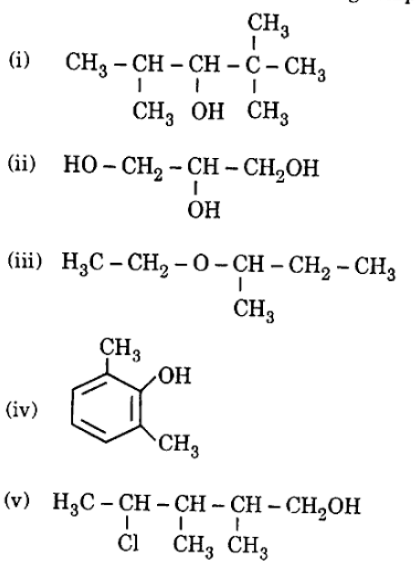
View Solution
(A) The compound has a branching with two methyl groups on the second carbon and an alcohol (-OH) group on the third carbon.
The IUPAC name is: \[ 2,3-Dimethyl-3-pentanol. \] Quick Tip: For compounds with branching, identify the longest chain containing the functional group and prioritize numbering based on the substituents and functional groups.
Predict the products obtained in the following reactions:

View Solution
(A) The reaction of ethyl phenyl ether (\( C_6H_5OC_2H_5 \)) with HBr results in cleavage of the ether bond. The products are phenol (\( C_6H_5OH \)) and ethyl bromide (\( C_2H_5Br \)). \[ C_6H_5OC_2H_5 + HBr \rightarrow C_6H_5OH + C_2H_5Br \] Quick Tip: Ether cleavage with HBr forms an alcohol and an alkyl halide. The phenyl group always retains the hydroxyl (-OH) group.
(a) Write only chemical equations for the following changes:
(A) Butanoic acid from Butan-1-ol
(B) Butanoic acid from Butanal
(C) 3-Nitrobenzoic acid from 3-Nitrobromobenzene
(D) Phenyl ethanoic acid from Benzyl alcohol
(v) Acetamide from Acetic acid
View Solution
(A) Butanoic acid from Butan-1-ol \[ CH_3CH_2CH_2CH_2OH + [O] \xrightarrow{K_2Cr_2O_7 / H^+} CH_3CH_2CH_2COOH \]
(B) Butanoic acid from Butanal \[ CH_3CH_2CH_2CHO + [O] \xrightarrow{K_2Cr_2O_7 / H^+} CH_3CH_2CH_2COOH \]
(C) 3-Nitrobenzoic acid from 3-Nitrobromobenzene \[ C_6H_4(NO_2)Br + Mg \xrightarrow{Dry\, Ether} C_6H_4(NO_2)MgBr \xrightarrow{CO_2, H^+} C_6H_4(NO_2)COOH \]
(D) Phenyl ethanoic acid from Benzyl alcohol \[ C_6H_5CH_2OH + [O] \xrightarrow{KMnO_4 / OH^-} C_6H_5CH_2COOH \]
(v) Acetamide from Acetic acid \[ CH_3COOH + NH_3 \xrightarrow{\Delta} CH_3CONH_2 + H_2O \] Quick Tip: Heating carboxylic acids with ammonia forms amides and releases water.
(b)A carboxylic acid ‘B’ and an alcohol ‘C’ were obtained after hydrolysis of an organic compound ‘A’ (molecular formula \( C_8H_{16}O_2 \)) with dilute sulphuric acid. ‘B’ is produced on oxidation of ‘C’ with chromic acid. But-1-ene is obtained on dehydration of ‘C’. Identify ‘A’, ‘B’ and ‘C’. Write chemical equations for all the reactions involved.
View Solution
Compound ‘A’ is \( CH_3COOCH_2CH_2CH_3 \) (propyl acetate).
Compound ‘B’ is \( CH_3COOH \) (acetic acid).
Compound ‘C’ is \( CH_3CH_2CH_2OH \) (propan-1-ol).
Reactions:
Hydrolysis of A: \[ CH_3COOCH_2CH_2CH_3 + H_2O \xrightarrow{H^+} CH_3COOH + CH_3CH_2CH_2OH \]
Oxidation of C to B: \[ CH_3CH_2CH_2OH + [O] \xrightarrow{K_2Cr_2O_7 / H^+} CH_3COOH \]
Dehydration of C: \[ CH_3CH_2CH_2OH \xrightarrow{H_2SO_4 / \Delta} CH_2=CHCH_3 + H_2O \] Quick Tip: Ester hydrolysis produces an alcohol and a carboxylic acid. Oxidation of primary alcohols forms carboxylic acids, while dehydration forms alkenes.
(b) Differentiate between the following pairs of compounds by writing chemical equations of one chemical test:
(A) Methylamine and Dimethylamine
(B) Ethylamine and Aniline
(C) Aniline and Benzylamine
(D) Aniline and N-Methylamine
(v) Secondary and Tertiary Amine
View Solution
(A) Methylamine and Dimethylamine
Methylamine gives a positive carbylamine test, forming isocyanide with an unpleasant smell: \[ CH_3NH_2 + CHCl_3 + 3KOH \xrightarrow{\Delta} CH_3NC + 3KCl + 3H_2O \]
Dimethylamine does not give the carbylamine test.
(B) Ethylamine and Aniline
Ethylamine forms a clear solution with water, while aniline forms a milky suspension due to its low solubility in water.
(C) Aniline and Benzylamine
Aniline reacts with bromine water to form a white precipitate of 2,4,6-tribromoaniline: \[ C_6H_5NH_2 + 3Br_2 \rightarrow C_6H_2Br_3NH_2 + 3HBr \]
Benzylamine does not react with bromine water.
(D) Aniline and N-Methylamine
Aniline reacts with \( HNO_2 \) to form a diazonium salt: \[ C_6H_5NH_2 + HNO_2 \rightarrow C_6H_5N_2^+Cl^- + H_2O \]
N-Methylamine forms methanol: \[ CH_3NHCH_3 + HNO_2 \rightarrow CH_3OH + N_2 + H_2O \]
(v) Secondary and Tertiary Amine
Secondary amines form nitrosamines with \( HNO_2 \), producing a yellow oily layer: \[ R_2NH + HNO_2 \rightarrow R_2NNO + H_2O \]
Tertiary amines do not react. Quick Tip: Reaction with \( HNO_2 \) differentiates secondary and tertiary amines.
(b) OR Write short notes on the following:
(i) Carbylamine Reaction:
View Solution
(A) Carbylamine Reaction:
The carbylamine reaction is used to detect primary amines. In this reaction, a primary amine reacts with chloroform (\( CHCl_3 \)) and alcoholic potassium hydroxide (\( KOH \)) to produce an isocyanide, which has an unpleasant odor: \[ RNH_2 + CHCl_3 + 3KOH \xrightarrow{\Delta} RNC + 3KCl + 3H_2O \] Quick Tip: The carbylamine test is specific for primary amines and does not occur with secondary or tertiary amines.
(B) (ii) Diazotization:
View Solution
N/A Quick Tip: Diazotization is commonly used in the synthesis of azo dyes and in coupling reactions for aromatic compounds.
(C) Gabriel Phthalimide Synthesis
View Solution
N/A Quick Tip: Gabriel synthesis is ideal for preparing primary aliphatic amines but not for aromatic amines.



Comments