




UP Board Class 12 Chemistry Question Paper 2024 PDF (Code 347 GB) is available for download here. The Chemistry exam was conducted on March 7, 2024 in the Evening Shift from 2 PM to 5:15 PM. The total marks for the theory paper are 70. Students reported the paper to be easy to moderate.
UP Board Class 12 Chemistry Question Paper 2024 (Code 347 GB) with Solutions
| UP Board Class Chemistry Question Paper with Answer Key | Download | Check Solution |

UP Board Class 12 Chemistry Questions with Solutions
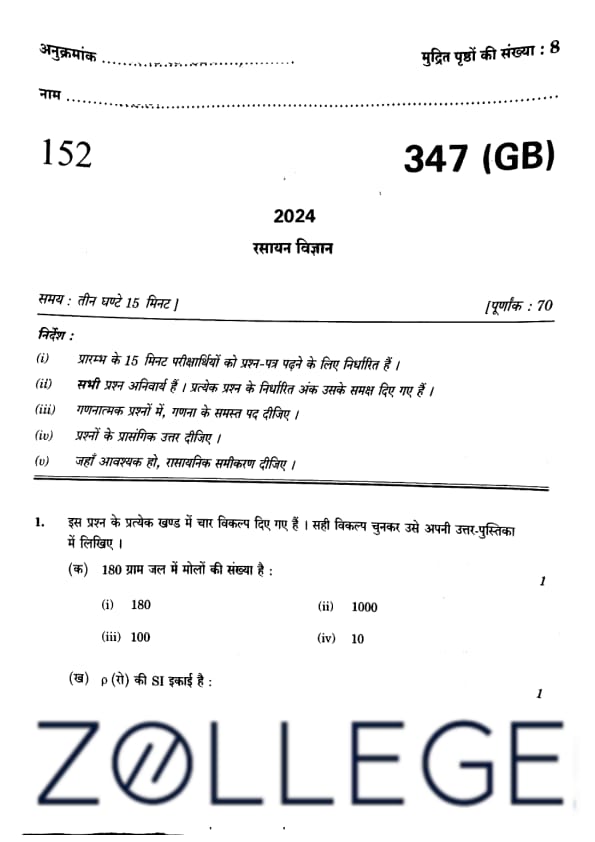
Question 1:
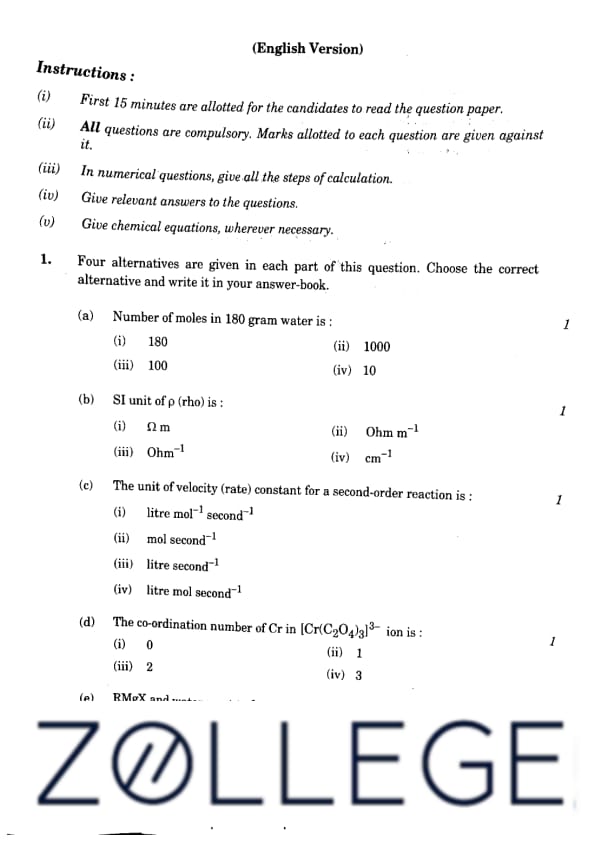
Four alternatives are given in each part of this question. Choose the correct alternative and write it in your answer-book.
(a) Number of moles in 180 g of water is:
View Solution
Moles of water can be calculated using: \[ Moles = \frac{Mass}{Molar mass} = \frac{180}{18} = 10. \] Quick Tip: To calculate moles, divide the given mass of the substance by its molar mass.
(b) SI unit of \( \rho \) (rho) is:
View Solution
The SI unit of resistivity (\( \rho \)) is \( \Omega \, m \), which is derived from: \[ \rho = R \cdot \frac{A}{l}, \]
where \( R \) is resistance, \( A \) is cross-sectional area, and \( l \) is length. Quick Tip: Resistivity depends on the material and is measured in \( \Omega \, m \).
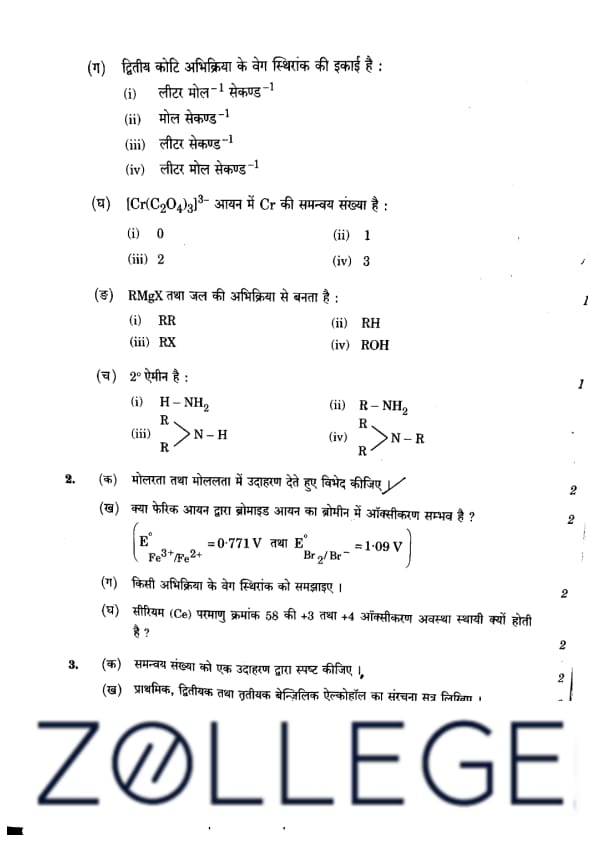
(c) The unit of velocity (rate) constant for a second-order reaction is:
View Solution
For a second-order reaction, the rate law is: \[ Rate = k[A][B]. \]
The unit of \( k \) is: \[ \frac{Rate}{Concentration^2} = \frac{mol litre^{-1} second^{-1}}{(mol litre^{-1})^2} = litre mol^{-1} second^{-1}. \] Quick Tip: The unit of the rate constant depends on the order of the reaction.
(d) The co-ordination number of Cr in \( [Cr(C_2O_4)_3]^{3-} \) ion is:
View Solution
The \( C_2O_4^{2-} \) (oxalate) ligand is bidentate, meaning it donates two pairs of electrons to the central metal atom. Since there are three oxalate ligands, the co-ordination number of Cr is: \[ 3 \times 2 = 6. \] Quick Tip: Co-ordination number is the total number of coordinate bonds formed between the central metal and ligands.
(e) \( RMgX \) and water react to form:
View Solution
The reaction of Grignard reagent (\( RMgX \)) with water produces an alkane: \[ RMgX + H_2O \rightarrow RH + Mg(OH)X. \] Quick Tip: Grignard reagents react with water to produce hydrocarbons and metal hydroxides.

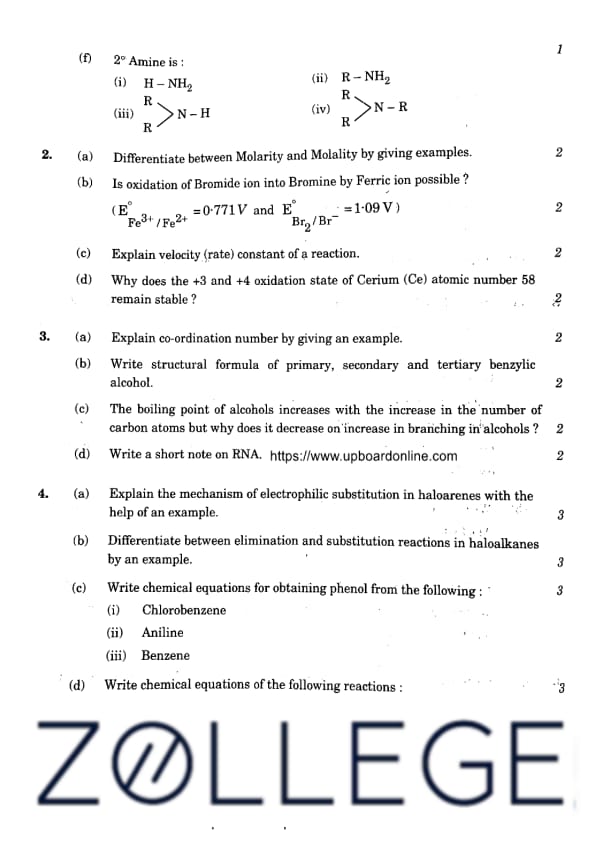
View Solution
A \( 2^\circ \) (secondary) amine has two alkyl or aryl groups attached to the nitrogen atom along with one hydrogen atom, represented as \( R_2-NH \). Quick Tip: Amines are classified as primary (\( RNH_2 \)), secondary (\( R_2NH \)), or tertiary (\( R_3N \)) based on the number of organic groups attached to nitrogen.
(a) Differentiate between Molarity and Molality by giving examples.
View Solution
- Molarity (M): The number of moles of solute dissolved in 1 liter of solution. \[ M = \frac{moles of solute}{volume of solution (L)}. \]
Example: A 1 M solution of NaCl contains 1 mole of NaCl in 1 liter of solution.
- Molality (m): The number of moles of solute dissolved in 1 kg of solvent. \[ m = \frac{moles of solute}{mass of solvent (kg)}. \]
Example: A 1 m solution of NaCl contains 1 mole of NaCl in 1 kg of solvent. Quick Tip: Molarity depends on volume (temperature-sensitive), while molality depends on mass (temperature-independent).
(b) Is oxidation of bromide ion into bromine by ferric ion possible?
View Solution
The standard electrode potentials are given as: \[ E^\circ_{Fe^{3+}/Fe^{2+}} = 0.771 \, V, \quad E^\circ_{Br_2/Br^-} = 1.09 \, V. \]
Since the reduction potential of \( Br_2/Br^- \) is higher than \( Fe^{3+}/Fe^{2+} \), bromide ions cannot be oxidized by ferric ions. Quick Tip: The species with a higher reduction potential acts as the oxidizing agent.
(c) Explain velocity (rate) constant of a reaction.
View Solution
The velocity (rate) constant \( k \) of a reaction is the proportionality factor in the rate equation: \[ Rate = k[A]^m[B]^n, \]
where \( m \) and \( n \) are the orders of the reaction. \( k \) depends on temperature and the nature of the reactants. Quick Tip: The rate constant increases with temperature, as explained by the Arrhenius equation.
(d) Why does the +3 and +4 oxidation state of Cerium (Ce) remain stable?
View Solution
Cerium (\( Ce \)) has an atomic number of 58, with the electronic configuration: \[ [Xe] 4f^1 5d^1 6s^2. \]
The \( +3 \) state is stable due to the removal of outer electrons (\( 6s^2, 5d^1 \)), while the \( +4 \) state achieves a stable \( 4f^0 \) configuration. Quick Tip: The stability of oxidation states in lanthanides depends on electronic configuration and lattice energy.
(a) Explain co-ordination number by giving an example.
View Solution
The co-ordination number is the number of ligand atoms directly bonded to the central atom in a coordination compound. Example: \[ [Co(NH_3)_6]^{3+}, \]
where the co-ordination number of cobalt is 6. Quick Tip: Co-ordination number depends on the number of donor atoms attached to the central metal ion.
(b) Write structural formula of primary, secondary, and tertiary benzylic alcohol.
View Solution
- Primary: \( C_6H_5CH_2OH \)
- Secondary: \( C_6H_5CH(OH)CH_3 \)
- Tertiary: \( C_6H_5C(CH_3)_2OH \) Quick Tip: Primary, secondary, and tertiary alcohols differ based on the number of alkyl groups attached to the carbon bonded to the hydroxyl group.
(c) The boiling point of alcohols increases with the increase in the number of carbon atoms but decreases on branching. Why?
View Solution
- Increase in boiling point: Higher carbon atoms increase molecular weight and van der Waals forces.
- Decrease in branching: Branching reduces surface area, weakening intermolecular forces. Quick Tip: Boiling point trends in alcohols depend on molecular weight, branching, and intermolecular hydrogen bonding.
(d) Write a short note on RNA.
View Solution
RNA (ribonucleic acid) is a nucleic acid involved in protein synthesis. Types:
- \( mRNA \): Carries genetic information from DNA to ribosomes.
- \( tRNA \): Transfers amino acids during translation.
- \( rRNA \): Structural component of ribosomes. Quick Tip: RNA is single-stranded and plays a vital role in gene expression and protein synthesis.
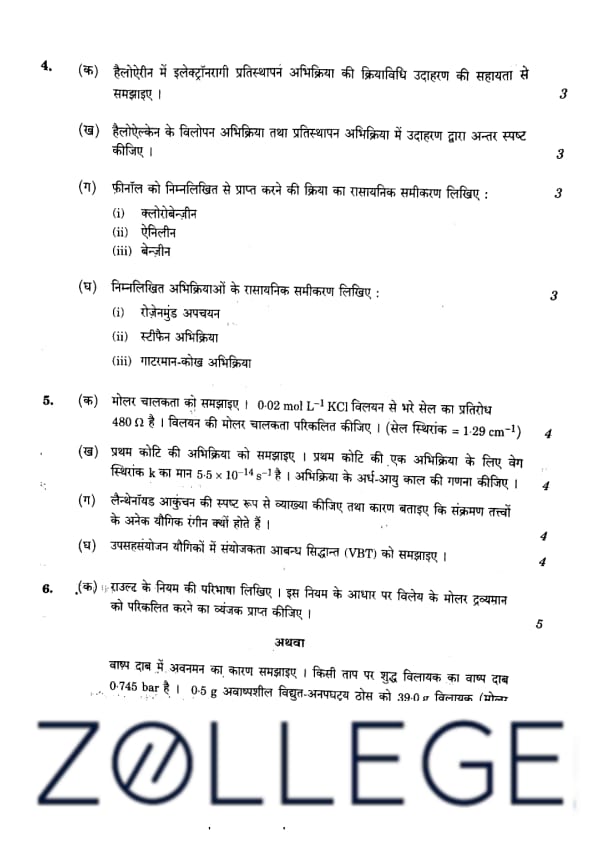
(a) Explain the mechanism of electrophilic substitution in haloarenes with the help of an example.
View Solution
Haloarenes undergo electrophilic substitution due to the resonance effect, which stabilizes the intermediate carbocation. Example: \[ C_6H_5Cl + Cl_2 \xrightarrow{FeCl_3} C_6H_4Cl_2 + HCl. \] Quick Tip: In haloarenes, the halogen group directs electrophilic substitution to ortho and para positions.
(b) Differentiate between elimination and substitution reactions in haloalkanes by an example.
View Solution
- Elimination: Haloalkane reacts with \( alc. \, KOH \) to form an alkene. \[ C_2H_5Br + alc.\,KOH \rightarrow C_2H_4 + HBr. \]
- Substitution: Haloalkane reacts with \( aq. \, KOH \) to form an alcohol. \[ C_2H_5Br + aq.\,KOH \rightarrow C_2H_5OH + KBr. \] Quick Tip: Elimination forms alkenes, while substitution forms alcohols.
(c) Write chemical equations for obtaining phenol from:
View Solution
(i) Chlorobenzene: \[ C_6H_5Cl + 2NaOH \xrightarrow{\Delta} C_6H_5OH + NaCl. \]
(ii) Aniline: \[ C_6H_5NH_2 + NaNO_2 + HCl \rightarrow C_6H_5N_2^+Cl^- \xrightarrow{H_2O} C_6H_5OH + N_2 + HCl. \]
(iii) Benzene: \[ C_6H_6 + SO_3 \xrightarrow{H_2SO_4} C_6H_5SO_3H \xrightarrow{NaOH, \Delta} C_6H_5ONa \xrightarrow{HCl} C_6H_5OH. \] Quick Tip: Phenol can be prepared by nucleophilic substitution or from diazonium salts.
(d) Write chemical equations of the following reactions:
View Solution
(i) Rosenmund reduction: \[ RCOCl + H_2 \xrightarrow{Pd/BaSO_4} RCHO. \]
Rosenmund reduction selectively reduces acid chlorides to aldehydes using a poisoned palladium catalyst.
(ii) Stephen reaction: \[ R-CN + 2[H] \xrightarrow{SnCl_2/HCl} R-CHO + NH_3. \]
The Stephen reaction is used to reduce nitriles to aldehydes using stannous chloride (\( SnCl_2 \)) in acidic medium.
(iii) Gattermann-Koch reaction: \[ C_6H_6 + CO + HCl \xrightarrow{AlCl_3/CuCl} C_6H_5CHO. \] Quick Tip: The Gattermann-Koch reaction introduces a formyl group into benzene to produce benzaldehyde.
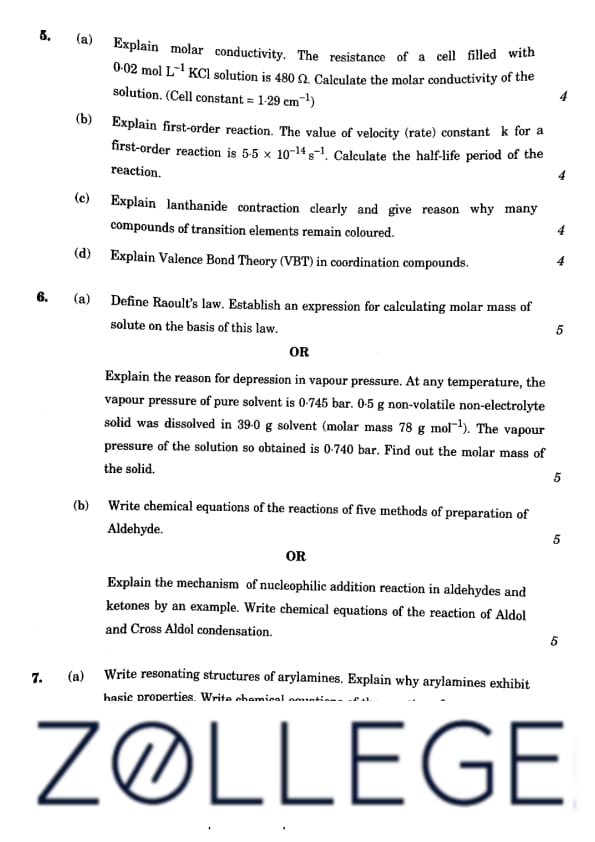
(a) Explain molar conductivity. The resistance of a cell filled with \( 0.02 \, mol L^{-1} \) KCl solution is \( 480 \, \Omega \). Calculate the molar conductivity of the solution. (Cell constant = \( 1.29 \, cm^{-1} \)).
View Solution
- Molar Conductivity (\( \Lambda_m \)): It is the conductivity of an electrolyte solution per unit concentration: \[ \Lambda_m = \kappa \cdot \frac{1000}{C}, \]
where \( \kappa \) is the conductivity and \( C \) is the molarity of the solution.
Calculation:
1. Conductivity (\( \kappa \)): \[ \kappa = \frac{Cell constant}{Resistance} = \frac{1.29}{480} = 0.0026875 \, S cm^{-1}. \]
2. Molar conductivity (\( \Lambda_m \)): \[ \Lambda_m = 0.0026875 \cdot \frac{1000}{0.02} = 134.375 \, S cm^2 mol^{-1}. \] Quick Tip: Molar conductivity increases with dilution due to a decrease in interionic attractions.
(b) Explain first-order reaction. The value of velocity (rate) constant \( k \) for a first-order reaction is \( 5.5 \times 10^{-14} \, s^{-1} \). Calculate the half-life period of the reaction.
View Solution
- First-order Reaction: The rate of reaction depends on the concentration of a single reactant. The rate law is: \[ Rate = k[A]. \]
- Half-life (\( t_{1/2} \)): For a first-order reaction: \[ t_{1/2} = \frac{0.693}{k}. \]
Calculation: \[ t_{1/2} = \frac{0.693}{5.5 \times 10^{-14}} = 1.26 \times 10^{13} \, s. \] Quick Tip: The half-life of a first-order reaction is independent of the initial concentration of the reactant.
(c) Explain lanthanide contraction clearly and give reason why many compounds of transition elements remain coloured.
View Solution
- Lanthanide Contraction: A gradual decrease in atomic and ionic radii across the lanthanide series due to poor shielding by 4f electrons.
- Reason for Colour: Transition elements have partially filled d-orbitals. When light falls on them, d-d transitions occur, absorbing certain wavelengths and reflecting others, giving them color. Quick Tip: Lanthanide contraction affects the properties of elements, including ionic radii and electronegativity.
(d) Explain Valence Bond Theory (VBT) in coordination compounds.
View Solution
Valence Bond Theory explains bonding in coordination compounds by hybridization of atomic orbitals on the central metal ion:
1. Ligands donate lone pairs to vacant orbitals of the metal ion.
2. Hybrid orbitals form sigma bonds with the ligands.
3. Example: In \( [Ni(CN)_4]^{2-} \), \( Ni^{2+} \) undergoes \( dsp^2 \) hybridization, forming a square planar structure. Quick Tip: VBT explains geometry but cannot predict color or magnetic properties of complexes.
(a) Define Raoult’s law. Establish an expression for calculating molar mass of solute on the basis of this law.
View Solution
- Raoult’s Law: The relative lowering of vapour pressure is proportional to the mole fraction of the solute: \[ \frac{P^0 - P}{P^0} = x_2 = \frac{n_2}{n_1 + n_2}, \]
where \( P^0 \) is the vapour pressure of the pure solvent, \( P \) is the vapour pressure of the solution, \( n_1 \) and \( n_2 \) are moles of solvent and solute.
Expression for Molar Mass:
For dilute solutions, \( n_2 \ll n_1 \), so: \[ \frac{P^0 - P}{P^0} = \frac{w_2}{M_2} \cdot \frac{M_1}{w_1}. \]
Rearranging: \[ M_2 = \frac{w_2 M_1}{w_1 \cdot \frac{P^0 - P}{P^0}}. \] Quick Tip: Raoult’s law is used to calculate molar mass and study colligative properties.
(OR) Explain the reason for depression in vapour pressure. At any temperature, the vapour pressure of pure solvent is 0.745 bar. \( 0.5 \, g \) non-volatile solute was dissolved in \( 39.0 \, g \) solvent (molar mass \( 78 \, g mol^{-1} \)). The vapour pressure of the solution so obtained is 0.740 bar. Find out the molar mass of the solid.
View Solution
Depression in Vapour Pressure: \[ \Delta P = P^0 - P = 0.745 - 0.740 = 0.005 \, bar. \]
Relative lowering of vapour pressure: \[ \frac{\Delta P}{P^0} = \frac{n_2}{n_1} = \frac{w_2}{M_2} \cdot \frac{M_1}{w_1}. \]
Given: \[ w_2 = 0.5 \, g, \, w_1 = 39.0 \, g, \, M_1 = 78 \, g mol^{-1}. \]
Substitute values: \[ \frac{0.005}{0.745} = \frac{0.5}{M_2} \cdot \frac{78}{39}. \]
Simplify: \[ M_2 = \frac{0.5 \cdot 78}{0.005 \cdot 39 \cdot 0.745} = 261.86 \, g mol^{-1}. \] Quick Tip: Depression in vapour pressure helps determine molar mass of non-volatile solutes.
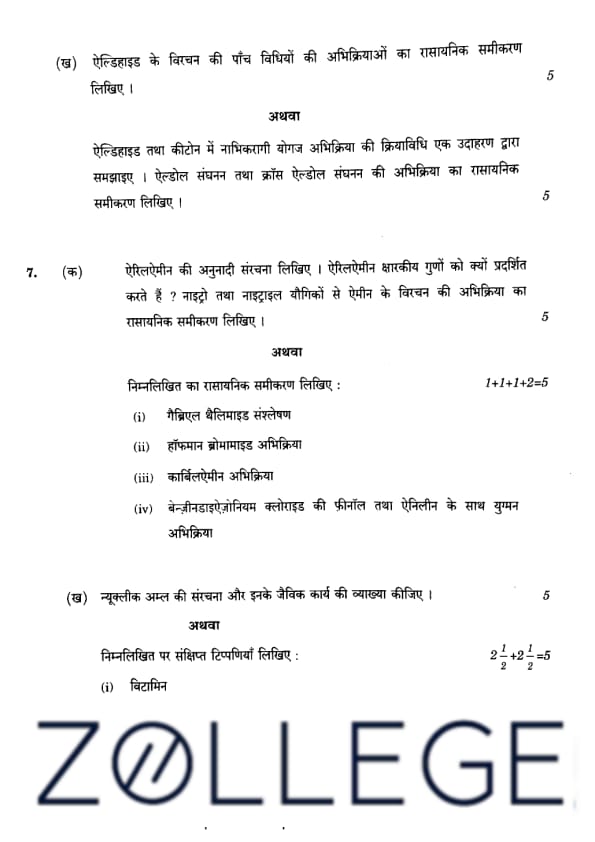
(b) Write chemical equations of the reactions of five methods of preparation of aldehyde.
View Solution
(i) Oxidation of primary alcohol: \[ RCH_2OH + [O] \rightarrow RCHO + H_2O. \]
(ii) Rosenmund reduction: \[ RCOCl + H_2 \xrightarrow{Pd/BaSO_4} RCHO. \]
(iii) Stephen reaction: \[ R-CN + 2[H] \xrightarrow{SnCl_2/HCl} RCHO. \]
(iv) Hydrolysis of geminal dihalides: \[ RCHCl_2 + H_2O \rightarrow RCHO + 2HCl. \]
(v) Gattermann-Koch reaction: \[ C_6H_6 + CO + HCl \xrightarrow{AlCl_3} C_6H_5CHO. \] Quick Tip: Aldehydes can be prepared from alcohols, acid chlorides, nitriles, and hydrocarbons.
(b) OR Explain the mechanism of nucleophilic addition reaction in aldehydes and ketones by an example. Write chemical equations of the reaction of Aldol and Cross Aldol condensation.
View Solution
Mechanism of Nucleophilic Addition Reaction:
Aldehydes and ketones undergo nucleophilic addition reactions due to the presence of a polar carbonyl group (\( C=O \)).
1. Step 1: Nucleophilic attack on the carbonyl carbon: \[ R-C(=O)-R' + Nu^- \rightarrow R-C(O^-)-R'Nu. \]
2. Step 2: Protonation: \[ R-C(O^-)-R'Nu + H^+ \rightarrow R-C(OH)-R'Nu. \]
Example: Reaction of formaldehyde with cyanide ion: \[ HCHO + CN^- \rightarrow H-C(CN)(OH). \]
Nucleophilic addition occurs due to the electrophilic nature of the carbonyl carbon.
Aldol Condensation:
Aldehydes or ketones having at least one \(\alpha\)-hydrogen undergo aldol condensation in the presence of a base: \[ 2CH_3CHO \xrightarrow{Dil. NaOH} CH_3CH(OH)CH_2CHO \xrightarrow{\Delta} CH_3CH=CHCHO + H_2O. \]
Aldol condensation involves the formation of \(\beta\)-hydroxy aldehydes or ketones, followed by dehydration.
Cross Aldol Condensation:
Cross aldol condensation occurs between two different aldehydes or ketones: \[ CH_3CHO + CH_3COCH_3 \xrightarrow{Dil. NaOH} CH_3CH(OH)CH_2COCH_3 \xrightarrow{\Delta} CH_3CH=CHCOCH_3 + H_2O. \] Quick Tip: In cross aldol condensation, products are a mixture of aldols, requiring careful selection of reactants for specificity.
(a) Write resonating structures of arylamines. Explain why arylamines exhibit basic properties. Write chemical equations of the reaction of preparation of amine from nitro and nitrile compounds.
View Solution
Resonating Structures of Arylamines:
Arylamines, such as aniline (\( C_6H_5NH_2 \)), exhibit resonance due to the delocalization of the lone pair of electrons on the nitrogen atom into the benzene ring.
\[ Structure 1: \quad {C6H5NH2} \quad \rightarrow \quad Structures showing delocalized electrons. \]
Basic Properties:
Arylamines are basic because the lone pair of electrons on the nitrogen atom can accept a proton (\( H^+ \)). However, resonance decreases the availability of the lone pair, making them less basic than aliphatic amines.
Preparation of Amines:
1. From Nitro Compounds: \[ {RNO2 + 6[H] -> RNH2 + 2H2O} \quad (Reduction with Sn/HCl or catalytic hydrogenation). \]
2. From Nitriles: \[ {RCN + 2[H] -> RCH2NH2} \quad (Reduction with LiAlH4). \] Quick Tip: Arylamines are less basic than aliphatic amines due to resonance, which delocalizes the lone pair on nitrogen.
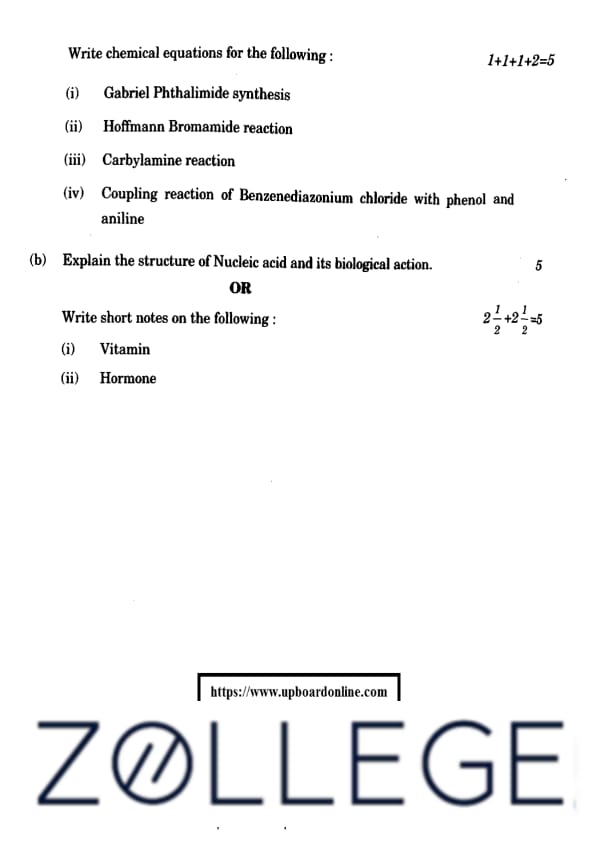
OR (a) Write chemical equations for the following:
View Solution
(i) Gabriel Phthalimide Synthesis: \[ {C6H4(CO)2N + KOH -> C6H4(CO)2NK + RX -> C6H4(CO)2NR -> RNH2}. \]
(ii) Hoffmann Bromamide Reaction: \[ {RCONH2 + Br2 + 4NaOH -> RNH2 + Na2CO3 + 2NaBr + 2H2O}. \]
(iii) Carbylamine Reaction: \[ {RNH2 + CHCl3 + 3KOH -> RNC + 3KCl + 3H2O}. \]
(iv) Coupling Reaction of Benzene Diazonium Chloride with Phenol and Aniline:
1. With Phenol: \[ {C6H5N2+Cl- + C6H5OH -> C6H5N=NC6H4OH}. \]
2. With Aniline: \[ {C6H5N2+Cl- + C6H5NH2 -> C6H5N=NC6H4NH2}. \] Quick Tip: The Gabriel synthesis is used for primary amines, Hoffmann reaction for amides, and carbylamine reaction for isocyanides.
(b) Explain the structure of nucleic acid and its biological action.
View Solution
Nucleic acids are biopolymers made of nucleotide monomers. Each nucleotide consists of:
1. A nitrogenous base (adenine, thymine/uracil, guanine, cytosine).
2. A pentose sugar (ribose in RNA, deoxyribose in DNA).
3. A phosphate group.
- DNA stores genetic information, and RNA helps in protein synthesis.
- DNA is double-stranded with complementary base pairing (\( A-T \), \( G-C \)), while RNA is single-stranded.
Biological Action:
- DNA replication ensures the transfer of genetic information.
- RNA facilitates transcription and translation processes for protein synthesis. Quick Tip: DNA stores genetic information, while RNA plays a key role in protein synthesis.



Comments