




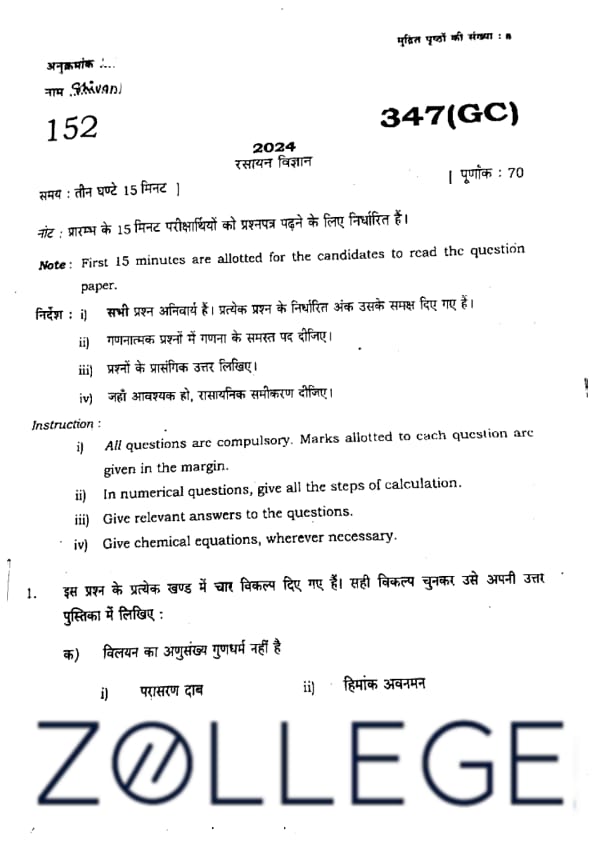
UP Board Class 12 Chemistry Question Paper 2024 PDF (Code 347 GC) is available for download here. The Chemistry exam was conducted on March 7, 2024 in the Evening Shift from 2 PM to 5:15 PM. The total marks for the theory paper are 70. Students reported the paper to be easy to moderate.
UP Board Class 12 Chemistry Question Paper 2024 (Code 347 GC) with Solutions
| UP Board Class Chemistry Question Paper with Answer Key |  Download Download |
Check Solution |

UP Board Class 12 Chemistry Questions with Solutions
Question 1:
(a) Which is not a colligative property of solution?
View Solution
Step 1: Understanding Colligative Properties
Colligative properties depend only on the number of solute particles in a solution, not their identity. The four main colligative properties are:
Relative lowering of vapor pressure
Boiling point elevation
Freezing point depression
Osmotic pressure
Since surface tension is not influenced by the number of solute particles but by intermolecular forces, it is not a colligative property. Quick Tip: Colligative properties are used to determine molecular weights of solutes in solutions and are independent of solute type.
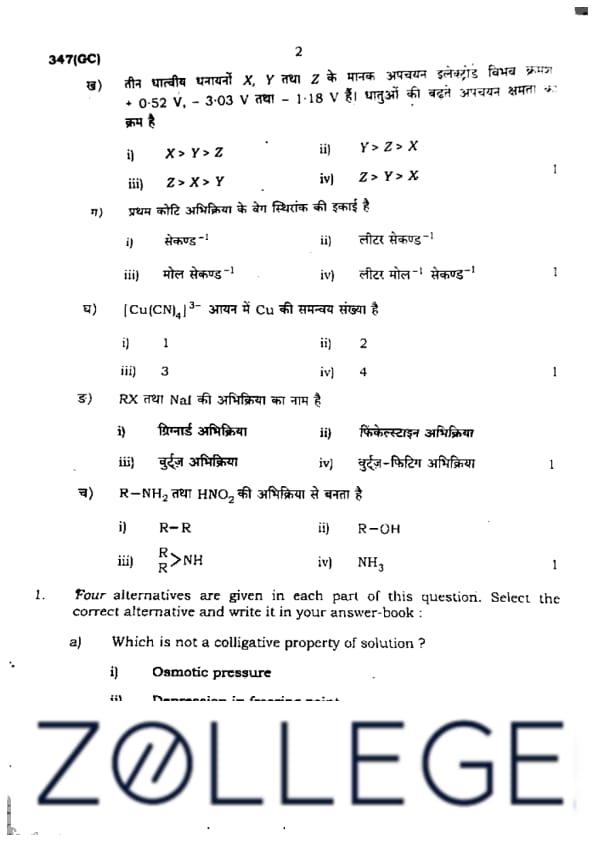
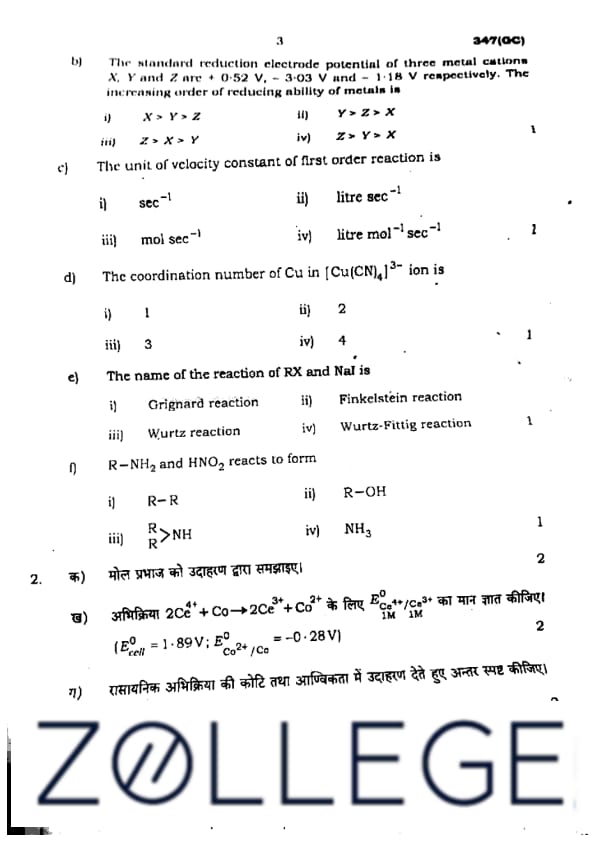
(b) The increasing order of reducing ability of metals X, Y, and Z, given their reduction electrode potentials:
\( E^\circ_X = +0.52V, \quad E^\circ_Y = -3.03V, \quad E^\circ_Z = -1.18V \)
View Solution
Step 1: Understanding Reduction Potential and Reducing Ability
The reducing ability of a metal is inversely related to its standard reduction potential. A lower (more negative) reduction potential means a stronger reducing agent.
\[ Order of reducing ability = Lower E^\circ value \Rightarrow Stronger reducing agent \]
Given \( E^\circ_X = +0.52V, E^\circ_Y = -3.03V, E^\circ_Z = -1.18V \), we arrange them in increasing reducing ability as:
\[ Z > Y > X \] Quick Tip: More negative reduction potential means stronger reducing power, leading to easier electron donation.
(c) The unit of velocity constant for a first-order reaction is:
View Solution
Step 1: Understanding the Unit of First-Order Reaction
For a first-order reaction, the rate equation is:
\[ Rate = k[A] \]
where \( k \) is the rate constant. Since rate has units of \( mol L^{-1} sec^{-1} \) and concentration has units of \( mol L^{-1} \), the unit of \( k \) is:
\[ \frac{mol L^{-1} sec^{-1}}{mol L^{-1}} = sec^{-1} \] Quick Tip: The unit of a rate constant depends on the order of the reaction: - Zero-order: \( mol L^{-1} sec^{-1} \) - First-order: \( sec^{-1} \) - Second-order: \( L mol^{-1} sec^{-1} \)
(d) The coordination number of Cu in \([Cu(CN)_4]^{3-}\) ion is:
View Solution
Step 1: Understanding Coordination Number
The coordination number is the number of ligand donor atoms bonded to the central metal ion. In \([Cu(CN)_4]^{3-}\), the cyanide ion (\(CN^-\)) acts as a monodentate ligand, coordinating to Cu through four bonds.
Thus, the coordination number of Cu in this complex is:
\[ 4 \] Quick Tip: Coordination number depends on ligand type and geometry: - \( 4 \)-coordination: Square planar/tetrahedral - \( 6 \)-coordination: Octahedral
(e) The name of the reaction of RX and NaI is:
View Solution
Step 1: Identifying the Reaction Type
The reaction:
\[ RX + NaI \rightarrow RI + NaX \]
is a nucleophilic substitution where halogens (X) are replaced by iodine (\(I^-\)). This is known as the Finkelstein reaction. Quick Tip: Finkelstein reaction is useful for converting alkyl chlorides/bromides to alkyl iodides using NaI in acetone.
(f) R-NH\(_2\) and HNO\(_2\) react to form:
View Solution
Step 1: Understanding the Reaction
When a primary amine (\( R-NH_2 \)) reacts with nitrous acid (\( HNO_2 \)), it undergoes deamination, producing nitrogen gas (\( N_2 \)) or ammonia (\( NH_3 \)), depending on the conditions.
\[ R-NH_2 + HNO_2 \rightarrow R-OH + N_2 + H_2O \]
Step 2: Special Case - Ammonia Formation
When the amine group is part of an ammonium salt (\( NH_4^+ \)), ammonia gas (\( NH_3 \)) is released.
\[ NH_4^+ + HNO_2 \rightarrow NH_3 + H_2O + N_2 \]
Thus, the correct answer is \( NH_3 \). Quick Tip: Nitrous acid is used in diazotization reactions. When primary amines react with \( HNO_2 \), they form alcohols or nitrogen gas, depending on conditions.
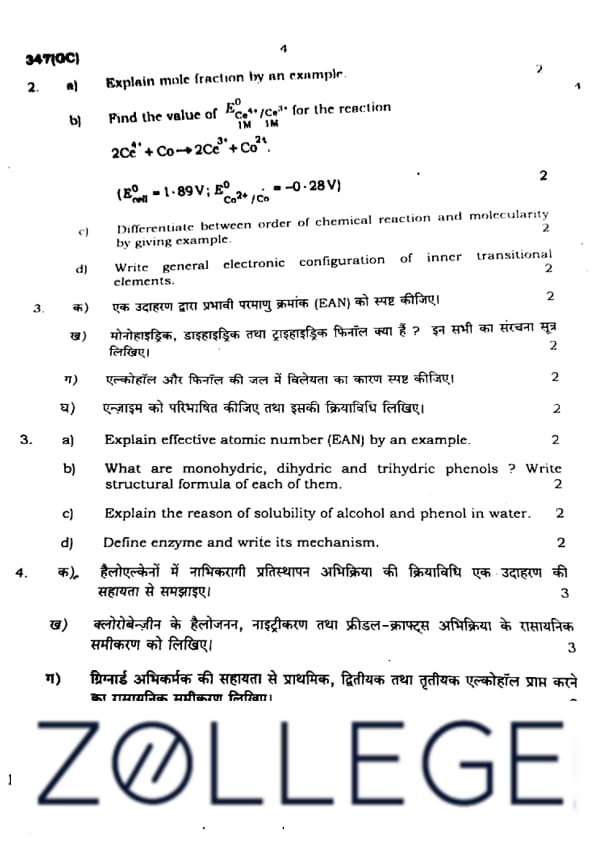
(a) Explain mole fraction by an example.
View Solution
Step 1: Definition of Mole Fraction
Mole fraction (\(X\)) of a component in a mixture is the ratio of the number of moles of that component to the total number of moles in the mixture.
\[ X_A = \frac{moles of component A}{total moles in the solution} \]
Step 2: Example
Consider a solution containing 2 moles of ethanol (\(C_2H_5OH\)) and 3 moles of water (\(H_2O\)).
\[ X_{ethanol} = \frac{2}{2+3} = \frac{2}{5} = 0.4, \quad X_{water} = \frac{3}{5} = 0.6 \] Quick Tip: Mole fraction is a unitless quantity and always sums up to 1 for all components in a mixture.
(b) Find the value of \( E^\circ_{Ce^{4+}/Ce^{3+}} \) for the reaction:
\[ 2Ce^{4+} + Co \rightarrow 2Ce^{3+} + Co^{2+} \]
Given:
\[ E^\circ_{cell} = 1.89V, \quad E^\circ_{Co^{2+}/Co} = -0.28V \]
View Solution
Step 1: Using the Standard Cell Potential Formula
The standard cell potential is given by:
\[ E^\circ_{cell} = E^\circ_{cathode} - E^\circ_{anode} \]
Here, Ce\(^{4+}/\)Ce\(^{3+}\) is the cathode and Co\(^{2+}/\)Co is the anode. Substituting values:
\[ 1.89 = E^\circ_{Ce^{4+}/Ce^{3+}} - (-0.28) \]
Step 2: Solving for \( E^\circ_{Ce^{4+}/Ce^{3+}} \)
\[ E^\circ_{Ce^{4+}/Ce^{3+}} = 1.89 + 0.28 = 2.17V \] Quick Tip: For a galvanic cell, the cathode has a higher reduction potential than the anode, and standard potentials are used to determine feasibility.
(c) Differentiate between order of chemical reaction and molecularity by giving an example.
View Solution
Step 1: Definitions
- Order of a reaction: The sum of the powers of concentration terms in the rate law.
- Molecularity: The number of reacting species involved in an elementary reaction.
Step 2: Example
For the reaction:
\[ 2A + B \rightarrow C \]
If the rate law is:
\[ Rate = k[A]^1[B]^1 \]
- The order of reaction is \(1+1 = 2\).
- If the reaction occurs in one step with three reactants colliding, its molecularity is 3. Quick Tip: Order of reaction is determined experimentally, while molecularity is a theoretical concept for elementary reactions.
(d) Write the general electronic configuration of inner transition elements.
View Solution
Step 1: Definition of Inner Transition Elements
Inner transition elements include lanthanides and actinides. Their general electronic configuration is:
\[ (n-2)f^{1-14} (n-1)d^{0-1} ns^2 \]
Step 2: Explanation for Lanthanides and Actinides
- Lanthanides: \( 4f^{1-14}5d^{0-1}6s^2 \)
- Actinides: \( 5f^{1-14}6d^{0-1}7s^2 \) Quick Tip: Lanthanides and actinides show variable oxidation states due to the filling of their f-orbitals.
(a) Explain effective atomic number (EAN) by an example.
View Solution
Step 1: Definition of Effective Atomic Number (EAN)
Effective Atomic Number (EAN) is the total number of electrons present around the central metal ion, including the electrons donated by ligands.
\[ EAN = Z - O + 2C \]
where:
- \( Z \) = Atomic number of metal
- \( O \) = Oxidation state of metal
- \( C \) = Number of ligands coordinated
Step 2: Example - Fe in \([Fe(CN)_6]^{3-}\)
For Fe in \([Fe(CN)_6]^{3-}\):
\[ Z = 26, \quad O = +3, \quad C = 6 \]
\[ EAN = 26 - 3 + 2(6) = 35 \] Quick Tip: EAN helps in predicting the stability of metal complexes. If EAN matches the nearest noble gas configuration, the complex is stable.
(b) What are monohydric, dihydric, and trihydric phenols? Write structural formula of each.
View Solution
Step 1: Classification of Phenols Based on Hydroxyl Groups
- Monohydric Phenol: Contains one \(-OH\) group (e.g., Phenol).
- Dihydric Phenol: Contains two \(-OH\) groups (e.g., Catechol).
- Trihydric Phenol: Contains three \(-OH\) groups (e.g., Pyrogallol).
Step 2: Structural Formulas
\[ Phenol \quad Catechol \quad Pyrogallol \] Quick Tip: Phenols show stronger hydrogen bonding than alcohols, leading to higher boiling points and water solubility.
(c) Explain the reason of solubility of alcohol and phenol in water.
View Solution
Step 1: Role of Hydrogen Bonding
Both alcohols and phenols dissolve in water due to hydrogen bonding between the \(-OH\) group and water molecules.
Step 2: Strength of Hydrogen Bonding
- Phenol has stronger hydrogen bonding due to resonance stabilization of the oxygen lone pair.
- Alcohol solubility decreases with increasing carbon chain length due to hydrophobic effects. Quick Tip: Hydrogen bonding increases solubility in polar solvents like water. Short-chain alcohols are more soluble than long-chain alcohols.
(d) Define enzyme and write its mechanism.
View Solution
Step 1: Definition of Enzyme
Enzymes are biological catalysts that speed up biochemical reactions without being consumed.
Step 2: Mechanism of Enzyme Action
1. Substrate Binding: The substrate binds to the enzyme's active site.
2. Formation of Enzyme-Substrate Complex: Temporary association forms.
3. Catalysis: The enzyme converts substrate into product.
4. Product Release: The enzyme releases the product and remains unchanged. Quick Tip: Enzymes work on the lock-and-key mechanism or induced-fit model to catalyze reactions efficiently.
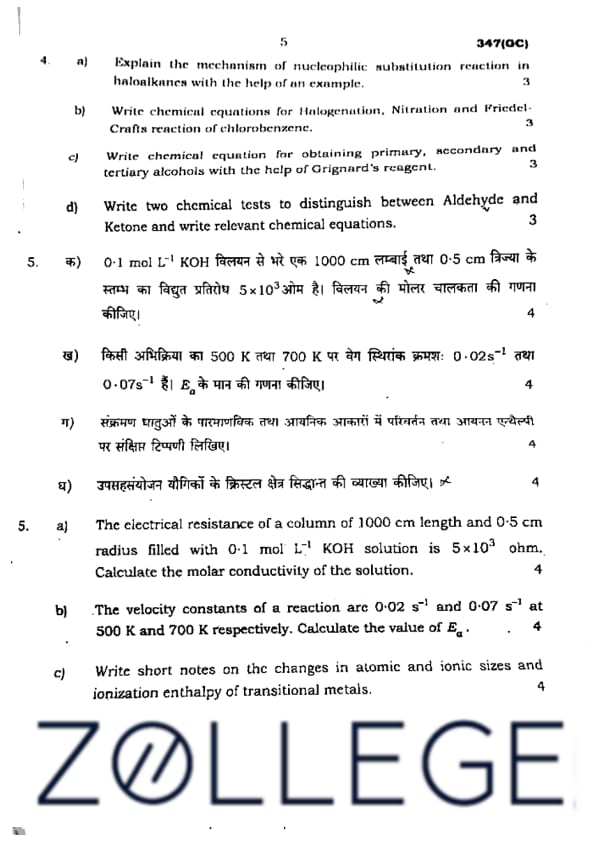
(a) Explain the mechanism of nucleophilic substitution reaction in haloalkanes with an example.
View Solution
Step 1: Types of Nucleophilic Substitution
1. SN1 Mechanism (Unimolecular)
- Two-step process involving a carbocation intermediate.
2. SN2 Mechanism (Bimolecular)
- One-step reaction with a transition state.
Step 2: Example - Hydrolysis of Methyl Bromide
\[ CH_3Br + OH^- \rightarrow CH_3OH + Br^- \] Quick Tip: SN1 is favored in polar protic solvents, while SN2 is preferred in polar aprotic solvents.
(b) Write chemical equations for halogenation, nitration, and Friedel-Crafts reaction of chlorobenzene.
View Solution
Step 1: Halogenation
\[ C_6H_5Cl + Cl_2 \xrightarrow{FeCl_3} C_6H_4Cl_2 + HCl \]
Step 2: Nitration
\[ C_6H_5Cl + HNO_3 \xrightarrow{H_2SO_4} C_6H_4NO_2Cl + H_2O \]
Step 3: Friedel-Crafts Alkylation
\[ C_6H_5Cl + CH_3Cl \xrightarrow{AlCl_3} C_6H_4CH_3Cl + HCl \] Quick Tip: Electrophilic substitution in chlorobenzene occurs at ortho and para positions due to the electron-donating effect of chlorine.
(c) Write chemical equation for obtaining primary, secondary, and tertiary alcohols with the help of Grignard's reagent.
View Solution
Step 1: Formation of Alcohols
1. Primary Alcohol
\[ R-MgX + HCHO \rightarrow R-CH_2OH \]
2. Secondary Alcohol
\[ R-MgX + CH_3CHO \rightarrow R-CH(OH)-CH_3 \]
3. Tertiary Alcohol
\[ R-MgX + CH_3COCH_3 \rightarrow R-C(OH)(CH_3)_2 \] Quick Tip: Grignard reagents react with aldehydes to give secondary alcohols and ketones to give tertiary alcohols.
(d) Write two chemical tests to distinguish between aldehyde and ketone and write relevant chemical equations.
View Solution
Step 1: Definition of Aldehydes and Ketones
- Aldehydes (\(-CHO\)) have a hydrogen attached to the carbonyl group.
- Ketones (\(R-CO-R'\)) have two alkyl groups attached to the carbonyl.
Step 2: Distinguishing Tests
(1) Tollens' Test: Silver Mirror Test
- Principle: Aldehydes reduce Tollens' reagent (\( AgNO_3 + NH_3 + H_2O \)) to form a silver mirror. Ketones do not react.
\[ R-CHO + 2[Ag(NH_3)_2]^+ + H_2O \rightarrow R-COOH + 2Ag + 4NH_3 \]
- Observation: A silver mirror appears inside the test tube for aldehydes. No reaction occurs with ketones.
(2) Fehling’s Test
- Principle: Aldehydes reduce Fehling’s solution (Cu\(^{2+}\) in alkaline medium) to red Cu\(_2\)O precipitate. Ketones do not react.
\[ R-CHO + 2Cu^{2+} + 5OH^- \rightarrow R-COO^- + Cu_2O + 3H_2O \]
- Observation: A brick-red precipitate forms for aldehydes. No reaction for ketones. Quick Tip: Tollens' and Fehling's tests are used to detect aldehydes. Ketones do not react because they lack a hydrogen atom on the carbonyl carbon.
(a) The electrical resistance of a column of 1000 cm length and 0.5 cm radius filled with 0.1 mol L\(^{-1}\) KOH solution is \(5 \times 10^3\) ohm. Calculate the molar conductivity of the solution.
View Solution
Step 1: Given Data
\[ R = 5 \times 10^3 ohm, \quad c = 0.1 mol L^{-1} \]
Step 2: Finding Conductivity (\( \kappa \))
Conductivity is given by:
\[ \kappa = \frac{1}{R} \times \frac{l}{A} \]
where:
\[ A = \pi r^2 = \pi (0.5)^2 = 0.785 cm^2, \quad l = 1000 cm \]
\[ \kappa = \frac{1}{5 \times 10^3} \times \frac{1000}{0.785} = 0.000255 S cm^{-1} \]
Step 3: Finding Molar Conductivity (\( \Lambda_m \))
\[ \Lambda_m = \frac{\kappa \times 1000}{c} = \frac{0.000255 \times 1000}{0.1} = 2.55 S cm^2 mol^{-1} \] Quick Tip: Molar conductivity increases with dilution because ion mobility increases in a dilute solution.
(b) The velocity constants of a reaction are 0.02 s\(^{-1}\) and 0.07 s\(^{-1}\) at 500 K and 700 K, respectively. Calculate the value of \( E_a \).
View Solution
Step 1: Using Arrhenius Equation
The Arrhenius equation:
\[ \ln k_2 - \ln k_1 = \frac{E_a}{R} \left( \frac{1}{T_1} - \frac{1}{T_2} \right) \]
Given:
\[ k_1 = 0.02, \quad k_2 = 0.07, \quad T_1 = 500K, \quad T_2 = 700K, \quad R = 8.314 J mol^{-1} K^{-1} \]
Step 2: Substituting Values
\[ \ln \left( \frac{0.07}{0.02} \right) = \frac{E_a}{8.314} \left( \frac{1}{500} - \frac{1}{700} \right) \]
\[ \ln (3.5) = \frac{E_a}{8.314} \times 0.000571 \]
\[ 1.25 = \frac{E_a \times 0.000571}{8.314} \]
\[ E_a = \frac{1.25 \times 8.314}{0.000571} = 18.2 kJ mol^{-1} \] Quick Tip: The activation energy \( E_a \) can be estimated from temperature dependence using the Arrhenius equation.
(c) Write short notes on the changes in atomic and ionic sizes and ionization enthalpy of transition metals.
View Solution
Atomic and Ionic Size:
Across a period, atomic size slightly decreases due to poor shielding by d-electrons.
Down a group, size increases due to the addition of a new energy level.
Ionization Enthalpy:
Transition metals have higher ionization enthalpy due to their small size and nuclear attraction.
Ionization energy does not increase significantly across the series because of screening effects. Quick Tip: Transition metals exhibit a gradual change in properties due to d-orbital electron configurations.
(d) Explain the Crystal Field Theory (CFT) of coordination compounds.
View Solution
Step 1: Introduction to CFT
Crystal Field Theory (CFT) explains the splitting of d-orbitals in transition metal complexes due to ligand interaction.
Step 2: Octahedral Splitting
In an octahedral field, d-orbitals split into two energy levels:
- \( t_{2g} \) (lower energy): \( d_{xy}, d_{yz}, d_{zx} \)
- \( e_g \) (higher energy): \( d_{z^2}, d_{x^2-y^2} \)
\[ \Delta_o = energy gap between these levels \]
Step 3: High-Spin vs Low-Spin Complexes
- Weak-field ligands (Cl\(^-\), H\(_2\)O) → High-spin, small \(\Delta_o\)
- Strong-field ligands (CN\(^-\), CO) → Low-spin, large \(\Delta_o\) Quick Tip: CFT helps explain magnetic properties, color, and stability of transition metal complexes.
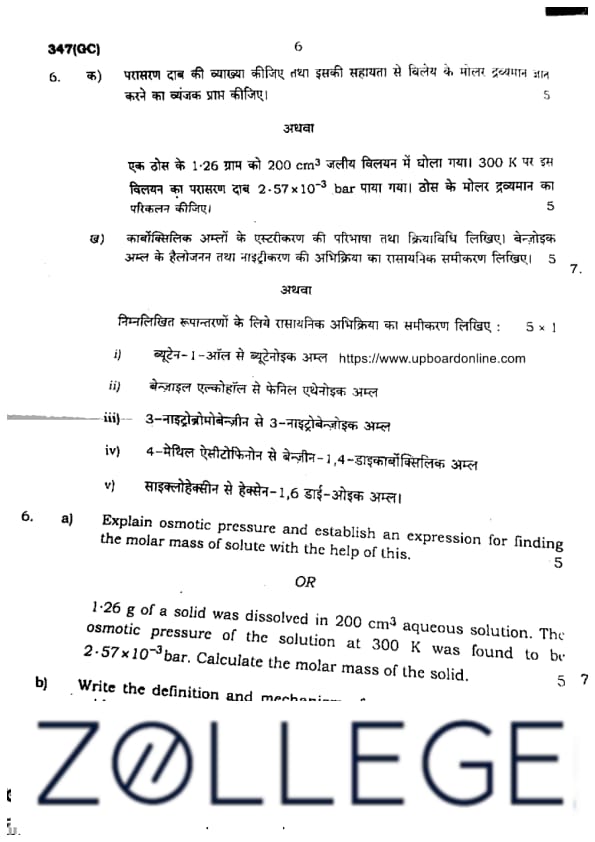
(a) Explain osmotic pressure and establish an expression for finding the molar mass of solute with the help of this.
View Solution
Step 1: Definition of Osmotic Pressure
Osmotic pressure (\(\pi\)) is the pressure required to stop the flow of solvent molecules through a semipermeable membrane.
Step 2: Van't Hoff Equation for Osmotic Pressure
\[ \pi = CRT \]
where:
- \( C \) = Concentration of solute (mol L\(^{-1}\))
- \( R \) = Universal gas constant
- \( T \) = Temperature (Kelvin)
Step 3: Finding Molar Mass of Solute
Since concentration (\( C \)) is given by \( C = \frac{n}{V} \) and \( n = \frac{w}{M} \), we substitute:
\[ \pi V = \frac{wRT}{M} \]
Rearranging for molar mass \( M \):
\[ M = \frac{wRT}{\pi V} \] Quick Tip: Osmotic pressure is a colligative property used to determine the molar mass of large biomolecules.
(a) 1.26 g of a solid was dissolved in 200 cm\(^3\) aqueous solution. The osmotic pressure of the solution at 300 K was found to be \( 2.57 \times 10^{-3} \) bar. Calculate the molar mass of the solid.
View Solution
Step 1: Given Data
\[ w = 1.26g, \quad V = 200cm^3 = 0.2L, \quad T = 300K, \quad \pi = 2.57 \times 10^{-3} bar, \quad R = 0.0831 L bar mol^{-1}K^{-1} \]
Step 2: Using Osmotic Pressure Formula
\[ M = \frac{wRT}{\pi V} \]
Step 3: Substituting Values
\[ M = \frac{1.26 \times 0.0831 \times 300}{(2.57 \times 10^{-3}) \times 0.2} \]
\[ M = \frac{31.41}{0.000514} = 61.1 g mol^{-1} \] Quick Tip: Use osmotic pressure to determine the molecular mass of polymers and macromolecules.
(b) Write the definition and mechanism of esterification of carboxylic acids. Write the chemical equations of the reactions of halogenation and nitration of benzoic acid.
View Solution
Step 1: Definition of Esterification
Esterification is a chemical reaction where a carboxylic acid reacts with an alcohol in the presence of an acid catalyst to form an ester and water.
Step 2: Mechanism of Esterification
\[ R-COOH + R'-OH \xrightarrow{H_2SO_4} R-COO-R' + H_2O \]
Step 3: Reactions of Benzoic Acid
Halogenation Reaction:
\[ C_6H_5COOH + Cl_2 \xrightarrow{FeCl_3} p-Chlorobenzoic Acid + HCl \]
Nitration Reaction:
\[ C_6H_5COOH + HNO_3 \xrightarrow{H_2SO_4} p-Nitrobenzoic Acid + H_2O \] Quick Tip: Esterification is a reversible reaction, and removal of water shifts equilibrium toward ester formation.
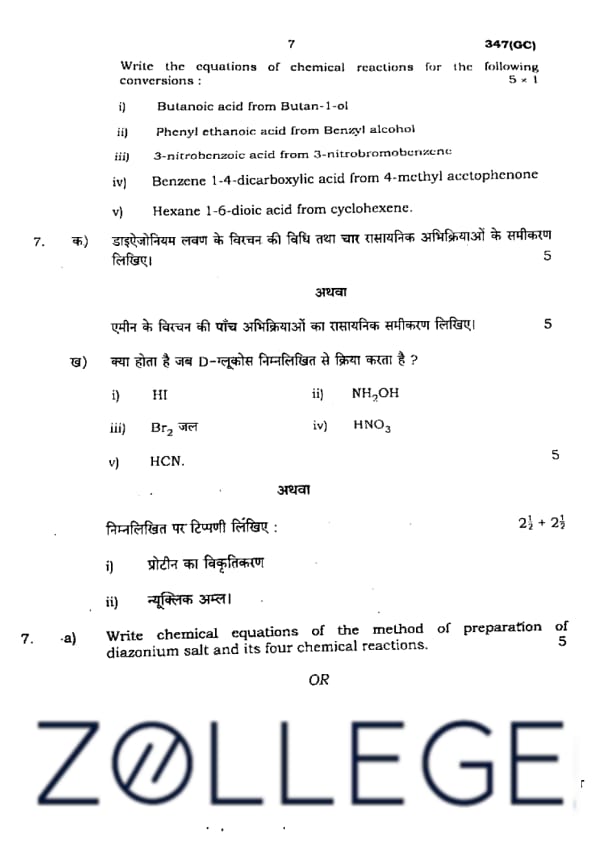
(b) Write the equations of chemical reactions for the following conversions:
(A) Butanoic acid from Butan-1-ol
(B) Phenyl ethanoic acid from Benzyl alcohol
(C) 3-Nitrobenzoic acid from 3-Nitrobromobenzene
(D) Benzene 1,4-dicarboxylic acid from 4-methyl acetophenone
(v) Hexane-1,6-dioic acid from cyclohexene
View Solution
(A) Butanoic acid from Butan-1-ol
\[ CH_3CH_2CH_2CH_2OH + [O] \xrightarrow{K_2Cr_2O_7/H_2SO_4} CH_3CH_2CH_2COOH + H_2O \]
(B) Phenyl ethanoic acid from Benzyl alcohol
\[ C_6H_5CH_2OH + [O] \xrightarrow{KMnO_4} C_6H_5CH_2COOH \]
(C) 3-Nitrobenzoic acid from 3-Nitrobromobenzene
\[ C_6H_4(NO_2)Br + Mg + CO_2 + H_3O^+ \rightarrow C_6H_4(NO_2)COOH \]
(D) Benzene 1,4-dicarboxylic acid from 4-methyl acetophenone
\[ C_6H_4(CH_3)COCH_3 + [O] \xrightarrow{KMnO_4} C_6H_4(COOH)_2 \]
(v) Hexane-1,6-dioic acid from cyclohexene
\[ C_6H_{10} + [O] \xrightarrow{KMnO_4} HOOC-(CH_2)_4-COOH \] Quick Tip: Oxidation of alcohols, alkylbenzenes, and alkenes can produce carboxylic acids.
(a) Write chemical equations of the method of preparation of diazonium salt and its four chemical reactions.
View Solution
Step 1: Preparation of Diazonium Salt
Diazonium salts are prepared by diazotization, where an aromatic primary amine reacts with sodium nitrite (\( NaNO_2 \)) and hydrochloric acid (HCl) at low temperatures (0–5°C).
\[ C_6H_5NH_2 + HNO_2 + HCl \rightarrow C_6H_5N_2^+Cl^- + 2H_2O \]
Step 2: Reactions of Diazonium Salt
(A) Sandmeyer Reaction (Halogenation)
\[ C_6H_5N_2^+Cl^- + CuCl \rightarrow C_6H_5Cl + N_2 \]
(B) Gattermann Reaction (Aryl Halide Formation)
\[ C_6H_5N_2^+Cl^- + CuBr \rightarrow C_6H_5Br + N_2 \]
(C) Coupling Reaction (Formation of Azo Compounds)
\[ C_6H_5N_2^+Cl^- + C_6H_5OH \rightarrow C_6H_5N=N-C_6H_4OH + HCl \]
(D) Reduction to Phenylhydrazine
\[ C_6H_5N_2^+Cl^- + H_2 \xrightarrow{Sn/HCl} C_6H_5NHNH_2 + HCl \] Quick Tip: Diazonium salts are highly reactive and are used in synthetic organic chemistry for producing aryl halides and azo dyes.
7(a) Write chemical equation for five reactions of preparation of Amine.
View Solution
Step 1: Reduction of Nitro Compounds
\[ R-NO_2 + 6[H] \xrightarrow{Sn/HCl} R-NH_2 + 2H_2O \]
Step 2: Reduction of Amides
\[ R-CONH_2 + 4[H] \xrightarrow{LiAlH_4} R-NH_2 + H_2O \]
Step 3: Hoffmann Bromamide Degradation
\[ R-CONH_2 + Br_2 + 4NaOH \rightarrow R-NH_2 + Na_2CO_3 + 2NaBr + 2H_2O \]
Step 4: Gabriel Phthalimide Synthesis
\[ C_6H_4(CO)_2N-K + R-X \rightarrow C_6H_4(CO)_2NR + KX \]
\[ C_6H_4(CO)_2NR + H_2NNH_2 \rightarrow R-NH_2 + C_6H_4(CO)_2N_2H_2 \]
Step 5: Alkylation of Ammonia
\[ NH_3 + R-X \rightarrow R-NH_2 + HX \] Quick Tip: Hoffmann degradation is used to prepare primary amines without increasing the carbon chain length.
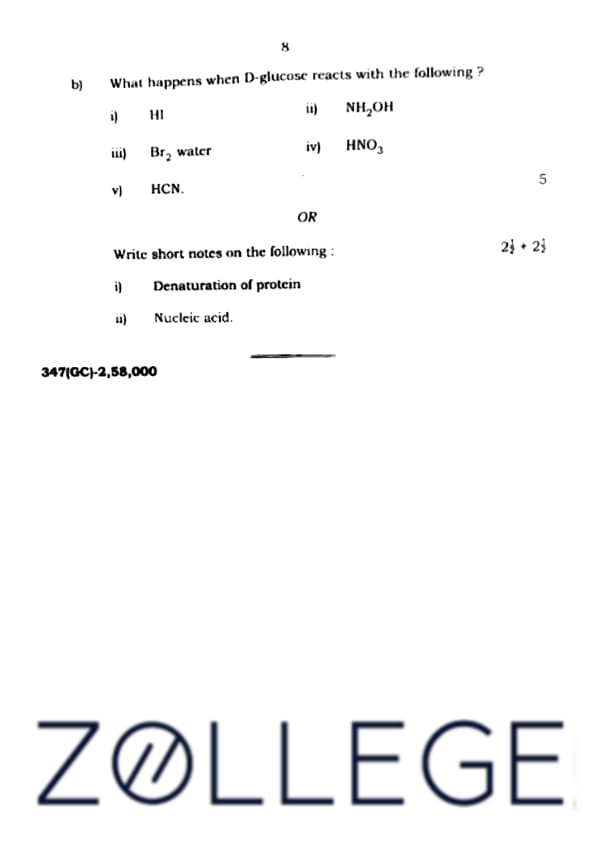
(b) What happens when D-glucose reacts with the following?
(A) HI
(B) NH\(_2\)OH
(C) Br\(_2\) water
(D) HNO\(_3\)
(E) HCN
View Solution
Step 1: Reaction of D-Glucose with Different Reagents
(A) With HI: Reduction of glucose to hexane occurs.
\[ C_6H_{12}O_6 + HI \rightarrow C_6H_{14} \]
(B) With NH\(_2\)OH: Formation of oxime.
\[ C_6H_{12}O_6 + NH_2OH \rightarrow C_6H_{11}NOH + H_2O \]
(C) With Br\(_2\) water: Oxidation of aldehyde to carboxylic acid.
\[ C_6H_{12}O_6 + Br_2 + H_2O \rightarrow C_6H_{12}O_7 + 2HBr \]
(D) With HNO\(_3\): Oxidation of aldehyde and primary alcohol to dicarboxylic acid.
\[ C_6H_{12}O_6 + HNO_3 \rightarrow C_6H_{10}O_8 + H_2O \]
(E) With HCN: Formation of cyanohydrin.
\[ C_6H_{12}O_6 + HCN \rightarrow C_6H_{12}O_6CN \] Quick Tip: D-glucose undergoes oxidation, reduction, and condensation reactions due to its functional groups.
7(b) Write short notes on the following:
(A) Denaturation of protein
(B) Nucleic acid
View Solution
(1) Denaturation of Protein:
- Denaturation is the loss of a protein's native structure due to heat, pH change, or chemicals.
- Causes unfolding of protein chains, leading to loss of biological activity.
\[ Protein (Native) \xrightarrow{Heat} Protein (Denatured) \]
(2) Nucleic Acid:
- Nucleic acids (DNA, RNA) store genetic information.
- Composed of nucleotides: sugar, phosphate, and nitrogen base. Quick Tip: Denaturation of proteins is often irreversible, like cooking an egg, while nucleic acids play a key role in genetics.



Comments