




UP Board Class 12 Chemistry Question Paper 2024 PDF (Code 347 GD) is available for download here. The Chemistry exam was conducted on March 7, 2024 in the Evening Shift from 2 PM to 5:15 PM. The total marks for the theory paper are 70. Students reported the paper to be easy to moderate.
UP Board Class 12 Chemistry Question Paper 2024 (Code 347 GD) with Solutions
| UP Board Class Chemistry Question Paper with Answer Key |  Download Download |
Check Solution |

UP Board Class 12 Chemistry Questions with Solutions
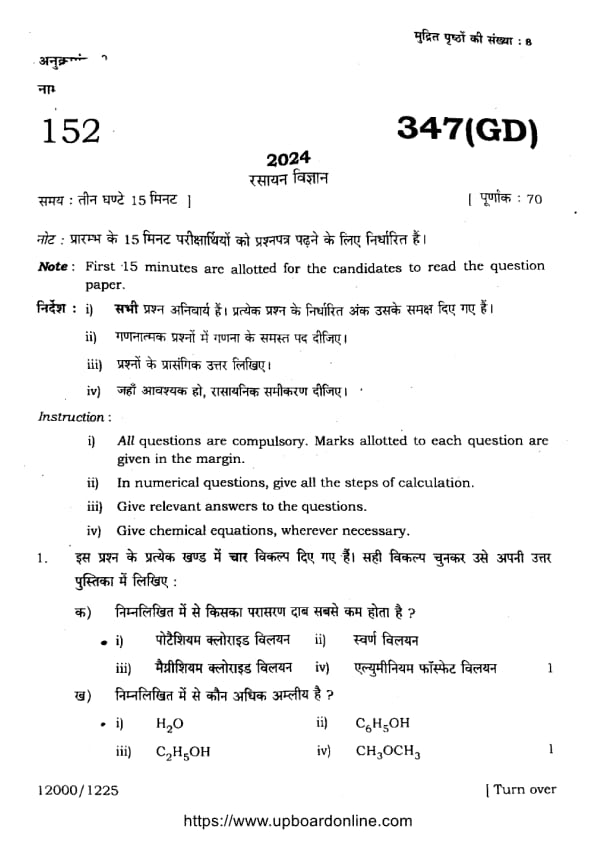
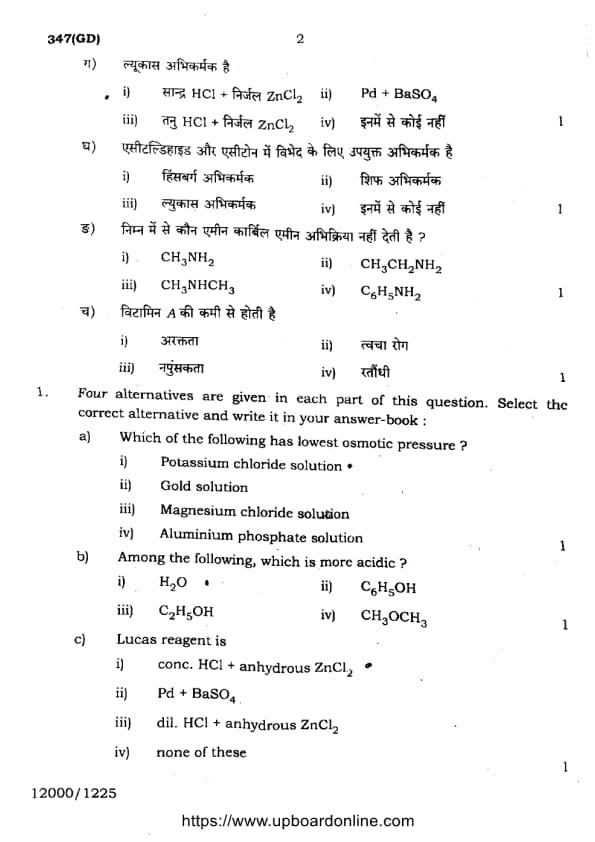
Four alternatives are given in each part of this question. Select the correct alternative and write it in your answer-book:
(a)Which of the following has lowest osmotic pressure?
View Solution
Step 1: Osmotic pressure is directly proportional to the number of dissolved particles in a solution.
Electrolytes dissociate into multiple ions, increasing the number of solute particles in solution.
Gold solution is a colloidal solution and has the lowest osmotic pressure as it contains fewer dissolved ions compared to ionic compounds like potassium chloride or magnesium chloride. Quick Tip: Osmotic pressure follows the relation \( \pi = iMRT \), where \( i \) is the van't Hoff factor, representing the number of particles a solute dissociates into.
(B) Among the following, which is more acidic?
View Solution
Step 1: Acidity is determined by the stability of the conjugate base formed after losing a proton.
Phenol (\( C_6H_5OH \)) is more acidic than water and ethanol due to resonance stabilization of its conjugate base (\( C_6H_5O^- \)).
Ether (\( CH_3OCH_3 \)) does not release protons easily and is least acidic. Quick Tip: The acidity of organic compounds can be compared by evaluating the stability of their conjugate bases.
(C) Lucas reagent is
View Solution
Step 1: Lucas reagent is a solution of concentrated hydrochloric acid and anhydrous zinc chloride (\( ZnCl_2 \)).
It is used to distinguish primary, secondary, and tertiary alcohols based on their reactivity in the Lucas test.
Tertiary alcohols react immediately, secondary alcohols show turbidity after some time, and primary alcohols do not react under normal conditions. Quick Tip: Lucas reagent is used for classifying alcohols based on their reactivity with \( ZnCl_2/HCl \), following the SN1 mechanism.
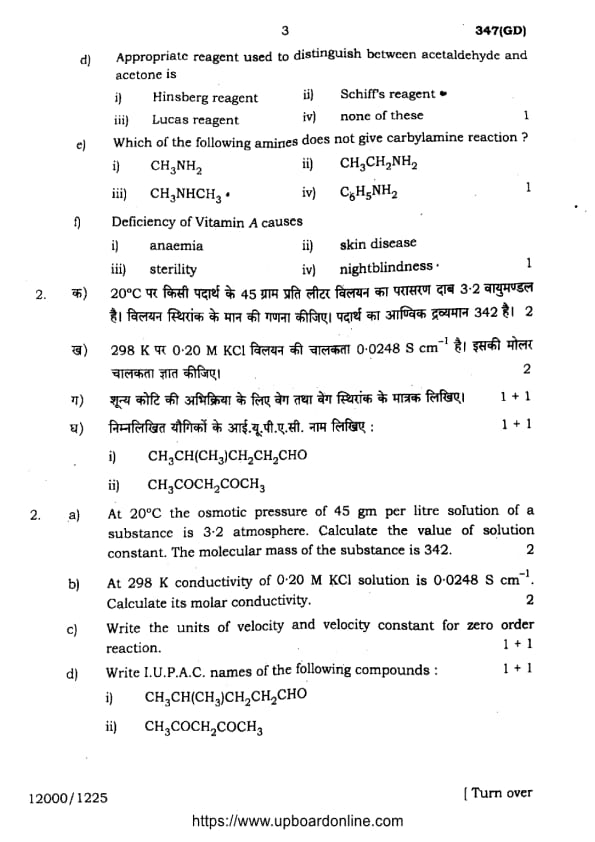
(D) Appropriate reagent used to distinguish between acetaldehyde and acetone is
View Solution
Step 1: Schiff’s reagent is used to distinguish between aldehydes and ketones.
Aldehydes react with Schiff’s reagent to give a pink color, whereas ketones do not react.
Since acetaldehyde is an aldehyde and acetone is a ketone, Schiff’s reagent can differentiate between them. Quick Tip: Schiff’s reagent test is a qualitative test to detect aldehydes, giving a pink/magenta color due to the formation of a complex.
(E) Which of the following amines does not give carbylamine reaction?
View Solution
Step 1: The carbylamine test is given by primary amines (both aliphatic and aromatic), but not by secondary or tertiary amines.
Step 2: \( CH_3NHCH_3 \) is a secondary amine, which does not give the carbylamine reaction.
All other options contain primary amines and will give a positive test. Quick Tip: The carbylamine reaction is used to detect primary amines, where they react with chloroform and alcoholic KOH to form isocyanides with a foul odor.
(F) Deficiency of Vitamin A causes
View Solution
Step 1: Vitamin A is essential for vision, immune function, and cell growth.
Step 2: Its deficiency primarily leads to night blindness (nyctalopia), which affects the ability to see in low light conditions.
Other symptoms may include dry skin, weakened immunity, and delayed growth. Quick Tip: Vitamin A plays a crucial role in vision by forming rhodopsin, a pigment needed for low-light vision.
(A) At 20°C the osmotic pressure of 45 gm per litre solution of a substance is 3.2 atmosphere. Calculate the value of solution constant. The molecular mass of the substance is 342.
View Solution
Step 1: The osmotic pressure (\( \pi \)) is related to molarity (\( C \)) using the formula:
\[ \pi = CRT \]
where \( R = 0.0821 \) L atm mol\(^{-1}\)K\(^{-1}\) and \( T = 293 \) K.
Step 2: Molarity \( C \) is given by:
\[ C = \frac{mass of solute}{molar mass \times volume (L)} \]
Substituting values,
\[ C = \frac{45}{342 \times 1} = 0.1316 mol/L \]
Step 3: Now, solving for \( C \),
\[ 3.2 = (0.0821 \times 293) C \]
\[ C = \frac{3.2}{0.0821 \times 293} = 0.1332 mol/L \] Quick Tip: Osmotic pressure calculations use the formula \( \pi = CRT \). Ensure correct unit conversions for temperature and gas constant.
(B) At 298 K conductivity of 0.20 M KCl solution is 0.0248 S cm\(^{-1}\). Calculate its molar conductivity.
View Solution
Step 1: The formula for molar conductivity (\( \Lambda_m \)) is:
\[ \Lambda_m = \frac{\kappa \times 1000}{C} \]
where \( \kappa = 0.0248 \) S cm\(^{-1}\) and \( C = 0.20 \) M.
Step 2: Substituting values:
\[ \Lambda_m = \frac{0.0248 \times 1000}{0.20} = 124 S cm^2 mol^{-1} \] Quick Tip: Molar conductivity is calculated using \( \Lambda_m = \frac{\kappa \times 1000}{C} \), where \( \kappa \) is conductivity and \( C \) is concentration.
(C) Write the units of velocity and velocity constant for zero order reaction.
View Solution
Step 1: For a zero-order reaction, the rate equation is:
\[ Rate = k [A]^0 \]
Step 2: The unit of velocity (rate of reaction) is:
\[ mol L^{-1} s^{-1} \]
Step 3: The unit of rate constant for a zero-order reaction is:
\[ mol L^{-1} s^{-1} \] Quick Tip: The unit of a rate constant depends on the reaction order: for a zero-order reaction, it is \( mol L^{-1} s^{-1} \).
(D) Write I.U.P.A.C. names of the following compounds:
(A) \( CH_3CH(CH_3)CH_2CH_2CH_2CHO \)
(B) \( CH_3COCH_2COCH_3 \)
View Solution
Step 1: Identify the longest carbon chain containing the aldehyde group.
The parent chain contains 6 carbons, making it a hexanal.
Step 2: Number the chain starting from the aldehyde functional group.
A methyl group is attached to carbon 3.
Step 3: The IUPAC name is:
\[ 3-methylhexanal \]
(B) \( CH_3COCH_2COCH_3 \)
Step 1: Identify the longest chain containing the ketone groups.
Step 2: The parent name is pentane with two ketone groups at positions 2 and 4.
Step 3: The IUPAC name is:
\[ 2,4-pentanedione \] Quick Tip: In aldehydes, numbering starts from the carbonyl carbon, and substituents are named accordingly.
For diketones, use the suffix ‘dione’ and specify ketone positions in the longest chain.
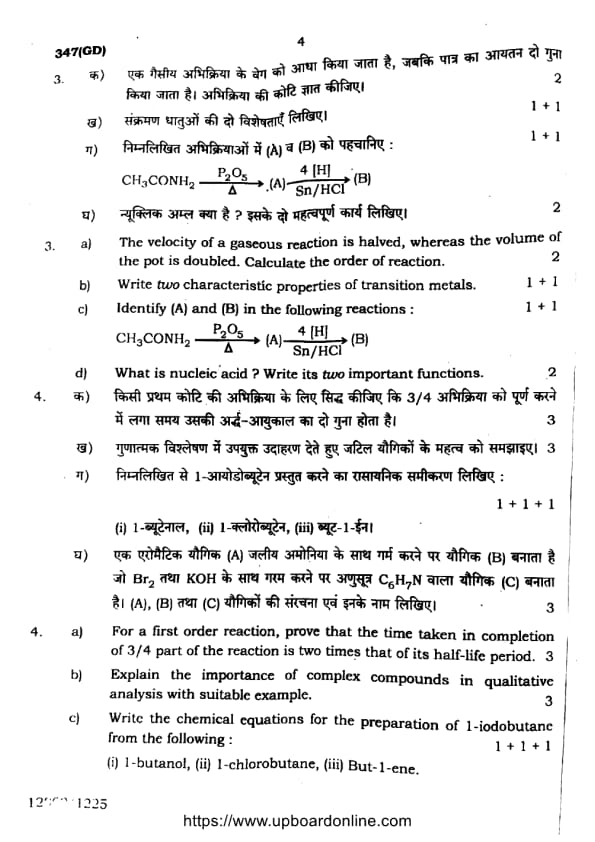
(A) The velocity of a gaseous reaction is halved, whereas the volume of the pot is doubled. Calculate the order of reaction.
View Solution
Step 1: The rate of reaction is given by:
\[ Rate \propto [C]^n \]
where \( n \) is the order of the reaction.
Step 2: Since the volume is doubled, the concentration is halved:
\[ [C]_{new} = \frac{[C]}{2} \]
Step 3: The rate is also halved:
\[ \frac{Rate_{new}}{Rate} = \left(\frac{1}{2}\right)^n = \frac{1}{2} \]
Step 4: Comparing,
\[ \left(\frac{1}{2}\right)^n = \frac{1}{2} \]
\[ n = 1 \]
Thus, the order of reaction is **1**. Quick Tip: The order of reaction can be determined using the rate equation: \( R \propto [C]^n \). Compare rate changes with concentration changes.
(B) Write two characteristic properties of transition metals.
View Solution
1. Variable oxidation states: Transition metals exhibit multiple oxidation states due to the involvement of d-electrons in bonding.
2. Formation of colored compounds: Transition metal ions form colored solutions due to d-d electronic transitions. Quick Tip: Transition metals exhibit unique properties such as variable oxidation states, catalytic behavior, and paramagnetism due to unpaired d-electrons.
(C) Identify (A) and (B) in the following reactions:
\[ CH_3CONH_2 \xrightarrow{P_2O_5, \Delta} (A) \xrightarrow{4[H], Sn/HCl} (B) \]
View Solution
Step 1: The given reaction sequence suggests dehydration followed by reduction.
- Dehydration of acetamide (\( CH_3CONH_2 \)) using \( P_2O_5 \) forms methyl isocyanide (\( CH_3NC \)).
\[ CH_3CONH_2 \xrightarrow{P_2O_5, \Delta} CH_3NC \]
So, (A) = Methyl isocyanide (\( CH_3NC \)).
Step 2: The second step is catalytic reduction using Sn/HCl.
- Reduction of methyl isocyanide leads to the formation of **methyl amine** (\( CH_3CH_2NH_2 \)).
\[ CH_3NC \xrightarrow{4[H], Sn/HCl} CH_3CH_2NH_2 \]
So, (B) = Methyl amine (\( CH_3CH_2NH_2 \)). Quick Tip: Dehydration of amides with \( P_2O_5 \) forms isocyanides, which can be reduced to primary amines using catalytic hydrogenation.
(A) For a first-order reaction, prove that the time taken in completion of 3/4 part of the reaction is two times that of its half-life period.
View Solution
Step 1: The integrated rate law for a first-order reaction is:
\[ t = \frac{2.303}{k} \log \frac{[A]_0}{[A]} \]
Step 2: For half-life, at \( t = t_{1/2} \), \( [A] = \frac{[A]_0}{2} \):
\[ t_{1/2} = \frac{0.693}{k} \]
Step 3: When 3/4 of the reaction is complete, \( [A] = \frac{[A]_0}{4} \):
\[ t = \frac{2.303}{k} \log \frac{[A]_0}{[A]_0/4} \]
\[ t = \frac{2.303}{k} \log 4 \]
\[ t = \frac{2.303}{k} \times 0.602 \]
\[ t = 2 t_{1/2} \]
Thus, the time taken for 3/4 completion is twice the half-life. Quick Tip: For a first-order reaction, the fraction of reactant remaining can be analyzed using the integrated rate equation \( t = \frac{2.303}{k} \log \frac{[A]_0}{[A]} \).
(B) Explain the importance of complex compounds in qualitative analysis with a suitable example.
View Solution
Step 1: Complex compounds are used in qualitative analysis due to their selective reactivity with metal ions.
Step 2: Example - Ammonia Complexation with Copper:
\[ Cu^{2+} + 4NH_3 \rightarrow [Cu(NH_3)_4]^{2+} \]
This forms a deep blue solution, aiding in the detection of \( Cu^{2+} \) ions. Quick Tip: Complex formation in qualitative analysis enhances selective detection of metal ions through distinct color changes.
(C) Write the chemical equations for the preparation of 1-iodobutane from the following:
(A) 1-butanol
(B) 1-chlorobutane
(C) But-1-ene
View Solution
\[ CH_3CH_2CH_2CH_2OH + HI \rightarrow CH_3CH_2CH_2CH_2I + H_2O \]
(B) 1-chlorobutane
\[ CH_3CH_2CH_2CH_2Cl + NaI \xrightarrow{acetone} CH_3CH_2CH_2CH_2I + NaCl \]
(C) But-1-ene
\[ CH_3CH_2CH=CH_2 + HI \rightarrow CH_3CH_2CH_2CH_2I \] Quick Tip: 1-Iodobutane can be synthesized via nucleophilic substitution or addition reactions involving iodide sources.
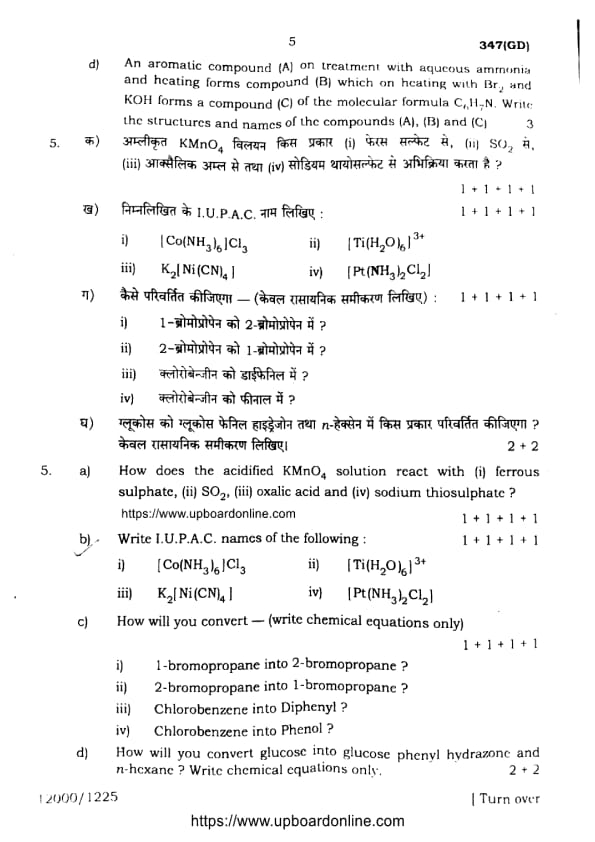
(D) An aromatic compound (A) on treatment with aqueous ammonia and heating forms compound (B), which on heating with \( Br_2 \) and KOH forms a compound (C) of molecular formula \( C_6H_7N \). Write the structures and names of the compounds (A), (B), and (C).
View Solution
Step 1: The given reaction suggests the Hoffmann bromamide degradation.
Step 2: The probable reactants and products are:
- Compound (A): Benzamide (\( C_6H_5CONH_2 \))
- Compound (B): Aniline (\( C_6H_5NH_2 \))
- Compound (C): Phenyl isocyanide (\( C_6H_5NC \))
Reactions:
\[ C_6H_5CONH_2 + NH_3 \rightarrow C_6H_5NH_2 + H_2O \]
\[ C_6H_5NH_2 + Br_2 + KOH \rightarrow C_6H_5NC + KBr + H_2O \] Quick Tip: The Hoffmann bromamide reaction converts amides to amines, and further treatment with \( Br_2/KOH \) can yield isocyanides.
(A) How does the acidified \( KMnO_4 \) solution react with (A) ferrous sulphate, (B) \( SO_2 \), (C) oxalic acid, and (D) sodium thiosulphate?
View Solution
Step 1: The acidified \( KMnO_4 \) acts as a strong oxidizing agent and reacts with various reducing agents.
Step 2: Reactions:
(A) With ferrous sulphate:
\[ 2 KMnO_4 + 10 FeSO_4 + 8 H_2SO_4 \rightarrow 5 Fe_2(SO_4)_3 + 2 MnSO_4 + K_2SO_4 + 8 H_2O \]
(B) With \( SO_2 \):
\[ 2 KMnO_4 + 5 SO_2 + 2 H_2O \rightarrow 2 MnSO_4 + K_2SO_4 + 2 H_2SO_4 \]
(C) With oxalic acid:
\[ 2 KMnO_4 + 5 (COOH)_2 + 3 H_2SO_4 \rightarrow 2 MnSO_4 + 10 CO_2 + 8 H_2O + K_2SO_4 \]
(D) With sodium thiosulphate:
\[ 2 KMnO_4 + 5 Na_2S_2O_3 + 6 H_2SO_4 \rightarrow 2 MnSO_4 + 5 Na_2SO_4 + 3 S + K_2SO_4 + 3 H_2O \] Quick Tip: Acidified \( KMnO_4 \) acts as an oxidizing agent, converting reducing agents into their oxidized forms while itself being reduced to \( Mn^{2+} \).
(B) Write I.U.P.A.C. names of the following:
(A) \([Co(NH_3)_6]Cl_3\)
(B) \([Ti(H_2O)_6]^{3+}\)
(C) \( K_2[Ni(CN)_4] \)
(D) \([Pt(NH_3)_2Cl_2]\)
View Solution
Step 1: Identify the ligands, oxidation state, and coordination number.
Step 2: The correct IUPAC names are:
(A) Hexaamminecobalt(C) chloride
(B) Hexaaquatitanium(C) ion
(C) Potassium tetracyanonickelate(B)
(D) Diammine dichloroplatinum(B) Quick Tip: In coordination compounds, ligands are named first in alphabetical order, followed by the central metal with oxidation state in Roman numerals.
(C) How will you convert: (write chemical equations only)
View Solution
(A) 1-bromopropane into 2-bromopropane
\[ CH_3CH_2CH_2Br \xrightarrow{alc. KOH} CH_3CH=CH_2 \xrightarrow{HBr, Peroxide} CH_3CHBrCH_3 \]
(B) 2-bromopropane into 1-bromopropane
\[ CH_3CHBrCH_3 \xrightarrow{alc. KOH} CH_3CH=CH_2 \xrightarrow{HBr} CH_3CH_2CH_2Br \]
(C) Chlorobenzene into Diphenyl
\[ C_6H_5Cl + 2Na + C_6H_5Cl \xrightarrow{Dry Ether} C_6H_5-C_6H_5 + 2NaCl \]
(D) Chlorobenzene into Phenol
\[ C_6H_5Cl + NaOH \xrightarrow{573K, 300 atm} C_6H_5OH + NaCl \] Quick Tip: Wurtz reaction is used for diphenyl preparation, while nucleophilic substitution helps convert chlorobenzene to phenol.
(D) How will you convert glucose into (A) glucose phenylhydrazone and (B) n-hexane? Write chemical equations only.
View Solution
(A) Glucose into Glucose Phenylhydrazone
\[ C_6H_{12}O_6 + C_6H_5NHNH_2 \rightarrow C_6H_{11}O_5CH=NNHC_6H_5 + H_2O \]
(B) Glucose into n-Hexane
\[ C_6H_{12}O_6 \xrightarrow{HI} C_6H_{14} \] Quick Tip: Glucose forms phenylhydrazone derivatives with phenylhydrazine, while reduction with HI converts it to n-hexane.
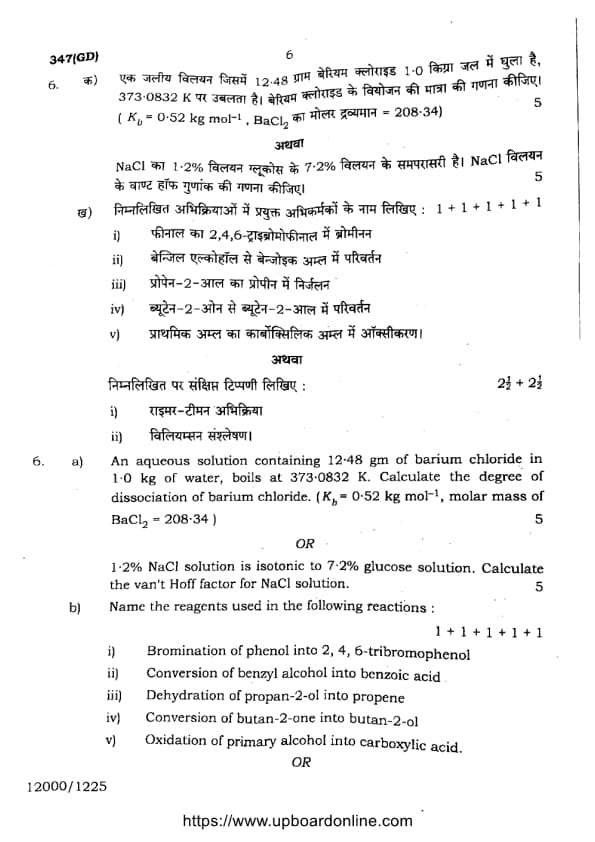
(A) An aqueous solution containing 12.48 gm of barium chloride in 1.0 kg of water, boils at 373.0832 K. Calculate the degree of dissociation of barium chloride. (\( K_b = 0.52 \) kg mol\(^{-1}\), molar mass of BaCl\(_2\) = 208.34)
View Solution
Step 1: The elevation in boiling point is given by:
\[ \Delta T_b = K_b \times m \times i \]
where \( m \) is the molality and \( i \) is the van't Hoff factor.
Step 2: Calculate molality:
\[ m = \frac{Mass of solute (g)}{Molar mass (g/mol) \times Mass of solvent (kg)} \]
\[ m = \frac{12.48}{208.34 \times 1} = 0.0599 mol/kg \]
Step 3: Calculate van't Hoff factor \( i \):
\[ \Delta T_b = 373.0832 - 373 = 0.0832 \]
\[ i = \frac{\Delta T_b}{K_b \times m} = \frac{0.0832}{0.52 \times 0.0599} = 2.67 \]
Step 4: Degree of dissociation \( \alpha \) is calculated as:
\[ i = 1 + \alpha(n - 1) \]
For BaCl\(_2\), \( n = 3 \):
\[ 2.67 = 1 + \alpha(3 - 1) \]
\[ \alpha = \frac{2.67 - 1}{2} = 0.835 \]
Thus, the degree of dissociation is **0.835**. Quick Tip: The van't Hoff factor (\( i \)) accounts for ionization in colligative properties and is used to determine dissociation in solutions.
(A) 1.2% NaCl solution is isotonic to 7.2% glucose solution. Calculate the van't Hoff factor for NaCl solution.
View Solution
Step 1: The van't Hoff factor (\( i \)) is determined using:
\[ \pi = i M R T \]
Since the solutions are isotonic, their osmotic pressures are equal:
\[ i \times M_{NaCl} = M_{glucose} \]
Step 2: Given:
\[ M_{NaCl} = \frac{1.2}{58.5} = 0.0205 mol/L \]
\[ M_{glucose} = \frac{7.2}{180} = 0.04 mol/L \]
Step 3: Solve for \( i \):
\[ i = \frac{M_{glucose}}{M_{NaCl}} = \frac{0.04}{0.0205} = 1.95 \]
Thus, the van't Hoff factor for NaCl is 1.95. Quick Tip: For isotonic solutions, osmotic pressure equations can be equated to determine the van't Hoff factor.
(B) Name the reagents used in the following reactions:
View Solution
(A) Bromination of phenol into 2,4,6-tribromophenol
Reagent: \( Br_2 \) (Bromine Water)
(B) Conversion of benzyl alcohol into benzoic acid
Reagent: \( K_2Cr_2O_7 \) / \( H_2SO_4 \) (Acidic Potassium Dichromate)
(C) Dehydration of propan-2-ol into propene
Reagent: \( H_2SO_4 \) at \( 443K \) (Concentrated Sulfuric Acid)
(D) Conversion of butan-2-one into butan-2-ol
Reagent: \( NaBH_4 \) (Sodium Borohydride) or \( LiAlH_4 \) (Lithium Aluminium Hydride)
(v) Oxidation of primary alcohol into carboxylic acid
Reagent: \( KMnO_4 \) / \( H_2SO_4 \) (Acidified Potassium Permanganate) Quick Tip: Reagents used in organic transformations are crucial for oxidation, reduction, and substitution reactions.
(B) OR Write short notes on the following:
(A) Reimer-Tiemann’s reaction
(B) Williamson’s synthesis
View Solution
Step 1: Reimer-Tiemann reaction is used to introduce a formyl (-CHO) group into phenol.
Step 2: Reaction:
\[ C_6H_5OH + CHCl_3 + NaOH \rightarrow o-hydroxybenzaldehyde + p-hydroxybenzaldehyde \]
Step 3: The reaction mechanism involves the formation of a dichlorocarbene intermediate, which undergoes electrophilic substitution at the ortho- and para-positions of phenol.
Reimer-Tiemann reaction is an electrophilic substitution reaction introducing an aldehyde (-CHO) group into phenol.
(B) Williamson’s synthesis
Step 1: Williamson’s synthesis is used for the preparation of ethers.
Step 2: Reaction:
\[ R-O^- + R'-X \rightarrow R-O-R' + X^- \]
where \( R'X \) is an alkyl halide and \( R-O^- \) is an alkoxide ion.
Step 3: Example:
\[ C_2H_5ONa + CH_3I \rightarrow C_2H_5OCH_3 + NaI \] Quick Tip: Williamson’s synthesis involves an SN2 reaction mechanism and is widely used for asymmetric ether synthesis.
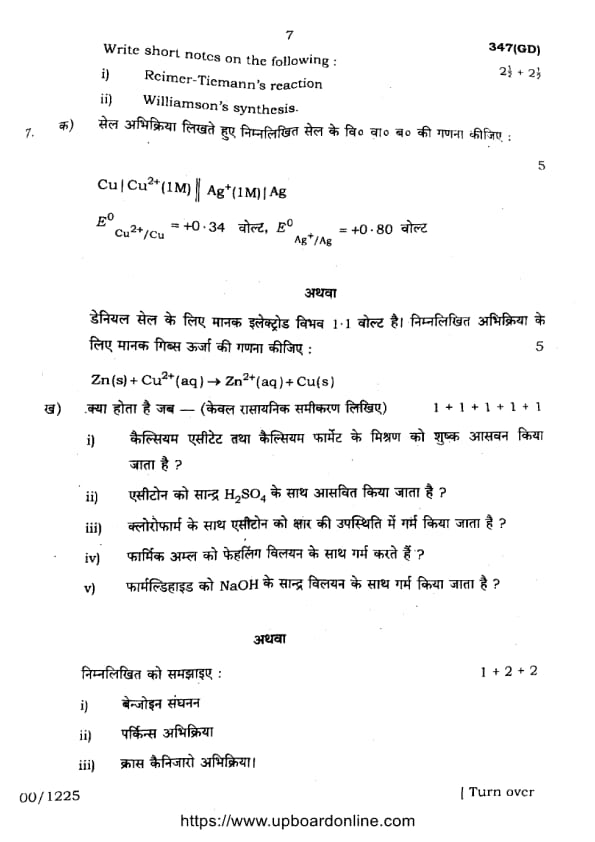
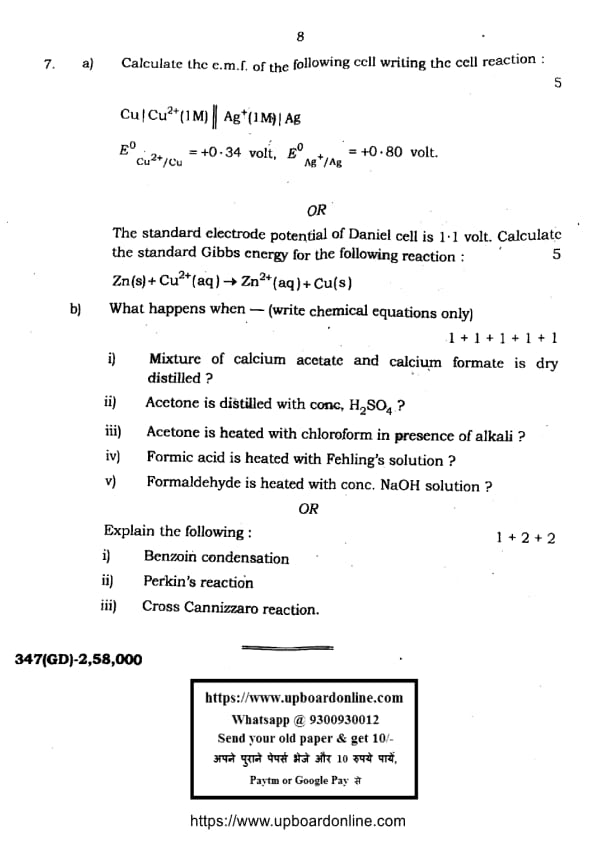
(A) Calculate the e.m.f. of the following cell writing the cell reaction:
\[ Cu | Cu^{2+}(1M) || Ag^+(1M) | Ag \]
Given:
\[ E^0_{Cu^{2+}/Cu} = +0.34 volt, \quad E^0_{Ag^+/Ag} = +0.80 volt \]
View Solution
Step 1: The cell reaction is:
\[ Cu^{2+} + 2e^- \rightarrow Cu \quad (E^0 = +0.34V) \]
\[ Ag^+ + e^- \rightarrow Ag \quad (E^0 = +0.80V) \]
Step 2: The overall cell reaction:
\[ Cu + 2Ag^+ \rightarrow Cu^{2+} + 2Ag \]
Step 3: The e.m.f. of the cell is calculated as:
\[ E_{cell} = E^0_{cathode} - E^0_{anode} \]
\[ E_{cell} = 0.80 - 0.34 = 0.46V \]
Thus, the e.m.f. of the cell is **0.46V**. Quick Tip: The standard e.m.f. of a galvanic cell is calculated using \( E_{cell} = E^0_{cathode} - E^0_{anode} \).
(A) The standard electrode potential of Daniel cell is 1.1 volt. Calculate the standard Gibbs energy for the following reaction:
\[ Zn(s) + Cu^{2+}(aq) \rightarrow Zn^{2+}(aq) + Cu(s) \]
View Solution
Step 1: Gibbs free energy is related to e.m.f. using:
\[ \Delta G^0 = -n F E^0_{cell} \]
where \( n = 2 \) (electrons transferred), \( F = 96500 \) C/mol, and \( E^0_{cell} = 1.1V \).
Step 2: Calculate:
\[ \Delta G^0 = - (2 \times 96500 \times 1.1) \]
\[ \Delta G^0 = -212300 J/mol = -212.3 kJ/mol \]
Thus, the Gibbs free energy is **-212.3 kJ/mol**. Quick Tip: The Gibbs free energy of a cell reaction is calculated using \( \Delta G^0 = -nFE^0_{cell} \).
(B) What happens when – (write chemical equations only)
i) Mixture of calcium acetate and calcium formate is dry distilled?
ii) Acetone is distilled with conc. H₂SO₄?
iii) Acetone is heated with chloroform in presence of alkali?
iv) Formic acid is heated with Fehling's solution?
v) Formaldehyde is heated with conc. NaOH solution?
View Solution
(A) Mixture of calcium acetate and calcium formate is dry distilled?
\[ (COO)_2Ca + HCOO_2Ca \xrightarrow{\Delta} CH_3CHO + CaCO_3 \]
(B) Acetone is distilled with conc. \( H_2SO_4 \)?
\[ 2 CH_3COCH_3 \xrightarrow{H_2SO_4} CH_3CH=CH_2 + CH_3COOH \]
(C) Acetone is heated with chloroform in presence of alkali?
\[ CH_3COCH_3 + CHCl_3 + NaOH \rightarrow CH_3CCl_3OH + NaCl \]
(D) Formic acid is heated with Fehling’s solution?
\[ HCOOH + 2Cu^{2+} + 5OH^- \rightarrow CO_2 + Cu_2O + 3H_2O \]
(v) Formaldehyde is heated with conc. NaOH solution?
\[ HCHO + NaOH \rightarrow HCOONa + H_2 \] Quick Tip: Dry distillation of salts, aldol condensation, and haloform reactions follow unique mechanistic pathways.
(B) OR Explain the following:
(A) Benzoin condensation
(B) Perkin’s reaction
(C) Cross Cannizzaro reaction
View Solution
Step 1: In benzoin condensation, two aldehyde molecules condense in presence of cyanide ion.
Step 2: Reaction:
\[ 2 C_6H_5CHO + CN^- \rightarrow C_6H_5CH(OH)C(=O)C_6H_5 \]
Benzoin is formed.
Benzoin condensation is a nucleophilic addition reaction involving aldehydes.
(B) Perkin’s reaction
Step 1: Perkin’s reaction involves condensation of aromatic aldehydes with acid anhydrides.
Step 2: Reaction:
\[ C_6H_5CHO + (CH_3CO)_2O \xrightarrow{NaOAc} C_6H_5CH=CHCOOH \]
It forms cinnamic acid.
Perkin’s reaction is used for the synthesis of α,β-unsaturated carboxylic acids.
(C) Cross Cannizzaro reaction
Solution:
Step 1: Cross Cannizzaro reaction occurs between two different aldehydes, one undergoing oxidation and the other reduction.
Step 2: Example:
\[ HCHO + C_6H_5CHO + NaOH \rightarrow HCOONa + C_6H_5CH_2OH \] Quick Tip: Cross Cannizzaro reaction involves disproportionation of non-enolizable aldehydes in strong base.



Comments