




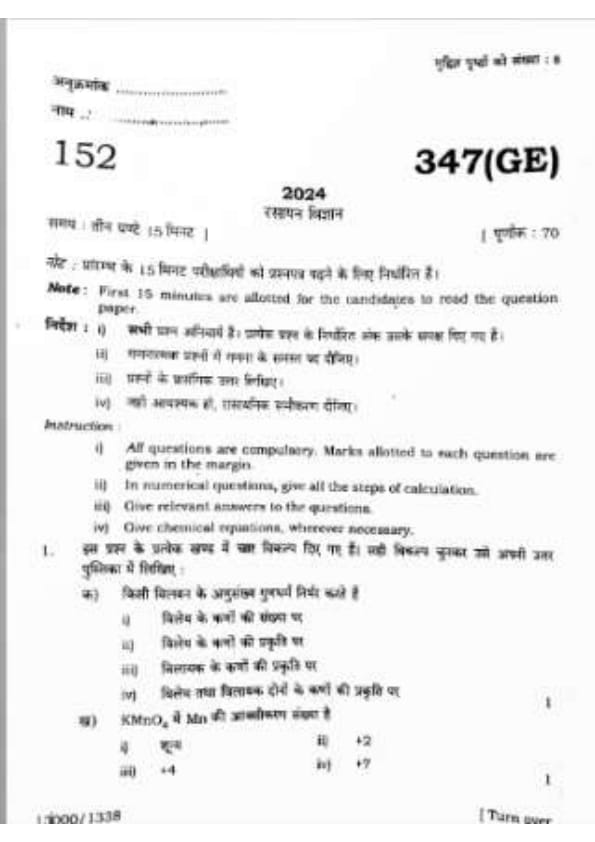
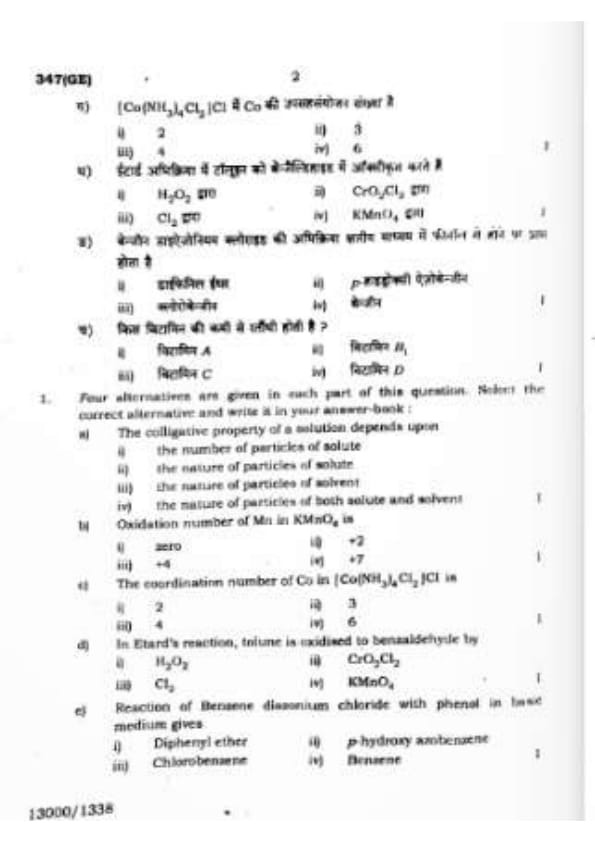
UP Board Class 12 Chemistry Question Paper 2024 PDF (Code 347 GE) is available for download here. The Chemistry exam was conducted on March 7, 2024 in the Evening Shift from 2 PM to 5:15 PM. The total marks for the theory paper are 70. Students reported the paper to be easy to moderate.
UP Board Class 12 Chemistry Question Paper 2024 (Code 347 GE) with Solutions
| UP Board Class Chemistry Question Paper with Answer Key |  Download Download |
Check Solution |

UP Board Class 12 Chemistry Questions with Solutions
Question 1:
(a) The colligative property of a solution depends upon
View Solution
Step 1: Colligative properties (such as boiling point elevation, freezing point depression, osmotic pressure, and vapor pressure lowering) depend only on the number of solute particles, not their identity.
Step 2: These properties are a function of solute concentration, not the chemical nature of solute or solvent. Quick Tip: Colligative properties are independent of the type of solute and depend only on the concentration of solute particles.
(b) Oxidation number of Mn in \( KMnO_4 \) is
View Solution
Step 1: Let the oxidation number of Mn be \( x \) in \( KMnO_4 \).
Step 2: Since \( K = +1 \) and \( O_4 = -8 \), the equation is:
\[ 1 + x + (-8) = 0 \]
\[ x = +7 \]
Thus, the oxidation state of Mn in \( KMnO_4 \) is +7. Quick Tip: The oxidation state of Mn in \( KMnO_4 \) can be calculated using the sum rule: \( Sum of oxidation states = 0 \).
(c) The coordination number of Co in \([Co(NH_3)_4Cl_2]Cl\) is
View Solution
Step 1: The coordination number is determined by counting the number of ligands directly attached to the central metal atom.
Step 2: In \([Co(NH_3)_4Cl_2]Cl\), cobalt is surrounded by four \( NH_3 \) ligands and two \( Cl^- \) ligands, making a total coordination number of 6. Quick Tip: Coordination number is the number of donor atoms directly attached to the metal center.
(d) In Etard’s reaction, toluene is oxidized to benzaldehyde by
View Solution
Step 1: In Etard’s reaction, toluene is selectively oxidized to benzaldehyde using chromyl chloride (\( CrO_2Cl_2 \)).
Step 2: The reaction proceeds as:
\[ C_6H_5CH_3 + CrO_2Cl_2 \rightarrow C_6H_5CHO \] Quick Tip: Etard’s reaction is a mild oxidation method used to convert toluene to benzaldehyde.
(e) Reaction of Benzene diazonium chloride with phenol in basic medium gives
View Solution
Step 1: Benzene diazonium chloride reacts with phenol in basic medium to form p-hydroxy azobenzene, an example of azo coupling.
Step 2: The reaction is:
\[ C_6H_5N_2Cl + C_6H_5OH \xrightarrow{NaOH} C_6H_5N=N-C_6H_4OH \] Quick Tip: Azo coupling is an electrophilic substitution reaction between diazonium salts and phenols.
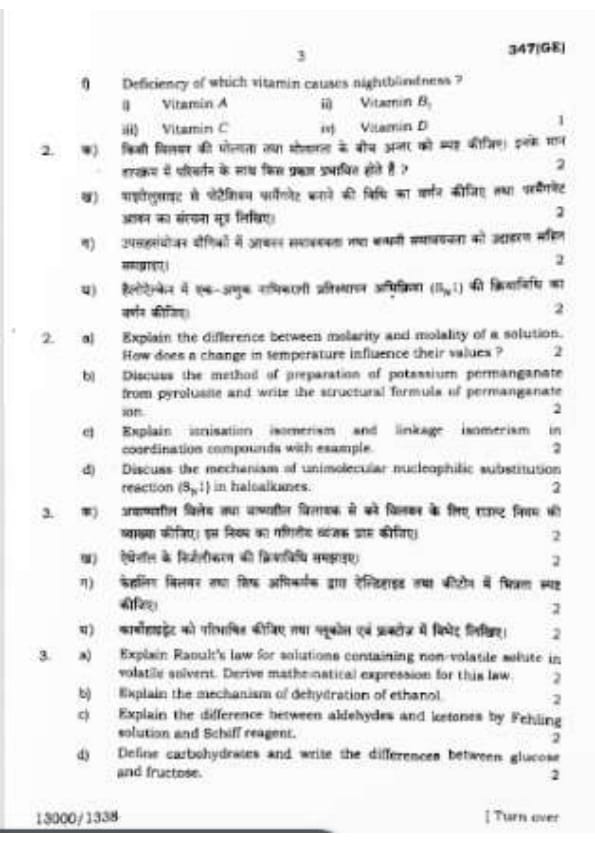
(f) Deficiency of which vitamin causes night blindness?
View Solution
Step 1: Night blindness (nyctalopia) is caused due to the deficiency of Vitamin A.
Step 2: Vitamin A is essential for the production of rhodopsin, a pigment necessary for low-light vision.
Step 3: Deficiency can be treated by increasing intake of vitamin A-rich foods like carrots, fish oil, and leafy greens. Quick Tip: Vitamin A is crucial for vision and immune function. Its deficiency causes night blindness.
(a) Explain the difference between molarity and molality of a solution. How does a change in temperature influence their values?
View Solution
Step 1: Definition
- Molarity (M): Number of moles of solute per liter of solution.
\[ M = \frac{moles of solute}{volume of solution in liters} \]
- Molality (m): Number of moles of solute per kg of solvent.
\[ m = \frac{moles of solute}{mass of solvent in kg} \]
Step 2: Effect of Temperature
- Molarity depends on volume, which changes with temperature due to thermal expansion. Thus, molarity decreases with an increase in temperature.
- Molality depends on the mass of the solvent, which remains unaffected by temperature, making it temperature-independent. Quick Tip: Molarity changes with temperature due to volume expansion, whereas molality remains constant as it depends only on mass.
(b) Discuss the method of preparation of potassium permanganate from pyrolusite and write the structural formula of permanganate ion.
View Solution
Step 1: Potassium permanganate (\( KMnO_4 \)) is prepared from pyrolusite (\( MnO_2 \)) via the following steps:
Step 2: Oxidation of Pyrolusite:
\[ 2 MnO_2 + 4 KOH + O_2 \rightarrow 2 K_2MnO_4 + 2 H_2O \]
Step 3: Disproportionation of Manganate:
\[ 3 K_2MnO_4 + 2 H_2O \rightarrow 2 KMnO_4 + MnO_2 + 4 KOH \]
Step 4: The structural formula of the permanganate ion (\( MnO_4^- \)):
\[ A tetrahedral structure with Mn in +7 oxidation state. \] Quick Tip: Potassium permanganate is synthesized via oxidation of manganese dioxide followed by disproportionation in acidic medium.
(c) Explain ionisation isomerism and linkage isomerism in coordination compounds with example.
View Solution
Step 1: Ionisation Isomerism:
- Occurs when two coordination compounds produce different ions in solution but have the same molecular formula.
- Example:
\[ [Co(NH_3)_5Br]SO_4 \quad and \quad [Co(NH_3)_5SO_4]Br \]
Step 2: Linkage Isomerism:
- Occurs when a ligand can bind through two different donor atoms.
- Example:
\[ [Co(NO_2)(NH_3)_5]^{2+} \quad (Nitro complex, N-bound) \]
\[ [Co(ONO)(NH_3)_5]^{2+} \quad (Nitrito complex, O-bound) \] Quick Tip: Ionisation isomerism occurs due to exchangeable ions, while linkage isomerism occurs when a ligand bonds through different atoms.
(d) Discuss the mechanism of unimolecular nucleophilic substitution reaction (\( S_N1 \)) in haloalkanes.
View Solution
Step 1: Definition:
- The \( S_N1 \) (unimolecular nucleophilic substitution) reaction follows a two-step mechanism.
- It occurs in tertiary haloalkanes due to carbocation stability.
Step 2: Mechanism:
Step 2.1: Formation of Carbocation (Rate Determining Step):
\[ R-X \rightarrow R^+ + X^- \]
Step 2.2: Nucleophilic Attack:
\[ R^+ + Nu^- \rightarrow R-Nu \]
Step 3: Example:
\[ (CH_3)_3CBr \xrightarrow{H_2O} (CH_3)_3C^+ + Br^- \]
\[ (CH_3)_3C^+ + H_2O \rightarrow (CH_3)_3COH + H^+ \] Quick Tip: \( S_N1 \) reactions involve carbocation formation and follow first-order kinetics: rate \( \propto [R-X] \).
(a) Explain Raoult’s law for solutions containing non-volatile solute in volatile solvent. Derive mathematical expression for this law.
View Solution
Step 1: Statement of Raoult’s Law:
Raoult’s law states that the partial vapor pressure of a solvent in a solution is directly proportional to its mole fraction.
\[ P_A = X_A P_A^0 \]
where \( P_A \) is the partial vapor pressure of the solvent, \( X_A \) is its mole fraction, and \( P_A^0 \) is the vapor pressure of the pure solvent.
Step 2: Mathematical Derivation:
For a solution containing a non-volatile solute:
\[ X_A + X_B = 1 \]
\[ X_A = 1 - X_B \]
Substituting in Raoult’s law:
\[ P_A = (1 - X_B) P_A^0 \]
Step 3: Relative Lowering of Vapor Pressure:
\[ \frac{P_A^0 - P_A}{P_A^0} = X_B \]
Thus, the relative lowering of vapor pressure is equal to the mole fraction of the solute. Quick Tip: Raoult’s law helps explain colligative properties like boiling point elevation and freezing point depression.
(b) Explain the mechanism of dehydration of ethanol.
View Solution
Step 1: Definition:
Dehydration of ethanol is an acid-catalyzed elimination reaction, producing ethene.
Step 2: Mechanism:
Step 2.1: Protonation of Ethanol:
\[ C_2H_5OH + H^+ \rightarrow C_2H_5OH_2^+ \]
Step 2.2: Formation of Carbocation:
\[ C_2H_5OH_2^+ \rightarrow C_2H_5^+ + H_2O \]
Step 2.3: Elimination of Proton:
\[ C_2H_5^+ \rightarrow C_2H_4 + H^+ \]
Step 3: Overall Reaction:
\[ C_2H_5OH \xrightarrow{H_2SO_4} C_2H_4 + H_2O \] Quick Tip: Dehydration of alcohols follows an E1 mechanism in acid medium, favoring alkene formation.
(c) Explain the difference between aldehydes and ketones by Fehling solution and Schiff reagent.
View Solution
Step 1: Fehling’s Test:
- Aldehydes reduce Fehling’s solution (blue) to a red precipitate of Cu\(_2\)O.
- Ketones do not react.
\[ R-CHO + 2Cu^{2+} + 5OH^- \rightarrow R-COO^- + Cu_2O + 3H_2O \]
Step 2: Schiff’s Test:
- Aldehydes turn Schiff’s reagent pink/magenta.
- Ketones do not react.
Step 3: Conclusion:
- Aldehydes give positive tests in both reactions.
- Ketones give negative results. Quick Tip: Fehling’s test detects reducing aldehydes, while Schiff’s reagent gives a color change for aldehydes but not ketones.
(d) Define carbohydrates and write the differences between glucose and fructose.
View Solution
Step 1: Definition of Carbohydrates:
Carbohydrates are biomolecules consisting of carbon, hydrogen, and oxygen, generally following the formula \( C_n(H_2O)_n \). They serve as an energy source and structural material.
Step 2: Differences Between Glucose and Fructose:
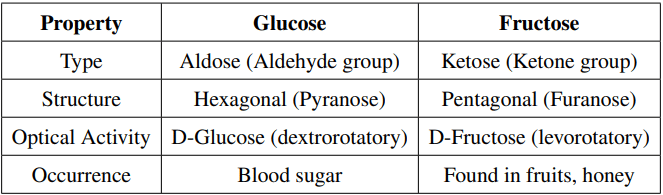 Quick Tip: Glucose is an aldose with a six-membered ring, while fructose is a ketose with a five-membered ring.
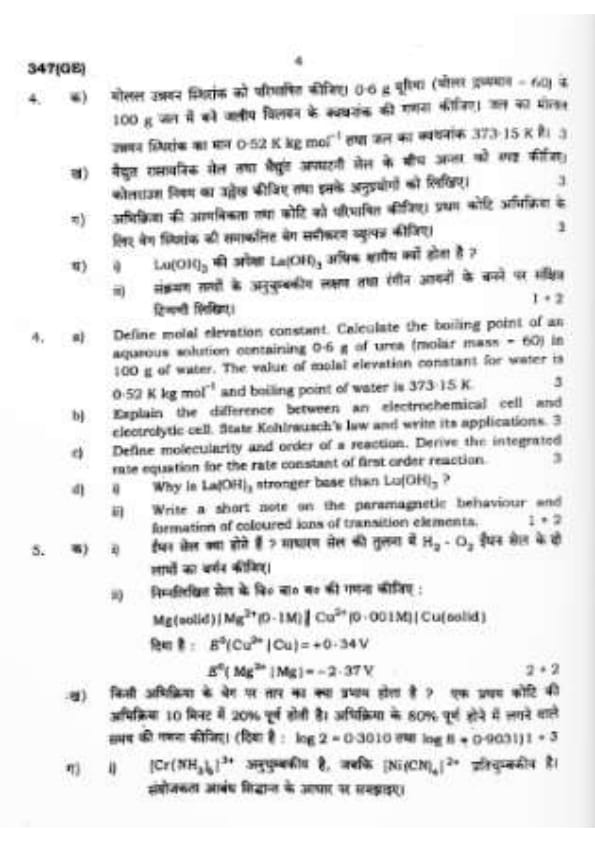
(a) Define molal elevation constant. Calculate the boiling point of an aqueous solution containing 0.6 g of urea (molar mass = 60) in 100 g of water. The value of molal elevation constant for water is 0.52 K kg mol\(^{-1}\) and boiling point of water is 373.15 K.
View Solution
Step 1: Definition:
The molal elevation constant (\( K_b \)) is the increase in boiling point when 1 mole of a non-volatile solute is dissolved in 1 kg of solvent.
Step 2: Formula for Boiling Point Elevation:
\[ \Delta T_b = K_b \times m \]
where,
\[ m = \frac{moles of solute}{mass of solvent (kg)} \]
Step 3: Calculate Molality:
\[ Moles of urea = \frac{0.6}{60} = 0.01 mol \]
\[ m = \frac{0.01}{0.1} = 0.1 mol/kg \]
Step 4: Calculate Boiling Point Elevation:
\[ \Delta T_b = 0.52 \times 0.1 = 0.052 K \]
Step 5: Final Boiling Point:
\[ T_b = 373.15 + 0.052 = 373.202 K \]
Thus, the boiling point of the solution is 373.20 K. Quick Tip: The increase in boiling point is proportional to the molality of the solute, and molal elevation constant (\( K_b \)) is solvent-specific.
(b) Explain the difference between an electrochemical cell and electrolytic cell. State Kohlrausch’s law and write its applications.
View Solution
Step 1: Difference Between Electrochemical and Electrolytic Cells:
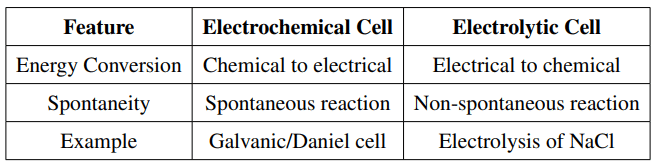
Step 2: Kohlrausch’s Law:
Kohlrausch’s law states:
\[ \Lambda_m^0 = \lambda^0_+ + \lambda^0_- \]
where \( \lambda^0_+ \) and \( \lambda^0_- \) are the limiting molar conductivities of cations and anions, respectively.
Step 3: Applications:
- Used to calculate the molar conductivity of weak electrolytes.
- Helps in determining dissociation constants of weak acids and bases. Quick Tip: Electrochemical cells generate electricity via redox reactions, whereas electrolytic cells drive non-spontaneous reactions using electrical energy.
(c) Define molecularity and order of a reaction. Derive the integrated rate equation for the rate constant of first-order reaction.
View Solution
Step 1: Definitions:
- Molecularity: The number of reactant molecules participating in an elementary reaction.
- Order of Reaction: The sum of powers of reactant concentrations in the rate law.
Step 2: Derivation of First-Order Rate Equation:
\[ Rate = k[A] \]
Step 3: Separating Variables:
\[ \frac{d[A]}{[A]} = -k dt \]
Step 4: Integrating Both Sides:
\[ \int \frac{d[A]}{[A]} = - \int k dt \]
\[ \ln [A] = -kt + C \]
Step 5: Applying Initial Conditions: \( [A] = [A]_0 \) at \( t = 0 \):
\[ \ln [A]_0 = C \]
\[ \ln [A] = -kt + \ln [A]_0 \]
\[ [A] = [A]_0 e^{-kt} \]
Thus, the first-order rate equation is:
\[ [A] = [A]_0 e^{-kt} \] Quick Tip: Molecularity is a theoretical concept for elementary steps, while reaction order is experimentally determined.
(d) (a) Why is \( La(OH)_3 \) a stronger base than \( Lu(OH)_3 \)?
View Solution
Step 1: Basicity and Lanthanoid Contraction:
- As we move across the lanthanide series, atomic size decreases due to lanthanoid contraction.
- \( La(OH)_3 \) has a larger ionic radius, making it more basic than \( Lu(OH)_3 \).
Step 2: Explanation:
- Larger ionic size in \( La^{3+} \) leads to weaker bond strength in \( La(OH)_3 \), making hydroxide ions (\( OH^- \)) more available.
- \( Lu^{3+} \) has a smaller radius, leading to a stronger attraction between \( Lu^{3+} \) and \( OH^- \), reducing basicity. Quick Tip: Lanthanoid contraction reduces atomic size across the series, affecting basicity trends.
(d) (b) Write a short note on the paramagnetic behaviour and formation of coloured ions of transition elements.
View Solution
Step 1: Paramagnetic Behaviour:
- Transition metals exhibit paramagnetism due to the presence of unpaired electrons in d-orbitals.
- Magnetic moment:
\[ \mu = \sqrt{n(n+2)} BM \]
where \( n \) is the number of unpaired electrons.
Step 2: Formation of Coloured Ions:
- Colour in transition metal ions arises due to d-d transitions when electrons absorb visible light and jump between d-orbitals.
- Example:
\[ [Cu(H_2O)_6]^{2+} (Blue) \] Quick Tip: The paramagnetic nature of transition elements depends on unpaired electrons, while colour formation is due to d-d transitions.
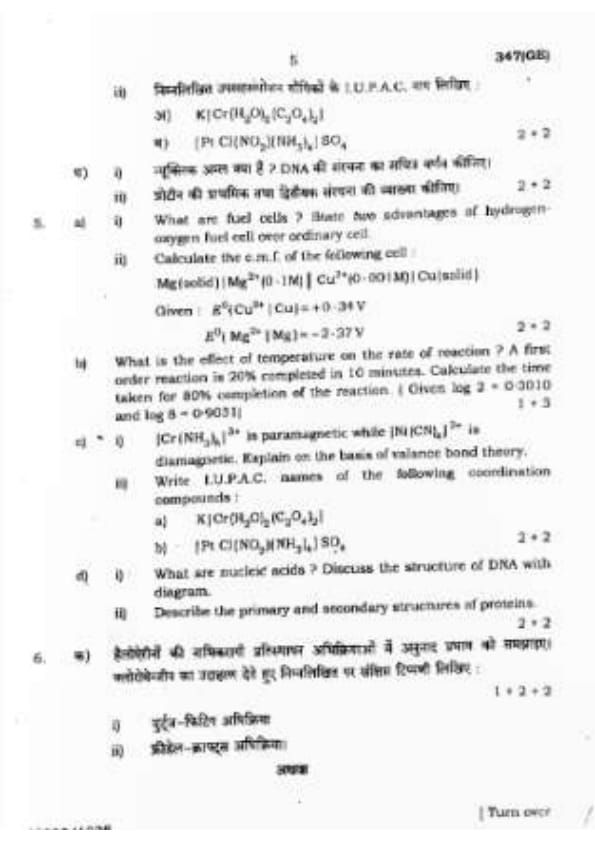
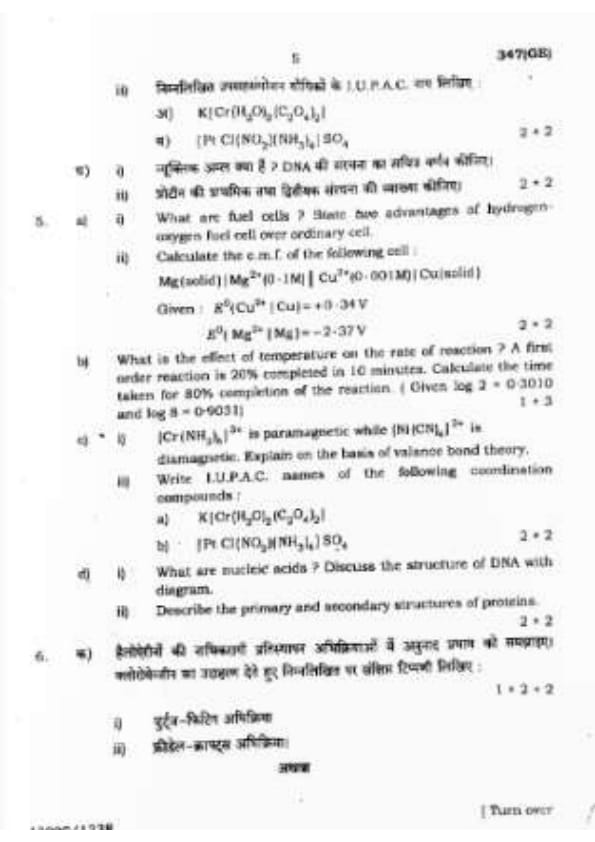
(a)(i) What are fuel cells? State two advantages of hydrogen-oxygen fuel cell over ordinary cell.
View Solution
Step 1: Definition of Fuel Cells:
Fuel cells are electrochemical devices that convert chemical energy into electrical energy through a redox reaction between fuel (e.g., hydrogen) and an oxidizing agent (e.g., oxygen).
Step 2: Advantages of Hydrogen-Oxygen Fuel Cell:
1. Higher Efficiency: Fuel cells have higher efficiency compared to conventional electrochemical cells.
2. Eco-friendly: Produces only water as a byproduct, making it environmentally friendly. Quick Tip: Fuel cells are highly efficient and environmentally friendly as they produce water instead of harmful emissions.
(a) (ii) Calculate the e.m.f. of the following cell:
\[ Mg(s) | Mg^{2+} (0.1 M) || Cu^{2+} (0.001 M) | Cu(s) \]
Given:
\[ E^0_{Cu^{2+}/Cu} = +0.34V, \quad E^0_{Mg^{2+}/Mg} = -2.37V \]
View Solution
Step 1: Cell Reaction:
\[ Mg + Cu^{2+} \rightarrow Mg^{2+} + Cu \]
Step 2: Standard E.M.F. Calculation:
\[ E_{cell}^0 = E_{cathode}^0 - E_{anode}^0 \]
\[ = 0.34 - (-2.37) = 2.71V \]
Step 3: Nernst Equation:
\[ E_{cell} = E_{cell}^0 - \frac{0.0591}{n} \log \frac{[Mg^{2+}]}{[Cu^{2+}]} \]
\[ E_{cell} = 2.71 - \frac{0.0591}{2} \log \frac{0.1}{0.001} \]
\[ E_{cell} = 2.71 - \frac{0.0591}{2} \times 2 \]
\[ E_{cell} = 2.71 - 0.0591 = 2.6509V \]
Thus, the e.m.f. of the cell is 2.65V. Quick Tip: The Nernst equation helps calculate the actual cell potential under non-standard conditions.
(b) Effect of temperature on rate of reaction and calculation of time for 80% completion.
View Solution
Step 1: Effect of Temperature:
- Higher temperature increases reaction rate by providing activation energy.
- Follows Arrhenius equation:
\[ k = A e^{-E_a/RT} \]
Step 2: First-Order Reaction Calculation:
Given: 20% completion in 10 minutes.
\[ k = \frac{2.303}{t} \log \frac{[A]_0}{[A]} \]
\[ k = \frac{2.303}{10} \log \frac{100}{80} \]
\[ k = \frac{2.303}{10} \times 0.0969 = 0.0223 min^{-1} \]
For 80% completion:
\[ t = \frac{2.303}{k} \log \frac{100}{20} \]
\[ t = \frac{2.303}{0.0223} \times 0.6989 \]
\[ t = 72.2 minutes \]
Thus, the time required for 80% completion is 72.2 minutes. Quick Tip: Reaction rate increases with temperature due to increased kinetic energy and collision frequency.
(c) (i) \([Cr(NH_3)_6]^{3+}\) is paramagnetic while \([Ni(CN)_4]^{2+}\) is diamagnetic. Explain on the basis of valence bond theory.
View Solution
Step 1: Electronic Configuration:
- \( Cr^{3+} \): \( 3d^3 \), unpaired electrons → Paramagnetic
- \( Ni^{2+} \): \( 3d^8 \), paired electrons due to strong ligand effect → Diamagnetic
Step 2: Explanation:
- \( NH_3 \) is a weak field ligand, so \( Cr^{3+} \) retains unpaired electrons.
- \( CN^- \) is a strong field ligand, causing pairing in \( Ni^{2+} \). Quick Tip: Ligand strength affects electron pairing, influencing magnetic properties of complexes.
(c) (ii) I.U.P.A.C. names of coordination compounds.
View Solution
(a) \( K[Cr(H_2O)_2(C_2O_4)_2] \)
Potassium diaquadioxalatochromate(C)
(b) \( [PtCl(NO_2)(NH_3)_4]SO_4 \)
Tetraamminechloronitroplatinum(D) sulfate Quick Tip: IUPAC naming follows sequence: ligands (alphabetical) → metal with oxidation state → counter ion.
(d) (i) What are nucleic acids? Discuss the structure of DNA with a diagram.
View Solution
Step 1: Definition:
Nucleic acids (DNA & RNA) are biomolecules composed of nucleotides, responsible for genetic information storage.
Step 2: Structure of DNA:
- Double-helix model by Watson and Crick.
- Consists of phosphate backbone and nitrogenous bases (A, T, C, G).
- Complementary base pairing: A-T, C-G.
Step 3: Diagram:
\[ (Include diagram of DNA double-helix) \] Quick Tip: DNA follows Chargaff’s rule: A pairs with T, and C pairs with G via hydrogen bonds.
(d) (ii) Describe the primary and secondary structures of proteins.
View Solution
- Primary Structure: Linear sequence of amino acids in a polypeptide chain.
- Secondary Structure: Regular coiling or folding due to hydrogen bonds (e.g., α-helix, β-pleated sheet). Quick Tip: Protein structure determines its function: primary structure defines sequence, while secondary gives stability.
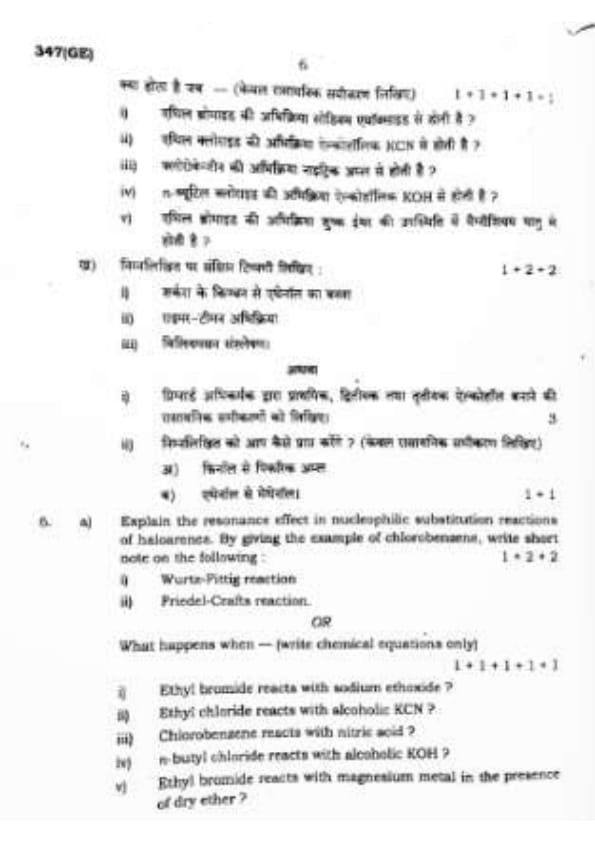
(a) Explain the resonance effect in nucleophilic substitution reactions of haloarenes. By giving the example of chlorobenzene, write short notes on the following:
(A) Wurtz-Fittig reaction
(B) Friedel-Crafts reaction
View Solution
Step 1: Resonance Effect in Haloarenes:
Haloarenes (e.g., chlorobenzene) show resonance due to delocalization of lone pair electrons on the halogen. This results in partial double bond character, reducing reactivity towards nucleophilic substitution.
\[ C_6H_5Cl \leftrightarrow Various Resonating Structures \]
Step 2: Wurtz-Fittig Reaction:
- This reaction involves the coupling of aryl halides with alkyl halides using sodium in dry ether.
- Reaction:
\[ C_6H_5Cl + 2Na + C_2H_5Cl \xrightarrow{Dry Ether} C_6H_5C_2H_5 + 2NaCl \]
Step 3: Friedel-Crafts Reaction:
- Aromatic compounds undergo electrophilic substitution with alkyl halides in the presence of a Lewis acid catalyst (\( AlCl_3 \)).
- Example:
\[ C_6H_6 + CH_3Cl \xrightarrow{AlCl_3} C_6H_5CH_3 + HCl \] Quick Tip: Haloarenes resist nucleophilic substitution due to resonance stabilization. Wurtz-Fittig and Friedel-Crafts reactions introduce alkyl groups.
(a) OR What happens when – (write chemical equations only)?
View Solution
(A) Ethyl bromide reacts with sodium ethoxide?
\[ C_2H_5Br + C_2H_5ONa \rightarrow C_2H_5-O-C_2H_5 + NaBr \]
(B) Ethyl chloride reacts with alcoholic KCN?
\[ C_2H_5Cl + KCN \xrightarrow{alc.} C_2H_5CN + KCl \]
(C) Chlorobenzene reacts with nitric acid?
\[ C_6H_5Cl + HNO_3 \xrightarrow{H_2SO_4} o-C_6H_4ClNO_2 + p-C_6H_4ClNO_2 \]
(D) \( n \)-butyl chloride reacts with alcoholic KOH?
\[ C_4H_9Cl + KOH \xrightarrow{alc.} C_4H_8 + H_2O + KCl \]
(v) Ethyl bromide reacts with magnesium metal in the presence of dry ether?
\[ C_2H_5Br + Mg \xrightarrow{Dry Ether} C_2H_5MgBr \] Quick Tip: Reactions with alkyl halides depend on nucleophile strength and solvent polarity, affecting substitution vs. elimination outcomes.
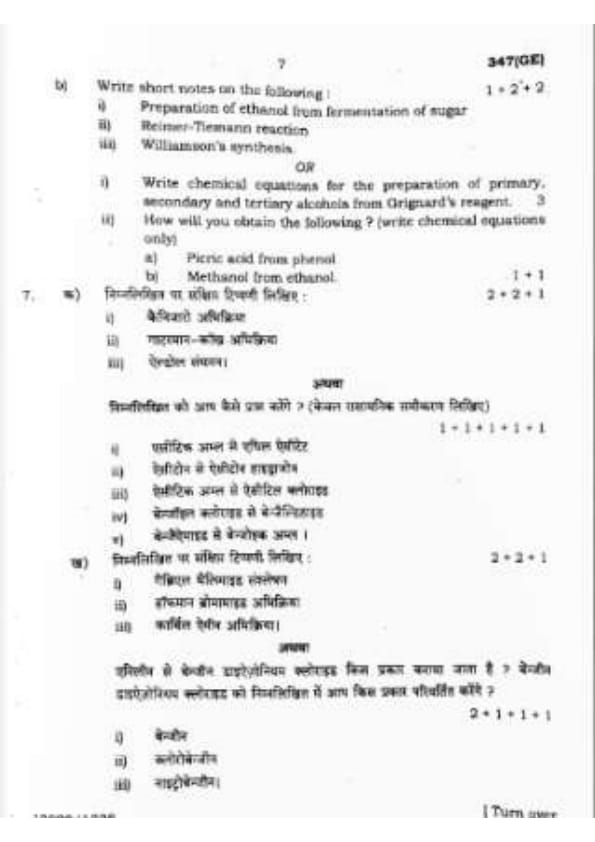
(b) Write short notes on the following:
(A) Preparation of ethanol from fermentation of sugar
(B) Reimer-Tiemann Reaction
(C) Williamson’s Synthesis
View Solution
(A) Preparation of ethanol from fermentation of sugar
\[ C_6H_{12}O_6 \xrightarrow{Yeast} 2C_2H_5OH + 2CO_2 \]
(B) Reimer-Tiemann Reaction
\[ C_6H_5OH + CHCl_3 + NaOH \rightarrow o-hydroxybenzaldehyde + p-hydroxybenzaldehyde \]
(C) Williamson’s Synthesis
\[ R-O^- + R'-X \rightarrow R-O-R' + X^- \] Quick Tip: Fermentation produces ethanol biologically, Reimer-Tiemann introduces -CHO into phenol, and Williamson’s synthesis forms ethers.
(b) (i) OR Write chemical equations for the preparation of primary, secondary, and tertiary alcohols from Grignard’s reagent.
Primary Alcohol
Secondary Alcohol:
Tertiary Alcohol:
View Solution
Primary Alcohol:
\[ R-MgX + HCHO \xrightarrow{H_2O} R-CH_2OH + Mg(OH)X \]
Secondary Alcohol:
\[ R-MgX + CH_3CHO \xrightarrow{H_2O} R-CHOH-CH_3 + Mg(OH)X \]
Tertiary Alcohol:
\[ R-MgX + R'CO-R'' \xrightarrow{H_2O} R-C(OH)-R'R'' + Mg(OH)X \] Quick Tip: Grignard reagents react with aldehydes/ketones to produce alcohols of different types.
(b) (ii) How will you obtain the following? (Write chemical equations only.)
(a) Picric acid from phenol
(b) Methanol from ethanol
View Solution
(a) Picric acid from phenol
\[ C_6H_5OH + 3HNO_3 \xrightarrow{H_2SO_4} C_6H_2(NO_2)_3OH + 3H_2O \]
(b) Methanol from ethanol
\[ C_2H_5OH \xrightarrow{Cu, 300^\circ C} CH_3OH + CO \] Quick Tip: Nitration of phenol produces picric acid, while methanol can be synthesized by oxidation of ethanol.
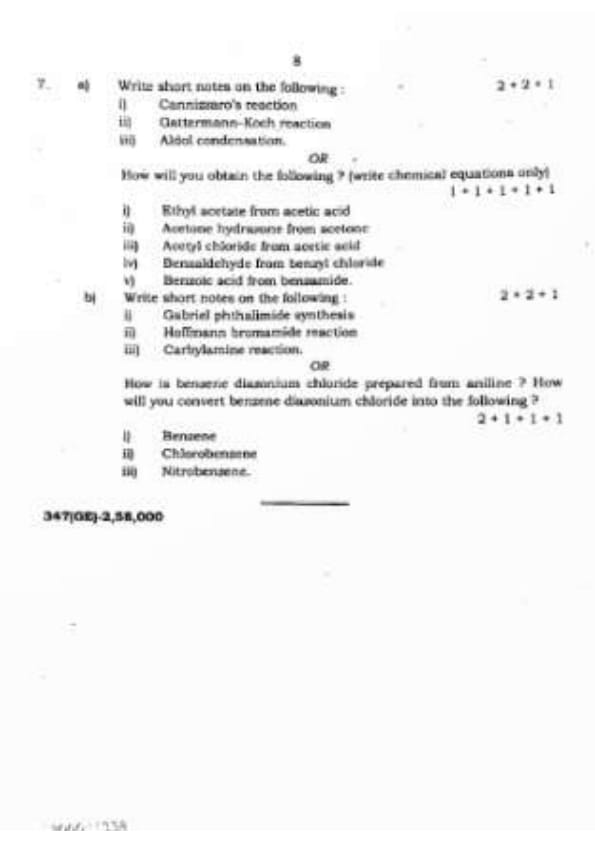
(a) Write short notes on the following:
(A) Cannizzaro’s reaction
(B) Gattermann-Koch reaction
(C) Aldol condensation
View Solution
Step 1: Definition:
Cannizzaro’s reaction is a redox reaction where non-enolizable aldehydes undergo disproportionation in a strong base.
Step 2: Reaction:
\[ 2 C_6H_5CHO + NaOH \rightarrow C_6H_5CH_2OH + C_6H_5COONa \]
One aldehyde molecule is reduced to an alcohol, and the other is oxidized to a carboxylate.
Cannizzaro’s reaction occurs with aldehydes lacking \(\alpha\)-hydrogen atoms.
(B) Gattermann-Koch reaction
Step 1: Definition:
Gattermann-Koch reaction is a method for formylation of benzene.
Step 2: Reaction:
\[ C_6H_6 + CO + HCl \xrightarrow{AlCl_3, CuCl} C_6H_5CHO \]
The reaction introduces a formyl (-CHO) group into benzene.
The Gattermann-Koch reaction is useful for direct formylation of aromatic rings.
(C) Aldol condensation
Step 1: Definition:
Aldol condensation is an organic reaction in which an enolate ion reacts with a carbonyl compound, forming a β-hydroxy ketone.
Step 2: Reaction:
\[ CH_3CHO + CH_3CHO \xrightarrow{NaOH} CH_3CH(OH)CH_2CHO \xrightarrow{\Delta} CH_3CH=CHCHO + H_2O \] Quick Tip: Aldol condensation is crucial in carbon-carbon bond formation and occurs under basic or acidic conditions.
(a) OR How will you obtain the following? (Write chemical equations only.)
View Solution
(A) Ethyl acetate from acetic acid
\[ CH_3COOH + C_2H_5OH \xrightarrow{H_2SO_4} CH_3COOC_2H_5 + H_2O \]
(B) Acetone hydrazone from acetone
\[ CH_3COCH_3 + NH_2NH_2 \rightarrow CH_3C=NNH_2CH_3 + H_2O \]
(C) Acetyl chloride from acetic acid
\[ CH_3COOH + PCl_5 \rightarrow CH_3COCl + POCl_3 + HCl \]
(D) Benzaldehyde from benzyl chloride
\[ C_6H_5CH_2Cl + H_2O \xrightarrow{MnO_2} C_6H_5CHO + HCl \]
(v) Benzoic acid from benzamide
\[ C_6H_5CONH_2 + H_2O \xrightarrow{H^+} C_6H_5COOH + NH_3 \] Quick Tip: Functional group conversions rely on specific reagents, such as oxidation for aldehydes and acid hydrolysis for amides.
(b) Write short notes on the following:
View Solution
(A) Gabriel phthalimide synthesis
\[ C_6H_4(CO)_2N^-K^+ + RX \rightarrow C_6H_4(CO)_2NR + KX \]
It produces primary amines selectively.
(B) Hoffmann bromamide reaction
\[ RCONH_2 + Br_2 + 4NaOH \rightarrow RNH_2 + Na_2CO_3 + 2NaBr + 2H_2O \]
Converts amides to primary amines.
(C) Carbylamine reaction
\[ R-NH_2 + CHCl_3 + 3KOH \rightarrow R-NC + 3KCl + 3H_2O \]
Produces isocyanides (carbylamines). Quick Tip: Gabriel synthesis selectively forms primary amines, Hoffmann’s reaction removes carbonyls, and Carbylamine reaction identifies primary amines.
(b) OR How is benzene diazonium chloride prepared from aniline? How will you convert benzene diazonium chloride into the following?
View Solution
Preparation of Benzene Diazonium Chloride:
\[ C_6H_5NH_2 + HNO_2 + HCl \xrightarrow{0^\circ C} C_6H_5N_2Cl + 2H_2O \]
Conversions:
(A) Benzene
\[ C_6H_5N_2Cl + H_3PO_2 + H_2O \rightarrow C_6H_6 + N_2 + H_3PO_3 + HCl \]
(B) Chlorobenzene
\[ C_6H_5N_2Cl + CuCl \rightarrow C_6H_5Cl + N_2 \]
(C) Nitrobenzene
\[ C_6H_5N_2Cl + CuNO_2 \rightarrow C_6H_5NO_2 + N_2 \] Quick Tip: Diazonium salts are versatile intermediates, enabling substitution with hydrogen, halogens, and functional groups.



Comments