




UP Board Class 12 Chemistry Question Paper 2024 PDF (Code 347 GF) is available for download here. The Chemistry exam was conducted on March 7, 2024 in the Evening Shift from 2 PM to 5:15 PM. The total marks for the theory paper are 70. Students reported the paper to be easy to moderate.
UP Board Class 12 Chemistry Question Paper 2024 (Code 347 GF) with Solutions
| UP Board Class Chemistry Question Paper with Answer Key |  Download Download |
Check Solution |


UP Board Class 12 Chemistry Questions with Solutions
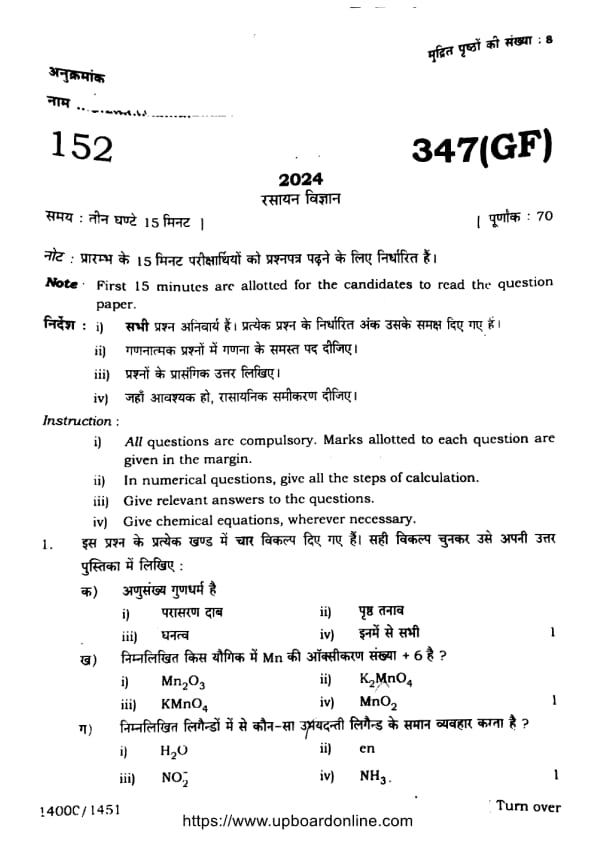
(a) The colligative property is
View Solution
Step 1: Definition of Colligative Properties:
Colligative properties depend on the number of solute particles in a solution and include:
- Osmotic Pressure
- Boiling Point Elevation
- Freezing Point Depression
- Vapor Pressure Lowering
Step 2: Why not other options?
- Surface tension and density depend on the nature of the substance, not the number of solute particles. Quick Tip: Colligative properties depend only on the number of solute particles, not their identity.
(b) In which of the following compounds, oxidation number of Mn is +6?
View Solution
Step 1: Calculate oxidation number:
\[ Let oxidation number of Mn be x \]
\[ K_2MnO_4: 2(+1) + x + 4(-2) = 0 \]
\[ 2 - 8 + x = 0 \Rightarrow x = +6 \]
Thus, the oxidation number of Mn in \( K_2MnO_4 \) is +6. Quick Tip: Oxidation number is calculated by balancing charge contributions from all atoms in a compound.
(c) Which of the following ligands can act as an ambidentate ligand?
View Solution
Step 1: Definition of Ambidentate Ligand:
Ambidentate ligands can coordinate through two different donor atoms.
Step 2: Why is \( NO_2^- \) ambidentate?
- It can bind via Nitrogen (\( NO_2^- \) as Nitro) or Oxygen (\( ONO^- \) as Nitrito). Quick Tip: Ambidentate ligands can bond through different atoms, providing isomerism in complexes.
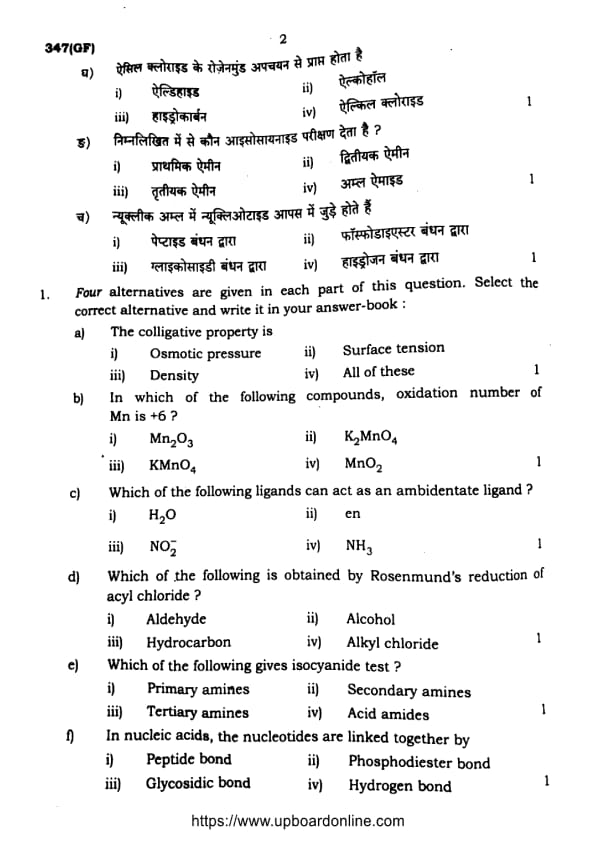
(d) Which of the following is obtained by Rosenmund’s reduction of acyl chloride?
View Solution
Step 1: Reaction Mechanism:
Rosenmund’s reduction involves catalytic hydrogenation of acyl chlorides to aldehydes.
\[ RCOCl + H_2 \xrightarrow{Pd/BaSO_4} RCHO + HCl \]
Step 2: Why aldehyde?
- The catalyst palladium on barium sulfate prevents over-reduction to alcohol. Quick Tip: Rosenmund’s reduction selectively converts acyl chlorides to aldehydes without over-reduction.
(e) Which of the following gives isocyanide test?
View Solution
Step 1: Carbylamine Reaction:
Primary amines react with chloroform and alcoholic KOH to give foul-smelling isocyanides.
\[ R-NH_2 + CHCl_3 + 3KOH \rightarrow R-NC + 3KCl + 3H_2O \]
Step 2: Why not secondary or tertiary amines?
- Secondary and tertiary amines lack the necessary NH\(_2\) group. Quick Tip: The isocyanide test distinguishes primary amines due to their ability to form carbylamines.
(f) In nucleic acids, the nucleotides are linked together by
View Solution
Step 1: Definition:
Nucleotides in nucleic acids (DNA/RNA) are linked by phosphodiester bonds between sugar and phosphate groups.
\[ DNA Backbone: -Sugar-Phosphate-Sugar- \]
Step 2: Why not other options?
- Peptide bond: Found in proteins.
- Glycosidic bond: Links sugars in carbohydrates.
- Hydrogen bond: Stabilizes base pairing in DNA. Quick Tip: Phosphodiester bonds form the backbone of DNA, linking nucleotides through phosphate groups.
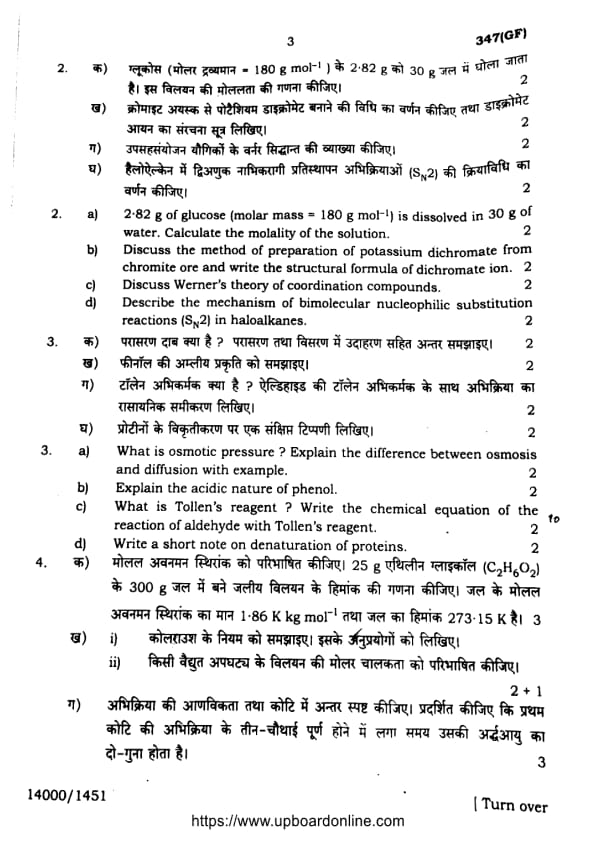
(a) 2.82 g of glucose (molar mass = 180 g mol\(^{-1}\)) is dissolved in 30 g of water. Calculate the molality of the solution.
View Solution
Step 1: Formula for Molality:
\[ Molality (m) = \frac{Moles of solute}{Mass of solvent (kg)} \]
Step 2: Calculate Moles of Glucose:
\[ Moles = \frac{2.82}{180} = 0.01567 mol \]
Step 3: Convert Solvent Mass to kg:
\[ 30 g = 0.030 kg \]
Step 4: Calculate Molality:
\[ m = \frac{0.01567}{0.030} = 0.522 mol/kg \]
Thus, the molality of the solution is 0.522 mol/kg. Quick Tip: Molality is independent of temperature because it is based on mass, unlike molarity which depends on volume.
(b) Discuss the method of preparation of potassium dichromate from chromite ore and write the structural formula of dichromate ion.
View Solution
Step 1: Preparation Steps:
\[ 4 FeCr_2O_4 + 8 Na_2CO_3 + 7 O_2 \rightarrow 8 Na_2CrO_4 + 2 Fe_2O_3 + 8 CO_2 \]
\[ 2 Na_2CrO_4 + H_2SO_4 \rightarrow Na_2Cr_2O_7 + Na_2SO_4 + H_2O \]
Step 2: Structural Formula of Dichromate Ion:
\[ [Cr_2O_7]^{2-} \] Quick Tip: Potassium dichromate is obtained by oxidation of chromite ore in an alkaline medium followed by acidification.
(c) Discuss Werner’s theory of coordination compounds.
View Solution
Step 1: Main Postulates of Werner’s Theory:
1. Metals exhibit primary valency (oxidation state) and secondary valency (coordination number).
2. Secondary valency is directed towards specific ligands in a fixed geometry.
3. Example: In \([Co(NH_3)_6]Cl_3\), Co has:
- Primary valency: +3 (satisfied by Cl\(^-\))
- Secondary valency: 6 (satisfied by NH\(_3\)) Quick Tip: Werner’s theory explains the geometry of coordination complexes, distinguishing between oxidation state and coordination number.
(d) Describe the mechanism of bimolecular nucleophilic substitution reactions (\( S_N2 \)) in haloalkanes.
View Solution
Step 1: Definition of \( S_N2 \) Reaction:
The \( S_N2 \) reaction is a one-step nucleophilic substitution mechanism where the nucleophile attacks while the leaving group departs simultaneously.
Step 2: Mechanism:
\[ R-Br + OH^- \rightarrow R-OH + Br^- \]
- Rate Law: \( Rate = k [R-X] [Nu^-] \)
- Stereochemistry: Inversion of configuration (Walden Inversion). Quick Tip: \( S_N2 \) reactions are favored by primary alkyl halides and strong nucleophiles.
(a) What is osmotic pressure? Explain the difference between osmosis and diffusion with an example.
View Solution
Step 1: Definition:
Osmotic pressure is the pressure required to stop the osmotic flow of solvent molecules across a semipermeable membrane.
\[ \pi = CRT \]
Step 2: Difference Between Osmosis and Diffusion:

Quick Tip: Osmosis occurs in biological systems, while diffusion applies to all states of matter.
(b) Explain the acidic nature of phenol.
View Solution
Step 1: Resonance Stabilization:
\[ C_6H_5OH \rightleftharpoons C_6H_5O^- + H^+ \]
Phenol ionizes to release H\(^+\), stabilized by resonance.
Step 2: Stronger Acid than Alcohols:
- Phenol (\( pK_a = 9.95 \)) is more acidic than alcohols because of resonance stabilization. Quick Tip: Phenols are weak acids due to delocalization of the negative charge on the oxygen in the conjugate base.
(c) What is Tollen’s reagent? Write the chemical equation of the reaction of aldehyde with Tollen’s reagent.
View Solution
Step 1: Definition:
Tollen’s reagent is an ammoniacal silver nitrate solution that oxidizes aldehydes to carboxylates, forming a silver mirror.
Step 2: Reaction:
\[ R-CHO + 2[Ag(NH_3)_2]^+ + 3OH^- \rightarrow R-COO^- + 2Ag + 4NH_3 + H_2O \] Quick Tip: Tollen’s test is used to distinguish aldehydes from ketones as only aldehydes undergo oxidation.
(d) Write a short note on denaturation of proteins.
View Solution
Denaturation disrupts the secondary and tertiary structures of proteins due to heat, acids, or chemicals, causing loss of function.
\[ Example: Cooking eggs denatures ovalbumin in egg whites. \] Quick Tip: Denatured proteins lose biological activity, but their primary structure remains intact.
(a) Define molal depression constant. Calculate the freezing point of the aqueous solution containing 25 g of ethylene glycol (C\(_2\)H\(_6\)O\(_2\)) in 300 g of water. The value of molal depression constant for water is 1.86 K kg mol\(^{-1}\) and freezing point of water is 273.15 K.
View Solution
Step 1: Formula for Freezing Point Depression:
\[ \Delta T_f = i \cdot K_f \cdot m \]
Step 2: Calculate Moles of Ethylene Glycol:
\[ Moles = \frac{25}{62} = 0.403 mol \]
Step 3: Convert Solvent Mass to kg:
\[ 300 g = 0.300 kg \]
Step 4: Calculate Molality:
\[ m = \frac{0.403}{0.300} = 1.343 mol/kg \]
Step 5: Calculate Depression in Freezing Point:
\[ \Delta T_f = 1.86 \times 1.343 = 2.50 K \]
Step 6: Calculate Freezing Point of Solution:
\[ T_f = 273.15 - 2.50 = 270.65 K \]
Thus, the freezing point of the solution is 270.65 K. Quick Tip: Molal depression constant (\(K_f\)) is a colligative property, depending only on the number of solute particles.
(b) Explain Kohlrausch’s law. Write its applications.
View Solution
Step 1: Kohlrausch’s Law:
The molar conductivity of an electrolyte at infinite dilution is the sum of the conductivities of its individual ions.
\[ \Lambda_m^\circ = \lambda^+ + \lambda^- \]
Step 2: Applications:
1. Determination of Limiting Molar Conductivity of weak electrolytes.
2. Calculation of Degree of Dissociation (\(\alpha\)).
3. Determination of Solubility of Sparingly Soluble Salts. Quick Tip: Kohlrausch’s law helps determine ionic conductivities and solubilities of weak electrolytes.
(c) Explain the difference between molecularity and order of reaction. Show that the time taken to complete three-fourth of the first-order reaction is doubled to its half-life.
View Solution
Step 1: Difference Between Molecularity and Order:

Step 2: First-Order Reaction Derivation:
\[ t = \frac{2.303}{k} \log \frac{[A]_0}{[A]} \]
For three-fourth completion:
\[ t_{3/4} = \frac{2.303}{k} \log \frac{4}{1} = 2 t_{1/2} \]
Thus, the time taken for 75% completion is twice the half-life. Quick Tip: Molecularity is theoretical while order is experimentally determined. First-order reactions follow exponential decay.
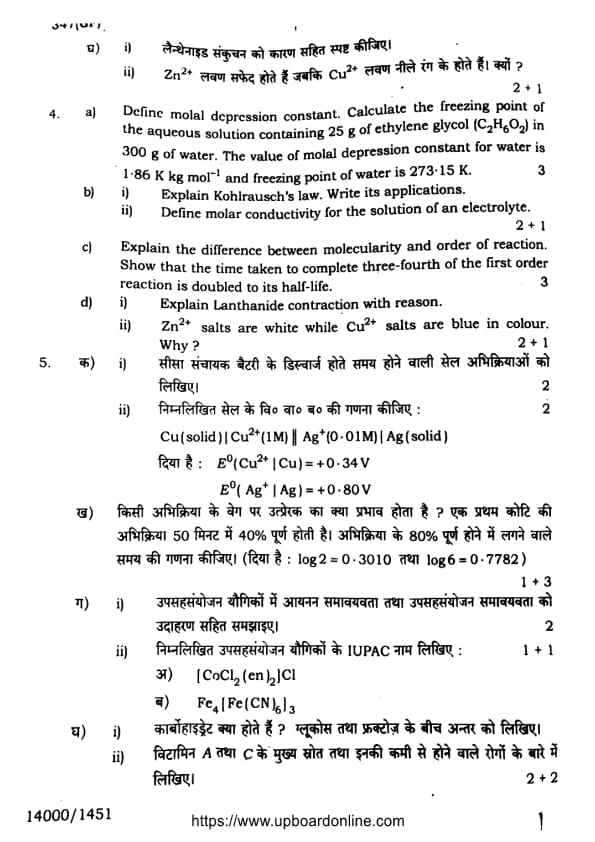
(D) (i) Explain Lanthanide contraction with reason.
View Solution
Step 1: Definition:
Lanthanide contraction refers to the gradual decrease in atomic and ionic radii of lanthanides across the series due to poor shielding by f-electrons.
Step 2: Reason:
- Poor shielding increases effective nuclear charge, pulling electrons inward. Quick Tip: Lanthanide contraction affects the properties of transition elements, reducing size variation.
(d) (ii) Zn\(^{2+}\) salts are white while Cu\(^{2+}\) salts are blue in colour. Why?
View Solution
Step 1: Electronic Configurations:
- Zn\(^{2+}\) = \(3d^{10}\) (fully filled, no d-d transitions)
- Cu\(^{2+}\) = \(3d^9\) (one unpaired electron, d-d transitions possible)
Step 2: Reason for Colour:
- Zn\(^{2+}\) has no unpaired d-electrons → No d-d transitions → Appears white.
- Cu\(^{2+}\) has d-d transitions absorbing red-orange light, reflecting blue. Quick Tip: Transition metal colour is due to d-d transitions; fully filled orbitals prevent absorption of visible light.
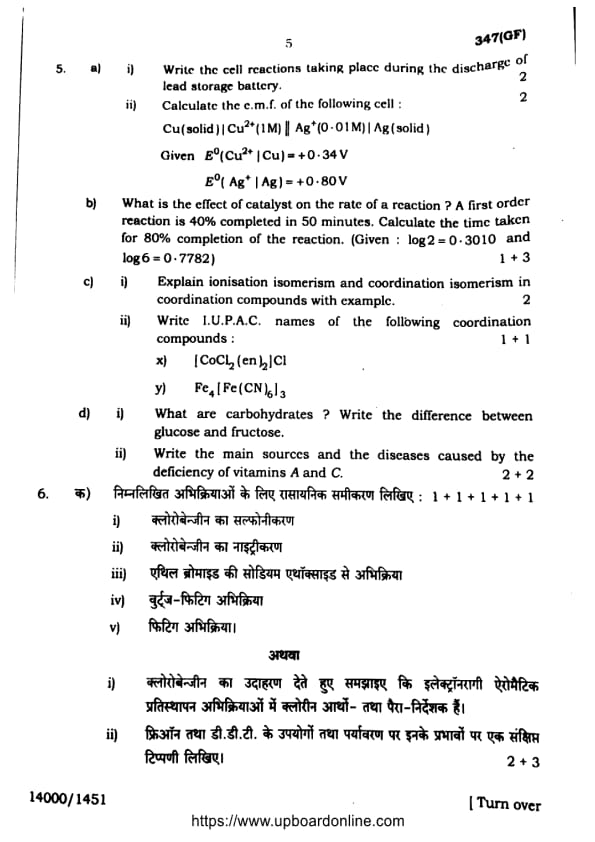
(a) (i) Write the cell reactions taking place during the discharge of the lead storage battery.
View Solution
Step 1: Introduction to Lead Storage Battery
- The lead storage battery is a secondary battery that can be recharged.
- It consists of lead (Pb) as the anode and lead dioxide (PbO\(_2\)) as the cathode, immersed in sulfuric acid (H\(_2\)SO\(_4\)) electrolyte.
Step 2: Cell Reactions During Discharge
Anode Reaction (Oxidation): \[ Pb (s) + SO_4^{2-} (aq) \rightarrow PbSO_4 (s) + 2e^- \]
Cathode Reaction (Reduction): \[ PbO_2 (s) + 4H^+ (aq) + SO_4^{2-} (aq) + 2e^- \rightarrow PbSO_4 (s) + 2H_2O (l) \]
Overall Cell Reaction: \[ Pb (s) + PbO_2 (s) + 4H^+ (aq) + 2SO_4^{2-} (aq) \rightarrow 2PbSO_4 (s) + 2H_2O (l) \]
Step 3: Working Principle
- During discharge, Pb and PbO\(_2\) get converted into PbSO\(_4\), releasing electrical energy.
- During charging, the reaction is reversed, regenerating Pb and PbO\(_2\). Quick Tip: The lead storage battery is rechargeable, making it widely used in automobiles and inverters.
(a) (ii) Calculate the e.m.f. of the following cell:
\[ Cu(s) | Cu^{2+} (1M) || Ag^{+} (0.01M) | Ag(s) \]
Given:
\[ E^0_{Cu^{2+}/Cu} = +0.34V, \quad E^0_{Ag^{+}/Ag} = +0.80V \]
View Solution
Step 1: Cell Reaction:
\[ Cu + 2Ag^{+} \rightarrow Cu^{2+} + 2Ag \]
Step 2: Standard E.M.F. Calculation:
\[ E_{cell}^0 = E_{cathode}^0 - E_{anode}^0 \]
\[ = 0.80 - 0.34 = 0.46V \]
Thus, the e.m.f. of the cell is 0.46V. Quick Tip: The Nernst equation helps calculate cell potential under non-standard conditions.
(b) What is the effect of catalyst on the rate of reaction? A first-order reaction is 40% completed in 50 minutes. Calculate the time taken for 80% completion of the reaction. (Given: \(\log 2 = 0.3010\) and \(\log 6 = 0.7782\))
View Solution
Step 1: First-Order Rate Law:
\[ t = \frac{2.303}{k} \log \frac{[A]_0}{[A]} \]
Step 2: Calculate Rate Constant \( k \):
For 40% completion:
t₄₀% = 50 = (2.303 / k) * log(100 / 60)
\[ k = \frac{2.303}{50} \times 0.2218 = 0.0102 min⁻¹ \]
Step 3: Calculate Time for 80% Completion:
t₈₀% = (2.303 / 0.0102) * log(100 / 20)
\[ = \frac{2.303}{0.0102} \times 0.7782 = 176 min \]
Thus, the time for 80% completion is 176 minutes. Quick Tip: The rate of a first-order reaction depends only on the concentration of one reactant, making calculations straightforward.
(c) (i) Explain ionisation isomerism and coordination isomerism in coordination compounds with examples.
View Solution
Step 1: Ionisation Isomerism:
Occurs when compounds produce different ions in solution.
Example:
\[ [Co(NH_3)_5SO_4]Br and [Co(NH_3)_5Br]SO_4 \]
Step 2: Coordination Isomerism:
Occurs when the ligands exchange between cation and anion parts.
Example:
\[ [Cr(NH_3)_6][Co(CN)_6] and [Co(NH_3)_6][Cr(CN)_6] \] Quick Tip: Ionisation isomerism changes the counter-ion, while coordination isomerism swaps ligands between metal centers.
(c) (ii) Write I.U.P.A.C. names of the following coordination compounds:
View Solution
(x) \([CoCl_2(en)_2]Cl\)
Dichlorobis(ethylenediamine)cobalt(C) chloride
(y) \(Fe_4[Fe(CN)_6]_3\)
Tetrairon(C) hexacyanoferrate(B)
Quick Tip: IUPAC naming follows metal oxidation state, ligand count, and anionic charge.
(d) (i) What are carbohydrates? Write the difference between glucose and fructose.
View Solution
Step 1: Definition:
Carbohydrates are biomolecules composed of C, H, and O, serving as energy sources.
Step 2: Difference Between Glucose and Fructose:

Quick Tip: Glucose is an aldose, while fructose is a ketose; both are monosaccharides.
(d) (ii) Write the main sources and the diseases caused by the deficiency of vitamins A and C.
View Solution
Step 1: Vitamin A:
- Sources: Carrots, milk, fish liver oil
- Deficiency Disease: Night blindness
Step 2: Vitamin C:
- Sources: Citrus fruits, green vegetables
- Deficiency Disease: Scurvy (bleeding gums, weakness) Quick Tip: Vitamins are essential for metabolism; deficiencies cause specific diseases.
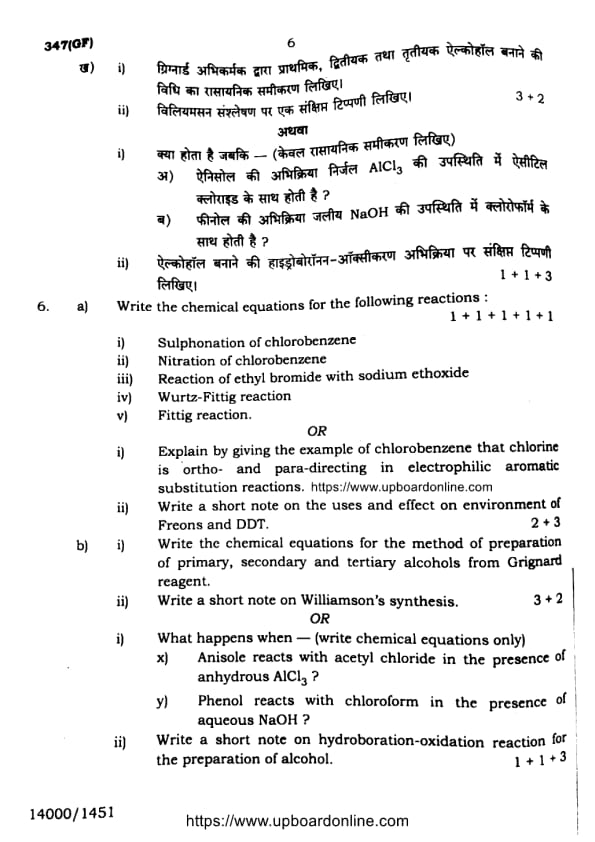
(a) Write the chemical equations for the following reactions:
(A) Sulphonation of chlorobenzene
(B) Nitration of chlorobenzene
(C) Reaction of ethyl bromide with sodium ethoxide
(D) Wurtz-Fittig reaction
(v) Fittig reaction
View Solution
(A) Sulphonation of chlorobenzene
\[ C_6H_5Cl + H_2SO_4 \xrightarrow{SO_3/H_2SO_4} C_6H_4ClSO_3H \]
(B) Nitration of chlorobenzene
\[ C_6H_5Cl + HNO_3 \xrightarrow{H_2SO_4} p-C_6H_4ClNO_2 + o-C_6H_4ClNO_2 \]
(C) Reaction of ethyl bromide with sodium ethoxide
\[ C_2H_5Br + C_2H_5ONa \rightarrow C_2H_5OC_2H_5 + NaBr \]
(D) Wurtz-Fittig reaction
\[ C_6H_5Cl + 2Na + CH_3Cl \rightarrow C_6H_5CH_3 + 2NaCl \]
(v) Fittig reaction
\[ C_6H_5Cl + 2Na + C_6H_5Cl \rightarrow C_6H_5C_6H_5 + 2NaCl \] Quick Tip: Electrophilic aromatic substitution reactions follow regioselectivity; ortho- and para-directing groups influence product formation.
(a) (i) OR Explain by giving the example of chlorobenzene that chlorine is ortho- and para-directing in electrophilic aromatic substitution reactions.
View Solution
Step 1: Electrophilic Substitution in Chlorobenzene:
Chlorine has a \(-I\) effect (electron-withdrawing) and a \(+M\) effect (electron-donating via resonance), making the ortho and para positions more reactive.
Step 2: Example - Nitration of Chlorobenzene:
\[ C_6H_5Cl + HNO_3 \xrightarrow{H_2SO_4} o-C_6H_4ClNO_2 + p-C_6H_4ClNO_2 \] Quick Tip: Halogens are deactivating but ortho/para-directing due to resonance.
(a) (ii) OR Write a short note on the uses and effect on environment of Freons and DDT.
View Solution
Step 1: Freons:
- Used as refrigerants and aerosol propellants.
- Environmental Effect: Depletes ozone layer.
Step 2: DDT:
- Used as an insecticide.
- Environmental Effect: Accumulates in the food chain, causing toxicity. Quick Tip: Freons destroy ozone, while DDT bioaccumulates, harming ecosystems.
(b) (i) Write the chemical equations for the method of preparation of primary, secondary, and tertiary alcohols from Grignard reagent.
(A) Preparation of Primary Alcohol
(B) Preparation of Secondary Alcohol
(C) Preparation of Tertiary Alcohol
View Solution
(A) Preparation of Primary Alcohol:
\[ RMgX + HCHO \xrightarrow{H_3O^+} RCH_2OH \]
(B) Preparation of Secondary Alcohol:
\[ RMgX + R'CHO \xrightarrow{H_3O^+} RCH(OH)R' \]
(C) Preparation of Tertiary Alcohol:
\[ RMgX + R'COR'' \xrightarrow{H_3O^+} RCR'(OH)R'' \] Quick Tip: Grignard reagents react with aldehydes/ketones to form alcohols.
(b) (ii) Write a short note on Williamson’s synthesis.
View Solution
Step 1: Reaction Mechanism:
\[ R-O^- + R'X \rightarrow R-O-R' + X^- \]
Step 2: Example:
\[ C_2H_5ONa + C_6H_5Cl \rightarrow C_6H_5OC_2H_5 + NaCl \] Quick Tip: Williamson’s synthesis is useful for the preparation of ethers.
(b) (i) OR What happens when (write chemical equations only)
View Solution
(x) Anisole reacts with acetyl chloride in the presence of anhydrous AlCl\(_3\)?
\[ C_6H_5OCH_3 + CH_3COCl \xrightarrow{AlCl_3} p-CH_3COC_6H_4OCH_3 + HCl \]
(y) Phenol reacts with chloroform in the presence of aqueous NaOH?
\[ C_6H_5OH + CHCl_3 + 3NaOH \rightarrow o-C_6H_4CHO + 3NaCl + 2H_2O \] Quick Tip: Phenol reacts with chloroform under basic conditions to form salicylaldehyde.
(b) (ii) Write a short note on hydroboration-oxidation reaction for the preparation of alcohol.
View Solution
Step 1: Reaction:
\[ R_2B-H + R'CH=CH_2 \rightarrow R'CH_2CH_2B(R_2) \]
\[ R'CH_2CH_2B(R_2) + H_2O_2/OH^- \rightarrow R'CH_2CH_2OH \]
Step 2: Characteristics:
- Anti-Markovnikov addition (OH group attaches to the least substituted carbon).
- Syn addition (H and OH add to the same face of the alkene). Quick Tip: Hydroboration-oxidation forms anti-Markovnikov alcohols in one step.
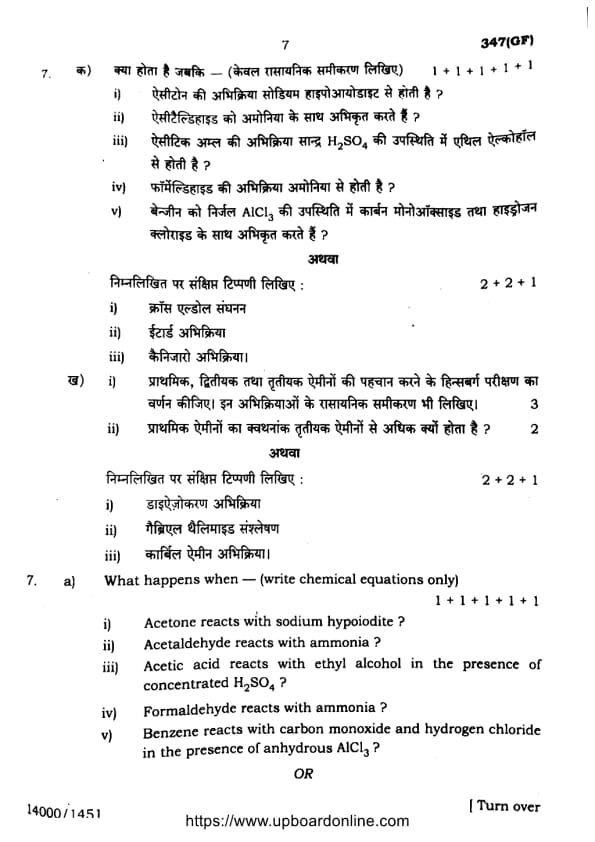
(a) What happens when—(write chemical equations only)
A) Acetone reacts with sodium hypoiodite
(B) Acetaldehyde reacts with ammonia
(C) Acetic acid reacts with ethyl alcohol in the presence of concentrated H\(_2\)SO\(_4\)
(D) Formaldehyde reacts with ammonia
(E) Benzene reacts with carbon monoxide and hydrogen chloride in the presence of anhydrous AlCl\(_3\)
View Solution
(A) Acetone reacts with sodium hypoiodite
\[ (CH_3)_2CO + 3NaOI \rightarrow (CH_3)_2COO^- Na^+ + I_2 + 2NaOH \]
(B) Acetaldehyde reacts with ammonia
\[ CH_3CHO + NH_3 \rightarrow CH_3CH=NH + H_2O \]
(C) Acetic acid reacts with ethyl alcohol in the presence of concentrated H\(_2\)SO\(_4\)
\[ CH_3COOH + C_2H_5OH \xrightarrow{H_2SO_4} CH_3COOC_2H_5 + H_2O \]
(D) Formaldehyde reacts with ammonia
\[ HCHO + NH_3 \rightarrow (CH_2)_6N_4 \]
(E) Benzene reacts with carbon monoxide and hydrogen chloride in the presence of anhydrous AlCl\(_3\)
\[ C_6H_6 + CO + HCl \xrightarrow{AlCl_3} C_6H_5CHO \] Quick Tip: Reagents like NaOI and AlCl\(_3\) act as oxidizing and Lewis acid catalysts respectively, influencing the type of reaction.
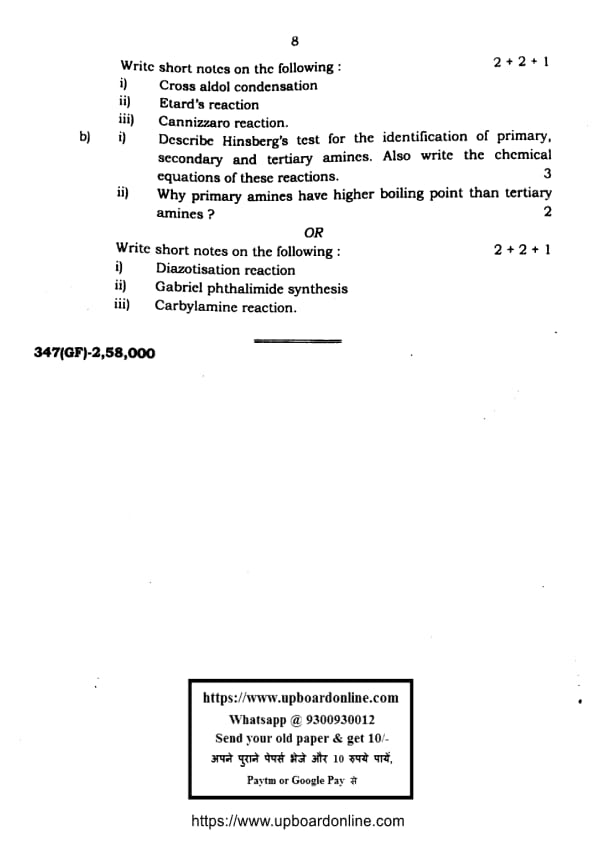
(a) OR Write short notes on the following:
View Solution
Cross Aldol Condensation
- Aldol condensation occurs between two different aldehydes or ketones.
- Example:
\[ CH_3CHO + C_6H_5CHO \xrightarrow{NaOH} CH_3CH(OH)C_6H_5CHO \]
Etard’s Reaction
- Selective oxidation of toluene to benzaldehyde.
- Reaction:
\[ C_6H_5CH_3 + CrO_2Cl_2 \rightarrow C_6H_5CHO + CrCl_3 + HCl \]
Cannizzaro Reaction
- Aldehydes without α-hydrogen undergo disproportionation.
- Example:
\[ 2 HCHO + NaOH \rightarrow CH_3OH + HCOONa \] Quick Tip: Cross aldol reaction occurs in the presence of a base, while Cannizzaro reaction is unique to aldehydes without α-hydrogen.
(b) (i) Describe Hinsberg’s test for the identification of primary, secondary, and tertiary amines. Also, write the chemical equations of these reactions.
View Solution
Hinsberg Test:
- Used to distinguish primary, secondary, and tertiary amines using benzene sulfonyl chloride \((C_6H_5SO_2Cl)\).
Reactions:
Primary Amine: \[ RNH_2 + C_6H_5SO_2Cl \rightarrow R-NH-SO_2C_6H_5 + HCl \]
(Soluble in alkali)
Secondary Amine: \[ R_2NH + C_6H_5SO_2Cl \rightarrow R_2N-SO_2C_6H_5 + HCl \]
(Insoluble in alkali)
Tertiary Amine: \[ R_3N + C_6H_5SO_2Cl \nrightarrow No reaction \] Quick Tip: Hinsberg’s test differentiates amines based on their solubility in an alkali.
(b) (ii) Why do primary amines have a higher boiling point than tertiary amines?
View Solution
- Hydrogen bonding in primary amines increases boiling points.
- Tertiary amines lack hydrogen bonding due to the absence of an H atom attached to nitrogen.
\[ Primary amine: Strong H-bonding > Tertiary amine: No H-bonding \] Quick Tip: Hydrogen bonding significantly impacts boiling points of organic compounds.
(b) OR Write short notes on the following:
(A) Diazotisation Reaction
(B) Gabriel Phthalimide Synthesis
(C) Carbylamine Reaction
View Solution
(A) Diazotisation Reaction
- Primary aromatic amines react with NaNO\(_2\) and HCl at 0-5°C to form diazonium salts.
- Example:
\[ C_6H_5NH_2 + NaNO_2 + HCl \rightarrow C_6H_5N_2^+Cl^- + H_2O \]
(B) Gabriel Phthalimide Synthesis
- Used for synthesizing primary amines.
- Example:
\[ C_6H_4(CO)_2N^-K^+ + RBr \rightarrow C_6H_4(CO)_2NR + KBr \]
(C) Carbylamine Reaction
- Primary amines react with chloroform and alcoholic KOH to form isocyanides (foul-smelling).
- Example:
\[ RNH_2 + CHCl_3 + 3KOH \rightarrow RNC + 3KCl + 3H_2O \] Quick Tip: Diazotisation forms diazonium salts, crucial for azo dye formation.



Comments