




UP Board Class 12 Chemistry Question Paper 2025 PDF (Code 347 KC) is available for download here. The Mathematics exam was conducted on March 8, 2025 in the Morning Shift from 2:00 PM to 5:15 PM. The total marks for the theory paper are 100. Students reported the paper to be easy to moderate.
UP Board Class 12 Chemistry Question Paper 2025 (Code 347 KC) with Solutions
| UP Board Class Physics Question Paper with Answer Key |  Download Download |
Check Solutions |
UP Board Class 12 Chemistry Questions with Solutions
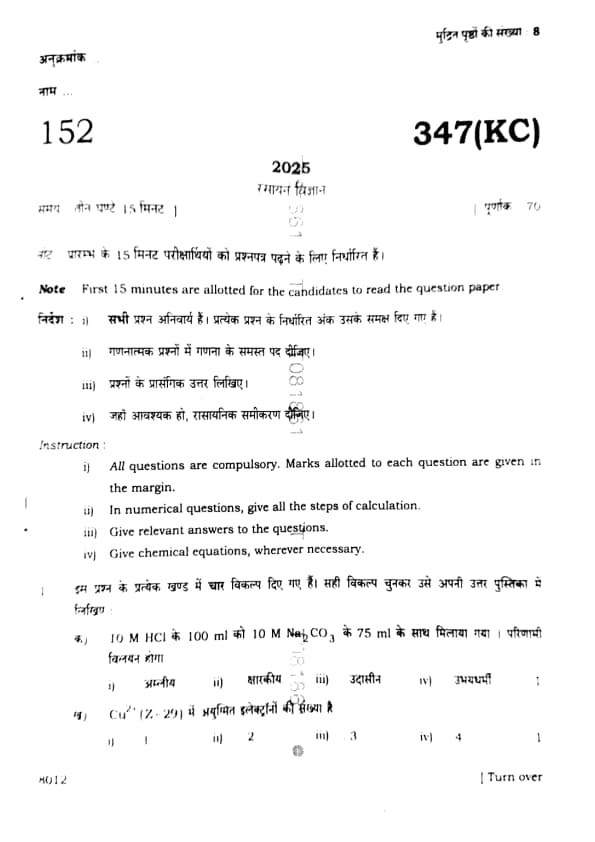
100 ml of 10 M HCl is mixed with 75 ml of 10 M Na\(_2\)CO\(_3\). The resulting solution would be –
Number of unpaired electrons in Cu\(^{2+}\) (Z = 29) is –
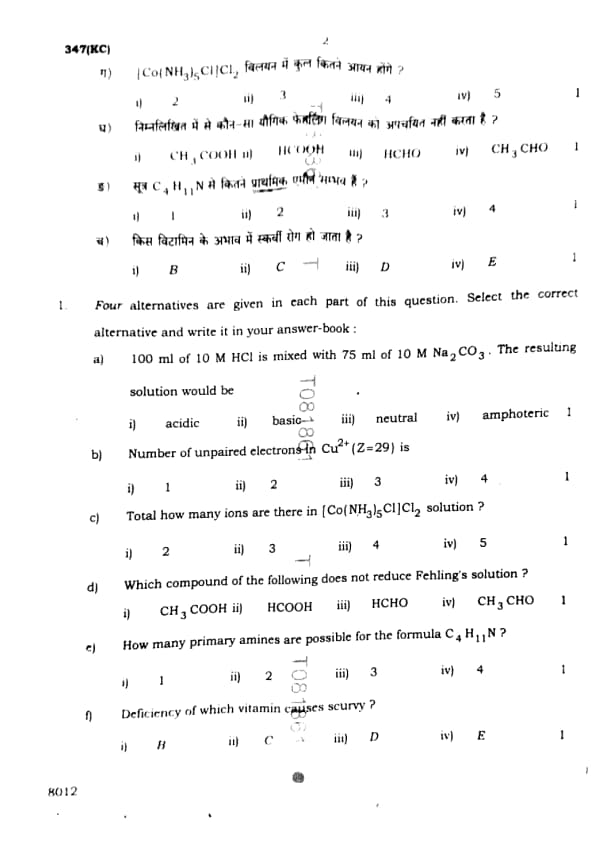
Total how many ions are there in [Co(NH\(_3\))\(_5\)Cl]Cl\(_2\) solution?
Which compound of the following does not reduce Fehling's solution?
How many primary amines are possible for the formula C\(_4\)H\(_{11}\)N?
Deficiency of which vitamin causes scurvy?
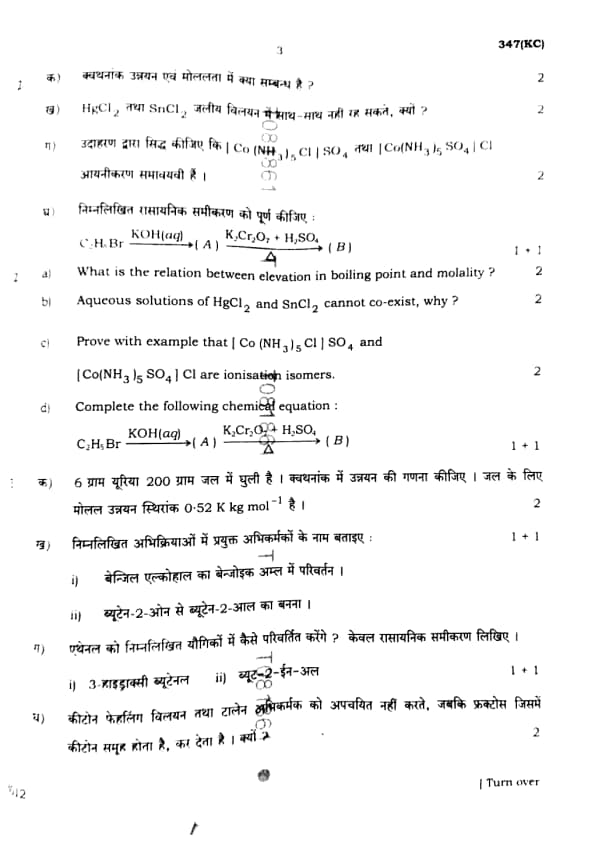
What is the relation between elevation in boiling point and molality?
Aqueous solutions of HgCl\(_2\) and SnCl\(_2\) cannot co-exist, why?
Prove with example that [Co(NH\(_3\))\(_5\)Cl]SO\(_4\) and [Co(NH\(_3\))\(_5\)SO\(_4\)]Cl are ionisation isomers.
Complete the following chemical equation: \(\; \mathrm{C_2H_5Br} \xrightarrow[]{\mathrm{KOH(aq)}} (A) \xrightarrow[\Delta]{\mathrm{K_2Cr_2O_7,\;H_2SO_4}} (B)\).
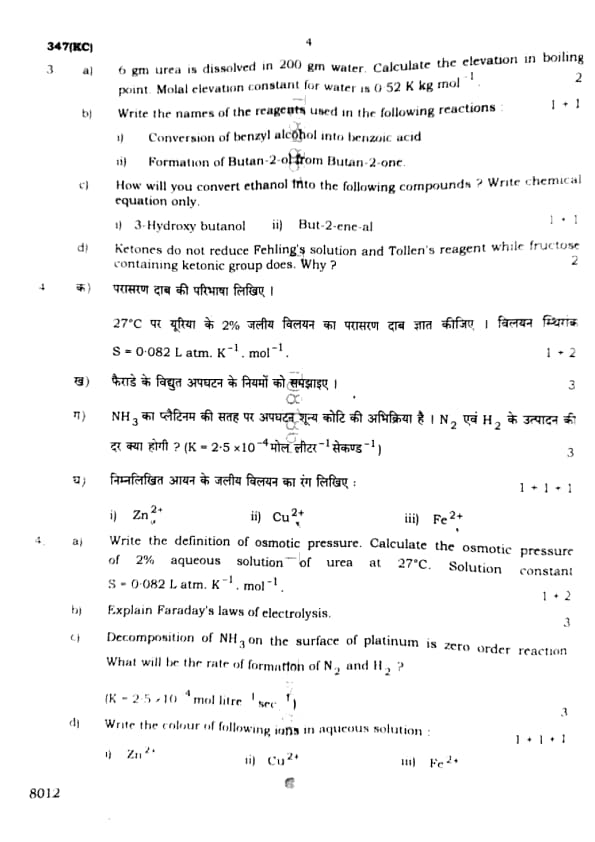
6 g urea is dissolved in 200 g water. Calculate the elevation in boiling point. Molal elevation constant for water is 0.52 K kg mol\(^{-1}\).
Write the names of the reagents used in the following reactions:
i) Conversion of benzyl alcohol into benzoic acid
ii) Formation of butan-2-ol from butan-2-one
How will you convert ethanol into the following compounds? Write chemical equation only.
(i) 3-Hydroxybutanol \quad (ii) But-2-enal
Ketones do not reduce Fehling's solution and Tollen's reagent while fructose containing ketonic group does. Why?
Write the definition of osmotic pressure. Calculate the osmotic pressure of 2% aqueous solution of urea at 27\(^\circ\)C. Solution constant \(R = 0.082\ L atm K^{-1}\ mol^{-1}\).
Explain Faraday's laws of electrolysis.
Decomposition of NH\(_3\) on the surface of platinum is a zero–order reaction. What will be the rate of formation of N\(_2\) and H\(_2\)? \; (Given: \(k=2.5\times10^{-4}\ \mathrm{mol\,L^{-1}\,s^{-1}}\))
Write the colour of the following ions in aqueous solution: (i) Zn\(^{2+}\) \quad (ii) Cu\(^{2+}\) \quad (iii) Fe\(^{2+}\).
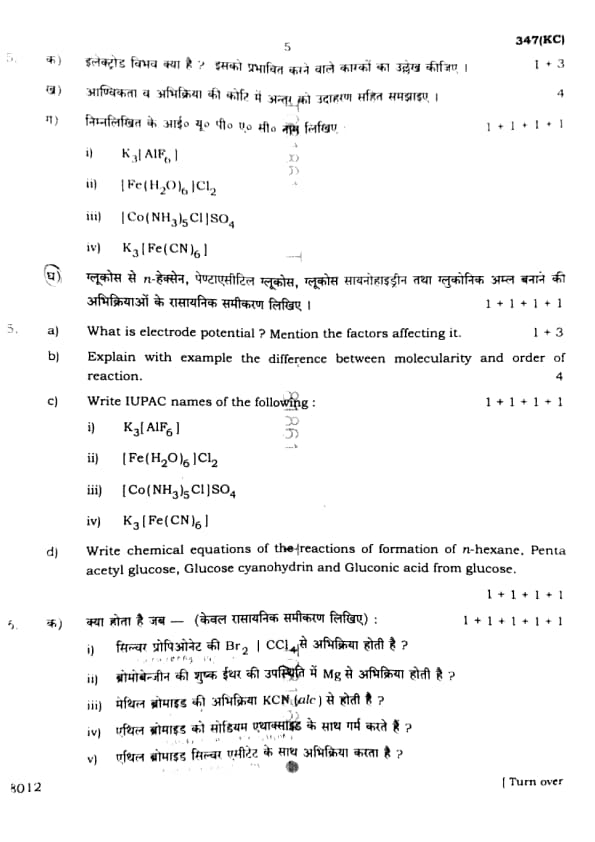
What is electrode potential? Mention the factors affecting it.
Explain with example the difference between molecularity and order of reaction.
Write IUPAC names of the following:
(i) K\(_3\)[AlF\(_6\)]
(ii) [Fe(H\(_2\)O)\(_6\)]Cl\(_2\)
(iii) [Co(NH\(_3\))\(_5\)Cl]SO\(_4\)
(iv) K\(_3\)[Fe(CN)\(_6\)]
Write chemical equations of the reactions of formation of \(n\)-hexane, pentaacetyl glucose, glucose cyanohydrin and gluconic acid from glucose.
What happens when (Write chemical equation only):
(i) Silver propionate reacts with Br\(_2\) in CCl\(_4\):
(ii) Bromobenzene reacts with Mg in the presence of dry ether:
(iii) Methyl bromide reacts with KCN (alc.):
(iv) Ethyl bromide is heated with sodium ethoxide:
(v) Ethyl bromide reacts with silver acetate:
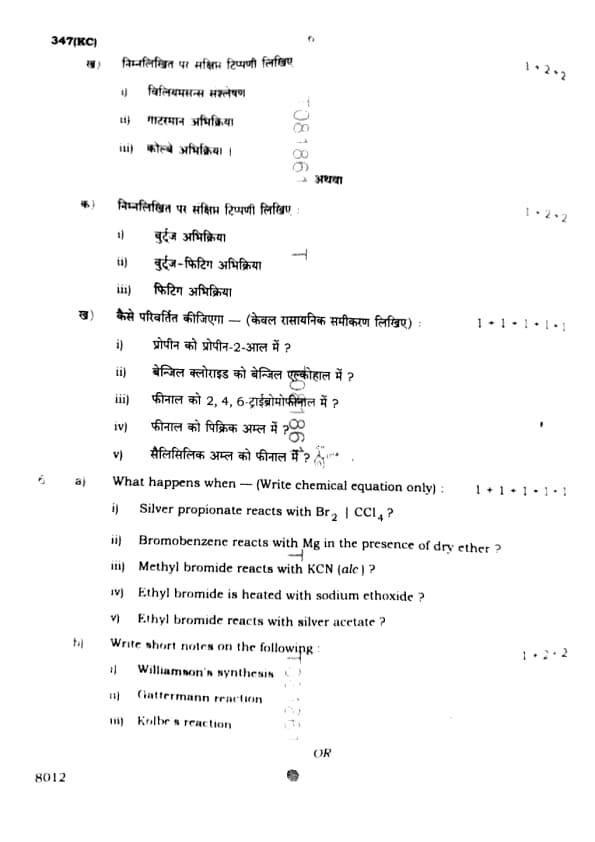
Write short notes on the following:
(i) Williamson's synthesis
(ii) Gattermann reaction
(iii) Kolbe's reaction
Write short notes on the following:
i) Wurtz reaction
ii) Wurtz-Fittig reaction
iii) Fittig reaction
How will you convert (Write chemical equation only):
(i) Propene into propan-2-ol \quad
(ii) Benzyl chloride into benzyl alcohol \quad
(iii) Phenol into 2,4,6-tribromophenol \quad
(iv) Phenol into picric acid \quad
(v) Salicylic acid into phenol
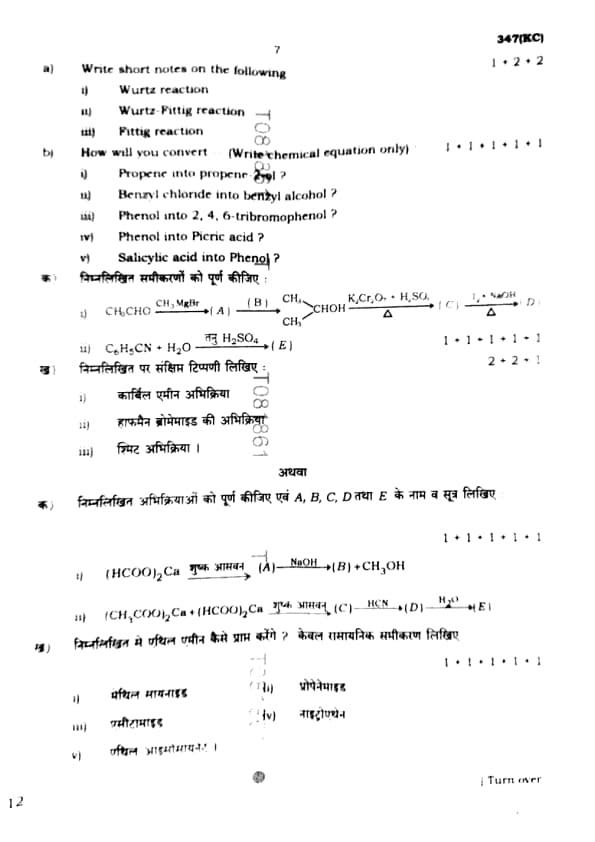
Complete the following equations:
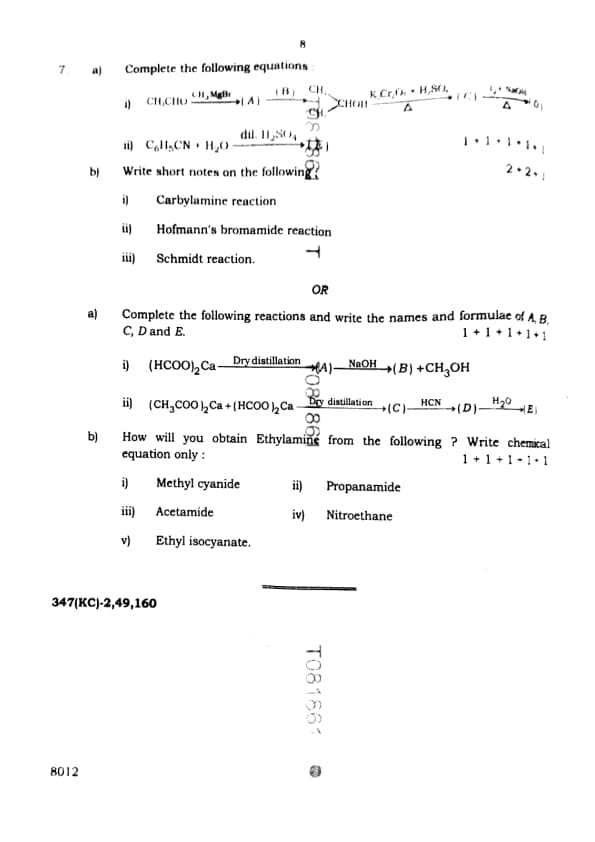
(i)\; \(\mathrm{CH_3CHO} \xrightarrow{\;CH_3MgBr\;} (A) \xrightarrow{\;(B)\;} CH_3\!-\!CHOH\!-\!CH_3 \xrightarrow[\ \Delta\ ]{\;K_2Cr_2O_7/H_2SO_4\;} (C) \xrightarrow[\ \Delta\ ]{\;NH_2OH\;} (D)\)
(ii)\; \(\mathrm{C_6H_5CN + H_2O \xrightarrow{\;dil.\ H_2SO_4\;} (E)}\)
Write short notes on the following:
(i) Carbylamine reaction
(ii) Hofmann's bromamide reaction
(iii) Schmidt reaction
Complete the following reactions and write the names and formulae of A, B, C, D and E.
i) \((\mathrm{HCOO})_2\mathrm{Ca}\ \xrightarrow[Dry distillation]{}\ (A)\ \xrightarrow[NaOH]{}\ (B) + \mathrm{CH_3OH}\)
ii) \((\mathrm{CH_3COO})_2\mathrm{Ca} + (\mathrm{HCOO})_2\mathrm{Ca}\ \xrightarrow[Dry distillation]{}\ (C)\ \xrightarrow[\ \mathrm{HCN}\ ]{}\ (D)\ \xrightarrow[\ \mathrm{H_2O}\ ]{}\ (E)\)
How will you obtain Ethylamine from the following? Write chemical equation only:
(i) Methyl cyanide
(ii) Propanamide
(iii) Acetamide
(iv) Nitroethane
(v) Ethyl isocyanate



Comments