




UP Board Class 12 English Question Paper 2024 PDF (Code 316 DX) is available for download here. The English exam was conducted on March 2, 2024 in the Evening Shift from 2 PM to 5:15 PM. The total marks for the theory paper are 100. Students reported the paper to be easy to moderate.
UP Board Class 12 English Question Paper 2024 (Code 316 DX) with Solutions
| UP Board Class 12 English Question Paper with Answer Key |  Download Download |
Check Solution |
UP Board Class 12 English Questions with Solutions
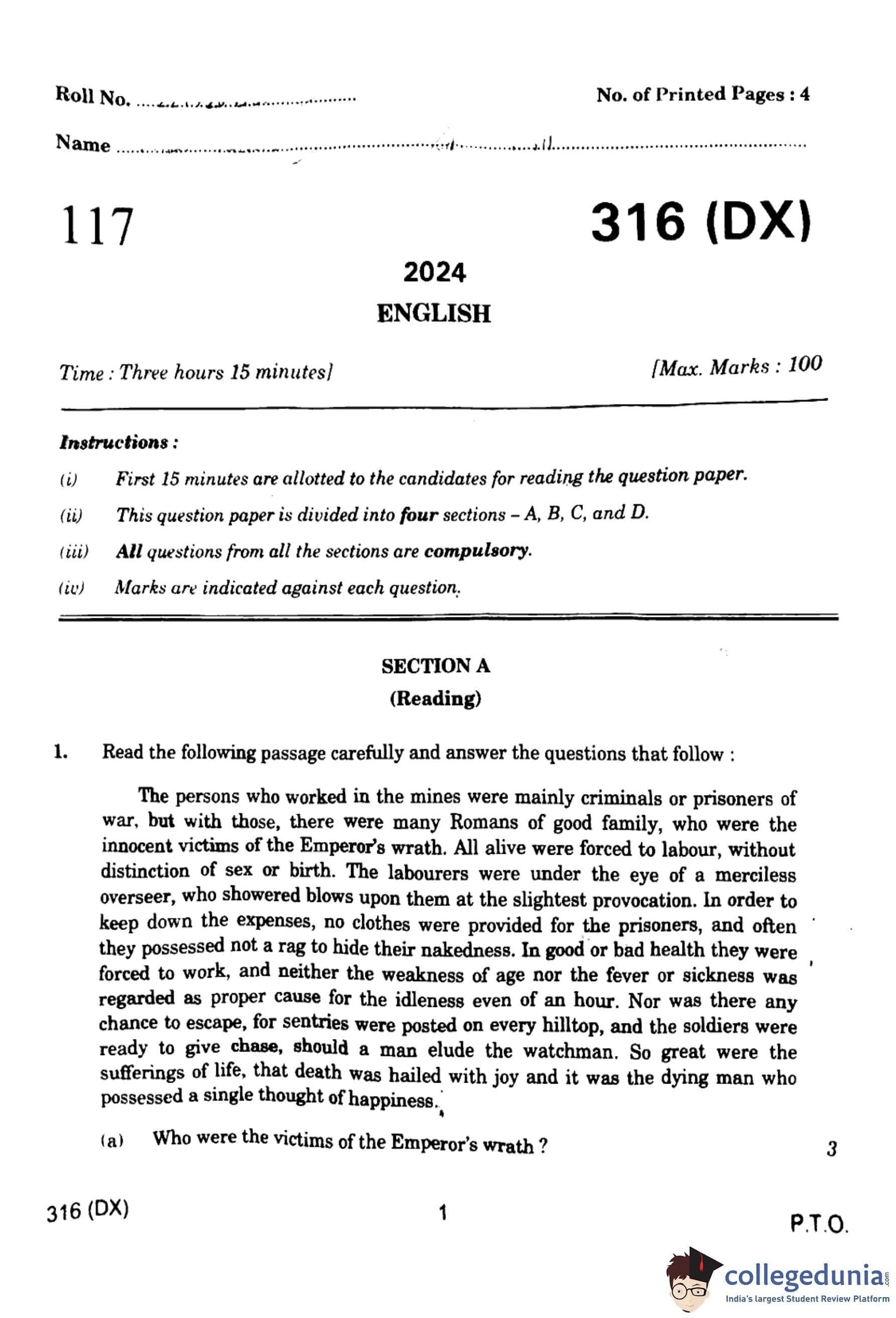
Question 1:
The persons who worked in the mines were mainly criminals or prisoners of war, but with
those, there were many Romans of good family, who were the innocent victims of the
Emperor’s wrath. All alike were forced to labour, without distinction of sex or birth.
Read More
Thelabourers were under the eye of a merciless overseer, who showered blows upon them at the
slightest provocation. In order to keep down the expenses, no clothes were provided for the
prisoners, and often they possessed not a rag to hide their nakedness. In good or bad health
they were forced to work, and neither the weakness of age nor the fever or sickness was
regarded as proper cause for idleness even of an hour. Nor was there any chance to escape,
for sentries were posted on every hilltop, and the soldiers were ready to give chase, should a
man elude the watchman. So great were the sufferings of life, that death was hailed with joy
and it was the dying man who possessed a single thought of happiness.
(a) Who were the victims of the Emperor's wrath?
View Solution
The victims of the Emperor's wrath were the prisoners and those who were forced to labour under his command, without distinction of sex or birth. These individuals were subjected to harsh and cruel treatment. Quick Tip: The phrase "victims of wrath" refers to those suffering due to the ruler's anger and harshness. Understanding context helps in identifying the victims of a situation.
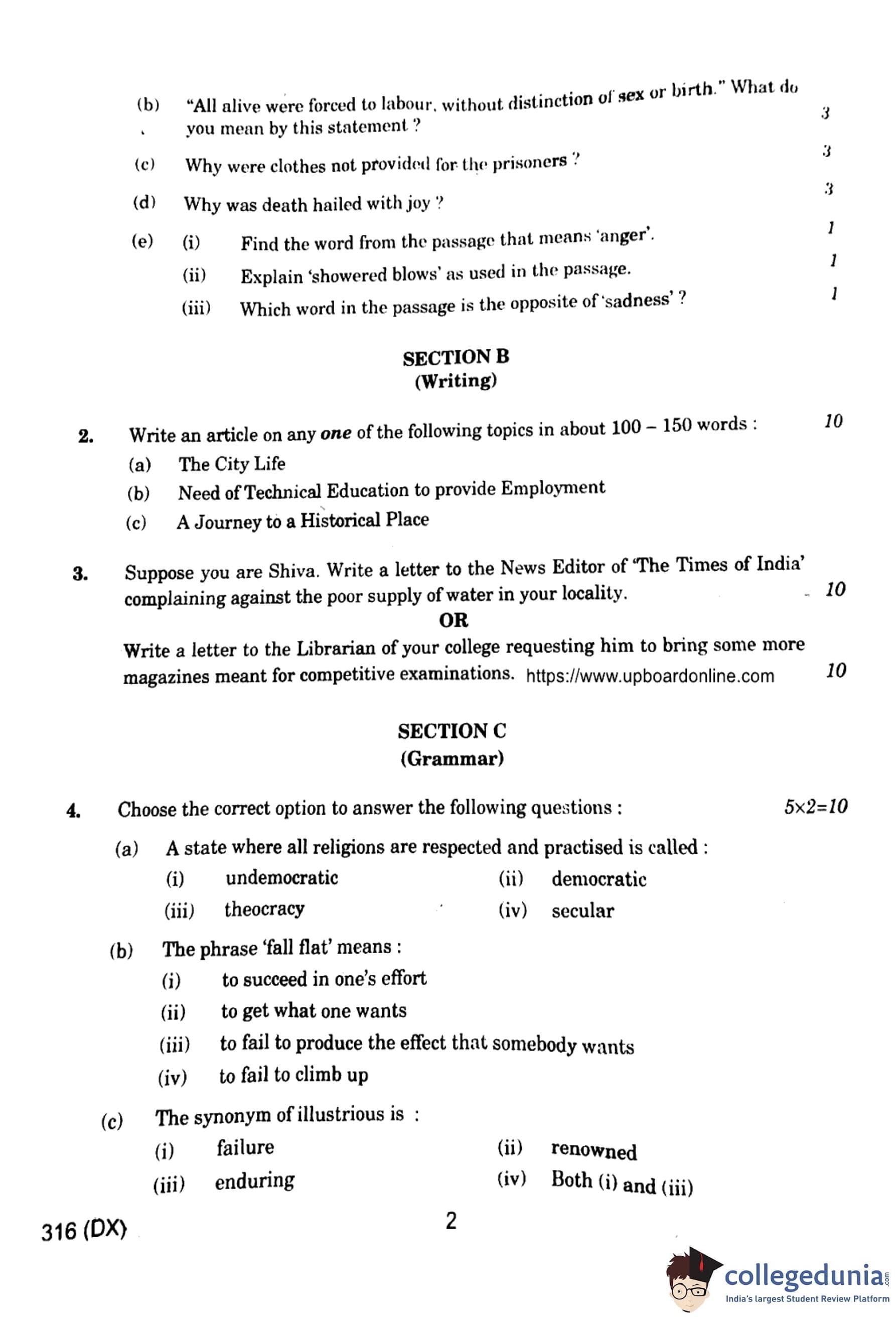
(b) "All alive were forced to labour, without distinction of sex or birth." What do you mean by this statement?
View Solution
This statement means that the forced labour imposed by the Emperor did not discriminate based on the gender or social status of the individuals. Everyone, regardless of their birth or sex, had to work under his orders. Quick Tip: This is an example of social injustice where everyone, regardless of their individual identities, faced the same harsh punishment.
(c) Why were clothes not provided for the prisoners?
View Solution
Clothes were not provided to the prisoners as a form of humiliation and to reinforce their status as captives or slaves. The deprivation of basic necessities like clothing was a method of exerting control and displaying the Emperor's power over them. Quick Tip: Lack of clothing symbolizes the loss of dignity and freedom, common in oppressive situations.
(d) Why was death hailed with joy?
View Solution
Death was hailed with joy because it was seen as a release from the unbearable suffering that the prisoners endured. It was viewed as a way to escape the cruel punishment imposed on them by the Emperor. Quick Tip: In extremely harsh environments, death can sometimes be seen as a form of relief from continuous suffering.
(e) (i) Find the word from the passage that means 'anger'.
View Solution
The word "wrath" in the passage means anger. Quick Tip: "Wrath" is a formal synonym for anger and is often used in literary contexts to emphasize intense rage.
(e) (ii) Explain 'showered blows' as used in the passage.
View Solution
The phrase "showered blows" refers to the physical punishment or beating given to the prisoners. It conveys the idea that the blows were delivered rapidly and in great number, symbolizing extreme cruelty. Quick Tip: The phrase suggests a relentless and continuous action, commonly used to describe excessive and brutal force.
(e) (iii) Which word in the passage is the opposite of 'sadness'?
View Solution
The word "joy" in the passage is the opposite of "sadness." Quick Tip: Opposites in literary texts can reveal contrasts in emotions and themes, such as joy and sadness.
Question 2:
Write an article on any one of the following topics in about 100–150 words:
(a) The City Life
View Solution
City life is fast-paced and dynamic, offering numerous opportunities for work, education,
and recreation. Cities are hubs of economic activities with advanced infrastructure and
facilities. However, city life comes with challenges such as pollution, congestion, and a high
cost of living. Despite these, the vibrant social and cultural life of a city attracts people from
all walks of life, making it a melting pot of diverse cultures.
(b) Need of Technical Education to Provide Employment
View Solution
Technical education plays a crucial role in providing employment opportunities. It equips
individuals with practical skills and knowledge essential for various industries, making them
job-ready. In today’s competitive world, technical skills are in high demand across sectors
like IT, manufacturing, and healthcare. By promoting technical education, we can reduce
unemployment and boost economic growth. Governments and institutions should invest in
technical training programs to empower the youth and bridge the skill gap.
(c) A Journey to a Historical Place
View Solution
Visiting a historical place is a fascinating experience that connects us with the past. I recently
visited the Taj Mahal in Agra, a symbol of love and architectural brilliance. The grandeur of
its white marble structure and intricate carvings left me spellbound. Walking through its
gardens and admiring the serene Yamuna river enhanced the experience. Such journeys not
only provide knowledge about history but also inspire a sense of pride in our heritage.
Write a letter to the News Editor of ‘The Times of India’ complaining against the poor supply of water in your locality.
View Solution
To,
The News Editor,
The Times of India,
(City Name),
(Date)
Subject: Complaint about Poor Water Supply in Locality
Respected Sir/Madam,
Through the columns of your esteemed newspaper, I wish to draw the attention of the
concerned authorities to the poor water supply in our locality. For the past few weeks, the
residents have been facing severe water shortages, making it difficult to meet even basic
needs. The situation worsens during peak hours, causing inconvenience to everyone.
I request you to highlight this issue in your newspaper to ensure prompt action by the
concerned authorities. Your support in bringing this issue to light will be highly appreciated.
Yours sincerely,
(Your Name)
(Your Address)
Write a letter to the Librarian of the college requesting him to bring some more mazagines meant for competitive exams.
View Solution
Date: [Insert Date]
To,
The Librarian,
(College Name),
(College Address),
(City, Pincode)
Subject: Request for more magazines meant for competitive examinations.
Respected Sir/Madam,
I am a student of [Your Course and Year] in this college. I am writing to request you to
kindly bring some more magazines related to competitive examinations. These magazines
are crucial for students like us who are preparing for various entrance exams and other
competitive tests.
The current collection is limited, and we find it difficult to access a variety of resources. We
would appreciate it if you could make arrangements to procure magazines such as [insert any
specific magazine names if needed] and any other relevant magazines that can help in our
preparation.
I hope you will consider this request favorably. Thank you for your attention to this matter. I
look forward to your positive response.
Yours faithfully,
(Your Name)
(Your Roll Number)
(Your Department Name)
(College Name)
(a) A state where all religions are respected and practiced is called:
View Solution
A secular state is one in which all religions are treated equally and there is no official state religion. The state respects religious diversity and ensures freedom of religion for all.
Quick Tip: In a secular state, religion and government are kept separate to ensure equal rights and protection for all religious groups.
(b) The phrase ‘fall flat’ means:
View Solution
The phrase "fall flat" means to fail to have the intended impact, or to not achieve the desired outcome. It is often used when something fails to impress or succeed.
Quick Tip: When something "falls flat," it means it failed to achieve success or produce the expected result, especially in a situation where success was anticipated.
(c) The synonym of illustrious is:
View Solution
"Illustrious" means highly respected and well-known, especially for achievements. The correct synonym for illustrious is "renowned," which refers to being widely recognized and respected.
Quick Tip: If someone is illustrious, they are renowned for their accomplishments and are celebrated in their field.
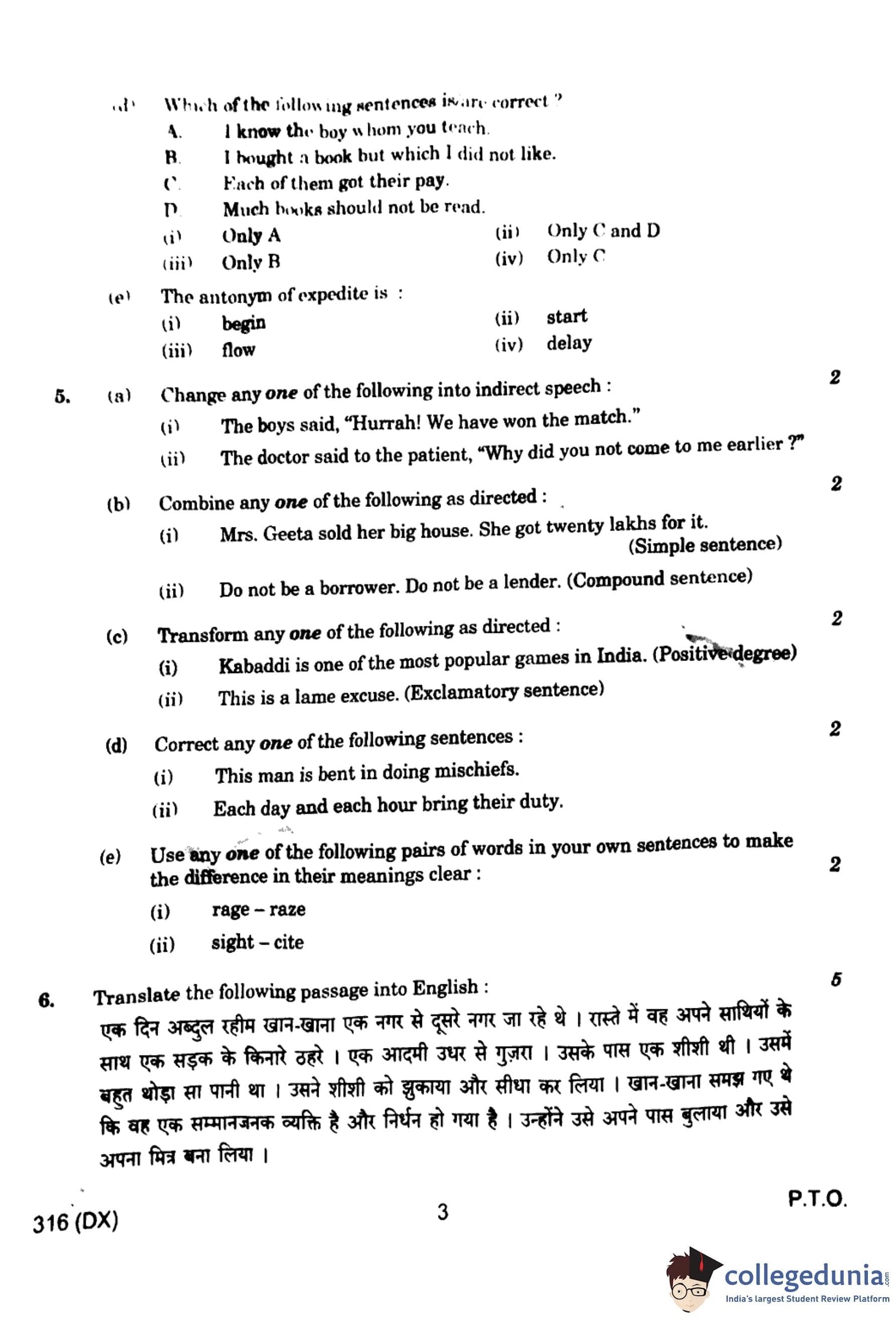
(d) Which of the following sentences is/are correct?
View Solution
Option (A) is correct because "whom" is the correct relative pronoun used after "the boy." Other options contain grammatical errors.
Quick Tip: Use "whom" when referring to a person as the object of a verb or preposition. Avoid errors like "much books," as "much" is used with uncountable nouns, and "books" is countable.
(e) The antonym of "expedite" is:
View Solution
The word "expedite" means to speed up or make something happen sooner. The opposite of this is "delay," which means to postpone or slow down the process.
Quick Tip: When you want to make something happen faster, you expedite it. To delay means to postpone it or make it take longer.
(i) The doctor said to the patient, "Why did you not come to me earlier?"
View Solution
In indirect speech, the exclamation "Hurrah!" is omitted and the sentence is reported in a calm tone. We also change the tense from present perfect to past perfect.
Quick Tip: When converting direct speech with an exclamation, use "exclaimed with joy" or similar phrases, and change the tense accordingly.
(i) Do not be a borrower. Do not be a lender.
View Solution
By using the conjunction "and," we combine the two simple sentences into one compound sentence.
Quick Tip: When combining simple sentences, use conjunctions like "and" or "but" to join ideas smoothly.
(ii) This is a lame excuse. (Exclamatory sentence)
View Solution
To convert the sentence into positive degree, we modify it to show comparison with other games.
Quick Tip: In positive degree, no comparison is made, but in comparative degree, we compare two or more things.
(i) Each day and each hour bring their duty.
View Solution
In option (i), the phrase "bent in" should be changed to "bent on," which is the correct expression.
Quick Tip: Remember to use "bent on" when describing someone's determination or obsession with something.
(ii) sight – cite
(i) The man’s rage was uncontrollable.
(ii) They will raze the old building to make space for a new one.
View Solution
"Rage" refers to extreme anger, while "raze" means to destroy or demolish. Similarly, "sight" refers to vision, while "cite" means to quote or refer to something.
Quick Tip: Be mindful of words with similar spelling but different meanings. "Rage" is related to anger, while "raze" is about destruction.
Translate the following passage into English:
View Solution
One day, a traveler was going from Ajmer. On the way, he remembered an
incident from his childhood. He said, “When I was in Ajmer, I called one of my friends.
Inviting my friend to my house, I used to discuss my problems with him.”
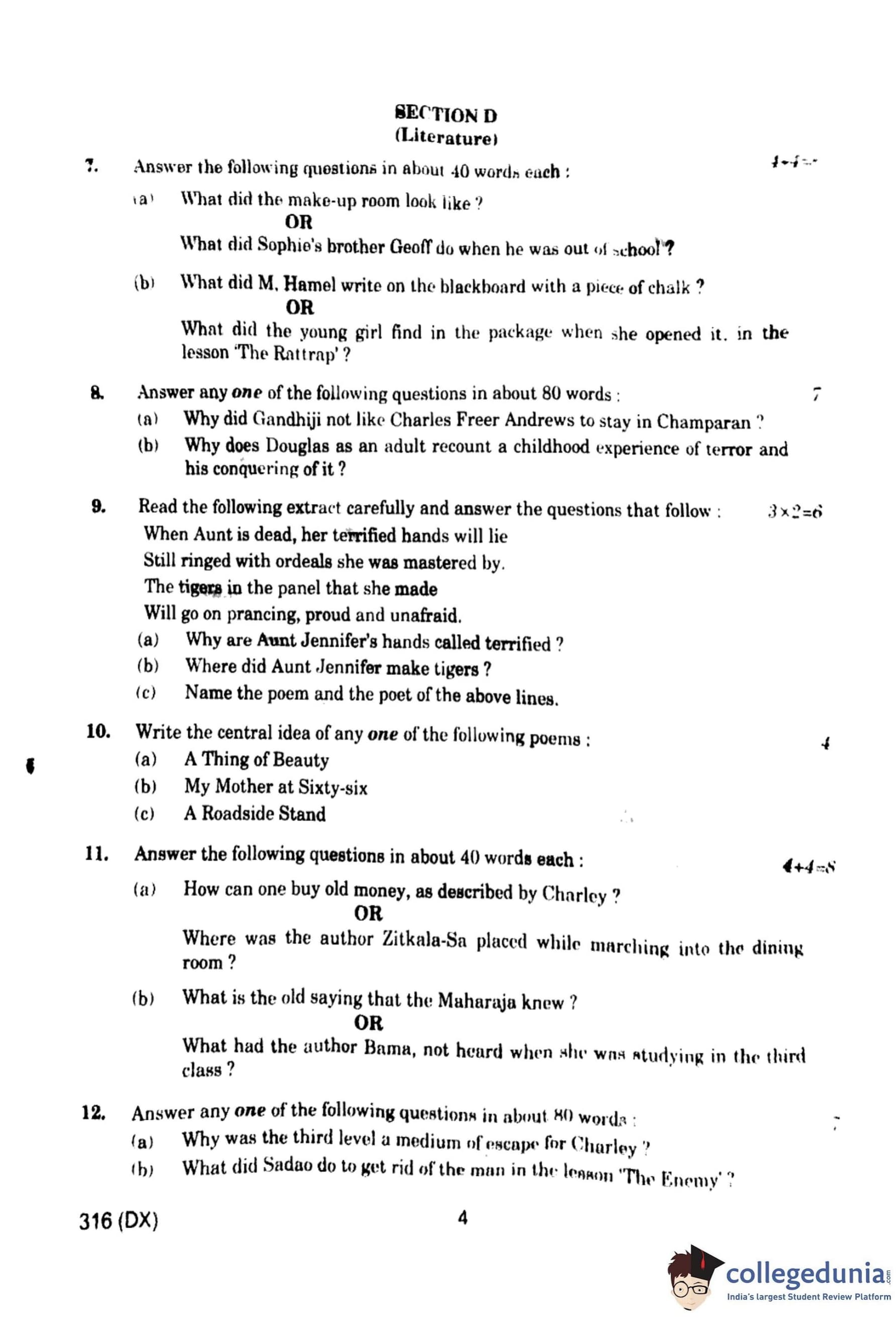
(a) What did the make-up room look like?
View Solution
The make-up room was described as a large, spacious room filled with mirrors, tables, and chairs. The lights around the mirrors gave it a theatrical feel, and it was a place where actors prepared themselves for their roles. There was an air of excitement and preparation in the room.
Quick Tip: When describing a room or setting, focus on key sensory details such as sight, sound, and mood to create a vivid picture.
(b) What did Sophie’s brother Geoff do when he was out of school?
View Solution
Sophie’s brother Geoff was a mechanic. When he was not in school, he spent his time working at a garage, repairing cars and learning the trade. Geoff was focused on his work, and his occupation was an important part of his life.
Quick Tip: When answering questions about characters, provide context from the text and link it to their behavior and role in the story.
(c) What did M. Hamel write on the blackboard with a piece of chalk?
View Solution
M. Hamel wrote "Vive la France!" on the blackboard with a piece of chalk. This was a passionate expression of patriotism, as he wanted to inspire his students to cherish their language and culture, especially during the time of the German occupation.
Quick Tip: When explaining symbolic actions, relate them to the broader themes of the text, such as patriotism or resistance.
(a) Why did Gandhiji not like Charles Freer Andrews to stay in Champaran?
View Solution
Gandhiji did not like Charles Freer Andrews to stay in Champaran because he felt that Andrews, being a British man, might overshadow the Indian leadership and reduce the impact of the movement led by the local leaders. Gandhiji wanted the people of Champaran to lead their own struggle for justice, without relying on foreign assistance or influence. His approach was to empower the people to take charge of their own destinies.
Quick Tip: When analyzing character motivations, focus on their beliefs and how they reflect the broader social or political context.
(b) Why does Douglas as an adult recount a childhood experience of terror and his conquering of it?
View Solution
Douglas recounts his childhood experience of terror to highlight the transformative journey he went through, from being terrified of water to overcoming that fear and becoming confident. His struggle with fear and its eventual conquest serves as a lesson in personal growth, self-determination, and the power of facing one’s fears. By sharing his experience, Douglas encourages others to confront their fears, no matter how daunting they may seem.
Quick Tip: Use personal experiences to illustrate universal lessons and encourage empathy or understanding in the audience.
Question 9:
Extract:
When Aunt is dead, her terrified hands will lie
Still ringed with ordeals she was mastered by.
The tigers in the panel that she made
Will go on prancing, proud and unafraid.
(a) Why are Aunt Jennifer’s hands called terrified?
View Solution
Aunt Jennifer’s hands are called terrified because they symbolize her fear and
submission to the oppressive patriarchal system. Even after her death, the fear of societal
expectations and norms is reflected in her hands.
(b) Where did Aunt Jennifer make tigers?
View Solution
Aunt Jennifer created the tigers on a panel of embroidery. These tigers represented
her suppressed desires for freedom and courage, traits she could not exhibit in her own life.
(c) Name the poem and the poet of the above lines.
View Solution
The poem is ”Aunt Jennifer’s Tigers,” and the poet is Adrienne Rich.
Question 10:
Write the central idea of any one of the following poems:
(a) A Thing of Beauty
View Solution
John Keats’ poem ”A Thing of Beauty” emphasizes the everlasting joy and solace
that beautiful things provide. It conveys how beauty in nature and art offers hope and respite
amidst life’s struggles and sorrows.
(b) My Mother at Sixty-six
View Solution
Kamala Das’ poem ”My Mother at Sixty-six” explores the emotional pain of
separation and the inevitability of aging and death. It reflects the poet’s love, concern, and
helplessness as she confronts her mother’s frailty.
(c) A Roadside Stand
View Solution
Robert Frost’s poem ”A Roadside Stand” highlights the struggles of rural people
who seek urban prosperity. It critiques the disparity between rural and urban life, focusing on
the exploitation and neglect faced by the poor.
(a) How can one buy old money, as described by Charley?
View Solution
According to Charley, one can buy old money from coin dealers. Old currency, no
longer in circulation, is sought by collectors and can sometimes be used to recreate an
atmosphere of the past.
(b) Who was the author Zitkala-Sa placed under while marching into the dining room?
View Solution
Zitkala-Sa was placed under the strict watch of a matron while marching into the
dining room. This reflects the rigid and oppressive discipline imposed on the Native
American children in boarding schools.
(a) What impression do you form of Dr. Sadao, both as a doctor and a human being, on the basis of the story "The Enemy"?
View Solution
Dr. Sadao is portrayed as a skilled and dedicated surgeon who prioritizes his
ethical duty to save lives, even if it involves risks. As a human being, he exhibits compassion
and integrity, helping the injured American soldier despite the political tension between their
countries.
(b) How did the Maharaja fulfill his vow? What dangers did he face while fulfilling it?
View Solution
The Maharaja fulfilled his vow of killing a hundred tigers to avoid his foretold
death by hunting them relentlessly. He faced dangers such as attacks by ferocious tigers and
the threat of losing his throne due to neglecting his administrative duties. However, his
obsession ultimately led to unforeseen consequences.



Comments