




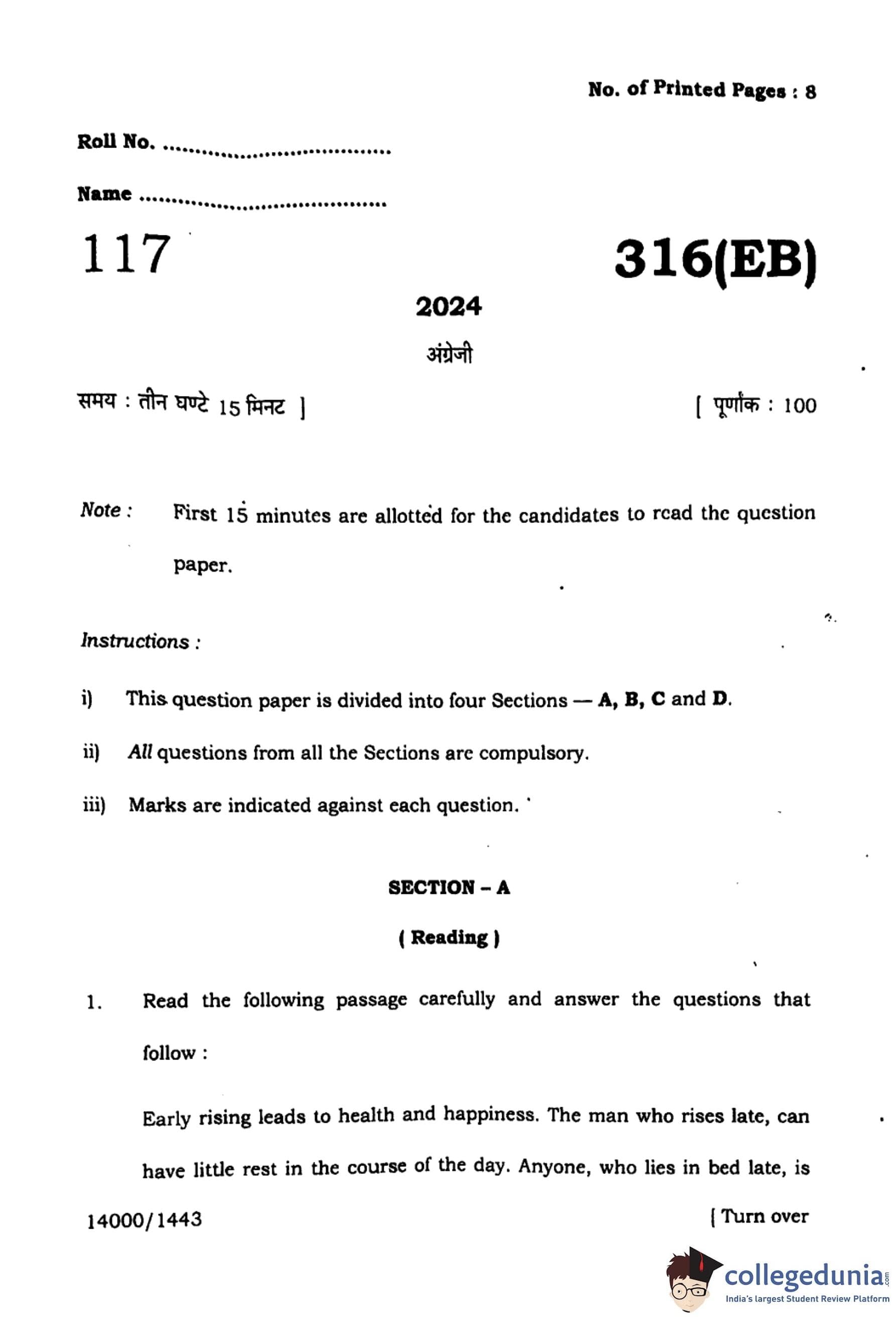
UP Board Class 12 English Question Paper 2024 PDF (Code 316 EB) is available for download here. The English exam was conducted on March 2, 2024 in the Evening Shift from 2 PM to 5:15 PM. The total marks for the theory paper are 100. Students reported the paper to be easy to moderate.
UP Board Class 12 English Question Paper 2024 (Code 316 EB) with Solutions
| UP Board Class 12 English Question Paper with Answer Key |  Download Download |
Check Solution |
UP Board Class 12 English Questions with Solutions
Question 1:
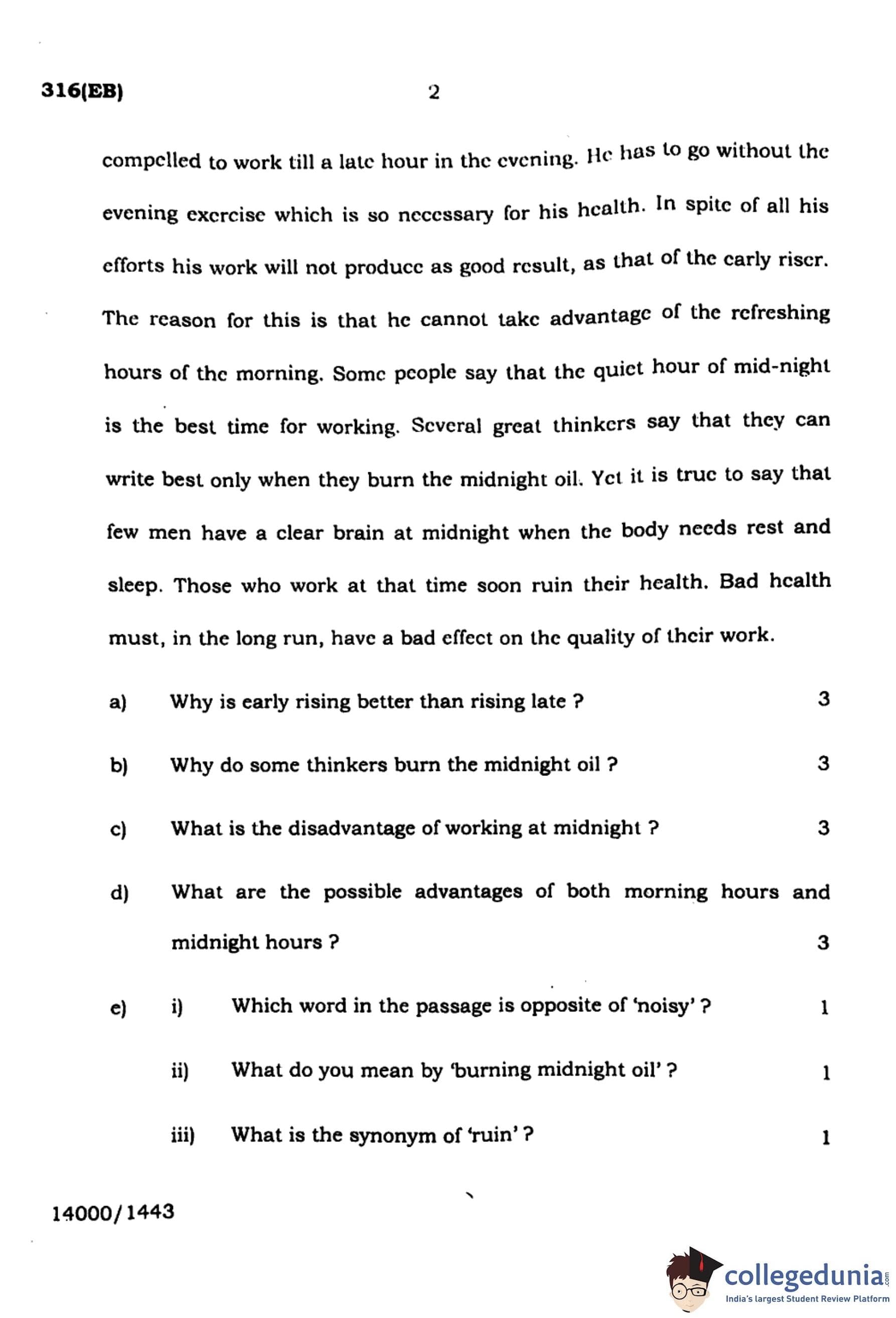
Early rising leads to health and happiness. The man who rises late, can have little rest in the
course of the day. Anyone, who lies in bed late, is compelled to work till a late hour in the
evening. He has to go without the evening exercise which is so necessary for his health. In
spite of all his efforts, his work will not produce as good a result, as that of the early riser.
Read More
The reason for this is that he cannot take advantage of the refreshing hours of the morning.
Some people say that the quiet hour of midnight is the best time for working. Several great
thinkers say that they can write best only when they burn the midnight oil. Yet it is true to
say that few men have a clear brain at midnight when the body needs rest and sleep. Those
who work at that time soon ruin their health. Bad health must, in the long run, have a bad
effect on the quality of their work.
(a) Why is early rising better than rising late?
View Solution
The passage explains that early rising helps individuals remain more productive throughout the day and supports good health. Those who rise late cannot enjoy these benefits as their routine is disrupted. Early rising allows individuals to take advantage of the refreshing hours of the morning, leading to better productivity and good health.
Quick Tip: Focus on the advantages explicitly stated in the passage for similar questions.
(b) Why do some thinkers burn the midnight oil?
View Solution
The passage states that several great thinkers find the midnight hours peaceful and ideal for working as it ensures no distractions, allowing for better concentration. Some thinkers believe that the quiet hours of midnight provide an environment conducive to creative and focused work.
Quick Tip: For reasoning-based questions, always identify the rationale or belief system mentioned in the passage.
(c) What is the disadvantage of working at midnight?
View Solution
The passage highlights that those who work at midnight deprive their body of essential rest, leading to health issues that affect their overall quality of life and work. Working at midnight leads to poor health in the long run as the body requires rest and sleep during these hours.
Quick Tip: Pay attention to the drawbacks explicitly mentioned in the passage for similar questions.
(d) What are the possible advantages of both morning hours and midnight hours?
View Solution
The passage mentions that morning hours help with health and happiness due to their refreshing nature, whereas midnight hours provide peace and quiet, which some thinkers find beneficial for creativity and deep work. Morning hours are refreshing and promote productivity, while midnight hours are quiet and ideal for focused work.
Quick Tip: For comparison questions, list the benefits of each element separately for clarity.
(e) (i) Which word in the passage is opposite of 'noisy'?
View Solution
N/A Quick Tip: For vocabulary questions, focus on contextual clues provided in the passage.
(e) (ii) What do you mean by 'burning midnight oil'?
View Solution
N/A Quick Tip: For phrase-based questions, refer to the context in which the phrase is used in the passage.
(e) (iii) What is the synonym of 'ruin'?
View Solution
N/A Quick Tip: For synonym questions, identify words in the passage with a similar meaning.
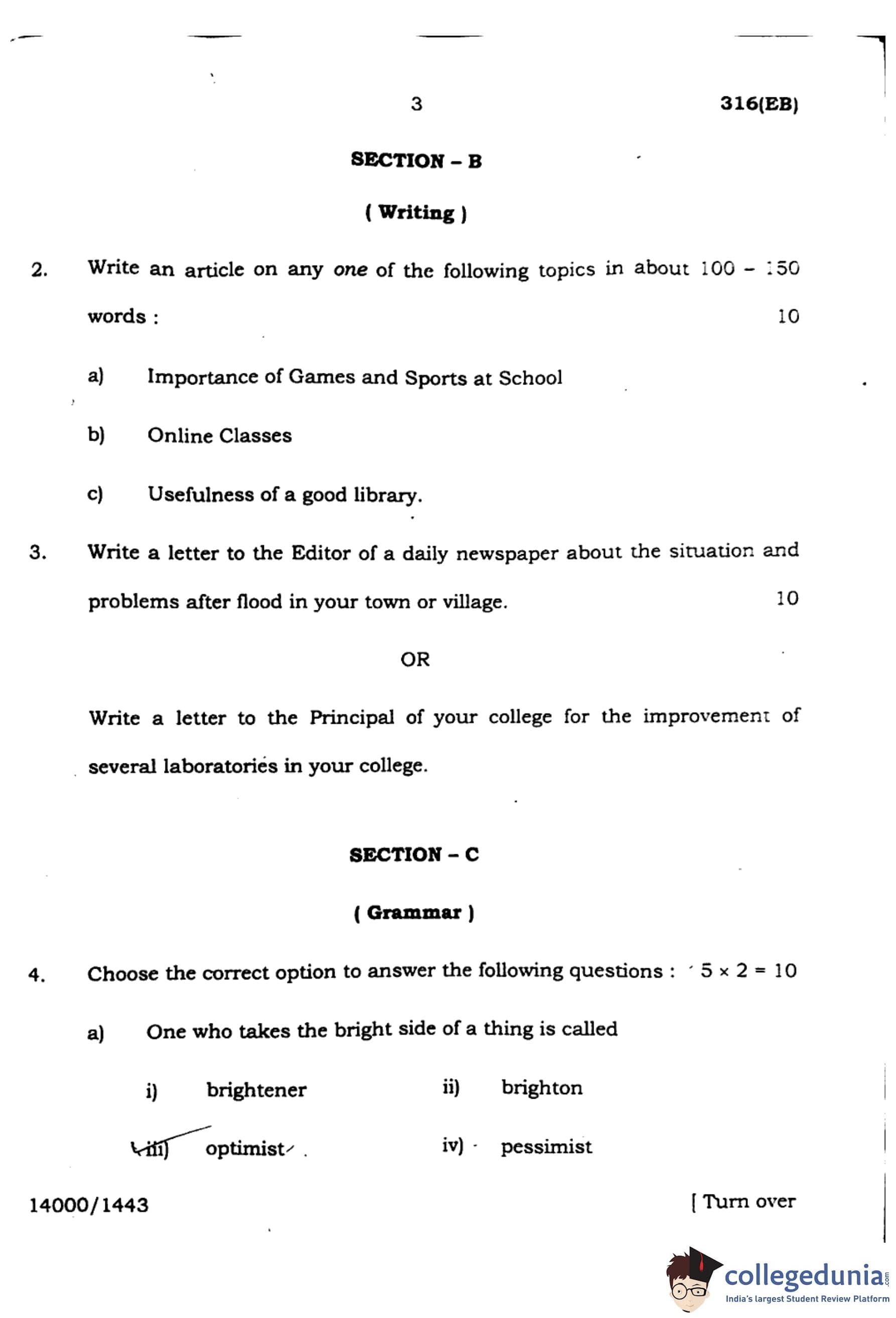
Question 2: Write an article on any one of the following topics in about 100 - 150 words.
(a) Importance of Games and Sports at School
View Solution
Games and sports play an essential role in the holistic development of students. They not only ensure physical fitness but also teach important life skills like teamwork, discipline, and perseverance. Participating in sports helps students relieve stress and boosts their concentration. A balance between academics and sports makes a child confident and well-rounded. Quick Tip: When writing about "Importance," focus on benefits and support them with examples.
(b) Online Classes
View Solution
Online classes have revolutionized education by enabling students to learn from anywhere. With flexible schedules, they provide opportunities for self-paced learning. However, they require a strong internet connection and self-discipline. Online classes are especially helpful during situations like pandemics when physical attendance is impossible. They bridge the gap between educators and learners, making education accessible to everyone. Quick Tip: Highlight both advantages and challenges while discussing online education.
(c) Usefulness of a Good Library
View Solution
A good library is a treasure trove of knowledge. It provides access to books on diverse topics, which helps broaden one’s perspective. Libraries create a quiet environment for focused learning and research. They also encourage the habit of reading, which enriches vocabulary and comprehension. A well-stocked library is essential for any educational institution. Quick Tip: Mention specific features of a library and their impact on learning.
Write a letter to the Editor of a daily newspaper about the situation and problems after a flood in your town or village.
View Solution
To,
The Editor,
The Daily News,
[Your City]
Subject: Problems Faced After the Recent Flood
Sir/Madam,
I wish to draw your attention to the hardships faced by residents in my town due to the recent flood. Many families have lost their homes and belongings. The waterlogging has led to severe health issues like the spread of diseases. Clean drinking water and basic amenities are unavailable. Immediate action from the authorities is needed to restore normalcy.
I request you to highlight this issue in your newspaper to attract the attention of concerned authorities.
Yours sincerely,
[Your Name]
Quick Tip: For formal letters, maintain proper formatting: address, subject, salutation, body, and conclusion.
(a) One who takes the bright side of a thing is called
(i) brightener
(ii) brighton
(iii) optimist
(iv) pessimist
View Solution
The word "optimist" refers to someone who always sees the positive or bright side of things, as per its definition.
Quick Tip: For vocabulary-based questions, focus on the meanings of words and their contextual usage.
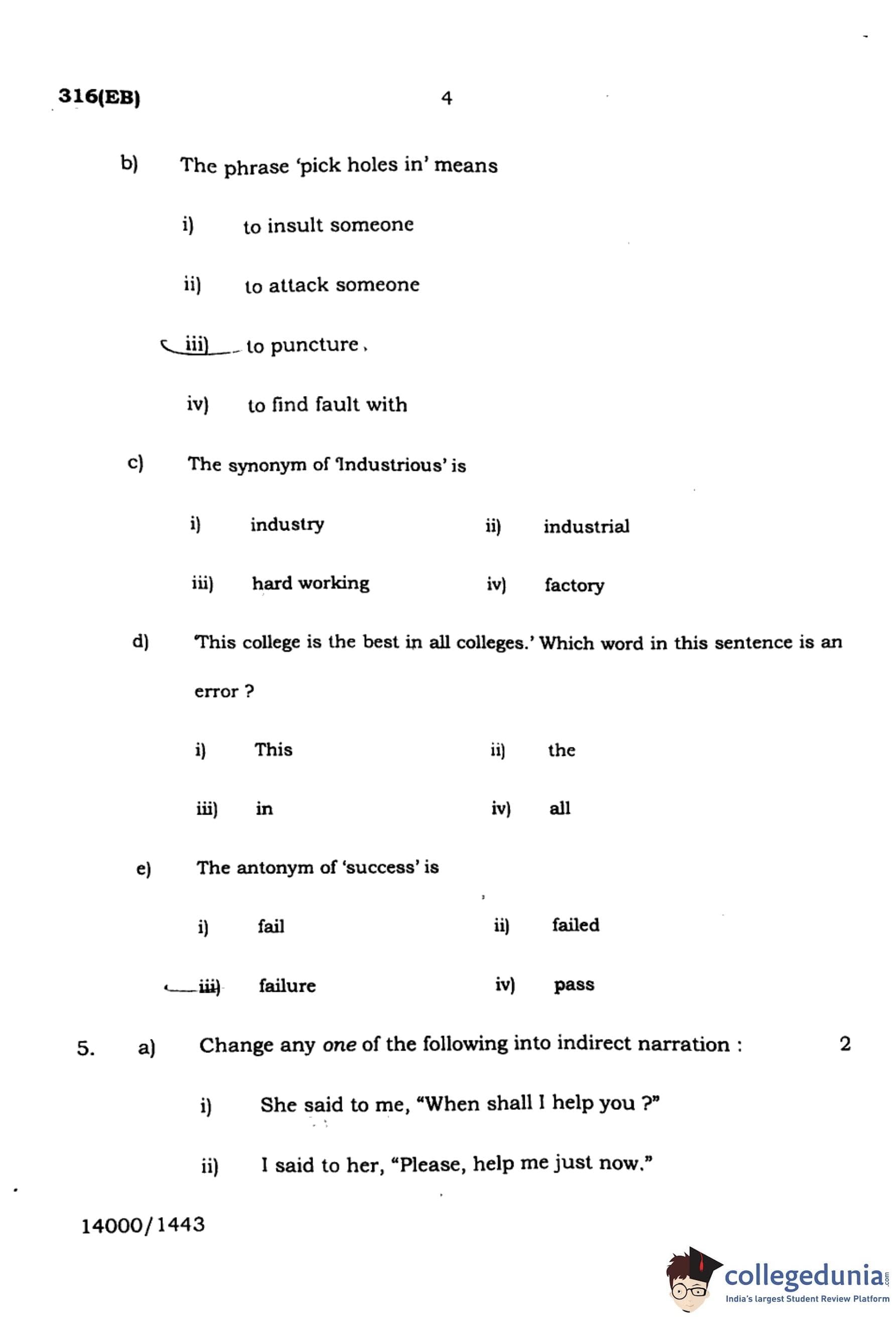
(b) The phrase 'pick holes in' means:
(i) to insult someone
(ii) to attack someone
(iii) to puncture
(iv) to find fault with
View Solution
The phrase 'pick holes in' refers to finding fault or pointing out flaws in something, especially to criticize.
Quick Tip: For phrases or idioms, think about their figurative meaning instead of the literal one.
(c) The synonym of 'industrious' is:
(i) industry
(ii) industrial
(iii) hard working
(iv) factory
View Solution
The word 'industrious' means diligent or hard working, which is the closest synonym.
Quick Tip: For synonyms, focus on the closest word that matches the given context.
(d) 'This college is the best in all colleges.' Which word in this sentence is an error?
(i) This
(ii) the
(iii) in
(iv) all
View Solution
The word 'all' is redundant in this sentence because 'the best' already signifies comparison among all colleges. Removing 'all' makes the sentence grammatically correct.
Quick Tip: Focus on redundancy or unnecessary words in error-identification questions.
(e) The antonym of 'success' is:
(i) fail
(ii) failed
(iii) failure
(iv) pass
View Solution
The word 'failure' is the exact opposite of 'success' and is the appropriate antonym.
Quick Tip: For antonyms, consider words that convey the opposite meaning in the given context.
(i) She said to me, "When shall I help you?"
View Solution
She asked me when she would help me. Quick Tip: In indirect narration, convert the question format into a statement and adjust the tense accordingly.
(ii) I said to her, "Please, help me just now."
View Solution
I requested her to help me immediately. Quick Tip: For polite requests in indirect speech, use 'requested' instead of 'said' and adjust the time expressions.
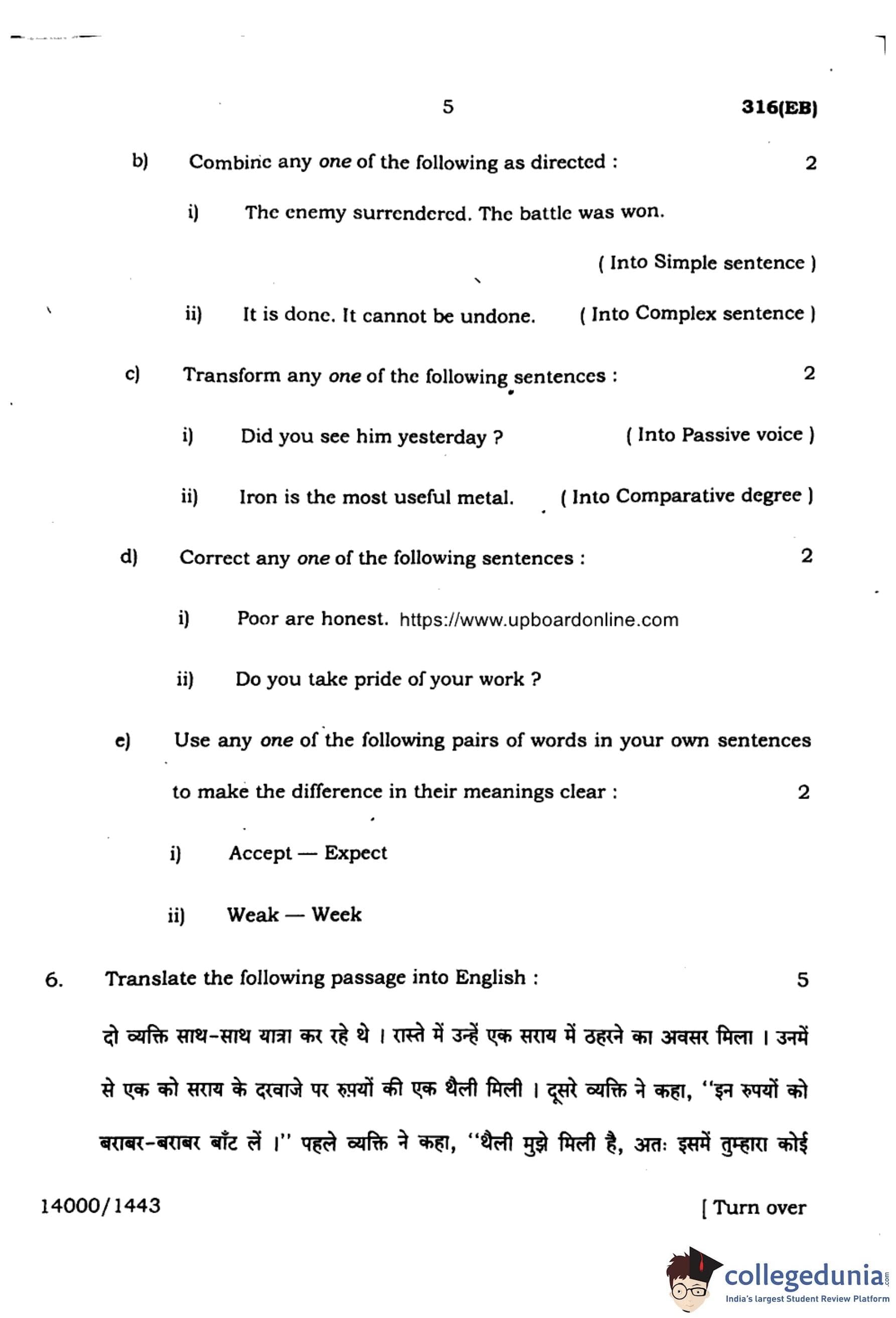
(i) The enemy surrendered. The battle was won. (Into Simple sentence)
View Solution
The enemy surrendered, and the battle was won. Quick Tip: When combining into a simple sentence, focus on using conjunctions like "and" or "but" effectively.
(ii) It is done. It cannot be undone. (Into Complex sentence)
View Solution
Once it is done, it cannot be undone. Quick Tip: For complex sentences, use subordinating conjunctions like "once," "because," or "although."
(i) Did you see him yesterday? (Into Passive voice)
View Solution
Was he seen by you yesterday? Quick Tip: For passive voice transformation, switch the subject and object while maintaining the verb tense.
(ii) Iron is the most useful metal. (Into Comparative degree)
View Solution
Iron is more useful than any other metal. Quick Tip: When converting into comparative degree, use "more" along with "than" to compare.
(i) Poor are honest.
View Solution
The poor are honest. Quick Tip: For nouns like "poor," always use "the" to denote a specific group.
(ii) Do you take pride of your work?
View Solution
Do you take pride in your work? Quick Tip: Always use the correct prepositions like "in" for "pride in."
(i) Accept — Expect
View Solution
1. I accept your apology.
2. I expect you to arrive on time. Quick Tip: "Accept" means to agree or receive something, while "expect" refers to anticipating something.
(ii) Weak — Week
View Solution
1. He was too weak to lift the box.
2. There are seven days in a week. Quick Tip: "Weak" refers to lack of strength, while "week" denotes seven days.
Translate the following passage into English:
View Solution
Two men were traveling together. On the way, they were surrounded by a lion. One of them climbed a nearby tree. The other lay down on the ground, pretending to be dead by holding his breath. The lion sniffed him for a while and, thinking he was dead, left him alone. Then the man on the tree said, "Brother, I heard the lion whispering something in your ear. What did he say?" The man on the ground replied, "The lion told me to stay away from a companion who does not help in times of trouble."
Later, the two men resumed their journey. They reached a dense forest where dangerous wild animals roamed freely. The tree-climbing man again saved himself, while the man on the ground had to fend off the animals with his stick. He eventually succeeded in scaring them away and said to his companion, "If I do not climb the tree, does that mean I am weak? Why don't you try helping me instead?" Saying this, he walked away confidently, leaving his companion to reflect on his actions. Quick Tip: When translating, ensure the flow of the story is smooth, maintaining the original context and meaning.
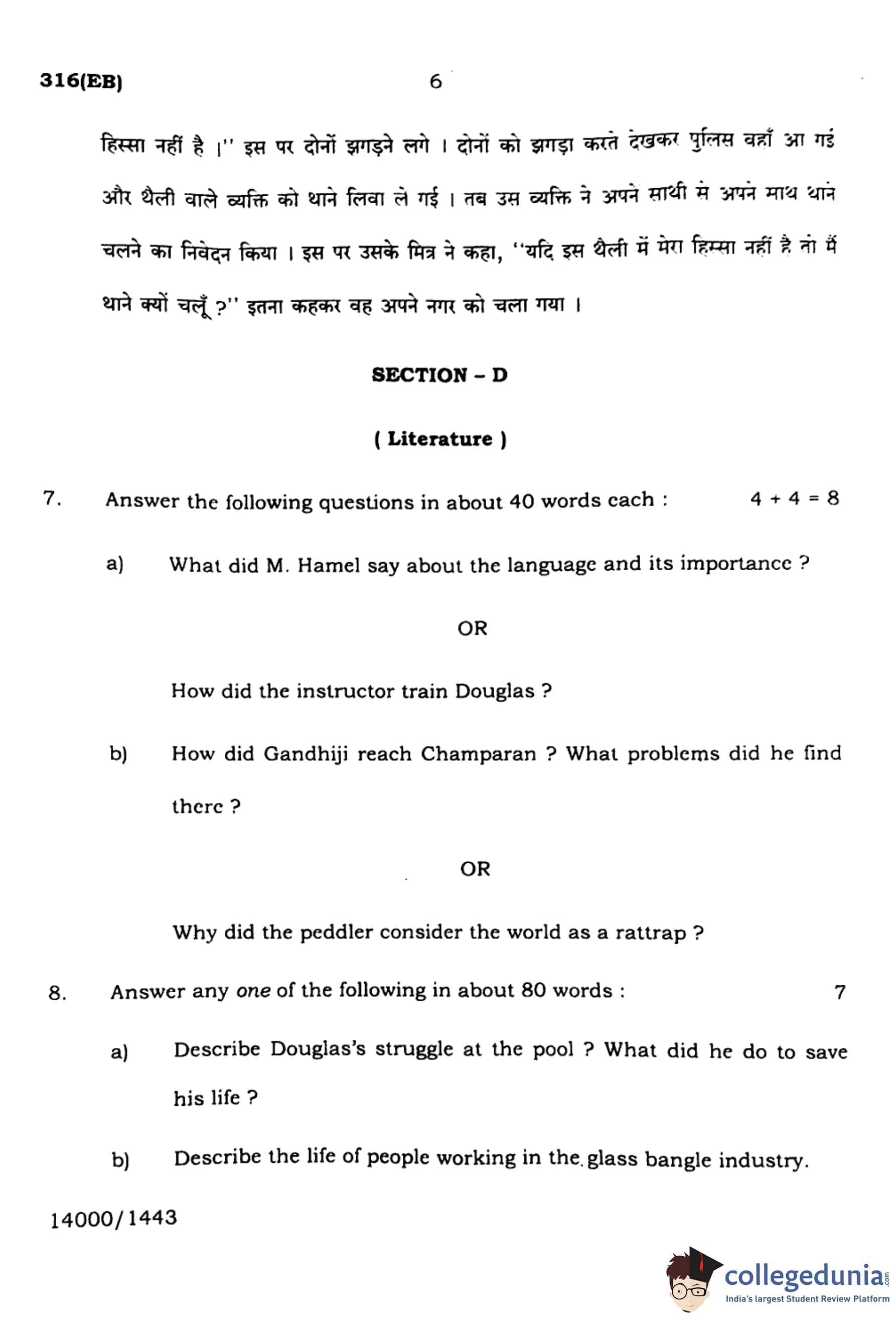
(a) What did M. Hamel say about the language and its importance?
View Solution
M. Hamel said that the French language is the most beautiful, logical, and clear language in the world. He emphasized its importance by saying that language is a key to freedom, and people should guard it and never forget it. Quick Tip: While answering questions from literature, focus on the main message or theme conveyed by the character or text.
How did the instructor train Douglas?
View Solution
The instructor trained Douglas by using a pulley system in the swimming pool to teach him how to swim. He made Douglas practice different swimming strokes repeatedly until Douglas gained confidence and overcame his fear of water. Quick Tip: Focus on specific actions or methods described in the story while answering such questions.
(b) How did Gandhiji reach Champaran? What problems did he find there?
View Solution
Gandhiji went to Champaran after hearing about the plight of indigo farmers. He discovered that the farmers were exploited by British landlords, who forced them to grow indigo on a part of their land and charged unfair rents. Quick Tip: While discussing events, mention the reason, action, and result in a concise manner.
Why did the peddler consider the world as a rattrap?
View Solution
The peddler considered the world a rattrap because it offered materialistic temptations, like cheese in a rattrap, to entangle people. He believed that greed and desires trapped humans, just as rats are trapped in a rattrap. Quick Tip: Explain metaphors or symbolic ideas with clarity and examples from the text.
(a) Describe Douglas's struggle at the pool. What did he do to save his life?
View Solution
Douglas was pushed into the deep end of a swimming pool by an older boy, which triggered his fear of drowning. He struggled desperately, trying to reach the surface, but kept sinking. Finally, he used all his strength to make one last attempt to save himself and managed to grab the edge of the pool. This horrifying experience motivated him to overcome his fear of water later. Quick Tip: While answering descriptive questions, highlight key events and their impact on the character.
(b) Describe the life of people working in the glass bangle industry.
View Solution
The lives of people working in the glass bangle industry are filled with hardships. They work in dim, poorly ventilated rooms with high temperatures, which harm their health. Most workers, including children, suffer from blindness or other illnesses due to long hours of exposure to heat and glass dust. They live in poverty and cannot escape the vicious cycle of debt and exploitation. Quick Tip: When discussing socio-economic conditions, include specific challenges and their effects on the individuals or community.
Question 9:
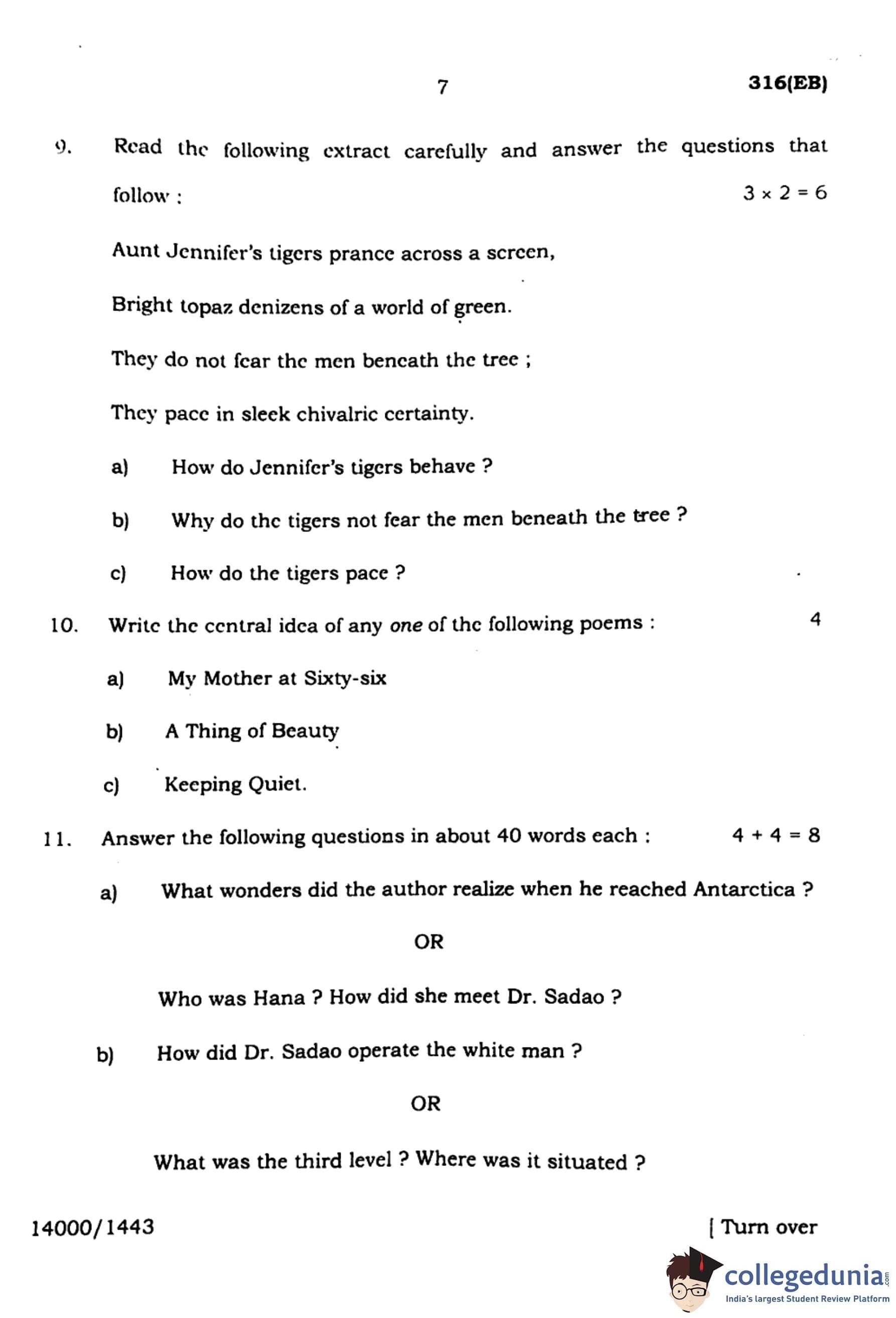
Aunt Jennifer’s tigers prance across a screen,
Bright topaz denizens of a world of green.
They do not fear the men beneath the tree;
They pace in sleek chivalric certainty.
(a) How do Jennifer’s tigers behave?
View Solution
Aunt Jennifer’s tigers behave fearlessly and confidently. They move with elegance, prancing across the screen with majestic certainty. Quick Tip: When answering literary questions, focus on the imagery and adjectives used in the poem.
(b) Why do the tigers not fear the men beneath the tree?
View Solution
The tigers do not fear the men beneath the tree because they symbolize strength, fearlessness, and freedom from human oppression. Quick Tip: For symbolic questions, interpret the underlying meaning represented in the poem.
(c) How do the tigers pace?
View Solution
The tigers pace with a sleek and chivalric certainty, symbolizing their dignity, confidence, and independence. Quick Tip: Look for keywords in the lines of the poem to frame your answer concisely.
(a) My Mother at Sixty-six
View Solution
The poem "My Mother at Sixty-six" by Kamala Das reflects the poet’s emotional pain and fear of losing her aging mother. It portrays the universal theme of human mortality and the inevitability of separation from loved ones. Quick Tip: Focus on the emotional tone and main theme while explaining the central idea.
(b) A Thing of Beauty
View Solution
The poem "A Thing of Beauty" by John Keats emphasizes the everlasting joy and solace that beautiful things bring to our lives. It highlights the ability of nature and art to provide comfort and uplift the human spirit. Quick Tip: Discuss the timeless and universal appeal of beauty while framing the central idea.
(c) Keeping Quiet
View Solution
The poem "Keeping Quiet" by Pablo Neruda conveys the importance of introspection and maintaining silence to understand oneself and others better. It advocates for peace, unity, and a pause from human conflicts. Quick Tip: Highlight the poet’s message and moral lesson while discussing the central idea.
(a) What wonders did the author realize when he reached Antarctica?
View Solution
The author realized the magnificence of Antarctica’s vast white expanse and its pristine environment. He became aware of the delicate balance of the ecosystem and the harmful effects of human activities on the planet’s fragile biodiversity. Quick Tip: Focus on the author’s observations and reflections while answering such questions.
Who was Hana? How did she meet Dr. Sadao?
View Solution
Hana was Dr. Sadao’s wife. They met at an American university while both were pursuing their studies. Hana impressed Sadao with her grace, intelligence, and charm, and they later got married. Quick Tip: Provide background and context while explaining relationships or character introductions.
(b) How did Dr. Sadao operate the white man?
View Solution
Dr. Sadao operated on the white man with great care and expertise. He removed the bullet from the man’s body, sterilized the wound, and stitched it up, ensuring that the man received the best medical treatment despite the risks involved. Quick Tip: Focus on the sequence of events and the character’s emotions while describing actions.
What was the third level? Where was it situated?
View Solution
The third level was a fictional and mysterious platform at Grand Central Station. It symbolized an escape from the modern world’s stress and chaos, offering a portal to a simpler and peaceful time. Quick Tip: For symbolic concepts, explain their literal and metaphorical meanings.
(a) Who was the psychiatrist? What did he say about the third level?
View Solution
The psychiatrist was a friend of Charley, the protagonist of the story "The Third Level." He dismissed Charley’s experience of the third level at Grand Central Station as a hallucination caused by his modern life’s stress and escapism. According to the psychiatrist, Charley’s longing for the third level was a psychological escape mechanism to cope with the uncertainties and pressures of contemporary life. Quick Tip: When answering such questions, include the character’s role, their statements, and the context in which they are discussed.
(b) Why did the king kill the hundredth tiger?
View Solution
The king in "The Tiger King" killed the hundredth tiger to fulfill a prophecy that he would die because of a tiger. Obsessed with proving the prophecy wrong, he hunted and killed tigers relentlessly. However, the hundredth tiger he "killed" was not actually killed by him but by his hunters. Ironically, the prophecy came true when he died because of a wooden tiger's sliver while playing with it. Quick Tip: Highlight the king’s motive, actions, and the irony of the outcome while explaining such questions.




Comments