




UP Board Class 12 English Question Paper 2025 PDF (Code 316 IB) is available for download here. The Mathematics exam was conducted on March 12, 2025 in the Evening Shift from 2:00 PM to 5:15 PM. The total marks for the theory paper are 100. Students reported the paper to be easy to moderate.
UP Board Class 12 English Question Paper 2025 (Code 316 IB) with Solutions
| UP Board Class English Question Paper with Answer Key |  Download Download |
Check Solutions |

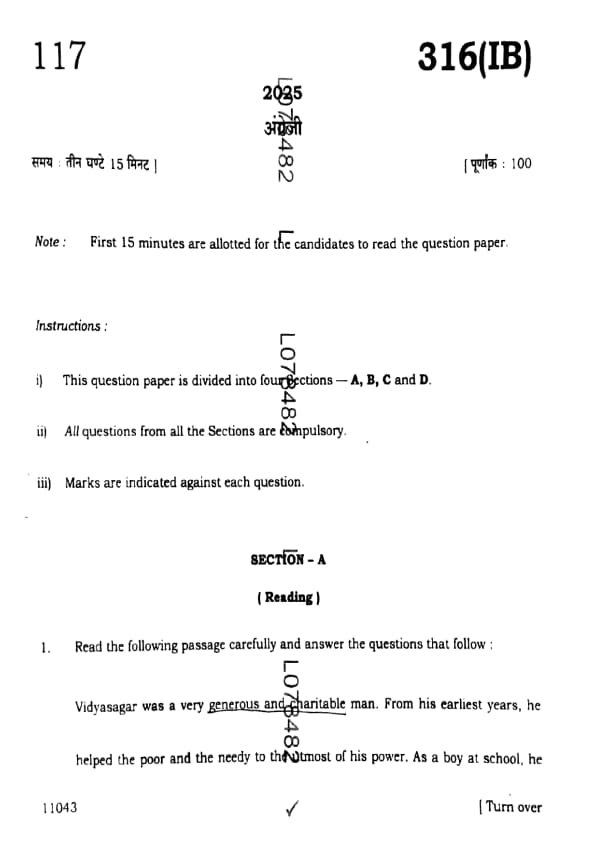
Read the following passage carefully and answer the questions that follow:
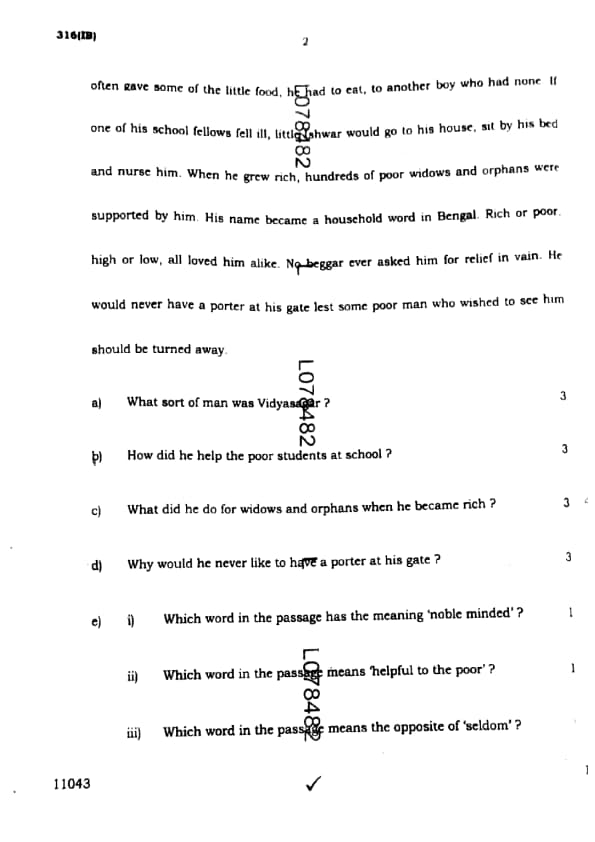
VidyaSagar was a very generous and charitable man. From his earliest years, he helped the poor and the needy to the utmost of his power. As a boy at school, he often gave some of the little food he had to eat to another boy who had none. If one of his school fellows fell ill, little Ishwar would go to his house, sit by his bed and nurse him. When he grew rich, hundreds of poor widows and orphans were supported by him. His name became a household word in Bengal. Rich or poor, high or low, all loved him alike. No beggar ever asked him for relief in vain. He would never have a porter at his gate lest some poor man who wished to see him should be turned away.
Question 1:
(a) What sort of man was Vidyasagar?
View Solution
Step 1: His Generosity and Charity.
Vidyasagar was a very generous and charitable person. From a young age, he had a habit of helping the poor, providing food to those who were in need, and assisting his sick schoolmates.
Step 2: Support in Adulthood.
When he became wealthy, he continued to help others by providing support to poor widows and orphans.
Step 3: His Reputation.
His charitable acts were well-known, and people from all walks of life loved him for his kindness.
Final Answer: \[ \boxed{Vidyasagar was a generous and charitable man. He helped the poor from a young age and continued to do so as an adult, supporting widows and orphans. He was loved by all for his kindness.} \] Quick Tip: When discussing a character's traits, highlight both their actions and the impact these actions have on others.
When Vidyasagar became rich, he supported hundreds of poor widows and orphans.
View Solution
Step 1: Widows and Orphans.
When Vidyasagar grew wealthy, he continued his tradition of helping the underprivileged. He supported many poor widows and orphans, ensuring they received the care they needed.
Step 2: The Impact.
His charitable actions helped those in dire circumstances, improving their lives and providing them with essential support.
Final Answer: \[ \boxed{Vidyasagar supported hundreds of poor widows and orphans when he became rich.} \] Quick Tip: When describing a character's contributions, highlight the scale and impact of their actions.
Q. d) Why would he never like to have a porter at his gate?
View Solution
Step 1: Not Wanting to Exclude.
Vidyasagar’s humility and generosity led him to refuse having a porter at his gate. He did not want any poor person who wished to meet him to be denied access, even if they could not afford to pay for entry.
Step 2: Respect for All.
His action showed that he valued everyone equally and wished to keep his doors open to all, regardless of their social or financial standing.
Final Answer: \[ \boxed{Vidyasagar would never like to have a porter at his gate because he didn't want to turn away any poor person wishing to meet him.} \] Quick Tip: A refusal to set boundaries based on wealth highlights a character's belief in equality and respect for all.
Q. e) i) Which word in the passage has the meaning 'noble minded'?
View Solution
Step 1: Identify the word in the passage that conveys 'noble minded'.
The word “generous” in the passage reflects the meaning of being 'noble minded', as Vidyasagar was always kind, giving, and had a noble spirit.
Final Answer: \[ \boxed{The word 'generous' in the passage means 'noble minded'.} \] Quick Tip: In literary passages, pay attention to adjectives that describe the character's traits as they often reveal deeper meanings.
Q. e) ii) Which word in the passage means 'helpful to the poor'?
View Solution
Step 1: Identify the word in the passage that means 'helpful to the poor'.
The word “charitable” directly indicates someone who is helpful to the poor, as it describes Vidyasagar’s willingness to help others, especially those in need.
Final Answer: \[ \boxed{The word 'charitable' means 'helpful to the poor'.} \] Quick Tip: Look for words that denote actions or characteristics tied to kindness or generosity when identifying meanings in context.
Q. e) iii) Which word in the passage means the opposite of 'seldom'?
View Solution
Step 1: Identify the opposite of 'seldom' in the passage.
The word “always” is the opposite of “seldom”. It conveys the idea of something happening frequently or regularly, as opposed to rarely.
Final Answer: \[ \boxed{The word 'always' means the opposite of 'seldom'.} \] Quick Tip: Look for context clues to identify opposite meanings, especially when paired with adverbs of frequency like 'always' and 'seldom'.
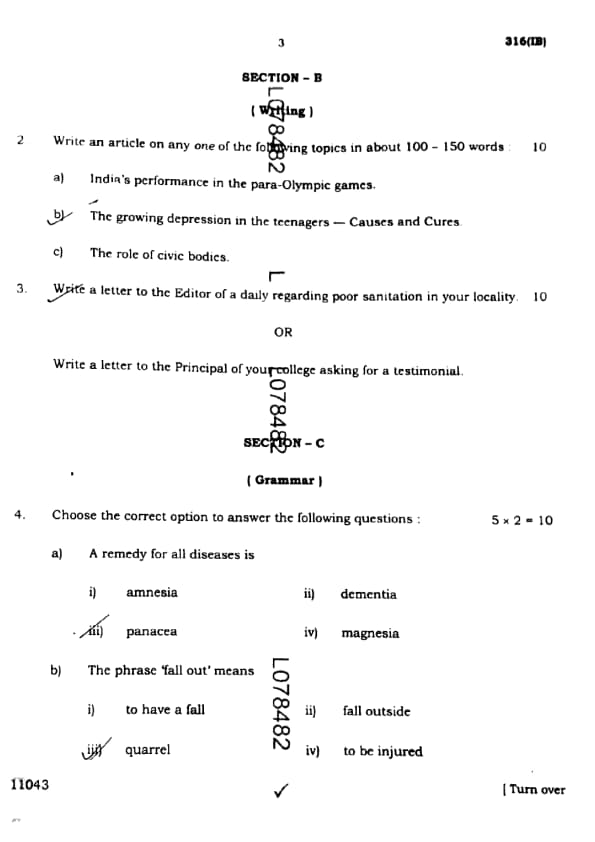
Write an article on any one of the following topics in about 100-150 words:
(a) India's performance in the para-Olympic games.
View Solution
Step 1: Introduction to the Para-Olympic Games.
The Para-Olympic Games are held every four years for athletes with physical disabilities. It is a significant event for showcasing the abilities of differently-abled individuals, and India's performance in these games has been gradually improving.
Step 2: India’s Progress in the Games.
India’s participation in the Para-Olympics has seen a steady rise in both the number of participants and medals won. Indian athletes have broken records, with a remarkable performance in sports like athletics, powerlifting, and badminton.
Step 3: Achievements and Recognition.
In recent Para-Olympics, India’s athletes have earned a respectable number of medals, and they have gained significant recognition. These achievements have inspired many young athletes in India and increased awareness about para-sports.
Step 4: Future Outlook.
The government and various organizations have started providing better facilities for para-athletes, which is expected to further enhance India's performance in future games. The support for these athletes is expected to grow, paving the way for more success on the global stage.
Final Answer: \[ \boxed{India’s performance in the Para-Olympic Games has improved significantly, with more athletes participating and achieving success in events like athletics and powerlifting. The future looks promising with better facilities and support.} \] Quick Tip: Supporting and providing facilities for para-athletes is crucial for their success in global events.
(a) Letter to the Editor regarding poor sanitation in your locality.
View Solution
Sender's Address:
XYZ Street, ABC Locality,
City Name - 12345.
Date:
1st September 2025
Receiver's Address:
The Editor,
The Daily Times,
City Name - 67890.
Subject:
Poor Sanitation in XYZ Locality
Dear Sir/Madam,
I am a resident of XYZ locality, and I would like to draw your attention to the worsening condition of sanitation in our area. Despite numerous complaints to the local municipal office, there has been no improvement in the situation. The streets are often littered with garbage, and the drains are overflowing, creating a breeding ground for diseases.
\
This issue has been affecting the health of the residents, especially children and the elderly. The smell of rotting waste has become unbearable, and it is becoming increasingly difficult to walk on the streets.
I request you to highlight this problem in your esteemed daily so that the concerned authorities are made aware of the dire situation and take immediate action to resolve it.
Yours faithfully,
[Your Name]
Final Answer: \[ \boxed{Letter to the Editor regarding poor sanitation in XYZ locality.} \] Quick Tip: When writing a letter to the editor, ensure you clearly state the problem, its impact, and the action you expect from the authorities.
Choose the correct option to answer the following questions:
(a) A remedy for all diseases is:
View Solution
Step 1: Understanding the terms.
- Amnesia refers to a condition of memory loss.
- Dementia is a broad category of brain diseases that cause long-term cognitive decline.
- Panacea refers to a universal remedy, often used to describe a solution for all problems or diseases.
- Magnesia is a type of magnesium used in medicine but is not a universal remedy.
Step 2: Conclusion.
The correct term for a remedy for all diseases is panacea.
Final Answer: The correct answer is (C) panacea.Quick Tip: When dealing with terms related to medicine, panacea is the term that signifies a universal cure, unlike other specific conditions or treatments.
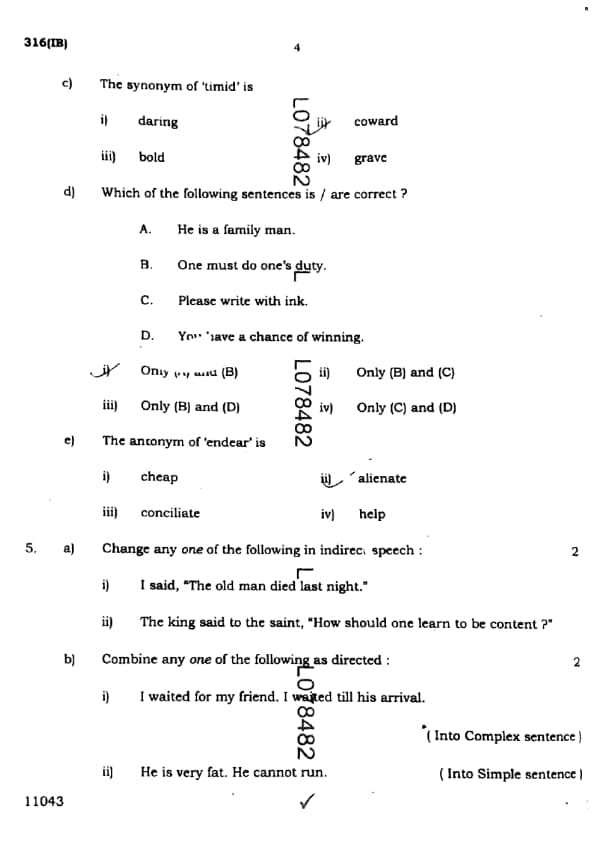
(c) The synonym of 'timid' is:
View Solution
Step 1: Understanding the word 'timid'.
- Timid means lacking courage or confidence.
- Coward is someone who is afraid and lacks bravery, which is the opposite of boldness or daring.
Step 2: Conclusion.
The synonym of timid is coward, as both refer to a lack of courage.
Final Answer: \[ \boxed{The correct answer is (B) coward.} \] Quick Tip: When identifying synonyms, focus on words that share similar meanings or express the same concept, in this case, a lack of courage.
(d) Which of the following sentences is/are correct?
(A) He is a family man.
(B) One must do one's duty.
(C) Please write with ink.
(D) You have a chance of winning.
View Solution
Step 1: Analyzing each sentence.
- (A) "He is a family man." - This sentence is grammatically correct.
- (B) "One must do one's duty." - This sentence is grammatically correct and follows the proper usage of the possessive pronoun "one's."
- (C) "Please write with ink." - This sentence is incorrect as it should use the phrase "Please write in ink."
- (D) "You have a chance of winning." - This sentence is grammatically correct.
Step 2: Conclusion.
The correct sentences are (B) and (D).
Final Answer: \[ \boxed{The correct answer is (iii) Only (B) and (D).} \] Quick Tip: When analyzing sentence correctness, pay attention to proper prepositions and possessive forms to ensure grammatical accuracy.
(e) The antonym of 'endear' is:
View Solution
Step 1: Understanding the word 'endear'.
- Endear means to cause someone to be loved or liked.
- Alienate means to make someone feel isolated or unfriendly, which is the opposite of endearing someone.
Step 2: Conclusion.
The antonym of endear is alienate.
Final Answer: \[ \boxed{The correct answer is (B) alienate.} \] Quick Tip: Antonyms refer to words that express the opposite meanings. In this case, "alienate" means to estrange, which is the opposite of "endear."
a) Change any one of the following into indirect speech:
(i) I said, "The old man died last night."
View Solution
Step 1: Identifying Direct Speech.
The given sentence is in direct speech. Direct speech involves quoting the exact words of a person. The sentence has a reporting verb "said" and uses quotation marks.
Step 2: Converting to Indirect Speech.
In indirect speech, the quotation marks are removed, and the reporting verb "said" is usually followed by "that." The tense of the reporting verb may also change. The sentence structure will change accordingly.
Step 3: Converting the Sentence.
Indirect Speech: I said that the old man had died the previous night.
Final Answer: \[ \boxed{I said that the old man had died the previous night.} \] Quick Tip: When converting direct speech to indirect speech, pay attention to changes in tense and pronouns, and remove quotation marks.
b) Combine any one of the following as directed:
(i) I waited for my friend. I waited till his arrival. (Into Complex sentence)
View Solution
Step 1: Understanding the task.
We need to combine two sentences into one complex sentence. A complex sentence contains an independent clause and a dependent clause.
Step 2: Combining the sentences.
The sentence "I waited for my friend." can be combined with "I waited till his arrival." by adding a subordinating conjunction to form a complex sentence.
Step 3: Final Complex Sentence.
Complex Sentence: I waited for my friend until he arrived.
Final Answer: \[ \boxed{I waited for my friend until he arrived.} \] Quick Tip: When forming a complex sentence, use subordinating conjunctions like "until," "because," or "although" to connect the independent and dependent clauses.
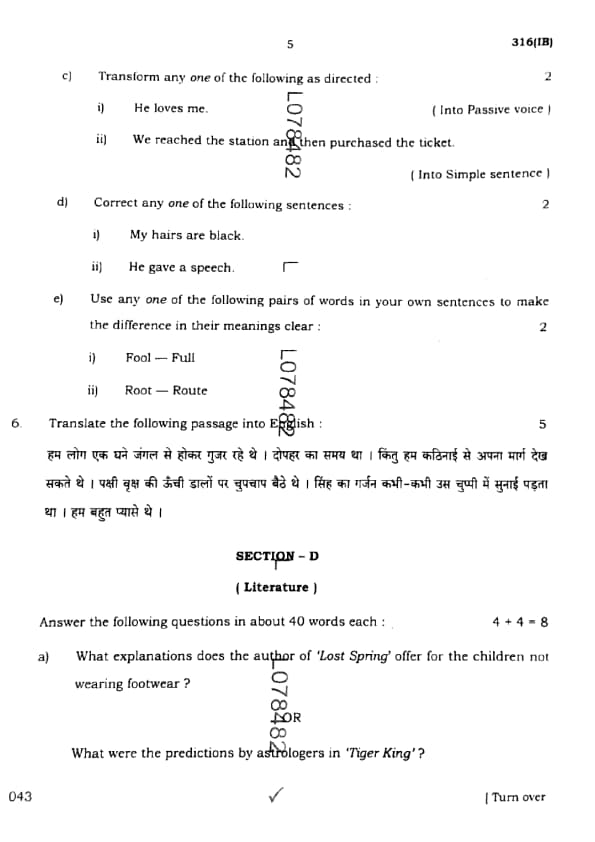
c) Transform any one of the following as directed:
(i) He loves me. (Into Passive voice)
View Solution
Step 1: Understanding the sentence.
The given sentence "He loves me" is in the active voice. In passive voice, the subject and object switch places, and the verb is changed accordingly.
Step 2: Converting to Passive Voice.
In passive voice, the object of the active sentence becomes the subject of the passive sentence. The verb "loves" changes to "is loved."
Step 3: Final Passive Voice Sentence.
Passive Sentence: I am loved by him.
Final Answer: \[ \boxed{I am loved by him.} \] Quick Tip: When converting to passive voice, remember that the object of the active sentence becomes the subject of the passive sentence, and the verb is changed to its past participle form.
d) Correct any one of the following sentences:
(i) My hairs are black.
View Solution
Step 1: Identifying the error.
The sentence "My hairs are black." contains an error in the use of the word "hairs." The word "hair" is generally uncountable and does not require the plural form "hairs" unless referring to individual strands in a specific context.
Step 2: Correcting the sentence.
The correct form should use the singular form "hair," as it is a mass noun when referring to the collective strands.
Step 3: Corrected Sentence.
Corrected Sentence: My hair is black.
Final Answer: \[ \boxed{My hair is black.} \] Quick Tip: Use "hair" as an uncountable noun when referring to it collectively, and avoid using the plural form unless referring to individual strands.
e) Use any one of the following pairs of words in your own sentences to make the difference in their meanings clear:
(i) Fool - Full
View Solution
Sentence using "Fool":
The man who walked into the meeting without any preparation was a complete fool.
Sentence using "Full":
The cup is full of water, and it cannot hold any more.
Explanation:
- Fool refers to a person who acts in a silly or unwise manner.
- Full refers to something that is completely filled or contains the maximum amount.
Final Answer: \[ \boxed{Fool refers to a person who lacks judgment, while full refers to something that is filled to capacity.} \] Quick Tip: When using homophones or similar-sounding words, ensure the sentence's meaning clarifies the distinct definitions of the words.
Answer the following questions in about 40 words each:
(a) What explanations does the author of 'Lost Spring' offer for the children not wearing footwear?
View Solution
Step 1: Identifying the Situation.
In 'Lost Spring,' the author describes the hardships faced by poor children who are forced to work instead of going to school. They come from poor families and cannot afford basic necessities like footwear.
Step 2: Author's Explanation.
The author explains that these children, due to their impoverished conditions, often walk barefoot as they are unable to buy shoes. Their primary concern is survival, and wearing shoes is not a priority.
Step 3: Conclusion.
The lack of footwear symbolizes the deprivation these children face and highlights the larger issue of child labor and poverty.
Final Answer: \[ \boxed{The author explains that the children in 'Lost Spring' cannot afford footwear because they come from poor families and are forced to work for survival, with no means to buy shoes.} \] Quick Tip: When explaining social issues, highlight the causes and how they affect individuals' lives, such as poverty and child labor in this case.
What were the predictions by astrologers in 'Tiger King'?
View Solution
Step 1: Setting the Context.
In the story 'Tiger King,' astrologers predict that the king will die when he kills 100 tigers. The astrologer also warns that the king should stop hunting tigers to avoid his impending death.
Step 2: The Predictions.
The astrologers predicted that the king’s actions would lead to his downfall, and this prophecy comes true when he is killed by a tiger. They also predict that the king’s own death would bring a curse upon him.
Step 3: Conclusion.
The predictions of the astrologers are central to the story, highlighting themes of fate and superstition.
Final Answer: \[ \boxed{In 'Tiger King,' the astrologers predict that the king will die when he kills 100 tigers, and that his actions will bring a curse upon him. These predictions come true when the king is killed by a tiger.} \] Quick Tip: When explaining predictions or prophecies, focus on the significance of the event and how it impacts the story or character development.
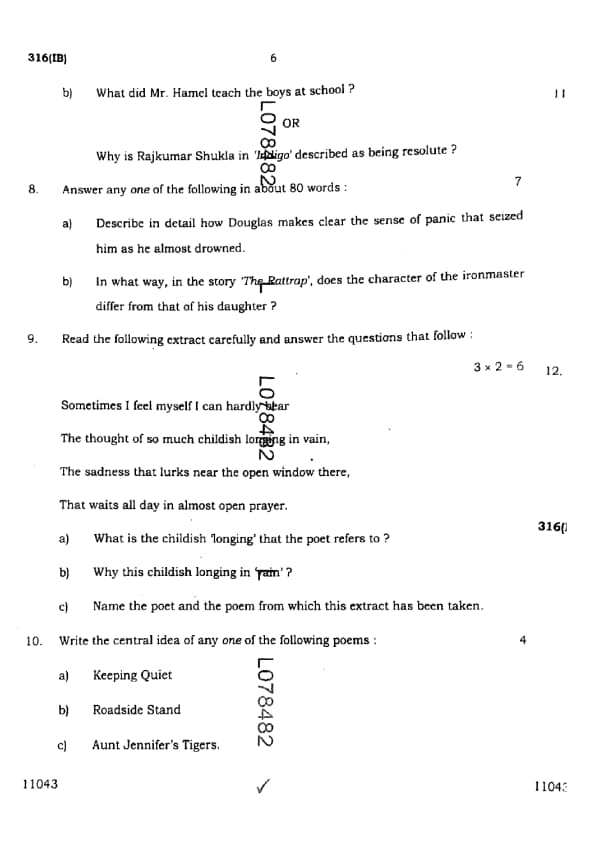
b) What did Mr. Hamel teach the boys at school?
View Solution
Step 1: Identifying the Subject.
In the story 'The Last Lesson,' Mr. Hamel was the teacher at a school in Alsace. The boys in his class were learning various subjects, but on that particular day, Mr. Hamel focused on teaching them French, as it was the last lesson he would be giving.
Step 2: The Subjects Taught.
Mr. Hamel taught French grammar and spelling to the boys. He emphasized the importance of the French language and reminded the boys of its significance for their identity and culture.
Step 3: Conclusion.
He also imparted a lesson on patriotism and loyalty to the country, as it was the last opportunity for the students to learn their mother tongue before the imposition of the German language.
Final Answer: \[ \boxed{Mr. Hamel taught the boys French grammar and spelling. He emphasized the importance of their mother tongue and also spoke about patriotism and loyalty to their country.} \] Quick Tip: When answering questions related to a story, always focus on the main lesson taught and the context of the lesson being given.
Why is Rajkumar Shukla in 'Indigo' described as being resolute?
View Solution
Step 1: Understanding Rajkumar Shukla's Role.
In the story 'Indigo' by Louis Fischer, Rajkumar Shukla is described as being resolute due to his determination to bring Mahatma Gandhi to Champaran to fight for the rights of indigo farmers.
Step 2: Shukla's Persistence.
Despite being a poor farmer, Shukla showed remarkable resolve by following Gandhi across different places until Gandhi agreed to visit Champaran and take action against the injustice faced by the farmers.
Step 3: Conclusion.
Rajkumar Shukla's unwavering determination and persistence in pursuing a noble cause is why he is described as resolute.
Final Answer: \[ \boxed{Rajkumar Shukla is described as being resolute due to his unwavering determination to bring Gandhiji to Champaran to fight for the rights of the indigo farmers.} \] Quick Tip: To understand why a character is described in a certain way, focus on their actions and persistence in overcoming obstacles to achieve their goals.
Answer any one of the following in about 80 words:
(a) Describe in detail how Douglas makes clear the sense of panic that seized him as he almost drowned.
View Solution
Step 1: Setting the Scene.
Douglas was swimming in a lake when a wave knocked him down. At first, he tried to swim back to the shore, but he quickly realized that he had no strength left. His body was exhausted, and he could not keep himself afloat.
Step 2: Panic Sets In.
As Douglas struggled, panic seized him. He was overwhelmed by a fear that he would drown. His thoughts were muddled, and he began to feel that death was inevitable. He felt his body becoming numb and was unable to control his movements.
Step 3: Conclusion.
The feeling of panic intensified as he realized there was no escape from the drowning waters, and the fear of death became all-consuming until he finally managed to fight his way to safety.
Final Answer: \[ \boxed{Douglas vividly describes how panic overcame him as he struggled against the waters, realizing his imminent danger. His fear intensified as he felt himself slipping into death's grasp, but he eventually managed to reach safety.} \] Quick Tip: When describing emotions like panic, focus on the physical and mental symptoms, such as irrational thoughts and physical weakness, to effectively convey the intensity of the feeling.
(b) In what way, in the story 'The Rattrap', does the character of the ironmaster differ from that of his daughter?
View Solution
Step 1: Character Analysis of the Ironmaster.
In 'The Rattrap,' the ironmaster is a man of wealth and status. He initially views the peddler with skepticism and as someone beneath his notice. However, his actions later reveal his softer side, as he shows kindness by inviting the peddler to stay and offering him a chance to redeem himself.
Step 2: Character Analysis of the Daughter.
In contrast, the ironmaster's daughter, Edla, is much more compassionate and empathetic. She instantly recognizes the peddler as a fellow human being in need of help. She treats him with respect and kindness, offering him shelter and not questioning his background.
Step 3: Conclusion.
While the ironmaster is initially cold and judgmental, Edla shows warmth and understanding. Their differing attitudes toward the peddler highlight their contrasting personalities—one hardened by status, the other softened by compassion.
Final Answer: \[ \boxed{The ironmaster is initially skeptical and distant, viewing the peddler with judgment, while his daughter Edla is compassionate and empathetic, offering kindness without question. Their differing attitudes highlight their contrasting personalities.} \] Quick Tip: When comparing characters, focus on their actions and attitudes toward others to highlight their differences. In this case, the ironmaster and Edla's treatment of the peddler serves as a contrast between cold judgment and warm empathy.
Read the following extract carefully and answer the questions that follow:
Extract:
Sometimes I feel myself I can hardly bear
The thought of so much childish longing in vain,
The sadness that lurks near the open window there,
That waits all day in almost open prayer.
(a) What is the childish 'longing' that the poet refers to?
View Solution
Step 1: Identifying the Longing.
In the extract, the poet refers to the childish longing as a feeling of unfulfilled desire. This longing represents the yearning for something that cannot be attained, possibly referring to innocence, happiness, or a longing for something lost.
Step 2: Emotional Connotation.
The longing mentioned in the extract is associated with sadness and helplessness, as it "lurks" near the window, suggesting a sense of yearning that remains unfulfilled and painful.
Step 3: Conclusion.
Thus, the poet describes a nostalgic or sorrowful longing that is impossible to satisfy.
Final Answer: \[ \boxed{The childish longing referred to by the poet is an unfulfilled yearning for something, possibly lost innocence or happiness, that remains unattainable.} \] Quick Tip: When interpreting emotional longing in literature, consider the words used to describe the feeling, such as "vain," "sadness," and "lurks," which suggest an unfulfilled or unreachable desire.
(b) Why this childish longing in 'vain'?
View Solution
Step 1: Understanding 'In Vain.'
The term "in vain" suggests that the longing is futile and will not be fulfilled. The use of this phrase indicates that the desire or yearning felt by the poet is hopeless, as it cannot be realized.
Step 2: Emotional and Psychological Effect.
The longing is not just unfulfilled; it is described as something that causes sorrow because it is a desire that cannot be attained, emphasizing the pain of yearning for something that cannot be achieved.
Step 3: Conclusion.
Thus, the longing is "in vain" because it is ultimately futile, leading to sadness and a sense of helplessness.
Final Answer: \[ \boxed{The childish longing is in vain because it is an unattainable desire, causing sorrow and frustration due to its futility.} \] Quick Tip: When the term "in vain" is used, it often highlights the futility of an action or desire, emphasizing its unfulfilled nature.
(c) Name the poet and the poem from which this extract has been taken.
View Solution
Step 1: Identifying the Poet and Poem.
The extract has been taken from the poem "The Ballad of Father Gilligan" by W.B. Yeats. This poem reflects themes of longing, unfulfilled desires, and the emotional impact of these feelings.
Step 2: Conclusion.
The poet, W.B. Yeats, uses these themes to convey complex human emotions in the form of a ballad, making this extract a poignant moment in the poem.
Final Answer: \[ \boxed{The poet is W.B. Yeats, and the poem is 'The Ballad of Father Gilligan.'} \] Quick Tip: When identifying the poet and poem, focus on key phrases or themes that are often unique to the poet’s style and subject matter.
Write the central idea of any one of the following poems:
(a) Keeping Quiet
View Solution
Step 1: Understanding the Poem.
In the poem "Keeping Quiet" by Pablo Neruda, the poet suggests a moment of stillness and introspection. The central idea is to stop and reflect on the world and oneself. By being silent and still, people can gain clarity, appreciate the world, and realize the importance of peace.
Step 2: Poetic Imagery.
Neruda uses powerful imagery, such as the idea of counting to twelve, to symbolize a pause in life. The act of quietness is portrayed not as an absence but as a moment for deeper understanding and connection.
Step 3: Conclusion.
The central idea of the poem is to call for a break from the fast-paced, chaotic world. Through this stillness, humans can attain peace, unity, and a sense of shared purpose.
Final Answer: \[ \boxed{The central idea of 'Keeping Quiet' is about taking a moment of stillness and introspection to find peace, unity, and a deeper understanding of ourselves and the world around us.} \] Quick Tip: When interpreting poems, focus on the tone, imagery, and message conveyed by the poet to understand the central idea.
(b) Roadside Stand
View Solution
Step 1: Understanding the Poem.
In the poem "Roadside Stand" by Robert Frost, the poet reflects on the contrast between rural life and urban development. The central idea is about the plight of the poor who live in rural areas, where they are ignored by those in the cities. The roadside stand represents the hope for economic change but also exposes the exploitation and neglect of these people.
Step 2: Poetic Imagery.
Frost uses the image of a roadside stand where rural people try to sell their goods to city dwellers, who do not stop or acknowledge them. This illustrates the economic disparity between rural and urban populations.
Step 3: Conclusion.
The central idea of the poem is the theme of social inequality and the exploitation of the rural poor by the urban rich, highlighting how society overlooks the struggles of marginalized communities.
Final Answer: \[ \boxed{The central idea of 'Roadside Stand' is about the economic disparity between the rural and urban populations, with the rural poor being neglected and exploited by the city dwellers.} \] Quick Tip: When analyzing poems about social issues, focus on the symbols used, such as the "roadside stand," which represents the hopes and struggles of marginalized groups.
(c) Aunt Jennifer's Tigers
View Solution
Step 1: Understanding the Poem.
"Aunt Jennifer's Tigers" by Adrienne Rich explores the themes of oppression and the desire for freedom. The central idea of the poem is that Aunt Jennifer, who is portrayed as oppressed in her marriage, creates vibrant and strong images of tigers in her tapestry. The tigers symbolize freedom, strength, and the power she lacks in her own life.
Step 2: Poetic Imagery.
The contrast between the lively, free tigers and Aunt Jennifer's own trapped, weary life is emphasized. The tigers represent the strength and courage that Aunt Jennifer wishes she could have, but she remains bound by societal and marital constraints.
Step 3: Conclusion.
The central idea of the poem is the contrast between the vibrant, fearless tigers created by Aunt Jennifer and her own repressed and subdued existence, symbolizing the unfulfilled desire for freedom and empowerment.
Final Answer: \[ \boxed{The central idea of 'Aunt Jennifer's Tigers' is about the contrast between Aunt Jennifer's oppressive life and the vibrant, free tigers she creates, symbolizing her unfulfilled desire for freedom and empowerment.} \] Quick Tip: When interpreting a poem, look for symbols such as the tigers in this poem, which represent the contrast between the speaker's inner desires and external constraints.
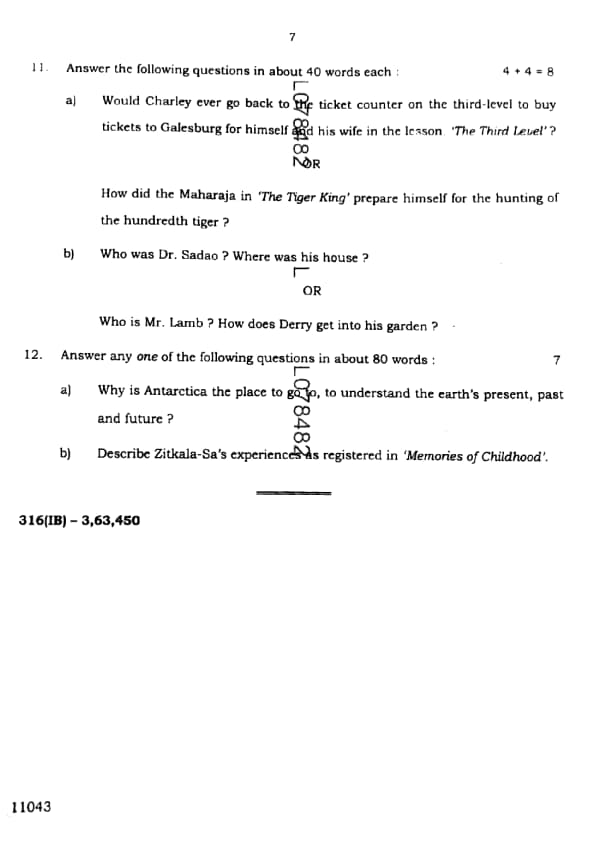
Answer the following questions in about 40 words each:
(a) Would Charley ever go back to the ticket counter on the third-level to buy tickets to Galesburg for himself and his wife in 'The Third Level'?
View Solution
Step 1: Understanding the Situation.
In 'The Third Level' by Jack Finney, Charley visits the third level of Grand Central Station, where he finds a ticket counter selling tickets to Galesburg, a place from the past. However, when he tries to return to buy tickets for his wife, he realizes that the third level was not a place that could be easily accessed.
Step 2: The Magical or Dreamlike Nature of the Third Level.
The third level seems to exist outside of time, a dreamlike and almost surreal space, where things from the past can be found. Charley believes that the third level is not a physical place he can go back to consciously.
Step 3: Charley’s Realization.
Charley recognizes that the third level was an inexplicable event that he cannot repeat. He is unsure if he will ever be able to find it again, as it was more of a mystical experience rather than a tangible reality.
Final Answer: \[ \boxed{Charley would not be able to go back to the ticket counter on the third-level, as it was a surreal and unrepeatable experience that he cannot consciously revisit.} \] Quick Tip: In magical realism, the boundaries between reality and fantasy are blurred. Focus on the surreal elements of the setting, which often cannot be revisited or explained in a logical manner.
How did the Maharaja in 'The Tiger King' prepare himself for the hunting of the hundredth tiger?
View Solution
Step 1: The Maharaja’s Determination.
In 'The Tiger King,' the Maharaja is obsessed with hunting tigers, particularly the hundredth tiger, which he believes is crucial for his legacy. He prepares for the hunt by using every possible means at his disposal, including consulting astrologers and planning every detail meticulously.
Step 2: Preparation Strategies.
The Maharaja’s obsession leads him to take extensive steps, such as tracking the tigers and ensuring that he has the best conditions for hunting. He is determined to kill the hundredth tiger, viewing it as a symbol of his strength and power.
Step 3: Consequences of His Preparation.
While preparing for the hunt, the Maharaja shows no regard for superstitions or warnings, which ultimately leads to his downfall. The hunt becomes symbolic of his hubris and obsession with power, as he ignores the consequences of his actions.
Final Answer: \[ \boxed{The Maharaja prepared for hunting the hundredth tiger by consulting astrologers, meticulously planning the hunt, and disregarding superstitions, driven by his obsession with power and legacy.} \] Quick Tip: When analyzing characters driven by obsession, focus on their actions, preparation, and disregard for consequences, as these traits often lead to their downfall.
Answer the following questions in about 40 words each:
(b) Who was Dr. Sadao? Where was his house?
View Solution
Step 1: Who Was Dr. Sadao?
Dr. Sadao was a skilled Japanese surgeon who was highly regarded for his medical expertise. He was also an army doctor during World War II. Despite his professional success, his character was marked by compassion and a deep sense of moral duty.
Step 2: Where Was His House?
Dr. Sadao’s house was located on the coast of Japan, near the sea. The house was modern and spacious, with an elegant design that reflected both the doctor’s high status and the serene environment surrounding it.
Step 3: Conclusion.
Dr. Sadao’s house was not only a place of residence but also a symbol of his success, serving as a place where his internal conflicts about duty and compassion played out, especially when he chose to save an enemy soldier.
Final Answer: \[ \boxed{Dr. Sadao was a skilled Japanese surgeon and army doctor. His house was located near the sea on the coast of Japan, reflecting his success and the quiet surroundings of his life.} \] Quick Tip: When explaining a character’s role, focus on both their professional identity and the internal conflicts they face, as these often define their actions and decisions in the narrative.
Who is Mr. Lamb? How does Derry get into his garden?
View Solution
Step 1: Who is Mr. Lamb?
Mr. Lamb is a reclusive, elderly man who lives in a large, quiet house surrounded by a beautiful garden. Despite his physical disability (he has a wooden leg), he is kind-hearted, open-minded, and enjoys interacting with people, especially children. He is known for his wisdom and for teaching life lessons to others.
Step 2: How Does Derry Get into His Garden?
Derry, a young boy with a disfigured face, climbs over the wall to enter Mr. Lamb’s garden. Initially, he is hesitant and unsure of himself, but Mr. Lamb's kind and welcoming nature soon puts him at ease. He finds comfort in the garden and starts learning important life lessons from Mr. Lamb.
Step 3: Conclusion.
Mr. Lamb’s garden represents a place of learning, acceptance, and transformation for Derry, where he gradually overcomes his insecurities and begins to embrace life.
Final Answer: \[ \boxed{Mr. Lamb is a kind and wise elderly man who lives in a house with a beautiful garden. Derry enters his garden by climbing over the wall, seeking refuge and guidance from Mr. Lamb.} \] Quick Tip: When analyzing characters who offer wisdom, focus on how they create a space for growth and learning, like Mr. Lamb’s garden, which becomes a metaphor for Derry’s personal transformation.
Answer any one of the following questions in about 80 words:
(a) Why is Antarctica the place to go to, to understand the earth's present, past, and future?
View Solution
Step 1: Understanding the Importance of Antarctica.
Antarctica plays a critical role in understanding the earth’s past, present, and future due to its unique environmental conditions. The ice sheets in Antarctica contain trapped air bubbles that serve as historical records, giving scientists insight into past climate conditions and atmospheric composition. The presence of these ice cores allows researchers to study long-term climate changes.
Step 2: Antarctica’s Climate and Ecosystem.
By analyzing the ice cores, scientists can determine how the Earth's climate has changed over thousands of years, providing a detailed picture of the planet’s past. The study of Antarctica’s ice also helps in predicting future climate trends, as the region is highly sensitive to global temperature changes.
Step 3: Conclusion.
Antarctica serves as a natural laboratory for studying both the history of Earth’s climate and how it may change in the future, making it a key location for understanding our planet’s past and future.
Final Answer: \[ \boxed{Antarctica is crucial for understanding the Earth’s present, past, and future due to its ice cores, which hold valuable data about historical climate conditions, helping scientists predict future climate trends.} \] Quick Tip: When answering questions about environmental science, emphasize the role of natural phenomena (like ice cores) in understanding long-term processes like climate change.
(b) Describe Zitkala-Sa's experiences as registered in 'Memories of Childhood'.
View Solution
Step 1: Zitkala-Sa’s Early Life and Cultural Conflict.
In 'Memories of Childhood,' Zitkala-Sa recalls her early life in her native Sioux community, where she was raised in a traditional environment. However, she was soon taken away to a missionary school, where she experienced cultural conflict and felt alienated from her heritage.
Step 2: Education and Emotional Turmoil.
At the school, Zitkala-Sa was subjected to harsh disciplinary measures and forced to abandon her native language and customs. She struggled with the imposed Western education and the loss of her cultural identity, which caused her great emotional turmoil. Her experiences were marked by a strong sense of loss and confusion.
Step 3: Resistance and Awakening.
Despite the oppressive environment, Zitkala-Sa developed a sense of resistance and eventually became more determined to fight for the rights and recognition of her people. Her experiences at the school became a catalyst for her later activism, as she sought to preserve Native American culture and traditions.
Final Answer: \[ \boxed{In 'Memories of Childhood,' Zitkala-Sa recounts her early life in her Sioux community and her painful experience at a missionary school, where she faced cultural alienation and emotional struggle. Despite this, she grew into a strong advocate for Native American rights.} \] Quick Tip: When writing about autobiographical experiences, focus on the emotional impact of cultural conflict and how it shapes the individual's future actions and identity.



Comments