




UP Board Class 12 English Question Paper 2025 PDF (Code 316 RX) is available for download here. The Mathematics exam was conducted on March 12, 2025 in the Evening Shift from 2:00 PM to 5:15 PM. The total marks for the theory paper are 100. Students reported the paper to be easy to moderate.
UP Board Class 12 English Question Paper 2025 (Code 316 RX) with Solutions
| UP Board Class English Question Paper with Answer Key |  Download Download |
Check Solutions |

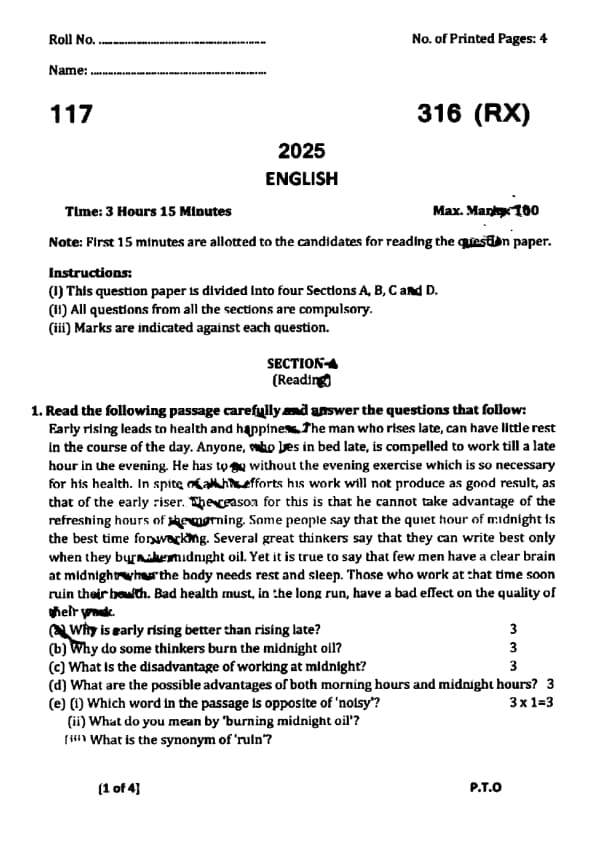
Read the following passage carefully and answer the questions that follow:
Early rising leads to health and happiness. The man who rises late can have little rest in the course of the day. Anyone, who lies in bed late, is compelled to work till a late hour in the evening. He has to go without the evening exercise which is so necessary for his health. In spite of all his efforts his work will not produce as good result, as that of the early riser. The reason for this is that he cannot take advantage of the refreshing hours of the morning. Some people say that the quiet hour of midnight is the best time for working. Several great thinkers say that they can write best only when they burn midnight oil. Yet it is true to say that few men have a clear brain at midnight when the body needs rest and sleep. Those who work at that time soon ruin their health. Bad health must, in the long run, have a bad effect on the quality of their work.
Question 1:
(a) Why is early rising better than rising late?
View Solution
Step 1: Understanding early rising.
Early rising allows the person to make the most of the fresh morning hours which are beneficial for both physical health and mental clarity.
Step 2: Comparison with late risers.
On the other hand, a late riser misses out on these hours and is compelled to work late into the night, which hampers productivity and affects overall health.
Step 3: Conclusion.
Thus, early rising is better as it ensures that a person is well-rested and can take full advantage of the productive morning hours.
Final Answer: \[ \boxed{Early rising is better than rising late because it allows the person to take advantage of the refreshing morning hours, improving both physical health and work productivity.} \] Quick Tip: Early rising promotes better mental clarity and physical health by allowing you to work during the most productive hours of the day.
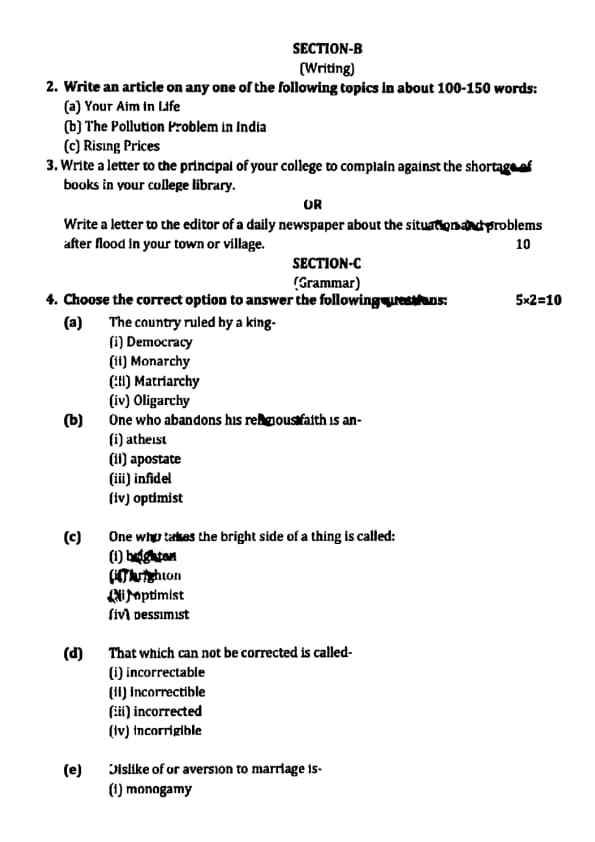
(a) Your Aim in Life
View Solution
Step 1: Introduction.
The aim in life is the driving force behind everything that we do. It provides us with the motivation to pursue our goals and ambitions. My aim in life is to become a successful doctor and serve humanity.
Step 2: Passion and Purpose.
Since my childhood, I have been fascinated by the medical field. The idea of healing people and making a difference in their lives inspires me to work hard. I want to specialize in pediatric care, as children are the future, and providing them with good health is crucial for their development.
Step 3: Challenges and Determination.
The road to becoming a doctor is not easy. It requires years of hard work, dedication, and perseverance. I am ready to face these challenges, as I am determined to achieve my goal.
Step 4: Conclusion.
In conclusion, my aim in life is not just to achieve personal success but also to contribute to society by improving the health and well-being of others.
Final Answer: \[ \boxed{My aim in life is to become a doctor, specializing in pediatric care, to serve society and improve people's health.} \] Quick Tip: When writing about personal goals, ensure that you explain the reason behind your ambition and how you plan to achieve it.
(b) The Pollution Problem in India
View Solution
Step 1: Introduction.
Pollution in India has become a severe concern. The increasing levels of air, water, and land pollution are threatening the environment and public health. Major cities like Delhi, Mumbai, and Kolkata are facing hazardous pollution levels.
Step 2: Causes of Pollution.
The primary causes of pollution in India are industrial emissions, vehicle exhaust, and deforestation. The rapid growth of industries and population has led to an increase in waste generation, while the burning of fossil fuels contributes to the deterioration of air quality.
Step 3: Effects of Pollution.
Pollution has disastrous effects on human health, causing respiratory diseases, cancer, and other health problems. The environment is also affected, leading to the loss of biodiversity and the depletion of natural resources.
Step 4: Solutions to Combat Pollution.
The government has taken steps to reduce pollution, including the implementation of stricter emission standards and promoting the use of cleaner energy. Public awareness campaigns and increased tree plantation are also essential to fight pollution.
Step 5: Conclusion.
Pollution is a grave issue that requires immediate action. With collective efforts from the government, industries, and citizens, India can overcome this environmental crisis.
Final Answer: \[ \boxed{The pollution problem in India is caused by industrial growth, vehicle emissions, and deforestation, and it poses serious health and environmental risks. Immediate action is needed to combat it.} \] Quick Tip: Focus on both the causes and solutions to create a balanced discussion on social issues like pollution.
(c) Rising Prices
View Solution
Step 1: Introduction.
Rising prices, or inflation, have become a persistent issue in India. The increasing cost of goods and services is affecting the middle class, making it harder for families to meet their daily needs.
Step 2: Causes of Rising Prices.
The primary causes of rising prices include the rising costs of raw materials, increased demand, and supply chain disruptions. Natural disasters and global price hikes also contribute to inflation.
Step 3: Effects of Rising Prices.
The effects of rising prices are severe, especially for the common man. The cost of basic goods such as food, fuel, and housing has increased, leading to financial strain for many households. The poor are the most affected, as their purchasing power is diminished.
Step 4: Solutions to Control Inflation.
To tackle rising prices, the government must control inflation through effective monetary policies, supply management, and regulation of essential goods. Encouraging local production and reducing dependence on imports can also help lower costs.
Step 5: Conclusion.
In conclusion, rising prices are a significant issue that requires government intervention and public awareness. By addressing the root causes, we can help stabilize prices and ensure economic stability for all.
Final Answer: \[ \boxed{Rising prices are caused by increased demand, supply chain disruptions, and rising raw material costs. It affects the common people, especially the poor, and requires effective government measures to control inflation.} \] Quick Tip: When writing about economic issues, emphasize both the causes and potential solutions, ensuring a comprehensive approach.
Write a letter to the principal of your college to complain against the shortage of books in your college library.
View Solution
Step 1: Letter Format.
A formal letter requires a specific structure. Begin with the sender's address, followed by the date, and then the recipient's address. Finally, use a polite and formal tone to state your complaint and request.
% Sample Letter:
Sender's Address:
Student Name
Course Name
College Name
City, State
Date: [Insert Date]
Principal's Address:
The Principal
[College Name]
[College Address]
Subject: Complaint Regarding Shortage of Books in the College Library
Dear Sir,
Introduction:
I am writing to bring to your attention the shortage of books in our college library. As a student of [course name], I have been facing great difficulty in accessing the required reference materials for my studies.
Details of the Problem:
Despite the fact that the library is a crucial part of our academic resources, it lacks a sufficient number of books on important subjects such as [subject name]. Moreover, many of the available books are outdated and no longer relevant to the current syllabus. This shortage is affecting our ability to prepare well for exams and assignments.
Request:
I kindly request that you take immediate action to address this issue by ordering new books and updating the library's collection to meet the academic needs of the students.
Conclusion:
I hope you will look into this matter and take prompt action to resolve the issue. Thank you for your attention to this matter.
Yours sincerely,
[Your Name]
[Roll Number]
[Course Name]
Final Answer: \[ \boxed{A formal letter to the principal, addressing the shortage of books in the library, should be polite, clear, and direct in its request for immediate action.} \] Quick Tip: Ensure that your letter follows the formal letter format and is concise but detailed enough to explain the issue.
Write a letter to the editor of a daily newspaper about the situation and problems after flood in your town or village.
View Solution
Step 1: Letter Format.
A formal letter to the editor follows the same structure as the previous one. It includes the sender’s address, date, the recipient’s address (the editor), and a polite tone for expressing the issue.
% Sample Letter:
Sender's Address:
[Your Name]
[Your Address]
[City, State]
Date: [Insert Date]
Editor’s Address:
The Editor
[Newspaper Name]
[Newspaper Address]
Subject: The Situation and Problems After the Recent Flood in [Town/Village Name]
Dear Sir,
Introduction:
I am writing to highlight the severe situation in our town/village after the recent flood. The flood has caused immense damage to property and lives, and the affected people are now facing numerous difficulties.
Details of the Situation:
Many homes have been submerged, and a significant portion of the town's infrastructure, including roads and bridges, has been destroyed. The floodwaters have also contaminated the local water supply, causing health concerns among the residents. Additionally, essential services such as medical aid and food supply are not reaching the affected areas on time.
Request for Help:
I urge the concerned authorities to take immediate action to provide relief to the victims. This includes the provision of clean drinking water, medicines, and the restoration of infrastructure. I also request that the government and NGOs come forward to help rebuild the community.
Conclusion:
The residents of our town/village are in desperate need of assistance, and I hope that by raising awareness through your esteemed newspaper, we can draw attention to this grave situation.
Yours faithfully,
[Your Name]
[Your Address]
Final Answer: \[ \boxed{A letter to the editor should clearly highlight the issues caused by the flood and request urgent attention and aid from the government and organizations.} \] Quick Tip: When writing letters to the editor, ensure that you present the situation factually and provide a clear call for action.
Choose the correct option to answer the following questions:
(a) The country ruled by a king is:
View Solution
Step 1: Understanding the terms.
- Democracy refers to a system of government where power is vested in the people, typically through elected representatives.
- Monarchy is a system of government where a king, queen, or emperor rules the country.
- Matriarchy is a system where women, especially mothers, hold authority.
- Oligarchy refers to a system where power is concentrated in the hands of a small group of people.
Step 2: Conclusion.
The correct answer is Monarchy, where a king rules the country.
Final Answer: \[ \boxed{The correct answer is (B) Monarchy.} \] Quick Tip: When identifying systems of government, pay attention to who holds power: the people (democracy), a single ruler (monarchy), a specific gender (matriarchy), or a small group (oligarchy).
(b) One who abandons his religious faith is an-
View Solution
Step 1: Understanding the terms.
- Atheist is a person who does not believe in any deity or gods.
- Apostate is a person who renounces or abandons their religious faith.
- Infidel is a derogatory term used for someone who does not adhere to a particular religion, especially in the context of the dominant religion in a region.
- Optimist refers to someone who always expects the best outcomes.
Step 2: Conclusion.
The correct answer is Apostate, as it refers to someone who abandons their religion.
Final Answer: \[ \boxed{The correct answer is (B) Apostate.} \] Quick Tip: An apostate specifically refers to someone who renounces their religion, while an atheist simply does not believe in a deity.
(c) One who takes the bright side of a thing is called:
View Solution
Step 1: Understanding the terms.
- Pessimist is someone who tends to see the negative side of things.
- Cynic is a person who believes that people are motivated by self-interest and often questions others' motives.
- Optimist is a person who looks at the bright side and expects the best outcomes.
- Realist is someone who sees things as they are, focusing on the practical aspects without being overly optimistic or pessimistic.
Step 2: Conclusion.
The correct answer is Optimist, as an optimist always looks on the bright side of situations.
Final Answer: \[ \boxed{The correct answer is (C) Optimist.} \] Quick Tip: An optimist focuses on positive outcomes, while a pessimist focuses on negative possibilities.
(d) That which cannot be corrected is called:
View Solution
Step 1: Understanding the terms.
- Incorrectable refers to something that cannot be corrected, but it is not the standard usage.
- Incorrectible is not commonly used in English.
- Incorrected is grammatically incorrect.
- Incorrigible refers to someone or something that is incapable of being corrected, reformed, or improved.
Step 2: Conclusion.
The correct term is incorrigible, as it specifically refers to something that cannot be corrected.
Final Answer: \[ \boxed{(D) Incorrigible} \] Quick Tip: When choosing between similar-sounding words, focus on the one that fits best in context and is widely used in standard English.
(e) Dislike of or aversion to marriage is:
View Solution
Step 1: Understanding the terms.
- Monogamy refers to the practice or state of having one spouse at a time.
- Misogamy refers to the hatred or aversion to marriage.
- Polygamy is the practice of having more than one spouse at the same time.
- Bigamy refers to the act of marrying someone while already being married to another person.
Step 2: Conclusion.
The correct answer is Misogamy, as it specifically refers to an aversion to or hatred of marriage.
Final Answer: \[ \boxed{(B) Misogamy} \] Quick Tip: To differentiate between similar terms, focus on their meanings: misogamy is aversion to marriage, while other terms relate to marriage practices.
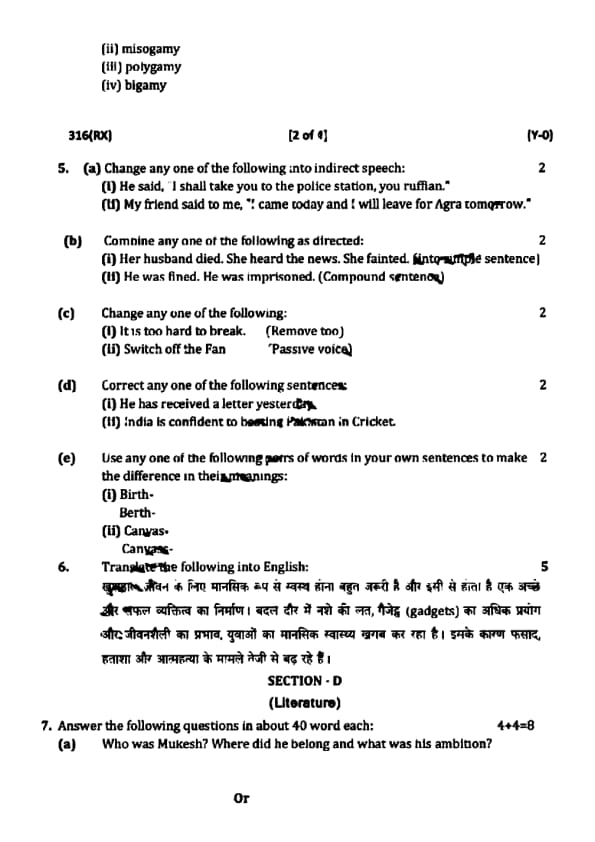
a. Change any one of the following into indirect speech:
(A) He said, "I shall take you to the police station, you ruffian."
View Solution
Step 1: Identifying Direct Speech.
The given sentence is in direct speech. It contains a quotation, where the speaker directly addresses another person. The reporting verb is "said," and the sentence is in future tense.
Step 2: Converting to Indirect Speech.
In indirect speech, we remove the quotation marks and change the reporting verb to "said that." The modal verb "shall" changes to "would" in indirect speech, and the pronouns also shift according to the context.
Step 3: Converting the Sentence.
Indirect Speech: He said that he would take me to the police station and called me a ruffian.
Final Answer: \[ \boxed{He said that he would take me to the police station and called me a ruffian.} \] Quick Tip: When converting future tense in direct speech to indirect speech, change "shall" to "would" and adjust pronouns accordingly.
(B) My friend said to me, "I came today and I will leave for Agra tomorrow."
View Solution
Step 1: Identifying Direct Speech.
The given sentence is in direct speech. It is a statement by my friend about his actions today and plans for tomorrow. The reporting verb here is "said to."
Step 2: Converting to Indirect Speech.
In indirect speech, the quotation marks are removed, and "said to me" becomes "told me." The present tense verb "came" remains the same, while the future tense "will leave" changes to "would leave" to match the past tense structure.
Step 3: Converting the Sentence.
Indirect Speech: My friend told me that he came today and would leave for Agra the next day.
Final Answer: \[ \boxed{My friend told me that he came today and would leave for Agra the next day.} \] Quick Tip: When converting direct speech that involves future tense or time expressions, ensure that the tense is appropriately shifted (e.g., "will" becomes "would" and "tomorrow" becomes "the next day").
(b) Combine any one of the following as directed:
(A) Her husband died. She heard the news. She fainted. (Into a simple sentence)
View Solution
Step 1: Understanding the task.
We are asked to combine three simple sentences into one simple sentence. A simple sentence contains a subject and a predicate, and it expresses a single idea.
Step 2: Combining the sentences.
We can combine the sentences by using the conjunction "and" to link them, while maintaining the structure of a simple sentence. The combination would look like this:
Simple Sentence: Her husband died, and upon hearing the news, she fainted.
Final Answer: \[ \boxed{Her husband died, and upon hearing the news, she fainted.} \] Quick Tip: When combining sentences into a simple sentence, use conjunctions like "and," "but," or "so" to link the ideas while ensuring the result is still a single clause.
(B) He was fined. He was imprisoned. (Compound sentence)
View Solution
Step 1: Understanding the task.
We are asked to combine two simple sentences into a compound sentence. A compound sentence consists of two independent clauses joined by a coordinating conjunction.
Step 2: Combining the sentences.
We can combine these sentences by using the conjunction "and" to form a compound sentence. The combination would look like this:
Compound Sentence: He was fined, and he was imprisoned.
Final Answer: \[ \boxed{He was fined, and he was imprisoned.} \] Quick Tip: When forming compound sentences, make sure to use a coordinating conjunction like "and," "but," or "so" to link two independent clauses.
(c) Change any one of the following:
(A) It is too hard to break. (Remove "too")
View Solution
Step 1: Understanding the Task.
We are given the sentence "It is too hard to break" and asked to remove the word "too." "Too" in this context is used to mean excessively or very. By removing "too," the sentence will still convey the general meaning but in a less emphatic manner.
Step 2: Converting the Sentence.
The sentence without "too" will be: \[ \boxed{It is hard to break.} \]
Final Answer: \[ \boxed{It is hard to break.} \] Quick Tip: When removing "too" from a sentence, ensure that the meaning remains intact, though it may become less emphatic.
(B) Switch off the fan. (Passive voice)
View Solution
Step 1: Understanding Passive Voice.
In passive voice, the object of the active sentence becomes the subject, and the verb changes accordingly. The structure typically includes a form of the verb "to be" followed by the past participle of the main verb.
Step 2: Converting the Sentence.
The sentence "Switch off the fan" is in active voice, with the subject understood (you). To convert it to passive voice, we make "the fan" the subject, and the verb "switch off" becomes "be switched off."
Step 3: Converting the Sentence.
\[ \boxed{Let the fan be switched off.} \]
Final Answer: \[ \boxed{Let the fan be switched off.} \] Quick Tip: In passive voice, the subject of the action becomes the recipient, and the verb tense must be adjusted with a form of "to be."
(d) Correct any one of the following sentences:
(A) He has received a letter yesterday.
View Solution
Step 1: Choose the sentence to correct.
We will correct sentence (A), "He has received a letter yesterday."
Step 2: Identifying the mistake.
The present perfect tense ("has received") is used to describe actions that have relevance to the present moment. However, "yesterday" refers to a specific point in the past, which should be used with the simple past tense.
Step 3: Correcting the sentence.
The corrected sentence would be: \[ \boxed{He received a letter yesterday.} \]
Final Answer: \[ \boxed{He received a letter yesterday.} \] Quick Tip: When using time expressions like "yesterday," "last week," or specific dates, use the simple past tense instead of the present perfect tense.
(B) India is confident to beating Pakistan in Cricket.
View Solution
Step 1: Identifying the mistake.
The sentence has a mistake in verb usage. The phrase "confident to" should be corrected to "confident of" as "confident" is followed by "of" when referring to a specific action.
Step 2: Correcting the sentence.
The corrected sentence would be: \[ \boxed{India is confident of beating Pakistan in Cricket.} \]
Final Answer: \[ \boxed{India is confident of beating Pakistan in Cricket.} \] Quick Tip: When using "confident," always use "of" to link it with an action or event that is expected to happen.
(e) Use any one of the following pairs of words in your own sentences to make the difference in their meanings:
(A) Birth - Berth
View Solution
Step 1: Understanding the Words.
- Birth refers to the process of being born or the start of something.
- Berth refers to a space or bed, especially on a ship, train, or vehicle.
Step 2: Creating Sentences.
- Birth: "The birth of the child brought joy to the entire family."
- Berth: "The passengers were assigned their berths in the train compartment."
Final Answer: \[ \boxed{The birth of the child brought joy to the entire family.} \] \[ \boxed{The passengers were assigned their berths in the train compartment.} \] Quick Tip: Although "birth" and "berth" sound similar, they refer to completely different concepts—birth being the start of life and berth referring to a bed or space in transport.
(B) Canvas - Canvass
View Solution
Step 1: Understanding the Words.
- Canvas refers to a strong, durable fabric used for making sails, tents, or paintings.
- Canvass refers to soliciting votes, opinions, or discussing a topic thoroughly.
Step 2: Creating Sentences.
- Canvas: "The artist worked on his painting on canvas for hours."
- Canvass: "The volunteers went door to door to canvass for support for the candidate."
Final Answer: \[ \boxed{The artist worked on his painting on canvas for hours.} \] \[ \boxed{The volunteers went door to door to canvass for support for the candidate.} \] Quick Tip: "Canvas" refers to a material used in art or construction, while "canvass" involves actively soliciting opinions or votes. Be mindful of the context when using these words.
Translate the following into English:

View Solution
The capacity of the human brain is rapidly increasing, and this is leading to a strange and new situation in the world. The increasing use of new technical gadgets and a shift in lifestyle is adversely affecting the mental health of the youth. Due to these factors, cases of stress, fatigue, and anxieties are increasing rapidly. Quick Tip: When translating from Hindi to English, make sure to maintain the meaning and structure, while converting verb forms and tenses to match English grammar.
Answer the following questions in about 40 words each:
(a) Who was Mukesh? Where did he belong and what was his ambition?
View Solution
Step 1: Identifying Mukesh's Background.
Mukesh was a poor boy living in Firozabad, a small village. He belonged to a family of glass-blowers, a traditional occupation passed down through generations. Despite this, Mukesh had a strong desire to break free from the cycle of poverty.
Step 2: Understanding Mukesh’s Ambition.
Mukesh's ambition was to become a motor mechanic. He was determined to improve his situation and escape the miserable conditions that trapped many people in his village, including his own family.
Final Answer: \[ \boxed{Mukesh was a poor boy from Firozabad, belonging to a family of glass-blowers. His ambition was to become a motor mechanic.} \] Quick Tip: When answering questions about characters' backgrounds and ambitions, be sure to mention both their family or societal background and the specific goals they aspire to achieve.
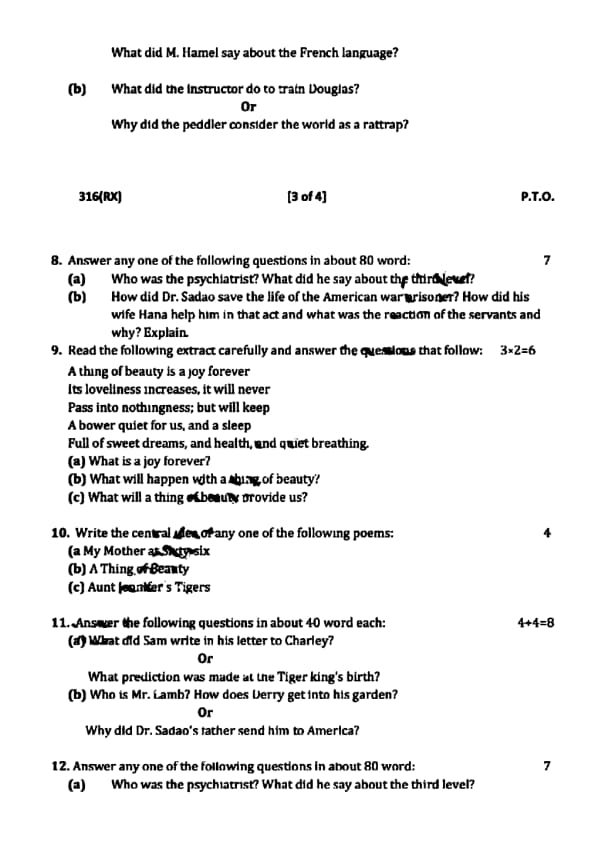
(b) What did M. Hamel say about the French language?
View Solution
Step 1: M. Hamel's Reflection on the French Language.
M. Hamel, the teacher in the story, expressed deep concern about the loss of the French language. He mentioned that it was the language of culture, civilization, and a nation’s identity. He believed that it was vital to preserve it.
Step 2: The Importance of the French Language.
He emphasized that losing the French language would mean losing the connection to the nation's heritage. M. Hamel deeply regretted the situation, as the language was being replaced by German due to political orders.
Step 3: M. Hamel’s Last Lesson.
In his final lesson, M. Hamel urged the students to learn French well and respect their mother tongue, recognizing that it was an essential part of their identity.
Final Answer: \[ \boxed{M. Hamel expressed that the French language was crucial for national identity, culture, and civilization. He stressed the importance of preserving it and regretted its replacement by German.} \] Quick Tip: When discussing the importance of language, focus on its role in shaping identity, culture, and civilization.
(b) What did the instructor do to train Douglas?
View Solution
Step 1: Identifying the Instructor’s Role.
The instructor played a pivotal role in training Douglas to swim. Douglas had a fear of water, which hindered his ability to learn swimming. The instructor was patient and developed a series of gradual lessons to help Douglas overcome his fear.
Step 2: The Training Process.
The instructor started by allowing Douglas to get accustomed to the water, teaching him basic swimming techniques. Over time, he built Douglas’s confidence in the water, enabling him to swim without fear.
Step 3: Overcoming the Fear of Water.
Through this careful and persistent training, Douglas was able to overcome his fear of water, and he eventually learned to swim, which had been an achievement he had long desired.
Final Answer: \[ \boxed{The instructor gradually trained Douglas by helping him overcome his fear of water, teaching him basic techniques, and building his confidence, ultimately enabling him to swim.} \] Quick Tip: When explaining how someone is trained or learns a new skill, focus on the steps taken to overcome challenges and build confidence.
(b)Why did the peddler consider the world as a rat-trap?
View Solution
Step 1: Understanding the Peddler’s Perspective.
The peddler considered the world as a rat-trap because he believed that it entices people into traps of greed, selfishness, and misery. He saw the world as a place that offers opportunities, but these opportunities are like the bait in a rat-trap—once taken, it leads to inevitable harm.
Step 2: The Symbolism of the Rat-Trap.
The rat-trap symbolizes the deceptive allure of worldly temptations. Just as a rat gets trapped by the bait, people are lured into situations where they are trapped by their desires, and eventually, they face the consequences.
Step 3: Conclusion.
The peddler’s view of the world reflects his own bitter experiences, where he had fallen into similar traps of life, leading him to see the world as a place that traps the unsuspecting, much like a rat-trap.
Final Answer: \[ \boxed{The peddler considered the world as a rat-trap because he believed it entices people with promises of gain, but ultimately leads them into traps of greed and misery.} \] Quick Tip: When analyzing a character's view of the world, consider their personal experiences and how they influence their perception of life and society.
Answer any one of the following questions in about 80 words:
(a) Who was the psychiatrist? What did he say about the third view?
View Solution
Step 1: Identifying the Psychiatrist.
The psychiatrist in the story is a learned individual who is asked for his opinion about the patient's mental state. He is consulted due to his expertise in understanding human behavior.
Step 2: The Third View.
Regarding the third view, the psychiatrist shares his observation that the patient, though appearing normal to others, might have deep-seated emotional issues. He highlights how sometimes people put on a facade of normalcy, but underneath, they might be struggling.
Step 3: Conclusion.
The psychiatrist’s input brings attention to the complex nature of mental health, suggesting that sometimes, the truth of a person’s mind can be hidden beneath outward appearances.
Final Answer: \[ \boxed{The psychiatrist is an expert who identifies hidden emotional struggles behind the facade of normalcy, emphasizing the complexity of mental health.} \] Quick Tip: When explaining mental health, focus on how outward appearances may differ from inner struggles, as often portrayed in literature.
(b) How did Dr. Sadao save the life of the American prisoner? How did his wife Hana help him in that act and what was the reaction of the servants and why? Explain.
View Solution
Step 1: Saving the Life of the American Prisoner.
Dr. Sadao, a Japanese doctor, finds an injured American soldier during World War II. Despite the risk to his life and career, Dr. Sadao decides to save the soldier’s life. He performs surgery to remove the bullet and treats him.
Step 2: Hana's Role in the Act.
Hana, Dr. Sadao’s wife, supports him in this act by providing emotional and physical assistance. She helps in nursing the soldier back to health, even though it goes against the sentiments of their country during the war.
Step 3: The Reaction of the Servants.
The servants in the house are initially shocked and appalled at the idea of helping an enemy soldier. They feel it is dishonorable, and their reactions reflect the intense nationalism and the pressure of wartime sentiments. However, Hana and Dr. Sadao continue to care for the soldier despite their opposition.
Final Answer: \[ \boxed{Dr. Sadao saved the American soldier's life through surgery, despite the risk. Hana supported him emotionally and physically. The servants reacted with anger and disapproval due to national loyalty, yet Dr. Sadao and Hana persisted.} \] Quick Tip: When discussing characters' actions in a difficult moral dilemma, focus on their values and the support they provide each other in the face of societal pressure.
Read the following extract carefully and answer the questions that follow:
A thing of beauty is a joy forever
Its loveliness increases, it will never
Pass into nothingness; but will keep
A bower quiet for us, and a sleep
Full of sweet dreams, and health, and quiet breathing.
(a) What is a joy forever?
View Solution
Step 1: Understanding the Poem's Meaning.
In the poem, the poet describes "a thing of beauty" as a joy that lasts forever. A thing of beauty refers to anything that brings joy, happiness, and positivity, such as nature, art, or love.
Step 2: The Essence of "Joy Forever."
The poet emphasizes that a thing of beauty does not fade or lose its appeal; rather, its beauty only grows over time, bringing everlasting joy and peace.
Step 3: Conclusion.
Thus, a thing of beauty, in the context of the poem, is something that continuously brings joy, and this joy is eternal.
Final Answer: \[ \boxed{A thing of beauty is something that continuously brings joy and happiness, and this joy lasts forever.} \] Quick Tip: When interpreting poetry, look at the symbolism behind phrases like "joy forever" to understand the deeper meaning of beauty and its lasting impact.
(b) What will happen with a thing of beauty?
View Solution
Step 1: Analyzing the Poem's Message.
The poet says that a thing of beauty will never fade away. It increases in its loveliness and has a lasting presence. It provides a sanctuary—a peaceful "bower"—and offers tranquility and health to the observer.
Step 2: The Significance of Beauty.
The beauty does not disappear over time. Instead, it continues to enhance our lives, providing us with rest, peace, and a sense of well-being.
Step 3: Conclusion.
Thus, a thing of beauty will provide us with lasting peace, joy, and health, and it will remain forever a source of happiness.
Final Answer: \[ \boxed{A thing of beauty will provide us with lasting joy, tranquility, and peace, and it will never fade or pass away.} \] Quick Tip: When answering about the effects of beauty, focus on its enduring and enriching impact on the soul, mind, and body.
(c) What will a thing of beauty provide us?
View Solution
Step 1: Describing What Beauty Provides.
A thing of beauty provides us with a "bower" of peace, offering a place of rest and comfort. It gives us sweet dreams, health, and quiet breathing, ensuring we experience both physical and mental tranquility.
Step 2: The Gifts of Beauty.
The beauty also provides us with emotional comfort and inner peace. It helps us escape the stresses of life and promotes a sense of well-being.
Step 3: Conclusion.
In essence, a thing of beauty enriches our lives with peace, good health, and a peaceful mind, making our existence more harmonious.
Final Answer: \[ \boxed{A thing of beauty provides us with peace, health, tranquility, and joy, making our lives more pleasant and restful.} \] Quick Tip: When describing what beauty provides, focus on the emotional, physical, and mental benefits it brings to a person.
Write the central idea of any one of the following poems:
(a) My Mother at Sixty-six
View Solution
Step 1: Understanding the Poem.
"My Mother at Sixty-six" by Kamala Das expresses the poet's feelings of love, concern, and sorrow for her aging mother. The poet reflects on the natural process of aging and the inevitable separation that comes with it.
Step 2: The Central Idea.
The central idea of the poem revolves around the poet's realization of her mother's frailty and aging. The poet acknowledges the universal truth that aging is a part of life, but it is also a painful experience. The poem captures the poet's internal struggle as she faces her mother's mortality.
Step 3: Conclusion.
The central theme is the emotional turmoil of watching a loved one grow old, and the poet's sense of helplessness and fear of losing her mother.
Final Answer: \[ \boxed{The central idea of "My Mother at Sixty-six" is the poet's emotional reaction to her mother's aging and the inevitable reality of separation and loss.} \] Quick Tip: When interpreting a poem, focus on the emotions conveyed by the poet and the key themes of love, loss, and the passage of time.
(b) A Thing of Beauty
View Solution
Step 1: Understanding the Poem.
"A Thing of Beauty" by John Keats highlights the everlasting value of beauty. Keats believes that beautiful things, whether they are objects, nature, or experiences, provide lasting happiness and peace to the human soul.
Step 2: The Central Idea.
The central idea of the poem is that beauty is eternal and offers solace in times of sorrow. It never fades, and its beauty gives joy and peace to the observer, offering them both physical and emotional comfort.
Step 3: Conclusion.
Keats emphasizes that a thing of beauty never dies and continues to bring joy and comfort to individuals, helping them find relief from life’s struggles.
Final Answer: \[ \boxed{The central idea of "A Thing of Beauty" is that beauty is everlasting and continues to bring joy and peace to the human soul.} \] Quick Tip: Focus on how the poet links beauty with eternal joy and emotional peace in life when analyzing poems about beauty.
(c) Aunt Jennifer's Tigers
View Solution
Step 1: Understanding the Poem.
"Aunt Jennifer's Tigers" by Adrienne Rich explores the idea of freedom and the constraints faced by women. Aunt Jennifer, a woman trapped in a difficult and oppressive marriage, expresses herself through her artwork.
Step 2: The Central Idea.
The central idea of the poem is that Aunt Jennifer's tigers represent the strength, freedom, and vitality she longs for. While her life is constrained by societal expectations and personal struggles, her artwork allows her to express a powerful, fearless image of life that contrasts with her own passive existence.
Step 3: Conclusion.
The poem highlights the contrast between Aunt Jennifer's passive life and her active, free expression through art, symbolized by the tigers, which reflect her inner desire for freedom.
Final Answer: \[ \boxed{The central idea of "Aunt Jennifer's Tigers" is the contrast between Aunt Jennifer's oppressive life and her longing for freedom and strength, symbolized by the tigers in her artwork.} \] Quick Tip: When analyzing poems that focus on characters, look at how the symbolism in their actions or creations represents their inner struggles and desires.
Answer the following questions in about 40 words each:
(a) What did Sam write in his letter to Charley?
View Solution
Step 1: Sam's Letter to Charley.
Sam, in his letter to Charley, expressed his concern for Charley and asked him to come and visit. He mentioned things happening in the town and described the situation to keep Charley informed. The tone was friendly and informal.
Step 2: Content of the Letter.
The letter reveals Sam’s care and personal connection with Charley. Sam tried to maintain their relationship and make sure that Charley felt involved in their community despite being separated.
Final Answer: \[ \boxed{Sam’s letter was a friendly one, expressing concern and updating Charley about the happenings in the town, showing their close relationship.} \] Quick Tip: In letter writing, focus on the tone, intent, and emotional aspects that reveal the relationship between the sender and recipient.
What prediction was made at the Tiger King's birth?
View Solution
Step 1: The Prediction.
At the birth of the Tiger King, a prediction was made by the royal astrologer that he would be killed by a tiger. This prediction cast a shadow over his life and influenced many of his decisions.
Step 2: King's Actions.
To prove the prediction wrong, the King went on a hunting spree and killed a large number of tigers, showing his determination to defy fate.
Final Answer: \[ \boxed{At the Tiger King’s birth, a prediction was made that he would be killed by a tiger. This led the King to take measures to prove the prediction wrong by hunting tigers.} \] Quick Tip: When discussing predictions, focus on how characters respond to them, especially how they shape the character's actions and decisions.
(b) Who is Mr. Lamb? How does Derry get into his garden?
View Solution
Step 1: Who is Mr. Lamb?
Mr. Lamb is an old man who lives in a large house. He is known for his kindness and acceptance of others, despite his disability (he has a prosthetic leg). His house is filled with beauty and nature.
Step 2: How Derry Gets into Mr. Lamb's Garden.
Derry, a young boy with a disfigured face, is initially hesitant but eventually finds his way into Mr. Lamb’s garden. He climbs over the fence to meet Mr. Lamb, who welcomes him despite Derry’s initial reluctance to interact with people.
Final Answer: \[ \boxed{Mr. Lamb is an old, kind man who welcomes Derry into his garden. Derry climbs over the fence to meet him, despite his initial fear of social interaction.} \] Quick Tip: In literature, characters who show kindness and acceptance can influence others positively, as seen in Mr. Lamb’s impact on Derry.
Why did Dr. Sadao's father send him to America?
View Solution
Step 1: Dr. Sadao's Father's Decision.
Dr. Sadao's father, recognizing his son's potential and desire to become a renowned surgeon, sent him to America to pursue advanced studies in medicine.
Step 2: The Reason for Sending Him.
The father wanted Dr. Sadao to acquire the best possible education in the field, so he could return to Japan and contribute to the development of modern medicine.
Final Answer: \[ \boxed{Dr. Sadao’s father sent him to America to pursue advanced medical studies, ensuring he would return with the knowledge to improve Japanese medicine.} \] Quick Tip: In literary works, parental decisions regarding education often reflect their hopes for their children’s future and the broader societal impact.
Answer any one of the following questions in about 80 words:
(a) Who was the psychiatrist? What did he say about the third level?
View Solution
Step 1: The Psychiatrist's Role.
The psychiatrist in the story "The Third Level" was Dr. Sam, who was a well-known figure, involved in mental health care. His role was crucial in trying to help Charley, the protagonist, understand his experiences and perceptions.
Step 2: The Psychiatrist's Explanation about the Third Level.
Dr. Sam explained that Charley’s experience of finding the third level in Grand Central Station was a result of his imagination. According to him, Charley had created this third level as a way to escape from his stress and the pressures of life.
Final Answer: \[ \boxed{The psychiatrist, Dr. Sam, believed that Charley’s experience of the third level was a product of his mind. He saw it as a form of escape from the tensions and anxieties of everyday life.} \] Quick Tip: In literature, psychiatrists are often used to analyze characters' behavior and offer insights into their mental states. This helps readers understand the deeper psychological aspects of the story.
(b) How did Dr. Sadao save the life of the American war prisoner? How did his wife Hana help him in that act, and what was the reaction of the servants and why? Explain.
View Solution
Step 1: Dr. Sadao Saves the American Prisoner.
Dr. Sadao, a Japanese surgeon, found an American soldier injured and wounded during World War II. Despite the risks involved, he decided to save the soldier’s life by performing surgery on him. He acted against the wishes of his countrymen, who saw the soldier as the enemy.
Step 2: Hana's Role.
Dr. Sadao’s wife, Hana, played a crucial role by assisting her husband during the entire process. She helped in nursing the prisoner back to health, providing him with food, and keeping him hidden in their house, as they were both aware of the dangers involved.
Step 3: Reaction of the Servants.
The servants in Dr. Sadao’s house were shocked and terrified by his decision to help the enemy. They were afraid that they might be punished by the authorities if anyone found out. Some even wanted to leave the house, showing their strong opposition to Dr. Sadao’s actions.
Final Answer: \[ \boxed{Dr. Sadao saved the American war prisoner by performing surgery and nursing him back to health. Hana supported him throughout the process. The servants, however, were horrified by his actions and feared the consequences.} \] Quick Tip: In morally difficult situations, characters are often faced with the choice between personal values and societal expectations. This creates tension and highlights the complex nature of human decisions.



Comments