




UP Board Class 12 Geography Question Paper 2024 (Code 322 EJ) with Solutions
| UP Board Class 12 Geography Question Paper with Answer Key |  Download Download |
Check Solution |
UP Board Class 12 Geography Questions with Solutions
Question 1:
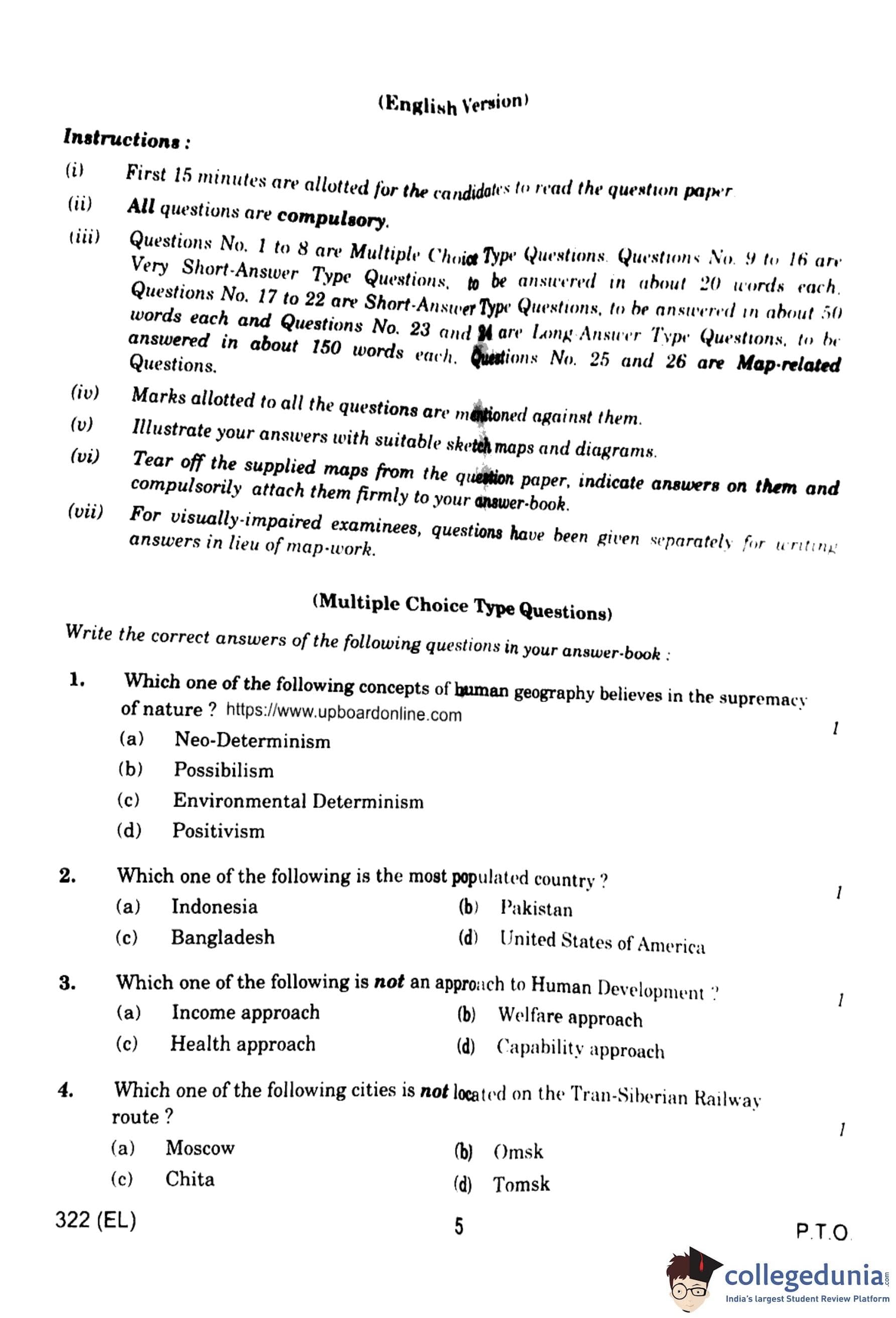
Which of the following is not a source of geographical information?
View Solution
Names of minerals from the moon do not serve as a source of geographical information as they are unrelated to Earth's geography. Ancient maps, descriptions by travelers, and scriptures provide valuable geographical insights. Quick Tip: Sources of geographical information are typically related to Earth’s features, historical records, and human activities.
Which of the following is not a densely populated area?
View Solution
The Polar regions are not densely populated due to extreme climatic conditions that make human habitation challenging. In contrast, South-East Asia is among the most densely populated areas in the world, and the North-Western region and Thar Desert have areas of sparse to moderate populations. Quick Tip: Densely populated regions often have favorable climatic conditions, fertile land, and access to resources, unlike extreme regions such as deserts and polar areas.
In which of the following regions is extensive commercial grain farming not practiced?
View Solution
The Amazon Basin is a tropical rainforest region unsuitable for extensive commercial grain farming due to its dense forests and high rainfall. Quick Tip: Commercial grain farming requires open plains, unlike the dense forests of the Amazon Basin.
Which of the following is a tertiary activity?
View Solution
Trade is classified as a tertiary activity because it involves the distribution and exchange of goods and services, unlike primary activities (e.g., agriculture) or secondary activities (e.g., weaving).
Quick Tip: Tertiary activities include services like trade, transport, and communication rather than direct production.
Which one of the following is not a land-use category?
View Solution
Marginal land is not classified as a formal land-use category. The categories listed in land use typically include net sown area, fallow land, and culturable wasteland. Quick Tip: Land-use categories focus on how land is used for agriculture, forestry, or development purposes.
Which one of the following minerals is known as 'Brown diamond'?
View Solution
Lignite, a type of coal, is often referred to as 'Brown diamond' due to its brownish appearance and economic value. Quick Tip: Lignite is a low-grade coal, also called 'Brown diamond,' used for energy production.
Which one of the following is the largest linguistic group of India?
View Solution
The Indo-Aryan group is the largest linguistic group in India, comprising languages such as Hindi, Bengali, Marathi, and others spoken by a majority of the population. Quick Tip: Indo-Aryan languages are dominant in northern and central India, making them the largest linguistic group.
Which one of the following is the most crucial factor for sustainable development in the Indira Gandhi Canal Command Area?
View Solution
Eco-development is essential for sustainable development as it focuses on maintaining ecological balance while improving agricultural productivity in the Indira Gandhi Canal Command Area. Quick Tip: Sustainable development requires ecological balance, which is achieved through eco-development initiatives.
Define human geography.
View Solution
Human geography is the branch of geography that deals with the study of how human activities are influenced by the earth’s surface and how humans, in turn, modify their environment. It examines spatial distributions of human populations, cultures, economies, and interactions with the natural environment. It also focuses on how geographic features such as climate, landforms, and resources impact human life. Human geography further studies population growth, urbanization, migration patterns, cultural landscapes, and the economic activities associated with different regions.
Quick Tip: Human geography connects the study of people, places, and their interactions with the environment.
What do you understand by population composition?
View Solution
Population composition refers to the demographic attributes of a population, such as age, gender, literacy, occupation, and income levels. It helps in understanding the structure of a population, planning for social and economic development, and analyzing population dynamics for policy-making. Factors like migration, birth and death rates, and economic conditions play a key role in shaping population composition. A detailed study of population composition allows policymakers to address challenges related to employment, healthcare, and education in a targeted manner.
Quick Tip: Population composition highlights the characteristics of a population, aiding better planning and resource allocation.
What are three basic areas of human development?
View Solution
The three basic areas of human development are health, education, and access to resources. Health ensures a long and healthy life, education provides knowledge and skills for personal and societal development, and access to resources guarantees the availability of essential goods and services needed to improve the quality of life and foster economic growth. These areas collectively contribute to improving human well-being and fostering social and economic progress in any society.
Quick Tip: Focus on health, education, and resources as the pillars of human development for a balanced and progressive society.
What do you understand by High-Tech Industry?
View Solution
High-Tech Industry refers to industries that involve advanced technology, innovation, and research in fields like information technology, biotechnology, and electronics. These industries require highly skilled labor, significant investment in research and development, and contribute to rapid technological advancements. Examples include software development, aerospace engineering, and pharmaceuticals. High-tech industries drive economic growth, improve quality of life, and offer solutions to various global challenges through cutting-edge technological applications.
Quick Tip: High-tech industries combine innovation and advanced technology to solve global challenges and drive growth.
Differentiate between push and pull factors of migration.
View Solution
Push factors force people to leave their place of origin, such as unemployment, natural disasters, political instability, or lack of educational opportunities. These factors create unfavorable living conditions and compel people to move in search of better options. Pull factors, on the other hand, attract people to new locations due to better job opportunities, improved living conditions, availability of better healthcare and education, and higher wages. Economic disparity, social security, and cultural freedom also play significant roles in migration decisions.
Quick Tip: Remember: Push factors "force" migration, while pull factors "attract" migrants with better opportunities.
Describe draught animals.
View Solution
Draught animals are animals like oxen, buffaloes, and horses that are used for labor-intensive tasks such as plowing fields, transporting goods, and performing other agricultural activities. These animals provide a sustainable source of labor in rural and agricultural settings, helping in tasks that require strength and endurance. They contribute significantly to traditional farming practices and transportation in areas with limited access to mechanized tools. Draught animals also support agricultural economies by reducing dependence on fossil fuels and enhancing food security in developing regions.
Quick Tip: Draught animals are essential for traditional agriculture and reduce dependence on modern machinery in rural areas.
Describe the major sources of air pollution.
View Solution
Major sources of air pollution include vehicular emissions, industrial discharges, burning of fossil fuels, and deforestation. Vehicular emissions contribute significantly to air pollution by releasing harmful gases such as carbon monoxide, nitrogen oxides, and particulate matter. Industrial discharges release pollutants like sulfur dioxide and volatile organic compounds that degrade air quality. The burning of fossil fuels for energy production emits greenhouse gases, leading to environmental concerns such as global warming and acid rain. Deforestation reduces the natural ability of forests to absorb carbon dioxide, increasing the concentration of pollutants in the atmosphere.
Quick Tip: Reducing vehicular emissions, promoting renewable energy, and reforestation are key steps to combat air pollution.
Explain the meaning of Hinterland.
View Solution
Hinterland refers to the area surrounding a port or urban center that supports it with resources and services, such as supplying goods for export. It serves as a crucial link between the city and rural areas, facilitating the movement of raw materials to industrial centers and finished products to markets. Hinterlands contribute to the economic development of a region by providing agricultural products, minerals, and labor supply. Efficient hinterland connectivity through transportation networks like roads, railways, and waterways enhances trade efficiency and regional integration.
Quick Tip: Hinterlands are vital for supporting ports and cities by providing resources and connecting them to rural areas.
Mention the approaches of human development.
View Solution
The approaches to human development are:
1. Income approach: Focuses on per capita income, measuring economic growth and standard of living. It considers GDP as a key indicator of development. However, it does not capture social and environmental aspects.
2. Welfare approach: Emphasizes well-being and basic needs such as healthcare, education, and nutrition, ensuring an improved quality of life for individuals. This approach highlights government interventions and welfare schemes.
3. Capability approach: Developed by Amartya Sen, focuses on the freedom to achieve well-being by enhancing people's choices and opportunities. It considers not only economic growth but also social justice and empowerment.
4. Basic needs approach: Ensures minimum requirements like food, shelter, and education, aimed at reducing poverty and ensuring a decent standard of living. It emphasizes the role of policies in addressing fundamental human needs.
Quick Tip: The approaches to human development focus on income, welfare, capabilities, and basic needs, highlighting economic and social aspects.
What is urbanisation? Discuss the development of urbanisation in India.
View Solution
Urbanisation is the process by which rural areas transform into urban areas, with increased population density and infrastructure development. It is driven by factors such as industrialization, economic opportunities, and improved living standards. Urbanisation leads to the expansion of cities and towns, providing better healthcare, education, and job prospects. However, it also brings challenges such as congestion, pollution, and socio-economic disparities.
In India, urbanisation has grown rapidly due to industrialization, better job opportunities, and improved living conditions in cities like Mumbai, Delhi, and Bengaluru. The development is marked by the rise of metropolitan cities, growth of IT hubs, and expansion of transportation networks. However, rapid urbanization has also led to the proliferation of slums, inadequate infrastructure, and environmental degradation. Government initiatives such as Smart Cities Mission aim to address these challenges and promote sustainable urban growth.
Quick Tip: Urbanisation in India is a mix of opportunities and challenges. Sustainable development is key to addressing urban issues.
Mention the main features of intensive subsistence agriculture.
View Solution
Main features include:
1. High labor input per unit of land due to the small scale of farming and dependency on manual labor. Farmers work intensively on their fields to achieve maximum productivity.
2. Small landholdings, often fragmented due to inheritance laws and population pressure, leading to inefficient land use.
3. Use of traditional methods and tools with minimal mechanization, leading to lower productivity compared to commercial farming. Farmers rely on practices passed down through generations.
4. Cultivation of rice, wheat, and other staple crops to meet the food requirements of the farmer's family, with little surplus for market sale.
5. Dependency on monsoon rains and natural resources for irrigation, making farming vulnerable to climate variability.
6. Intensive cropping practices to maximize yield and ensure food security. Farmers may practice multiple cropping or intercropping to make the best use of available resources.
7. Predominantly practiced in densely populated regions of Asia, such as India and China, where land is scarce and population pressure is high.
Quick Tip: Intensive subsistence agriculture focuses on small-scale farming with high labor input to meet local food needs.
Give an account of the rural settlement types in India.
View Solution
Rural settlements in India are classified as:
1. Clustered settlements: Closely built houses, commonly found in fertile plains and valleys. These settlements have a compact layout with narrow lanes and are socially cohesive.
2. Semi-clustered settlements: Partially dispersed, often formed due to the expansion of clustered settlements or due to uneven terrain. They are found in transitional zones between plains and plateaus.
3. Dispersed settlements: Isolated houses scattered over a large area, usually found in forested, hilly, or arid regions. These settlements are less accessible and rely on subsistence farming.
4. Linear settlements: Developed along roads, rivers, or canals to facilitate transport and trade. These settlements are commonly found in coastal areas, river valleys, and regions with infrastructural connectivity.
Quick Tip: Rural settlements in India vary based on geography and socio-economic conditions, ranging from clustered to dispersed layouts.
Discuss the problems of water pollution in India.
View Solution
Problems of water pollution in India include:
1. Contamination by industrial waste releasing toxic chemicals such as heavy metals into water bodies, causing harm to aquatic life and human health.
2. Agricultural runoff containing pesticides, fertilizers, and other chemicals that lead to eutrophication and loss of biodiversity in water bodies.
3. Untreated sewage discharge from urban areas, contributing to waterborne diseases and affecting the quality of drinking water.
4. Over-extraction of groundwater leading to depletion and contamination with arsenic, fluoride, and other harmful elements.
5. Religious practices such as idol immersion and ritual bathing contributing to the accumulation of pollutants in rivers like the Ganges.
6. Lack of proper waste management systems and public awareness about water conservation exacerbates the issue.
Quick Tip: Promoting industrial regulation, sustainable farming, and public awareness can help mitigate water pollution in India.
What are the social benefits of Integrated Tribal Development Programme (ITDP) in the Bharmaur tribal region?
View Solution
The social benefits include:
1. Improved access to education and healthcare through initiatives like mobile health units, scholarship programs, and adult literacy campaigns.
2. Better infrastructure and connectivity, including roads, bridges, and communication networks that link remote tribal areas to mainstream regions.
3. Skill development and employment opportunities through vocational training, promotion of traditional crafts, and self-employment schemes.
4. Empowerment of tribal communities through self-governance and participation in local decision-making, fostering a sense of ownership and accountability.
5. Preservation of cultural heritage and promotion of sustainable practices to improve the quality of life while maintaining ecological balance.
Quick Tip: ITDP enhances tribal livelihoods by integrating education, infrastructure, and self-reliance while preserving their heritage.
Discuss the factors influencing the distribution and density of population in the world.
View Solution
The factors influencing population distribution and density include:
1. Physical factors: Climate, landforms, and soil fertility significantly impact population density. Favorable conditions, such as moderate temperatures, abundant rainfall, and fertile plains, attract larger populations. For example, river valleys like the Nile and Ganges support high population densities due to their fertile soils and access to water. Conversely, harsh environments such as deserts, mountains, and polar regions discourage settlement due to challenging living conditions.
2. Economic factors: Availability of jobs, industrialization, and urbanization lead to higher population densities. Regions with robust economic activities, such as metropolitan cities and industrial hubs, attract migrants in search of better livelihoods. Well-developed infrastructure, transportation facilities, and trade opportunities also play a vital role in supporting dense populations in urban centers like New York, Tokyo, and Shanghai.
3. Social and cultural factors: Regions with better healthcare, education, and cultural significance attract higher populations. Societies offering social stability, improved quality of life, and access to cultural amenities encourage people to settle. For instance, cities with renowned educational institutions or healthcare facilities, such as Boston or Geneva, attract a diverse population. Additionally, religious and cultural heritage sites like Varanasi or Mecca often support localized population concentrations.
Other influencing factors include political stability, government policies promoting migration or settlement, and historical patterns of colonization and trade, which have shaped the distribution of populations globally.
Quick Tip: Population distribution is shaped by physical, economic, and social factors, with fertile plains and urban hubs attracting higher densities.
Describe the trans-continental railways in the world.
View Solution
Trans-continental railways are major rail systems crossing continents, facilitating trade, travel, and cultural exchange over vast distances. These railways have played a significant role in connecting remote regions, supporting economic growth, and fostering international cooperation. Examples include:
1. Trans-Siberian Railway: Spanning from Moscow to Vladivostok, it is the longest railway in the world, covering 9,289 kilometers. This railway connects European Russia with the Far East, enabling the transport of goods such as timber, coal, and oil. It also boosts tourism and cultural exchange across Russia, linking multiple time zones and diverse landscapes.
2. Canadian Pacific Railway: Connecting the eastern and western coasts of Canada, this railway played a significant role in the settlement and economic development of western Canada. It supports the transportation of agricultural products, minerals, and manufactured goods, contributing to Canada’s export economy. The scenic routes through the Rockies also promote tourism.
3. Union Pacific Railway: Running across the United States, this railway was instrumental in westward expansion during the 19th century. It connects the Atlantic and Pacific coasts, facilitating the movement of people, goods, and resources. The railway has been crucial in supporting the growth of industries and towns along its route, playing a major role in the economic integration of the United States.
4. Australian Transcontinental Railway: Connecting Perth on the west coast to Sydney on the east coast, this railway crosses the vast Australian outback. It supports the transportation of goods and people across remote and sparsely populated regions, enhancing connectivity within the continent.
5. Trans-Andean Railway: Linking Chile and Argentina, this railway crosses the Andes mountains, overcoming challenging terrain. It facilitates trade and cultural exchange between the two countries, highlighting engineering achievements in high-altitude rail transport.
Trans-continental railways continue to play a vital role in connecting regions, promoting globalization, and driving socio-economic development across continents.
Quick Tip: Trans-continental railways enhance connectivity, trade, and cultural exchange, uniting regions across vast distances.
Describe the development of non-conventional sources of energy in India.
View Solution
The development of non-conventional energy sources in India includes:
1. Solar energy: India has established numerous solar parks, like the Bhadla Solar Park in Rajasthan, which is one of the largest solar farms in the world. The government has initiated the National Solar Mission to increase solar energy production. Rooftop solar systems are being promoted in urban areas, and off-grid solar solutions are transforming rural electrification.
2. Wind energy: India ranks among the top wind energy producers globally. Tamil Nadu and Gujarat lead in wind energy generation, with massive wind farms and advanced turbine technology. Wind energy plays a significant role in reducing carbon emissions and providing sustainable power in coastal and high-altitude regions.
3. Biomass energy: Utilization of agricultural and animal waste to produce energy is growing in rural areas. Biomass projects include biogas plants, biomass gasifiers, and power generation facilities using organic residues. These projects help manage agricultural waste while providing clean and affordable energy.
4. Hydropower: Small and micro-hydropower projects are being developed in hilly regions to generate renewable energy. These projects are environmentally friendly and contribute to local community development.
5. Geothermal energy: India is exploring geothermal energy potential in regions like Ladakh and the Himalayas. Although still in its nascent stages, geothermal energy has the potential to provide a reliable and sustainable energy source.
6. Policy support and incentives: The government has introduced policies such as feed-in tariffs, tax benefits, and subsidies to encourage the development and adoption of non-conventional energy sources.
India’s focus on non-conventional energy aims to reduce dependence on fossil fuels, mitigate climate change, and ensure energy security for future generations.
Quick Tip: India's commitment to renewable energy includes solar, wind, biomass, and hydropower, driving sustainability and energy independence.
Divide Indian towns into major types on the basis of functions.
View Solution
Indian towns can be categorized as follows:
1. Administrative towns: These towns serve as centers of governance and administration. Examples include Delhi, which is the national capital, and Bhopal, the state capital of Madhya Pradesh. Such towns house government offices, administrative buildings, and decision-making bodies. They play a pivotal role in policymaking and governance.
2. Industrial towns: Towns like Jamshedpur and Bhilai are known for their industrial activities, such as steel production and heavy manufacturing. These towns are characterized by large-scale factories, industrial estates, and employment opportunities, attracting workers from various regions.
3. Commercial towns: Cities like Mumbai and Kolkata are major hubs of trade, commerce, and finance. Mumbai is home to the Bombay Stock Exchange and several multinational corporations, while Kolkata serves as a key trade and cultural center in eastern India. Commercial towns support vibrant markets, financial institutions, and logistical networks.
4. Religious towns: These towns are significant for their cultural and spiritual importance. Varanasi, considered one of the holiest cities, attracts millions of pilgrims annually, while Haridwar is a major destination for religious ceremonies and festivals. These towns contribute to religious tourism and preserve cultural heritage.
5. Educational towns: Cities like Pune and Prayagraj (Allahabad) are renowned for their academic institutions and centers of learning. Pune is known as the "Oxford of the East," hosting several universities and research institutions. These towns attract students and researchers from across the country, fostering intellectual development.
6. Port towns: Coastal towns like Chennai, Kochi, and Visakhapatnam are crucial for maritime trade and commerce. They feature docks, warehouses, and transport facilities, playing a vital role in the import and export of goods.
7. Tourist towns: Towns such as Jaipur and Shimla are popular tourist destinations known for their historical monuments, cultural significance, or scenic beauty. Jaipur is famous for its palaces and forts, while Shimla serves as a hill station and summer retreat.
8. Military and cantonment towns: Examples include Ambala and Secunderabad, which are known for their defense establishments and training centers. These towns are strategically important and house military bases and academies.
Quick Tip: Indian towns serve diverse functions like administration, commerce, education, and tourism, reflecting their multi-functional nature.
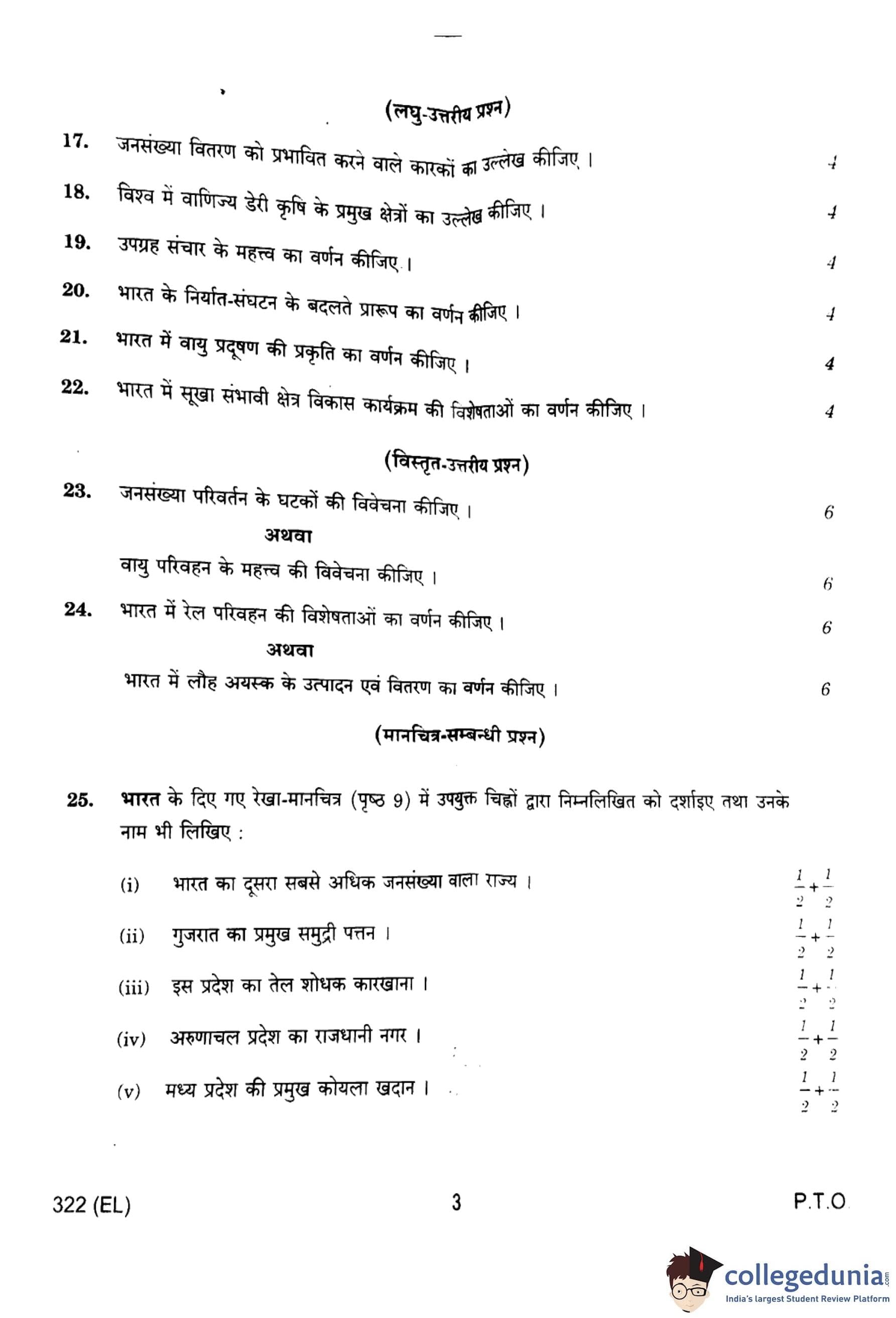
(1) The State with the lowest population in India.
View Solution
Sikkim is the state with the lowest population in India. With its small area and challenging terrain in the Himalayas, it has a population of fewer than 700,000 people as per the latest census. Despite its small population, Sikkim is known for its vibrant culture and ecological biodiversity.
Quick Tip: Sikkim, located in the northeastern region, stands out for its natural beauty and lowest population density in India.
(2) The Capital of Rajasthan.
View Solution
Jaipur, also known as the "Pink City," is the capital of Rajasthan. It is renowned for its historical significance, with landmarks like the Hawa Mahal, Amber Fort, and Jantar Mantar, a UNESCO World Heritage Site. Jaipur serves as a cultural and administrative hub, attracting millions of tourists every year.
Quick Tip: Jaipur is not only Rajasthan’s capital but also a key tourist destination known for its architectural marvels.
(3) The State with the highest literacy rate in India.
View Solution
Kerala has the highest literacy rate in India, exceeding 90%. This achievement is attributed to the state’s focus on education, with widespread access to schools, libraries, and literacy programs. Kerala’s progressive social policies have made it a model for literacy and human development.
Quick Tip: Kerala’s high literacy rate reflects its emphasis on education, gender equality, and public welfare.
(4) A main nuclear power plant in India.
View Solution
The Kudankulam Nuclear Power Plant in Tamil Nadu is one of the largest and most advanced nuclear power plants in India. It plays a crucial role in meeting the energy needs of southern India, producing thousands of megawatts of electricity. The plant uses pressurized water reactors (PWR) with state-of-the-art safety measures.
Quick Tip: Kudankulam is a key contributor to India’s nuclear energy program, ensuring energy security with advanced safety protocols.
Question 25:
(5) The State with the largest urban population in India.
View Solution
Maharashtra has the largest urban population in India, with cities like Mumbai, Pune, and Nagpur driving urbanization. Mumbai, the financial capital of India, is home to major industries, Bollywood, and the Bombay Stock Exchange. Maharashtra’s urban areas contribute significantly to India’s GDP and serve as centers for education, healthcare, and commerce.
Quick Tip: Maharashtra’s urban population growth is fueled by its economic hubs, offering diverse opportunities in finance, industry, and entertainment.
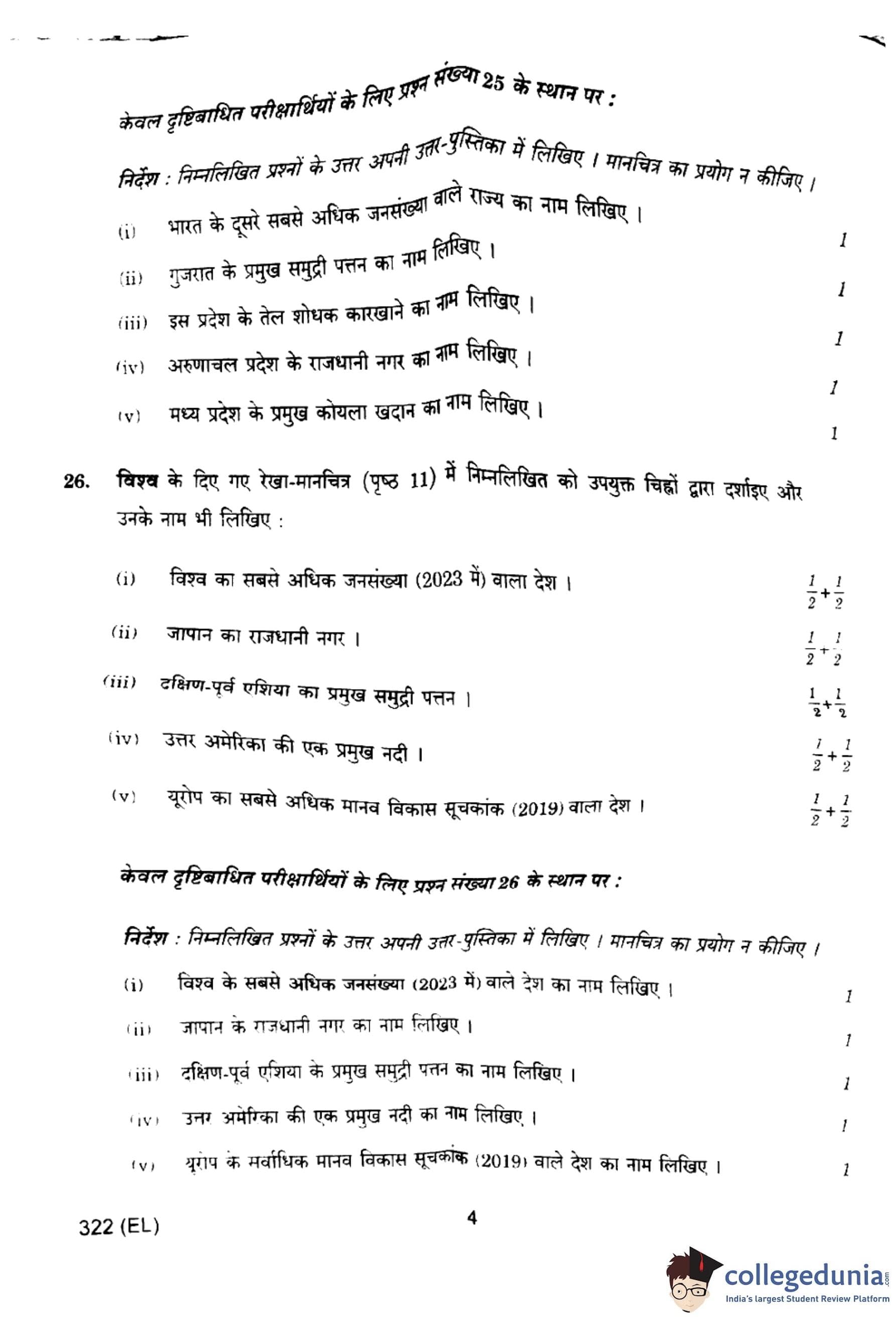
(1) Write the name of the State with the lowest population in India.
View Solution
Sikkim has the lowest population in India. It is a small Himalayan state with a population of fewer than 700,000 people, known for its rich biodiversity, natural beauty, and sustainable practices.
Quick Tip: Sikkim, located in the northeastern region, is renowned for its smallest population and eco-tourism initiatives.
(2) Write the name of the Capital of Rajasthan.
View Solution
Jaipur is the capital of Rajasthan. Known as the "Pink City," it is famous for its architectural marvels like the Hawa Mahal, Amber Fort, and City Palace. Jaipur is a major tourist destination and a cultural hub in India.
Quick Tip: Jaipur, the Pink City, symbolizes Rajasthan’s cultural richness and historical grandeur.
(3) Write the name of the State with the highest literacy rate in India.
View Solution
Kerala has the highest literacy rate in India, exceeding 90%. The state is recognized for its advanced education system, public libraries, and gender equality in education.
Quick Tip: Kerala’s literacy achievements stem from its investment in education and progressive social policies.
(4) Write the name of a main nuclear power plant in India.
View Solution
Kudankulam Nuclear Power Plant, located in Tamil Nadu, is a major nuclear power facility. It is one of the largest nuclear power plants in India, contributing significantly to the country’s energy production.
Quick Tip: Kudankulam is a critical player in India’s nuclear energy program, ensuring sustainable power generation.
(5) Write the name of the State with the largest urban population in India.
View Solution
Maharashtra has the largest urban population in India. Cities like Mumbai, Pune, and Nagpur contribute to its urban dominance. Mumbai, the financial capital of India, attracts millions of people due to its economic opportunities.
Quick Tip: Maharashtra’s urban hubs like Mumbai drive India’s economic and cultural development.
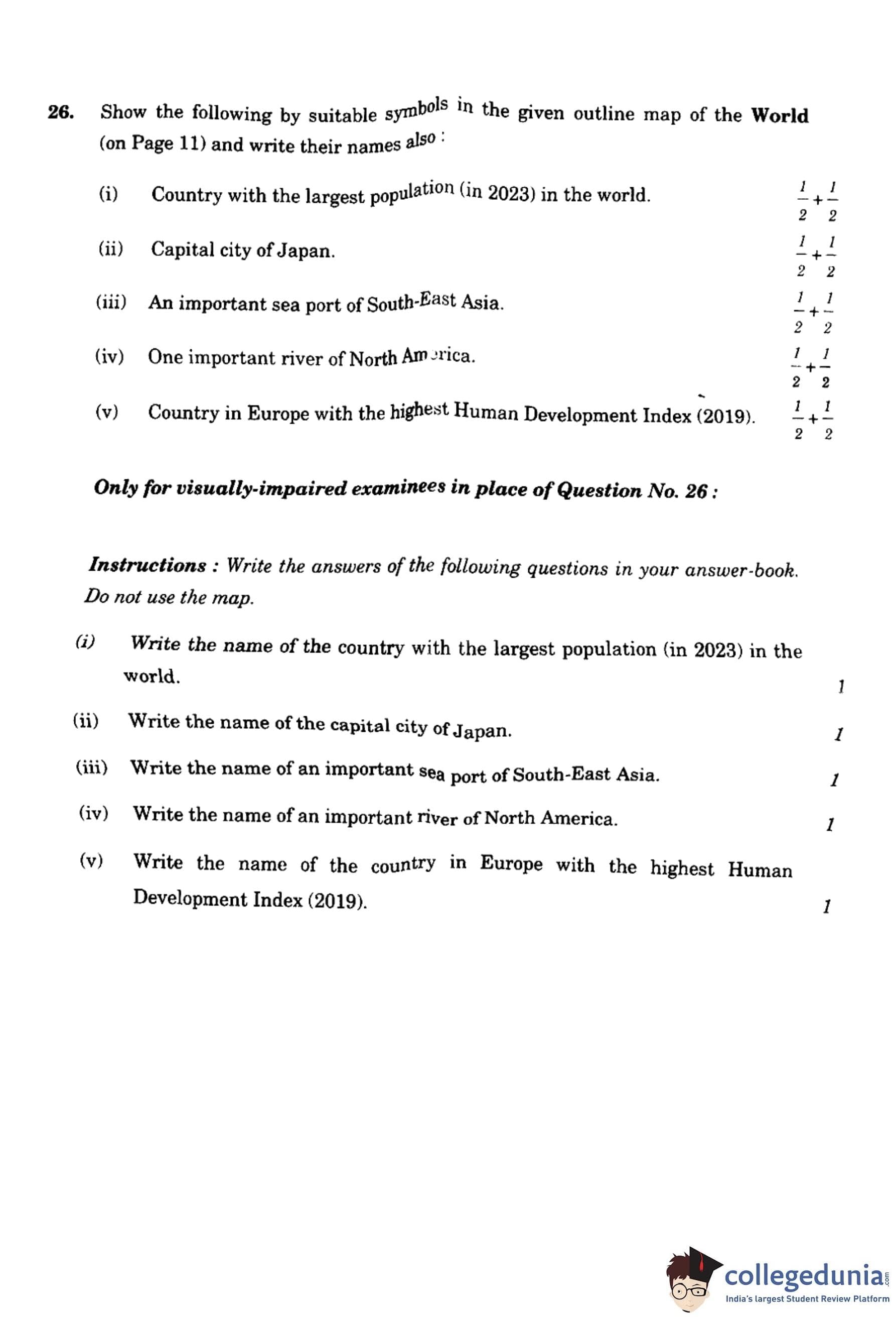
(1) The Capital city of Russia.
View Solution
Moscow is the capital city of Russia and serves as the administrative, political, and economic hub of the country. It is home to iconic landmarks such as the Kremlin, a UNESCO World Heritage Site, and St. Basil's Cathedral. Moscow's metro system is one of the busiest and most efficient in the world, showcasing its urban sophistication. Additionally, the city hosts major industries, international summits, and cultural events, solidifying its global influence.
Quick Tip: Moscow, located on the Moskva River, is a vibrant mix of historical heritage and modern development.
(2) The Country with the largest population in North America.
View Solution
The United States of America, with a population exceeding 330 million, has the largest population in North America. It is a melting pot of cultures, offering a dynamic society that thrives on diversity and innovation. The USA is a global leader in technology, finance, and entertainment, hosting iconic landmarks such as the Statue of Liberty and the Grand Canyon. Its democratic governance and world-class infrastructure attract migrants, further boosting its population.
Quick Tip: The USA’s population growth is driven by immigration and its strong economy, making it a land of opportunities.
(3) The Country with the highest Human Development Index (HDI) in the world.
View Solution
Norway consistently ranks highest in the Human Development Index due to its focus on healthcare, education, and income equality. Its citizens enjoy universal healthcare, free education, and one of the highest per capita incomes globally. Norway's commitment to renewable energy and environmental sustainability further enhances its development model. The country also ranks high in gender equality and life satisfaction.
Quick Tip: Norway’s exemplary HDI reflects its holistic approach to social welfare, economic prosperity, and environmental care.
(4) One sea port of South-East Asia.
View Solution
Singapore, located at the crossroads of major global shipping routes, is a leading sea port in South-East Asia. Known for its efficiency and advanced infrastructure, the Port of Singapore handles millions of containers annually, facilitating trade between Asia, Europe, and the Americas. Singapore’s Free Trade Zone policies and maritime services attract businesses worldwide. The port also plays a critical role in the country's economic growth, contributing significantly to its GDP.
Quick Tip: Singapore's port is not just a trade hub but also a model of technological and logistical innovation.
(5) One main river of Brazil.
View Solution
The Amazon River, spanning over 6,400 kilometers, is the largest river in Brazil and one of the most significant rivers in the world. It supports the Amazon Rainforest, often called the "lungs of the Earth," as it produces a significant portion of the planet's oxygen. The river is vital for transportation, connecting remote areas to urban centers. It also supports fishing, agriculture, and hydropower projects, playing a central role in Brazil’s economy and ecology.
Quick Tip: The Amazon River is a lifeline for Brazil, fostering biodiversity, transportation, and economic activities.



Comments