




UP Board Class 12 History Question Paper 2024 PDF (Code 321 ED) is available for download here. The History exam was conducted on March 6, 2024 in the Evening Shift from 2 PM to 5:15 PM. The total marks for the theory paper are 100. Students reported the paper to be moderate.
UP Board Class 12 History Question Paper 2024 (Code 321 ED) with Solutions
|
UP Board12 History Core Question Paper With Answer Key |
 Download Download |
Check Solution |
UP Board Class 12 History Question Paper With Solution
SECTION A (Multiple Choice Type Questions)
Question 1:
M.S. Vats began excavations at Harappa in:
View Solution
M.S. Vats began the excavations at Harappa in 1922, which was a significant step in uncovering the ancient civilization of the Indus Valley. Quick Tip: Remember, Harappa is one of the most important sites of the Indus Valley Civilization, and excavations in the 1920s played a pivotal role in understanding ancient urban planning and culture.
The Jatakas were written in:
View Solution
The Jatakas, which are a collection of stories about the previous lives of the Buddha, were written in Pali. Quick Tip: The Jatakas are an important part of Buddhist literature and provide insight into the ethical teachings and moral values of Buddhism.
The first gold coins were issued by the:
View Solution
The first gold coins were issued by the Kushanas in the 1st century CE. These coins played a significant role in the development of trade and economy in ancient India. Quick Tip: Kushana coinage is an important archaeological source, giving us information about Kushana rulers and their religious and political affiliations.
The 'Mrichchhakatika' was written by:
View Solution
The 'Mrichchhakatika' (The Little Clay Cart) is a Sanskrit play written by Shudraka, which is known for its portrayal of contemporary social and moral issues. Quick Tip: 'Mrichchhakatika' is an important work in ancient Indian literature, reflecting the urban life of the time and offering insights into the complexities of human relationships.
Who described the kingdom of Awadh as 'a cherry?
View Solution
Henry Hardinge, the British Governor-General of India, described the kingdom of Awadh as a "cherished" territory in the context of British expansion in India during the 19th century. Quick Tip: Awadh (or Oudh) played a significant role in the Revolt of 1857, as it was one of the key regions where the uprising against British rule was strongest.
The Western education policies were adopted under the leadership of:
View Solution
William Bentinck, the Governor-General of India, introduced several reforms that laid the foundation for Western education in India, particularly through the promotion of English as the medium of instruction. Quick Tip: Bentinck's education policy included the famous 1835 Charter Act, which promoted the use of English in educational institutions and facilitated the spread of Western ideas in India.
The 1929 annual session of the Indian National Congress was held at:
View Solution
The 1929 session of the Indian National Congress, which was presided over by Jawaharlal Nehru, took place in Lahore and marked a significant turning point in the Indian freedom struggle with the declaration of Purna Swaraj (complete independence). Quick Tip: The 1929 Lahore session is a pivotal moment in India's history, as it was the first time the Congress formally demanded full independence from British rule.
The Second Round Table Conference was held in:
View Solution
The Second Round Table Conference, aimed at discussing constitutional reforms in India, was held in London in 1931, with key Indian leaders participating in it. Quick Tip: The Second Round Table Conference was significant for the inclusion of Indian leaders like Gandhi and Ambedkar, although it ended without a major breakthrough.
A Bunch of Old Letters was edited by:
View Solution
"A Bunch of Old Letters" was a collection of letters edited by Jawaharlal Nehru, offering insight into his thoughts and the history of India’s struggle for independence. Quick Tip: The book is a valuable resource for understanding Nehru’s personal reflections and the evolution of his political ideology during the freedom movement.
Mahatma Gandhi returned to his homeland after two decades in:
View Solution
Mahatma Gandhi returned to India in 1915 after spending 21 years in South Africa, where he had been leading the fight for civil rights for the Indian community. Quick Tip: Gandhi's return to India in 1915 marked the beginning of his active involvement in the Indian freedom struggle, particularly with the Champaran Satyagraha of 1917.
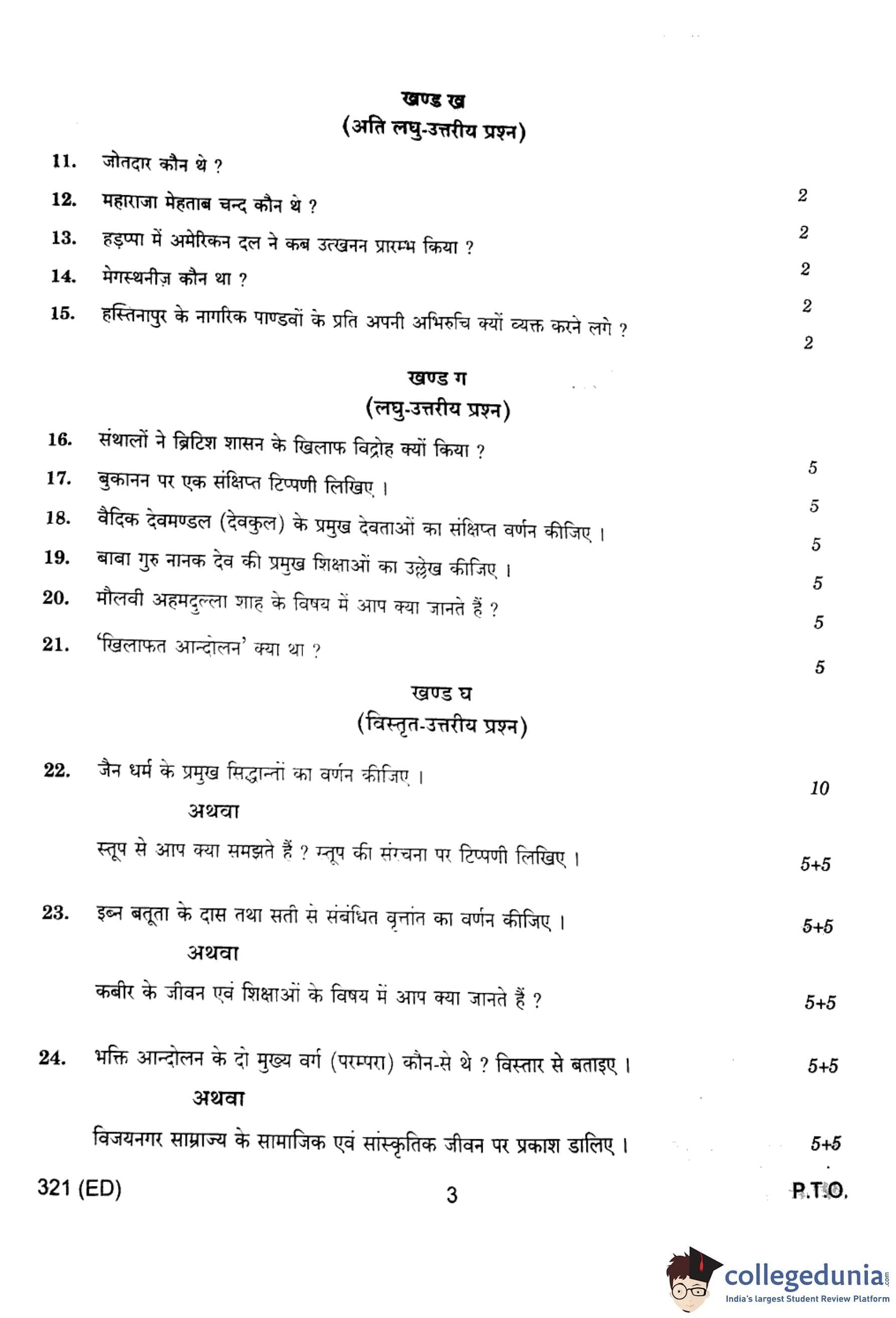
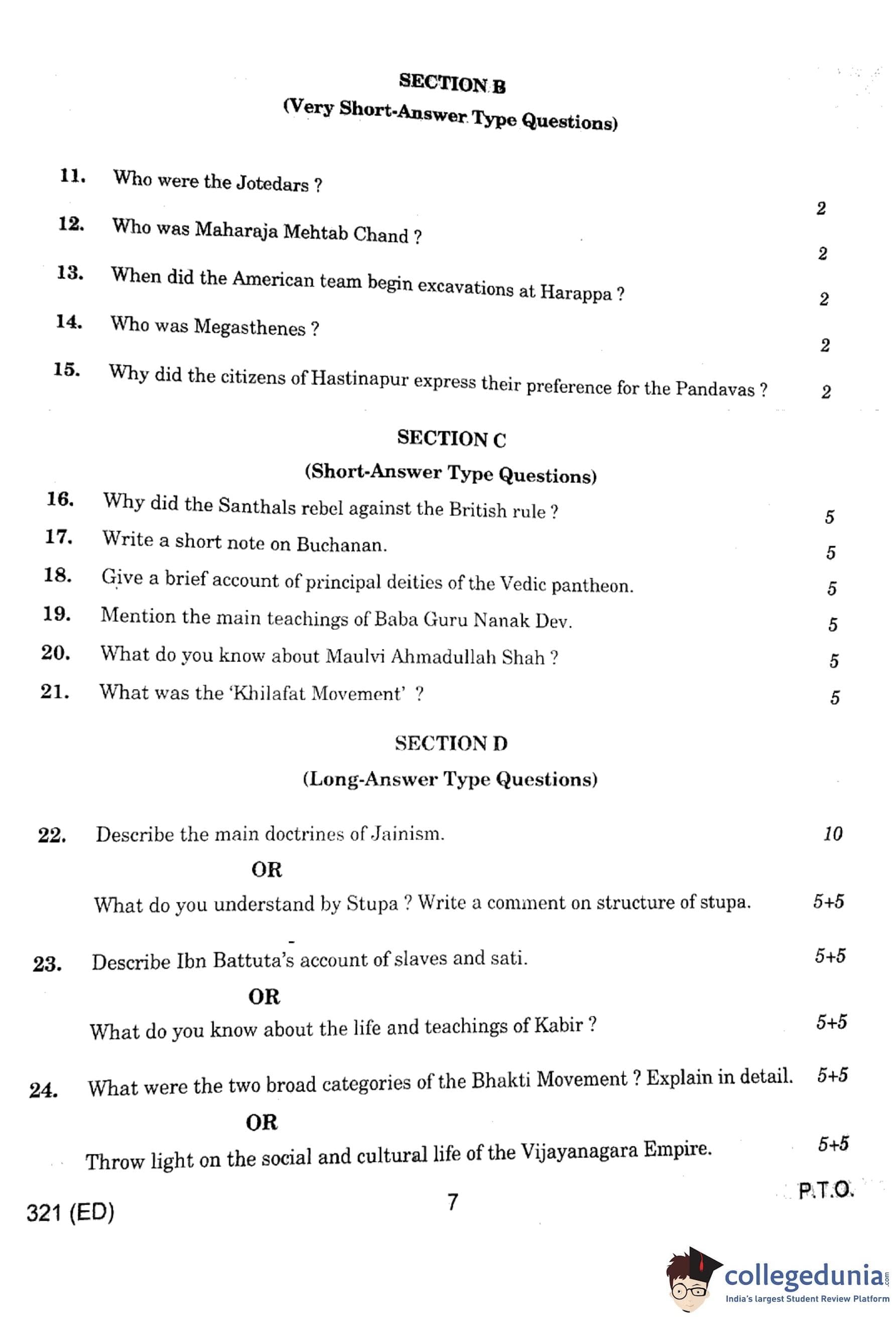
SECTION B (Very Short-Answer Type Questions)
Question 11:
Who were the Jotedars?
View Solution
The Jotedars were influential landowners in rural Bengal during the colonial period, particularly in the 19th and early 20th centuries. They were part of the rural elite and held significant control over land, peasants, and agricultural production. Often, they were the intermediaries between the British colonial administration and the peasants, as they were responsible for collecting taxes from the peasants and remitting them to the British. The Jotedars were considered a powerful class and played a major role in the socio-economic structure of rural Bengal. They also acted as protectors of local interests, although some were seen as exploitative landlords. The rise of the Jotedars occurred due to the introduction of the Permanent Settlement of 1793, which gave them ownership of vast agricultural lands. Quick Tip: Jotedars played a significant role in the socio-political landscape of colonial India, especially with regard to land policies like the Permanent Settlement. Their influence persisted into the post-independence period in various forms.
Who was Maharaja Mehtab Chand?
View Solution
Maharaja Mehtab Chand was a prominent ruler of the princely state of Charkhari, located in Bundelkhand, during the 19th century. He is known for his support to the British during the Indian Rebellion of 1857. Although some rulers sided with the British to maintain their power, Maharaja Mehtab Chand managed to secure the loyalty of his state through his cooperation with the British. After the suppression of the rebellion, he was rewarded by the British with increased autonomy for his state. His collaboration, however, made him a controversial figure in Indian history, as it conflicted with the broader anti-colonial sentiments of the time. Quick Tip: Maharaja Mehtab Chand's role in the 1857 Rebellion highlights the complexities of princely states during the period. Many rulers had to make strategic decisions to maintain their sovereignty, sometimes leading to alliances with the British.
When did the American team begin excavations at Harappa?
View Solution
The American team, led by Professor George Dales and his team from the University of Pennsylvania, began excavations at Harappa in 1946. This was after the initial British excavations in the 1920s that uncovered the remains of the Indus Valley Civilization. The American team focused on uncovering the extent of Harappa’s urban planning, its advanced drainage system, and evidence of trade networks. Their work further solidified Harappa’s place as one of the key cities of the ancient Indus Valley Civilization. Their findings, along with the work of other archaeologists, have been crucial in expanding our knowledge of the civilization’s layout, culture, and history. Quick Tip: The American excavations at Harappa provided new insights into the city’s sophisticated urban design and its role in ancient trade, contributing greatly to the understanding of the Indus Valley Civilization's complexity.
Who was Megasthenes?
View Solution
Megasthenes was a Greek ambassador who came to India during the reign of Chandragupta Maurya in the 4th century BCE. He served as an ambassador to the Mauryan court in Pataliputra (modern-day Patna), and he wrote an important work called "Indica." This book provides a detailed account of Indian society, economy, and governance, and offers valuable information about the Mauryan Empire and its rulers. Megasthenes’ observations, however, were often filtered through his Greek cultural lens, leading to some inaccuracies and biases in his descriptions. Nonetheless, his work remains an essential source for historians studying ancient India. Quick Tip: Megasthenes' "Indica" is one of the earliest accounts of India by a foreign traveler. Despite some biases, it provides unique insights into the political and social structures of the Mauryan Empire.
Why did the citizens of Hastinapur express their preference for the Pandavas?
View Solution
The citizens of Hastinapur expressed their preference for the Pandavas because of their virtues, ethical conduct, and adherence to dharma (moral principles). The Pandavas, especially Yudhishthira, were seen as upholders of justice, fairness, and truth. In contrast, the Kauravas, led by Duryodhana, were known for their greed, arrogance, and disregard for dharma. The people of Hastinapur were aware of the Kauravas' unjust treatment of the Pandavas, especially in the game of dice, where the Pandavas were unfairly humiliated and exiled. The righteousness and moral integrity of the Pandavas made them more popular among the citizens, who preferred a just rule over one based on power and deceit. Quick Tip: The preference for the Pandavas illustrates the importance of ethics and dharma in Indian literature, particularly in the Mahabharata, where the characters' moral choices define their fate.
SECTION C (Short-Answer Type Questions)
Question 16:
Why did the Santhals rebel against the British rule?
View Solution
The Santhal rebellion, also known as the Santhal Hul, was a tribal revolt against the British East India Company and their exploitation of tribal lands in the region of present-day Jharkhand, Bihar, and West Bengal. The primary causes of the rebellion included:
1. Economic Exploitation: The British and their allies, including zamindars, moneylenders, and traders, subjected the Santhals to harsh economic exploitation. The tribals were forced into heavy taxation and were subjected to the zamindari system that deprived them of their ancestral lands.
2. Social and Religious Oppression: The Santhals were also facing social discrimination under the British administration. The introduction of Western education and the imposition of foreign cultural norms created a sense of alienation among the tribals.
3. Injustice by Revenue Collectors: The local revenue collectors and moneylenders often harassed the Santhals, forcing them into debt and landlessness. The British administrators failed to address the grievances of the tribal people, leading to frustration and anger.
4. Leadership of the Santhal Leaders: The rebellion was led by the Santhal brothers, Sidhu and Kanhu, who organized a large-scale revolt against the British rule. They called for the protection of their land and their right to live freely from exploitation.
The Santhal Hul ultimately failed due to the overwhelming military power of the British forces, but it is remembered as a symbol of resistance against colonial exploitation. Quick Tip: The Santhal Rebellion is significant as it marked one of the earliest organized tribal uprisings against the British colonial rule and set the stage for future resistance movements in India.
Write a short note on Buchanan.
View Solution
Francis Buchanan, a British physician and traveler, is best known for his detailed surveys and writings on the geography, culture, and society of India during the early 19th century. He was appointed as a physician with the East India Company and traveled extensively across India. Buchanan’s work focused on the natural history, economy, and population statistics of the regions he visited. He is most famous for his survey of the eastern regions of India, particularly Bengal and Orissa, which provided valuable insights into the agricultural practices, flora, and fauna of these areas.
Buchanan's major work, A Journey from Madras through the Countries of the Mysore, Canara, and Malabar, is an important document in the study of colonial India as it offers a detailed account of the conditions in South India. He also contributed to the compilation of ethnographic and linguistic data, which later became significant for colonial administrators and historians. Quick Tip: Buchanan’s work is an important resource for understanding the socio-economic conditions in colonial India, particularly his contributions to the study of geography and local customs.
Give a brief account of the principal deities of the Vedic pantheon.
View Solution
The Vedic pantheon consists of a wide array of gods and goddesses, each responsible for different aspects of the natural world and human life. The principal deities of the Vedic pantheon are:
1. Indra: The king of the gods and the god of thunder, lightning, and war. Indra is portrayed as a warrior deity who battles the demons (asuras) and brings rains for the fertility of the earth.
2. Agni: The god of fire, Agni is central to Vedic rituals, especially in yajnas (sacrificial rituals). He serves as the messenger between humans and gods, carrying offerings to the deities.
3. Varuna: The god of cosmic order, Varuna is associated with the sky, waters, and the moral law of the universe. He is often invoked for forgiveness and maintaining harmony in the world.
4. Vayu: The god of wind, Vayu is associated with life and breath. His power as the life-giver is crucial to both humans and animals.
5. Surya: The sun god, Surya is seen as the source of light and life. He is worshipped as the dispeller of darkness and ignorance and symbolizes knowledge and truth.
6. Soma: The god of the moon and the plant that produces a sacred drink used in Vedic rituals. Soma is a symbol of immortality and divine ecstasy.
These deities were worshipped with hymns, rituals, and sacrifices that aimed to maintain cosmic order and ensure the prosperity of the people. Quick Tip: The Vedic pantheon reflects the close relationship between the natural elements and spiritual practices. The gods of the Vedas represent natural forces that the early Indo-Aryans revered for their ability to sustain life and order.
Mention the main teachings of Baba Guru Nanak Dev.
View Solution
Baba Guru Nanak Dev was the founder of Sikhism, and his teachings laid the foundation for the Sikh faith. His key teachings are:
1. Oneness of God (Ik Onkar): Guru Nanak emphasized the belief in one supreme God, who is formless, eternal, and transcendent. This is the core principle of Sikhism and is encapsulated in the phrase "Ik Onkar" (One God).
2. Equality of All People: Guru Nanak preached the equality of all human beings, regardless of caste, creed, or religion. He rejected the hierarchical structure of society and encouraged social justice.
3. Honest Living: Guru Nanak stressed the importance of earning a living through honest means. He encouraged people to work hard, be truthful, and live a life of integrity.
4. Service to Humanity: Selfless service (seva) to others was a key component of Guru Nanak's teachings. He believed that serving humanity is an expression of devotion to God.
5. Devotional Prayer: Guru Nanak taught that meditation on God's name (Naam Japna) is essential for spiritual growth. He emphasized the importance of devotion and prayer in daily life.
These teachings were revolutionary for the time and contributed to the creation of a new religious community that valued spirituality, equality, and social justice. Quick Tip: Guru Nanak's emphasis on equality and service laid the foundation for Sikhism as a religion focused on community, humility, and devotion, challenging the rigid caste and social structures of contemporary society.
What do you know about Maulvi Ahmadullah Shah?
View Solution
Maulvi Ahmadullah Shah was a prominent leader during the Indian Rebellion of 1857, particularly in the northern parts of India. He was a well-respected religious scholar and a key figure in the uprising, often referred to as the “Shah of the Rebellion.” Ahmadullah Shah played a significant role in organizing the rebellion in the Awadh region and was known for his leadership among the Indian soldiers and civilians.
His influence and leadership inspired many to join the revolt against the British. He was a passionate supporter of the cause of Indian independence and opposed British colonial policies. Unfortunately, after the failure of the rebellion, Ahmadullah Shah was captured and executed by the British. Quick Tip: Ahmadullah Shah's contribution to the 1857 uprising highlights the role of religious leaders in India's struggle for independence. He remains a symbol of resistance and patriotism.
What was the Khilafat Movement?
View Solution
The Khilafat Movement was a pan-Islamic political movement initiated by Indian Muslims in the aftermath of World War I. It aimed to protect the Ottoman Caliphate, which was dismantled by the Allied powers after the war. The movement was launched in 1919 by the Ali Brothers (Maulana Mohammad Ali and Maulana Shaukat Ali) and other Muslim leaders in India to safeguard the position of the Caliph, who was seen as the spiritual leader of Muslims worldwide.
The movement had two main goals:
1. Preservation of the Caliphate: To preserve the authority of the Ottoman Sultan, who was also the Caliph, against Western imperialist powers.
2. Reform and Unity among Indian Muslims: To promote unity among Indian Muslims and gain political and social rights for the community.
The Khilafat Movement was closely aligned with the Indian National Congress and Mahatma Gandhi’s Non-Cooperation Movement. The collaboration between the Khilafat Movement and the Congress was significant in the context of the Indian freedom struggle. However, the movement lost momentum after the abolition of the Caliphate in 1924. Quick Tip: The Khilafat Movement is a key example of how global events influenced Indian politics and how Indian Muslims played an important role in the national independence movement.
SECTION D
(Long-Answer Type Questions)
Question 22:
Describe the main doctrines of Jainism.
View Solution
Jainism is one of the oldest religions in India, founded by Lord Mahavira in the 6th century BCE. The core doctrines of Jainism are:
1. Ahimsa (Non-violence): Jainism emphasizes the principle of Ahimsa, or non-violence, in every aspect of life. Followers are taught to avoid causing harm to any living being, whether through thought, word, or deed. This doctrine is central to Jain ethical conduct and influences all aspects of Jain practice, from diet to social interactions.
2. Anekantavada (Multiplicity of Views): Jainism teaches that reality is complex and can be understood from multiple perspectives. According to Anekantavada, no single point of view can capture the entirety of truth. This doctrine encourages tolerance and understanding of different beliefs and viewpoints.
3. Aparigraha (Non-attachment): The principle of non-attachment encourages Jains to live a life of simplicity and detachment from material possessions. It teaches that attachment to worldly things leads to suffering, and true spiritual progress comes from renouncing desires.
4. Karma and Liberation: Jainism believes in the concept of karma, where every action, whether good or bad, accumulates and affects future lives. The ultimate goal of Jainism is to achieve liberation (moksha) from the cycle of birth and rebirth (samsara). This is achieved through self-discipline, right knowledge, right faith, and right conduct.
5. Five Vows of Jain Monks (Mahavratas): Jain monks take five main vows: non-violence, truth, non-stealing, celibacy, and non-possession. These vows are essential for spiritual progress and are followed rigorously by Jain ascetics.
These doctrines guide the religious and ethical life of Jains, promoting non-violence, respect for all life forms, and the pursuit of spiritual liberation. Quick Tip: Jainism's teachings on non-violence and non-attachment are not only religious principles but also offer important ethical guidelines for daily life, particularly in the context of modern environmentalism and peaceful coexistence.
OR What do you understand by Stupa? Write a comment on the structure of the Stupa.
View Solution
A Stupa is a dome-shaped structure that serves as a Buddhist religious monument, traditionally housing relics of the Buddha or other significant Buddhist figures. Stupas are among the earliest forms of Buddhist architecture, and they played a crucial role in the dissemination of Buddhist teachings and relics across Asia.
1. Significance and Symbolism of the Stupa:
- The stupa is not merely a physical structure but is also deeply symbolic in Buddhist thought. It represents the Buddha’s enlightened mind, as well as his body, speech, and mind. The dome shape symbolizes the universe, and the axis at the top represents the spiritual path leading to enlightenment.
2. Structure of the Stupa:
- Base: The stupa usually has a square base that represents the earth. It is often adorned with carvings and inscriptions that depict various aspects of the Buddha’s life and teachings.
- Dome (Anda): Above the base is the dome-shaped structure that symbolizes the universe. It often houses relics and sacred objects. The dome represents the cosmos, with its curving shape symbolizing the heavens and the earth’s spherical form.
- Harmika: At the top of the dome is a platform known as the harmika. This is a small enclosure that represents the heavenly realm and is often adorned with symbolic motifs.
- Chhatra (Umbrella): Above the harmika is the chhatra, which consists of one or more umbrellas. The chhatra symbolizes protection and the divine presence of the Buddha. It is a symbol of the Buddha’s spiritual power and enlightenment.
- Toranas (Gateways): Many stupas have gateways or toranas that are richly decorated with scenes from the Buddha’s life, as well as symbolic figures like lions and elephants. These serve as entrances and are often placed at cardinal points.
Stupas were initially constructed as a way to house relics of the Buddha and to mark important Buddhist sites. Over time, their structure became more complex, with a blend of local architectural styles, but the fundamental shape remained consistent. Quick Tip: The stupa is not just a burial site; it is a spiritual symbol of the Buddha's presence, designed to inspire reverence and contemplation in its viewers.
Describe Ibn Battuta's account of slaves and Sati.
View Solution
Ibn Battuta, the famous Moroccan traveler and scholar, visited India during the reign of Muhammad bin Tughlaq (1325-1351 CE). His travelogue, Rihla, provides a detailed account of Indian society, customs, and administration during the 14th century. Among the many observations he made, two significant aspects were the practice of slavery and the custom of Sati.
Ibn Battuta’s Account of Slavery:
1. Prevalence of Slavery:
- Ibn Battuta observed that slavery was widespread in India, and enslaved people were used in households, palaces, and even administrative roles.
- The Delhi Sultanate and noble families had large numbers of slaves, both male and female, who performed various tasks such as domestic work, entertainment, and military service.
2. Sources of Slaves:
- Many slaves were captured as war prisoners or obtained through trade.
- He noted that some slaves were given as gifts to nobles and sultans, and it was common for high-ranking officials to gift slaves to win royal favor.
3. Roles of Slaves:
- Slaves served as bodyguards, concubines, musicians, and palace attendants.
- Skilled slaves were sometimes trained in professions such as weaving, cooking, and singing.
4. Treatment of Slaves:
- Some slaves led relatively comfortable lives, especially those working in royal courts.
- However, many were subjected to harsh treatment, depending on the temperament of their masters.
Ibn Battuta’s Account of Sati:
1. What is Sati?
- Sati was a Hindu ritual where a widow voluntarily or forcibly burned herself on her deceased husband’s funeral pyre.
- Ibn Battuta, a Muslim traveler, found this practice shocking and described it in detail.
2. Observations of the Practice:
- He witnessed an incident of Sati in India and noted that it was considered an honorable act by Hindu communities.
- Women who performed Sati were regarded with great respect and devotion.
- He recorded that the widow was dressed in fine clothes and garlanded with flowers before she immolated herself.
3. Voluntary vs. Forced Sati:
- Ibn Battuta noted that while many women performed Sati willingly, some were forced by family members and societal pressure.
- He was surprised by how widows were sometimes celebrated for their "sacrifice" rather than being mourned.
Conclusion:
Ibn Battuta’s accounts provide valuable insights into 14th-century Indian society, including its class structures, gender roles, and religious practices. His writings highlight the stark differences between Hindu and Muslim customs and reveal the complexity of India’s social system during the Delhi Sultanate. Quick Tip: Ibn Battuta’s travelogue is a crucial historical source for understanding medieval Indian society. His descriptions help modern historians analyze the cultural interactions and social norms of the period.
OR What do you know about the life and teachings of Kabir?
View Solution
Kabir was one of the most prominent saints of the Bhakti Movement in medieval India. He was a poet-saint and reformer whose teachings focused on spiritual devotion, social equality, and religious harmony. His dohaas (couplets) are widely revered for their wisdom and simplicity.
Life of Kabir:
1. Birth and Early Life:
- Kabir was born in the 15th century, most likely in Varanasi.
- His exact birth details remain debated, but he is believed to have been raised by a Muslim weaver family.
- He was greatly influenced by Ramananda, a Hindu saint, and also interacted with Sufi traditions.
2. Influence and Religious Beliefs:
- He rejected caste distinctions and idol worship.
- His teachings blended elements of Hindu Bhakti and Islamic Sufism, advocating monotheism and devotion to a single, formless God.
- Kabir’s followers, known as Kabir Panthis, continue to revere his teachings.
Teachings of Kabir:
1. Belief in One God:
- Kabir emphasized that God is one, formless, and beyond rituals.
- He criticized religious divisions between Hindus and Muslims, calling them superficial and unnecessary.
2. Criticism of Rituals and Superstitions:
- He opposed meaningless rituals like idol worship, fasting, and pilgrimages.
- Instead, he promoted inner devotion (bhakti) and self-purification.
3. Equality of All Human Beings:
- He strongly condemned the caste system and untouchability.
- He believed in a classless society, where all humans were equal before God.
4. Simplicity in Life:
- Kabir advocated for truthfulness, humility, and self-discipline.
- He encouraged people to lead a simple, honest life without material greed.
5. Opposition to Religious Conflicts:
- Kabir spoke against Hindu-Muslim conflicts, emphasizing that true worship lies in love and compassion.
- His famous couplets highlight the futility of religious disputes.
Famous Dohe (Couplets) of Kabir:
"What is the use of growing tall, like a date palm tree?
It provides no shade to travelers, and its fruits are too far to reach."
This doha by Kabir Das conveys that mere growth in stature, wealth, or position is meaningless if it does not benefit others
Meaning: A person’s greatness is not in their status but in how helpful they are to others.
"The clay says to the potter, why do you trample on me?
A day will come when I will trample on you."
This doha by Kabir Das highlights the impermanence of life and the inevitability of death, reminding us that no one remains powerful forever.
Meaning: The clay (human body) reminds the potter (human) that death is inevitable, and one must not be arrogant
Conclusion:
Kabir’s teachings continue to inspire people across religions and communities. His philosophy of love, unity, and devotion made him one of the most respected spiritual leaders in Indian history.
Quick Tip: Kabir’s teachings remain relevant today, as they promote religious tolerance, social harmony, and spiritual wisdom in a world often divided by differences.
What were the two broad categories of the Bhakti Movement? Explain in detail.
View Solution
The Bhakti Movement, which emphasized devotion to a personal god, was a significant religious and social reform movement that spread across India from the 7th to 17th century. It was characterized by the devotion (bhakti) of the individual to a god, as opposed to ritualistic and caste-based practices. The movement can be broadly divided into two categories:
1. Nirguna Bhakti (Devotion to the Formless God):
- Concept: Nirguna Bhakti emphasizes devotion to an abstract, formless god who transcends all worldly attributes. This form of Bhakti focuses on the omnipresence and omnipotence of God, and the worship is centered around inner purity, meditation, and the renunciation of material possessions.
- Key Figures: Key figures in this category include Kabir, Guru Nanak, Dnyaneshwar, and Ravidas, who taught that God was beyond human comprehension and could only be realized through intense devotion and personal experience.
- Philosophy: Nirguna Bhakti rejects idol worship and rituals, focusing instead on the internal realization of God’s presence. The devotees strive for union with the divine through devotion, meditation, and constant remembrance of God’s name (Naam Japna).
2. Saguna Bhakti (Devotion to the God with Attributes):
- Concept: Saguna Bhakti involves devotion to a personal god with specific attributes, forms, and incarnations. Worship in this category includes rituals, temple worship, and often involves visualizing and meditating on the deity in a human form.
- Key Figures: Prominent figures in this category include Ramanuja, Alvars, Nayanars, and Meera Bai. These saints promoted the worship of gods like Vishnu, Shiva, or the Goddess in specific forms.
- Philosophy: Devotees believe that God, in his divine incarnation, takes a form that can be seen and worshipped. Through acts of devotion like singing hymns, chanting the name of God, and performing rituals, devotees believe they can establish a close relationship with God.
Both these categories of Bhakti have their roots in the idea that the path to salvation lies in sincere devotion and surrender to God, transcending social barriers such as caste and rituals. However, while Nirguna Bhakti emphasizes a more philosophical, personal connection to God, Saguna Bhakti involves communal worship and rituals. Quick Tip: The Bhakti Movement was instrumental in democratizing religion in India, allowing people from all walks of life, including lower castes, to connect with God through devotion.
OR Throw light on the social and cultural life of the Vijayanagara Empire.
View Solution
The Vijayanagara Empire, which flourished in South India from the 14th to the 17th century, was a highly prosperous and advanced state with a rich social and cultural life. Here are some key aspects:
1. Social Life:
- Caste System: The society of the Vijayanagara Empire was based on the rigid caste system, though the empire saw the emergence of new social and economic groups, such as trading communities and military families. Brahmins were highly respected and often served as advisors and administrators.
- Role of Women: Women in the Vijayanagara Empire were engaged in both household and agricultural activities. They also had significant roles in religious and cultural events, though their participation in public life was limited.
- Religious Diversity: The empire was home to a variety of religious communities, including Hindus, Muslims, and Jains. While Hinduism was the dominant religion, the rulers of the empire patronized different religious practices, which led to a cosmopolitan society.
2. Cultural Life:
- Art and Architecture: The Vijayanagara Empire is known for its splendid architecture, with the construction of massive temples, palaces, and other public buildings. The Virupaksha Temple, Hampi, and Chandragiri are examples of Vijayanagara's architectural brilliance.
- Literature and Learning: The empire fostered a flourishing of literature, especially in Kannada, Telugu, and Sanskrit. The court of King Krishnadevaraya, in particular, supported a group of poets known as the "Ashta Diggaj," who produced important works in Sanskrit and regional languages.
- Music and Dance: The Vijayanagara rulers were patrons of classical music and dance. The empire saw the development of classical dance forms, and music was an integral part of religious and cultural festivals.
- Trade and Economy: The Vijayanagara Empire was an important center of trade, both within India and with foreign lands. The empire had extensive trade relations with Persia, Portugal, and Southeast Asia, and its economy was based on agriculture, textile production, and mineral resources.
The Vijayanagara Empire's vibrant culture and social systems played a key role in shaping the history of South India and left a lasting legacy in Indian civilization. Quick Tip: The Vijayanagara Empire's cultural and social developments left an indelible mark on South Indian history, influencing art, literature, and religion for centuries to come.
SECTION-E
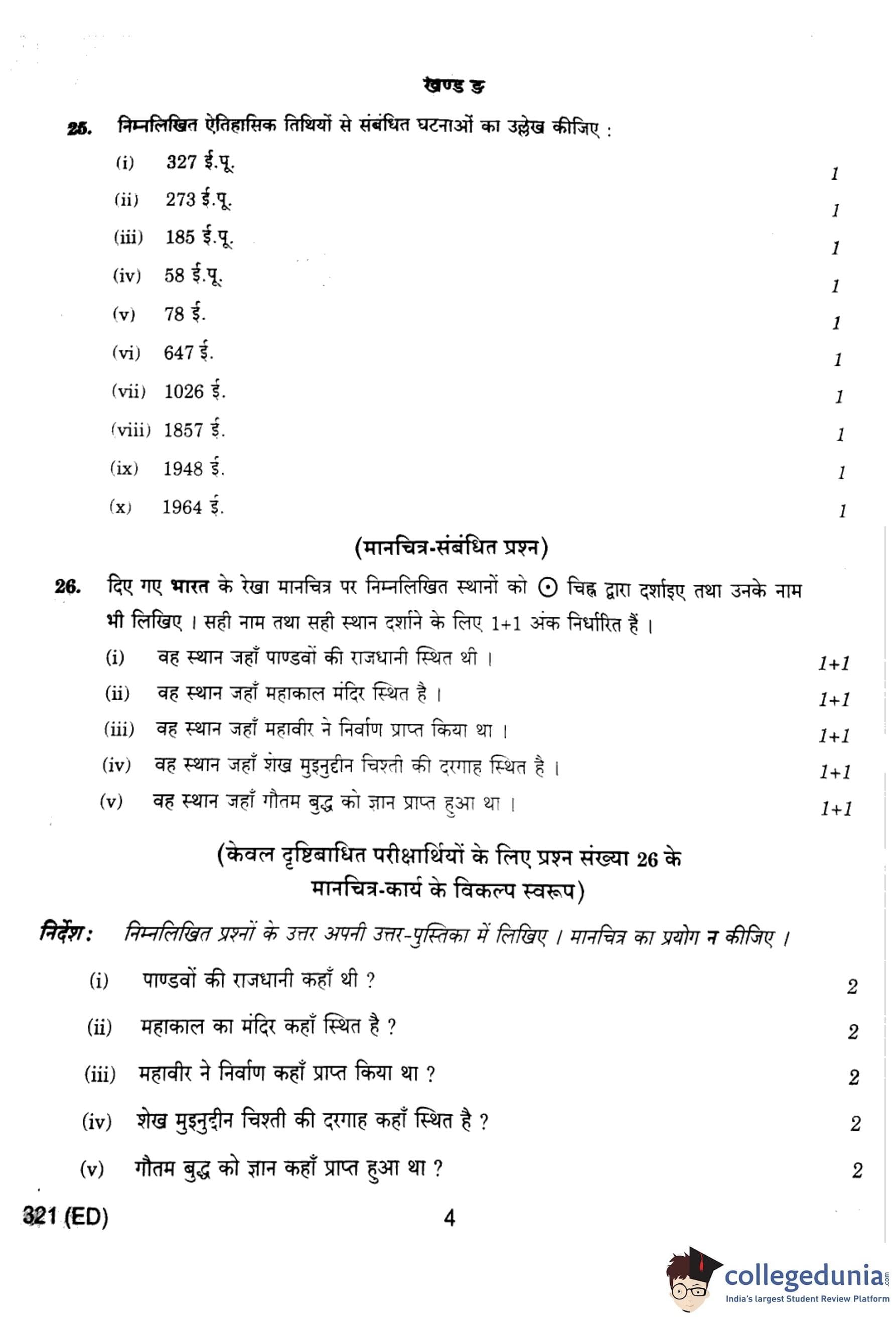
Question 25:
Mention the events related to the following historical dates:
(i) 327 B.C.
(ii) 273 B.С.
(iii) 185 B.C.
(iv) 58 B.C.
(v) 78 A.D.
(vi) 647 A.D.
(vii) 1026 A.D.
(viii) 1857 A.D.
(ix) 1948 A.D.
(x) 1964 A.D.
View Solution
(i) In 327 B.C., Alexander the Great invaded India. His campaign began with the crossing of the Hindukush Mountains and the subsequent battle against various local rulers in northwestern India. His invasion marked the first significant contact between India and the Greek world. Alexander’s army eventually reached the banks of the Beas River, after which his soldiers refused to advance further into India.
(ii) In 273 B.C., Ashoka the Great ascended the throne of the Mauryan Empire. After a period of consolidation, he expanded his empire significantly. His reign is known for administrative efficiency, the spread of Buddhism, and policies of Dhamma (righteousness).
(iii) In 185 B.C., the Mauryan Empire came to an end with the assassination of the last Mauryan ruler, Brihadratha, by his general Pushyamitra Shunga. This led to the establishment of the Shunga dynasty, which ruled over North India and played a crucial role in reviving Hinduism after the Mauryan period.
(iv) In 58 B.C., Vikramaditya established the Vikram Samvat calendar after defeating the Shakas. This calendar is still used in India today, particularly in Hindu religious and festival calculations.
(v)I n 78 A.D., the Shaka Era was introduced by King Kanishka, the ruler of the Kushan Empire. This era is used in India’s official calendars today. Kanishka was also a great patron of Mahayana Buddhism and expanded his empire into Central Asia.
(vi) In 647 A.D., Harsha Vardhana, the last great ruler of North India, passed away. His death led to political instability and the rise of various regional kingdoms in India. The unity of Northern India fragmented, paving the way for future invasions.
(vii) In 1026 A.D., Mahmud of Ghazni attacked the famous Somnath Temple in Gujarat. This was one of his seventeen invasions into India. His raids were primarily motivated by wealth, and they had a significant impact on North Indian politics.
(viii) In 1857 A.D., the First War of Indian Independence (Sepoy Mutiny) took place. It was the first large-scale revolt against British rule, involving leaders like Rani Lakshmibai, Bahadur Shah Zafar, Nana Sahib, and Tantia Tope. Though it was suppressed by the British, it laid the foundation for India’s independence movement.
(ix) In 1948 A.D., Mahatma Gandhi was assassinated by Nathuram Godse on January 30, 1948. This was a tragic event for India, as Gandhi had led the country’s struggle for independence through non-violent means.
(x)In 1964 A.D., Jawaharlal Nehru, the first Prime Minister of India, passed away on May 27. Nehru played a key role in shaping modern India through his policies on industrialization, non-alignment, and democracy.
(Map-related Questions)
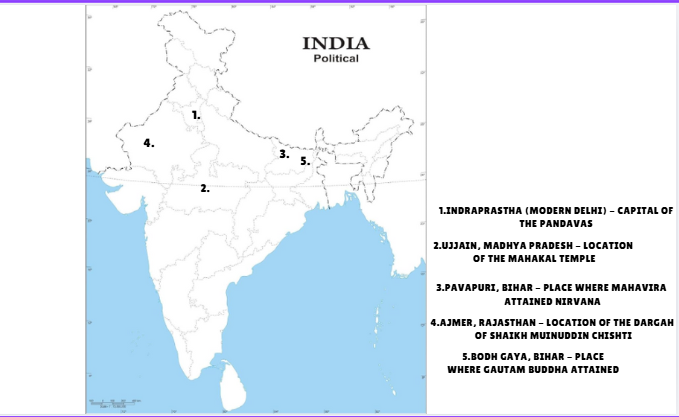
Question 26:
Show the following places on the outline map of India supplied to you with the symbol and also write their names. For correct name and location are allotted.
(i) The place where the capital of Pandavas was located.
(ii) The place where the Temple of Mahakal is located.
(iii) The place where Mahavira attained Nirvana.
(iv) The place where the Dargah of Shaikh Muinuddin Chishti is located.
(v) The place where Gautam Buddha attained enlightenment.
Instructions:
Mark the locations accurately on the given map.
Write the names of these places clearly beside the marked symbols.
View Solution









Comments