




UP Board Class 12 Physics Question Paper 2023 with Answer Key Code 346 BT is available for download. The exam was conducted by the Uttar Pradesh Madhyamik Shiksha Parishad (UPMSP) on March 1, 2023 in Afternoon Session 2 PM to 5:15 PM. The medium of paper was English and Hindi. In terms of difficulty level, UP Board Class 12 Physics paper was Easy. The question paper comprised a total of 9 questions.
UP Board Class 12 Physics (Code 346 BT) Question Paper 2023 with Solutions PDF
| UP Board Class 12 Physics Question Paper with Solutions PDF |  Download Download |
Check Solutions |
a) Unit of \( \frac{1}{\mu_0 \epsilon_0} \) \text{is:
b) The equation \( E = pc \), where \( E \), \( p \), and \( c \) represent energy, momentum, and velocity of light, is valid:
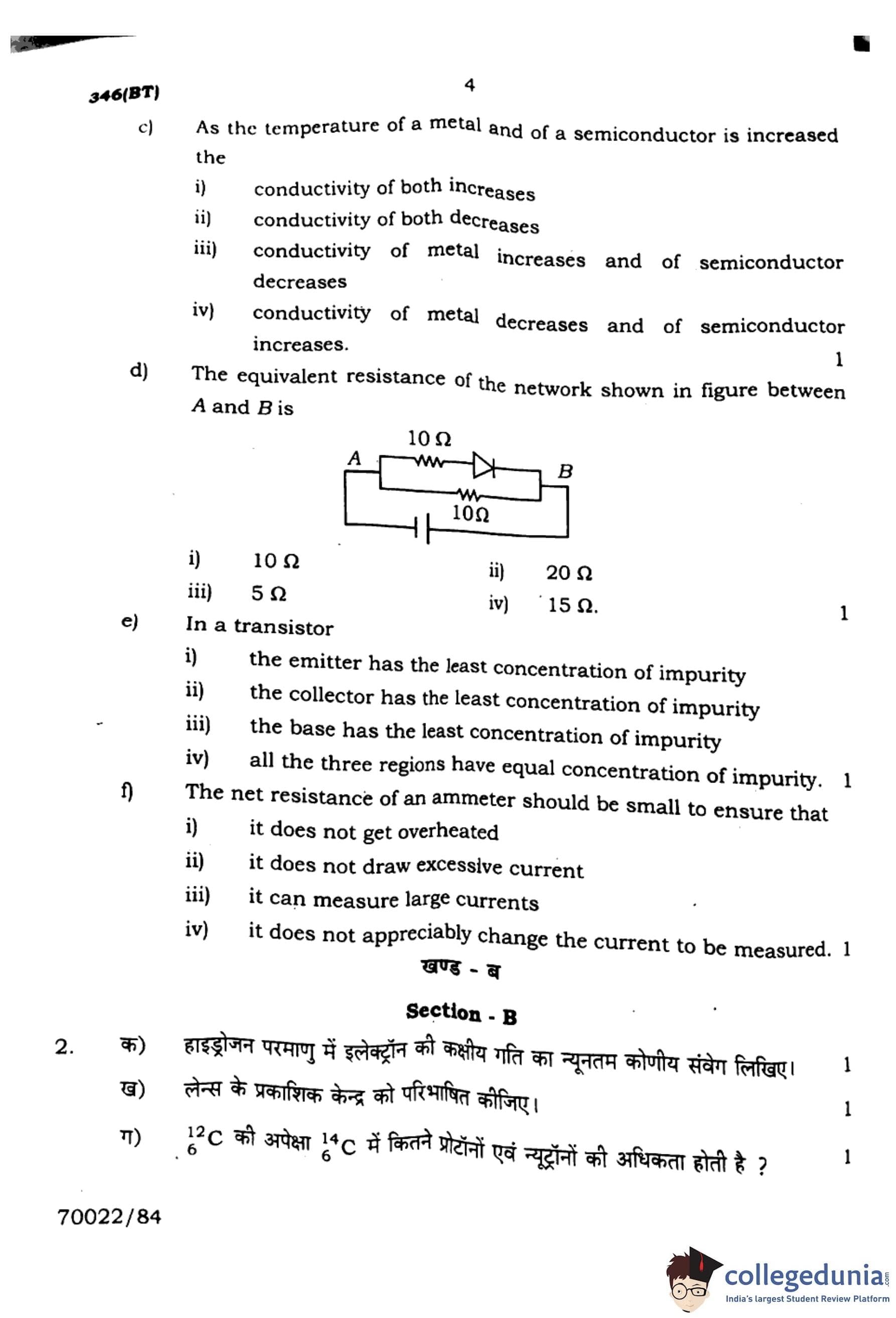
c) As the temperature of a metal and of a semiconductor is increased, the:
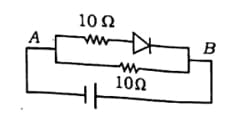
d) The equivalent resistance of the network shown in figure between A and B is:
e) In a transistor:
f) The net resistance of an ammeter should be small to ensure that:
a) Write the minimum orbital angular momentum of the electron in a hydrogen atom.
b) Define optical centre of a lens.
c) As compared to \(^{12}_6C\) atom, how many extra protons and neutrons does the \(^{14}_6C\) atom have?
d) How much energy is released in mass defect of 1 amu?
e) The electric field of intensity \( \vec{E} = (3 \hat{i} + 4 \hat{j}) \, N/C \) passes through the plane of area \( \vec{A} = (10 \hat{i}) \, m^2 \). Find the electric flux.
f) Draw the logic symbol of a NOR gate and write its truth table.
a) Calculate the energy of a \( He^+ (Z = 2) \) in its first excited state.
b) Define drift velocity of free electrons and write the relation between drift velocity and current density.
c) Obtain the formula for the electric potential on the axial line of an electric dipole.
d) What are matter waves? Write de Broglie equation.
a) Define critical angle. Explain working of optical fibre.
b) The work function of a metal is \( 2.5 \times 10^{-9} \) joule. If the metal is exposed to a light beam of frequency \( 6.0 \times 10^{14} \) Hz, what will be the stopping potential?
c) Explain Biot-Savart law and find the unit of \( \mu_0 \) with the help of the Biot-Savart equation.
d) Find the angle of minimum deviation for an equilateral prism made of refractive index \( 1.732 \). What is the angle of incidence for the deviation?
e) A metallic stick of length \( L \) confined in a plane is rotated in its own plane with angular velocity \( \omega \) in a uniform magnetic field \( \vec{B} \) exists in the region. Find the expression of emf induced between the ends of the stick.
a) A diverging lens of focal length 20 cm and a converging lens of focal length 30 cm are placed 15 cm apart with their principal axes coinciding. Where should an object be placed on the principal axis so that its image is formed at infinity?
b) Draw a suitable ray diagram of a compound microscope, when the image is formed at the least distance of distinct vision. Find the expression of magnifying power in this case.
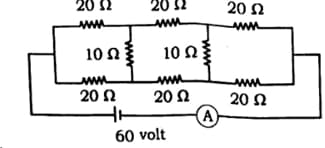
c) Write the principle of Wheatstone's Bridge. Find the current measured by the ammeter in the given circuit diagram.
d) Explain the classification of conductors, insulators, and semiconductors on the basis of energy bands.
The electric field in an electromagnetic wave is given by \( E = 50 \sin \left( \omega t - \frac{x}{c} \right) \, N/C\). Find the energy contained in a cylinder of cross-section \( 10 \, cm^2 \) and length 50 cm along the x-axis.
e) If binding energy per nucleon of deuteron and \( \alpha \)-particle are 1.25 MeV and 7.4 MeV respectively, then find the value of \( Q \) in the following reaction:
\[ 2 \, ^1_1H \rightarrow 2 \, ^4_2He + Q \]
Find the expression of the capacity of the parallel plate capacitor partly filled with dielectric substance. If the capacitor is charged by 100 μC and dielectric constant of the slab putting in it is 2.0, then find the induced charge on the dielectric slab in the capacitor.
Write Gauss' law of electrostatics and obtain Coulomb's law with its help.
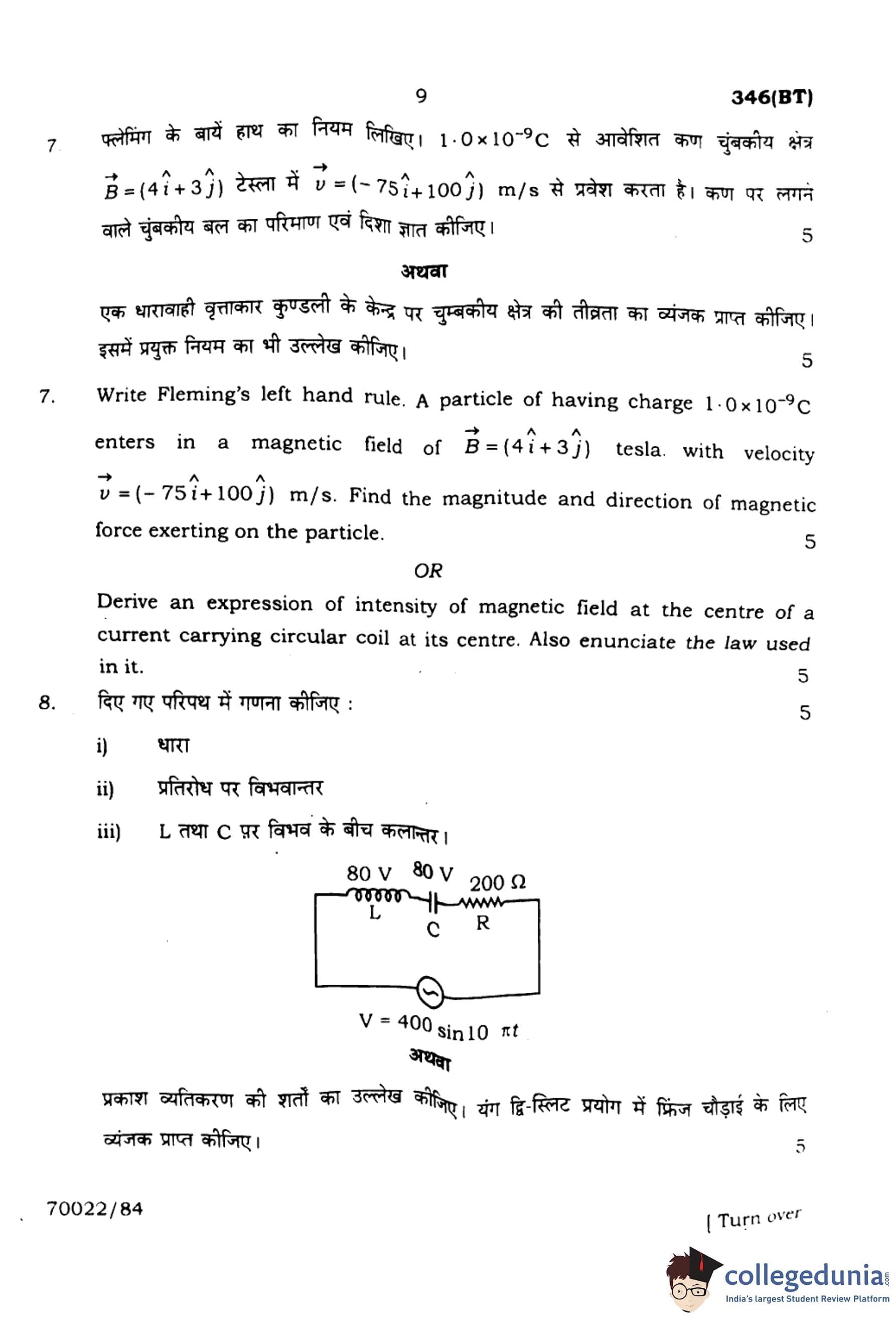
Write Fleming's left hand rule. A particle of having charge \( 1.0 \times 10^{-9} \, C \) enters in a magnetic field of \( \vec{B} = (4 \hat{i} + 3 \hat{j}) \, tesla \) with velocity \( \vec{v} = (-75 \hat{i} + 100 \hat{j}) \, m/s \). Find the magnitude and direction of magnetic force exerting on the particle.
Derive an expression of intensity of magnetic field at the centre of a current-carrying circular coil at its centre. Also, enunciate the law used in it.
In the given circuit, calculate:
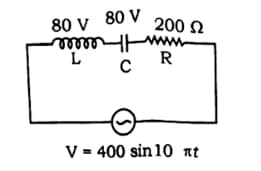
i) Current
ii) Voltage across the resistor
iii) Phase difference between L and C
State the conditions of interference of light. Obtain the expression for the fringe width in Young's double slit experiment.
Explain p-n-p transistor as a common emitter amplifier. What are the gains in it?
What is optical path? A monochromatic light ray of 6000 Å is incident on a glass slab. Refractive index of the slab is 1.5. Find the velocity and wavelength of reflected and refracted rays from the slab.








Comments