




UP Board Class 12 Physics Question Paper 2023 with Answer Key Code 346 BX is available for download. The exam was conducted by the Uttar Pradesh Madhyamik Shiksha Parishad (UPMSP) on March 1, 2023 in Afternoon Session 2 PM to 5:15 PM. The medium of paper was English and Hindi. In terms of difficulty level, UP Board Class 12 Physics paper was Easy. The question paper comprised a total of 9 questions.
UP Board Class 12 Physics (Code 346 BX) Question Paper 2023 with Solutions PDF
| UP Board Class 12 Physics Question Paper with Solutions PDF |  Download Download |
Check Solutions |
In an A.C. circuit, potential difference and current are given as, \[ V = 100 \sin(100t) \, volts, \quad i = 100 \sin\left(100t + \frac{\pi}{3}\right) \, mA. \]
The power consumed in the circuit is:
The isotones pair of the following are:
The amplitude of the magnetic field in an electromagnetic wave is \(3 \times 10^{-10}\) T. If frequency of the wave is \(10^{12}\) Hz, then the amplitude of the associated electric field is:
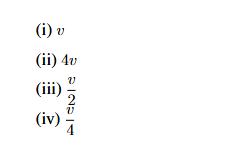
The drift velocity of free electrons is \(v\) on passing current \(i\) in a conducting wire. Drift velocity of electrons in the same wire having twice the radius and current \(2i\) will be:
The refracting angle of three prisms is \(15^\circ\), but their refractive indices are 1.6, 1.5, and 1.4 respectively. If angles of deviation produced by them are \(\delta_1, \delta_2,\) and \(\delta_3\) respectively, then:
If actual angle of dip is \(\theta\) and \(\theta'\) is the angle of dip in a plane at an angle \(\alpha\) from the magnetic meridian, then \(\dfrac{\tan \theta'}{\tan \theta}\) is:
If the magnification of objective and eyepiece lenses of a compound microscope are \(m_1\) and \(m_2\) respectively, then write down the formula for the magnifying power of the microscope.
What is meant by shunt?
What is Kirchhoff’s First Law for the electrical circuit?
Define coefficient of self-induction.
A particle of mass \(m\) moves with a speed \(v\). Write down the formula of the corresponding de Broglie wavelength of the particle.
Write down the formula for the electric potential on the axial line of an electric dipole.
A coil of area \(5 \, cm^2\) is placed in a uniform magnetic field of \(1.5 \, N/Am\). If the coil has 100 turns and \(0.2 \, A\) of current is passed in it, then find:
Magnetic dipole moment of the coil
Maximum torque on the coil
The radius of nucleus is expressed as \(R = R_0 A^{1/3}\), where \(A\) is mass number and \(R_0 = 1.2 \times 10^{-15} \, m\). Prove that the density of nucleus does not depend upon the mass number \(A\).
With the help of symbol diagram of AND gate, prepare its truth table.
The length of a wire of \(10 \, \Omega\) resistance is three times the length on stretching it. Now the wire is cut into three equal parts and then they are joined in an electrical circuit as shown in the figure. Find out the total resistance of the combination between A and B.
Prove that the period of revolution (T) of electrons in stable orbits of the atom is directly proportional to the cube of the principal quantum number (\(n\)), on the basis of Bohr’s atom model.
The first minima for the wavelength \(\lambda_1 = 660 \, nm\) coincides with the first maxima of some other wavelength \(\lambda_2\), in the single-slit diffraction experiment of light. Find out the value of wavelength \(\lambda_2\).
Work function of silver is \(4.7 \, eV\). When ultraviolet light of wavelength \(100 \, nm\) is incident on it, the stopping potential obtained is \(7.7 \, V\). Find out the value of the stopping potential for the wavelength of light of \(200 \, nm\).
Obtain the formula for the magnetic field at the centre of a current carrying circular coil with the help of Biot-Savart law.
Diameters of two spheres of metal are \(6 \, cm\) and \(4 \, cm\). They are charged to the same potential. Find out the ratio of the surface densities of charge on the sphere.
Find out the formula for the capacitance of the parallel plate capacitor shown in the figure. Area of the plates is \(A\) and thicknesses of the dielectric slabs between the plates are \(d_1\) and \(d_2\), and their dielectric constants are \(K_1\) and \(K_2\) respectively.
A metallic rod PQ whose length is \(1 \, m\), is moving with a uniform speed of \(2 \, ms^{-1}\) in a uniform magnetic field of \(4 \, T\). A capacitor of \(10 \, \mu F\) capacitance is connected as shown in the figure. Magnetic field is directed downwards, perpendicular to the plane of the paper. Find out:
Induced e.m.f. across the rod PQ.
Charge on the capacitor.
Which plate of the capacitor has positive charge?
Derive the formula for the determination of internal resistance of a cell with the help of a potentiometer.
The radius of curvature of a plastic hemisphere is \(8 \, cm\) and refractive index is \(1.6\). A point source \(O\) is placed on the principal axis inside the hemisphere. Find the position of image of \(O\) when it is:
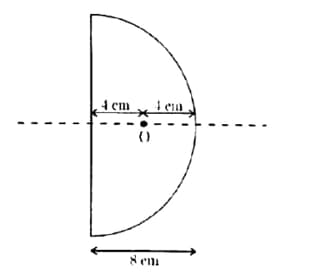
viewed through the plane surface.
viewed through the spherical surface.
What is the principle of a transformer? Explain the working process of a step-up transformer by drawing a circuit diagram. Enunciate any two reasons of energy losses in transformer.
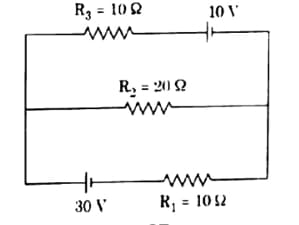
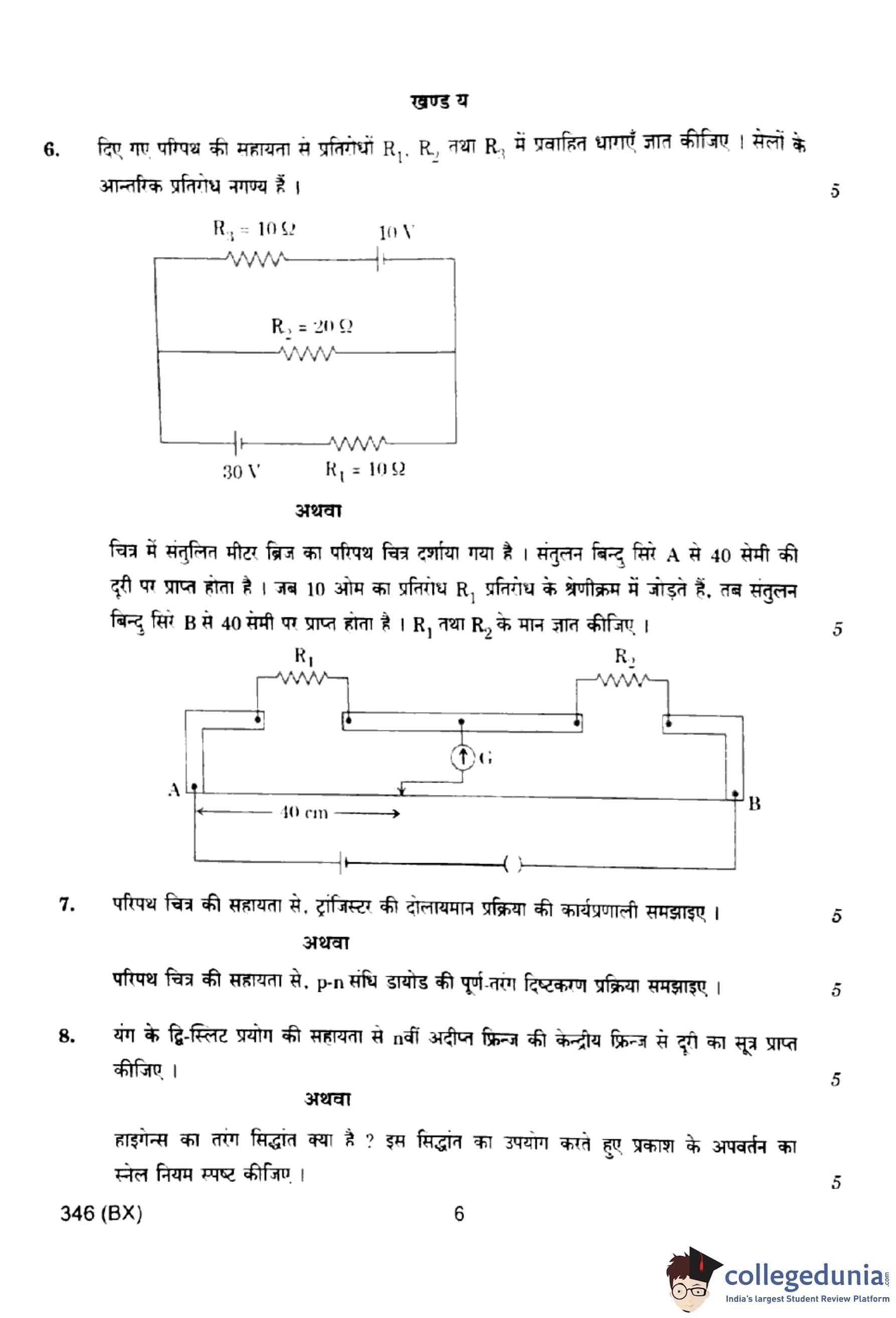
(i) Find the currents through the resistors \(R_1, R_2\), and \(R_3\) with the help of the given circuit. Internal resistances of the cells are negligible.
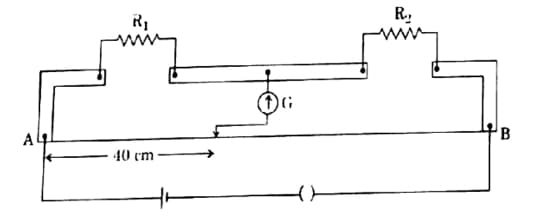
The circuit diagram of a balanced meter bridge is shown in the figure. The balanced point is obtained at \(40 \, cm\) from the end A. When a \(10 \, \Omega\) resistor is joined in series with \(R_1\), the balanced point is obtained at \(40 \, cm\) from the end B. Find the values of \(R_1\) and \(R_2\).
Explain the working of oscillating process of a transistor, with the help of circuit diagram.
Explain the full-wave rectification process of p-n junction diode, with the help of a circuit diagram.
Obtain the formula for the distance of \(n^{th}\) order dark fringe from the central fringe with the help of Young’s double-slit experiment.
What is Huygens’ wave theory? Enunciate Snell’s law of refraction of light by using this theory.
From the given A.C. circuit, find out:
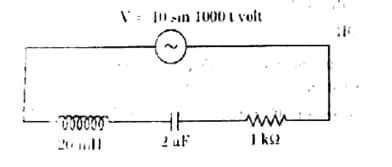
Inductive and capacitive reactance
Frequency of the applied voltage in the state of resonance
Impedance of the circuit in resonance stage
What are Faraday’s laws of electromagnetic induction? A wire is placed in a magnetic field of \(100 \, T\), with its perpendicular plane in the form of a circle of radius \(10 \, cm\). If the wire is pulled in the same plane in \(0.1 \, s\), so as to give it the form of a square, then find the average induced e.m.f. produced in the loop.







Comments