




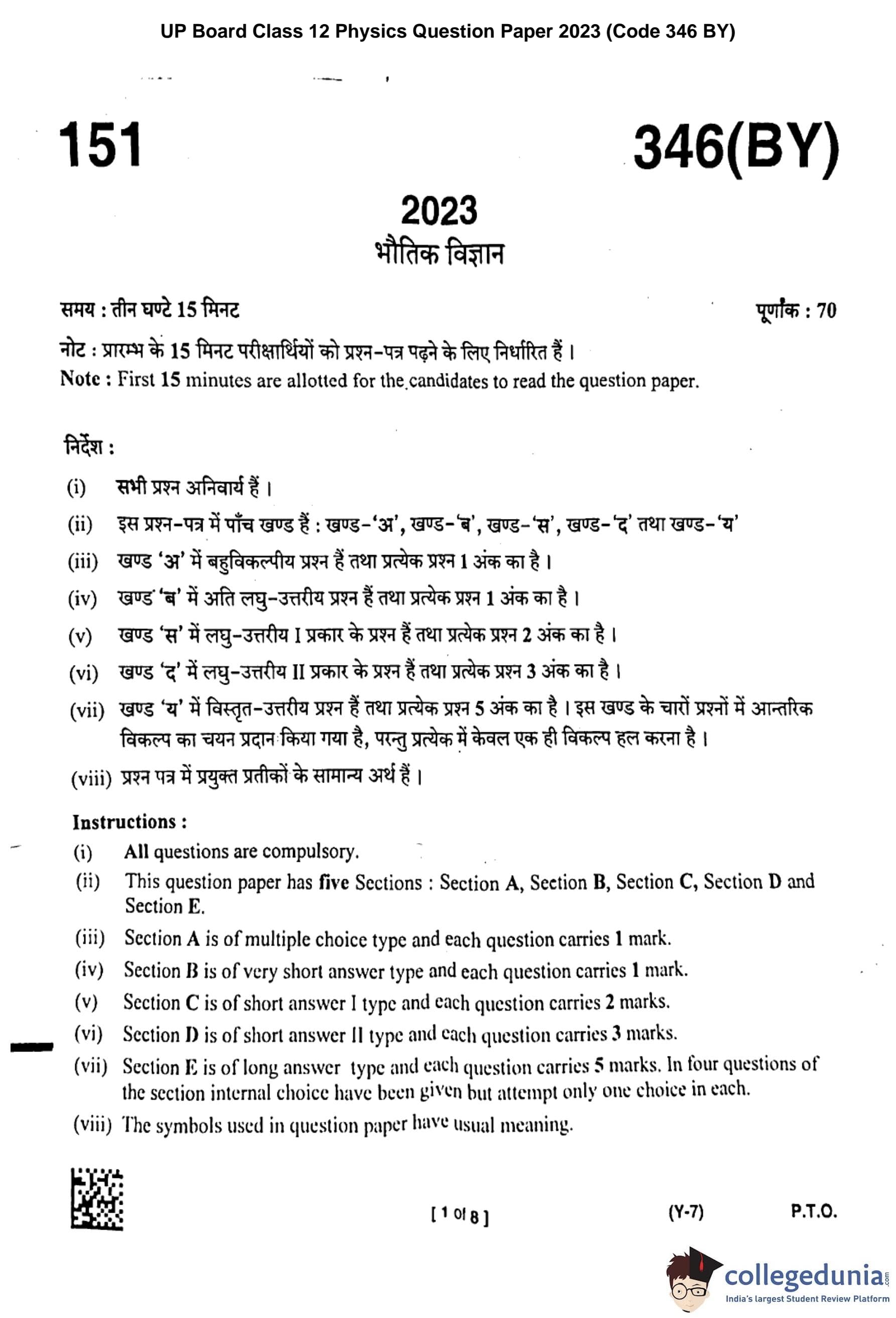
UP Board Class 12 Physics Question Paper 2023 with Answer Key Code 346 BY is available for download. The exam was conducted by the Uttar Pradesh Madhyamik Shiksha Parishad (UPMSP) on March 1, 2023 in Afternoon Session 2 PM to 5:15 PM. The medium of paper was English and Hindi. In terms of difficulty level, UP Board Class 12 Physics paper was Easy. The question paper comprised a total of 9 questions.
UP Board Class 12 Physics (Code 346 BY) Question Paper 2023 with Solutions PDF
| UP Board Class 12 Physics Question Paper with Solutions PDF |  Download Download |
Check Solutions |
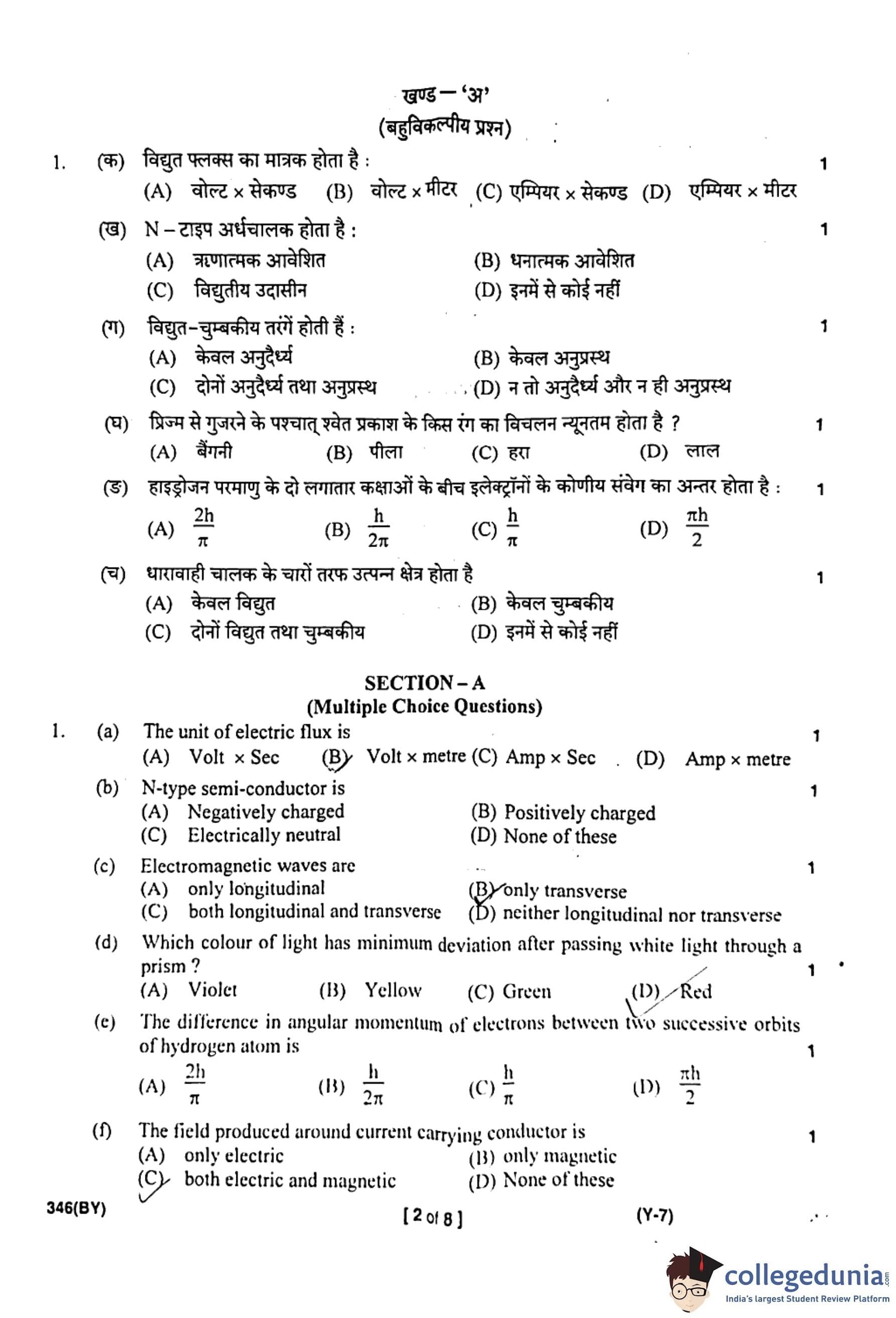
The unit of electric flux is:
N-type semi-conductor is:
Electromagnetic waves are:
Which colour of light has minimum deviation after passing white light through a prism?
The difference in angular momentum of electrons between two successive orbits of hydrogen atom is:
The field produced around current carrying conductor is:
State limitations of the formula for the refraction of light on a spherical surface: \[ \frac{n_1}{u} + \frac{n_2}{v} = \frac{n_2 - n_1}{R} \]
where symbols have their usual meanings.
Why LED is kept in forward biased condition?
Find the refractive index of material of a prism, if the angle of prism and the angle of minimum deviation are equal to \(A\).
Electric and magnetic field vectors of an EM wave are \(\vec{E}\) and \(\vec{B}\) respectively. Find the direction of propagation.
What is the principle of a transformer?
On what factors does the internal resistance of a cell depend?
Draw circuit diagram of Wheatstone’s bridge. Which are its conjugate arms?
What is meant by shunt and mention its one use in electrical circuit?
Two lenses of powers +5D and –3D are placed in contact. Find (i) the focal length and (ii) the power of the combined lens.
A metal has work function of 2.0 eV and is illuminated by monochromatic light of wavelength 5000 \AA. Calculate (i) the threshold wavelength and (ii) the stopping potential.
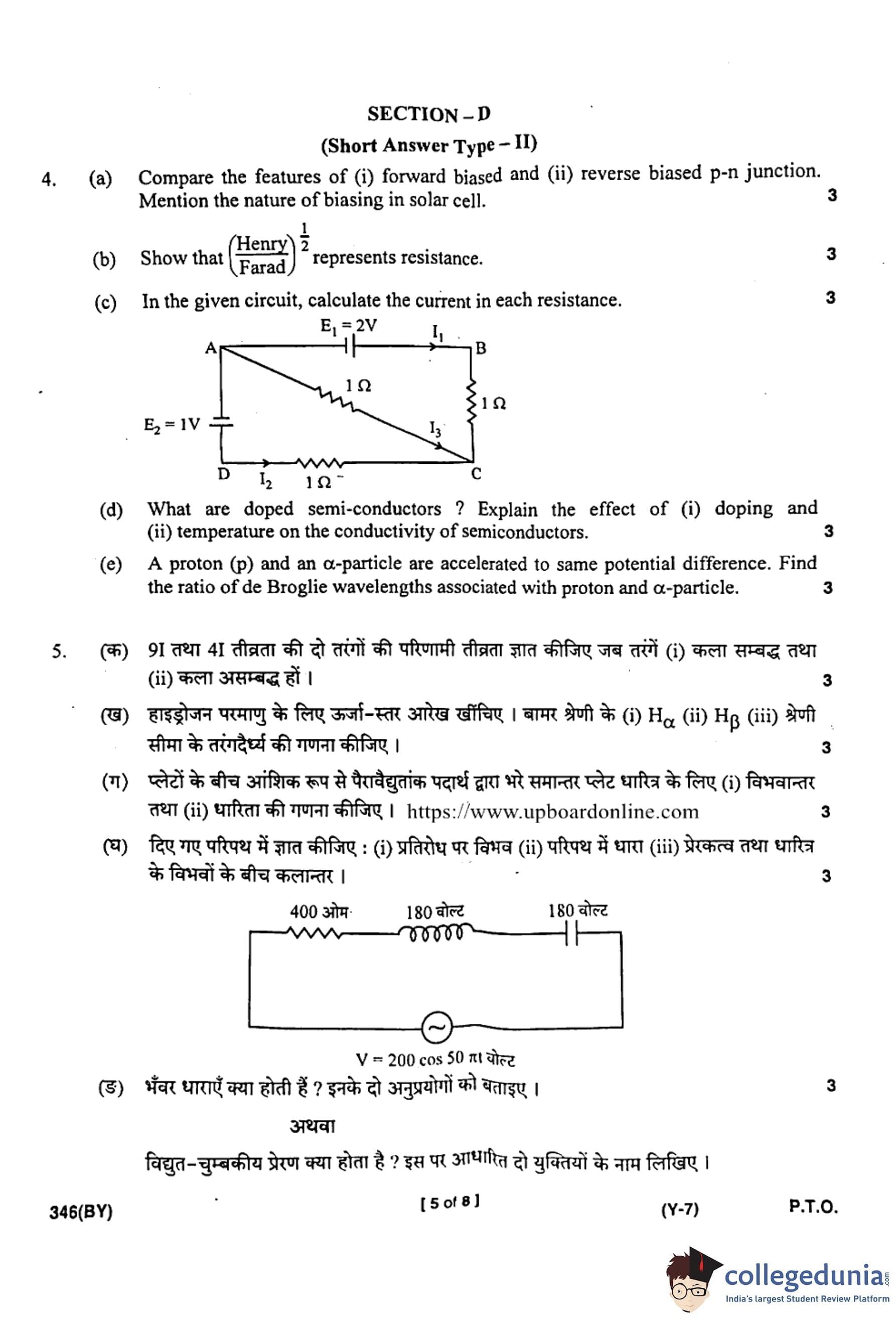
Compare the features of (i) forward biased and (ii) reverse biased p-n junction. Mention the nature of biasing in solar cell.
Show that \(\left(\dfrac{Henry}{Farad}\right)^{1/2}\) represents resistance.
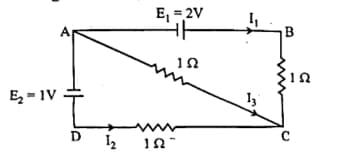
In the given circuit, calculate the current in each resistance.
What are doped semiconductors? Explain the effect of (i) doping and (ii) temperature on the conductivity of semiconductors.
A proton (p) and an \(\alpha\)-particle are accelerated to the same potential difference. Find the ratio of de Broglie wavelengths associated with proton and \(\alpha\)-particle.
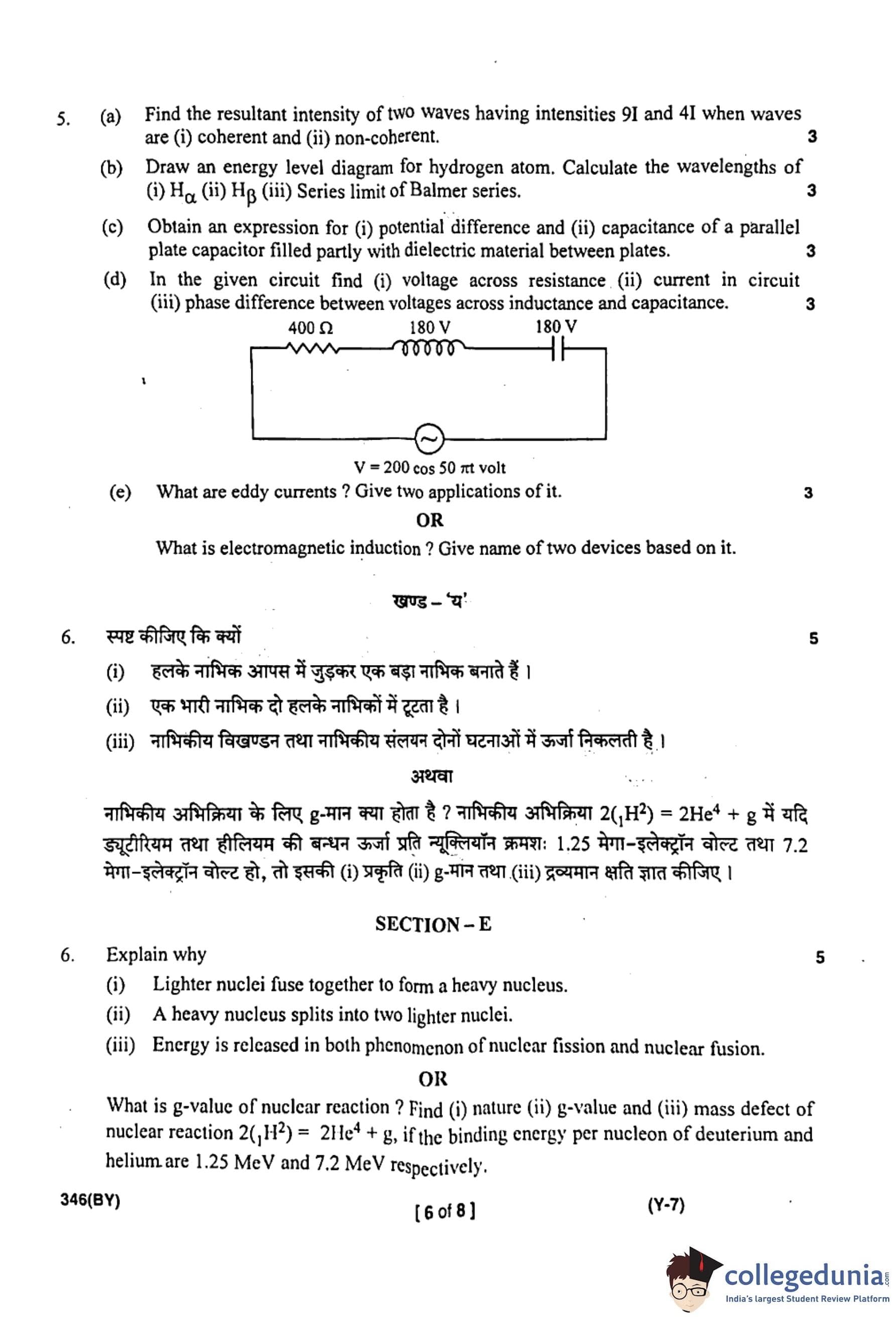
Find the resultant intensity of two waves having intensities \(9I\) and \(4I\) when waves are (i) coherent and (ii) non-coherent.
Draw an energy level diagram for hydrogen atom. Calculate the wavelengths of (i) H\(_\alpha\), (ii) H\(_\beta\), and (iii) Series limit of Balmer series.
Obtain an expression for (i) potential difference and (ii) capacitance of a parallel plate capacitor filled partly with dielectric material between plates.
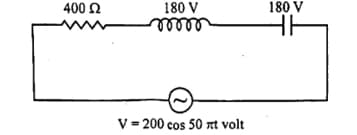
In the given circuit, find (i) voltage across resistance, (ii) current in the circuit, (iii) phase difference between voltages across inductance and capacitance.
What are eddy currents? Give two applications of it.
Explain why:
[(i)] Lighter nuclei fuse together to form a heavy nucleus.
[(ii)] A heavy nucleus splits into two lighter nuclei.
[(iii)] Energy is released in both phenomenon of nuclear fission and nuclear fusion.
What is \(Q\)-value of a nuclear reaction? Find (i) nature, (ii) \(Q\)-value, and (iii) mass defect of nuclear reaction:
\[ 2({}^1H^2) \; \longrightarrow \; {}^4He^2 + g \]
if the binding energy per nucleon of deuterium and helium are \(1.25 \, MeV\) and \(7.2 \, MeV\) respectively.
Compare astronomical telescope with compound microscope. Can a telescope be used as a microscope and vice-versa? Explain with reason.
The refractive index for material of prism having refracting angle \(60^\circ\) is \(1.414\). For light incident on prism in minimum deviation position, calculate:
(i) Angle of minimum deviation, (ii) Angle of incidence, (iii) Angle of refraction, (iv) Angle of emergence. Also draw ray diagram.
State, explain and compare features of (i) Gauss’s law in electrostatics and (ii) Ampere’s circuital law in magnetostatics.
Write the nature of path of a charged particle moving:
(i) along the electric field,
(ii) perpendicular to the electric field,
(iii) perpendicular to the magnetic field,
(iv) along the magnetic field,
(v) along the combination of electric field and magnetic field acting mutually perpendicular to each other.
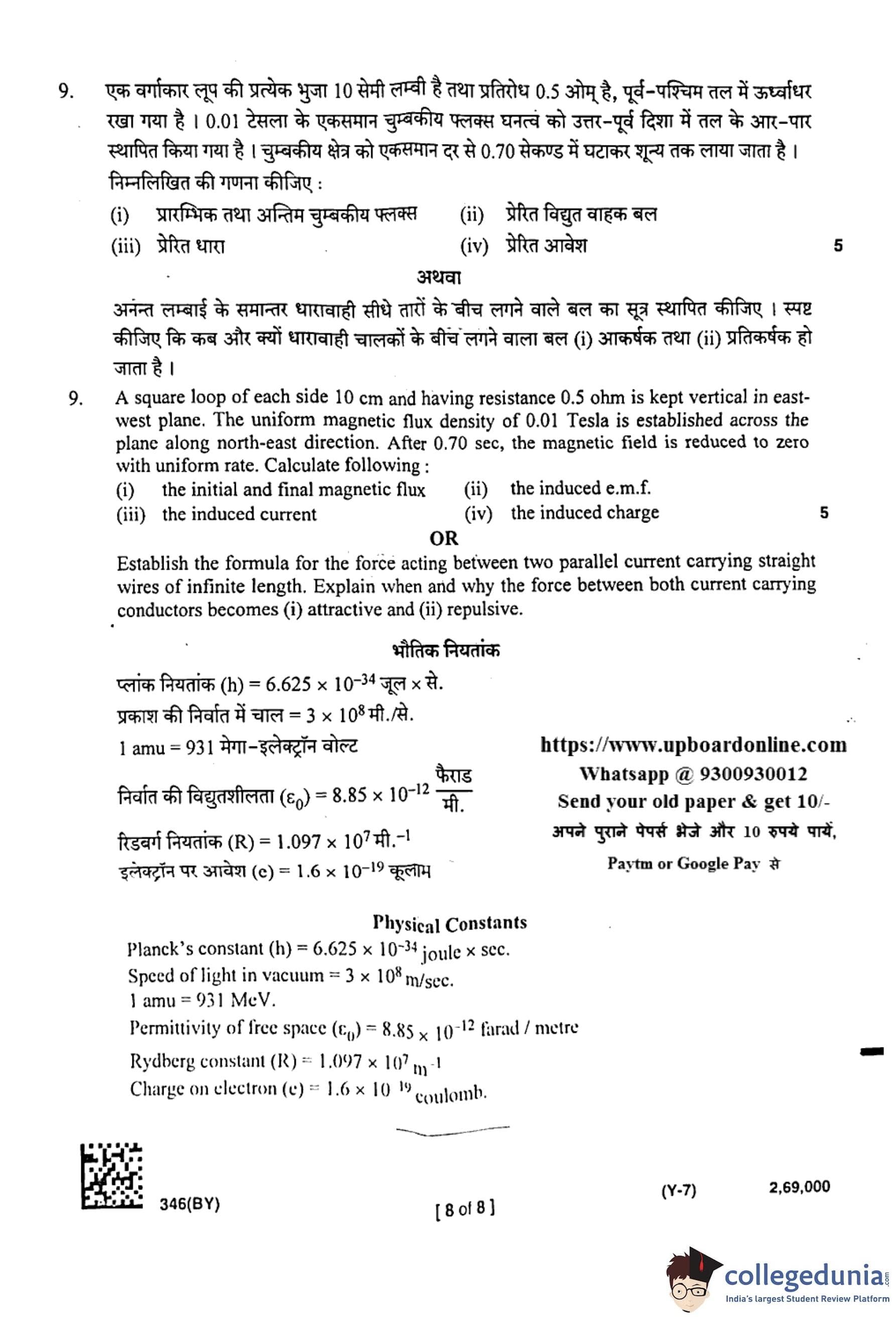
A square loop of each side 10 cm and having resistance 0.5 \(\Omega\) is kept vertical in east-west plane. The uniform magnetic flux density of 0.01 Tesla is established across the plane along north-east direction. After 0.70 sec, the magnetic field is reduced to zero with uniform rate. Calculate the following:
(i) the initial and final magnetic flux, (ii) the induced e.m.f., (iii) the induced current, (iv) the induced charge.
Establish the formula for the force acting between two parallel current carrying straight wires of infinite length. Explain when and why the force between both current carrying conductors becomes (i) attractive and (ii) repulsive.






Comments