




UP Board Class 12 Physics Question Paper 2025 PDF (Code 346 JX) is available for download here. The Mathematics exam was conducted on March 6, 2025 in the Morning Shift from 2:00 PM to 5:15 PM. The total marks for the theory paper are 100. Students reported the paper to be easy to moderate.
UP Board Class 12 Physics Question Paper 2025 (Code 346 JX) with Solutions
| UP Board Class Physics Question Paper with Answer Key |  Download Download |
Check Solutions |
UP Board Class 12 Physics Questions with Solutions
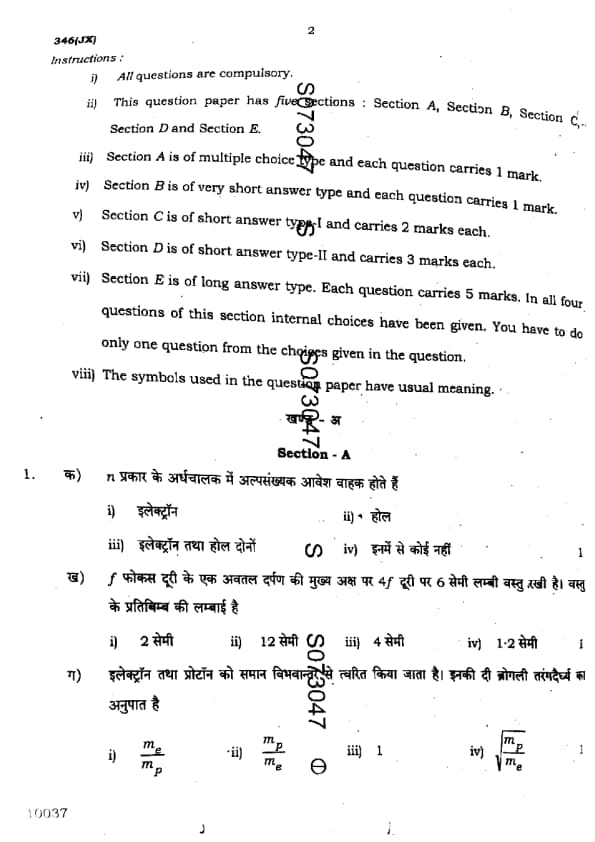
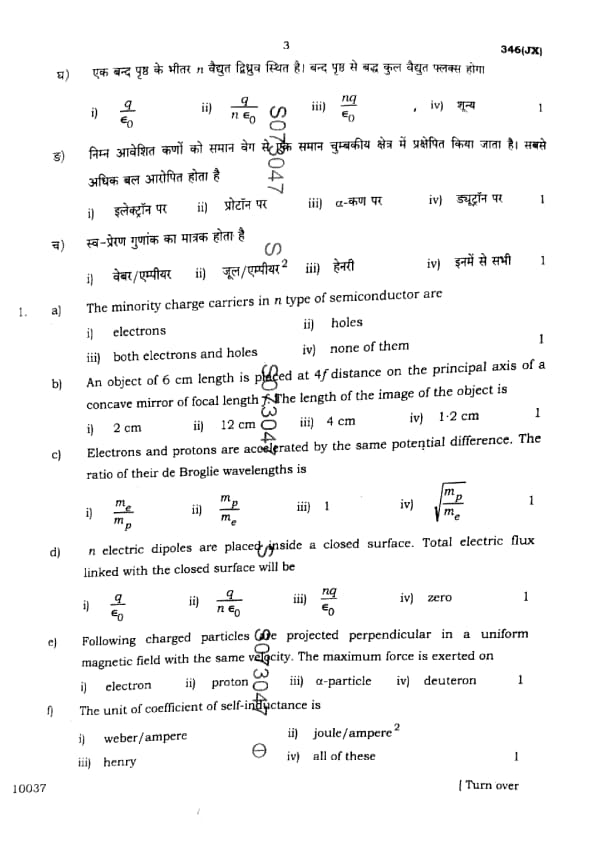
The minority charge carriers in n type of semiconductors:
The length of the image formed by a concave mirror:
Electrons and protons are accelerated by the same potential difference. The ratio of their de Broglie wavelengths is:
n electric dipoles are placed inside a closed surface. Total electric flux linked with the closed surface will be:
Following charged particles are projected perpendicular in a uniform magnetic field with the same velocity. The maximum force is exerted on:
The unit of coefficient of self-inductance is:
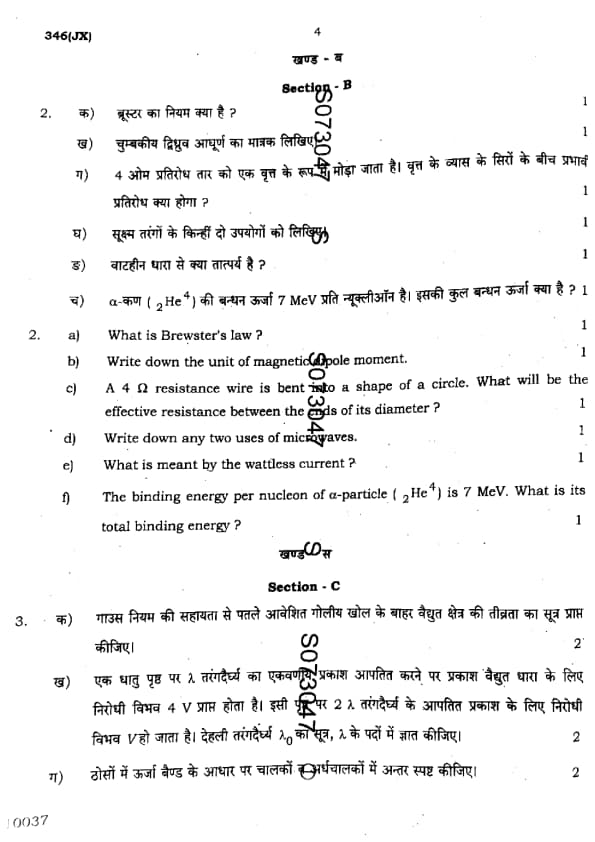
What is Brewster's law?
Write down the unit of magnetic dipole moment.
A \( 4 \, \Omega \) resistance wire is bent into a shape of a circle. What will be the effective resistance between the ends of its diameter?
Write down any two uses of microwaves.
What is meant by the wattless current?
The binding energy per nucleon of \(\alpha\)-particle (\(_2^4He\)) is 7 MeV. What is its total binding energy?
Obtain the formula for the intensity of electric field outside a charged thin spherical shell with the help of Gauss' law.
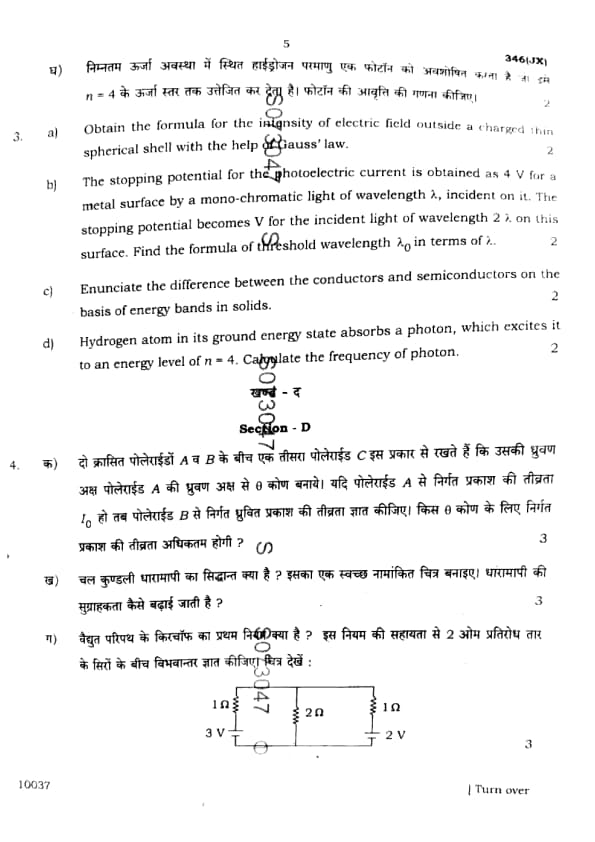
The stopping potential for the photoelectric current is obtained as 4 V for a metal surface by a monochromatic light of wavelength \( \lambda \), incident on it. The stopping potential becomes \(V\) for the incident light of wavelength \( 2\lambda \) on this surface. Find the formula of threshold wavelength \( \lambda_0 \) in terms of \( \lambda \).
Enunciate the difference between the conductors and semiconductors on the basis of energy bands in solids.
Hydrogen atom in its ground energy state absorbs a photon, which excites it to an energy level of \(n = 4\). Calculate the frequency of photon.
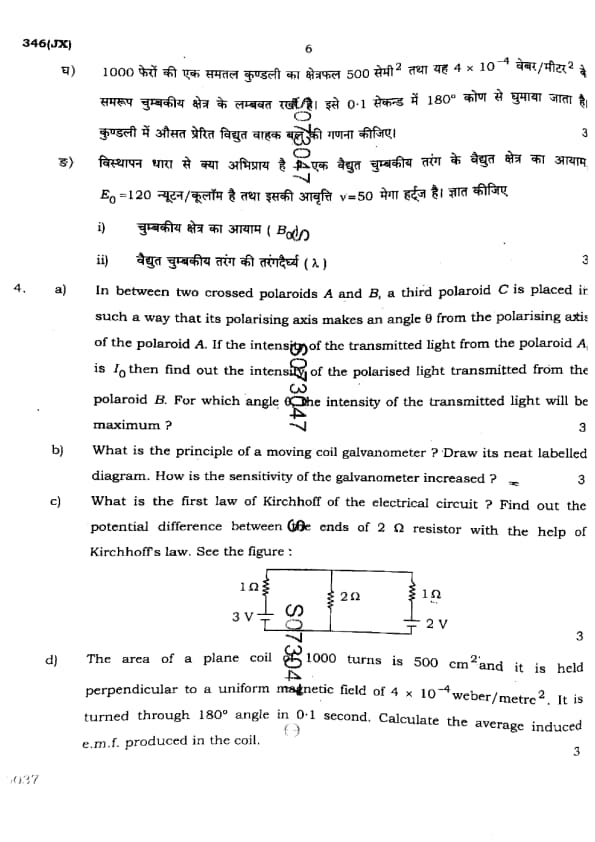
In between two crossed polaroids A and B, a third polaroid C is placed in such a way that its polarising axis makes an angle \( \theta \) from the polarising axis of the polaroid A. If the intensity of the transmitted light from the polaroid A is \( I_0 \), then find out the intensity of the polarised light transmitted from the polaroid B. For which angle \( \theta \) the intensity of the transmitted light will be maximum?
What is the principle of a moving coil galvanometer? Draw its neat labelled diagram. How is the sensitivity of the galvanometer increased?
What is the first law of Kirchhoff of the electrical circuit? Find out the potential difference between the ends of 2 \(\Omega\) resistor with the help of Kirchhoff's law. See the figure:

The area of a plane coil 1000 turns is 500 cm\(^2\) and it is held perpendicular to a uniform magnetic field of \(4 \times 10^{-4}\) weber/m\(^2\). It is turned through 180° angle in 0.1 second. Calculate the average induced e.m.f. produced in the coil.
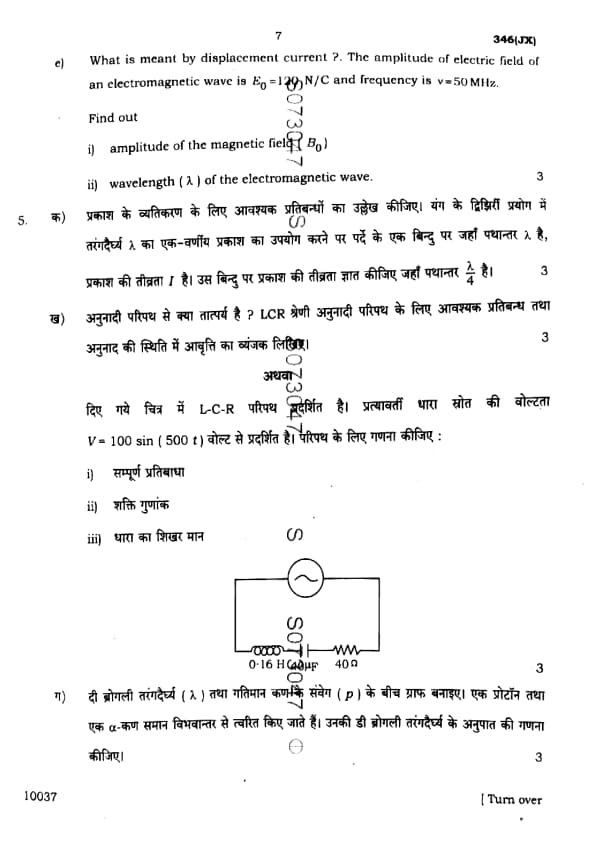
What is meant by displacement current? The amplitude of electric field of an electromagnetic wave is \( E_0 = 120 \, N/C \) and frequency is \( \nu = 50 \, MHz \). Find out:
i) Amplitude of the magnetic field \( B_0 \)
ii) Wavelength \( \lambda \) of the electromagnetic wave.
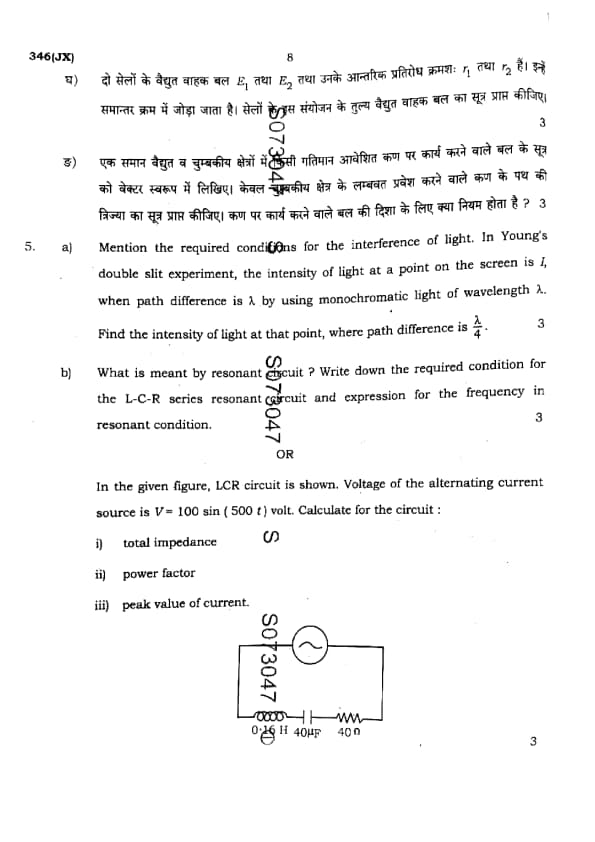
Mention the required conditions for the interference of light. In Young's double slit experiment, the intensity of light at a point on the screen is \( I \), when path difference is \( \lambda \) by using monochromatic light of wavelength \( \lambda \). Find the intensity of light at that point, where path difference is \( \frac{\lambda}{4} \).
What is meant by resonant circuit? Write down the required condition for the L-C-R series resonant circuit and expression for the frequency in resonant condition.
In the given figure, LCR circuit is shown. Voltage of the alternating current source is \( V = 100 \sin (500 t) \) volt. Calculate for the circuit:

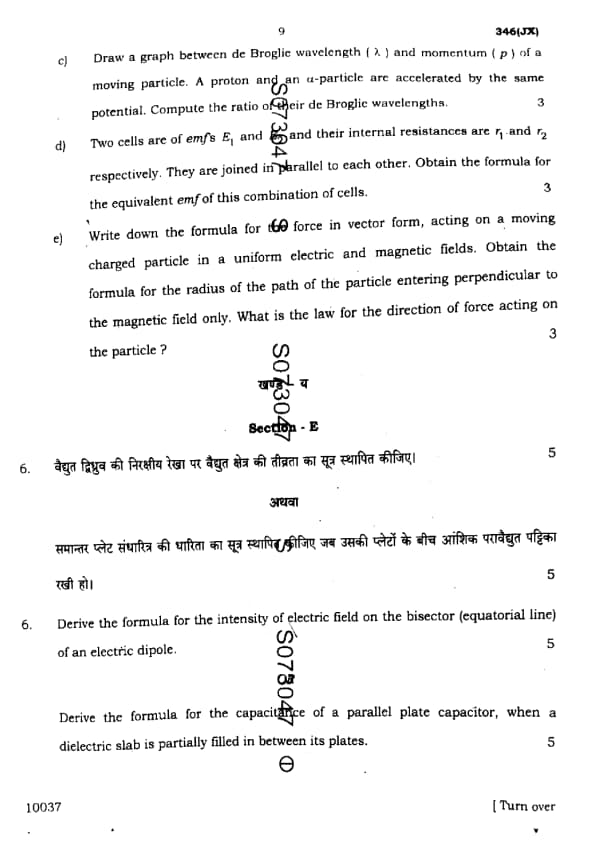
Draw a graph between de Broglie wavelength (\(\lambda\)) and momentum (\(p\)) of a moving particle. A proton and an \(\alpha\)-particle are accelerated by the same potential. Compute the ratio of their de Broglie wavelengths.
Two cells are of emf's \(E_1\) and \(E_2\) and their internal resistances are \(r_1\) and \(r_2\) respectively. They are joined in parallel to each other. Obtain the formula for the equivalent emf of this combination of cells.
Write down the formula for the force in vector form, acting on a moving charged particle in a uniform electric and magnetic fields. Obtain the formula for the radius of the path of the particle entering perpendicular to the magnetic field only. What is the law for the direction of force acting on the particle?
Derive the formula for the intensity of electric field on the bisector (equatorial line) of an electric dipole.
Derive the formula for the capacitance of a parallel plate capacitor, when a dielectric slab is partially filled in between its plates.
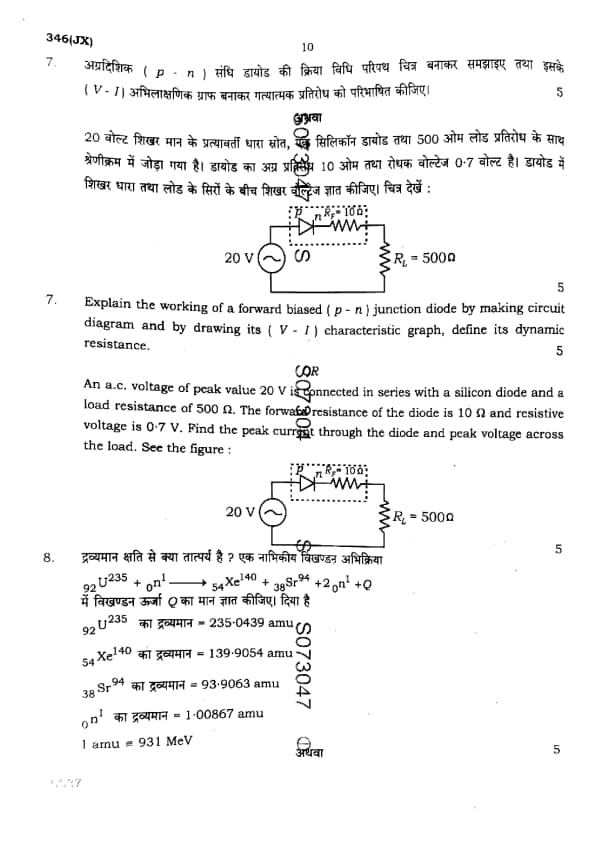
Explain the working of a forward biased (\( p - n \)) junction diode by making circuit diagram and by drawing its \( V - I \) characteristic graph. Define its dynamic resistance.
An a.c. voltage of peak value 20 V is connected in series with a silicon diode and a load resistance of 500 \(\Omega\). The forward resistance of the diode is 10 \(\Omega\) and the resistive voltage is 0.7 V. Find the peak current through the diode and peak voltage across the load.

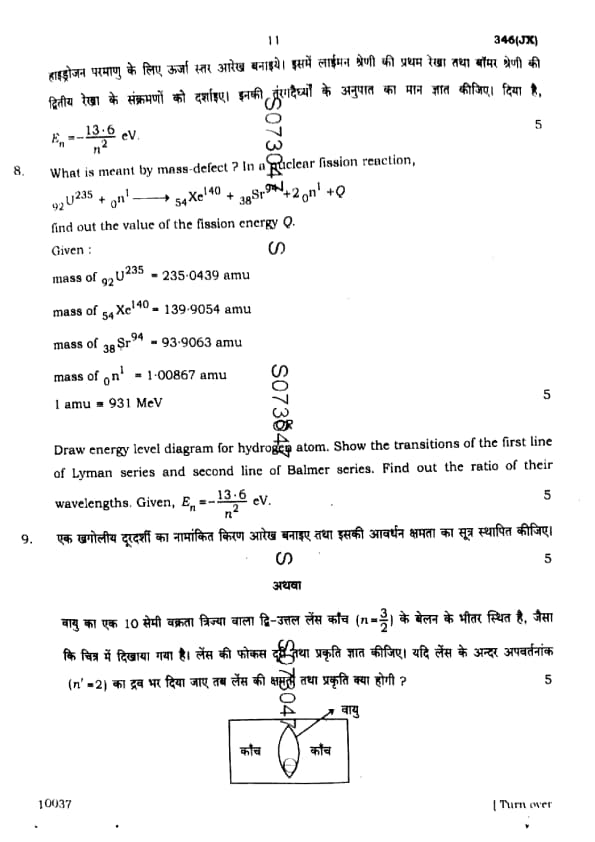
What is meant by mass-defect? In a nuclear fission reaction, find out the value of the fission energy \( Q \).
Draw energy level diagram for hydrogen atom. Show the transitions of the first line of Lyman series and second line of Balmer series. Find out the ratio of their wavelengths.
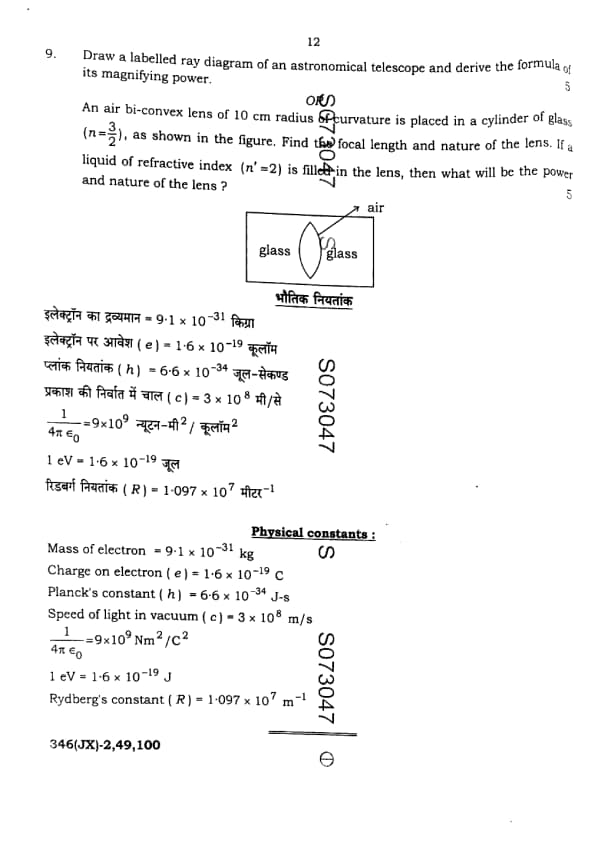
Draw a labelled ray diagram of an astronomical telescope and derive the formula of its magnifying power.
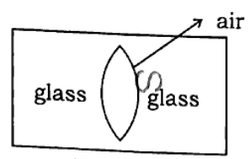
An air bi-convex lens of 10 cm radius of curvature is placed in a cylinder of glass (\(n = \frac{3}{2}\)), as shown in the figure. Find the focal length and nature of the lens. If a liquid of refractive index \(n' = 2\) is filled in the lens, then what will be the power and nature of the lens?



Comments