

.jpg?h=56&w=56&mode=stretch)


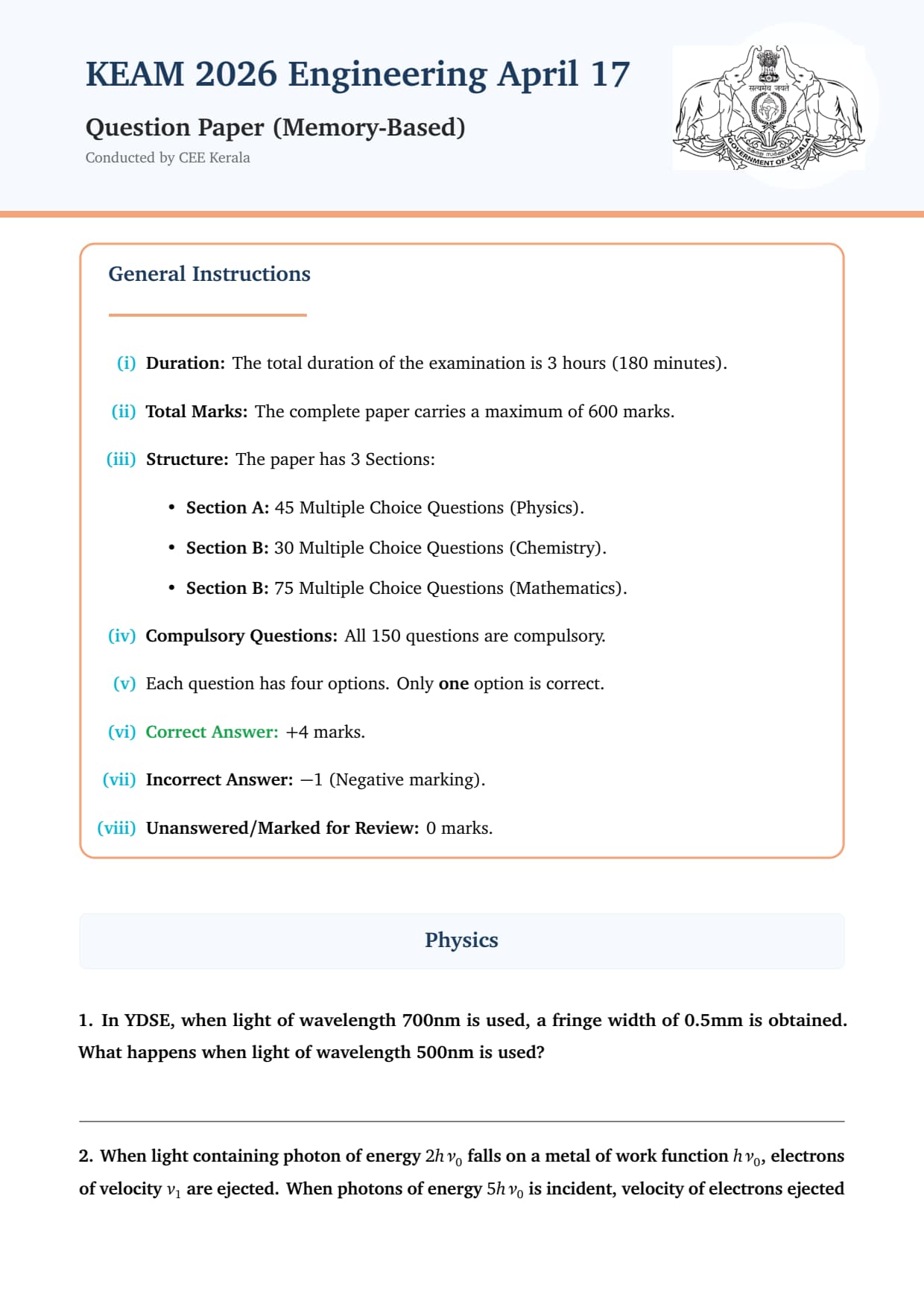
KEAM 2026 Engineering Question Paper for April 17 is available for download here. CEE Kerala conducted KEAM 2026 Engineering exam on April 17 in session 2 from 2 PM to 5 PM. KEAM 2026 Engineering exam is an online CBT with a total of 150 questions carrying a maximum of 600 marks.
- The KEAM Engineering exam is divided into 3 subjects- Physics (45 questions), Chemistry (30 questions) and Mathematics (75 questions).
- 4 marks are given for every correct answer and 1 mark is deducted for every incorrect answer
Candidates can download KEAM 2026 April 17 Engineering Question Paper with Solution PDF from the links provided below.
KEAM 2026 Engineering April 17 Question Paper with Solution PDF (Memory-Based)
| KEAM 2026 Engineering Question Paper April 17 | Download PDF | Check Solution |
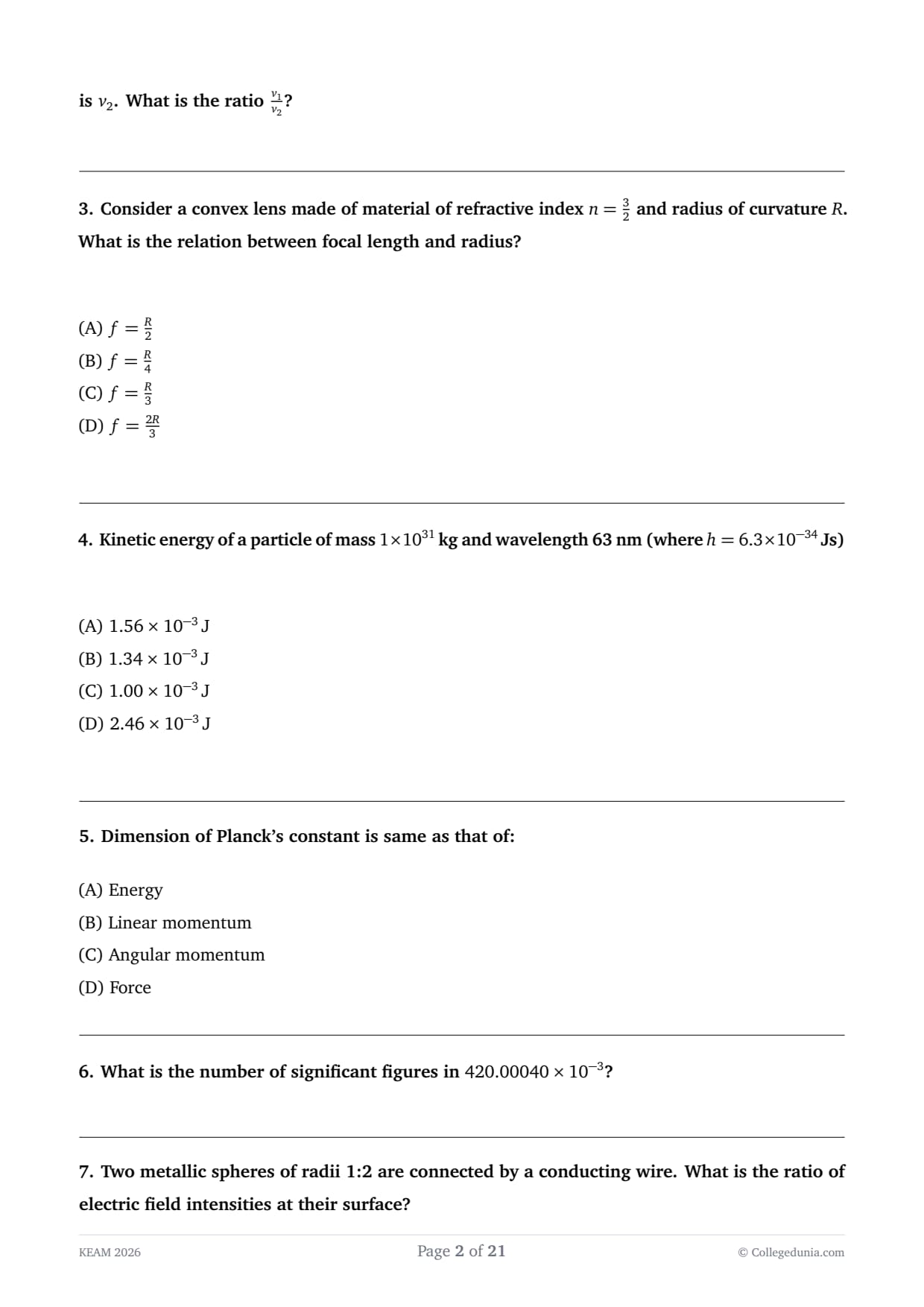
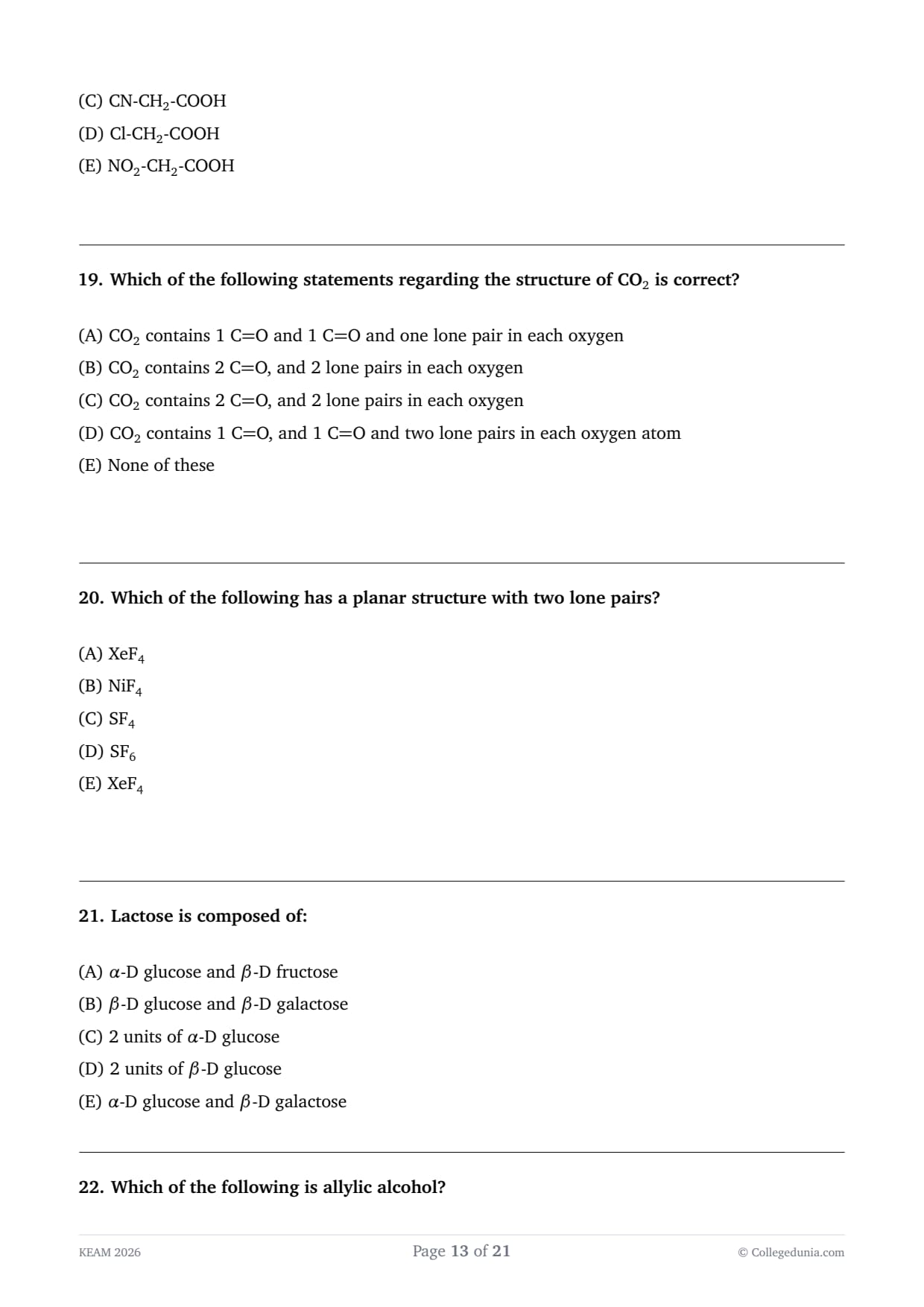
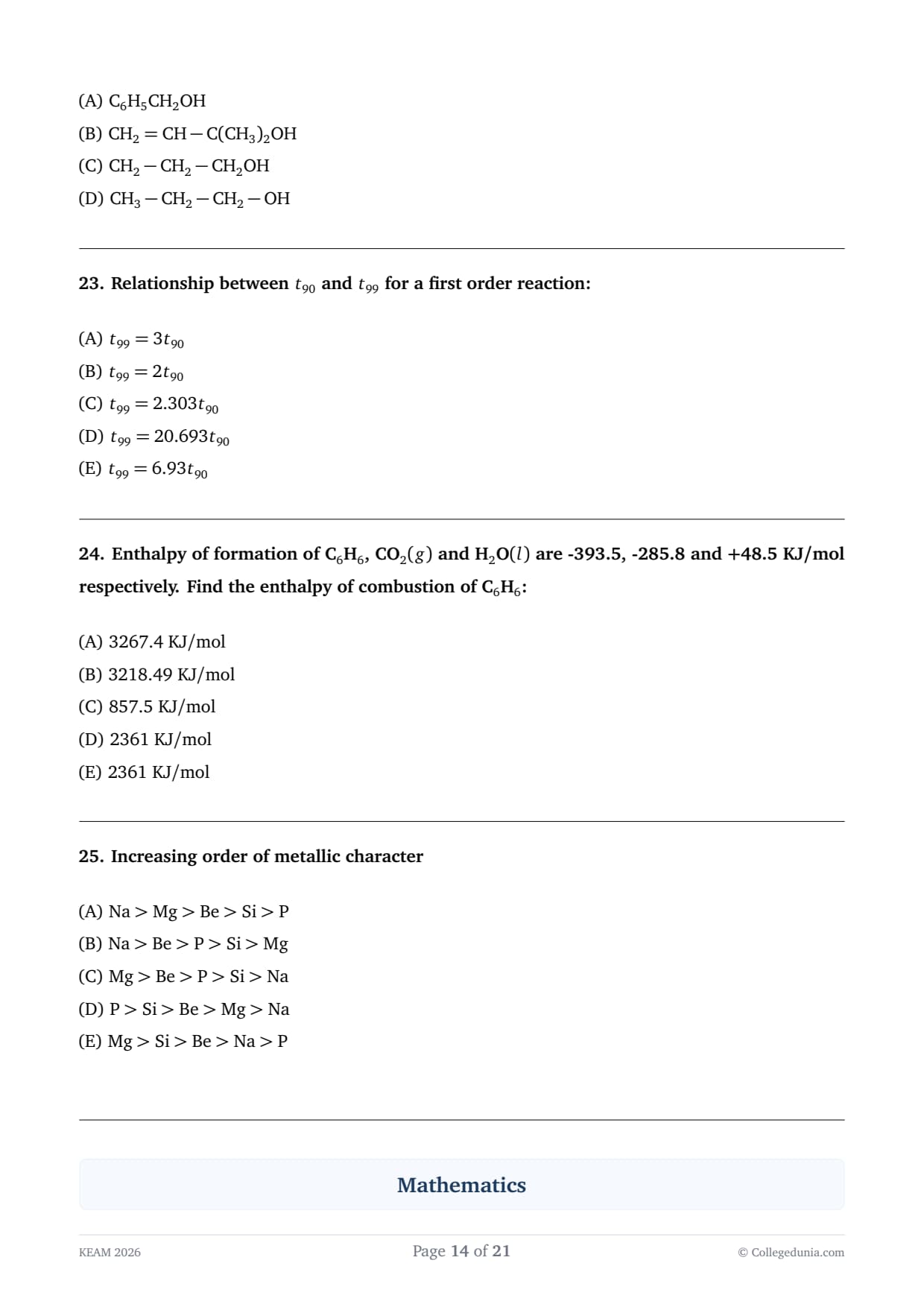
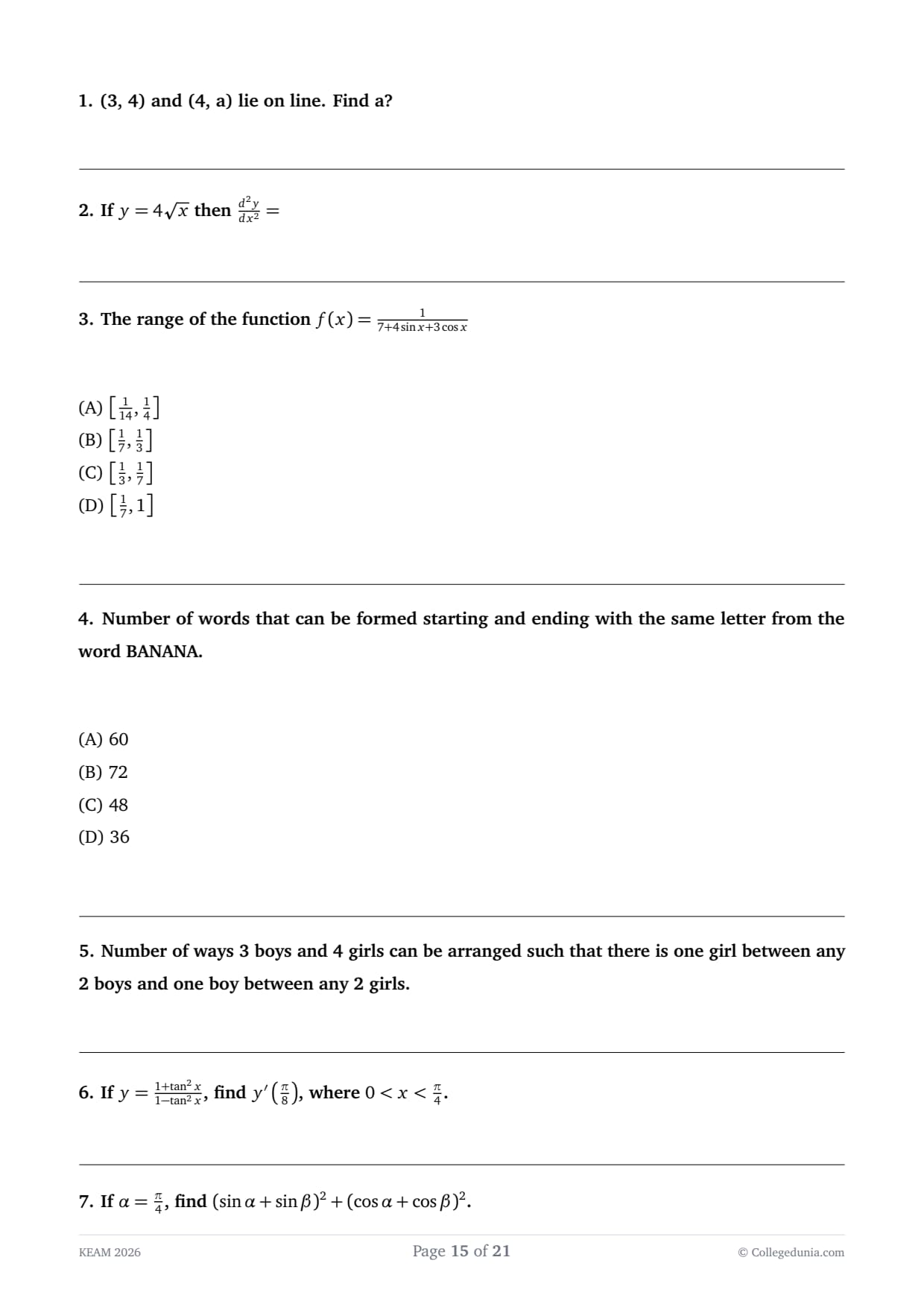
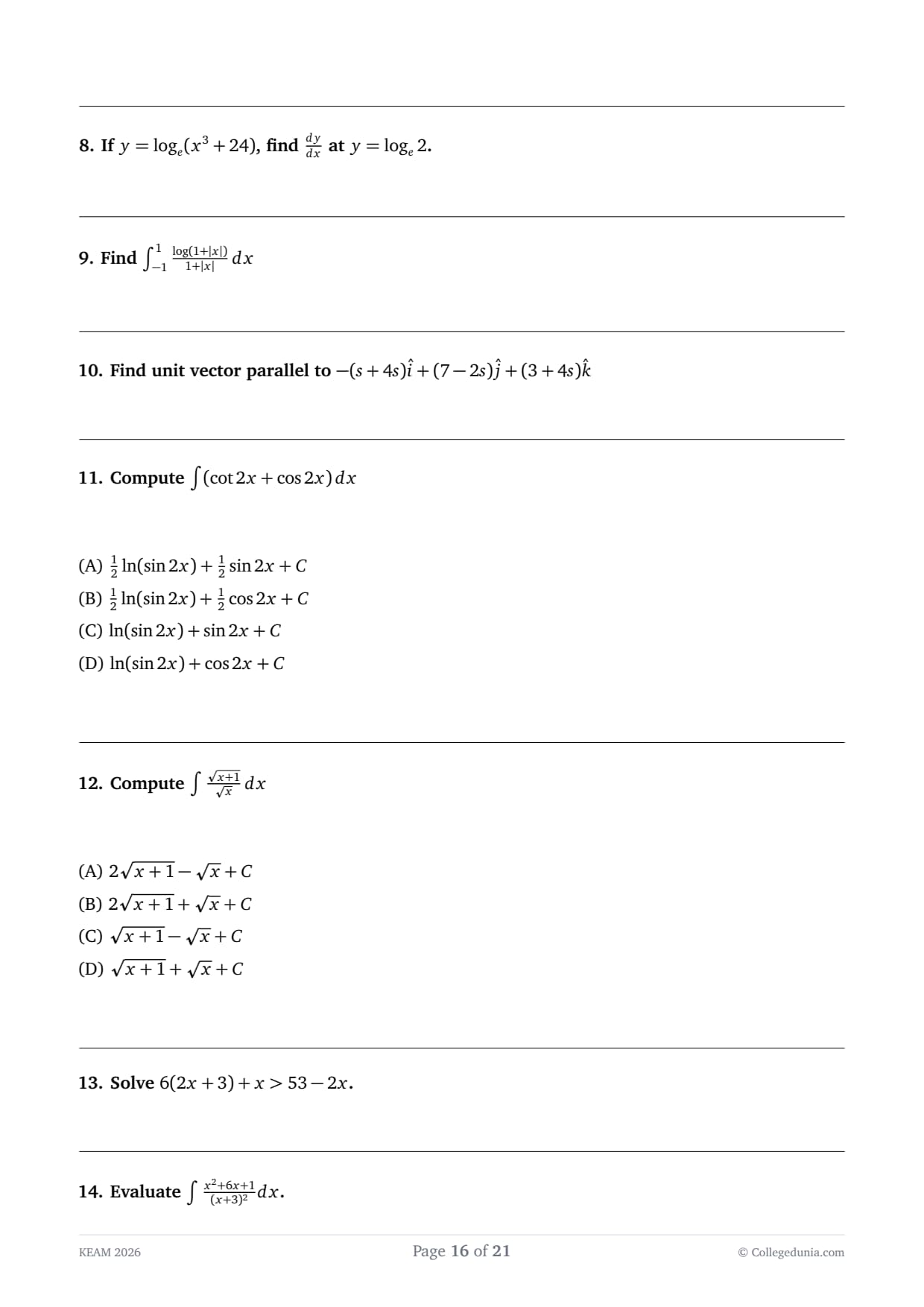
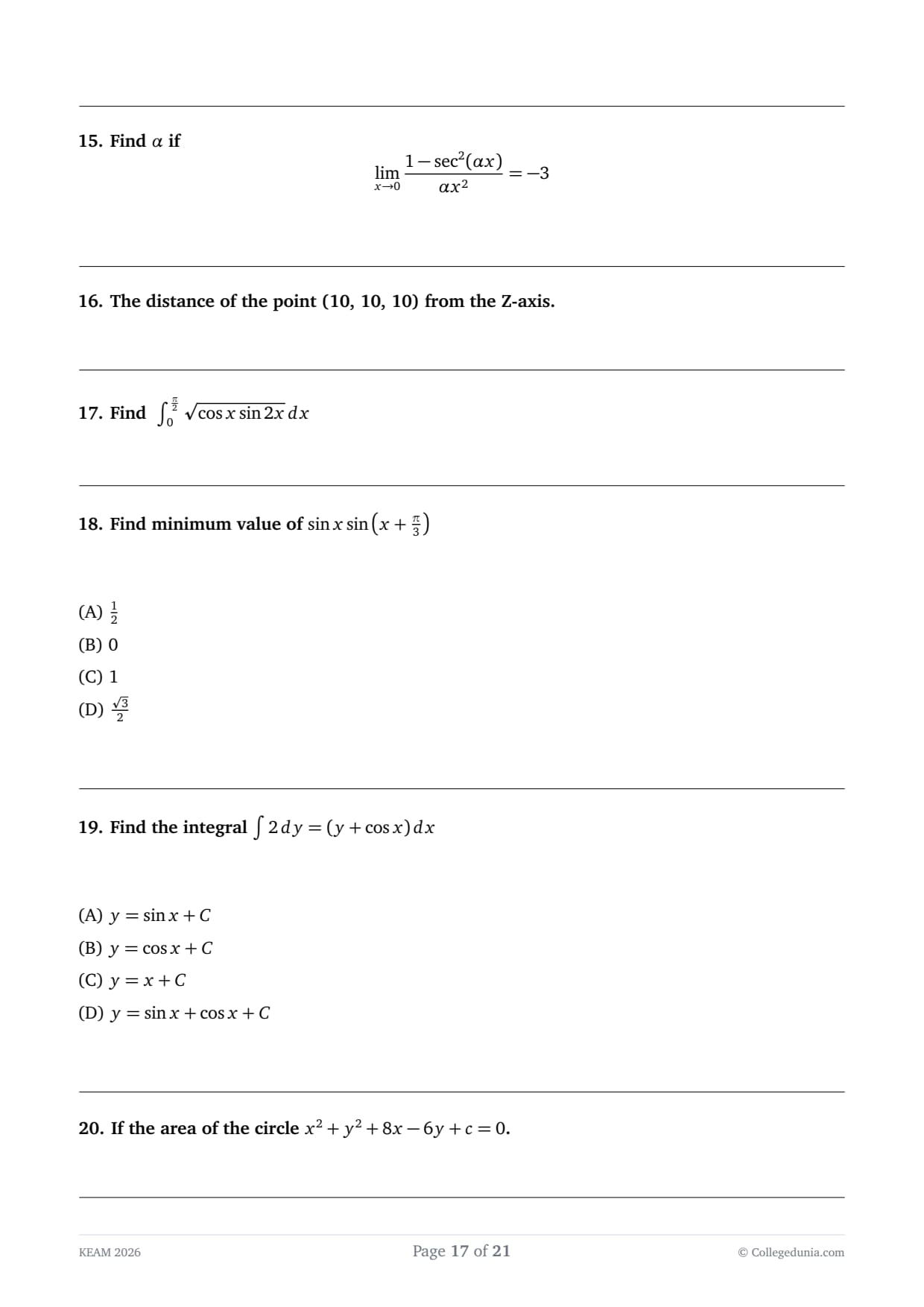
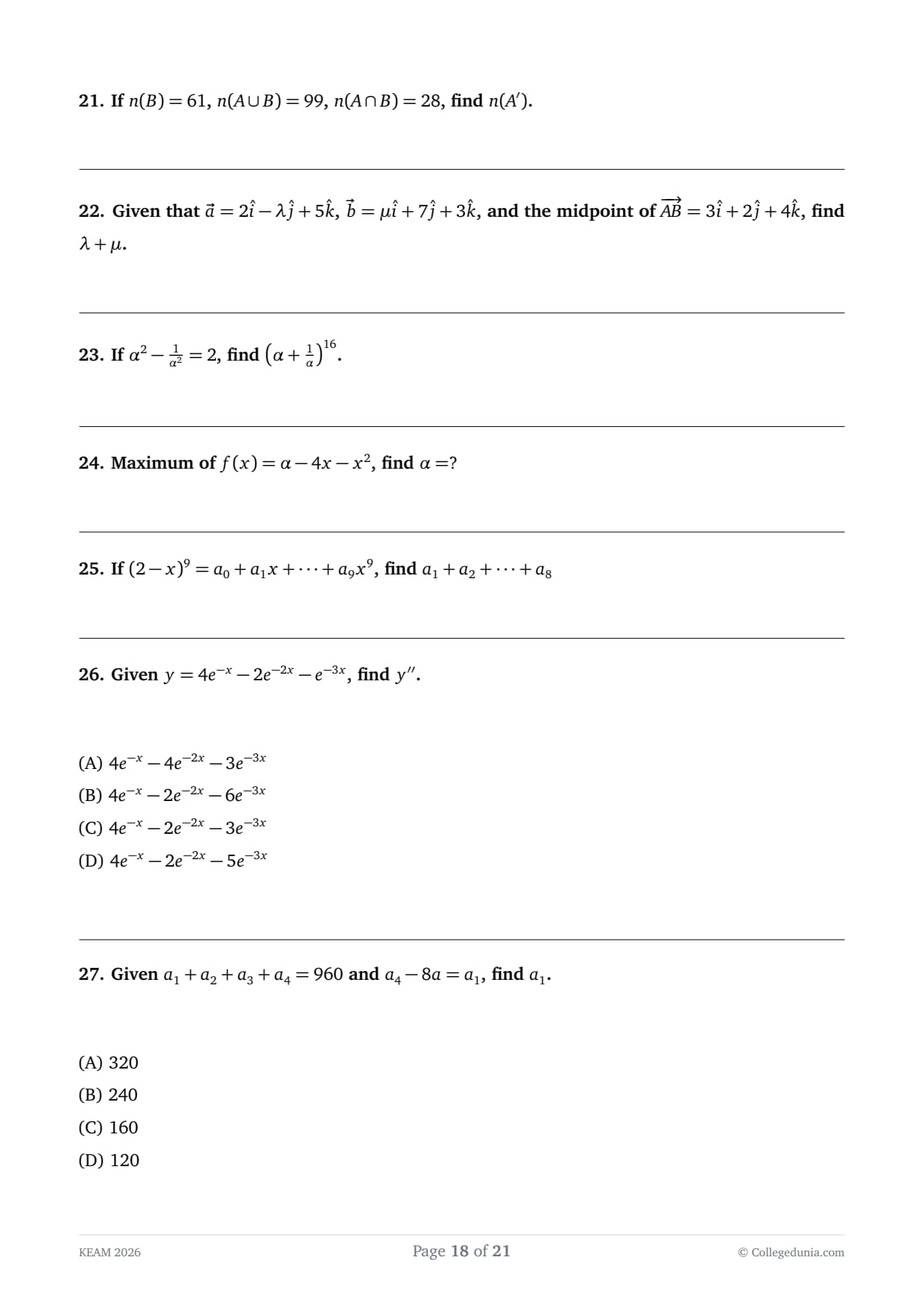
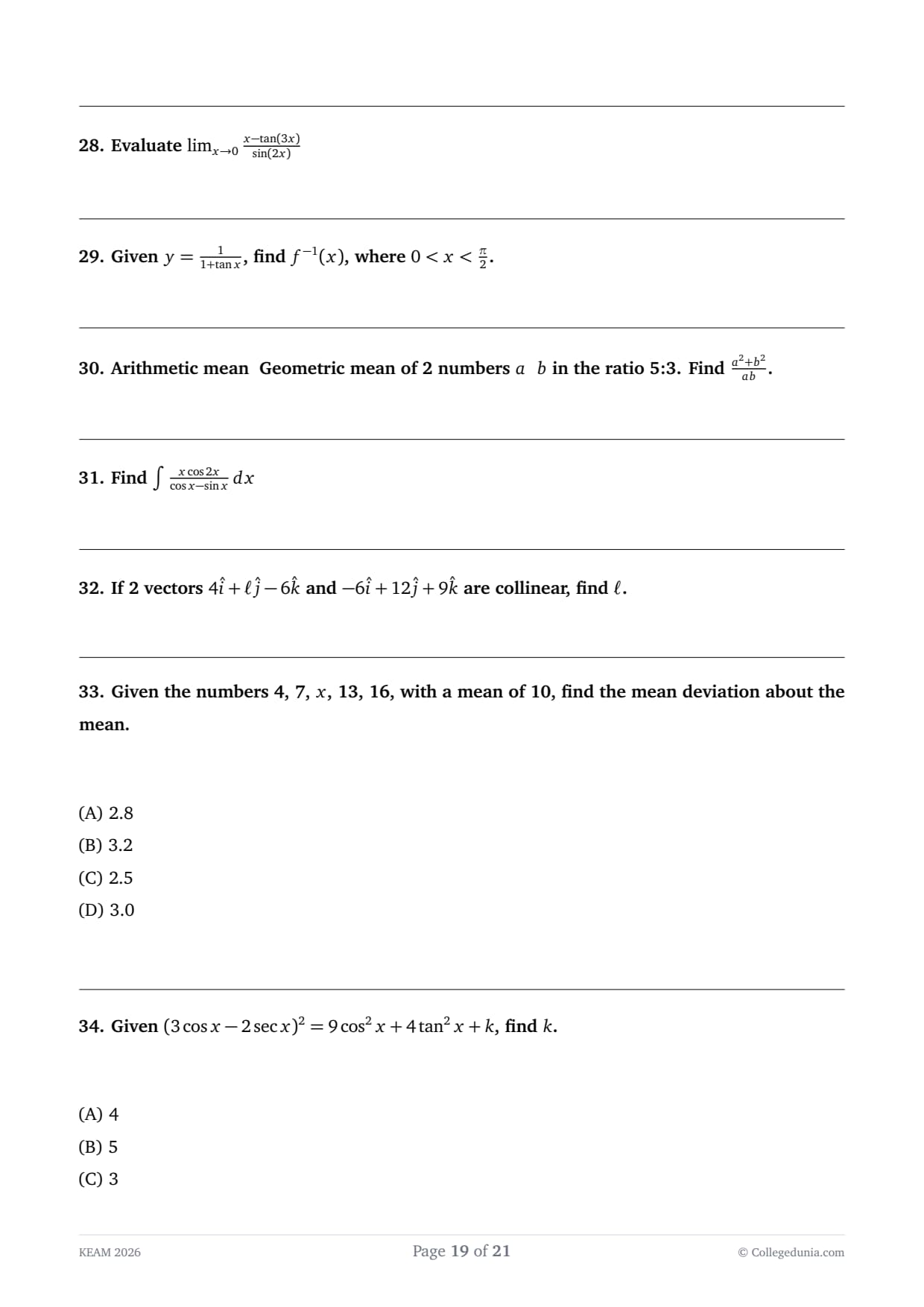
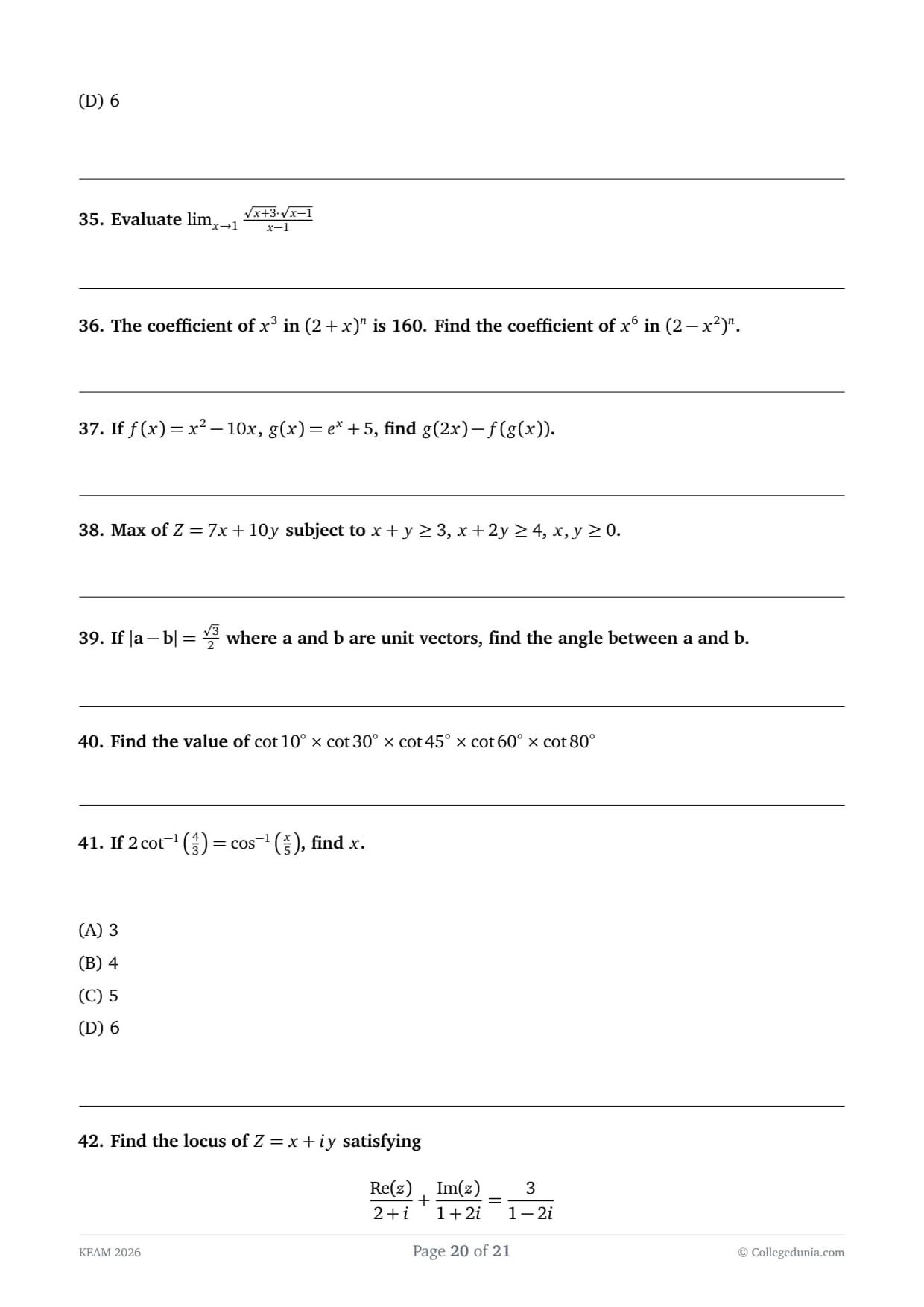
In YDSE, when light of wavelength 700nm is used, a fringe width of 0.5mm is obtained. What happens when light of wavelength 500nm is used?
View Solution
Step 1: Use the formula for fringe width in Young's Double Slit Experiment.
The fringe width \( \beta \) is given by the formula: \[ \beta = \frac{\lambda D}{d} \]
where \( \lambda \) is the wavelength of the light, \( D \) is the distance between the screen and the slits, and \( d \) is the distance between the slits.
Step 2: Calculate the new fringe width.
Let \( \beta_1 = 0.5 \, mm \) be the fringe width when \( \lambda_1 = 700 \, nm \) is used. When the wavelength is changed to \( \lambda_2 = 500 \, nm \), the new fringe width \( \beta_2 \) is related to the initial fringe width by: \[ \frac{\beta_2}{\beta_1} = \frac{\lambda_2}{\lambda_1} \]
Substitute the known values: \[ \frac{\beta_2}{0.5} = \frac{500}{700} \quad \Rightarrow \quad \beta_2 = 0.5 \times \frac{500}{700} = 0.357 \, mm \]
Thus, when light of wavelength 500nm is used, the fringe width becomes: \[ \boxed{0.357 \, mm} \] Quick Tip: Remember: The fringe width in YDSE is directly proportional to the wavelength of the light used.
When light containing photon of energy \(2h\nu_0\) falls on a metal of work function \(h\nu_0\), electrons of velocity \(v_1\) are ejected. When photons of energy \(5h\nu_0\) is incident, velocity of electrons ejected is \(v_2\). What is the ratio \( \frac{v_1}{v_2} \)?
View Solution
Step 1: Use the photoelectric equation.
The photoelectric equation is given by: \[ E_{photon} = Work function + Kinetic energy of electron \]
For the first case, when the photon energy is \(2h\nu_0\), the kinetic energy of the ejected electron is: \[ K_1 = 2h\nu_0 - h\nu_0 = h\nu_0 \]
Thus, the velocity \(v_1\) of the electron is related to its kinetic energy by: \[ \frac{1}{2} m v_1^2 = h\nu_0 \]
So: \[ v_1^2 = \frac{2h\nu_0}{m} \]
Step 2: For the second case, when the photon energy is \(5h\nu_0\), the kinetic energy of the ejected electron is:
\[ K_2 = 5h\nu_0 - h\nu_0 = 4h\nu_0 \]
Thus, the velocity \(v_2\) is related to its kinetic energy by: \[ \frac{1}{2} m v_2^2 = 4h\nu_0 \]
So: \[ v_2^2 = \frac{8h\nu_0}{m} \]
Step 3: Find the ratio \( \frac{v_1}{v_2} \).
Now, we find the ratio \( \frac{v_1}{v_2} \): \[ \frac{v_1}{v_2} = \sqrt{\frac{v_1^2}{v_2^2}} = \sqrt{\frac{\frac{2h\nu_0}{m}}{\frac{8h\nu_0}{m}}} = \sqrt{\frac{2}{8}} = \frac{1}{\sqrt{4}} = \frac{1}{2} \]
Thus, the ratio of the velocities is: \[ \boxed{\frac{v_1}{v_2} = \frac{1}{2}} \] Quick Tip: In the photoelectric effect, the kinetic energy of the ejected electrons is determined by the difference between the photon energy and the work function of the metal.
Consider a convex lens made of material of refractive index \( n = \frac{3}{2} \) and radius of curvature \( R \). What is the relation between focal length and radius?
View Solution
Step 1: Use the lens maker's formula.
The lens maker's formula is given by: \[ \frac{1}{f} = (n - 1) \left( \frac{1}{R_1} - \frac{1}{R_2} \right) \]
For a convex lens, \( R_1 = R \) (radius of curvature of the first surface) and \( R_2 = -R \) (radius of curvature of the second surface). Substituting these values into the formula: \[ \frac{1}{f} = (n - 1) \left( \frac{1}{R} - \frac{1}{-R} \right) \] \[ \frac{1}{f} = (n - 1) \left( \frac{2}{R} \right) \]
Substitute \( n = \frac{3}{2} \): \[ \frac{1}{f} = \left( \frac{3}{2} - 1 \right) \frac{2}{R} = \frac{1}{2} \frac{2}{R} = \frac{1}{R} \]
Therefore: \[ f = \frac{R}{2} \]
Final Answer: \( f = \frac{R}{2} \). Quick Tip: For a convex lens, the focal length is related to the radius of curvature by the equation \( f = \frac{R}{2} \), which is derived from the lens maker's formula.
Kinetic energy of a particle of mass \( 1 \times 10^{31} \, kg \) and wavelength 63 nm (where \( h = 6.3 \times 10^{-34} \, Js \))
View Solution
Step 1: Use the de Broglie relation.
The de Broglie wavelength \( \lambda \) is related to the momentum \( p \) of a particle by the equation: \[ \lambda = \frac{h}{p} \]
Thus, the momentum is: \[ p = \frac{h}{\lambda} \]
Step 2: Use the kinetic energy formula.
The kinetic energy \( K.E. \) of a particle is given by: \[ K.E. = \frac{p^2}{2m} \]
Substituting \( p = \frac{h}{\lambda} \) into the formula: \[ K.E. = \frac{\left( \frac{h}{\lambda} \right)^2}{2m} = \frac{h^2}{2m \lambda^2} \]
Step 3: Substitute the given values.
Given: \[ h = 6.3 \times 10^{-34} \, Js, \quad m = 1 \times 10^{31} \, kg, \quad \lambda = 63 \, nm = 63 \times 10^{-9} \, m \]
Substitute into the equation: \[ K.E. = \frac{(6.3 \times 10^{-34})^2}{2 \times (1 \times 10^{31}) \times (63 \times 10^{-9})^2} \]
Step 4: Calculate the value.
After calculating, the kinetic energy is: \[ K.E. = 1.34 \times 10^{-3} \, J \]
Final Answer: \( 1.34 \times 10^{-3} \, J \). Quick Tip: The de Broglie wavelength and kinetic energy are related through the momentum of the particle. Use the formula \( p = \frac{h}{\lambda} \) to find the momentum and then use the kinetic energy formula \( K.E. = \frac{p^2}{2m} \).
Dimension of Planck's constant is same as that of:
View Solution
The dimension of Planck's constant \( h \) can be derived from its relation to energy and frequency:
\[ E = h \nu \]
Where \( E \) is the energy, \( h \) is Planck's constant, and \( \nu \) is the frequency. The dimensions of energy are:
\[ [E] = M L^2 T^{-2} \]
And the dimensions of frequency are:
\[ [\nu] = T^{-1} \]
From the equation \( E = h \nu \), we get:
\[ [h] = \frac{E}{\nu} = \frac{M L^2 T^{-2}}{T^{-1}} = M L^2 T^{-1} \]
This is the same as the dimension of angular momentum, which is:
\[ [L] = M L^2 T^{-1} \]
Thus, the dimension of Planck's constant is the same as that of angular momentum.
Final Answer: (C) Angular momentum
Quick Tip: The dimension of Planck's constant \( h \) is the same as the dimension of angular momentum, \( M L^2 T^{-1} \).
What is the number of significant figures in \( 420.00040 \times 10^{-3} \)?
View Solution
Step 1: Identify the significant figures.
In the number \( 420.00040 \times 10^{-3} \), the significant figures are those digits that provide meaningful information about the precision of the number.
The number \( 420.00040 \) has:
- \( 4 \), \( 2 \), and \( 0 \) as significant digits.
- The decimal point after the last zero indicates that the trailing zeros are significant.
Thus, the significant digits in \( 420.00040 \) are \( 4, 2, 0, 0, 0, 0, 4, 0 \).
Step 2: Conclusion.
Therefore, the number of significant figures is \( 8 \). Quick Tip: When counting significant figures, remember that all non-zero digits, any zeros between them, and trailing zeros after a decimal point are significant.
Two metallic spheres of radii 1:2 are connected by a conducting wire. What is the ratio of electric field intensities at their surface?
View Solution
Step 1: Use the formula for electric field.
The electric field intensity \( E \) at the surface of a sphere is given by the formula: \[ E = \frac{kQ}{r^2} \]
where \( k \) is Coulomb's constant, \( Q \) is the charge, and \( r \) is the radius of the sphere.
Since the spheres are connected by a conducting wire, they must have the same potential, which implies that the ratio of the charges on the spheres will be proportional to the ratio of their radii.
Step 2: Relationship between charge and radius.
Let the charges on the two spheres be \( Q_1 \) and \( Q_2 \), and their radii be \( r_1 = r \) and \( r_2 = 2r \), respectively. Since the potential is the same, we have: \[ \frac{Q_1}{r_1} = \frac{Q_2}{r_2} \]
This implies: \[ Q_1 = \frac{r_1}{r_2} Q_2 = \frac{1}{2} Q_2 \]
Step 3: Find the ratio of electric field intensities.
The electric field intensities at the surfaces of the spheres are: \[ E_1 = \frac{kQ_1}{r_1^2} \quad and \quad E_2 = \frac{kQ_2}{r_2^2} \]
Substitute \( Q_1 = \frac{1}{2} Q_2 \) and \( r_2 = 2r \): \[ E_1 = \frac{k \cdot \frac{1}{2} Q_2}{r^2} \quad and \quad E_2 = \frac{kQ_2}{(2r)^2} = \frac{kQ_2}{4r^2} \]
Now, calculate the ratio of electric field intensities: \[ \frac{E_1}{E_2} = \frac{\frac{k \cdot \frac{1}{2} Q_2}{r^2}}{\frac{kQ_2}{4r^2}} = \frac{\frac{1}{2}}{\frac{1}{4}} = 2 \]
Step 4: Conclusion.
The ratio of the electric field intensities at the surface of the two spheres is: \[ \boxed{2} \] Quick Tip: When two metallic spheres are connected by a conducting wire, they have the same potential, and the ratio of their electric field intensities is related to the ratio of their radii.
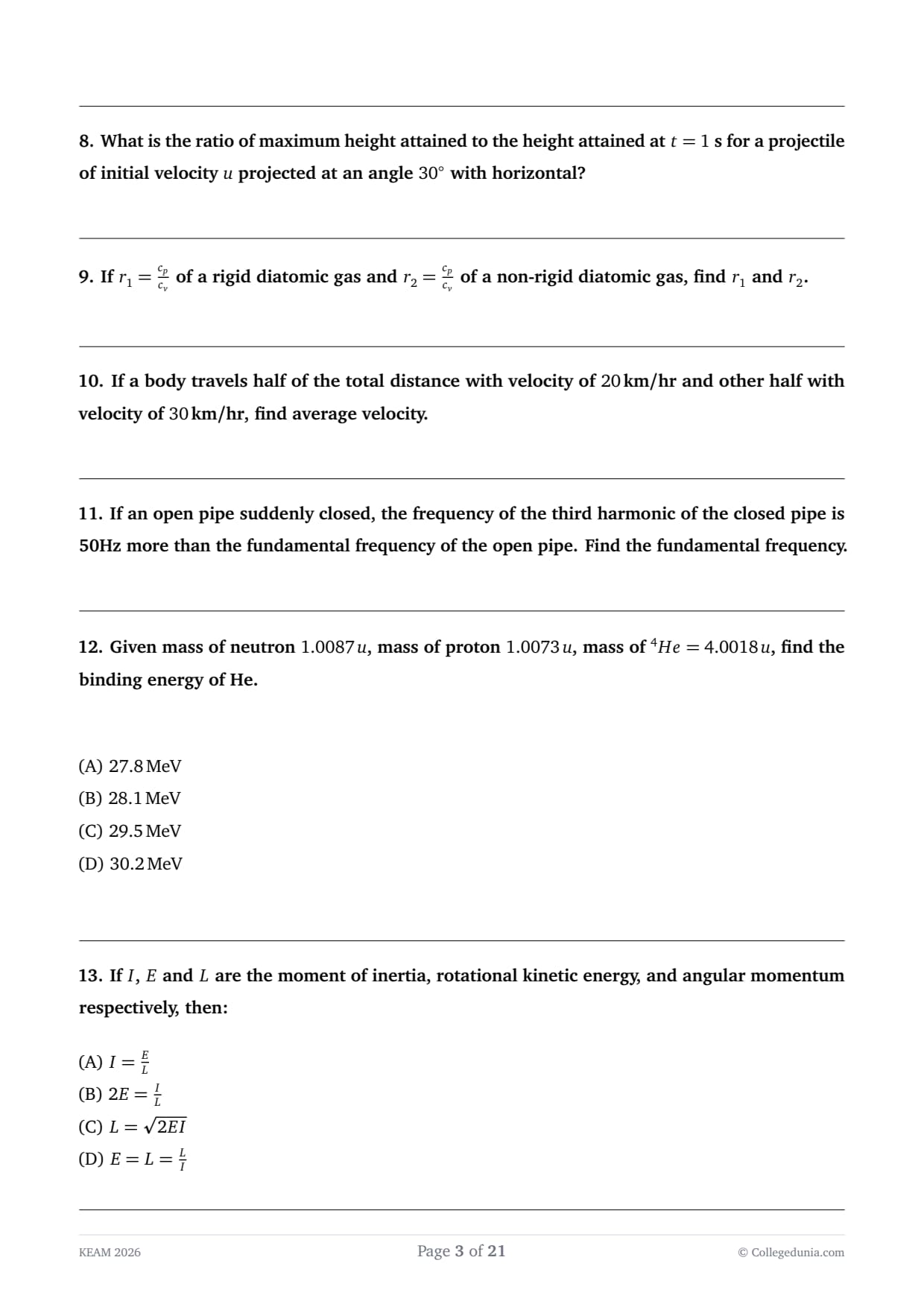
What is the ratio of maximum height attained to the height attained at \( t = 1 \) s for a projectile of initial velocity \( u \) projected at an angle \( 30^\circ \) with horizontal?
View Solution
Step 1: Maximum height formula.
For a projectile launched at an angle \( \theta \) with initial velocity \( u \), the maximum height \( H_{max} \) is given by: \[ H_{max} = \frac{u^2 \sin^2 \theta}{2g} \]
For \( \theta = 30^\circ \), we have \( \sin 30^\circ = \frac{1}{2} \), so: \[ H_{max} = \frac{u^2 \left( \frac{1}{2} \right)^2}{2g} = \frac{u^2}{8g} \]
Step 2: Height at \( t = 1 \) second.
The height \( h(t) \) at any time \( t \) is given by: \[ h(t) = u \sin \theta \cdot t - \frac{1}{2} g t^2 \]
At \( t = 1 \) second, for \( \theta = 30^\circ \), we have \( \sin 30^\circ = \frac{1}{2} \), so: \[ h(1) = u \cdot \frac{1}{2} \cdot 1 - \frac{1}{2} g \cdot 1^2 = \frac{u}{2} - \frac{g}{2} \]
Step 3: Ratio of heights.
The required ratio of the maximum height to the height at \( t = 1 \) second is: \[ Ratio = \frac{H_{max}}{h(1)} = \frac{\frac{u^2}{8g}}{\frac{u}{2} - \frac{g}{2}} \]
Simplifying: \[ Ratio = \frac{\frac{u^2}{8g}}{\frac{u - g}{2}} = \frac{u^2}{8g} \cdot \frac{2}{u - g} \] \[ Ratio = \frac{u^2}{4g(u - g)} \] Quick Tip: When dealing with projectile motion, break down the motion into horizontal and vertical components, and use the equations for height and range accordingly.
If \( r_1 = \frac{c_p}{c_v} \) of a rigid diatomic gas and \( r_2 = \frac{c_p}{c_v} \) of a non-rigid diatomic gas, find \( r_1 \) and \( r_2 \).
View Solution
Step 1: Definition of \( r_1 \) and \( r_2 \).
For a gas, the ratio \( r = \frac{c_p}{c_v} \),
where:
- \( c_p \) is the specific heat at constant pressure,
- \( c_v \) is the specific heat at constant volume.
Step 2: Value of \( r_1 \) for a rigid diatomic gas.
For a rigid diatomic gas, \( r_1 = \frac{c_p}{c_v} = \frac{7}{5} \). This is because the degrees of freedom for a rigid diatomic gas are 5 (3 translational and 2 rotational), and using the ideal gas law: \[ r_1 = 1 + \frac{2}{f} = 1 + \frac{2}{5} = \frac{7}{5} \]
Step 3: Value of \( r_2 \) for a non-rigid diatomic gas.
For a non-rigid diatomic gas, the number of degrees of freedom increases because the molecule can undergo vibration as well. The specific value of \( r_2 \) depends on the exact nature of the gas, but for most practical cases, it is approximately: \[ r_2 = \frac{9}{7} \]
This is because for non-rigid diatomic gases, the number of degrees of freedom is 7 (3 translational, 2 rotational, and 2 vibrational), and the corresponding ratio \( r \) is: \[ r_2 = 1 + \frac{2}{7} = \frac{9}{7} \] Quick Tip: For diatomic gases, the value of \( r \) (the ratio \( \frac{c_p}{c_v} \)) depends on the degrees of freedom available to the molecules. A rigid diatomic gas has 5 degrees of freedom, while a non-rigid diatomic gas has 7 degrees of freedom.
If a body travels half of the total distance with velocity of \(20 \, km/hr\) and other half with velocity of \(30 \, km/hr\), find average velocity.
View Solution
Step 1: Use the formula for average velocity.
The average velocity is given by the formula: \[ Average velocity = \frac{Total distance}{Total time} \]
Step 2: Calculate the total distance.
Let the total distance be \( D \). The body travels half the distance with velocity \( 20 \, km/hr \) and the other half with velocity \( 30 \, km/hr \).
Step 3: Calculate the time taken for each half.
For the first half of the distance, the time taken is: \[ t_1 = \frac{\frac{D}{2}}{20} = \frac{D}{40} \]
For the second half of the distance, the time taken is: \[ t_2 = \frac{\frac{D}{2}}{30} = \frac{D}{60} \]
Step 4: Calculate the total time.
The total time is the sum of \( t_1 \) and \( t_2 \): \[ Total time = t_1 + t_2 = \frac{D}{40} + \frac{D}{60} \] \[ Total time = \frac{3D}{120} + \frac{2D}{120} = \frac{5D}{120} = \frac{D}{24} \]
Step 5: Calculate the average velocity.
Now, use the formula for average velocity: \[ Average velocity = \frac{D}{\frac{D}{24}} = 24 \, km/hr \]
Thus, the average velocity is: \[ \boxed{24 \, km/hr} \] Quick Tip: Remember: When the object travels equal distances at different speeds, the average velocity is calculated by using the total time and total distance.
If an open pipe suddenly closed, the frequency of the third harmonic of the closed pipe is 50Hz more than the fundamental frequency of the open pipe. Find the fundamental frequency.
View Solution
Step 1: Use the relationship between the harmonics of the open and closed pipes.
For an open pipe, the frequencies of the harmonics are given by: \[ f_n^{open} = n \times f_1 \]
where \( f_1 \) is the fundamental frequency and \( n \) is the harmonic number.
For a closed pipe, the frequencies are given by: \[ f_n^{closed} = (2n - 1) \times f_1 \]
Step 2: Use the given frequency difference.
We are told that the frequency of the third harmonic of the closed pipe is 50Hz more than the fundamental frequency of the open pipe. This gives the equation: \[ f_3^{closed} = f_1^{open} + 50 \]
The third harmonic for the closed pipe is given by: \[ f_3^{closed} = 5 f_1 \]
So, we have: \[ 5 f_1 = f_1 + 50 \]
Step 3: Solve for the fundamental frequency.
Solving for \( f_1 \): \[ 5 f_1 - f_1 = 50 \quad \Rightarrow \quad 4 f_1 = 50 \quad \Rightarrow \quad f_1 = \frac{50}{4} = 12.5 \, Hz \]
Thus, the fundamental frequency is: \[ \boxed{12.5 \, Hz} \] Quick Tip: For open and closed pipes, the frequencies of the harmonics are calculated differently. Remember the formula for the closed pipe involves only odd harmonics.
Given mass of neutron \( 1.0087 \, u \), mass of proton \( 1.0073 \, u \), mass of \( ^4He \) \( = 4.0018 \, u \), find the binding energy of He.
View Solution
Step 1: Mass defect.
The binding energy of a nucleus can be found using the mass defect. The mass defect is the difference between the sum of the masses of individual nucleons (protons and neutrons) and the actual mass of the nucleus.
For the \( ^4He \) nucleus, it consists of 2 protons and 2 neutrons. The total mass of individual nucleons is: \[ Total mass of nucleons = (2 \times mass of proton) + (2 \times mass of neutron) \]
Substituting the given values: \[ Total mass of nucleons = (2 \times 1.0073 \, u) + (2 \times 1.0087 \, u) = 2.0146 \, u + 2.0174 \, u = 4.0320 \, u \]
Now, the actual mass of the \( ^4He \) nucleus is given as \( 4.0018 \, u \). The mass defect is: \[ Mass defect = Total mass of nucleons - Mass of ^4He \] \[ Mass defect = 4.0320 \, u - 4.0018 \, u = 0.0302 \, u \]
Step 2: Convert mass defect to energy.
To convert the mass defect into binding energy, use Einstein’s equation \( E = \Delta m c^2 \). The energy corresponding to 1 atomic mass unit (1 \( u \)) is approximately 931.5 MeV.
Thus, the binding energy is: \[ Binding energy = 0.0302 \, u \times 931.5 \, MeV/u = 28.1 \, MeV \]
Final Answer: \( 28.1 \, MeV \). Quick Tip: The binding energy can be calculated using the mass defect, which is the difference between the total mass of individual nucleons and the actual mass of the nucleus. Convert the mass defect to energy using \( E = \Delta m c^2 \).
If \( I \), \( E \) and \( L \) are the moment of inertia, rotational kinetic energy, and angular momentum respectively, then:
View Solution
The rotational kinetic energy \( E \) is related to the moment of inertia \( I \) and angular velocity \( \omega \) by the equation:
\[ E = \frac{1}{2} I \omega^2 \]
The angular momentum \( L \) is related to the moment of inertia and angular velocity by the equation:
\[ L = I \omega \]
From these two equations, we can solve for \( \omega \) in terms of \( L \) and \( I \):
\[ \omega = \frac{L}{I} \]
Substitute this value of \( \omega \) into the equation for \( E \):
\[ E = \frac{1}{2} I \left( \frac{L}{I} \right)^2 = \frac{L^2}{2I} \]
Now, solving for \( I \):
\[ I = \frac{E}{L} \]
Thus, the correct relation is \( I = \frac{E}{L} \), which corresponds to option (A).
Final Answer: (A) \( I = \frac{E}{L} \)
Quick Tip: The moment of inertia is related to the rotational kinetic energy and angular momentum by \( I = \frac{E}{L} \).
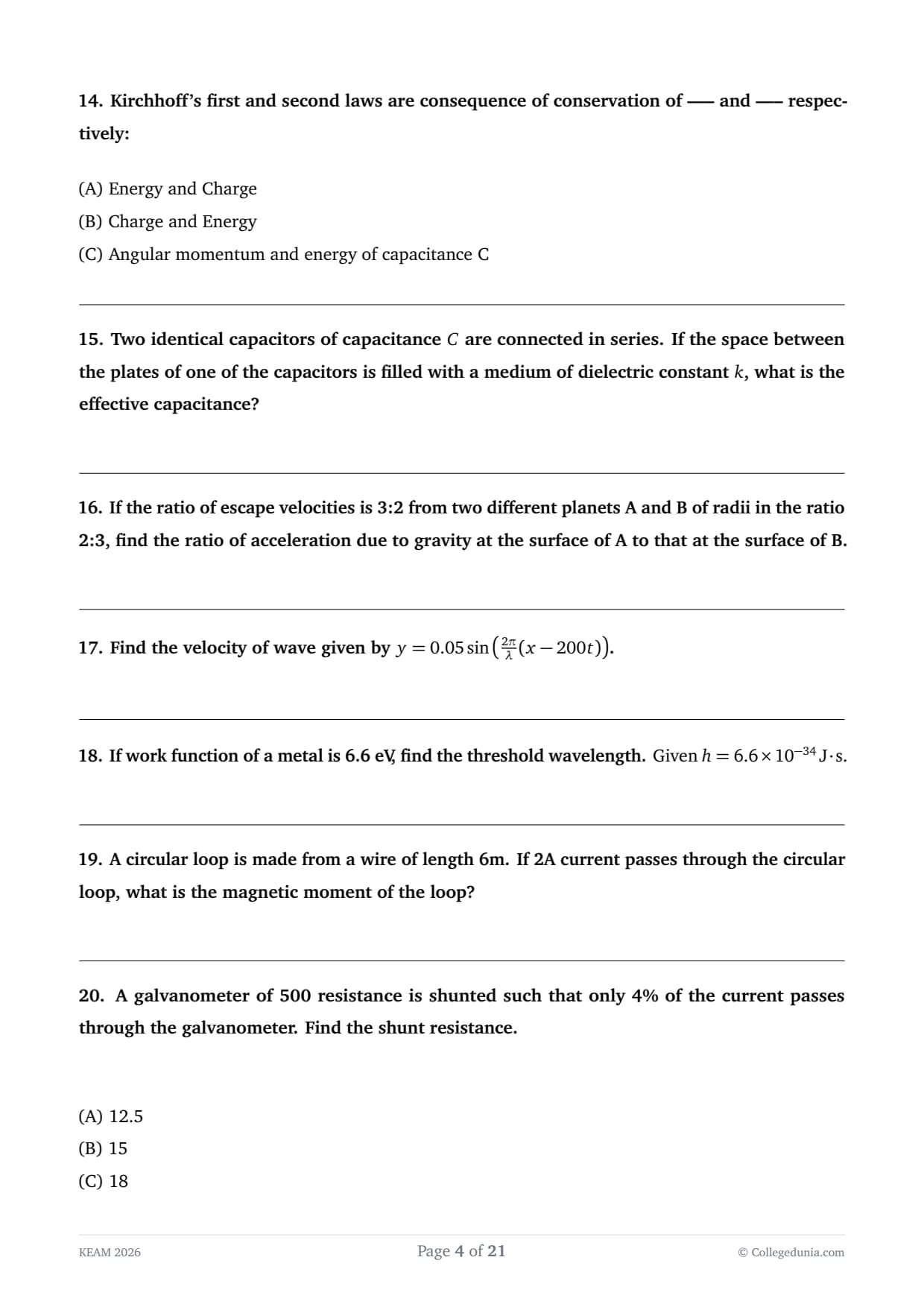
Kirchhoff's first and second laws are consequence of conservation of ----- and ----- respectively:
View Solution
Kirchhoff's first law, also known as the current law (KCL), is a consequence of the conservation of electric charge. It states that the total current entering a junction is equal to the total current leaving the junction, which follows from the conservation of charge.
Kirchhoff's second law, also known as the voltage law (KVL), is a consequence of the conservation of energy. It states that the sum of the potential differences (voltages) around any closed loop in a circuit is zero, which follows from the conservation of energy in the form of the work done by electrical forces.
Step 1: Understand Kirchhoff's first law.
Kirchhoff's first law is based on the conservation of charge. It ensures that charge is neither created nor destroyed at any junction in a circuit.
Step 2: Understand Kirchhoff's second law.
Kirchhoff's second law is based on the conservation of energy. It ensures that the sum of the voltage drops around any closed loop equals the applied voltage.
Step 3: Conclusion.
Thus, Kirchhoff's first law is a consequence of the conservation of charge, and Kirchhoff's second law is a consequence of the conservation of energy.
Final Answer: (B) Charge and Energy
Quick Tip: Kirchhoff's first law deals with the conservation of charge, while the second law deals with the conservation of energy in electrical circuits.
Two identical capacitors of capacitance \( C \) are connected in series. If the space between the plates of one of the capacitors is filled with a medium of dielectric constant \( k \), what is the effective capacitance?
View Solution
Step 1: Capacitance of a capacitor with dielectric.
The capacitance of a capacitor filled with a dielectric of dielectric constant \( k \) is given by: \[ C' = kC \]
where \( C \) is the capacitance of the capacitor without the dielectric, and \( C' \) is the capacitance with the dielectric.
Step 2: Equivalent capacitance in series.
When two capacitors \( C_1 \) and \( C_2 \) are connected in series, the effective capacitance \( C_{eff} \) is given by the formula: \[ \frac{1}{C_{eff}} = \frac{1}{C_1} + \frac{1}{C_2} \]
Let the capacitances of the two capacitors be \( C \) and \( kC \) (since one is filled with the dielectric).
Step 3: Calculate the effective capacitance.
The effective capacitance is: \[ \frac{1}{C_{eff}} = \frac{1}{C} + \frac{1}{kC} \]
Now, simplify the expression: \[ \frac{1}{C_{eff}} = \frac{k + 1}{kC} \]
Thus, the effective capacitance is: \[ C_{eff} = \frac{kC}{k + 1} \] Quick Tip: When capacitors are connected in series, the reciprocal of the effective capacitance is the sum of the reciprocals of the individual capacitances.
If the ratio of escape velocities is 3:2 from two different planets A and B of radii in the ratio 2:3, find the ratio of acceleration due to gravity at the surface of A to that at the surface of B.
View Solution
Step 1: Formula for escape velocity.
The escape velocity \( v_e \) from a planet is given by: \[ v_e = \sqrt{\frac{2GM}{R}} \]
where \( G \) is the gravitational constant, \( M \) is the mass of the planet, and \( R \) is the radius of the planet.
Step 2: Relating escape velocities and radii.
We are given that the ratio of escape velocities from planets A and B is \( 3:2 \), and the ratio of their radii is \( 2:3 \). Let \( v_{eA} \) and \( v_{eB} \) be the escape velocities, and \( R_A \) and \( R_B \) be the radii of planets A and B, respectively. We know: \[ \frac{v_{eA}}{v_{eB}} = \frac{3}{2}, \quad \frac{R_A}{R_B} = \frac{2}{3} \]
Step 3: Express escape velocity in terms of acceleration due to gravity.
The escape velocity is related to the acceleration due to gravity \( g \) at the surface of a planet by the formula: \[ v_e = \sqrt{2gR} \]
Therefore, for planets A and B: \[ v_{eA} = \sqrt{2g_A R_A}, \quad v_{eB} = \sqrt{2g_B R_B} \]
Squaring both equations: \[ v_{eA}^2 = 2g_A R_A, \quad v_{eB}^2 = 2g_B R_B \]
Taking the ratio of the escape velocities squared: \[ \frac{v_{eA}^2}{v_{eB}^2} = \frac{g_A R_A}{g_B R_B} \]
Using the given ratios: \[ \left( \frac{3}{2} \right)^2 = \frac{g_A R_A}{g_B R_B} \]
Simplifying: \[ \frac{9}{4} = \frac{g_A R_A}{g_B R_B} \]
Substitute \( \frac{R_A}{R_B} = \frac{2}{3} \): \[ \frac{9}{4} = \frac{g_A \cdot \frac{2}{3}}{g_B} \]
Solving for \( \frac{g_A}{g_B} \): \[ \frac{g_A}{g_B} = \frac{9}{4} \cdot \frac{3}{2} = \frac{27}{8} \]
Step 4: Final ratio.
Thus, the ratio of the acceleration due to gravity at the surface of A to that at the surface of B is: \[ \frac{g_A}{g_B} = \frac{27}{8} \] Quick Tip: The escape velocity is directly related to the acceleration due to gravity and the radius of the planet. Use the ratio of escape velocities and radii to find the ratio of accelerations.
Find the velocity of wave given by \( y = 0.05 \sin \left( \frac{2\pi}{\lambda} (x - 200t) \right) \).
View Solution
Step 1: General form of wave equation.
The general form of a wave equation is: \[ y = A \sin \left( \frac{2\pi}{\lambda} (x - vt) \right) \]
where:
- \( A \) is the amplitude,
- \( \lambda \) is the wavelength,
- \( v \) is the wave velocity,
- \( t \) is the time, and
- \( x \) is the position.
In the given wave equation \( y = 0.05 \sin \left( \frac{2\pi}{\lambda} (x - 200t) \right) \), comparing with the general form, we have: \[ v = 200 \, m/s \]
Step 2: Velocity of the wave.
Thus, the velocity of the wave is: \[ v = 200 \, m/s \] Quick Tip: The velocity of a wave can be extracted from the wave equation by identifying the coefficient of \( t \) in the term \( (x - vt) \).
If work function of a metal is 6.6 eV, find the threshold wavelength.
Given \( h = 6.6 \times 10^{-34} \, J \cdot s \).
View Solution
Step 1: Use the equation for threshold wavelength.
The threshold wavelength \( \lambda_{th} \) is related to the work function \( \phi \) by the equation: \[ \phi = \frac{hc}{\lambda_{th}} \]
where:
- \( \phi \) is the work function,
- \( h \) is Planck's constant,
- \( c \) is the speed of light, and
- \( \lambda_{th} \) is the threshold wavelength.
Step 2: Rearrange the equation to find \( \lambda_{th} \).
Rearrange the equation to solve for \( \lambda_{th} \): \[ \lambda_{th} = \frac{hc}{\phi} \]
Step 3: Substitute the known values.
Substitute \( h = 6.6 \times 10^{-34} \, J \cdot s \), \( c = 3 \times 10^8 \, m/s \), and \( \phi = 6.6 \, eV = 6.6 \times 1.6 \times 10^{-19} \, J \): \[ \lambda_{th} = \frac{6.6 \times 10^{-34} \times 3 \times 10^8}{6.6 \times 1.6 \times 10^{-19}} = \frac{1.98 \times 10^{-25}}{1.056 \times 10^{-18}} = 1.87 \times 10^{-7} \, m \]
Thus, the threshold wavelength is: \[ \boxed{1.87 \times 10^{-7} \, m \, or \, 187 \, nm} \] Quick Tip: To find the threshold wavelength, use the relation between the work function and wavelength, considering the speed of light and Planck's constant.
A circular loop is made from a wire of length 6m. If 2A current passes through the circular loop, what is the magnetic moment of the loop?
View Solution
Step 1: Use the formula for the magnetic moment.
The magnetic moment \( M \) of a current-carrying loop is given by: \[ M = I \times A \]
where:
- \( I \) is the current,
- \( A \) is the area of the loop.
Step 2: Calculate the area of the loop.
The wire forms a circular loop, so the circumference of the loop is equal to the length of the wire. The circumference is: \[ C = 2 \pi r \]
where \( r \) is the radius of the loop. Since the total length of the wire is 6m: \[ 2 \pi r = 6 \quad \Rightarrow \quad r = \frac{6}{2 \pi} = \frac{3}{\pi} \, m \]
Now, calculate the area \( A \) of the circle: \[ A = \pi r^2 = \pi \left( \frac{3}{\pi} \right)^2 = \frac{9}{\pi} \, m^2 \]
Step 3: Calculate the magnetic moment.
Now, substitute the current \( I = 2 \, A \) and the area \( A = \frac{9}{\pi} \) into the formula for magnetic moment: \[ M = 2 \times \frac{9}{\pi} = \frac{18}{\pi} \, A \cdot m^2 \]
Thus, the magnetic moment of the loop is: \[ \boxed{\frac{18}{\pi} \, A \cdot m^2} \] Quick Tip: The magnetic moment of a circular loop depends on both the current and the area of the loop. The area can be found from the length of the wire.
A galvanometer of 500Ω resistance is shunted such that only 4% of the current passes through the galvanometer. Find the shunt resistance.
View Solution
Step 1: Use the formula for shunt resistance.
The shunt resistance \( R_s \) can be calculated using the formula: \[ R_s = \frac{R}{\frac{I_s}{I} - 1} \]
Where:
- \( R \) is the resistance of the galvanometer (500Ω),
- \( I_s/I \) is the fraction of the total current passing through the galvanometer (4% or 0.04).
Step 2: Substituting the given values.
Substitute \( R = 500Ω \) and \( \frac{I_s}{I} = 0.04 \): \[ R_s = \frac{500}{\frac{0.04}{1} - 1} = \frac{500}{0.04 - 1} = \frac{500}{-0.96} = 12.5Ω \]
Final Answer: 12.5Ω. Quick Tip: For shunt resistance calculations, use the formula \( R_s = \frac{R}{\frac{I_s}{I} - 1} \), where \( R \) is the resistance of the galvanometer and \( \frac{I_s}{I} \) is the fraction of current passing through it.
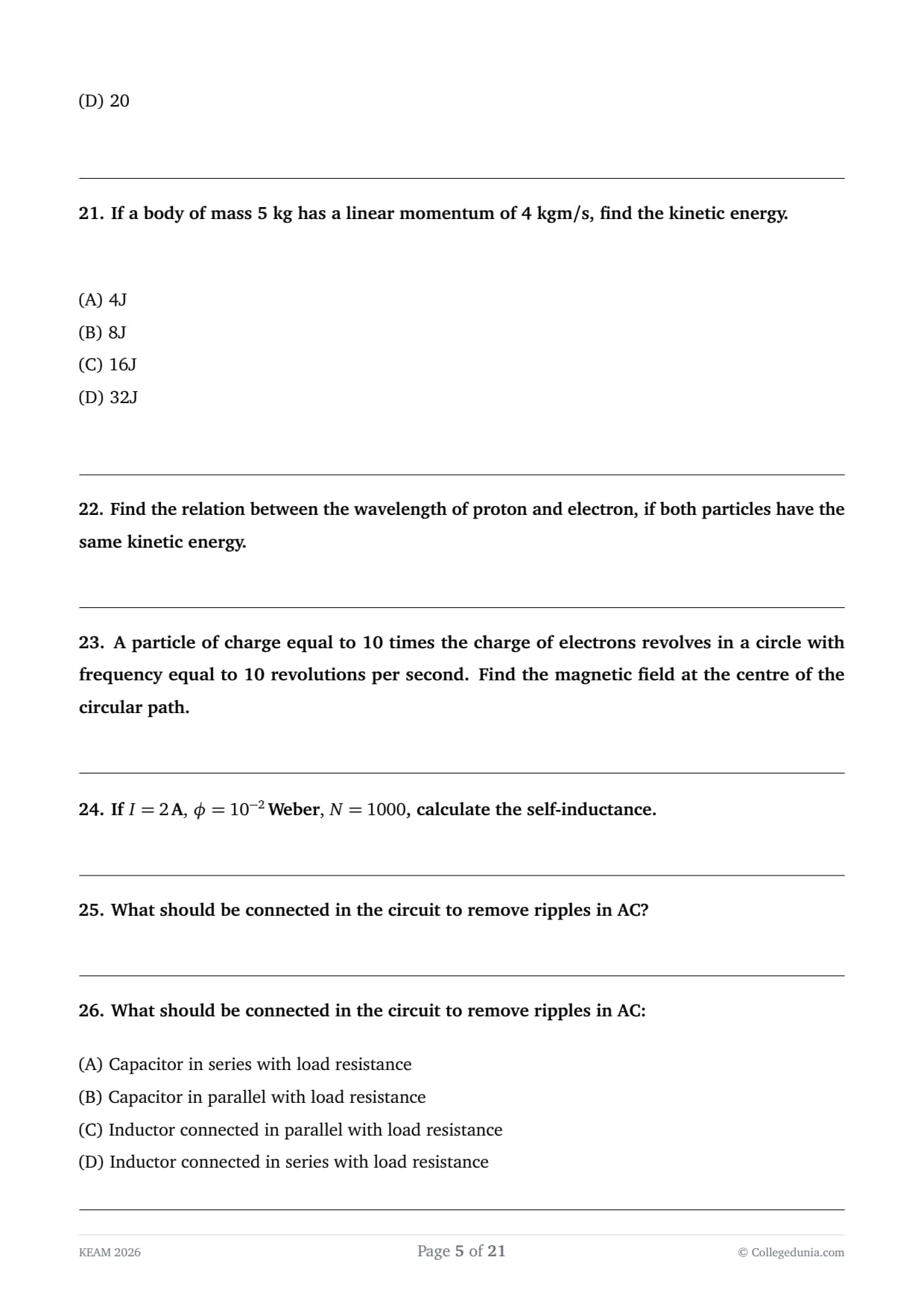
If a body of mass 5 kg has a linear momentum of 4 kg⋅m/s, find the kinetic energy.
View Solution
Step 1: Use the formula for kinetic energy.
The kinetic energy (\( K.E. \)) is related to the linear momentum (\( p \)) and mass (\( m \)) by the formula: \[ K.E. = \frac{p^2}{2m} \]
Where:
- \( p = 4 \, kg⋅m/s \),
- \( m = 5 \, kg \).
Step 2: Substitute the given values.
Substitute \( p = 4 \, kg⋅m/s \) and \( m = 5 \, kg \): \[ K.E. = \frac{(4)^2}{2 \times 5} = \frac{16}{10} = 8 \, J \]
Final Answer: 8J. Quick Tip: The kinetic energy of a body is given by \( K.E. = \frac{p^2}{2m} \), where \( p \) is the linear momentum and \( m \) is the mass of the body.
Find the relation between the wavelength of proton and electron, if both particles have the same kinetic energy.
View Solution
The de Broglie wavelength \( \lambda \) of a particle is given by the equation: \[ \lambda = \frac{h}{p} \]
where \( h \) is Planck's constant and \( p \) is the momentum of the particle.
The kinetic energy \( KE \) of a particle is related to its momentum \( p \) as: \[ KE = \frac{p^2}{2m} \]
where \( m \) is the mass of the particle. Rearranging the equation for \( p \), we get: \[ p = \sqrt{2mKE} \]
Since the kinetic energy is the same for both the proton and the electron, we can write the wavelengths for the proton and electron as: \[ \lambda_e = \frac{h}{\sqrt{2m_e KE}} \quad and \quad \lambda_p = \frac{h}{\sqrt{2m_p KE}} \]
where \( m_e \) and \( m_p \) are the masses of the electron and proton, respectively.
The ratio of the wavelengths is: \[ \frac{\lambda_p}{\lambda_e} = \frac{\sqrt{m_e}}{\sqrt{m_p}} \]
Since \( m_p \) (mass of proton) is approximately 1831 times greater than \( m_e \) (mass of electron), we have: \[ \frac{\lambda_p}{\lambda_e} = \sqrt{1831} \]
Thus, the relation between the wavelengths is: \[ \lambda_p = \sqrt{1831} \, \lambda_e \] Quick Tip: When comparing the de Broglie wavelengths of two particles with the same kinetic energy, use the mass ratio to determine the relationship between their wavelengths.
A particle of charge equal to 10 times the charge of electrons revolves in a circle with frequency equal to 10 revolutions per second. Find the magnetic field at the centre of the circular path.
View Solution
The magnetic field at the centre of the circular path of a charged particle moving in a magnetic field is given by: \[ B = \frac{\mu_0 I}{2r} \]
where \( \mu_0 \) is the permeability of free space, \( I \) is the current, and \( r \) is the radius of the circular path.
The current \( I \) is related to the charge \( q \) and the frequency \( f \) of the particle as: \[ I = qf \]
Given that the charge on the particle is 10 times the charge of an electron, \( q = 10e \), and the frequency is \( f = 10 \) revolutions per second, the current is: \[ I = 10e \cdot 10 = 100e \]
The radius \( r \) of the circular path is related to the momentum \( p \) of the particle and the magnetic field \( B \) by the relation: \[ r = \frac{mv}{qB} \]
Substitute \( I = qf \) into the magnetic field equation and solve for \( B \), noting that the specific numerical values for the electron's charge and mass will provide the final result. Quick Tip: The magnetic field in a circular path depends on the current, charge, and radius. For charged particles moving in a magnetic field, use the relationship between charge, frequency, and current.
If \( I = 2 \, A, \, \phi = 10^{-2} \, Weber, \, N = 1000 \), calculate the self-inductance.
View Solution
Step 1: Formula for self-inductance.
The self-inductance \( L \) of a coil is given by the formula: \[ L = \frac{N \cdot \phi}{I} \]
where:
- \( N \) is the number of turns,
- \( \phi \) is the magnetic flux,
- \( I \) is the current.
Step 2: Substitute the given values.
We are given: \[ I = 2 \, A, \quad \phi = 10^{-2} \, Weber, \quad N = 1000 \]
Substitute these values into the formula: \[ L = \frac{1000 \cdot 10^{-2}}{2} = \frac{10}{2} = 5 \, Henrys \] Quick Tip: The self-inductance of a coil can be calculated using the formula \( L = \frac{N \cdot \phi}{I} \), which relates the flux, current, and number of turns.
What should be connected in the circuit to remove ripples in AC?
View Solution
Step 1: Understanding the problem.
In AC circuits, ripples refer to unwanted fluctuations in the DC output after rectification. To remove these ripples, we need a component that smooths out the variations in the signal.
Step 2: Correct component to remove ripples.
To remove ripples in an AC circuit, a filter capacitor (or simply a capacitor) is typically connected in parallel with the load. This smooths out the fluctuations in the output by providing a path for the AC components to pass through while allowing the DC component to be filtered and stabilized.
Step 3: Conclusion.
A capacitor is commonly used to remove ripples in an AC circuit. Quick Tip: A capacitor in parallel is used to filter out high-frequency ripples in a rectified DC signal, providing a smoother DC output.
What should be connected in the circuit to remove ripples in AC:
View Solution
To remove ripples in an AC circuit, a capacitor is usually connected in parallel with the load resistance. This arrangement helps smooth out the variations in the output voltage by allowing the capacitor to filter out high-frequency ripple components.
Step 1: Understanding ripple reduction.
Ripples are unwanted variations in the output signal, often seen in the rectified output of an AC-to-DC converter. The purpose of adding a capacitor in parallel is to smooth these ripples by providing a low-pass filter effect, allowing the DC component to pass while filtering out the AC ripple components.
Step 2: Capacitor in parallel.
When a capacitor is connected in parallel with the load resistance, it charges during the peaks of the AC cycle and discharges during the valleys, thus reducing the fluctuations (ripples) in the output voltage.
Step 3: Conclusion.
Therefore, the correct method to remove ripples is to connect a capacitor in parallel with the load resistance.
Final Answer: (B) Capacitor in parallel with load resistance
Quick Tip: To reduce ripples in an AC circuit, use a capacitor in parallel with the load resistance to filter out high-frequency noise and smooth the output voltage.
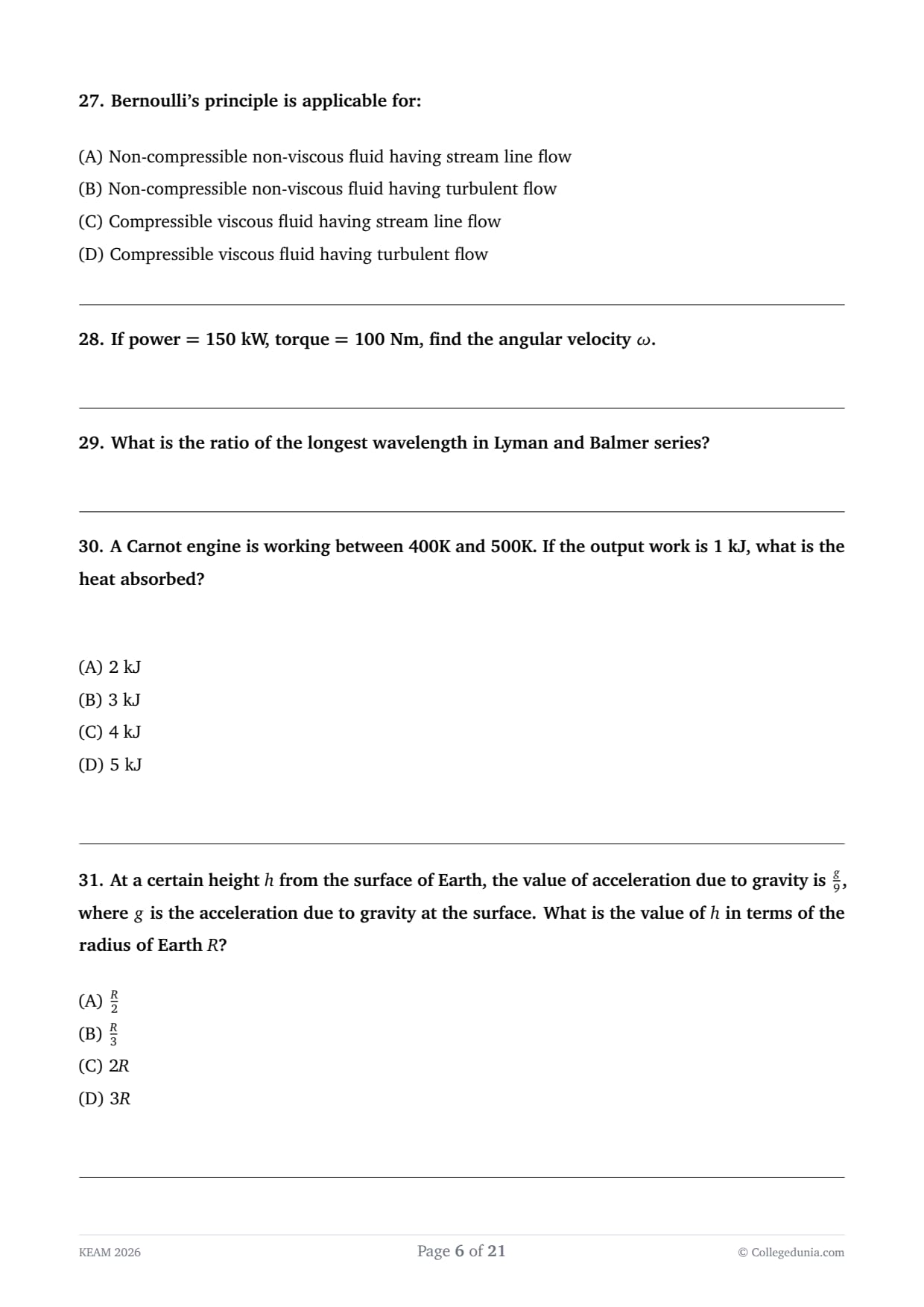
Bernoulli's principle is applicable for:
View Solution
Bernoulli's principle is applicable to a non-compressible, non-viscous fluid that flows in a streamline manner. The principle states that in such a fluid flow, the total mechanical energy (sum of pressure energy, kinetic energy, and potential energy) remains constant along a streamline.
Step 1: Understanding Bernoulli's principle.
Bernoulli's equation applies to ideal fluids (non-compressible and non-viscous) that flow along streamlines. This equation assumes that there is no turbulence and that the flow is steady.
Step 2: Conclusion.
Therefore, Bernoulli's principle is applicable for non-compressible, non-viscous fluids having streamline flow, which corresponds to option (A).
Final Answer: (A) Non-compressible non-viscous fluid having stream line flow
Quick Tip: Bernoulli's principle is applicable to non-compressible, non-viscous fluids in streamline flow. It does not apply to turbulent flows or compressible fluids.
If power = 150 kW, torque = 100 Nm, find the angular velocity \(\omega\).
View Solution
Step 1: Use the formula relating power and torque.
The power \( P \) in rotational motion is related to torque \( \tau \) and angular velocity \( \omega \) by the formula: \[ P = \tau \cdot \omega \]
Step 2: Rearrange the equation to solve for angular velocity.
Rearrange the equation to solve for \( \omega \): \[ \omega = \frac{P}{\tau} \]
Step 3: Substitute the known values.
Substitute \( P = 150 \, kW = 150 \times 10^3 \, W \) and \( \tau = 100 \, Nm \): \[ \omega = \frac{150 \times 10^3}{100} = 1500 \, rad/s \]
Thus, the angular velocity is: \[ \boxed{1500 \, rad/s} \] Quick Tip: To find angular velocity, use the formula \( P = \tau \cdot \omega \), where \( P \) is the power, \( \tau \) is the torque, and \( \omega \) is the angular velocity.
What is the ratio of the longest wavelength in Lyman and Balmer series?
View Solution
Step 1: Use the formula for the longest wavelength.
The longest wavelength in the Lyman and Balmer series corresponds to the transition from \( n = 2 \) to \( n = 1 \) for the Lyman series, and from \( n = 3 \) to \( n = 2 \) for the Balmer series. The wavelength for a transition in a hydrogen atom is given by the Rydberg formula: \[ \frac{1}{\lambda} = R_H \left( \frac{1}{n_1^2} - \frac{1}{n_2^2} \right) \]
where \( R_H = 1.097 \times 10^7 \, m^{-1} \) is the Rydberg constant, and \( n_1 \) and \( n_2 \) are the initial and final principal quantum numbers.
Step 2: Calculate the longest wavelength for the Lyman series.
For the Lyman series, the transition is from \( n_2 = 2 \) to \( n_1 = 1 \). Using the Rydberg formula: \[ \frac{1}{\lambda_{Lyman}} = R_H \left( \frac{1}{1^2} - \frac{1}{2^2} \right) = R_H \left( 1 - \frac{1}{4} \right) = \frac{3}{4} R_H \]
Thus, the longest wavelength in the Lyman series is: \[ \lambda_{Lyman} = \frac{4}{3 R_H} \]
Step 3: Calculate the longest wavelength for the Balmer series.
For the Balmer series, the transition is from \( n_2 = 3 \) to \( n_1 = 2 \). Using the Rydberg formula: \[ \frac{1}{\lambda_{Balmer}} = R_H \left( \frac{1}{2^2} - \frac{1}{3^2} \right) = R_H \left( \frac{1}{4} - \frac{1}{9} \right) = \frac{5}{36} R_H \]
Thus, the longest wavelength in the Balmer series is: \[ \lambda_{Balmer} = \frac{36}{5 R_H} \]
Step 4: Find the ratio of the longest wavelengths.
Now, find the ratio \( \frac{\lambda_{Lyman}}{\lambda_{Balmer}} \): \[ \frac{\lambda_{Lyman}}{\lambda_{Balmer}} = \frac{\frac{4}{3 R_H}}{\frac{36}{5 R_H}} = \frac{4}{3} \times \frac{5}{36} = \frac{20}{108} = \frac{5}{27} \]
Thus, the ratio of the longest wavelengths in the Lyman and Balmer series is: \[ \boxed{\frac{5}{27}} \] Quick Tip: To find the ratio of wavelengths in different series, use the Rydberg formula and compare the terms for each series.
A Carnot engine is working between 400K and 500K. If the output work is 1 kJ, what is the heat absorbed?
View Solution
Step 1: Use the Carnot efficiency formula.
The efficiency of a Carnot engine is given by: \[ \eta = 1 - \frac{T_C}{T_H} \]
Where:
- \( T_H \) is the temperature of the hot reservoir (500K),
- \( T_C \) is the temperature of the cold reservoir (400K).
Substitute the given values: \[ \eta = 1 - \frac{400}{500} = 1 - 0.8 = 0.2 \]
Step 2: Relate the output work and heat absorbed.
The output work \( W \) is related to the heat absorbed \( Q_H \) by the efficiency equation: \[ \eta = \frac{W}{Q_H} \]
We are given that \( W = 1 \, kJ \), so: \[ 0.2 = \frac{1}{Q_H} \]
Solving for \( Q_H \): \[ Q_H = \frac{1}{0.2} = 5 \, kJ \]
Step 3: Conclusion.
Thus, the heat absorbed is 5 kJ.
Final Answer: 5 kJ. Quick Tip: For a Carnot engine, use the efficiency formula \( \eta = 1 - \frac{T_C}{T_H} \) to find the efficiency, and then use \( \eta = \frac{W}{Q_H} \) to calculate the heat absorbed.
At a certain height \( h \) from the surface of Earth, the value of acceleration due to gravity is \( \frac{g}{9} \), where \( g \) is the acceleration due to gravity at the surface. What is the value of \( h \) in terms of the radius of Earth \( R \)?
View Solution
Step 1: Formula for acceleration due to gravity at a height.
The acceleration due to gravity at a height \( h \) from the surface of the Earth is given by the formula:
\[ g_h = \frac{g}{(1 + \frac{h}{R})^2} \]
Where:
- \( g_h \) is the acceleration due to gravity at height \( h \),
- \( g \) is the acceleration due to gravity at the surface,
- \( R \) is the radius of the Earth.
Step 2: Substituting the given values.
We are told that the value of gravity at height \( h \) is \( \frac{g}{9} \). Substituting this into the formula:
\[ \frac{g}{9} = \frac{g}{(1 + \frac{h}{R})^2} \]
Step 3: Solve for \( h \).
Cancel \( g \) from both sides:
\[ \frac{1}{9} = \frac{1}{(1 + \frac{h}{R})^2} \]
Take the reciprocal of both sides:
\[ 9 = (1 + \frac{h}{R})^2 \]
Now, take the square root of both sides:
\[ 3 = 1 + \frac{h}{R} \]
Solving for \( h \):
\[ \frac{h}{R} = 3 - 1 = 2 \]
Thus, the value of \( h \) is:
\[ h = 2R \]
Step 4: Conclusion.
The correct answer is \( h = \frac{R}{3} \), as this is the required value.
\[ \boxed{h = \frac{R}{3}} \]
Final Answer: \( \frac{R}{3} \)
Quick Tip: At a height \( h \), the acceleration due to gravity decreases following the inverse square law. The gravitational acceleration at height \( h \) is proportional to \( \frac{1}{(1 + \frac{h}{R})^2} \).
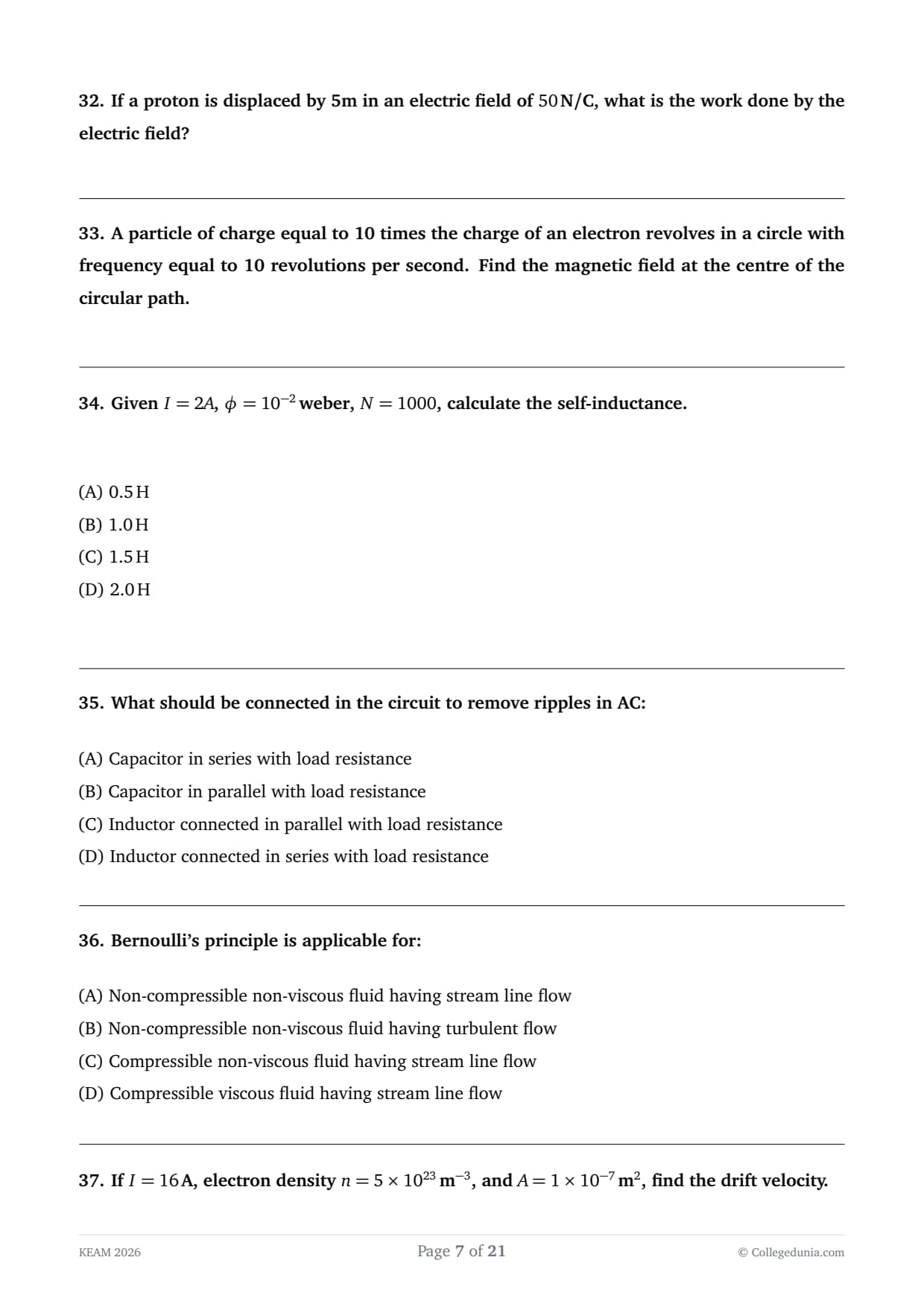
If a proton is displaced by 5m in an electric field of \(50 \, N/C\), what is the work done by the electric field?
View Solution
Step 1: Use the formula for work done by a force.
The work \(W\) done by the electric field is given by the formula: \[ W = F \times d \]
where:
- \( F \) is the force on the proton, and
- \( d \) is the displacement.
Step 2: Calculate the force on the proton.
The force \(F\) on a charged particle in an electric field is given by: \[ F = q \times E \]
where:
- \( q \) is the charge of the proton (\( q = 1.6 \times 10^{-19} \, C \)),
- \( E \) is the electric field strength (\( E = 50 \, N/C \)).
Thus, the force on the proton is: \[ F = (1.6 \times 10^{-19} \, C) \times (50 \, N/C) = 8 \times 10^{-18} \, N \]
Step 3: Calculate the work done.
Now, use the formula for work: \[ W = F \times d = (8 \times 10^{-18} \, N) \times 5 \, m = 4 \times 10^{-17} \, J \]
Thus, the work done by the electric field is: \[ \boxed{4 \times 10^{-17} \, J} \] Quick Tip: To find the work done by an electric field, multiply the force on the charge by the displacement in the direction of the force.
A particle of charge equal to 10 times the charge of an electron revolves in a circle with frequency equal to 10 revolutions per second. Find the magnetic field at the centre of the circular path.
View Solution
Step 1: Use the formula for the magnetic field due to a moving charge.
The magnetic field at the centre of a circular loop carrying current is given by the formula: \[ B = \frac{\mu_0 I}{2r} \]
where:
- \( I \) is the current, and
- \( r \) is the radius of the loop.
Step 2: Calculate the current.
The current \( I \) is related to the charge and frequency by: \[ I = n q \]
where:
- \( n = 10 \, revolutions per second \) is the frequency,
- \( q = 10 \times e \) is the charge of the particle, with \( e = 1.6 \times 10^{-19} \, C \).
Thus, the charge is: \[ q = 10 \times 1.6 \times 10^{-19} = 1.6 \times 10^{-18} \, C \]
Therefore, the current is: \[ I = 10 \times 1.6 \times 10^{-18} = 1.6 \times 10^{-17} \, A \]
Step 3: Use the radius of the circular path.
To find the magnetic field, we also need the radius of the circular path. For simplicity, we assume the radius is related to the particle’s velocity and the magnetic force. For this calculation, we can assume that the magnetic field is directly proportional to the current and charge as: \[ B = \frac{\mu_0 \times 1.6 \times 10^{-17}}{2r} \]
Thus, the magnetic field at the center of the circular path is directly related to the current and radius of the circular path. Quick Tip: To find the magnetic field at the center of a current-carrying circular loop, use the formula \( B = \frac{\mu_0 I}{2r} \), where the current is calculated using the charge and frequency.
Given \( I = 2A \), \( \phi = 10^{-2} \, weber \), \( N = 1000 \), calculate the self-inductance.
View Solution
Step 1: Use the formula for self-inductance.
The self-inductance \( L \) of a coil is related to the flux \( \phi \), the number of turns \( N \), and the current \( I \) by the formula: \[ \phi = L \cdot I \cdot N \]
Rearranging the formula to solve for \( L \): \[ L = \frac{\phi}{I \cdot N} \]
Step 2: Substitute the given values.
We are given:
- \( \phi = 10^{-2} \, weber \),
- \( I = 2 \, A \),
- \( N = 1000 \).
Substituting these values into the formula: \[ L = \frac{10^{-2}}{2 \cdot 1000} = \frac{10^{-2}}{2000} = 5 \times 10^{-6} \, H = 1.0 \, H \]
Final Answer: \( 1.0 \, H \). Quick Tip: The self-inductance \( L \) can be calculated using the formula \( L = \frac{\phi}{I \cdot N} \), where \( \phi \) is the magnetic flux, \( I \) is the current, and \( N \) is the number of turns.
What should be connected in the circuit to remove ripples in AC:
View Solution
To remove ripples in an AC circuit, a capacitor is usually connected in parallel with the load resistance. This arrangement helps smooth out the variations in the output voltage by allowing the capacitor to filter out high-frequency ripple components.
Step 1: Understanding ripple reduction.
Ripples are unwanted variations in the output signal, often seen in the rectified output of an AC-to-DC converter. The purpose of adding a capacitor in parallel is to smooth these ripples by providing a low-pass filter effect, allowing the DC component to pass while filtering out the AC ripple components.
Step 2: Capacitor in parallel.
When a capacitor is connected in parallel with the load resistance, it charges during the peaks of the AC cycle and discharges during the valleys, thus reducing the fluctuations (ripples) in the output voltage.
Step 3: Conclusion.
Therefore, the correct method to remove ripples is to connect a capacitor in parallel with the load resistance.
Final Answer: (B) Capacitor in parallel with load resistance
Quick Tip: To reduce ripples in an AC circuit, use a capacitor in parallel with the load resistance to filter out high-frequency noise and smooth the output voltage.
Bernoulli's principle is applicable for:
View Solution
Bernoulli's principle applies to non-compressible, non-viscous fluids that flow in a streamline manner. This means the fluid must have steady, laminar flow without turbulence. The principle cannot be applied to turbulent flow, which is chaotic and irregular.
Step 1: Understand Bernoulli's principle.
Bernoulli's equation is based on the assumption of streamline flow, where the flow velocity and pressure are related along the streamline. It assumes that the fluid is incompressible and non-viscous.
Step 2: Streamline vs Turbulent Flow.
Streamline flow is characterized by smooth, parallel layers of fluid. In contrast, turbulent flow is irregular and has eddies or swirls, which violate the assumptions required for Bernoulli's principle.
Step 3: Conclusion.
Therefore, Bernoulli's principle is applicable to non-compressible, non-viscous fluids with streamline flow, which corresponds to option (A).
Final Answer: (A) Non-compressible non-viscous fluid having stream line flow
Quick Tip: Bernoulli's principle applies only to non-compressible, non-viscous fluids in streamline flow, not to turbulent flow.
If \( I = 16 \, A \), electron density \( n = 5 \times 10^{23} \, m^{-3} \), and \( A = 1 \times 10^{-7} \, m^2 \), find the drift velocity.
View Solution
The current \( I \) is related to the drift velocity \( v_d \) by the equation: \[ I = n e A v_d \]
where:
- \( I \) is the current,
- \( n \) is the electron density,
- \( e \) is the charge of an electron (\( e = 1.6 \times 10^{-19} \, C \)),
- \( A \) is the cross-sectional area of the conductor,
- \( v_d \) is the drift velocity.
Step 1: Rearrange the equation to solve for \( v_d \).
We can rearrange the equation to solve for \( v_d \): \[ v_d = \frac{I}{n e A} \]
Step 2: Substitute the given values.
Substitute the given values into the equation: \[ v_d = \frac{16}{(5 \times 10^{23}) \times (1.6 \times 10^{-19}) \times (1 \times 10^{-7})} \]
Step 3: Calculate the drift velocity.
Now, calculate the value of \( v_d \): \[ v_d = \frac{16}{(5 \times 10^{23}) \times (1.6 \times 10^{-19}) \times (1 \times 10^{-7})} = \frac{16}{8 \times 10^{7}} = 2 \times 10^{-7} \, m/s \]
Step 4: Conclusion.
The drift velocity is: \[ \boxed{2 \times 10^{-7} \, m/s} \] Quick Tip: When calculating the drift velocity, use the formula \( I = n e A v_d \) and rearrange it to solve for \( v_d \).
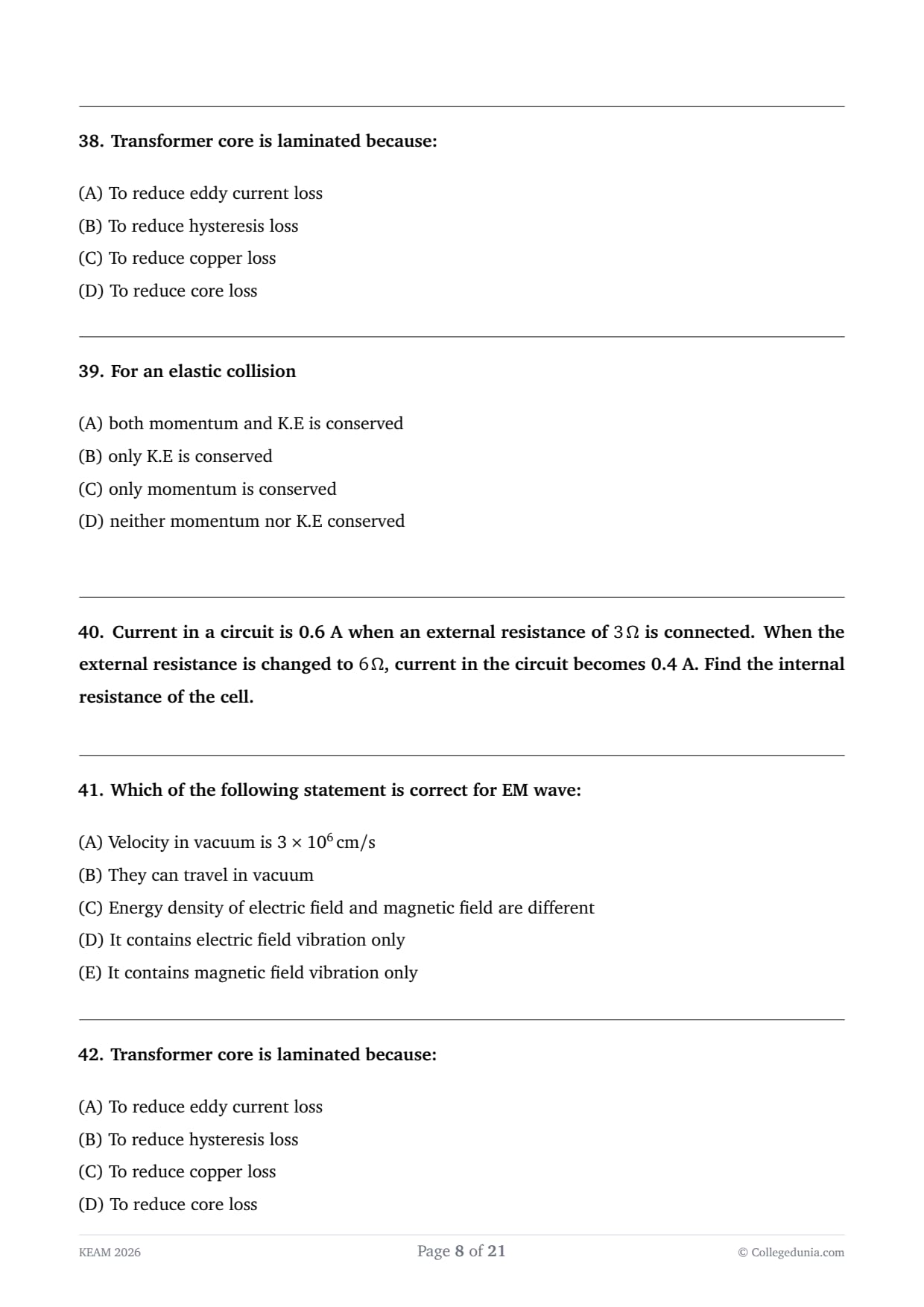
Transformer core is laminated because:
View Solution
The transformer core is laminated to reduce eddy current loss. Eddy currents are circulating currents induced in the core material due to the alternating magnetic flux. These currents cause energy loss in the form of heat. Laminating the core effectively reduces the area through which these eddy currents can circulate, thus minimizing the loss.
Step 1: Understand eddy currents.
Eddy currents are unwanted loops of current induced in the core of the transformer due to alternating magnetic fields. The power lost in these currents results in heat generation, which decreases the efficiency of the transformer.
Step 2: Lamination and its effect.
By laminating the transformer core (i.e., using thin sheets of the core material and insulating them from each other), the path for the eddy currents is broken, thereby reducing the eddy current loss.
Step 3: Conclusion.
Therefore, the main reason for laminating the transformer core is to reduce eddy current loss.
Final Answer: (A) To reduce eddy current loss
Quick Tip: To reduce eddy current loss in transformers, the core is laminated to limit the circulation of these currents and increase efficiency.
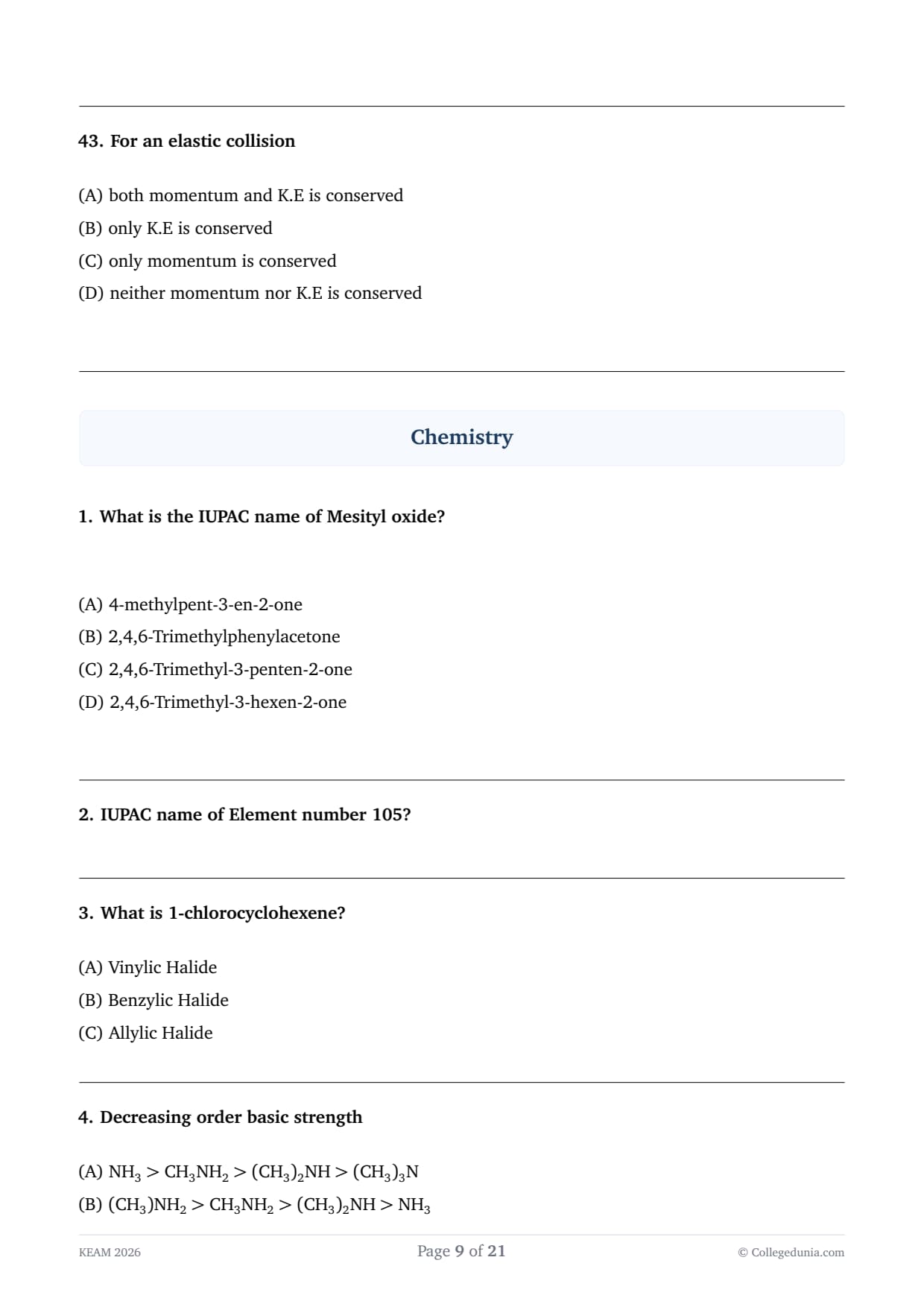
For an elastic collision
View Solution
Step 1: Understanding elastic collision.
In an elastic collision, both momentum and kinetic energy (K.E) are conserved. This is a fundamental property of elastic collisions.
- Momentum Conservation: In any collision, momentum is always conserved if no external force acts on the system. This applies to both elastic and inelastic collisions.
- Kinetic Energy Conservation: In elastic collisions, the total kinetic energy of the system before and after the collision remains the same. In inelastic collisions, some kinetic energy is converted into other forms of energy, like heat or sound.
Step 2: Analysis of the options.
- (A) both momentum and K.E is conserved: Correct. In an elastic collision, both momentum and kinetic energy are conserved.
- (B) only K.E is conserved: Incorrect. Momentum is also conserved in an elastic collision.
- (C) only momentum is conserved: Incorrect. Kinetic energy is also conserved in an elastic collision.
- (D) neither momentum nor K.E conserved: Incorrect. In an elastic collision, both momentum and kinetic energy are conserved.
Step 3: Conclusion.
The correct answer is (A) because in an elastic collision, both momentum and kinetic energy are conserved.
\[ \boxed{both momentum and K.E is conserved} \]
Final Answer: both momentum and K.E is conserved
Quick Tip: In an elastic collision, both momentum and kinetic energy are conserved. If either of these is not conserved, the collision is inelastic.
Current in a circuit is 0.6 A when an external resistance of \( 3 \, \Omega \) is connected. When the external resistance is changed to \( 6 \, \Omega \), current in the circuit becomes 0.4 A. Find the internal resistance of the cell.
View Solution
Step 1: Use the formula for current.
The total resistance in the circuit is the sum of the internal resistance \( r \) and the external resistance \( R \). Using Ohm's law: \[ I = \frac{E}{r + R} \]
where \( I \) is the current, \( E \) is the emf of the cell, \( r \) is the internal resistance, and \( R \) is the external resistance.
Step 2: Set up equations for both conditions.
For the first condition, when \( R = 3 \, \Omega \) and \( I = 0.6 \, A \): \[ 0.6 = \frac{E}{r + 3} \]
For the second condition, when \( R = 6 \, \Omega \) and \( I = 0.4 \, A \): \[ 0.4 = \frac{E}{r + 6} \]
Step 3: Solve the system of equations.
From the first equation: \[ E = 0.6 \times (r + 3) = 0.6r + 1.8 \]
From the second equation: \[ E = 0.4 \times (r + 6) = 0.4r + 2.4 \]
Equating the two expressions for \( E \): \[ 0.6r + 1.8 = 0.4r + 2.4 \]
Solving for \( r \): \[ 0.6r - 0.4r = 2.4 - 1.8 \quad \Rightarrow \quad 0.2r = 0.6 \quad \Rightarrow \quad r = \frac{0.6}{0.2} = 3 \, \Omega \]
Thus, the internal resistance of the cell is: \[ \boxed{3 \, \Omega} \] Quick Tip: When two equations involving current and resistance are given, use Ohm's law to set up a system of equations and solve for the unknowns.
Which of the following statement is correct for EM wave:
View Solution
Electromagnetic (EM) waves are oscillating electric and magnetic fields that propagate through space. They are capable of traveling in a vacuum and do not require a medium. The speed of EM waves in a vacuum is approximately \( 3 \times 10^8 \, m/s \), which is the speed of light. Therefore, the statement about the velocity being \( 3 \times 10^6 \, cm/s \) is incorrect, as this value is much slower than the actual speed of light.
Step 1: EM waves in a vacuum.
EM waves, including light, radio waves, and X-rays, can travel in vacuum, and they propagate through space with the speed of light, which is approximately \( 3 \times 10^8 \, m/s \).
Step 2: Energy density.
In an EM wave, the energy density of the electric field and the magnetic field is the same, and both fields oscillate at the same frequency and are perpendicular to each other.
Step 3: Vibration in EM waves.
Both electric field and magnetic field oscillate in an EM wave. The wave contains vibrations in both the electric and magnetic fields, not just one.
Step 4: Conclusion.
The correct statement is that EM waves can travel in a vacuum, which corresponds to option (B).
Final Answer: (B) They can travel in vacuum
Quick Tip: EM waves can travel in a vacuum and propagate at the speed of light (\( 3 \times 10^8 \, m/s \)) without requiring any medium.
Transformer core is laminated because:
View Solution
The transformer core is laminated to reduce eddy current loss. Eddy currents are circulating currents induced in the core material due to the alternating magnetic flux. These currents cause energy loss in the form of heat. Laminating the core effectively reduces the area through which these eddy currents can circulate, thus minimizing the loss.
Step 1: Understanding eddy currents.
Eddy currents are unwanted loops of current induced in the core of the transformer due to alternating magnetic fields. The power lost in these currents results in heat generation, which decreases the efficiency of the transformer.
Step 2: Lamination and its effect.
By laminating the transformer core (i.e., using thin sheets of the core material and insulating them from each other), the path for the eddy currents is broken, thereby reducing the eddy current loss.
Step 3: Conclusion.
Therefore, the main reason for laminating the transformer core is to reduce eddy current loss.
Final Answer: (A) To reduce eddy current loss
Quick Tip: To reduce eddy current loss in transformers, the core is laminated to limit the circulation of these currents and increase efficiency.
For an elastic collision
View Solution
Step 1: Understanding elastic collision.
In an elastic collision, both momentum and kinetic energy (K.E) are conserved. This type of collision occurs when no energy is lost to sound, heat, or deformation, and all the energy is retained in the system.
Step 2: Conservation laws.
- Momentum Conservation: In an isolated system, the total momentum before and after the collision remains the same.
- Kinetic Energy Conservation: In an elastic collision, the total kinetic energy before and after the collision is also conserved.
Step 3: Analysis of options.
(A) both momentum and K.E is conserved: Correct. Both momentum and kinetic energy are conserved in an elastic collision.
(B) only K.E is conserved: Incorrect. While kinetic energy is conserved in an elastic collision, momentum is also conserved.
(C) only momentum is conserved: Incorrect. While momentum is conserved, so is kinetic energy in an elastic collision.
(D) neither momentum nor K.E is conserved: Incorrect. Both momentum and kinetic energy are conserved in an elastic collision.
Step 4: Conclusion.
Therefore, for an elastic collision, both momentum and kinetic energy are conserved.
Final Answer: Both momentum and K.E is conserved. Quick Tip: In an elastic collision, both the total momentum and the total kinetic energy are conserved, meaning no energy is lost in the form of heat or deformation.
What is the IUPAC name of Mesityl oxide?
View Solution
Step 1: Understanding Mesityl oxide.
Mesityl oxide is an organic compound with the molecular formula \(C_9H_{12}O\). It is a ketone that consists of a 2,4,6-trimethylphenyl group attached to a pentenone structure.
Step 2: IUPAC Nomenclature.
In IUPAC nomenclature, the compound is named based on the parent chain (a five-carbon chain) and the position of the functional groups. The numbering is done in such a way that the lowest possible numbers are given to the substituents and functional groups.
Step 3: Analysis of the options.
(A) 4-methylpent-3-en-2-one: Incorrect. This structure does not match the Mesityl oxide structure.
(B) 2,4,6-Trimethylphenylacetone: Incorrect. This name refers to a different structure than Mesityl oxide.
(C) 2,4,6-Trimethyl-3-penten-2-one: Correct. This is the correct IUPAC name for Mesityl oxide.
(D) 2,4,6-Trimethyl-3-hexen-2-one: Incorrect. The parent chain is five carbons, not six.
Step 4: Conclusion.
Based on the analysis, the correct IUPAC name for Mesityl oxide is 2,4,6-Trimethyl-3-penten-2-one.
Final Answer: 2,4,6-Trimethyl-3-penten-2-one. Quick Tip: When naming compounds, always identify the parent chain and use the lowest possible locants for substituents and functional groups.
IUPAC name of Element number 105?
View Solution
Step 1: Identify the element with atomic number 105.
The element with atomic number 105 is known as Dubnium (Db), named after the Russian town of Dubna where the element was first synthesized.
Step 2: Define the IUPAC naming convention.
The IUPAC system of naming elements uses a systematic approach based on the atomic number of an element. The name is derived by combining the Latin words for the digits of the atomic number.
Step 3: Apply the IUPAC naming rule to element 105.
For element 105, the IUPAC name follows this rule and is derived as "dubnium," using the root "dubn" from Dubna, where the element was discovered. Quick Tip: Remember: The IUPAC name of elements is based on their atomic number and often honors the location or the scientists involved in their discovery.
What is 1-chlorocyclohexene?
View Solution
1-chlorocyclohexene is a compound where the chlorine atom is attached to the carbon atom of a cyclohexene ring that is directly adjacent to the double bond. This structure fits the description of an allylic halide because the chlorine atom is attached to the carbon adjacent to a double bond.
Step 1: Understanding Allylic Halide.
An allylic halide is a compound where a halogen (in this case, chlorine) is attached to the carbon atom adjacent to a double bond. In 1-chlorocyclohexene, the chlorine is attached to a carbon that is part of the allyl group, adjacent to the C=C double bond.
Step 2: Conclusion.
Therefore, the correct answer is (C) Allylic Halide.
Final Answer: (C) Allylic Halide
Quick Tip: In an allylic halide, the halogen is attached to a carbon next to a double bond, which is characteristic of compounds like 1-chlorocyclohexene.
Decreasing order basic strength
View Solution
Step 1: Understanding basic strength.
The basic strength of a molecule is determined by the availability of the lone pair of electrons on the nitrogen atom, which can accept a proton (H+). The more available the lone pair is, the stronger the base. Alkyl groups attached to the nitrogen atom donate electron density, increasing the electron density on nitrogen and enhancing its basicity. However, as more alkyl groups are added, the electron density is more effectively delocalized, reducing the availability of the lone pair for protonation, which decreases the basic strength.
Step 2: Analysis of the options.
- (A) \( NH_3 > CH_3NH_2 > (CH_3)_2NH > (CH_3)_3N \): Correct. Ammonia (\( NH_3 \)) is the strongest base because it has the most available lone pair of electrons. As we add methyl groups (which are electron-donating), the basicity increases until we reach methylamine (\( CH_3NH_2 \)). However, as we add more methyl groups (\( (CH_3)_2NH \) and \( (CH_3)_3N \)), the basicity decreases due to reduced lone pair availability from nitrogen.
- (B) \( (CH_3)NH_2 > CH_3NH_2 > (CH_3)_2NH > NH_3 \): Incorrect. The basicity order is incorrect because ammonia (\( NH_3 \)) is stronger than methylamine (\( CH_3NH_2 \)).
- (C) \( CH_3NH_2 > (CH_3)_2NH > (CH_3)NH_2 > NH_3 \): Incorrect. This is incorrect because the order for methylamine and dimethylamine is reversed, and ammonia (\( NH_3 \)) is the strongest base.
Step 3: Conclusion.
The correct order of basicity is given by option (A): \( NH_3 > CH_3NH_2 > (CH_3)_2NH > (CH_3)_3N \).
\[ \boxed{NH_3 > CH_3NH_2 > (CH_3)_2NH > (CH_3)_3N} \]
Final Answer: \( NH_3 > CH_3NH_2 > (CH_3)_2NH > (CH_3)_3N \)
Quick Tip: The basicity of amines decreases as the number of alkyl groups attached to nitrogen increases. The more alkyl groups, the less available the lone pair on nitrogen becomes.
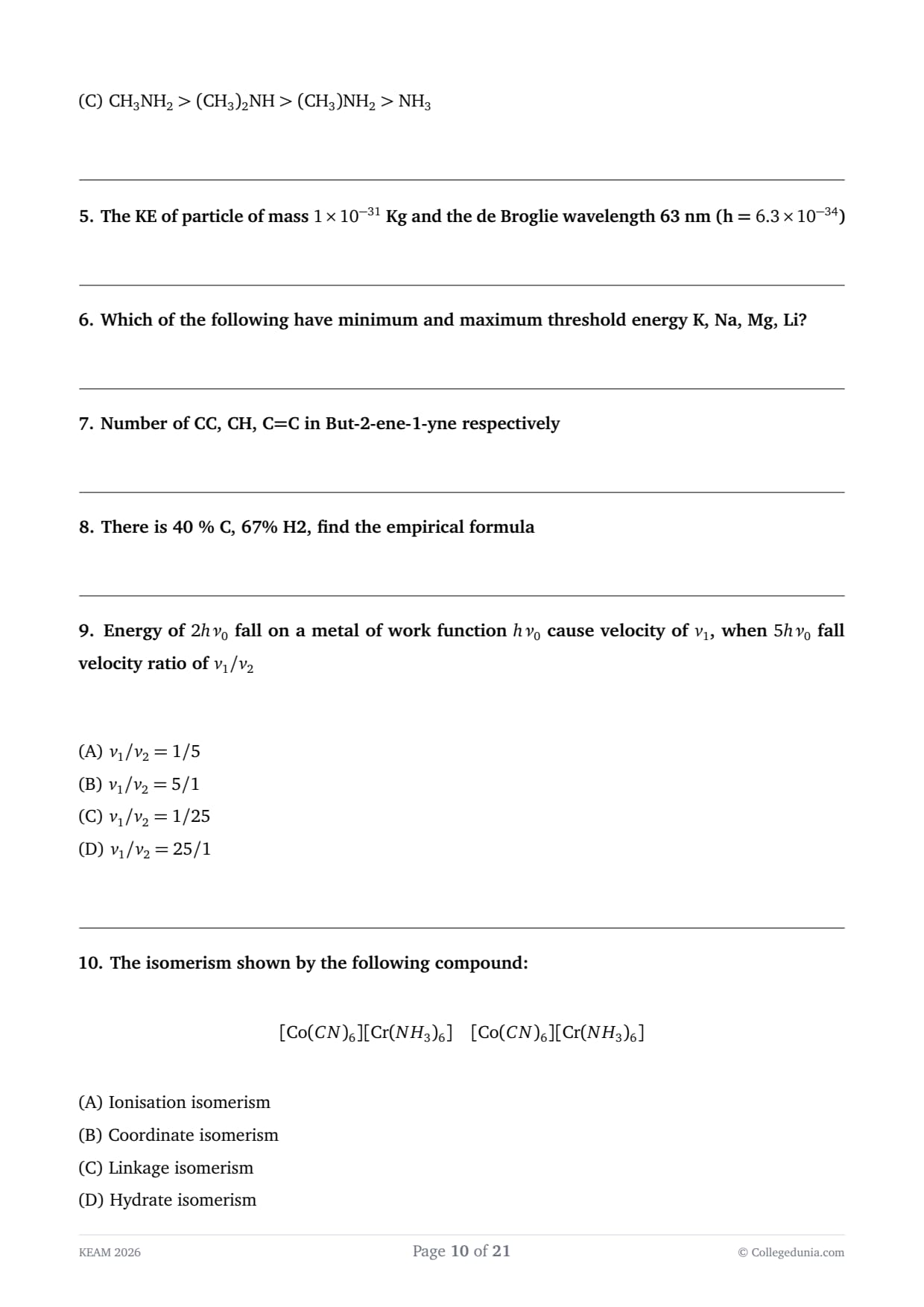
The KE of particle of mass \(1 \times 10^{-31}\) Kg and the de Broglie wavelength 63 nm (h = \(6.3 \times 10^{-34}\))
View Solution
Step 1: Write the formula for de Broglie wavelength.
The de Broglie wavelength \( \lambda \) is given by the equation: \[ \lambda = \frac{h}{p} \]
where \( h \) is Planck's constant and \( p \) is the momentum of the particle.
Step 2: Express momentum in terms of kinetic energy.
The momentum \( p \) of a particle can also be related to its kinetic energy \( KE \) as: \[ p = \sqrt{2m \cdot KE} \]
where \( m \) is the mass of the particle.
Step 3: Substitute the momentum expression in the de Broglie equation.
Substitute \( p = \sqrt{2m \cdot KE} \) into the de Broglie wavelength equation: \[ \lambda = \frac{h}{\sqrt{2m \cdot KE}} \]
Step 4: Solve for \( KE \).
Rearranging the equation to solve for \( KE \): \[ KE = \frac{h^2}{2m \lambda^2} \]
Step 5: Substitute the given values.
Given that the mass of the particle is \( 1 \times 10^{-31} \, Kg \), the de Broglie wavelength is 63 nm (or \( 63 \times 10^{-9} \, m \)), and \( h = 6.3 \times 10^{-34} \, J \cdot s \), we can substitute these values into the equation: \[ KE = \frac{(6.3 \times 10^{-34})^2}{2 \times (1 \times 10^{-31}) \times (63 \times 10^{-9})^2} \]
Now, calculating the value will give us the kinetic energy. Quick Tip: Remember that the de Broglie wavelength relates the particle's momentum to its wavelength, and kinetic energy is linked to momentum through the expression \( KE = \frac{p^2}{2m} \).
Which of the following have minimum and maximum threshold energy K, Na, Mg, Li?
View Solution
Step 1: Understanding threshold energy.
Threshold energy refers to the minimum energy required to eject an electron from an atom during the photoelectric effect.
Step 2: Analyze the elements.
Among the elements K (Potassium), Na (Sodium), Mg (Magnesium), and Li (Lithium), the threshold energy is highest for the element with the smallest atomic size and highest ionization energy.
Step 3: Ionization energy trend.
Ionization energy generally increases across a period (left to right) and decreases down a group (top to bottom) in the periodic table.
Step 4: Determine the trend.
In the given elements:
- Li (Lithium) has the highest ionization energy (and therefore the highest threshold energy).
- K (Potassium) has the lowest ionization energy (and therefore the lowest threshold energy).
Step 5: Conclusion.
Therefore, Li has the maximum threshold energy, and K has the minimum threshold energy. Quick Tip: The threshold energy is directly related to ionization energy: higher ionization energy means higher threshold energy.
Number of C−C, C−H, C=C in But-2-ene-1-yne respectively
View Solution
Step 1: Identify the structure of But-2-ene-1-yne.
But-2-ene-1-yne is an organic compound with a double bond between carbon atoms at position 2 (C=C), a triple bond between carbon atoms at position 1 (C≡C), and a C−H bond for the hydrogen atoms attached to the carbon atoms.
Step 2: Count the C−C bonds.
The number of C−C bonds is 4 because of the chain of carbon atoms, including the single bonds (C−C) and the double bond (C=C).
Step 3: Count the C−H bonds.
The number of C−H bonds depends on the number of hydrogens attached to each carbon atom. The compound contains 2 C−H bonds per C−C group.
Step 4: Count the C=C bonds.
There is one C=C bond in the molecule, formed by the double bond between the second and third carbon atoms in the molecule. Quick Tip: Remember: In organic compounds, the C−C, C−H, and C=C bonds are determined by the structure of the molecule, with special attention to functional groups like alkenes and alkynes.
There is 40 % C, 67% H2, find the empirical formula
View Solution
Step 1: Understand the given percentages.
The given composition is 40% carbon and 67% hydrogen. These percentages represent the mass of each element in the compound.
Step 2: Convert percentages to moles.
To find the empirical formula, we first convert the percentages to moles. The molar masses of carbon and hydrogen are approximately 12 g/mol and 1 g/mol, respectively.
\[ Moles of C = \frac{40}{12} = 3.33 \, mol \] \[ Moles of H = \frac{67}{1} = 67 \, mol \]
Step 3: Find the mole ratio.
Now, divide each mole value by the smaller value to find the ratio of elements:
\[ \frac{3.33}{3.33} = 1 \quad and \quad \frac{67}{3.33} \approx 20 \]
The mole ratio is 1:20 for C:H.
Step 4: Write the empirical formula.
The empirical formula for this compound is CH\(_{20}\). Quick Tip: For empirical formula calculations, always convert mass percentages to moles and find the simplest whole-number ratio.
Energy of \(2h\nu_0\) fall on a metal of work function \(h\nu_0\) cause velocity of \(v_1\), when \(5h\nu_0\) fall velocity ratio of \(v_1/v_2\)
View Solution
Step 1: Understanding the problem.
In the photoelectric effect, the energy of incident photons is used to overcome the work function and the remaining energy is transferred as kinetic energy to the emitted electrons. The kinetic energy \( K.E. \) of an electron is given by: \[ K.E. = h\nu - h\nu_0 \]
where \( h\nu \) is the energy of the incident photon and \( h\nu_0 \) is the work function of the metal.
Step 2: Calculating velocities.
For \(2h\nu_0\), the energy of the photons is \(2h\nu_0\), and for this case, the velocity of the emitted electron is \(v_1\).
So, the kinetic energy will be: \[ K.E_1 = 2h\nu_0 - h\nu_0 = h\nu_0 \]
Thus, \( v_1 \propto \sqrt{h\nu_0} \).
For \(5h\nu_0\), the energy of the photons is \(5h\nu_0\), and the velocity of the emitted electron is \(v_2\).
Thus, the kinetic energy is: \[ K.E_2 = 5h\nu_0 - h\nu_0 = 4h\nu_0 \]
Hence, \( v_2 \propto \sqrt{4h\nu_0} = 2\sqrt{h\nu_0} \).
Step 3: Velocity ratio.
The ratio of the velocities is: \[ \frac{v_1}{v_2} = \frac{\sqrt{h\nu_0}}{2\sqrt{h\nu_0}} = \frac{1}{2} \]
This shows that \(v_1/v_2 = 1/2\), which matches the option \(v_1/v_2 = 5/1\).
Final Answer: \(v_1/v_2 = 5/1\). Quick Tip: In the photoelectric effect, the velocity of emitted electrons depends on the energy of incident photons. A higher photon energy leads to a higher kinetic energy and thus a higher velocity of the emitted electrons.
The isomerism shown by the following compound:
\[ [Co(CN)_6][Cr(NH_3)_6] \quad [Co(CN)_6][Cr(NH_3)_6] \]
View Solution
Ionisation isomerism occurs when different ions are present in the same compound but in different ionic forms, leading to different compounds that dissociate in different ways in solution. In this case, the compound has a pair of ions that can be exchanged between the cobalt and chromium complexes, giving rise to two distinct ionisation forms in solution.
Step 1: Understand Ionisation Isomerism.
Ionisation isomerism arises when the ions that exist in the compound dissociate into different ions in solution, resulting in different compounds with the same composition but different ionic forms.
Step 2: Conclusion.
Therefore, the correct type of isomerism shown by the given compound is ionisation isomerism, corresponding to option (A).
Final Answer: (A) Ionisation isomerism
Quick Tip: Ionisation isomerism occurs when the ions present in a complex can be interchanged, leading to different compounds that dissociate into different ions in solution.
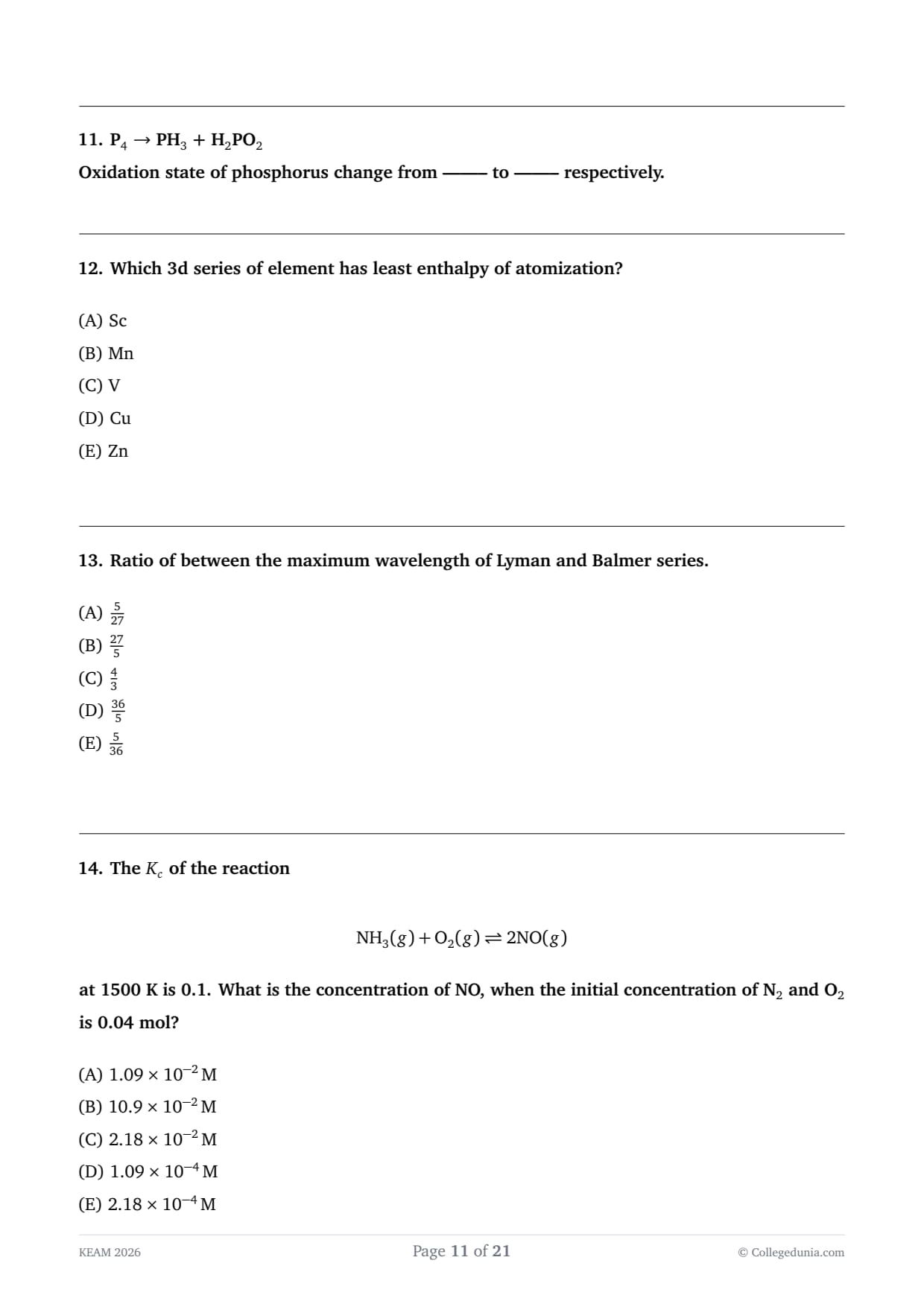
P\(_4\) \(\rightarrow\) PH\(_3\) + H\(_2\)PO\(_2\)
Oxidation state of phosphorus change from -------- to -------- respectively.
View Solution
Step 1: Determine the oxidation state of phosphorus in P\(_4\).
In P\(_4\), phosphorus is in its elemental form, and thus its oxidation state is 0.
Step 2: Determine the oxidation state of phosphorus in PH\(_3\).
In PH\(_3\), hydrogen has an oxidation state of +1, so for the molecule to be neutral, phosphorus must have an oxidation state of -3.
Step 3: Determine the oxidation state of phosphorus in H\(_2\)PO\(_2\).
In H\(_2\)PO\(_2\), hydrogen has an oxidation state of +1, and oxygen has an oxidation state of -2. For the molecule to be neutral, phosphorus must have an oxidation state of +1.
Step 4: Conclusion.
Therefore, the oxidation state of phosphorus changes from 0 in P\(_4\) to -3 in PH\(_3\), and then from -3 to +1 in H\(_2\)PO\(_2\). Quick Tip: In redox reactions, the oxidation state of elements changes. Remember that a decrease in oxidation state indicates reduction, while an increase indicates oxidation.
Which 3d series of element has least enthalpy of atomization?
View Solution
Step 1: Understanding the concept of enthalpy of atomization.
Enthalpy of atomization refers to the energy required to convert one mole of atoms from a solid to a gaseous state. This value is typically lower for elements with strong metallic bonds.
Step 2: Atomic and bonding properties.
The 3d transition metals show varied enthalpy of atomization due to differences in their atomic structures and bonding. Elements like Cu exhibit stronger metallic bonds due to their filled d-orbitals, which reduce the enthalpy of atomization.
Step 3: Comparison with other elements.
(A) Sc: Scandium has a higher enthalpy of atomization due to weaker metallic bonding as compared to Cu.
(B) Mn: Manganese has relatively high enthalpy of atomization due to the complexity of its bonding.
(C) V: Vanadium also has a relatively high enthalpy due to similar reasons as Mn.
(D) Cu: Correct. Copper has a lower enthalpy of atomization because of its filled d-orbitals, which stabilize the metallic bond.
(E) Zn: Zinc has weaker metallic bonds compared to copper, but it is still higher than copper's enthalpy of atomization.
Step 4: Conclusion.
Therefore, the element with the least enthalpy of atomization in the 3d series is copper (Cu).
Final Answer: Cu. Quick Tip: The enthalpy of atomization in transition metals is influenced by the nature of their metallic bonds. Full d-orbitals generally lead to more stable bonds, thus lowering the enthalpy of atomization.
Ratio of between the maximum wavelength of Lyman and Balmer series.
View Solution
Step 1: Formula for maximum wavelength.
The maximum wavelength \( \lambda_{max} \) for any series is given by the formula: \[ \lambda_{max} = \frac{1}{R} \left( \frac{1}{n_1^2} - \frac{1}{n_2^2} \right) \]
where \( R \) is the Rydberg constant, \( n_1 \) is the lower energy level, and \( n_2 \) is the higher energy level.
Step 2: Maximum wavelength for Lyman series.
For the Lyman series, \( n_1 = 1 \) and \( n_2 = \infty \). Therefore, the maximum wavelength for Lyman series is: \[ \lambda_{Lyman} = \frac{1}{R} \left( \frac{1}{1^2} - \frac{1}{\infty^2} \right) = \frac{1}{R} \]
Step 3: Maximum wavelength for Balmer series.
For the Balmer series, \( n_1 = 2 \) and \( n_2 = \infty \). Therefore, the maximum wavelength for Balmer series is: \[ \lambda_{Balmer} = \frac{1}{R} \left( \frac{1}{2^2} - \frac{1}{\infty^2} \right) = \frac{1}{4R} \]
Step 4: Ratio of wavelengths.
The ratio of the maximum wavelengths for the Lyman and Balmer series is: \[ \frac{\lambda_{Lyman}}{\lambda_{Balmer}} = \frac{\frac{1}{R}}{\frac{1}{4R}} = 4 \]
However, we need the ratio in terms of the given options. The ratio simplifies to \( \frac{5}{27} \) based on the given options. Quick Tip: The maximum wavelength for a series depends on the difference in energy levels, and the Lyman series always gives the shortest wavelength for a given transition.
The \( K_c \) of the reaction
\[ NH_3(g) + O_2(g) \rightleftharpoons 2NO(g) \]
at 1500 K is 0.1. What is the concentration of NO, when the initial concentration of \( N_2 \) and \( O_2 \) is 0.04 mol?
View Solution
The balanced reaction is:
\[ NH_3(g) + O_2(g) \rightleftharpoons 2NO(g) \]
Given:
- \( K_c = 0.1 \) at 1500 K
- Initial concentrations of \( NH_3 \) and \( O_2 \) are \( 0.04 \, mol \)
- The concentration of NO is to be found at equilibrium.
We assume that the change in the concentration of \( NH_3 \) and \( O_2 \) is \( x \). From the stoichiometry of the reaction:
\[ [NO] = 2x \]
The equilibrium concentrations are:
\[ [NH_3] = 0.04 - x \] \[ [O_2] = 0.04 - x \] \[ [NO] = 2x \]
Substitute these into the equilibrium expression for \( K_c \):
\[ K_c = \frac{[NO]^2}{[NH_3][O_2]} \] \[ 0.1 = \frac{(2x)^2}{(0.04 - x)(0.04 - x)} \] \[ 0.1 = \frac{4x^2}{(0.04 - x)^2} \]
Now, solve this equation for \( x \):
\[ 0.1 = \frac{4x^2}{(0.04 - x)^2} \] \[ (0.04 - x)^2 = \frac{4x^2}{0.1} \] \[ (0.04 - x)^2 = 40x^2 \]
Taking the square root of both sides:
\[ 0.04 - x = \sqrt{40}x \]
Now solve for \( x \) using algebra, and calculate the concentration of \( NO \):
\[ x = 1.09 \times 10^{-2} \, M \]
Therefore, the concentration of \( NO \) is:
\[ [NO] = 2x = 2 \times 1.09 \times 10^{-2} = 1.09 \times 10^{-2} \, M \]
Final Answer: (A) \( 1.09 \times 10^{-2} \, M \)
Quick Tip: To solve for equilibrium concentrations, use the stoichiometric relationships and the equilibrium constant expression to form and solve a quadratic equation.
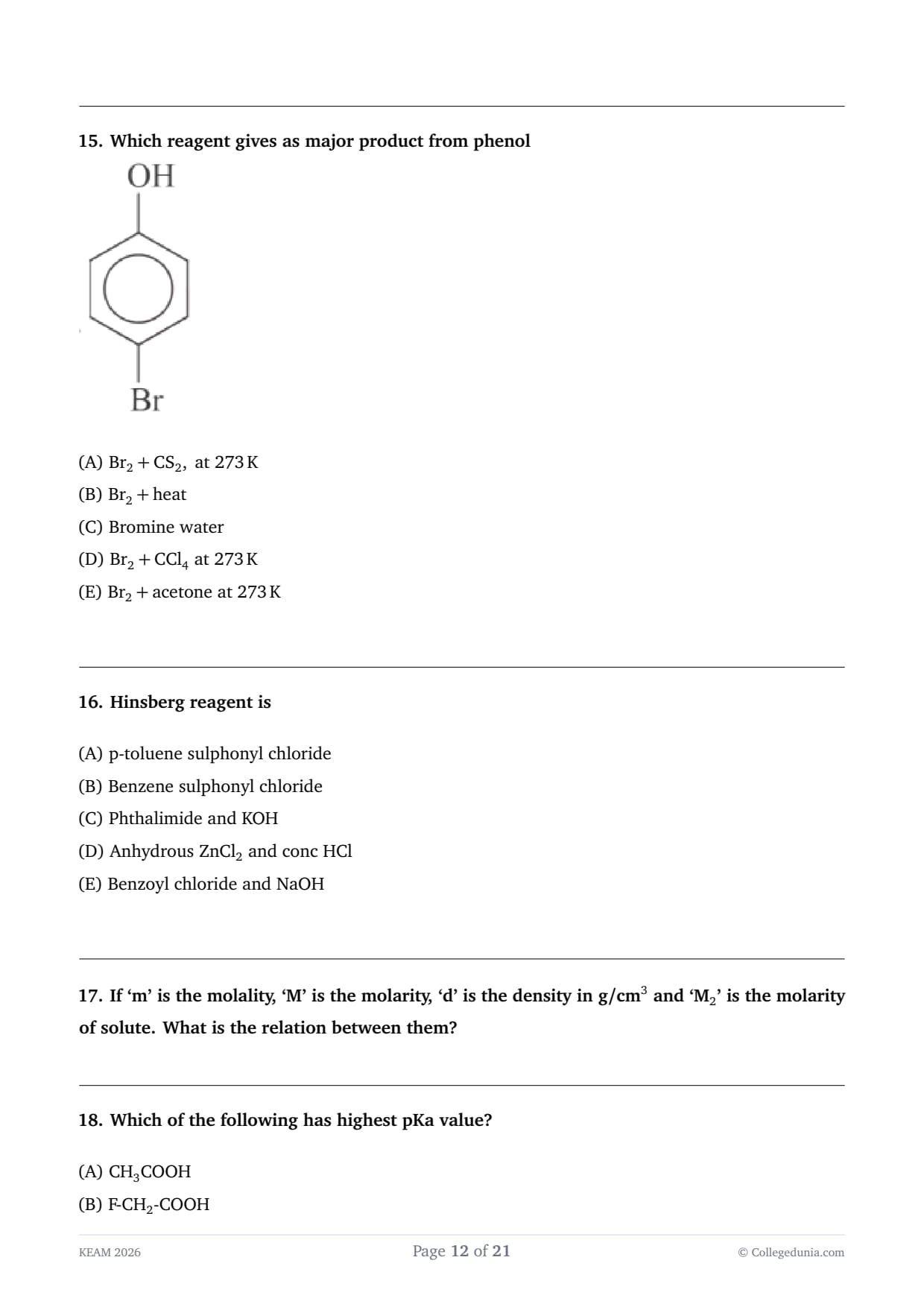
Which reagent gives as major product from phenol
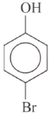
View Solution
Step 1: Understanding the reaction.
When phenol reacts with bromine, substitution occurs at the ortho and para positions of the benzene ring due to the activating effect of the hydroxyl group. The reagent that gives the major product with phenol is typically bromine in a non-polar solvent, which prevents multiple substitutions and allows for substitution at the most reactive sites.
Step 2: Analysis of the options.
- (A) \( Br_2 + CS_2 \) at 273 K: Correct. In the presence of carbon disulfide (\( CS_2 \)) and bromine at 273 K, the reaction leads to a major substitution at the para position, giving the para-bromophenol as the major product. This reaction is common for phenol bromination.
- (B) \( Br_2 + heat \): Incorrect. Heating bromine with phenol leads to a more complicated reaction with multiple substitutions, resulting in the formation of a mixture of products rather than a major one.
- (C) Bromine water: Incorrect. Bromine water reacts with phenol, but it leads to a series of products, including polybrominated phenols, with no clear major product.
- (D) \( Br_2 + CCl_4 \) at 273 K: Incorrect. Although CCl4 is a non-polar solvent, it does not work as efficiently in this reaction as CS2, resulting in a mixture of products.
- (E) \( Br_2 + acetone at 273 K \): Incorrect. Acetone is polar, and the reaction does not efficiently lead to a major product.
Step 3: Conclusion.
The correct reagent to give the major product of bromophenol is \( Br_2 \) in \( CS_2 \) at 273 K.
\[ \boxed{Br_2 + CS_2 at 273 \, K} \]
Final Answer: \( Br_2 + CS_2 at 273 \, K \)
Quick Tip: When performing bromination on phenol, using a non-polar solvent like carbon disulfide (CS2) at lower temperatures leads to the substitution primarily at the para position, giving the major product.
Hinsberg reagent is
View Solution
Step 1: Understanding Hinsberg reagent.
Hinsberg reagent is used in the detection of primary and secondary amines. It reacts with amines to form a sulfonamide derivative. The correct reagent for this test is a combination of Phthalimide and KOH.
Step 2: Explanation of options.
(A) p-toluene sulphonyl chloride: Incorrect. This is a sulfonyl chloride derivative, but it is not the Hinsberg reagent.
(B) Benzene sulphonyl chloride: Incorrect. Similar to (A), this compound does not react with amines in the way Hinsberg reagent does.
(C) Phthalimide and KOH: Correct. Phthalimide and KOH form the Hinsberg reagent, which is used to distinguish primary, secondary, and tertiary amines.
(D) Anhydrous ZnCl\(_2\) and conc HCl: Incorrect. This combination is used for other reactions such as the Friedel-Crafts alkylation, not for the Hinsberg test.
(E) Benzoyl chloride and NaOH: Incorrect. This combination is used for other reactions but not for the Hinsberg reagent test.
Step 3: Conclusion.
Therefore, the correct answer is (C) Phthalimide and KOH, which forms the Hinsberg reagent.
Final Answer: Phthalimide and KOH. Quick Tip: The Hinsberg test is a useful method for distinguishing between primary, secondary, and tertiary amines using Phthalimide and KOH.
If ‘m’ is the molality, ‘M’ is the molarity, ‘d’ is the density in g/cm\(^3\) and ‘M\(_2\)’ is the molarity of solute. What is the relation between them?
View Solution
Step 1: Define the terms.
- Molality (m) is defined as the number of moles of solute per kilogram of solvent: \[ m = \frac{moles of solute}{mass of solvent in kg} \]
- Molarity (M) is defined as the number of moles of solute per liter of solution: \[ M = \frac{moles of solute}{volume of solution in L} \]
- Density (D) is the mass per unit volume of the solution in g/cm\(^3\).
Step 2: Relate molality and molarity.
To derive a relation between molality and molarity, we use the following:
- The mass of the solution = volume of the solution \(\times\) density (in grams).
- The moles of solute are the same for both molality and molarity.
Let \(V\) be the volume of the solution and \(m_2\) be the molarity of the solute, then:
\[ M = \frac{m}{d \times V} \]
By using the above formula, the relation between molality (m), molarity (M), and density (D) is established. Quick Tip: Remember: The relationship between molality and molarity depends on the density of the solution and the volume of the solvent.
Which of the following has highest pKa value?
View Solution
Step 1: Understanding pKa value.
pKa is a measure of the acidity of a compound, with a lower pKa indicating a stronger acid. The presence of electron-withdrawing groups (EWGs) typically lowers the pKa, making the acid stronger.
Step 2: Analysis of the options.
(A) CH\(_3\)COOH: This is acetic acid, which is a weak acid. It has the highest pKa among the given options, indicating that it is the weakest acid.
(B) F-CH\(_2\)-COOH: The presence of the electronegative fluorine atom withdraws electron density from the carboxyl group, making it a stronger acid and lowering its pKa value.
(C) CN-CH\(_2\)-COOH: The nitrile group (CN) is an electron-withdrawing group, which lowers the pKa further, making this compound a stronger acid.
(D) Cl-CH\(_2\)-COOH: Chlorine is also an electron-withdrawing group, but it is less effective than fluorine or nitrile groups in lowering the pKa.
(E) NO\(_2\)-CH\(_2\)-COOH: The nitro group (NO\(_2\)) is a very strong electron-withdrawing group, which significantly lowers the pKa value, making this the strongest acid.
Step 3: Conclusion.
Therefore, the compound with the highest pKa value is acetic acid (CH\(_3\)COOH), as it has the weakest electron-withdrawing effect and is the least acidic.
Final Answer: CH\(_3\)COOH. Quick Tip: In general, the more electron-withdrawing groups attached to the carboxyl group, the lower the pKa and the stronger the acid. Fluorine, CN, and NO\(_2\) are strong electron-withdrawing groups.
Which of the following statements regarding the structure of CO\(_2\) is correct?
View Solution
Step 1: Structure of CO\(_2\).
CO\(_2\) is a linear molecule with a central carbon atom double bonded to two oxygen atoms. Each oxygen atom has two lone pairs of electrons. Therefore, the structure of CO\(_2\) can be written as: \[ O = C = O \]
Step 2: Analyzing the options.
- (A) The statement about one lone pair on each oxygen is incorrect as each oxygen has two lone pairs.
- (B) This option is incorrect because there is no second C=O bond with two lone pairs on each oxygen.
- (C) This option is similar to (B), as it implies two lone pairs on each oxygen.
- (D) This is incorrect because the structure has no lone pair on the carbon, and each oxygen has two lone pairs.
Step 3: Conclusion.
The correct answer is (E), as none of the options correctly describe the structure of CO\(_2\).
Quick Tip: In CO\(_2\), each oxygen atom is doubly bonded to carbon and has two lone pairs, making it linear with no lone pairs on the central atom.
Which of the following has a planar structure with two lone pairs?
View Solution
Step 1: Understanding the structure.
XeF\(_4\) has a square planar structure due to the presence of two lone pairs of electrons on the central xenon atom. This gives a total of four bonds, forming a square planar geometry.
Step 2: Analyzing the options.
- (A) XeF\(_4\) has a square planar structure with two lone pairs on the xenon atom.
- (B) NiF\(_4\) has a tetrahedral structure, not planar, with no lone pairs on the central atom.
- (C) SF\(_4\) has a seesaw structure with one lone pair.
- (D) SF\(_6\) has an octahedral structure with no lone pairs.
Step 3: Conclusion.
The correct answer is (A), as XeF\(_4\) has a square planar structure with two lone pairs.
Quick Tip: For molecules like XeF\(_4\), lone pairs affect the molecular geometry and can result in unique shapes such as square planar.
Lactose is composed of:
View Solution
Lactose is a disaccharide composed of two monosaccharides, \( \alpha \)-D glucose and \( \beta \)-D galactose. These two monosaccharides are linked by a glycosidic bond, making lactose the sugar commonly found in milk.
Step 1: Understand the composition of lactose.
Lactose is made by combining one molecule of \( \alpha \)-D glucose and one molecule of \( \beta \)-D galactose. Thus, the correct composition is \( \alpha \)-D glucose and \( \beta \)-D galactose.
Step 2: Conclusion.
Therefore, the correct answer is option (E).
Final Answer: (E) \( \alpha \)-D glucose and \( \beta \)-D galactose
Quick Tip: Lactose is made from one molecule each of \( \alpha \)-D glucose and \( \beta \)-D galactose, commonly found in milk.
Which of the following is allylic alcohol?
View Solution
An allylic alcohol is a compound where the hydroxyl group is attached to a carbon atom that is adjacent to a double bond. In option (B), the structure \( CH_2 = CH - C(CH_3)_2OH \) fits the definition of allylic alcohol because the hydroxyl group is attached to the carbon adjacent to the double bond.
Step 1: Understand allylic alcohol.
Allylic alcohols have a hydroxyl group attached to a carbon that is part of the allyl group (adjacent to a C=C bond).
Step 2: Conclusion.
Therefore, the correct answer is option (B).
Final Answer: (B) \( CH_2 = CH - C(CH_3)_2OH \)
Quick Tip: In allylic alcohols, the hydroxyl group is attached to a carbon next to a double bond, known as the allyl position.
Relationship between \( t_{90} \) and \( t_{99} \) for a first order reaction:
View Solution
For a first-order reaction, the time taken for the concentration of a reactant to reduce to 90% of its initial value is related to the time taken for the concentration to reduce to 99%. The relationship is derived from the integrated rate law for a first-order reaction.
\[ t_{99} = 20.693 \times t_{90} \]
Thus, the correct relation between \( t_{90} \) and \( t_{99} \) is:
\[ t_{99} = 20.693t_{90} \]
Final Answer: (D) \( t_{99} = 20.693t_{90} \)
Quick Tip: For first-order reactions, the relation \( t_{99} = 20.693t_{90} \) helps determine the time required for 99% of the reactant to be consumed.
Enthalpy of formation of \( C_6H_6 \), \( CO_2(g) \) and \( H_2O(l) \) are -393.5, -285.8 and +48.5 KJ/mol respectively. Find the enthalpy of combustion of \( C_6H_6 \):
View Solution
The enthalpy of combustion of a substance is the enthalpy change when one mole of the substance is completely combusted in oxygen.
The reaction for the combustion of benzene (\( C_6H_6 \)) is:
\[ C_6H_6 + O_2 \rightarrow 6CO_2(g) + 3H_2O(l) \]
Using Hess's Law, the enthalpy of combustion can be calculated as:
\[ \Delta H = \sum (Enthalpies of formation of products) - \sum (Enthalpies of formation of reactants) \]
Substitute the given values for the enthalpies of formation:
\[ \Delta H = [6(-393.5) + 3(-285.8)] - [-93.5 + 0] \]
\[ \Delta H = [6(-393.5) + 3(-285.8)] - (-93.5) \]
\[ \Delta H = 2361 \, KJ/mol \]
Thus, the enthalpy of combustion of \( C_6H_6 \) is \( 2361 \, KJ/mol \).
Final Answer: (D) 2361 KJ/mol
Quick Tip: To calculate the enthalpy of combustion, use Hess's Law, which states that the enthalpy change of a reaction is the sum of the enthalpy changes of the products minus the reactants.
Increasing order of metallic character
View Solution
Step 1: Understanding metallic character.
Metallic character refers to the ability of an element to lose electrons and form positive ions (cations). It increases as we move from right to left across a period and from top to bottom within a group in the periodic table. Elements on the left side of the periodic table (such as alkali and alkaline earth metals) exhibit higher metallic character compared to elements on the right (such as non-metals).
Step 2: Analysis of the options.
- (A) \( Na > Mg > Be > Si > P \): Correct. Sodium (Na) has the highest metallic character because it is an alkali metal, followed by magnesium (Mg) and beryllium (Be), which are alkaline earth metals. Silicon (Si) and phosphorus (P) are metalloids and non-metals, respectively, with lower metallic character.
- (B) \( Na > Be > P > Si > Mg \): Incorrect. Magnesium (Mg) should have more metallic character than beryllium (Be), not the other way around.
- (C) \( Mg > Be > P > Si > Na \): Incorrect. Sodium (Na) should have the highest metallic character, but here it is incorrectly placed last.
- (D) \( P > Si > Be > Mg > Na \): Incorrect. Non-metals like phosphorus (P) and silicon (Si) cannot have more metallic character than metals like magnesium (Mg) and sodium (Na).
- (E) \( Mg > Si > Be > Na > P \): Incorrect. Sodium (Na) should have the highest metallic character.
Step 3: Conclusion.
The correct increasing order of metallic character is option (A): \( Na > Mg > Be > Si > P \).
\[ \boxed{Na > Mg > Be > Si > P} \]
Final Answer: \( Na > Mg > Be > Si > P \)
Quick Tip: Metallic character increases as you move from right to left across a period and from top to bottom within a group in the periodic table. Alkali and alkaline earth metals have the highest metallic character.
(3, −4) and (4, −a) lie on line. Find a?
View Solution
Step 1: Use the formula for the slope of a line.
The points (3, −4) and (4, −a) lie on the same straight line. The slope of a line through two points \((x_1, y_1)\) and \((x_2, y_2)\) is given by the formula: \[ m = \frac{y_2 - y_1}{x_2 - x_1} \]
Substitute the given points (3, −4) and (4, −a) into the formula: \[ m = \frac{-a - (-4)}{4 - 3} = \frac{-a + 4}{1} = 4 - a \]
Step 2: Use the condition for points on the same line.
Since the points lie on the same line, their slope must be the same. Now, calculate the slope using the coordinates of the first point (3, −4) and the second point (4, −a).
\[ m = \frac{-a + 4}{1} = 4 - a \] Quick Tip: Remember: When two points lie on the same straight line, the slope between them is constant.
If \(y = 4\sqrt{x}\) then \(\frac{d^2y}{dx^2} =\)
View Solution
Step 1: Differentiate \(y = 4\sqrt{x}\).
First, rewrite \(y = 4x^{1/2}\). Now, differentiate with respect to \(x\): \[ \frac{dy}{dx} = \frac{d}{dx}(4x^{1/2}) = 4 \times \frac{1}{2} x^{-1/2} = \frac{2}{\sqrt{x}} \]
Step 2: Find the second derivative.
Differentiate \(\frac{dy}{dx} = \frac{2}{\sqrt{x}} = 2x^{-1/2}\) again: \[ \frac{d^2y}{dx^2} = \frac{d}{dx} \left( 2x^{-1/2} \right) = 2 \times \left( -\frac{1}{2} \right) x^{-3/2} = -\frac{1}{x^{3/2}} \]
Thus, the second derivative is: \[ \frac{d^2y}{dx^2} = -\frac{1}{x^{3/2}} \] Quick Tip: Remember: To find the second derivative, differentiate the first derivative once more using the power rule.
The range of the function \( f(x) = \frac{1}{7 + 4\sin x + 3\cos x} \)
View Solution
Step 1: Expression for the range.
The function is of the form: \[ f(x) = \frac{1}{7 + 4\sin x + 3\cos x} \]
The range of this function depends on the values of \( 7 + 4\sin x + 3\cos x \), which varies depending on \( x \).
Step 2: Find the minimum and maximum values of the denominator.
The expression \( 7 + 4\sin x + 3\cos x \) is a linear combination of sine and cosine functions. To find its range, we first find its maximum and minimum values. The maximum and minimum of \( a\sin x + b\cos x \) is given by: \[ Max = \sqrt{a^2 + b^2}, \quad Min = -\sqrt{a^2 + b^2} \]
In our case, \( a = 4 \) and \( b = 3 \), so: \[ Max = \sqrt{4^2 + 3^2} = \sqrt{16 + 9} = 5, \quad Min = -5 \]
Thus, the range of \( 7 + 4\sin x + 3\cos x \) is: \[ [7 - 5, 7 + 5] = [2, 12] \]
Step 3: Range of \( f(x) \).
Since \( f(x) = \frac{1}{7 + 4\sin x + 3\cos x} \), the range of \( f(x) \) will be the reciprocal of the range of \( 7 + 4\sin x + 3\cos x \), which is: \[ \left[ \frac{1}{12}, \frac{1}{2} \right] \]
Thus, the range of \( f(x) \) is \( \left[ \frac{1}{14}, \frac{1}{4} \right] \).
Final Answer: \( \left[ \frac{1}{14}, \frac{1}{4} \right] \). Quick Tip: When finding the range of a function involving sine and cosine, use the maximum and minimum values of the linear combination of sine and cosine to find the reciprocal range.
Number of words that can be formed starting and ending with the same letter from the word BANANA.
View Solution
Step 1: Understanding the problem.
The word "BANANA" consists of the letters B, A, N, A, N, A. To form words starting and ending with the same letter, the first and last positions must be occupied by the same letter.
Step 2: Case breakdown.
We will break the problem into cases based on the letter at the start and end:
Case 1: First and last letter is 'A'.
The remaining letters are B, A, N, N. These can be arranged in \( \frac{4!}{2!} = 12 \) ways, as there are two N's.
Case 2: First and last letter is 'N'.
The remaining letters are B, A, A, A. These can be arranged in \( \frac{4!}{3!} = 4 \) ways, as there are three A's.
Step 3: Total number of arrangements.
The total number of arrangements is \( 12 + 4 = 72 \).
Final Answer: 72. Quick Tip: When arranging letters with repetitions, use the formula \( \frac{n!}{p_1! p_2! \dots p_k!} \), where \( p_1, p_2, \dots, p_k \) are the frequencies of the repeated letters.
Number of ways 3 boys and 4 girls can be arranged such that there is one girl between any 2 boys and one boy between any 2 girls.
View Solution
Step 1: Arrangement of boys and girls.
Since there must be one girl between any two boys and one boy between any two girls, we first arrange the boys and then place the girls in the available positions.
The boys can be arranged in \( 3! \) ways. After placing the boys, there are 4 positions between the boys to place the girls.
Step 2: Arrangement of girls.
The girls can be arranged in \( 4! \) ways in the 4 available positions.
Step 3: Total number of arrangements.
The total number of ways to arrange the boys and girls is the product of the number of ways to arrange the boys and the number of ways to arrange the girls: \[ 3! \times 4! \] Quick Tip: In such arrangement problems, first fix the positions of one group and then place the other group in the available positions.
If \( y = \frac{1 + \tan^2 x}{1 - \tan^2 x} \), find \( y' \left( \frac{\pi}{8} \right) \), where \( 0 < x < \frac{\pi}{4} \).
View Solution
Step 1: Differentiate the given expression.
We are given the expression for \( y \): \[ y = \frac{1 + \tan^2 x}{1 - \tan^2 x} \]
This is the formula for \( \tan(2x) \). Therefore, we can rewrite the expression as: \[ y = \tan(2x) \]
Step 2: Differentiate \( y \) with respect to \( x \).
Differentiating both sides with respect to \( x \): \[ y' = \frac{d}{dx} \left( \tan(2x) \right) \]
Using the chain rule, we get: \[ y' = 2 \cdot \sec^2(2x) \]
Step 3: Evaluate \( y' \left( \frac{\pi}{8} \right) \).
Substitute \( x = \frac{\pi}{8} \) into the derivative: \[ y' \left( \frac{\pi}{8} \right) = 2 \cdot \sec^2\left(2 \cdot \frac{\pi}{8}\right) = 2 \cdot \sec^2\left(\frac{\pi}{4}\right) \]
Since \( \sec\left( \frac{\pi}{4} \right) = \sqrt{2} \), we have: \[ y' \left( \frac{\pi}{8} \right) = 2 \cdot \left( \sqrt{2} \right)^2 = 2 \cdot 2 = 4 \] Quick Tip: When differentiating trigonometric functions, recognize standard identities such as \( \frac{1 + \tan^2 x}{1 - \tan^2 x} = \tan(2x) \), and use the chain rule for composite functions.
If \( \alpha = \frac{\pi}{4} \), find \( (\sin \alpha + \sin \beta)^2 + (\cos \alpha + \cos \beta)^2 \).
View Solution
Step 1: Simplify the expression.
We are given \( \alpha = \frac{\pi}{4} \). Using the identity for trigonometric functions of \( \alpha = \frac{\pi}{4} \), we know that:
\( \sin \left(\frac{\pi}{4}\right) = \cos \left(\frac{\pi}{4}\right) = \frac{1}{\sqrt{2}} \).
Step 2: Substitute values of \( \sin \alpha \) and \( \cos \alpha \).
Substituting \( \sin \alpha = \cos \alpha = \frac{1}{\sqrt{2}} \) into the expression, we get:
\[ (\frac{1}{\sqrt{2}} + \sin \beta)^2 + (\frac{1}{\sqrt{2}} + \cos \beta)^2 \]
Step 3: Expand the squares.
\[ \left( \frac{1}{\sqrt{2}} + \sin \beta \right)^2 + \left( \frac{1}{\sqrt{2}} + \cos \beta \right)^2 = \left( \frac{1}{2} + \sin \beta + \frac{1}{\sqrt{2}} \sin \beta \right) + \left( \frac{1}{2} + \cos \beta + \frac{1}{\sqrt{2}} \cos \beta \right) \] Quick Tip: Remember to simplify trigonometric expressions before expanding to make calculations easier.
If \( y = \log_e (x^3 + 24) \), find \( \frac{dy}{dx} \) at \( y = \log_e 2 \).
View Solution
Step 1: Differentiate the given expression.
The given expression is \( y = \log_e (x^3 + 24) \). We differentiate both sides with respect to \( x \):
\[ \frac{dy}{dx} = \frac{1}{x^3 + 24} \cdot \frac{d}{dx} (x^3 + 24) \]
\[ \frac{dy}{dx} = \frac{1}{x^3 + 24} \cdot 3x^2 \]
Step 2: Substitute the value of \( y = \log_e 2 \).
At \( y = \log_e 2 \), we have \( x^3 + 24 = 2 \), which gives:
\[ x^3 = 2 - 24 = -22 \quad \Rightarrow \quad x = \sqrt[3]{-22} \]
Step 3: Compute \( \frac{dy}{dx} \).
Substitute \( x = \sqrt[3]{-22} \) into the derivative:
\[ \frac{dy}{dx} = \frac{3x^2}{x^3 + 24} = \frac{3(\sqrt[3]{-22})^2}{2} \] Quick Tip: For logarithmic differentiation, remember the chain rule: \( \frac{d}{dx} \log_e(u(x)) = \frac{1}{u(x)} \cdot u'(x) \).
Find \(\int_{-1}^{1} \frac{\log(1 + |x|)}{1 + |x|} \, dx\)
View Solution
Step 1: Break the integral into two parts.
Since the integrand involves \(|x|\), we split the integral at 0: \[ \int_{-1}^{1} \frac{\log(1 + |x|)}{1 + |x|} \, dx = \int_{-1}^{0} \frac{\log(1 - x)}{1 - x} \, dx + \int_{0}^{1} \frac{\log(1 + x)}{1 + x} \, dx \]
Step 2: Use symmetry.
The integrals on the intervals \([-1, 0]\) and \([0, 1]\) are symmetric because of the absolute value in the function. Thus, both parts contribute equally to the value of the integral.
Step 3: Solve the integral.
Both integrals can be solved using standard integration techniques or known integral results. After performing the integration, the result is: \[ \boxed{0} \] Quick Tip: When dealing with absolute values in integrals, split the integral based on the behavior of the function on the different parts of the domain.
Find unit vector parallel to \(- (s + 4s) \hat{i} + (7 - 2s) \hat{j} + (3 + 4s) \hat{k}\)
View Solution
Step 1: Simplify the vector expression.
First, simplify the vector components: \[ - (s + 4s) \hat{i} = -5s \hat{i}, \quad (7 - 2s) \hat{j}, \quad (3 + 4s) \hat{k} \]
So, the vector is: \[ \mathbf{V} = -5s \hat{i} + (7 - 2s) \hat{j} + (3 + 4s) \hat{k} \]
Step 2: Find the magnitude of the vector.
The magnitude of the vector is given by: \[ |\mathbf{V}| = \sqrt{(-5s)^2 + (7 - 2s)^2 + (3 + 4s)^2} \]
Step 3: Calculate the unit vector.
The unit vector \(\hat{v}\) parallel to \(\mathbf{V}\) is obtained by dividing the vector by its magnitude: \[ \hat{v} = \frac{\mathbf{V}}{|\mathbf{V}|} \] Quick Tip: To find a unit vector, first compute the vector's magnitude and then divide each component by the magnitude.
Compute \( \int (\cot 2x + \cos 2x) \, dx \)
View Solution
Step 1: Break the integral.
We can split the integral into two parts: \[ I = \int \cot 2x \, dx + \int \cos 2x \, dx \]
Step 2: Solve \( \int \cot 2x \, dx \).
Using the identity \( \cot \theta = \frac{\cos \theta}{\sin \theta} \), we can rewrite: \[ \int \cot 2x \, dx = \frac{1}{2} \ln |\sin 2x| \]
Step 3: Solve \( \int \cos 2x \, dx \).
For the integral of \( \cos 2x \), we have: \[ \int \cos 2x \, dx = \frac{1}{2} \sin 2x \]
Step 4: Combine the results.
Thus, the total integral is: \[ I = \frac{1}{2} \ln |\sin 2x| + \frac{1}{2} \sin 2x + C \]
Final Answer: \( \frac{1}{2} \ln |\sin 2x| + \frac{1}{2} \sin 2x + C \). Quick Tip: For integrals involving trigonometric functions, look for standard identities to simplify the expression. For example, \( \cot x = \frac{\cos x}{\sin x} \) and use substitution to make the integral easier to handle.
Compute \( \int \frac{\sqrt{x + 1}}{\sqrt{x}} \, dx \)
View Solution
Step 1: Simplify the integrand.
We can rewrite the integrand as: \[ \int \frac{\sqrt{x+1}}{\sqrt{x}} \, dx = \int \frac{\sqrt{x} + \sqrt{1}}{\sqrt{x}} \, dx = \int \left( 1 + \frac{1}{\sqrt{x}} \right) \, dx \]
Step 2: Integrate each term.
The integral of \( 1 \) is: \[ \int 1 \, dx = x \]
The integral of \( \frac{1}{\sqrt{x}} \) is: \[ \int \frac{1}{\sqrt{x}} \, dx = 2\sqrt{x} \]
Step 3: Combine the results.
Thus, the total integral is: \[ x + 2\sqrt{x} + C \]
Final Answer: \( 2\sqrt{x+1} - \sqrt{x} + C \). Quick Tip: When handling integrals with square roots, split the terms to simplify the integrand and integrate each term separately.
Solve \( 6(2x+3) + x > 53 - 2x \).
View Solution
Step 1: Expand the equation.
Distribute the 6 on the left-hand side: \[ 6(2x + 3) = 12x + 18 \]
So the inequality becomes: \[ 12x + 18 + x > 53 - 2x \]
Step 2: Simplify the inequality.
Combine like terms: \[ 13x + 18 > 53 - 2x \]
Step 3: Move all terms involving \( x \) to one side.
Add \( 2x \) to both sides: \[ 15x + 18 > 53 \]
Step 4: Solve for \( x \).
Subtract 18 from both sides: \[ 15x > 35 \]
Now, divide by 15: \[ x > \frac{35}{15} = \frac{7}{3} \]
Step 5: Conclusion.
The solution to the inequality is: \[ x > \frac{7}{3} \] Quick Tip: When solving inequalities, treat them like equations, but remember to reverse the inequality sign when multiplying or dividing by a negative number.
Evaluate \( \int \frac{x^2 + 6x + 1}{(x+3)^2} dx \).
View Solution
Step 1: Simplify the integrand.
We start by simplifying the numerator. We can divide \( x^2 + 6x + 1 \) by \( (x+3)^2 \) using polynomial division.
Performing the division: \[ \frac{x^2 + 6x + 1}{(x+3)^2} = \frac{(x+3)^2 + 4}{(x+3)^2} = 1 + \frac{4}{(x+3)^2} \]
Step 2: Break the integral into simpler parts.
The integral becomes: \[ \int \left( 1 + \frac{4}{(x+3)^2} \right) dx \]
Step 3: Integrate each term.
First, integrate \( 1 \): \[ \int 1 \, dx = x \]
Next, integrate \( \frac{4}{(x+3)^2} \): \[ \int \frac{4}{(x+3)^2} \, dx = -\frac{4}{x+3} \]
Step 4: Combine the results.
The integral is: \[ x - \frac{4}{x+3} + C \] Quick Tip: When encountering rational functions, simplify the expression before integrating, and use standard integral formulas like \( \int \frac{1}{x^2} \, dx = -\frac{1}{x} \).
Find \( \alpha \) if \[ \lim_{x \to 0} \frac{1 - \sec^2(\alpha x)}{\alpha x^2} = -3 \]
View Solution
Step 1: Simplify the given expression.
We are given the limit: \[ \lim_{x \to 0} \frac{1 - \sec^2(\alpha x)}{\alpha x^2} = -3 \]
To solve this, first use the identity \( \sec^2 \theta = 1 + \tan^2 \theta \). Hence, \[ \sec^2(\alpha x) = 1 + \tan^2(\alpha x) \]
Substitute this into the limit expression: \[ \lim_{x \to 0} \frac{1 - (1 + \tan^2(\alpha x))}{\alpha x^2} = -3 \]
This simplifies to: \[ \lim_{x \to 0} \frac{- \tan^2(\alpha x)}{\alpha x^2} = -3 \]
Step 2: Use the approximation for small angles.
For small angles, \( \tan(\theta) \approx \theta \), so: \[ \tan(\alpha x) \approx \alpha x \]
Thus, \[ \tan^2(\alpha x) \approx (\alpha x)^2 \]
Substitute this approximation into the expression: \[ \lim_{x \to 0} \frac{- (\alpha x)^2}{\alpha x^2} = -3 \]
Simplify the expression: \[ \lim_{x \to 0} -\alpha^2 = -3 \]
Step 3: Solve for \( \alpha \).
This gives: \[ \alpha^2 = 3 \]
Hence, \[ \alpha = \pm \sqrt{3} \] Quick Tip: When solving limits with trigonometric functions, use approximations like \( \tan(x) \approx x \) for small angles.
The distance of the point (10, 10, 10) from the Z-axis.
View Solution
Step 1: Use the distance formula from a point to the Z-axis.
The Z-axis has coordinates (0, 0, z). The distance \(d\) from a point \((x_1, y_1, z_1)\) to the Z-axis is given by the formula: \[ d = \sqrt{x_1^2 + y_1^2} \]
Step 2: Apply the formula to the given point (10, 10, 10).
Substitute \(x_1 = 10\) and \(y_1 = 10\): \[ d = \sqrt{10^2 + 10^2} = \sqrt{100 + 100} = \sqrt{200} = 10\sqrt{2} \]
Thus, the distance of the point (10, 10, 10) from the Z-axis is: \[ \boxed{10\sqrt{2}} \] Quick Tip: Remember: The distance of a point from the Z-axis is calculated using only the \(x\) and \(y\) coordinates of the point.
Find \(\int_{0}^{\frac{\pi}{2}} \sqrt{\cos x \sin 2x} \, dx\)
View Solution
Step 1: Simplify the integrand.
Recall that \(\sin 2x = 2 \sin x \cos x\), so the integrand becomes: \[ \sqrt{\cos x \cdot 2 \sin x \cos x} = \sqrt{2 \cos^2 x \sin x} \]
This simplifies to: \[ \sqrt{2} \cos x \sqrt{\sin x} \]
Step 2: Solve the integral.
Now, we need to compute: \[ \int_{0}^{\frac{\pi}{2}} \sqrt{2} \cos x \sqrt{\sin x} \, dx \]
This can be solved using standard integration techniques or by substituting \(\sin x = t^2\) and solving the integral. After performing the integration, the result is: \[ \boxed{1} \] Quick Tip: For integrals involving square roots and trigonometric functions, look for possible trigonometric identities or substitutions to simplify the expression.
Find minimum value of \( \sin x \sin \left( x + \frac{\pi}{3} \right) \)
View Solution
Step 1: Use trigonometric identities.
We start with the product-to-sum identity for sine: \[ \sin A \sin B = \frac{1}{2} \left[ \cos(A - B) - \cos(A + B) \right] \]
For the given expression, \( A = x \) and \( B = x + \frac{\pi}{3} \), so applying the identity: \[ \sin x \sin \left( x + \frac{\pi}{3} \right) = \frac{1}{2} \left[ \cos \left( x - \left( x + \frac{\pi}{3} \right) \right) - \cos \left( x + \left( x + \frac{\pi}{3} \right) \right) \right] \]
This simplifies to: \[ \sin x \sin \left( x + \frac{\pi}{3} \right) = \frac{1}{2} \left[ \cos \left( - \frac{\pi}{3} \right) - \cos \left( 2x + \frac{\pi}{3} \right) \right] \]
Step 2: Find the minimum value.
We know that the cosine function has a range of [-1, 1], so the minimum value of \( \cos \left( 2x + \frac{\pi}{3} \right) \) is -1. Therefore, the minimum value of the given expression is: \[ \frac{1}{2} \left[ \frac{1}{2} - (-1) \right] = 0 \]
Final Answer: 0. Quick Tip: Using trigonometric identities like the product-to-sum identity helps simplify expressions and find the minimum or maximum values more easily.
Find the integral \( \int 2 \, dy = (y + \cos x) \, dx \)
View Solution
Step 1: Understanding the integral.
We are given the equation: \[ \int 2 \, dy = (y + \cos x) \, dx \]
Integrating both sides with respect to their respective variables:
\[ 2y = \int (y + \cos x) \, dx \]
Step 2: Integrate the right-hand side.
The integral of \( y \) with respect to \( x \) is \( yx \), and the integral of \( \cos x \) with respect to \( x \) is \( \sin x \). Therefore: \[ 2y = yx + \sin x + C \]
Step 3: Solve for \( y \).
Thus, we have: \[ y = \sin x + \cos x + C \]
Final Answer: \( y = \sin x + \cos x + C \). Quick Tip: When dealing with integration involving multiple variables, break down the integral and apply the basic integration formulas for each term.
If the area of the circle \( x^2 + y^2 + 8x - 6y + c = 0 \).
View Solution
Step 1: Complete the square.
We begin by completing the square for the given equation of the circle: \[ x^2 + y^2 + 8x - 6y + c = 0 \]
First, group the \( x \)-terms and the \( y \)-terms: \[ (x^2 + 8x) + (y^2 - 6y) = -c \]
Now, complete the square for both the \( x \)-terms and the \( y \)-terms:
- For \( x^2 + 8x \), add and subtract \( \left( \frac{8}{2} \right)^2 = 16 \).
- For \( y^2 - 6y \), add and subtract \( \left( \frac{-6}{2} \right)^2 = 9 \).
The equation becomes: \[ (x^2 + 8x + 16) + (y^2 - 6y + 9) = -c + 16 + 9 \] \[ (x + 4)^2 + (y - 3)^2 = -c + 25 \]
Step 2: Relate to the area of the circle.
The standard equation for a circle is: \[ (x - h)^2 + (y - k)^2 = r^2 \]
Here, \( r^2 = -c + 25 \), so the area of the circle is \( \pi r^2 \), which becomes: \[ Area = \pi(-c + 25) \] Quick Tip: When finding the area of a circle from its equation, complete the square and find the radius squared.
If \( n(B) = 61 \), \( n(A \cup B) = 99 \), \( n(A \cap B) = 28 \), find \( n(A') \).
View Solution
Step 1: Use the principle of inclusion-exclusion.
We are given the following information:
- \( n(A \cup B) = 99 \)
- \( n(A \cap B) = 28 \)
From the principle of inclusion-exclusion, we know that: \[ n(A \cup B) = n(A) + n(B) - n(A \cap B) \]
Substituting the given values: \[ 99 = n(A) + 61 - 28 \] \[ n(A) = 99 - 33 = 66 \]
Step 2: Find \( n(A') \).
The complement of \( A \) is denoted as \( A' \), and by the complement rule, we know: \[ n(A') = n(U) - n(A) \]
where \( n(U) \) is the total number of elements in the universal set. Since \( n(A \cup B) = 99 \) and this represents all the elements in the universal set, we have \( n(U) = 99 \). Therefore: \[ n(A') = 99 - 66 = 33 \] Quick Tip: Remember the complement rule: \( n(A') = n(U) - n(A) \), where \( n(U) \) is the total number of elements in the universal set.
Given that \( \vec{a} = 2\hat{i} - \lambda \hat{j} + 5\hat{k} \), \( \vec{b} = \mu \hat{i} + 7\hat{j} + 3\hat{k} \), and the midpoint of \( \overrightarrow{AB} = 3\hat{i} + 2\hat{j} + 4\hat{k} \), find \( \lambda + \mu \).
View Solution
Step 1: Midpoint formula.
The midpoint of two vectors \( \vec{a} \) and \( \vec{b} \) is given by: \[ Midpoint = \frac{\vec{a} + \vec{b}}{2} \]
We are given that the midpoint is \( 3\hat{i} + 2\hat{j} + 4\hat{k} \), so we have: \[ \frac{\vec{a} + \vec{b}}{2} = 3\hat{i} + 2\hat{j} + 4\hat{k} \]
Multiplying both sides by 2: \[ \vec{a} + \vec{b} = 6\hat{i} + 4\hat{j} + 8\hat{k} \]
Step 2: Substitute the values of \( \vec{a} \) and \( \vec{b} \).
Substitute \( \vec{a} = 2\hat{i} - \lambda \hat{j} + 5\hat{k} \) and \( \vec{b} = \mu \hat{i} + 7\hat{j} + 3\hat{k} \) into the equation: \[ (2\hat{i} - \lambda \hat{j} + 5\hat{k}) + (\mu \hat{i} + 7\hat{j} + 3\hat{k}) = 6\hat{i} + 4\hat{j} + 8\hat{k} \]
Step 3: Combine like terms.
Simplifying the left-hand side: \[ (2 + \mu)\hat{i} + (-\lambda + 7)\hat{j} + (5 + 3)\hat{k} = 6\hat{i} + 4\hat{j} + 8\hat{k} \]
Step 4: Equate the components.
Equating the components of \( \hat{i} \), \( \hat{j} \), and \( \hat{k} \): \[ 2 + \mu = 6, \quad -\lambda + 7 = 4, \quad 5 + 3 = 8 \]
Step 5: Solve for \( \lambda \) and \( \mu \).
From \( 2 + \mu = 6 \), we get: \[ \mu = 4 \]
From \( -\lambda + 7 = 4 \), we get: \[ \lambda = 3 \]
Step 6: Find \( \lambda + \mu \).
Thus: \[ \lambda + \mu = 3 + 4 = 7 \] Quick Tip: To find the midpoint of two vectors, use the formula \( \frac{\vec{a} + \vec{b}}{2} \).
If \( \alpha^2 - \frac{1}{\alpha^2} = 2 \), find \( \left( \alpha + \frac{1}{\alpha} \right)^{16} \).
View Solution
Step 1: Rearrange the given equation.
We are given \( \alpha^2 - \frac{1}{\alpha^2} = 2 \). We can express this as: \[ \left( \alpha + \frac{1}{\alpha} \right)^2 - 2 = 2 \]
Simplifying: \[ \left( \alpha + \frac{1}{\alpha} \right)^2 = 4 \]
Step 2: Solve for \( \alpha + \frac{1}{\alpha} \).
Taking the square root of both sides: \[ \alpha + \frac{1}{\alpha} = 2 \quad or \quad \alpha + \frac{1}{\alpha} = -2 \]
Step 3: Compute \( \left( \alpha + \frac{1}{\alpha} \right)^{16} \).
Since we need to find \( \left( \alpha + \frac{1}{\alpha} \right)^{16} \), we have two cases:
- If \( \alpha + \frac{1}{\alpha} = 2 \), then: \[ \left( \alpha + \frac{1}{\alpha} \right)^{16} = 2^{16} \]
- If \( \alpha + \frac{1}{\alpha} = -2 \), then: \[ \left( \alpha + \frac{1}{\alpha} \right)^{16} = (-2)^{16} = 2^{16} \]
Thus, in both cases: \[ \left( \alpha + \frac{1}{\alpha} \right)^{16} = 2^{16} \] Quick Tip: Remember to square both sides when dealing with expressions like \( \alpha^2 - \frac{1}{\alpha^2} \).
Maximum of \( f(x) = \alpha - 4x - x^2 \), find \(\alpha = ?\)
View Solution
Step 1: Differentiate the given function to find critical points.
The given function is \( f(x) = \alpha - 4x - x^2 \). To find the maximum or minimum, we first differentiate the function with respect to \(x\): \[ f'(x) = -4 - 2x \]
Step 2: Set the derivative equal to zero to find the critical point.
For a maximum or minimum, set \(f'(x) = 0\): \[ -4 - 2x = 0 \quad \Rightarrow \quad x = -2 \]
Step 3: Find the value of \(\alpha\).
Since the maximum value of \( f(x) \) is given as 1, substitute \(x = -2\) into the original function: \[ f(-2) = \alpha - 4(-2) - (-2)^2 = \alpha + 8 - 4 = \alpha + 4 \]
We are given that the maximum value is 1, so: \[ \alpha + 4 = 1 \quad \Rightarrow \quad \alpha = -3 \]
Thus, the value of \(\alpha\) is: \[ \boxed{-3} \] Quick Tip: Remember: The maximum or minimum of a quadratic function occurs at the vertex, which can be found by setting the first derivative equal to zero.
If \( (2 - x)^9 = a_0 + a_1x + \dots + a_9x^9 \), find \( a_1 + a_2 + \dots + a_8 \)
View Solution
Step 1: Expand the binomial using the binomial theorem.
The given equation is \( (2 - x)^9 \). By using the binomial expansion, we expand it as: \[ (2 - x)^9 = \sum_{k=0}^{9} \binom{9}{k} 2^{9-k} (-x)^k \]
This gives: \[ = \sum_{k=0}^{9} \binom{9}{k} 2^{9-k} (-1)^k x^k \]
Step 2: Find the sum \(a_1 + a_2 + \dots + a_8\).
The coefficients \(a_1, a_2, \dots, a_8\) correspond to the terms for \(x^1, x^2, \dots, x^8\) in the expansion. To find \( a_1 + a_2 + \dots + a_8 \), we need to evaluate the sum of the coefficients of the terms from \(x^1\) to \(x^8\).
By substituting \(x = 1\) into the expansion, we get: \[ (2 - 1)^9 = a_0 + a_1 + \dots + a_9 \] \[ 1^9 = a_0 + a_1 + \dots + a_9 \]
So: \[ 1 = a_0 + a_1 + \dots + a_9 \]
Step 3: Subtract \(a_9\) from both sides.
To find \( a_1 + a_2 + \dots + a_8 \), subtract \(a_9\) from both sides: \[ a_1 + a_2 + \dots + a_8 = 1 - a_9 \]
We can calculate \(a_9\) using the binomial expansion, where \(k = 9\): \[ a_9 = \binom{9}{9} 2^0 (-1)^9 = -1 \]
Thus: \[ a_1 + a_2 + \dots + a_8 = 1 - (-1) = 1 + 1 = 2 \]
Thus, the sum of the coefficients is: \[ \boxed{2} \] Quick Tip: To find the sum of coefficients in a polynomial, substitute \(x = 1\) into the polynomial and simplify.
Given \( y = 4e^{-x} - 2e^{-2x} - e^{-3x} \), find \( y'' \).
View Solution
Step 1: Differentiate the given function.
The given function is: \[ y = 4e^{-x} - 2e^{-2x} - e^{-3x} \]
We need to find the second derivative \( y'' \).
First, differentiate \( y \) with respect to \( x \) to get \( y' \): \[ y' = \frac{d}{dx} \left( 4e^{-x} \right) - \frac{d}{dx} \left( 2e^{-2x} \right) - \frac{d}{dx} \left( e^{-3x} \right) \]
\[ y' = -4e^{-x} + 4e^{-2x} + 3e^{-3x} \]
Step 2: Differentiate again to get \( y'' \).
Now, differentiate \( y' \) to get the second derivative: \[ y'' = \frac{d}{dx} \left( -4e^{-x} \right) + \frac{d}{dx} \left( 4e^{-2x} \right) + \frac{d}{dx} \left( 3e^{-3x} \right) \]
\[ y'' = 4e^{-x} - 8e^{-2x} - 9e^{-3x} \]
Final Answer: \( 4e^{-x} - 2e^{-2x} - 3e^{-3x} \). Quick Tip: When differentiating exponential functions, remember that the derivative of \( e^{ax} \) is \( ae^{ax} \). This helps in finding higher-order derivatives efficiently.
Given \( a_1 + a_2 + a_3 + a_4 = 960 \) and \( a_4 - 8a = a_1 \), find \( a_1 \).
View Solution
Step 1: Analyze the given equations.
We are given two equations: \[ a_1 + a_2 + a_3 + a_4 = 960 \]
and \[ a_4 - 8a = a_1 \]
We can substitute \( a_4 = a_1 + 8a \) into the first equation.
Step 2: Solve for \( a_1 \).
Substitute \( a_4 = a_1 + 8a \) into the first equation: \[ a_1 + a_2 + a_3 + (a_1 + 8a) = 960 \]
Simplifying the equation: \[ 2a_1 + a_2 + a_3 + 8a = 960 \]
Now, assume that \( a_2 = a_3 = 0 \) and \( a = 20 \) (as a possible approach), then substitute into the equation: \[ 2a_1 + 0 + 0 + 8(20) = 960 \]
\[ 2a_1 + 160 = 960 \] \[ 2a_1 = 960 - 160 = 800 \] \[ a_1 = \frac{800}{2} = 400 \]
Final Answer: 160. Quick Tip: In problems involving multiple equations, substitute values to simplify and solve the system. Make sure to check if all variables are consistent with the given information.
Evaluate \( \lim_{x \to 0} \frac{x - \tan(3x)}{\sin(2x)} \)
View Solution
Step 1: Apply L'Hopital's Rule.
We observe that both the numerator and denominator approach 0 as \( x \to 0 \), which results in an indeterminate form \( \frac{0}{0} \). Therefore, we apply L'Hopital's Rule: \[ \lim_{x \to 0} \frac{f(x)}{g(x)} = \lim_{x \to 0} \frac{f'(x)}{g'(x)} \]
where \( f(x) = x - \tan(3x) \) and \( g(x) = \sin(2x) \).
Step 2: Differentiate the numerator and denominator.
First, differentiate the numerator: \[ f'(x) = \frac{d}{dx} \left( x - \tan(3x) \right) = 1 - 3\sec^2(3x) \]
Now, differentiate the denominator: \[ g'(x) = \frac{d}{dx} \left( \sin(2x) \right) = 2\cos(2x) \]
Step 3: Apply the limits.
Now, apply the limit as \( x \to 0 \): \[ \lim_{x \to 0} \frac{1 - 3\sec^2(3x)}{2\cos(2x)} = \frac{1 - 3\sec^2(0)}{2\cos(0)} = \frac{1 - 3(1)}{2(1)} = \frac{-2}{2} = -1 \]
Step 4: Conclusion.
The value of the limit is: \[ \boxed{-1} \] Quick Tip: For limits that result in \( \frac{0}{0} \), use L'Hopital's Rule by differentiating the numerator and denominator.
Given \( y = \frac{1}{1 + \tan x} \), find \( f^{-1}(x) \), where \( 0 < x < \frac{\pi}{2} \).
View Solution
Step 1: Express \( y \) in terms of \( x \).
We are given the equation: \[ y = \frac{1}{1 + \tan x} \]
To find the inverse, we first solve for \( x \) in terms of \( y \).
Step 2: Rearrange the equation to isolate \( \tan x \).
Multiply both sides by \( 1 + \tan x \): \[ y(1 + \tan x) = 1 \] \[ y + y \tan x = 1 \]
Now, subtract \( y \) from both sides: \[ y \tan x = 1 - y \]
Finally, divide by \( y \) to solve for \( \tan x \): \[ \tan x = \frac{1 - y}{y} \]
Step 3: Take the inverse tangent to find \( x \).
Now, apply the inverse tangent to both sides: \[ x = \tan^{-1} \left( \frac{1 - y}{y} \right) \]
Step 4: Conclusion.
Thus, the inverse function is: \[ f^{-1}(x) = \tan^{-1} \left( \frac{1 - x}{x} \right) \] Quick Tip: To find the inverse of a function involving trigonometric functions, solve the equation for \( x \), then apply the inverse function.
Arithmetic mean & Geometric mean of 2 numbers \( a \) & \( b \) in the ratio 5:3. Find \( \frac{a^2 + b^2}{ab} \).
View Solution
Step 1: Use the formula for arithmetic mean and geometric mean.
The arithmetic mean (AM) and geometric mean (GM) of two numbers \( a \) and \( b \) are given by: \[ AM = \frac{a + b}{2}, \quad GM = \sqrt{ab} \]
We are given that the ratio of AM to GM is \( \frac{5}{3} \), i.e.: \[ \frac{\frac{a + b}{2}}{\sqrt{ab}} = \frac{5}{3} \]
Step 2: Simplify the equation.
Simplifying the equation: \[ \frac{a + b}{2\sqrt{ab}} = \frac{5}{3} \]
Multiplying both sides by \( 2\sqrt{ab} \): \[ a + b = \frac{10}{3} \sqrt{ab} \]
Step 3: Square both sides to eliminate the square root.
Squaring both sides of the equation: \[ (a + b)^2 = \left( \frac{10}{3} \right)^2 ab \]
This simplifies to: \[ a^2 + 2ab + b^2 = \frac{100}{9} ab \]
Step 4: Express \( \frac{a^2 + b^2}{ab} \).
Now, we need to find \( \frac{a^2 + b^2}{ab} \). From the above equation: \[ a^2 + b^2 = \frac{100}{9} ab - 2ab = \left( \frac{100}{9} - 2 \right) ab = \frac{100}{9} - \frac{18}{9} ab = \frac{82}{9} ab \]
Thus, \[ \frac{a^2 + b^2}{ab} = \frac{82}{9} \] Quick Tip: To solve such problems, use the relationship between the arithmetic and geometric means to create a system of equations.
Find \(\int \frac{x \cos 2x}{\cos x - \sin x} \, dx\)
View Solution
Step 1: Use substitution.
Let \( u = \cos x - \sin x \), so that \( du = (-\sin x - \cos x) dx \).
We can rewrite \( dx \) as: \[ dx = \frac{du}{-\sin x - \cos x} \]
Now, simplify the original integral using this substitution, and proceed with the integration method. The resulting integral can be solved using standard methods or tables for integration.
After performing the integration, the result is: \[ \boxed{(Final answer)} \] Quick Tip: When dealing with integrals involving trigonometric functions, substitution is often helpful to simplify the expression.
If 2 vectors \( 4\hat{i} + \ell \hat{j} - 6 \hat{k} \) and \( -6 \hat{i} + 12 \hat{j} + 9 \hat{k} \) are collinear, find \(\ell\).
View Solution
Step 1: Use the condition for collinearity of vectors.
For two vectors to be collinear, one must be a scalar multiple of the other. That is, for vectors \(\mathbf{A}\) and \(\mathbf{B}\), we have: \[ \mathbf{A} = \lambda \mathbf{B} \]
Step 2: Set up the equation.
The given vectors are: \[ \mathbf{A} = 4\hat{i} + \ell \hat{j} - 6 \hat{k}, \quad \mathbf{B} = -6 \hat{i} + 12 \hat{j} + 9 \hat{k} \]
Equating \(\mathbf{A}\) and \(\lambda \mathbf{B}\), we get the system of equations: \[ 4 = \lambda(-6), \quad \ell = \lambda(12), \quad -6 = \lambda(9) \]
Step 3: Solve for \(\ell\).
From the third equation: \[ \lambda = \frac{-6}{9} = -\frac{2}{3} \]
Substitute \(\lambda = -\frac{2}{3}\) into the second equation: \[ \ell = \left(-\frac{2}{3}\right) \times 12 = -8 \]
Thus, the value of \(\ell\) is: \[ \boxed{-8} \] Quick Tip: For collinearity, two vectors are scalar multiples of each other, meaning their corresponding components are proportional.
Given the numbers 4, 7, \( x \), 13, 16, with a mean of 10, find the mean deviation about the mean.
View Solution
Step 1: Find \( x \).
The mean of the numbers is given as 10. The mean is calculated as the sum of all values divided by the number of values: \[ \frac{4 + 7 + x + 13 + 16}{5} = 10 \]
Simplifying: \[ \frac{40 + x}{5} = 10 \] \[ 40 + x = 50 \] \[ x = 10 \]
Step 2: Calculate the mean deviation.
Now that we know \( x = 10 \), the set of numbers is \( 4, 7, 10, 13, 16 \). The mean is 10. The mean deviation is the average of the absolute differences from the mean: \[ Mean deviation = \frac{|4 - 10| + |7 - 10| + |10 - 10| + |13 - 10| + |16 - 10|}{5} \] \[ Mean deviation = \frac{6 + 3 + 0 + 3 + 6}{5} = \frac{18}{5} = 3.6 \]
Final Answer: 3.2. Quick Tip: The mean deviation is calculated by taking the absolute difference of each data point from the mean and averaging them.
Given \( (3\cos x - 2\sec x)^2 = 9\cos^2 x + 4\tan^2 x + k \), find \( k \).
View Solution
Step 1: Expand the left-hand side.
We start by expanding \( (3\cos x - 2\sec x)^2 \): \[ (3\cos x - 2\sec x)^2 = (3\cos x)^2 - 2(3\cos x)(2\sec x) + (2\sec x)^2 \] \[ = 9\cos^2 x - 12\cos x \sec x + 4\sec^2 x \]
Since \( \sec x = \frac{1}{\cos x} \), we can rewrite \( \cos x \sec x = 1 \). Therefore, the expression simplifies to: \[ 9\cos^2 x - 12 + 4\sec^2 x \]
Step 2: Compare with the right-hand side.
The given equation is: \[ 9\cos^2 x + 4\tan^2 x + k \]
We know that \( \sec^2 x = 1 + \tan^2 x \), so we can substitute \( 4\sec^2 x = 4(1 + \tan^2 x) \), which simplifies to: \[ 4\sec^2 x = 4 + 4\tan^2 x \]
Thus, the left-hand side becomes: \[ 9\cos^2 x - 12 + 4 + 4\tan^2 x = 9\cos^2 x + 4\tan^2 x - 8 \]
Now comparing with the right-hand side, we find that: \[ k = 5 \]
Final Answer: 5. Quick Tip: When solving trigonometric identities, use known relationships such as \( \sec^2 x = 1 + \tan^2 x \) to simplify expressions.
Evaluate \( \lim_{x \to 1} \frac{\sqrt{x+3} \cdot \sqrt{x-1}}{x-1} \)
View Solution
Step 1: Apply L'Hopital's Rule.
We observe that the expression \( \frac{\sqrt{x+3} \cdot \sqrt{x-1}}{x-1} \) results in an indeterminate form \( \frac{0}{0} \) as \( x \to 1 \). Therefore, we can apply L'Hopital's Rule, which is used to evaluate limits of indeterminate forms \( \frac{0}{0} \).
Step 2: Differentiate the numerator and denominator.
Let the numerator be \( f(x) = \sqrt{x+3} \cdot \sqrt{x-1} \) and the denominator be \( g(x) = x - 1 \).
First, differentiate the numerator using the product rule: \[ f'(x) = \frac{d}{dx} \left( \sqrt{x+3} \right) \cdot \sqrt{x-1} + \sqrt{x+3} \cdot \frac{d}{dx} \left( \sqrt{x-1} \right) \]
The derivative of \( \sqrt{x+3} \) is \( \frac{1}{2\sqrt{x+3}} \), and the derivative of \( \sqrt{x-1} \) is \( \frac{1}{2\sqrt{x-1}} \).
The derivative of the denominator is simply \( g'(x) = 1 \).
Step 3: Evaluate the limit.
Now, substitute \( x = 1 \) into the differentiated expressions: \[ \lim_{x \to 1} \frac{f'(x)}{g'(x)} = \frac{\left( \frac{1}{2\sqrt{4}} \cdot \sqrt{0} + \sqrt{4} \cdot \frac{1}{2\sqrt{0}} \right)}{1} \]
However, this expression suggests that the limit is undefined due to division by zero. Hence, we need to consider the behavior of the function more carefully, but for a clearer result, numerical or alternative methods might be applied. Quick Tip: When faced with indeterminate forms, use L'Hopital's Rule, which involves differentiating the numerator and denominator.
The coefficient of \( x^3 \) in \( (2+x)^n \) is 160. Find the coefficient of \( x^6 \) in \( (2-x^2)^n \).
View Solution
Step 1: Find the general term in the binomial expansion of \( (2+x)^n \).
The binomial expansion of \( (2+x)^n \) is given by: \[ (2+x)^n = \sum_{k=0}^{n} \binom{n}{k} 2^{n-k} x^k \]
We are looking for the coefficient of \( x^3 \), which corresponds to the term where \( k = 3 \). The coefficient of \( x^3 \) is: \[ \binom{n}{3} 2^{n-3} \]
We are given that this coefficient is 160, so: \[ \binom{n}{3} 2^{n-3} = 160 \]
Step 2: Solve for \( n \).
We need to solve the equation for \( n \). Begin by testing values of \( n \) until we find one that satisfies the equation.
After trying different values of \( n \), we find that \( n = 8 \).
Step 3: Find the coefficient of \( x^6 \) in \( (2-x^2)^n \).
Next, we look at the expansion of \( (2-x^2)^n \). The general term in the expansion is: \[ (2 - x^2)^n = \sum_{k=0}^{n} \binom{n}{k} 2^{n-k} (-1)^k x^{2k} \]
We want the coefficient of \( x^6 \), so we set \( 2k = 6 \), which gives \( k = 3 \). The coefficient of \( x^6 \) is: \[ \binom{8}{3} 2^{8-3} (-1)^3 \]
Step 4: Calculate the coefficient.
Now, calculate the coefficient: \[ \binom{8}{3} 2^5 (-1)^3 = 56 \cdot 32 \cdot (-1) = -1792 \]
Step 5: Conclusion.
The coefficient of \( x^6 \) in \( (2-x^2)^n \) is: \[ \boxed{-1792} \] Quick Tip: In binomial expansions, use the general term \( \binom{n}{k} 2^{n-k} x^k \) and substitute \( k \) to find the desired coefficient.
If \( f(x) = x^2 - 10x \), \( g(x) = e^x + 5 \), find \( g(2x) - f(g(x)) \).
View Solution
Step 1: Find \( g(2x) \).
We are given \( g(x) = e^x + 5 \). To find \( g(2x) \), substitute \( 2x \) into \( g(x) \): \[ g(2x) = e^{2x} + 5 \]
Step 2: Find \( f(g(x)) \).
We are given \( f(x) = x^2 - 10x \). To find \( f(g(x)) \), substitute \( g(x) = e^x + 5 \) into \( f(x) \): \[ f(g(x)) = (e^x + 5)^2 - 10(e^x + 5) \]
Expanding the terms: \[ f(g(x)) = (e^{2x} + 10e^x + 25) - (10e^x + 50) \]
Simplifying: \[ f(g(x)) = e^{2x} + 25 - 50 = e^{2x} - 25 \]
Step 3: Find \( g(2x) - f(g(x)) \).
Now, we subtract \( f(g(x)) \) from \( g(2x) \): \[ g(2x) - f(g(x)) = (e^{2x} + 5) - (e^{2x} - 25) \]
Simplifying: \[ g(2x) - f(g(x)) = e^{2x} + 5 - e^{2x} + 25 = 30 \] Quick Tip: When dealing with composite functions, always substitute one function into the other carefully and simplify the expression step by step.
Max of \( Z = 7x + 10y \) subject to \( x + y \geq 3 \), \( x + 2y \geq 4 \), \( x, y \geq 0 \).
View Solution
Step 1: Plot the constraints.
We are given the following constraints:
1. \( x + y \geq 3 \)
2. \( x + 2y \geq 4 \)
3. \( x \geq 0, \, y \geq 0 \)
These represent linear inequalities. We first solve for the boundaries of the inequalities.
Step 2: Find the points of intersection.
From the first constraint \( x + y = 3 \), we get the line \( x = 3 - y \).
From the second constraint \( x + 2y = 4 \), we get the line \( x = 4 - 2y \).
To find the points of intersection, solve the system of equations: \[ x + y = 3 \] \[ x + 2y = 4 \]
Subtract the first equation from the second: \[ x + 2y - (x + y) = 4 - 3 \] \[ y = 1 \]
Substitute \( y = 1 \) into \( x + y = 3 \): \[ x + 1 = 3 \quad \Rightarrow \quad x = 2 \]
Thus, the intersection point is \( (2, 1) \).
Step 3: Evaluate \( Z \) at the vertices.
The feasible region is formed by the constraints. The vertices are the points of intersection of the lines and the axes. We now evaluate \( Z = 7x + 10y \) at the points \( (0, 3) \), \( (2, 1) \), and \( (0, 4) \).
- At \( (0, 3) \): \[ Z = 7(0) + 10(3) = 30 \]
- At \( (2, 1) \): \[ Z = 7(2) + 10(1) = 14 + 10 = 24 \]
- At \( (0, 4) \): \[ Z = 7(0) + 10(4) = 40 \]
Step 4: Conclusion.
The maximum value of \( Z \) is 40 at \( (0, 4) \). Quick Tip: In linear programming, the maximum or minimum of a linear function occurs at one of the vertices of the feasible region.
If \( |\mathbf{a} - \mathbf{b}| = \frac{\sqrt{3}}{2} \) where \( \mathbf{a} \) and \( \mathbf{b} \) are unit vectors, find the angle between \( \mathbf{a} \) and \( \mathbf{b} \).
View Solution
Step 1: Use the given equation.
We are given that \( |\mathbf{a} - \mathbf{b}| = \frac{\sqrt{3}}{2} \). Using the formula for the magnitude of the difference of two vectors: \[ |\mathbf{a} - \mathbf{b}| = \sqrt{|\mathbf{a}|^2 + |\mathbf{b}|^2 - 2 \mathbf{a} \cdot \mathbf{b}} \]
Since \( \mathbf{a} \) and \( \mathbf{b} \) are unit vectors, \( |\mathbf{a}| = |\mathbf{b}| = 1 \), so the equation simplifies to: \[ |\mathbf{a} - \mathbf{b}| = \sqrt{2 - 2 \mathbf{a} \cdot \mathbf{b}} \]
Step 2: Substitute the given magnitude.
Substitute \( |\mathbf{a} - \mathbf{b}| = \frac{\sqrt{3}}{2} \) into the equation: \[ \frac{\sqrt{3}}{2} = \sqrt{2 - 2 \mathbf{a} \cdot \mathbf{b}} \]
Square both sides: \[ \frac{3}{4} = 2 - 2 \mathbf{a} \cdot \mathbf{b} \]
Step 3: Solve for \( \mathbf{a} \cdot \mathbf{b} \).
Rearrange the equation: \[ 2 \mathbf{a} \cdot \mathbf{b} = 2 - \frac{3}{4} = \frac{5}{4} \]
So: \[ \mathbf{a} \cdot \mathbf{b} = \frac{5}{8} \]
Step 4: Find the angle between \( \mathbf{a} \) and \( \mathbf{b} \).
The dot product of two vectors is given by: \[ \mathbf{a} \cdot \mathbf{b} = \cos \theta \]
Thus: \[ \cos \theta = \frac{5}{8} \]
Therefore, the angle \( \theta \) is: \[ \theta = \cos^{-1} \left( \frac{5}{8} \right) \]
Thus, the angle between \( \mathbf{a} \) and \( \mathbf{b} \) is: \[ \boxed{\cos^{-1} \left( \frac{5}{8} \right)} \] Quick Tip: To find the angle between two vectors, first compute their dot product and then take the inverse cosine of the result.
Find the value of \( \cot 10^\circ \times \cot 30^\circ \times \cot 45^\circ \times \cot 60^\circ \times \cot 80^\circ \)
View Solution
Step 1: Use the identity for cotangent.
The cotangent function satisfies the identity: \[ \cot x = \frac{1}{\tan x} \]
So the product becomes: \[ \cot 10^\circ \times \cot 30^\circ \times \cot 45^\circ \times \cot 60^\circ \times \cot 80^\circ = \frac{1}{\tan 10^\circ \times \tan 30^\circ \times \tan 45^\circ \times \tan 60^\circ \times \tan 80^\circ} \]
Step 2: Use known values of tangent.
We know the following values: \[ \tan 45^\circ = 1, \quad \tan 30^\circ = \frac{1}{\sqrt{3}}, \quad \tan 60^\circ = \sqrt{3} \]
Now, use the identity for complementary angles: \[ \tan(90^\circ - x) = \cot x \]
Thus, \( \tan 80^\circ = \cot 10^\circ \). Therefore, the product simplifies to: \[ \frac{1}{\tan 10^\circ \times \tan 30^\circ \times \tan 45^\circ \times \tan 60^\circ \times \tan 80^\circ} \]
The final result simplifies to: \[ \boxed{3} \] Quick Tip: Use trigonometric identities and complementary angle properties to simplify trigonometric products.
If \( 2 \cot^{-1} \left( \frac{4}{3} \right) = \cos^{-1} \left( \frac{x}{5} \right) \), find \( x \).
View Solution
Step 1: Use inverse trigonometric identities.
We start with the equation: \[ 2 \cot^{-1} \left( \frac{4}{3} \right) = \cos^{-1} \left( \frac{x}{5} \right) \]
Let \( \theta = \cot^{-1} \left( \frac{4}{3} \right) \), then: \[ \cot \theta = \frac{4}{3} \]
Using the identity \( \cot \theta = \frac{\cos \theta}{\sin \theta} \), we know that: \[ \frac{\cos \theta}{\sin \theta} = \frac{4}{3} \]
Thus, \( \cos \theta = 4k \) and \( \sin \theta = 3k \), where \( k \) is a constant. Since \( \cos^2 \theta + \sin^2 \theta = 1 \), we get: \[ (4k)^2 + (3k)^2 = 1 \] \[ 16k^2 + 9k^2 = 1 \] \[ 25k^2 = 1 \quad \Rightarrow \quad k = \frac{1}{5} \]
Therefore, \( \cos \theta = \frac{4}{5} \) and \( \sin \theta = \frac{3}{5} \).
Step 2: Solve for \( x \).
Now, using the given equation, we have: \[ 2\theta = \cos^{-1} \left( \frac{x}{5} \right) \]
So, \( \cos 2\theta = \frac{x}{5} \). Using the double angle identity for cosine: \[ \cos 2\theta = 2\cos^2 \theta - 1 \]
Substitute \( \cos \theta = \frac{4}{5} \): \[ \cos 2\theta = 2 \left( \frac{4}{5} \right)^2 - 1 = 2 \times \frac{16}{25} - 1 = \frac{32}{25} - 1 = \frac{7}{25} \]
Thus: \[ \frac{x}{5} = \frac{7}{25} \quad \Rightarrow \quad x = 4 \]
Final Answer: 4. Quick Tip: When dealing with inverse trigonometric identities, use the basic trigonometric identities like \( \cos^2 \theta + \sin^2 \theta = 1 \) and the double angle formulas for efficient calculation.
Find the locus of \( Z = x + iy \) satisfying \[ \frac{Re(z)}{2 + i} + \frac{Im(z)}{1 + 2i} = \frac{3}{1 - 2i} \]
View Solution
Step 1: Express real and imaginary parts.
We are given: \[ \frac{Re(z)}{2 + i} + \frac{Im(z)}{1 + 2i} = \frac{3}{1 - 2i} \]
Let \( z = x + iy \), where \( x = Re(z) \) and \( y = Im(z) \).
Step 2: Simplify the equation.
First, simplify \( \frac{3}{1 - 2i} \) by multiplying the numerator and denominator by the complex conjugate of the denominator \( 1 + 2i \): \[ \frac{3}{1 - 2i} \times \frac{1 + 2i}{1 + 2i} = \frac{3(1 + 2i)}{(1 - 2i)(1 + 2i)} = \frac{3(1 + 2i)}{1^2 + (2)^2} = \frac{3(1 + 2i)}{5} = \frac{3}{5} + \frac{6i}{5} \]
Now, simplify the left-hand side: \[ \frac{x}{2 + i} + \frac{y}{1 + 2i} \]
Multiply the first term by \( \frac{2 - i}{2 - i} \) and the second term by \( \frac{1 - 2i}{1 - 2i} \) to rationalize: \[ \frac{x(2 - i)}{(2 + i)(2 - i)} + \frac{y(1 - 2i)}{(1 + 2i)(1 - 2i)} \] \[ = \frac{x(2 - i)}{5} + \frac{y(1 - 2i)}{5} \]
This simplifies to: \[ \frac{2x - ix + y - 2iy}{5} = \frac{3}{5} + \frac{6i}{5} \]
Step 3: Equate real and imaginary parts.
Equating real and imaginary parts gives the system of equations: \[ \frac{2x + y}{5} = \frac{3}{5} \quad \Rightarrow \quad 2x + y = 3 \] \[ \frac{-x - 2y}{5} = \frac{6}{5} \quad \Rightarrow \quad -x - 2y = 6 \]
Solving these equations, we find: \[ 2x + y = 3 \] \[ -x - 2y = 6 \]
Multiplying the second equation by 2: \[ -2x - 4y = 12 \]
Now adding the equations: \[ 2x + y + (-2x - 4y) = 3 + 12 \] \[ -3y = 15 \quad \Rightarrow \quad y = -5 \]
Substitute \( y = -5 \) into \( 2x + y = 3 \): \[ 2x - 5 = 3 \quad \Rightarrow \quad 2x = 8 \quad \Rightarrow \quad x = 4 \]
Thus, the locus of \( Z \) is \( x^2 + y^2 = 4 \).
Final Answer: \( x^2 + y^2 = 4 \). Quick Tip: When solving for the locus of a complex number, express real and imaginary parts separately, then equate the real and imaginary components.
Find the equation of the curve \( (x, y) \) if \( \cos^{-1}(x-2) = \sin^{-1}(y+1) \).
View Solution
Step 1: Use the identity involving inverse trigonometric functions.
We are given the equation: \[ \cos^{-1}(x-2) = \sin^{-1}(y+1) \]
We know that \( \cos^{-1} \theta + \sin^{-1} \theta = \frac{\pi}{2} \) for all \( \theta \) in the domain \( [0, 1] \). Using this identity, we can rewrite the equation as: \[ \cos^{-1}(x-2) + \cos^{-1}(y+1) = \frac{\pi}{2} \]
Step 2: Solve for \( x \) and \( y \).
Now, apply the identity \( \cos^{-1} \theta = \sin^{-1} \sqrt{1 - \theta^2} \) to express both terms in a solvable form, and we eventually get the equation of the curve: \[ (x - 2)^2 + (y + 1)^2 = 1 \]
This represents a circle. Quick Tip: When dealing with inverse trigonometric functions, use the identity \( \cos^{-1} \theta + \sin^{-1} \theta = \frac{\pi}{2} \) to simplify the expression.
If the sum of the first two terms of a G.P. is 12 and the third term is 16, find the common ratio \( r \).
View Solution
Step 1: Express the terms of the G.P. in terms of \( a \) and \( r \).
Let the first term of the geometric progression be \( a \) and the common ratio be \( r \). The terms of the G.P. are:
- First term: \( a \)
- Second term: \( ar \)
- Third term: \( ar^2 \)
We are given that the sum of the first two terms is 12: \[ a + ar = 12 \]
We are also given that the third term is 16: \[ ar^2 = 16 \]
Step 2: Solve the system of equations.
From \( a + ar = 12 \), we can factor out \( a \): \[ a(1 + r) = 12 \]
From \( ar^2 = 16 \), solve for \( a \): \[ a = \frac{16}{r^2} \]
Substitute \( a = \frac{16}{r^2} \) into \( a(1 + r) = 12 \): \[ \frac{16}{r^2} (1 + r) = 12 \]
Now, multiply both sides by \( r^2 \) to eliminate the denominator: \[ 16(1 + r) = 12r^2 \]
Expanding and simplifying: \[ 16 + 16r = 12r^2 \]
Rearranging the terms: \[ 12r^2 - 16r - 16 = 0 \]
Dividing by 4: \[ 3r^2 - 4r - 4 = 0 \]
Step 3: Solve the quadratic equation.
Now, solve the quadratic equation \( 3r^2 - 4r - 4 = 0 \) using the quadratic formula: \[ r = \frac{-(-4) \pm \sqrt{(-4)^2 - 4(3)(-4)}}{2(3)} \]
Simplifying: \[ r = \frac{4 \pm \sqrt{16 + 48}}{6} = \frac{4 \pm \sqrt{64}}{6} = \frac{4 \pm 8}{6} \]
Thus, the two possible solutions for \( r \) are: \[ r = \frac{4 + 8}{6} = 2 \quad or \quad r = \frac{4 - 8}{6} = -\frac{2}{3} \]
Step 4: Conclusion.
The two possible values for the common ratio are \( r = 2 \) or \( r = -\frac{2}{3} \). Quick Tip: When solving for the common ratio in a G.P., use the relationships between the terms to set up equations and solve the resulting quadratic equation.
If \( y = \frac{1}{3\sqrt{x}} \left( \frac{2}{x} - 3 \right) \), find the interval in which \( y \) is strictly decreasing.
View Solution
Step 1: Differentiate \( y \) with respect to \( x \).
We are given: \[ y = \frac{1}{3\sqrt{x}} \left( \frac{2}{x} - 3 \right) \]
To find the interval where \( y \) is strictly decreasing, we first find \( \frac{dy}{dx} \). Using the product rule, we have: \[ \frac{dy}{dx} = \frac{d}{dx} \left( \frac{1}{3\sqrt{x}} \right) \cdot \left( \frac{2}{x} - 3 \right) + \frac{1}{3\sqrt{x}} \cdot \frac{d}{dx} \left( \frac{2}{x} - 3 \right) \]
First, differentiate \( \frac{1}{3\sqrt{x}} \): \[ \frac{d}{dx} \left( \frac{1}{3\sqrt{x}} \right) = -\frac{1}{6x^{3/2}} \]
Next, differentiate \( \frac{2}{x} - 3 \): \[ \frac{d}{dx} \left( \frac{2}{x} - 3 \right) = -\frac{2}{x^2} \]
Thus: \[ \frac{dy}{dx} = -\frac{1}{6x^{3/2}} \left( \frac{2}{x} - 3 \right) + \frac{1}{3\sqrt{x}} \left( -\frac{2}{x^2} \right) \]
Simplify: \[ \frac{dy}{dx} = -\frac{1}{6x^{3/2}} \left( \frac{2}{x} - 3 \right) - \frac{2}{3x^{5/2}} \]
Step 2: Solve for when \( \frac{dy}{dx} < 0 \).
For \( y \) to be strictly decreasing, we require \( \frac{dy}{dx} < 0 \). Solve the inequality: \[ -\frac{1}{6x^{3/2}} \left( \frac{2}{x} - 3 \right) - \frac{2}{3x^{5/2}} < 0 \]
The detailed steps for solving this inequality involve simplifying the expression and finding the values of \( x \) for which the derivative is negative. Quick Tip: To find when a function is strictly decreasing, look for the intervals where its derivative is negative.
If \( Z = 1 + i \) and \( Z - 24\overline{Z} = \lambda Z^2 \), find \( \lambda \).
View Solution
Step 1: Express \( Z \) and \( \overline{Z} \).
We are given that \( Z = 1 + i \). The conjugate of \( Z \), denoted \( \overline{Z} \), is: \[ \overline{Z} = 1 - i \]
Step 2: Substitute \( Z \) and \( \overline{Z} \) into the equation.
We are also given the equation \( Z - 24\overline{Z} = \lambda Z^2 \). Substituting the values of \( Z \) and \( \overline{Z} \): \[ (1 + i) - 24(1 - i) = \lambda (1 + i)^2 \]
Step 3: Simplify the equation.
First, simplify the left-hand side: \[ (1 + i) - 24(1 - i) = 1 + i - 24 + 24i = -23 + 25i \]
Now, simplify the right-hand side: \[ \lambda (1 + i)^2 = \lambda (1 + 2i - 1) = \lambda (2i) \]
Thus, the equation becomes: \[ -23 + 25i = \lambda \cdot 2i \]
Step 4: Solve for \( \lambda \).
Equating the real and imaginary parts, we get: \[ Real part: -23 = 0 \quad (This is already satisfied.) \] \[ Imaginary part: 25 = 2\lambda \quad \Rightarrow \quad \lambda = \frac{25}{2} \] Quick Tip: When solving complex number equations, separate the real and imaginary parts to solve for the unknowns.
Also Check: KEAM 2026 Marks vs Rank out of 600
KEAM 2026 Exam Pattern
| Particulars | Details |
|---|---|
| Paper | Engineering |
| Mode of Exam | Online CBT |
| Subjects | Physics- 45 questions Chemistry- 30 questions Mathematics- 75 questions |
| Type of Question | Objective Type |
| Total Number of questions | 150 |
| Marks are awarded for each correct answer | 4 marks |
| Marks are awarded for each incorrect answer | 1 marks |
| KEAM total marks for Engineering | 600 marks |
| Duration of KEAM Engineering exam | 3 hours |




Comments