




Assam Board is conducting the Class 10 General Science Board Exam 2026 on February 23, 2026. Class 10 General Science Question Paper with Solution PDF is available here for download.
The official question paper of Assam Board Class 10 General Science Board Exam 2026 is provided below. Students can download the official paper in PDF format for reference.
Assam Board Class 10, 2026 General Science Question Paper with Solution PDF
| Assam Board Class 10 General Science Question Paper 2026 | Download PDF | Check Solutions |

Identify the product which represents the solid state in the above reaction.
View Solution
We are given a reaction (not explicitly shown in the question) where we need to identify the product that represents the solid state.
Step 1: Understand the context of the reaction.
The reaction in question is likely a double displacement reaction between barium chloride and sodium sulphate: \[ BaCl_2(aq) + Na_2SO_4(aq) \rightarrow BaSO_4(s) + 2NaCl(aq) \]
Step 2: Analyze the solubility of the products.
Using solubility rules:
Most chloride salts are soluble in water. Therefore, barium chloride (BaCl\(_2\)) and sodium chloride (NaCl) are soluble and remain in aqueous solution.
Most sodium salts are soluble in water. Therefore, sodium sulphate (Na\(_2\)SO\(_4\)) is soluble and remains in aqueous solution.
Sulphates are generally soluble, but barium sulphate (BaSO\(_4\)) is a notable exception. Barium sulphate is insoluble in water and precipitates as a solid.
Step 3: Identify the solid product.
From the reaction, barium sulphate (BaSO\(_4\)) is insoluble and forms a white precipitate, which represents the solid state. The other product, sodium chloride (NaCl), remains dissolved in the solution.
Final Answer: Barium sulphate Quick Tip: When identifying solid products in chemical reactions, remember the solubility rules: All sodium, potassium, and ammonium salts are soluble. Most chlorides are soluble (except AgCl, PbCl\(_2\), and Hg\(_2\)Cl\(_2\)). Most sulphates are soluble (except BaSO\(_4\), PbSO\(_4\), and CaSO\(_4\)).
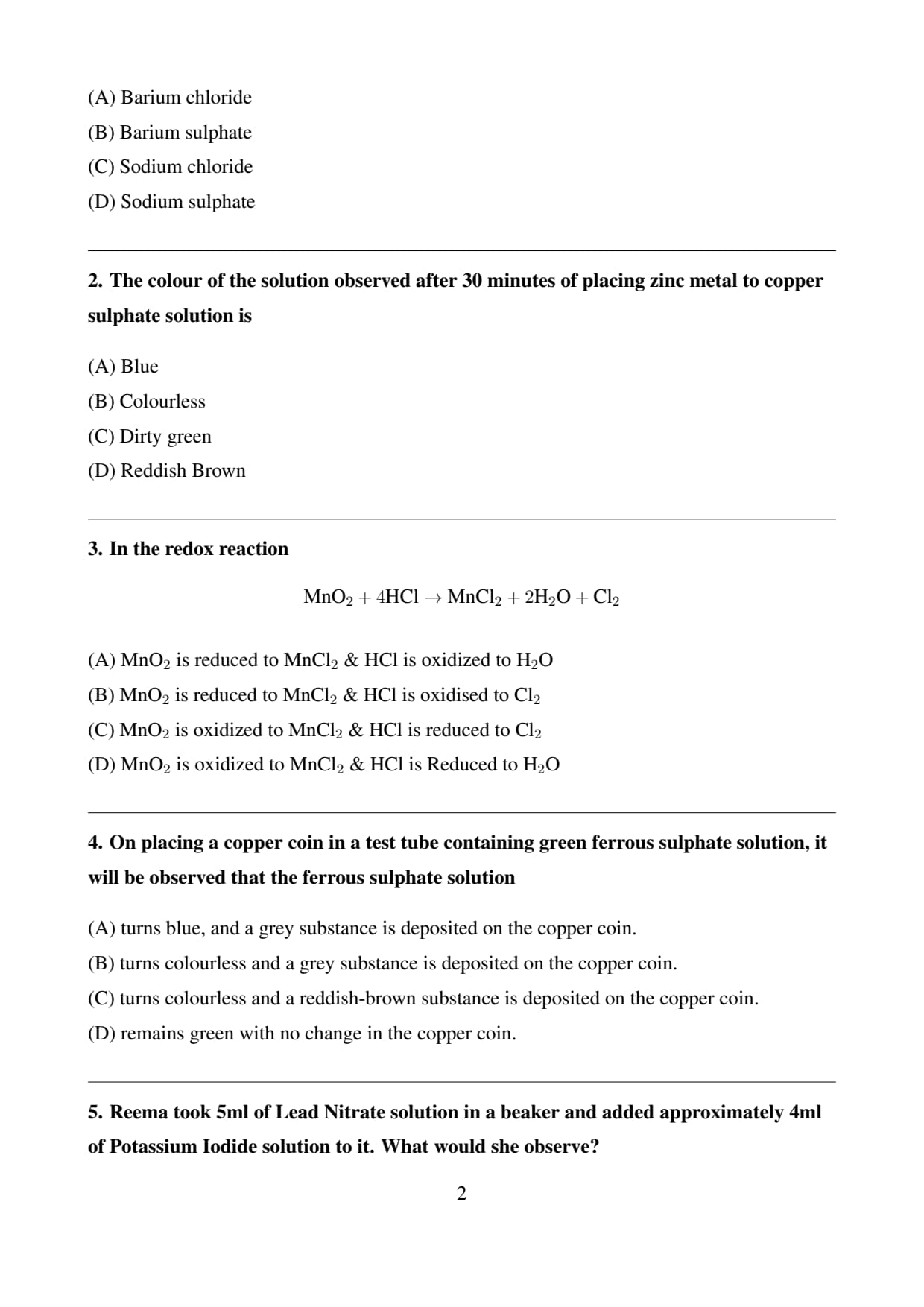
The colour of the solution observed after 30 minutes of placing zinc metal to copper sulphate solution is
View Solution
We are given a reaction where zinc metal is placed in copper sulphate solution and asked to identify the colour of the solution after 30 minutes.
Step 1: Understand the reaction.
Zinc is more reactive than copper according to the reactivity series. When zinc metal is placed in copper sulphate (CuSO\(_4\)) solution, a displacement reaction occurs: \[ Zn(s) + CuSO_4(aq) \rightarrow ZnSO_4(aq) + Cu(s) \]
Step 2: Analyze the colour changes.
Copper sulphate solution (CuSO\(_4\)) is blue in colour due to the presence of Cu\(^{2+}\) ions.
As the reaction proceeds, zinc displaces copper from copper sulphate, forming zinc sulphate (ZnSO\(_4\)) and metallic copper.
Zinc sulphate solution (ZnSO\(_4\)) is colourless.
Metallic copper (Cu) is reddish-brown and may deposit on the zinc metal or settle at the bottom.
Step 3: Observe after 30 minutes.
After 30 minutes, sufficient time has passed for the reaction to occur significantly. The blue colour of the copper sulphate solution fades as Cu\(^{2+}\) ions are removed from the solution and replaced by colourless Zn\(^{2+}\) ions. The solution becomes colourless, while a reddish-brown deposit of copper metal appears on the zinc strip.
Final Answer: Colourless Quick Tip: In displacement reactions, a more reactive metal displaces a less reactive metal from its salt solution. Remember the reactivity series: Potassium > Sodium > Calcium > Magnesium > Aluminium > Zinc > Iron > Tin > Lead > (Hydrogen) > Copper > Silver > Gold. Zinc is above copper, so it displaces copper from copper sulphate solution.
In the redox reaction \[ MnO_2 + 4HCl \rightarrow MnCl_2 + 2H_2O + Cl_2 \]
View Solution
We are given the redox reaction: \[ MnO_2 + 4HCl \rightarrow MnCl_2 + 2H_2O + Cl_2 \]
and need to identify the correct oxidation and reduction processes.
Step 1: Assign oxidation states to identify changes.
In MnO\(_2\): Oxygen has oxidation state -2, so Mn has oxidation state +4.
In MnCl\(_2\): Chlorine has oxidation state -1, so Mn has oxidation state +2.
In HCl: Hydrogen is +1, Chlorine is -1.
In Cl\(_2\): Elemental form, oxidation state 0.
In H\(_2\)O: Hydrogen is +1, Oxygen is -2 (no change from HCl).
Step 2: Identify which species is oxidized and which is reduced.
Oxidation is loss of electrons (increase in oxidation state).
Reduction is gain of electrons (decrease in oxidation state).
For Mn: \[ Mn in MnO_2: +4 \rightarrow Mn in MnCl_2: +2 \]
Oxidation state decreases from +4 to +2, so Mn is reduced.
For Cl in HCl: \[ Cl in HCl: -1 \rightarrow Cl in Cl_2: 0 \]
Oxidation state increases from -1 to 0, so Cl is oxidized.
Note: Some Cl atoms in HCl go to form MnCl\(_2\) (oxidation state remains -1, no change), while others go to form Cl\(_2\) (oxidation state changes from -1 to 0, oxidized).
Step 3: Match with the given options.
MnO\(_2\) is reduced to MnCl\(_2\) ✓
HCl is oxidized to Cl\(_2\) (not to H\(_2\)O) ✓
This matches option (B).
Final Answer: (B) MnO\(_2\) is reduced to MnCl\(_2\) \& HCl is oxidised to Cl\(_2\) Quick Tip: In redox reactions, remember OIL RIG: Oxidation Is Loss (of electrons), Reduction Is Gain (of electrons). Alternatively, track oxidation states: An increase in oxidation state means oxidation, a decrease means reduction.
On placing a copper coin in a test tube containing green ferrous sulphate solution, it will be observed that the ferrous sulphate solution
View Solution
We are given a situation where a copper coin is placed in green ferrous sulphate (FeSO\(_4\)) solution and asked to observe the changes.
Step 1: Understand the reactivity series.
The reactivity series of metals from most reactive to least reactive is: \[ K > Na > Ca > Mg > Al > Zn > Fe > Pb > H > Cu > Ag > Au \]
Step 2: Determine if a displacement reaction occurs.
A more reactive metal can displace a less reactive metal from its salt solution.
In this case, copper (Cu) and iron (Fe) are involved.
Iron (Fe) is more reactive than copper (Cu) as per the reactivity series.
Since copper is less reactive than iron, it cannot displace iron from ferrous sulphate solution.
Step 3: Analyze the observation.
No displacement reaction occurs because copper is less reactive than iron.
Ferrous sulphate solution remains green (colour of Fe\(^{2+}\) ions).
The copper coin remains unchanged with no deposit.
Therefore, the ferrous sulphate solution remains green with no change in the copper coin.
Final Answer: (D) remains green with no change in the copper coin. Quick Tip: For a displacement reaction to occur, the metal being added must be MORE reactive than the metal in the salt solution. A less reactive metal cannot displace a more reactive metal from its salt solution.
Reema took 5ml of Lead Nitrate solution in a beaker and added approximately 4ml of Potassium Iodide solution to it. What would she observe?
View Solution
We are given a reaction where Lead Nitrate solution is mixed with Potassium Iodide solution.
Step 1: Write the chemical equation.
When lead nitrate (Pb(NO\(_3\))\(_2\)) reacts with potassium iodide (KI), a double displacement reaction occurs: \[ Pb(NO_3)_2(aq) + 2KI(aq) \rightarrow PbI_2(s) + 2KNO_3(aq) \]
Step 2: Identify the product and its properties.
Lead iodide (PbI\(_2\)) is formed as a precipitate.
Lead iodide is insoluble in water and has a characteristic bright yellow colour.
Potassium nitrate (KNO\(_3\)) remains in solution and is colourless.
Step 3: Determine the observation.
Upon mixing, a bright yellow precipitate of lead iodide is immediately formed. This is a classic example of a precipitation reaction used to test for lead ions or iodide ions.
Final Answer: (B) Yellow precipitate was formed. Quick Tip: Lead iodide (PbI\(_2\)) is a bright yellow precipitate. This reaction between lead nitrate and potassium iodide is a confirmatory test for lead ions (Pb\(^{2+}\)) or iodide ions (I\(^-\)). Remember: "Golden rain" experiment!
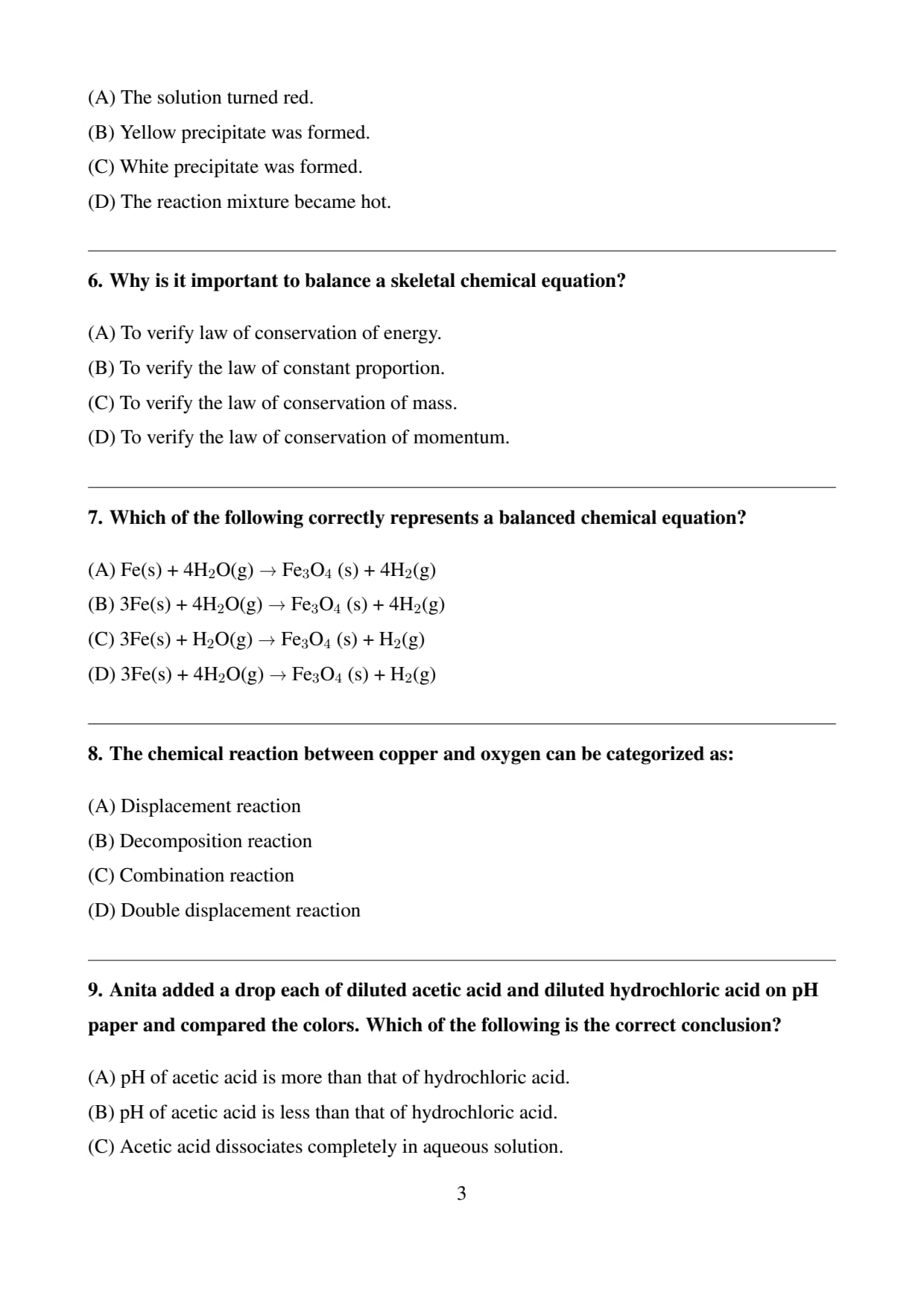
Why is it important to balance a skeletal chemical equation?
View Solution
We are asked why it is important to balance a skeletal chemical equation.
Step 1: Understand what a skeletal chemical equation is.
A skeletal chemical equation is an unbalanced equation that only shows the chemical formulas of reactants and products without indicating their quantities. For example: \[ H_2 + O_2 \rightarrow H_2O \]
Step 2: Recall the law of conservation of mass.
The law of conservation of mass states that mass can neither be created nor destroyed in a chemical reaction. This means the total mass of reactants must equal the total mass of products.
Step 3: Relate balancing to the law of conservation of mass.
In a chemical reaction, atoms are neither created nor destroyed; they are simply rearranged.
Therefore, the number of atoms of each element must be the same on both sides of the equation.
Balancing a chemical equation ensures that the number of atoms of each element is equal on both sides.
This satisfies the law of conservation of mass.
Step 4: Eliminate incorrect options.
(A) Law of conservation of energy: Balancing equations deals with atoms/mass, not energy.
(B) Law of constant proportion: This law states that a chemical compound always contains the same elements in the same proportion by mass. This is about composition of compounds, not about balancing equations.
(D) Law of conservation of momentum: This is a physics law related to motion, not relevant to chemical equations.
Therefore, balancing a skeletal chemical equation is important to verify the law of conservation of mass.
Final Answer: (C) To verify the law of conservation of mass. Quick Tip: The law of conservation of mass is the fundamental reason for balancing chemical equations. Remember: "Atoms are neither created nor destroyed in a chemical reaction." Always ensure the number of atoms of each element is equal on both sides!
Which of the following correctly represents a balanced chemical equation?
View Solution
We are given four options and need to identify which one correctly represents a balanced chemical equation.
Step 1: Understand what a balanced chemical equation means.
A balanced chemical equation has the same number of atoms of each element on both the reactant and product sides. This follows the law of conservation of mass.
Step 2: Check each option by counting atoms.
Option (A): Fe(s) + 4H\(_2\)O(g) → Fe\(_3\)O\(_4\)(s) + 4H\(_2\)(g)
\begin{tabular{|l|c|c|
\hline
Element & Reactants & Products
\hline
Fe & 1 & 3
H & 8 (4H\(_2\)O × 2H) & 8 (4H\(_2\) × 2H)
O & 4 (4H\(_2\)O × 1O) & 4 (Fe\(_3\)O\(_4\))
\hline
\end{tabular
Iron atoms are not balanced (1 ≠ 3). Hence, not balanced.
Option (B): 3Fe(s) + 4H\(_2\)O(g) → Fe\(_3\)O\(_4\)(s) + 4H\(_2\)(g)
\begin{tabular{|l|c|c|
\hline
Element & Reactants & Products
\hline
Fe & 3 & 3
H & 8 (4H\(_2\)O × 2H) & 8 (4H\(_2\) × 2H)
O & 4 (4H\(_2\)O × 1O) & 4 (Fe\(_3\)O\(_4\))
\hline
\end{tabular
All atoms are balanced. Hence, this is balanced.
Option (C): 3Fe(s) + H\(_2\)O(g) → Fe\(_3\)O\(_4\)(s) + H\(_2\)(g)
\begin{tabular{|l|c|c|
\hline
Element & Reactants & Products
\hline
Fe & 3 & 3
H & 2 (H\(_2\)O × 2H) & 2 (H\(_2\) × 2H)
O & 1 (H\(_2\)O × 1O) & 4 (Fe\(_3\)O\(_4\))
\hline
\end{tabular
Oxygen atoms are not balanced (1 ≠ 4). Hence, not balanced.
Option (D): 3Fe(s) + 4H\(_2\)O(g) → Fe\(_3\)O\(_4\)(s) + H\(_2\)(g)
\begin{tabular{|l|c|c|
\hline
Element & Reactants & Products
\hline
Fe & 3 & 3
H & 8 (4H\(_2\)O × 2H) & 2 (H\(_2\) × 2H)
O & 4 (4H\(_2\)O × 1O) & 4 (Fe\(_3\)O\(_4\))
\hline
\end{tabular
Hydrogen atoms are not balanced (8 ≠ 2). Hence, not balanced.
Step 3: Conclusion.
Only option (B) has the same number of atoms of each element on both sides of the equation.
Final Answer: (B) 3Fe(s) + 4H\(_2\)O(g) → Fe\(_3\)O\(_4\) (s) + 4H\(_2\)(g) Quick Tip: To check if a chemical equation is balanced, count the number of atoms of each element on both sides. They must be equal. Start with the most complex molecule (like Fe\(_3\)O\(_4\)) and work backwards.
The chemical reaction between copper and oxygen can be categorized as:
View Solution
We are asked to categorize the chemical reaction between copper and oxygen.
Step 1: Write the chemical equation for the reaction between copper and oxygen.
When copper reacts with oxygen, it forms copper oxide. Depending on the conditions, it can form either copper(I) oxide or copper(II) oxide: \[ 2Cu + O_2 \rightarrow 2CuO \quad (Copper(II) oxide) \]
or \[ 4Cu + O_2 \rightarrow 2Cu_2O \quad (Copper(I) oxide) \]
Step 2: Understand the types of chemical reactions.
Displacement reaction: A more reactive element displaces a less reactive element from its compound. Example: \( Zn + CuSO_4 \rightarrow ZnSO_4 + Cu \)
Decomposition reaction: A single compound breaks down into two or more simpler substances. Example: \( 2H_2O \rightarrow 2H_2 + O_2 \)
Combination reaction: Two or more reactants combine to form a single product. Example: \( 2Mg + O_2 \rightarrow 2MgO \)
Double displacement reaction: Two compounds exchange ions to form two new compounds. Example: \( AgNO_3 + NaCl \rightarrow AgCl + NaNO_3 \)
Step 3: Identify the type of reaction.
In the reaction between copper and oxygen: \[ Copper + Oxygen \rightarrow Copper oxide \]
Two reactants (copper and oxygen) combine to form a single product (copper oxide). This fits the definition of a combination reaction.
Step 4: Eliminate incorrect options.
(A) Displacement reaction: No element is being displaced from a compound.
(B) Decomposition reaction: The reaction involves two reactants forming one product, not one reactant breaking down.
(D) Double displacement reaction: There is no exchange of ions between two compounds.
Final Answer: (C) Combination reaction Quick Tip: Combination reactions are also called synthesis reactions. They generally have the form: A + B → AB. Remember: When a metal reacts with oxygen, it always forms a metal oxide, which is a combination reaction.
Anita added a drop each of diluted acetic acid and diluted hydrochloric acid on pH paper and compared the colors. Which of the following is the correct conclusion?
View Solution
We are given that Anita tested diluted acetic acid and diluted hydrochloric acid on pH paper and compared the colors. We need to identify the correct conclusion.
Step 1: Understand the nature of the two acids.
Hydrochloric acid (HCl): This is a strong acid. Strong acids dissociate completely in aqueous solution:
\[ HCl \rightarrow H^+ + Cl^- \]
Acetic acid (CH\(_3\)COOH): This is a weak acid. Weak acids dissociate only partially in aqueous solution:
\[ CH_3COOH \rightleftharpoons CH_3COO^- + H^+ \]
Step 2: Relate dissociation to pH.
pH is a measure of hydrogen ion concentration: \[ pH = -\log[H^+] \]
For the same concentration (both are diluted), a strong acid like HCl will produce more H\(^+\) ions because it dissociates completely.
A weak acid like acetic acid will produce fewer H\(^+\) ions because it dissociates only partially.
Higher [H\(^+\)] means lower pH. Lower [H\(^+\)] means higher pH.
Therefore, for the same concentration, HCl will have a lower pH (more acidic) and acetic acid will have a higher pH (less acidic).
Step 3: Analyze the given options.
(A) pH of acetic acid is more than that of hydrochloric acid. ✓ This is correct because acetic acid is weaker, so its pH is higher.
(B) pH of acetic acid is less than that of hydrochloric acid. ✗ This would mean acetic acid is stronger, which is false.
(C) Acetic acid dissociates completely in aqueous solution. ✗ This is false; acetic acid is a weak acid and dissociates only partially.
(D) Acetic acid is a strong acid. ✗ This is false; acetic acid is a classic example of a weak acid.
Final Answer: (A) pH of acetic acid is more than that of hydrochloric acid. Quick Tip: Strong acids dissociate completely and have lower pH (more acidic) than weak acids of the same concentration. Weak acids have higher pH because they produce fewer H\(^+\) ions. Remember: pH scale: 0-6 (acidic), 7 (neutral), 8-14 (basic). Lower pH = stronger acid.
An element ‘M’ has 50% of the electrons filled in the 3\(^rd\) shell as in the 2nd shell.
The atomic number of ‘M’ is:
View Solution
We are given that an element 'M' has 50% of the electrons filled in the 3rd shell as in the 2nd shell. We need to find its atomic number.
Step 1: Understand electron shell filling order.
Electrons fill shells in the order: 1st shell (K), 2nd shell (L), 3rd shell (M), and so on. The maximum capacity of each shell is given by \(2n^2\):
1st shell (\(n=1\)): Maximum \(2(1)^2 = 2\) electrons
2nd shell (\(n=2\)): Maximum \(2(2)^2 = 8\) electrons
3rd shell (\(n=3\)): Maximum \(2(3)^2 = 18\) electrons
However, electrons fill according to the Aufbau principle, so the 3rd shell starts filling only after the 2nd shell is completely filled.
Step 2: Interpret the given condition.
The condition states: "50% of the electrons filled in the 3rd shell as in the 2nd shell."
Let \(x\) = number of electrons in the 2nd shell
Let \(y\) = number of electrons in the 3rd shell
According to the condition: \[ y = 50% of x = \frac{x}{2} \]
Step 3: Determine possible electron configurations.
The 2nd shell can hold a maximum of 8 electrons. The 3rd shell starts filling only after the 2nd shell is complete.
Case 1: If the 2nd shell is completely filled (\(x = 8\)), then: \[ y = \frac{8}{2} = 4 electrons in the 3rd shell \]
Electron configuration:
1st shell: 2 electrons
2nd shell: 8 electrons
3rd shell: 4 electrons
Total electrons = \(2 + 8 + 4 = 14\)
Case 2: If the 2nd shell is not completely filled (\(x < 8\)), then the 3rd shell wouldn't start filling yet according to the Aufbau principle. So this case is not possible.
Step 4: Verify with the given options.
Atomic number 14 corresponds to Silicon (Si) with electron configuration: \(1s^2 2s^2 2p^6 3s^2 3p^2\)
2nd shell (L shell): \(2s^2 2p^6\) = 8 electrons
3rd shell (M shell): \(3s^2 3p^2\) = 4 electrons
4 is exactly 50% of 8. ✓
Check other options:
(A) 10 (Neon): Electron configuration \(1s^2 2s^2 2p^6\) - 3rd shell has 0 electrons, not 50% of 8.
(B) 12 (Magnesium): \(1s^2 2s^2 2p^6 3s^2\) - 2nd shell = 8, 3rd shell = 2. 2 is 25% of 8, not 50%.
(D) 18 (Argon): \(1s^2 2s^2 2p^6 3s^2 3p^6\) - 2nd shell = 8, 3rd shell = 8. 8 is 100% of 8, not 50%.
Final Answer: (C) 14 Quick Tip: Remember the electron shell filling order: 1st shell (2 electrons), 2nd shell (8 electrons), 3rd shell (18 electrons maximum but fills progressively). For elements with atomic numbers 11-18, the 3rd shell fills from 1 to 8 electrons after the 2nd shell is complete.
Generally food is broken and absorbed within the body of organisms. In which of the following organisms is it done outside the body?
View Solution
We are asked to identify which organism breaks down and absorbs food outside its body.
Step 1: Understand the two types of digestion.
Internal digestion: Food is taken inside the body and then broken down and absorbed. This is common in most animals.
External digestion: Organisms secrete digestive enzymes onto food to break it down outside their body, and then absorb the nutrients. This is common in fungi and some other organisms.
Step 2: Analyze each option.
(A) Amoeba: Amoeba is a protozoan that engulfs food through phagocytosis, forming a food vacuole. Digestion occurs inside the food vacuole within the body. So, digestion is internal.
(B) Mushroom: Mushroom is a fungus. Fungi secrete digestive enzymes onto organic matter, breaking it down externally, and then absorb the nutrients through their hyphae. So, digestion is external.
(C) Paramoecium: Paramoecium is a protozoan that has a definite oral groove. Food is ingested through the oral groove, and digestion occurs inside food vacuoles within the body. So, digestion is internal.
(D) Lice: Lice are insects (arthropods). They have a complete digestive system. They ingest food (blood or skin debris) and digest it internally. So, digestion is internal.
Step 3: Conclusion.
Only mushrooms (and fungi in general) perform external digestion by secreting enzymes onto food and then absorbing the broken-down nutrients.
Final Answer: (B) Mushroom Quick Tip: Fungi (like mushrooms, bread mold, yeast) are saprophytes. They secrete digestive enzymes onto dead and decaying organic matter and absorb the nutrients. This is called extracellular or external digestion. Most animals and protozoa perform internal digestion.
Opening and closing of stomatal pore depends on:
View Solution
We are asked to identify what the opening and closing of the stomatal pore depends on.
Step 1: Understand the structure of stomata.
Stomata are tiny pores present on the surface of leaves. Each stoma is surrounded by two specialized kidney-shaped cells called guard cells. These guard cells contain chloroplasts and have thick inner walls and thin outer walls.
Step 2: Mechanism of opening and closing of stomata.
The opening and closing of stomata is regulated by the turgor pressure (water content) in the guard cells:
When water enters guard cells: The guard cells become turgid (swell up). Due to their thick inner walls and thin outer walls, they curve outward, causing the stomatal pore to open.
When water leaves guard cells: The guard cells become flaccid (shrink) and come closer together, causing the stomatal pore to close.
Step 3: What causes water movement in guard cells?
The movement of water into and out of guard cells is controlled by:
Ion uptake (especially K\(^+\) ions) which changes osmotic pressure
Sugar concentration changes due to photosynthesis
These factors ultimately affect the water content in guard cells
Step 4: Analyze the given options.
(A) Atmospheric temperature: Temperature can influence transpiration rate and indirectly affect stomatal opening, but it is not the direct cause.
(B) Oxygen concentration around stomata: Oxygen concentration does not directly control stomatal movement.
(C) Carbon dioxide concentration around stomata: Low CO\(_2\) concentration inside the leaf (due to photosynthesis) triggers stomatal opening, but this works by affecting guard cell turgor. The direct mechanism still depends on water content.
(D) Water content in the guard cells: This is the direct factor that determines whether stomata open or close. Turgid guard cells = open pore; flaccid guard cells = closed pore.
Final Answer: (D) water content in the guard cells Quick Tip: Remember: Stomatal opening and closing is a turgor-mediated process. When guard cells take up water, they become turgid and the pore opens. When they lose water, they become flaccid and the pore closes. Factors like light, CO\(_2\) concentration, and potassium ion uptake influence this water movement.
Given below are the functions of some parts of human circulatory system. Identify the correct match.
View Solution
We are given four statements about parts of the human circulatory system and need to identify the correct match.
Step 1: Recall the functions of blood vessels in human circulatory system.
Pulmonary vein: Brings oxygenated blood from the lungs to the left atrium of the heart.
Artery: Generally carries blood away from the heart. Most arteries carry oxygenated blood, but pulmonary artery carries deoxygenated blood from heart to lungs.
Aorta (including dorsal aorta): Carries oxygenated blood from the left ventricle to all body parts.
Vena cava: Carries deoxygenated blood from body parts to the right atrium of the heart.
Step 2: Analyze each option.
(A) Pulmonary vein - takes oxygenated blood from body parts to heart:
Incorrect. Pulmonary vein brings blood from lungs (not body parts) to heart.
(B) Artery - takes oxygenated blood from heart to lung:
Incorrect. The vessel that takes blood from heart to lungs is the pulmonary artery, which carries deoxygenated blood. Not all arteries carry oxygenated blood.
(C) Dorsal aorta - takes deoxygenated blood from heart to body parts:
Incorrect. Dorsal aorta carries oxygenated blood (not deoxygenated) to body parts.
(D) Vena cava - takes deoxygenated blood from body parts to right atrium:
Correct. Vena cava (superior and inferior) collects deoxygenated blood from all body parts and delivers it to the right atrium.
Final Answer: (D) Vena cava - takes deoxygenated blood from body parts to right atrium Quick Tip: Remember the exceptions: Pulmonary vein is the only vein carrying oxygenated blood. Pulmonary artery is the only artery carrying deoxygenated blood. Veins generally carry blood toward the heart; arteries carry blood away from the heart.
What happens when right and left ventricle contract during pumping of blood by human heart?
View Solution
We are asked what happens when the right and left ventricles contract during the cardiac cycle.
Step 1: Understand the cardiac cycle and ventricular systole.
The cardiac cycle consists of:
Atrial systole: Atria contract, pushing blood into ventricles.
Ventricular systole: Ventricles contract, pushing blood out of the heart.
Diastole: Relaxation phase.
Step 2: Trace the blood flow during ventricular contraction.
When the ventricles contract (ventricular systole):
Right ventricle contracts and pumps deoxygenated blood through the pulmonary artery to the lungs for oxygenation.
Left ventricle contracts and pumps oxygenated blood through the aorta to all body parts (various organs).
Both ventricles contract simultaneously, sending blood to lungs and body at the same time.
Step 3: Analyze the given options.
(A) Blood transferred to the right ventricle and left ventricle simultaneously:
Incorrect. During ventricular contraction, blood is pumped out of ventricles, not into them. Blood enters ventricles during relaxation phase.
(B) Blood is transferred to lungs for oxygenation and is pumped into various organs simultaneously:
Correct. Right ventricle sends blood to lungs, left ventricle sends blood to body organs, both at the same time.
(C) Blood transferred to the right atrium and left atrium simultaneously:
Incorrect. Blood flows from atria to ventricles, not the reverse. Valves prevent backflow into atria during ventricular contraction.
(D) Blood is received from lungs after oxygenation and is received from various organs of the body:
Incorrect. This describes what happens during relaxation/diastole when blood enters the heart, not during ventricular contraction.
Final Answer: (B) Blood is transferred to lungs for oxygenation and is pumped into various organs simultaneously. Quick Tip: Remember: Ventricular systole (contraction) = pumping phase. Right ventricle pumps deoxygenated blood to lungs; left ventricle pumps oxygenated blood to body. Both happen simultaneously! Atrial systole fills the ventricles, and diastole is the relaxation/filling phase.
This experimental set up is used to prove essentiality of which of the following requirements of photosynthesis?
View Solution
We are asked to identify which requirement of photosynthesis is being proved essential by the experimental setup shown.
Step 1: Recall the requirements for photosynthesis.
Photosynthesis requires:
Sunlight (energy source)
Chlorophyll (pigment to trap sunlight)
Carbon dioxide (raw material)
Water (raw material)
Step 2: Understand the common experiment to prove CO\(_2\) is essential.
A typical experiment to prove that carbon dioxide is essential for photosynthesis involves:
A plant (often a destarched potted plant) is kept in a setup with a bell jar.
A beaker containing potassium hydroxide (KOH) solution is placed inside the bell jar.
KOH absorbs carbon dioxide from the air inside the bell jar.
A control setup is kept without KOH (or with water instead of KOH).
Both setups are exposed to sunlight for a few hours.
A leaf from each plant is tested for starch using iodine solution.
Step 3: Analyze the result.
The plant in the setup with KOH (no CO\(_2\)) will not perform photosynthesis and will show no starch (no blue-black color with iodine).
The plant in the setup without KOH (CO\(_2\) present) will perform photosynthesis and will show starch (blue-black color with iodine).
This proves that carbon dioxide is essential for photosynthesis.
Step 4: Match with the given options.
Since KOH is mentioned (in question 77), this setup is clearly the experiment to prove carbon dioxide is essential.
Final Answer: (C) Carbon dioxide Quick Tip: In photosynthesis experiments, KOH is used to absorb CO\(_2\). If the setup contains KOH, the experiment is likely testing the essentiality of carbon dioxide. Remember: No CO\(_2\) = No photosynthesis = No starch formation.
The function of KOH is to absorb
View Solution
We are asked about the function of KOH (potassium hydroxide) in experimental setups.
Step 1: Recall the chemical property of KOH.
Potassium hydroxide (KOH) is a strong base. It readily reacts with carbon dioxide (CO\(_2\)) to form potassium carbonate and water: \[ 2KOH + CO_2 \rightarrow K_2CO_3 + H_2O \]
Step 2: Understand its use in photosynthesis experiments.
In experiments related to photosynthesis, KOH is placed in the setup to absorb carbon dioxide from the surrounding air. This creates a CO\(_2\)-free environment to test whether carbon dioxide is essential for photosynthesis.
Step 3: Analyze the given options.
(A) Oxygen: KOH does not absorb oxygen. Oxygen is not reactive with KOH under normal conditions.
(B) Carbon dioxide: ✓ Correct. KOH readily absorbs CO\(_2\) by chemical reaction.
(C) Moisture: KOH is hygroscopic (absorbs moisture from air), but in photosynthesis experiments, its primary function is to absorb CO\(_2\), not moisture. Some drying agents like calcium chloride are used for moisture absorption.
(D) Sunlight: KOH cannot absorb sunlight; it's a chemical substance, not a physical filter.
Step 4: Conclusion.
In the context of photosynthesis experiments, KOH is specifically used to absorb carbon dioxide.
Final Answer: (B) Carbon dioxide. Quick Tip: KOH (potassium hydroxide) and NaOH (sodium hydroxide) are both used to absorb CO\(_2\) in experiments. They react with CO\(_2\) to form carbonates. Remember: KOH + CO\(_2\) → K\(_2\)CO\(_3\) + H\(_2\)O
Rays from Sun converge at a point 15 cm in front of a concave mirror.
Where should an object be placed so that size of its image is equal to the
size of the object?
View Solution
We are given that rays from the Sun converge at a point 15 cm in front of a concave mirror. We need to find where to place an object so that the image size equals the object size.
Step 1: Determine the focal length of the mirror.
The Sun is at infinity, so rays coming from the Sun are parallel rays. For a concave mirror, parallel rays converge at the focus (F).
Given that these rays converge at a point 15 cm in front of the mirror, this point is the focus. Therefore: \[ f = 15 cm \]
Step 2: Recall the condition for same image size.
For a concave mirror, the image size equals the object size when the object is placed at the center of curvature (C).
The center of curvature is at a distance of twice the focal length: \[ R = 2f = 2 \times 15 = 30 cm \]
Step 3: Image characteristics when object is at C.
When an object is placed at the center of curvature (C) of a concave mirror:
Image is formed at the same point (C)
Image is real and inverted
Image size is equal to object size
Step 4: Verify with mirror formula.
Mirror formula: \(\frac{1}{f} = \frac{1}{u} + \frac{1}{v}\)
Magnification: \(m = -\frac{v}{u}\)
For object at \(u = -30\) cm (using sign convention: u is negative for object in front of mirror): \[ \frac{1}{-15} = \frac{1}{-30} + \frac{1}{v} \] \[ -\frac{1}{15} = -\frac{1}{30} + \frac{1}{v} \] \[ \frac{1}{v} = -\frac{1}{15} + \frac{1}{30} = -\frac{2}{30} + \frac{1}{30} = -\frac{1}{30} \] \[ v = -30 cm \]
Magnification: \[ m = -\frac{v}{u} = -\frac{(-30)}{(-30)} = -\frac{30}{30} = -1 \]
Magnitude of m is 1, so image size equals object size.
Final Answer: (A) 30 cm in front of the mirror Quick Tip: For a concave mirror: At focus (f): Image at infinity (highly magnified) At center of curvature (2f): Image at center, same size Beyond center: Diminished image Between pole and focus: Virtual, enlarged image Remember: Same size image occurs when object is at 2f (center of curvature)!
Nalin draws a ray diagram for an object in front of a concave mirror. She draws a ray starting from the top of the object and falling on the mirror perpendicularly.
The ray after reflection will
View Solution
We are asked about the path of a ray that starts from the top of an object and falls perpendicularly on a concave mirror.
Step 1: Understand what "falling on the mirror perpendicularly" means.
A ray falling perpendicularly on a mirror means it strikes the mirror along the normal to the mirror surface at that point.
Step 2: Recall the law of reflection.
The law of reflection states that the angle of incidence equals the angle of reflection. For a ray incident along the normal, the angle of incidence is 0°, so it reflects back along the same path (angle of reflection also 0°).
Step 3: Apply this to a concave mirror.
For a spherical mirror, the normal at any point on the mirror passes through the centre of curvature (C). This is because the radius of a sphere is perpendicular to the tangent at any point, and the centre of curvature is the centre of the sphere.
Therefore:
A ray incident perpendicularly on a concave mirror strikes along the radius.
Since it's along the normal, it reflects back along the same path.
That path passes through the centre of curvature (C).
Step 4: Analyze the given options.
(A) pass through focus: No, only rays parallel to principal axis pass through focus after reflection.
(B) pass through pole: No, the pole is on the principal axis, but a perpendicular ray at another point won't pass through pole.
(C) pass through the centre of curvature: ✓ Correct. A ray incident perpendicularly (along the radius) reflects back through the centre of curvature.
(D) pass through any point on the principal axis: No, it specifically passes through centre of curvature.
Final Answer: (C) pass through the centre of curvature. Quick Tip: For spherical mirrors, remember these special rays: Ray parallel to principal axis → passes through focus Ray through focus → becomes parallel to principal axis Ray through centre of curvature → reflects back along itself (perpendicular incidence) Ray to pole → reflects with equal angle A ray perpendicular to the mirror is along the radius and passes through C.
If the refractive index of water with respect to air is 1.33 and of that of glass with respect to air is 1.5 then
View Solution
We are given refractive indices with respect to air:
Refractive index of water w.r.t. air: \( _a n_w = 1.33 \)
Refractive index of glass w.r.t. air: \( _a n_g = 1.5 \)
We need to compare the optical densities of these media.
Step 1: Understand refractive index and optical density.
The refractive index of a medium with respect to air indicates how much slower light travels in that medium compared to air. A higher refractive index means:
Light travels slower in that medium
The medium is optically denser
Step 2: Compare the given refractive indices.
\[ _a n_g = 1.5 > _a n_w = 1.33 \]
Since both are with respect to the same reference medium (air), we can directly compare:
Glass has a higher refractive index (1.5) than water (1.33)
Therefore, glass is optically denser than water
Step 3: Analyze the given options.
(A) water is optically denser than glass:
Incorrect. 1.33 < 1.5, so water is optically rarer than glass.
(B) air is optically densest of all the three media:
Incorrect. Refractive index of air with respect to air is 1, which is less than both 1.33 and 1.5. So air is optically rarer than both water and glass.
(C) air’s optical density is between glass and air:
Incorrect and poorly worded. Air's refractive index is 1, which is less than both, so it is not between them.
(D) glass is optically denser than water:
✓ Correct. 1.5 > 1.33, so glass is optically denser than water.
Final Answer: (D) glass is optically denser than water. Quick Tip: Higher refractive index means optically denser medium. If \( _a n_m > _a n_n \), then medium m is optically denser than medium n. Remember: Refractive index of air is 1, so any medium with n > 1 is denser than air.
Chlorine gas was prepared using electrolysis of brine solution. Write the chemical equation to represent the change. Identify the other products formed in the process and give one application of each.
View Solution
When brine (concentrated sodium chloride solution) is electrolyzed, chlorine gas is produced at the anode. The chemical equation for this process is:
\[ 2NaCl(aq) + 2H_2O(l) \xrightarrow{electrolysis} 2NaOH(aq) + Cl_2(g) + H_2(g) \]
This reaction represents the chlor-alkali process. The other products formed are:
[0.3cm]
1. Sodium hydroxide (NaOH)
\quad Application: Used in the manufacture of soaps and detergents.
[0.2cm]
2. Hydrogen gas (H\(_2\))
\quad Application: Used as a fuel in hydrogen fuel cells or in the manufacture of ammonia (Haber process).
[0.2cm]
3. Chlorine gas (Cl\(_2\))
\quad Application: Used for water purification (disinfection) and in the manufacture of PVC (polyvinyl chloride). Quick Tip: In the electrolysis of brine, remember the mnemonic "CH" (Chlorine at anode, Hydrogen at cathode) and NaOH remains in the solution.
Chlorine gas was prepared using electrolysis of brine solution. Write the chemical equation to represent the change. Identify the other products formed in the process and give one application of each.
View Solution
When brine (concentrated sodium chloride solution) is electrolyzed, chlorine gas is produced at the anode. The chemical equation for this process is:
\[ 2NaCl(aq) + 2H_2O(l) \xrightarrow{electrolysis} 2NaOH(aq) + Cl_2(g) + H_2(g) \]
This reaction represents the chlor-alkali process. The other products formed are:
[0.3cm]
1. Sodium hydroxide (NaOH)
\quad Application: Used in the manufacture of soaps and detergents.
[0.2cm]
2. Hydrogen gas (H\(_2\))
\quad Application: Used as a fuel in hydrogen fuel cells or in the manufacture of ammonia (Haber process).
[0.2cm]
3. Chlorine gas (Cl\(_2\))
\quad Application: Used for water purification (disinfection) and in the manufacture of PVC (polyvinyl chloride). Quick Tip: In the electrolysis of brine, remember the mnemonic "CH" (Chlorine at anode, Hydrogen at cathode) and NaOH remains in the solution.
Rehmat classified the reaction between Methane and Chlorine in presence of sunlight as a substitution reaction. Support Rehmat's view with suitable justification and illustrate the reaction with the help of a balanced chemical equation.
View Solution
Rehmat's classification is correct because in this reaction, chlorine atoms substitute (replace) the hydrogen atoms in methane one by one. This is a characteristic feature of substitution reactions where an atom or group is replaced by another atom or group.
[0.3cm]
Justification:
The reaction between methane and chlorine in the presence of sunlight is a free radical substitution reaction. Here, chlorine molecules break into free radicals in the presence of sunlight (photochemical dissociation), which then attack methane molecules, replacing hydrogen atoms with chlorine atoms. This happens stepwise, producing a mixture of products.
[0.3cm]
Balanced Chemical Equation:
[0.3cm]
Step 1: Formation of chloromethane (methyl chloride)
\[ CH_4 + Cl_2 \xrightarrow{Sunlight} CH_3Cl + HCl \]
Step 2: Further substitution can occur, leading to:
\[ CH_3Cl + Cl_2 \xrightarrow{Sunlight} CH_2Cl_2 + HCl \quad (Dichloromethane) \] \[ CH_2Cl_2 + Cl_2 \xrightarrow{Sunlight} CHCl_3 + HCl \quad (Trichloromethane/Chloroform) \] \[ CHCl_3 + Cl_2 \xrightarrow{Sunlight} CCl_4 + HCl \quad (Tetrachloromethane/Carbon tetrachloride) \]
The overall reaction can be represented as a series of substitution steps where hydrogen atoms are progressively replaced by chlorine atoms. Quick Tip: Remember: In substitution reactions, an atom/group is replaced by another atom/group. In free radical substitution, sunlight provides energy for homolytic cleavage of chlorine molecule into free radicals.
A lot of waste is generated in neighborhood. However, almost all of it is biodegradable. What impact will it have on the environment or human health?
View Solution
If most of the waste generated in a neighborhood is biodegradable, it will have both positive and negative impacts on the environment and human health depending on how it is managed.
[0.3cm]
Positive Impacts (if managed properly):
[0.2cm] \(\bullet\) Environmental: Biodegradable waste decomposes naturally through the action of microorganisms, returning nutrients to the soil and improving soil fertility if composted properly.
[0.2cm] \(\bullet\) Human Health: Proper decomposition reduces the risk of harmful chemical pollution compared to non-biodegradable waste.
[0.3cm]
Negative Impacts (if not managed properly):
[0.2cm] \(\bullet\) Environmental:
[-] Decomposition of biodegradable waste produces foul odors due to release of gases like hydrogen sulfide and ammonia.
[-] It generates greenhouse gases like methane and carbon dioxide, contributing to air pollution and global warming.
[-] Leachate from decomposing waste can contaminate soil and groundwater if not properly contained.
[0.2cm] \(\bullet\) Human Health:
[-] Decomposing waste attracts disease-carrying vectors like flies, mosquitoes, rats and cockroaches, which can spread diseases such as dengue, malaria, cholera and plague.
[-] The foul smell can cause respiratory problems, nausea and discomfort to nearby residents.
[-] It creates unhygienic living conditions, promoting the growth of pathogenic microorganisms.
Thus, while biodegradable waste is inherently less harmful than non-biodegradable waste, improper management can still lead to significant environmental pollution and health hazards. Proper segregation, collection and composting are essential to harness its benefits and minimize negative impacts. Quick Tip: Biodegradable waste is nature-friendly only when managed properly. Without proper management, it becomes a breeding ground for disease vectors and a source of greenhouse gases.
Why is damage to the ozone layer a cause for concern? What are its causes and what steps are being taken to limit this damage?
View Solution
[0.3cm]
Why ozone layer damage is a cause for concern:
[0.2cm]
The ozone layer present in the stratosphere acts as a protective shield for life on Earth. It absorbs about 97-99% of the harmful ultraviolet (UV) radiation coming from the sun, specifically UV-B and UV-C rays. Damage to this layer allows more UV radiation to reach the Earth's surface, leading to:
[0.2cm] \(\bullet\) Increased risk of skin cancer (including melanoma) in humans
[0.2cm] \(\bullet\) Higher incidence of cataracts and weakened immune system
[0.2cm] \(\bullet\) Damage to crops and reduced agricultural productivity
[0.2cm] \(\bullet\) Harm to phytoplankton and aquatic life, disrupting marine ecosystems
[0.2cm] \(\bullet\) Premature aging of skin and increased cases of sunburn
[0.3cm]
Causes of ozone layer damage:
[0.2cm]
The primary cause of ozone depletion is the release of certain man-made chemicals, including:
[0.2cm] \(\bullet\) Chlorofluorocarbons (CFCs): Used in refrigerators, air conditioners, aerosol sprays, and foam blowing agents
[0.2cm] \(\bullet\) Halons: Used in fire extinguishers
[0.2cm] \(\bullet\) Carbon tetrachloride and methyl chloroform: Used as solvents
[0.2cm] \(\bullet\) Hydrochlorofluorocarbons (HCFCs): Introduced as temporary substitutes for CFCs but still ozone-depleting
[0.2cm]
These chemicals release chlorine and bromine atoms when broken down by UV radiation in the stratosphere, which then destroy ozone molecules catalytically. A single chlorine atom can destroy thousands of ozone molecules.
[0.3cm]
Steps being taken to limit the damage:
[0.2cm] \(\bullet\) Montreal Protocol (1987): An international treaty signed by many countries to phase out the production and use of ozone-depleting substances. It is considered one of the most successful environmental treaties.
[0.2cm] \(\bullet\) Phase-out of CFCs: Complete ban on CFCs in developed countries and gradual phase-out in developing countries
[0.2cm] \(\bullet\) Development of substitutes: Introduction of environmentally safer alternatives like hydrofluorocarbons (HFCs) which do not deplete the ozone layer (though some are greenhouse gases)
[0.2cm] \(\bullet\) Kigali Amendment (2016): Amendment to the Montreal Protocol to phase down HFCs due to their high global warming potential
[0.2cm] \(\bullet\) Awareness programs: Public education about avoiding products containing ozone-depleting substances
[0.2cm] \(\bullet\) Monitoring: Regular assessment of the ozone layer through satellites and instruments to track recovery
[0.3cm]
Current Status:
Thanks to these efforts, scientific evidence shows that the ozone layer is gradually healing and is expected to recover fully by around 2060-2070. Quick Tip: Remember: Ozone protects us from UV radiation. CFCs are the main culprits of ozone depletion. Montreal Protocol (1987) is the key international agreement to protect the ozone layer.






Comments