




The Assam Board (SEBA) HSLC 2026 English Question Paper is available for download here. The Board of Secondary Education, Assam has conducted the HSLC examinations on February 10, 2026. Students can check subject-wise paper analysis along with memory based question papers here. You can download the Assam Board Class 10 Question Paper with Solution PDF from the links provided
Assam Board HSLC 2026 English Question Paper with Solutions (10 Feb, 2026) – Memory Based

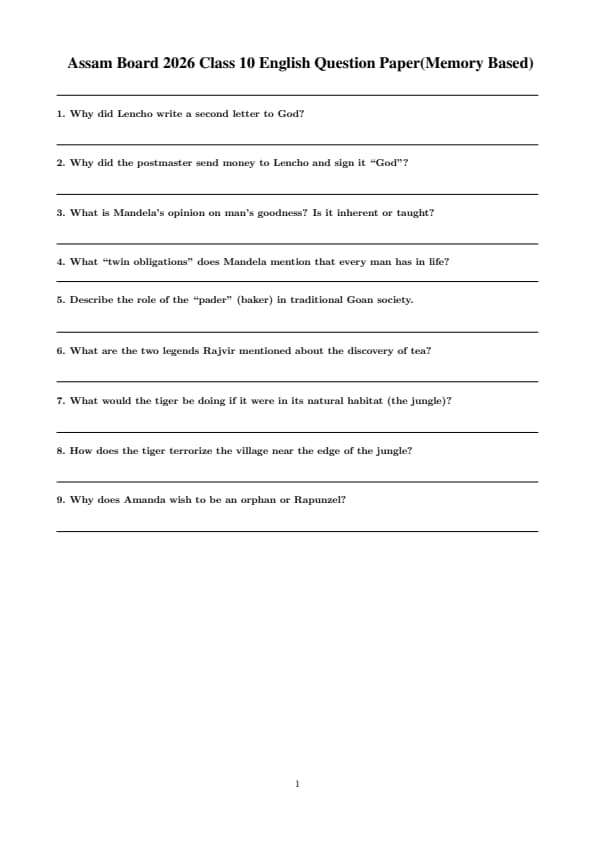
Why did Lencho write a second letter to God?
View Solution
Lencho wrote a second letter to God because he did not receive the full amount of money he had asked for in his first letter. After his crop was destroyed by hail, Lencho had requested one hundred pesos from God. However, when he received only seventy pesos through the post office employees, he believed that the remaining money had been taken by dishonest people.
Lencho had complete faith in God and could not imagine that God would send less money. Therefore, he assumed that the post office officials had stolen the rest. In his second letter, he requested God to send the remaining thirty pesos and warned Him not to send it through the post office again. Quick Tip: Lencho’s letters highlight his blind faith in God. The incident adds irony and humour to the story.
Why did the postmaster send money to Lencho and sign it ``God''?
View Solution
The postmaster sent money to Lencho because he was deeply moved by Lencho’s strong faith in God. He did not want Lencho’s belief to be shaken after reading the letter asking God for help. Although the postmaster knew it was impossible for God to reply directly, he decided to help Lencho himself.
The postmaster collected money from his colleagues and added some of his own savings to send to Lencho. He signed the letter as ``God'' so that Lencho would believe his prayer had been answered and continue to have faith. His action shows kindness, empathy, and generosity. Quick Tip: The postmaster represents humanity and compassion. His action keeps Lencho’s faith alive.
What is Mandela's opinion on man's goodness? Is it inherent or taught?
View Solution
According to Nelson Mandela, man’s goodness is inherent rather than taught. He believes that people are born good, but circumstances, fear, and hatred make them act cruelly. Mandela compares goodness to a flame that can be hidden but never completely extinguished.
He feels that love and compassion come naturally to human beings, while hatred has to be learned. Therefore, with understanding and guidance, people can rediscover their natural goodness and choose peace over violence. Quick Tip: Mandela believes goodness is natural to humans. Hatred is learned; love comes instinctively.
What ``twin obligations'' does Mandela mention that every man has in life?
View Solution
According to Nelson Mandela, every man has two fundamental or “twin obligations” in life. The first obligation is towards his family, including his parents, wife, and children, whom he must love, support, and care for. The second obligation is towards his community, people, and country.
Mandela explains that under the system of apartheid, it was impossible for a black man to fulfil both these obligations fully. If he tried to serve his people and fight injustice, he could not live a normal family life. Thus, these twin obligations often came into conflict. Quick Tip: Twin obligations = duty to family + duty to society. Apartheid made it hard to balance both responsibilities.
Describe the role of the ``pader'' (baker) in traditional Goan society.
View Solution
In traditional Goan society, the pader or baker played a very important role in the daily lives of people. He supplied fresh bread every morning and evening, and his arrival was announced by the jingling sound of his bamboo staff. Bread was an essential part of Goan meals, and no household function was considered complete without it.
The pader also prepared special varieties of bread for festivals, weddings, and other celebrations. He was a familiar and respected figure in the village, often moving from house to house on his bicycle. Thus, the pader was not only a bread-maker but also an integral part of Goan culture and tradition. Quick Tip: The pader symbolises Goan tradition and community life. Bread was central to daily meals and celebrations in Goa.
What are the two legends Rajvir mentioned about the discovery of tea?
View Solution
Rajvir mentions two popular legends related to the discovery of tea. According to the first Chinese legend, a Chinese emperor was boiling water when a few tea leaves accidentally fell into it. The water turned fragrant and refreshing, leading to the discovery of tea.
The second legend comes from India and is associated with a Buddhist monk named Bodhidharma. It is believed that tea plants grew from his eyelids, which he cut off to prevent sleep during meditation. These legends highlight tea’s ancient and mystical origins. Quick Tip: Tea is linked to both Chinese and Indian legends. Rajvir shares these stories during the train journey.
What would the tiger be doing if it were in its natural habitat (the jungle)?
View Solution
If the tiger were in its natural habitat, the jungle, it would be moving freely and confidently through the forest. It would be hunting its prey, showing its strength and agility, and resting under the shade of trees. The tiger would be expressing its natural instincts, ruling its territory, and living a life of freedom and dignity instead of being confined behind bars. Quick Tip: The jungle symbolizes freedom and power for the tiger. Captivity takes away the tiger’s natural pride and strength.
How does the tiger terrorize the village near the edge of the jungle?
View Solution
The tiger terrorizes the village near the edge of the jungle by sneaking out silently at night. It attacks livestock and sometimes even human beings, spreading fear among the villagers. Its powerful presence, sharp claws, and sudden attacks make the people live in constant fear. The tiger’s roar and unseen movements create panic, forcing villagers to remain alert and cautious at all times. Quick Tip: The tiger symbolizes fear and power in the poem. Its actions highlight the danger of wild animals near human settlements.
Why does Amanda wish to be an orphan or Rapunzel?
View Solution
Amanda wishes to be an orphan or Rapunzel because she feels constantly restricted and controlled by her mother. She is repeatedly instructed about her behaviour, habits, and manners, which makes her feel suffocated and unhappy. To escape this continuous nagging, Amanda imagines a life of freedom.
She thinks that an orphan would have no one to scold or supervise her, while Rapunzel, living alone in a tower, would enjoy peace and independence. These fantasies reflect Amanda’s desire for freedom, silence, and a life without constant instructions. Quick Tip: Amanda’s wish shows her longing for freedom. The poem highlights the impact of excessive control on children.
Assam Board HSLC Class 10 English Exam Pattern 2026
| Section | Topics Covered | Marks |
|---|---|---|
| A | Reading Comprehension (Unseen Passage) | 20 |
| B | Grammar and Vocabulary | 15 |
| C | Writing Skills (Letter, Paragraph, Essay, Report) | 20 |
| D | Literature (Prose, Poetry, Supplementary Reader) | 45 |
| Total | — | 100 |



Comments