




Assam Board HSLC 2026 Social Science Question Paper is available for download here. The Board of Secondary Education, Assam (SEBA) is conducting the HSLC examinations from 10th Feb 2026. Students can check subject wise paper analysis along with question papers here. Download the Assam Board Class 10 Question Paper with Solution PDF from the links provided below.
Assam Board HSLC 2026 Social Science Question Paper with Solutions (13 Feb, 2026)
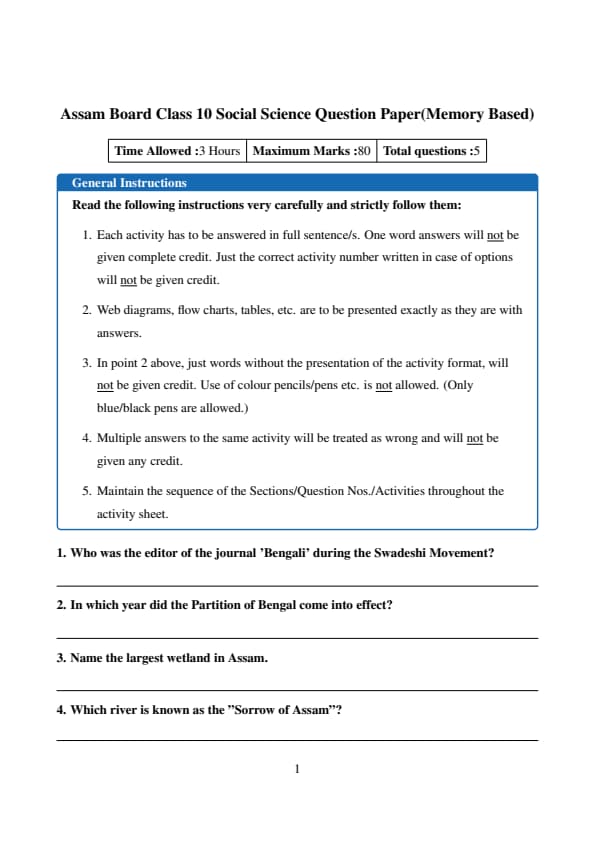
Who was the editor of the journal 'Bengali' during the Swadeshi Movement?
View Solution
Concept:
During the Swadeshi Movement (1905), newspapers and journals played an important role in spreading nationalist ideas and awakening political consciousness among the people. Many prominent leaders used the press as a powerful tool of resistance.
Explanation:
The editor of the journal \textit{'Bengali' during the Swadeshi Movement was Surendranath Banerjee.
Surendranath Banerjee was an important nationalist leader, educator, and political activist of the Indian freedom struggle. Through his journal \textit{'Bengali', he strongly supported the Swadeshi Movement and criticized British policies, especially the partition of Bengal in 1905. The newspaper helped in mobilizing public opinion and spreading nationalist sentiments across Bengal and other parts of India.
Thus, Surendranath Banerjee served as the editor of the journal \textit{'Bengali' during the Swadeshi Movement. Quick Tip: In history questions related to movements, remember the role of newspapers and leaders. The press was a powerful medium for spreading nationalist ideas during the freedom struggle.
In which year did the Partition of Bengal come into effect?
View Solution
Concept:
The Partition of Bengal was a major administrative decision taken by the British Government in India. It aimed at dividing Bengal on the basis of administrative convenience but was widely seen as an attempt to weaken the growing nationalist movement.
Explanation:
The Partition of Bengal came into effect in the year 1905. It was officially implemented on 16th October 1905 by Lord Curzon, the then Viceroy of India.
The decision led to widespread protests and gave rise to the Swadeshi Movement, which encouraged the use of indigenous goods and the boycott of British products. The movement became a significant phase in India’s freedom struggle.
Thus, the Partition of Bengal came into effect in 1905. Quick Tip: While answering history questions, try to remember important dates along with the related events. Dates help in clearly identifying historical milestones.
Name the largest wetland in Assam.
View Solution
Concept:
Wetlands are important ecosystems that support biodiversity, regulate water flow, and maintain ecological balance. Assam, being rich in rivers and floodplains, has several significant wetlands.
Explanation:
The largest wetland in Assam is Deepor Beel.
Deepor Beel is a permanent freshwater lake located to the southwest of Guwahati city. It is recognized as a Ramsar Site due to its ecological importance. The wetland serves as a natural habitat for a wide variety of migratory birds and aquatic species. It also plays a crucial role in flood control and groundwater recharge in the region.
Thus, Deepor Beel is the largest wetland in Assam. Quick Tip: For geography questions, remember important natural features along with their location and ecological importance.
Which river is known as the "Sorrow of Assam"?
View Solution
Concept:
Some rivers are given special titles because of their impact on the regions through which they flow. When a river frequently causes floods and damage, it may be referred to as the “sorrow” of that region.
Explanation:
The river known as the “Sorrow of Assam” is the Brahmaputra River.
The Brahmaputra is one of the major rivers of India and flows through Assam. Although it is a lifeline for agriculture and transportation, it frequently causes severe floods during the monsoon season. These floods lead to large-scale destruction of crops, houses, and infrastructure, causing great suffering to the people of Assam.
Because of these repeated floods and the resulting damage, the Brahmaputra River is called the “Sorrow of Assam.” Quick Tip: When rivers are called the “sorrow” of a region, it usually refers to frequent floods and the destruction caused by them.
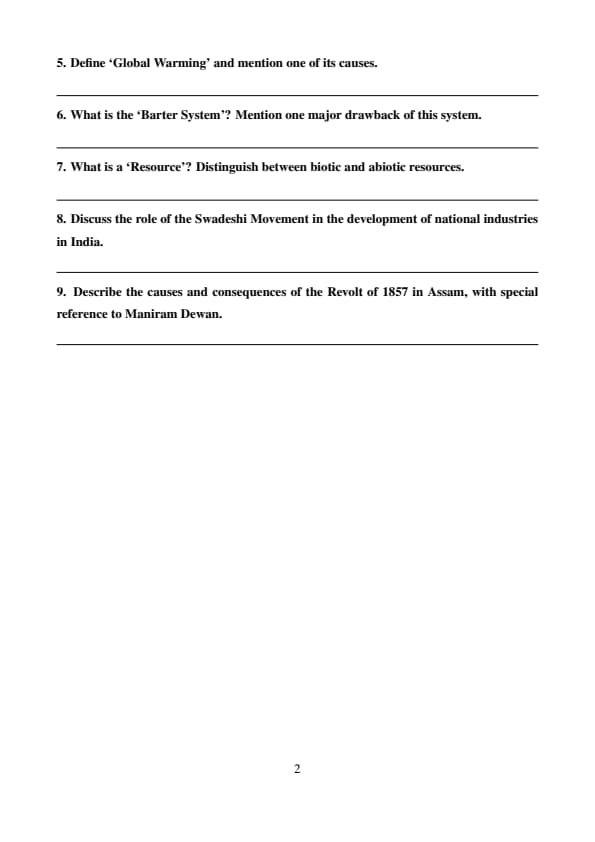
Define ‘Global Warming’ and mention one of its causes.
View Solution
Concept:
Environmental changes occurring due to human activities have led to a gradual rise in the Earth’s temperature. This phenomenon affects climate patterns and ecosystems worldwide.
Explanation:
Global Warming refers to the gradual increase in the average temperature of the Earth’s surface due to the excessive accumulation of greenhouse gases in the atmosphere.
One major cause of global warming is the burning of fossil fuels such as coal, petroleum, and natural gas. The combustion of these fuels releases carbon dioxide (CO\textsubscript{2), a greenhouse gas that traps heat in the atmosphere and leads to a rise in global temperatures.
Thus, global warming is the rise in Earth’s temperature mainly caused by greenhouse gas emissions, especially from the burning of fossil fuels. Quick Tip: For definition-based questions, write a clear and concise definition first, then mention one key cause or example separately.
What is the ‘Barter System’? Mention one major drawback of this system.
View Solution
Concept:
Before the invention of money, people exchanged goods and services directly. This early method of trade is known as the Barter System.
Explanation:
The Barter System is a system of exchange in which goods and services are directly exchanged for other goods and services without the use of money.
For example, a farmer might exchange rice for clothes from a weaver instead of paying money.
One major drawback of the barter system is the lack of double coincidence of wants. This means that both parties must want what the other is offering at the same time. If this condition is not satisfied, exchange becomes difficult.
Thus, the barter system involves direct exchange of goods, but it suffers from the problem of double coincidence of wants. Quick Tip: In economics questions, define the term clearly first and then mention one limitation or example to make the answer complete.
What is a ‘Resource’? Distinguish between biotic and abiotic resources.
View Solution
Concept:
Resources are essential elements of the environment that satisfy human needs and contribute to economic development. They may be living or non-living in nature.
Explanation:
A resource is anything that has utility and can be used to satisfy human needs. It must be technologically accessible, economically feasible, and culturally acceptable.
Difference between Biotic and Abiotic Resources:
Biotic Resources:
These are resources obtained from the biosphere and have life. They include plants, animals, forests, fisheries, and livestock. For example, timber, crops, and wool.
Abiotic Resources:
These are non-living resources derived from the physical environment. They include land, water, air, minerals, and metals such as iron and copper.
Thus, biotic resources are living resources, whereas abiotic resources are non-living resources. Quick Tip: In distinction-type questions, first define the main term, then present differences clearly using points or headings for better clarity.
Discuss the role of the Swadeshi Movement in the development of national industries in India.
View Solution
Concept:
The Swadeshi Movement began in 1905 in response to the Partition of Bengal. It aimed at promoting the use of indigenous goods and boycotting British products. This movement played a crucial role in encouraging the growth of national industries in India.
Explanation:
The Swadeshi Movement significantly contributed to the development of national industries in the following ways:
Promotion of Indigenous Goods:
People were encouraged to boycott foreign goods and use products made in India. This increased the demand for Indian-made textiles, soap, matches, and other goods, thereby boosting local industries.
Establishment of New Industries:
Many small-scale and large-scale industries were set up during this period. Indian entrepreneurs started textile mills, soap factories, match factories, and tanneries to meet the growing demand for Swadeshi goods.
Encouragement to Indian Entrepreneurs:
The movement inspired Indian businessmen to invest in national industries. It strengthened self-reliance and economic nationalism.
Growth of National Education:
National schools and technical institutions were established to promote scientific and industrial education. This helped in developing skilled manpower for Indian industries.
Spread of Economic Nationalism:
The idea that economic independence was essential for political freedom gained popularity. This laid the foundation for future industrial development in India.
Thus, the Swadeshi Movement not only strengthened the freedom struggle but also encouraged the growth of indigenous industries and promoted economic self-reliance in India. Quick Tip: In long-answer history questions, organize the answer into clear points such as causes, effects, and significance to make the response systematic and well-structured.
Describe the causes and consequences of the Revolt of 1857 in Assam, with special reference to Maniram Dewan.
View Solution
Concept:
The Revolt of 1857, also known as the First War of Indian Independence, spread to several parts of India, including Assam. In Assam, the movement had its own regional causes and leaders, among whom Maniram Dewan played a significant role.
Explanation:
Causes of the Revolt in Assam:
Political Causes:
After the British annexed Assam, the Ahom monarchy was abolished. The British policies caused dissatisfaction among the local nobility and people who were loyal to the Ahom royal family.
Economic Exploitation:
Heavy taxation and the introduction of new revenue systems affected peasants and local landholders. Many traditional privileges were withdrawn, leading to resentment.
Discontent among Soldiers:
Indian sepoys serving under the British were influenced by the larger revolt taking place in other parts of India.
Role of Maniram Dewan:
Maniram Dewan, a prominent Assamese nobleman and former official under the British, became dissatisfied with British policies. He supported the restoration of the Ahom monarchy and secretly communicated with rebel leaders to organize resistance in Assam.
Consequences of the Revolt in Assam:
The revolt in Assam was suppressed by the British before it could gain full momentum.
Maniram Dewan was arrested for his involvement in the conspiracy. He was tried and publicly hanged in 1858.
Several other local leaders and supporters were punished severely.
The British strengthened their administrative control over Assam to prevent future uprisings.
Thus, although the Revolt of 1857 in Assam did not succeed, it marked an important chapter in the region’s resistance against British rule. Maniram Dewan is remembered as one of the earliest martyrs of Assam’s freedom struggle. Quick Tip: In history answers with “causes and consequences,” present the response under clear headings. Mention key personalities separately to highlight their importance.



Comments