




The Council for the Indian School Certificate Examinations (CISCE) successfully conducted the ICSE Class 10 Physical Education (Group III – Section A) Exam on March 23, 2026. The ICSE Class 10 Physical Education (Group III – Section A) Question Paper with Solution PDF is now available for download.
The ICSE Class 10 Physical Education (Group III – Section A) paper covered key topics from physical fitness, sports rules, health education, and training methods. Students should focus on understanding fitness components, rules of games, and maintaining a healthy lifestyle. The exam is marked out of 100, with 80 marks for the theory paper and 20 for internal assessment.
ICSE Class 10 Physical Education (Group III – Section A) Question Paper 2026 with Solution PDF
| ICSE Class 10 Physical Education (Group III – Section A) Question Paper 2026 | Download PDF | Check Solution |
Strength, endurance, reaction time and perceptual abilities are minimal in the stage of _________.
View Solution
Concept:
Human development occurs through different stages such as infancy, childhood, adolescence, and adulthood. Each stage is characterized by specific physical, cognitive, and psychological changes.
Infancy (0–2 years): Physical strength, endurance, reaction time, and perceptual abilities are at their lowest because the body and nervous system are still developing.
Childhood: Gradual improvement in motor skills, coordination, and perceptual abilities occurs.
Adolescence: Rapid physical growth and improvement in strength and endurance take place.
Adulthood: These abilities generally reach their peak.
Thus, the stage in which strength, endurance, reaction time, and perceptual abilities are minimal is the infancy stage.
Step 1: Understanding the early developmental stage.
During infancy, the body is still growing and the muscular and nervous systems are not fully developed. As a result, physical abilities such as strength, endurance, reaction time, and perceptual abilities are very low.
Step 2: Comparing with later stages of development.
In childhood and adolescence, these abilities gradually increase due to growth, physical activity, and neurological development. In adulthood, many of these abilities reach their peak level.
Step 3: Conclusion.
Therefore, the stage where these abilities are at their minimum level is infancy. Quick Tip: In human development, physical abilities such as strength, endurance, and reaction time increase gradually from infancy to adulthood. Infancy represents the stage where these abilities are at their lowest because the body and brain are still developing.
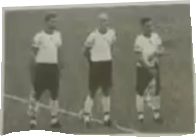
Identify the group of people shown in the picture given below.
View Solution
Concept:
In sports competitions, different personnel perform specific roles to ensure that the game is conducted fairly and according to the rules.
Officials: They supervise the game, enforce rules, make decisions, and ensure fair play. Examples include referees, umpires, judges, and line officials.
Coaches: They train and guide athletes or teams.
Managers: They handle administrative and organizational duties for teams.
Commentators: They describe and analyze the game for the audience through media broadcasts.
The people shown in the picture appear to be wearing uniforms and holding whistles, which are typically used by referees or umpires who supervise the match.
Step 1: Observing the attire and equipment in the picture.
The individuals are dressed in similar uniforms and appear to carry whistles, which are commonly used by referees or umpires during sports events.
Step 2: Understanding their role in sports.
Referees and umpires are responsible for controlling the game, making decisions, and ensuring that the rules are followed.
Step 3: Identifying the correct category.
Since referees and umpires fall under the category of sports officials, the correct answer is Officials. Quick Tip: Sports officials are responsible for enforcing rules and maintaining fairness during competitions. Common officials include referees, umpires, judges, and line officials.
__________ is a primary source of energy.
View Solution
Concept:
Food provides energy and nutrients required for the proper functioning of the body. Nutrients are broadly classified into carbohydrates, proteins, fats, vitamins, and minerals.
Carbohydrates: They are the main and immediate source of energy for the body. Foods such as rice, wheat, potatoes, and sugar contain carbohydrates.
Fats: They also provide energy but are mainly stored in the body as reserve energy.
Minerals: They help in body regulation and development but do not provide energy.
Vitamins: They help maintain proper body functions and immunity but do not supply energy.
Thus, carbohydrates are considered the primary source of energy for the body.
Step 1: Understanding energy-providing nutrients.
Among the nutrients, carbohydrates and fats provide energy to the body.
Step 2: Identifying the primary energy source.
Carbohydrates are the first nutrient used by the body to produce energy during daily activities.
Step 3: Conclusion.
Therefore, the primary source of energy is carbohydrates. Quick Tip: Carbohydrates are the body's main and quickest source of energy, especially during physical activities and sports.
A mesomorph has the following physical characteristic:
View Solution
Concept:
The concept of somatotypes classifies human body types based on physical structure and composition. According to this classification, there are three main body types:
Ectomorph: Characterized by a lean and delicate body structure with thin arms and legs and very little body fat.
Mesomorph: Characterized by a strong, muscular body with well-developed muscles and a naturally athletic physique.
Endomorph: Characterized by a round or pear-shaped body with higher fat accumulation.
Thus, a mesomorph typically has a muscular and athletic body structure.
Step 1: Understanding the somatotype classification.
Human body types are generally categorized into ectomorph, mesomorph, and endomorph based on body composition and structure.
Step 2: Identifying the characteristics of a mesomorph.
Mesomorphs have broad shoulders, a strong skeletal structure, and well-developed muscles, which make them naturally suited for sports and physical activities.
Step 3: Selecting the correct option.
Among the given options, the characteristic that best describes a mesomorph is a muscular body. Quick Tip: Remember the three somatotypes easily: Ectomorph – thin body, Mesomorph – muscular body, Endomorph – round or pear-shaped body.
According to the Principle of Periodization, a Microcycle training programme lasts for __________.
View Solution
Concept:
Periodization is a systematic planning of athletic training that divides a training programme into different phases to achieve peak performance at the right time. The training period is generally divided into three cycles:
Macrocycle: The longest training cycle, usually lasting for a year or an entire season.
Mesocycle: A medium-length training phase that generally lasts several weeks to a few months.
Microcycle: The shortest training cycle, focusing on short-term training goals and adjustments.
A microcycle usually consists of a short training period that commonly lasts about 1–2 weeks.
Step 1: Understanding the concept of periodization.
Periodization divides the overall training programme into macrocycle, mesocycle, and microcycle to manage training load and performance.
Step 2: Identifying the duration of a microcycle.
A microcycle is the smallest unit of training planning and generally lasts about 1–2 weeks.
Step 3: Selecting the correct option.
Among the given options, the duration that matches a microcycle is 1–2 weeks. Quick Tip: In training periodization: Macrocycle = long-term (about 1 year), Mesocycle = medium-term (several weeks to months), Microcycle = short-term (about 1–2 weeks).
Assertion (A): Ankle sprains are the most commonly experienced sports injuries.
Reason (R): A sprain occurs when the ligaments supporting the ankle gets torn or ruptured.
View Solution
Concept:
Sports injuries occur during physical activities due to accidents, improper technique, or excessive stress on body parts. Among these injuries, sprains and strains are very common.
Sprain: It is an injury that occurs when ligaments (the tissues connecting bones at a joint) are stretched, torn, or ruptured.
Ankle sprain: It is one of the most common injuries in sports because the ankle joint frequently bears body weight and is involved in movements like running, jumping, and sudden changes in direction.
Thus, both the assertion and the reason are correct statements, but the reason only defines a sprain and does not explain why ankle sprains are the most common sports injuries.
Step 1: Evaluating the Assertion (A).
Ankle sprains are indeed among the most commonly experienced sports injuries due to frequent stress on the ankle joint during sports activities. Therefore, Assertion (A) is true.
Step 2: Evaluating the Reason (R).
A sprain occurs when ligaments supporting a joint are stretched, torn, or ruptured. Hence, Reason (R) is also true.
Step 3: Checking the relationship between (A) and (R).
The reason only explains what a sprain is but does not explain why ankle sprains are the most common sports injuries.
Step 4: Conclusion.
Both statements are correct, but the reason does not correctly explain the assertion. Quick Tip: Remember the difference: \textbf{Sprain} = Injury to ligaments. \textbf{Strain} = Injury to muscles or tendons.
Best results are achieved in sports training if the:
View Solution
Concept:
Effective sports training requires proper planning of training load and nutrition. Training load refers to the intensity, duration, and frequency of exercise. According to the Principle of Progressive Overload, the load should gradually increase so that the body adapts and performance improves. Along with training, a balanced diet is necessary to provide energy, repair tissues, and support recovery.
If the training load increases progressively, the body adapts and performance improves.
A balanced diet supplies essential nutrients like carbohydrates, proteins, fats, vitamins, and minerals.
Proper balance between training load and nutrition helps athletes achieve better results and avoid injuries.
Thus, the best results in sports training are achieved when the training load increases progressively and is supported by a balanced diet.
Step 1: Understanding training load.
Training load refers to the amount and intensity of exercise performed by an athlete during training sessions.
Step 2: Applying the principle of progressive overload.
For continuous improvement, the load should be increased gradually so that the body adapts to higher levels of performance.
Step 3: Importance of proper nutrition.
A balanced diet provides the necessary nutrients and energy required for training, recovery, and muscle development.
Step 4: Conclusion.
Therefore, the best results are achieved when the training load is increased progressively along with a balanced diet plan. Quick Tip: For effective sports training remember: \textbf{Progressive training load + Balanced nutrition + Proper recovery = Best performance.}
Change in memory and perception of an individual are indicators of:
View Solution
Concept:
Human development includes several dimensions such as physical, mental, emotional, and social development. Each dimension reflects changes in different abilities of an individual.
Physical development: Refers to changes in body structure, height, weight, and physical abilities.
Mental (Cognitive) development: Involves changes in thinking ability, memory, perception, reasoning, and intelligence.
Social development: Refers to the ability to interact and adjust with others in society.
Emotional development: Refers to the ability to understand, express, and control emotions.
Since memory and perception are related to thinking and cognitive processes, they indicate mental development.
Step 1: Understanding memory and perception.
Memory refers to the ability to store and recall information, while perception refers to how individuals interpret and understand sensory information.
Step 2: Identifying the type of development.
Both memory and perception are cognitive functions related to the brain and thinking processes.
Step 3: Conclusion.
Therefore, changes in memory and perception are indicators of mental development. Quick Tip: Mental (cognitive) development includes abilities such as thinking, reasoning, memory, perception, learning, and problem-solving.
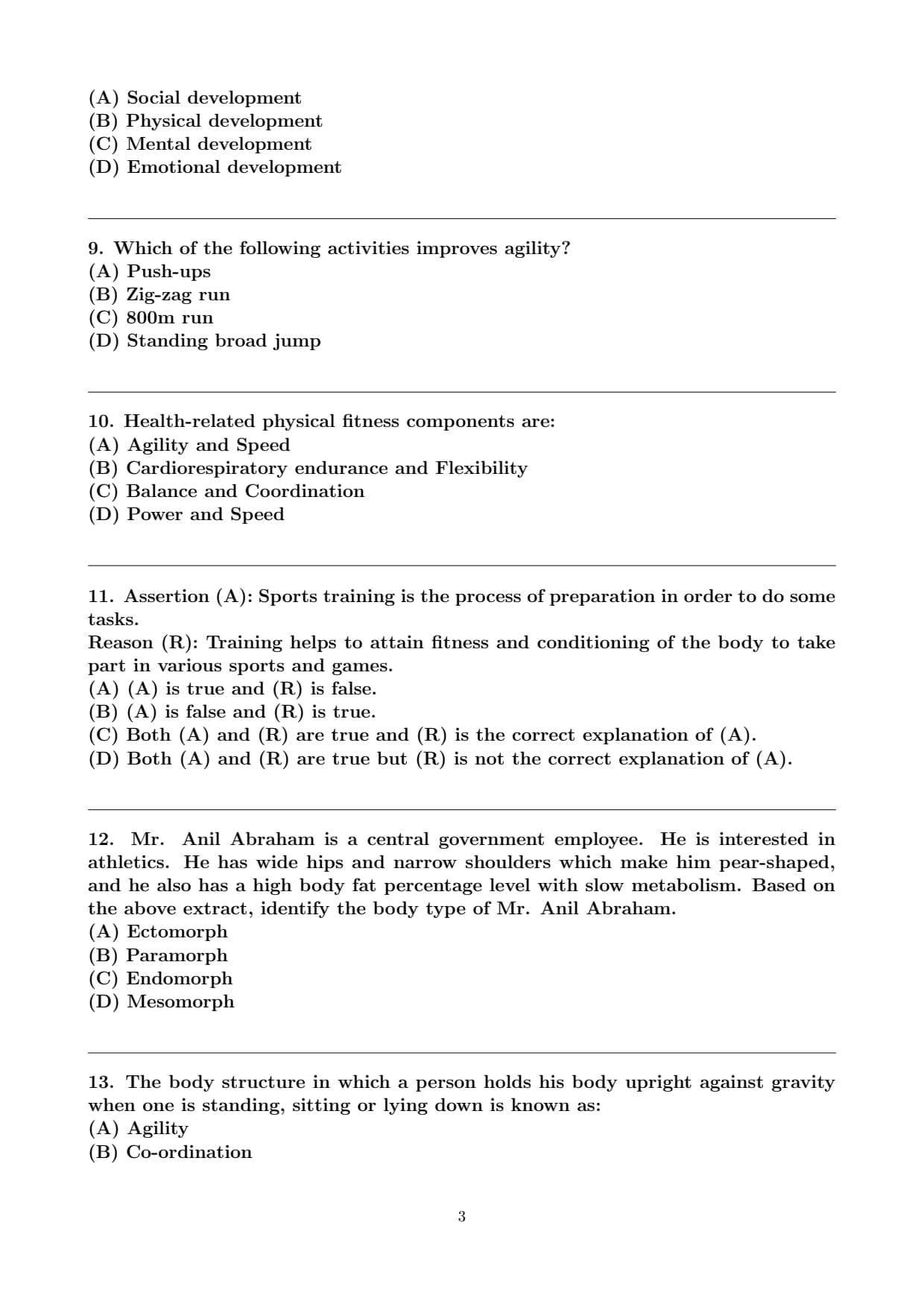
Which of the following activities improves agility?
View Solution
Concept:
Agility is the ability of an individual to change direction and position of the body quickly and effectively while maintaining balance and control. It is an important component of physical fitness, especially in sports such as football, basketball, and hockey.
Different physical activities develop different components of fitness:
Push-ups: Improve muscular strength and endurance of the upper body.
Zig-zag run: Involves quick directional changes and improves agility and coordination.
800 m run: Primarily develops cardiovascular endurance.
Standing broad jump: Measures explosive leg strength and power.
Thus, the activity that improves agility is the zig-zag run.
Step 1: Understanding agility.
Agility refers to the ability to move quickly and change direction efficiently without losing balance.
Step 2: Analyzing the activities given in the options.
Among the options, zig-zag running requires rapid direction changes, which directly develops agility.
Step 3: Conclusion.
Therefore, the activity that improves agility is the zig-zag run. Quick Tip: Agility improves through drills that involve quick changes in direction such as zig-zag runs, shuttle runs, and ladder drills.
Health-related physical fitness components are:
View Solution
Concept:
Physical fitness is commonly divided into two categories: health-related fitness and skill-related fitness.
Health-related physical fitness components:
Cardiorespiratory endurance
Muscular strength
Muscular endurance
Flexibility
Body composition
Skill-related physical fitness components:
Agility
Balance
Coordination
Power
Speed
Reaction time
Among the given options, cardiorespiratory endurance and flexibility belong to health-related fitness components.
Step 1: Understanding health-related fitness.
Health-related fitness focuses on improving overall health and the efficient functioning of body systems.
Step 2: Identifying the correct components.
Cardiorespiratory endurance improves heart and lung efficiency, while flexibility improves the range of motion of joints.
Step 3: Conclusion.
Therefore, the correct health-related physical fitness components from the options are cardiorespiratory endurance and flexibility. Quick Tip: Health-related fitness components = Cardiorespiratory endurance, Muscular strength, Muscular endurance, Flexibility, and Body composition.
Assertion (A): Sports training is the process of preparation in order to do some tasks.
Reason (R): Training helps to attain fitness and conditioning of the body to take part in various sports and games.
View Solution
Concept:
Sports training is a systematic and scientific process aimed at preparing athletes to improve their performance in sports. It involves planned exercises, drills, and activities that enhance physical fitness, skills, and overall performance.
Sports training: It is the process of preparing an individual to perform specific physical tasks or sports activities efficiently.
Purpose of training: Training improves physical fitness, strength, endurance, flexibility, and conditioning of the body so that athletes can perform better in sports and games.
Thus, both the assertion and the reason are correct, and the reason properly explains why sports training is a preparation process.
Step 1: Evaluating Assertion (A).
Sports training is indeed a systematic preparation process that enables athletes to perform certain physical tasks or sports activities effectively. Therefore, Assertion (A) is true.
Step 2: Evaluating Reason (R).
Training improves the physical fitness and conditioning of the body, enabling individuals to participate successfully in sports and games. Hence, Reason (R) is also true.
Step 3: Analyzing the relationship between (A) and (R).
The reason clearly explains why sports training is considered a preparation process because it helps in improving fitness and conditioning.
Step 4: Conclusion.
Both statements are true and the reason correctly explains the assertion. Quick Tip: Sports training is a planned process aimed at improving physical fitness, skills, and performance so that athletes can participate effectively in sports and competitions.
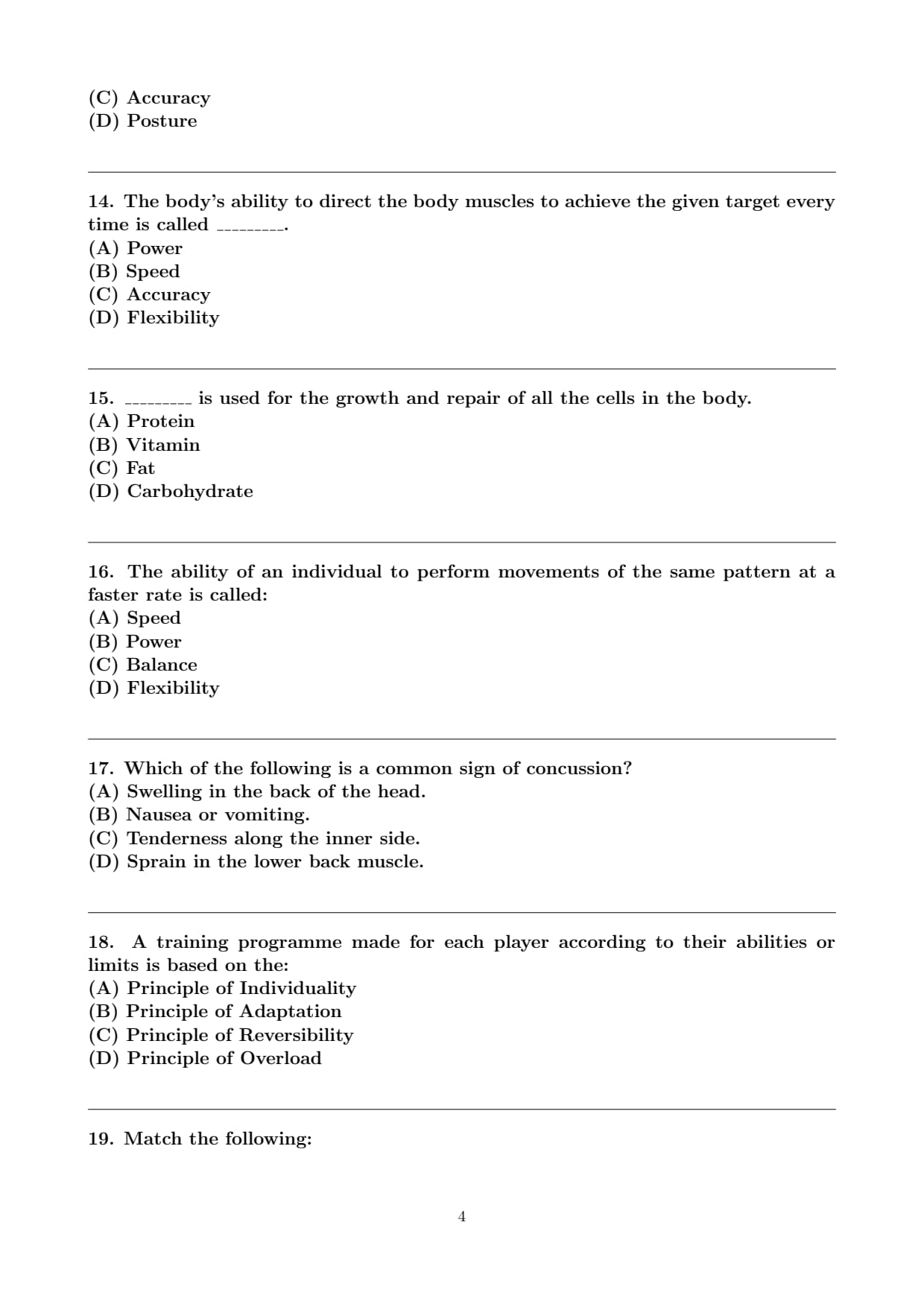
Mr. Anil Abraham is a central government employee. He is interested in athletics. He has wide hips and narrow shoulders which make him pear-shaped, and he also has a high body fat percentage level with slow metabolism. Based on the above extract, identify the body type of Mr. Anil Abraham.
View Solution
Concept:
Human body types are classified under somatotypes. This classification explains the physical structure and body composition of individuals. The three main somatotypes are:
Ectomorph: Individuals with a lean and thin body structure, narrow shoulders, low body fat, and a fast metabolism.
Mesomorph: Individuals with a muscular and athletic body build, broad shoulders, and well-developed muscles.
Endomorph: Individuals with a round or pear-shaped body, wide hips, narrow shoulders, higher body fat percentage, and slower metabolism.
The characteristics mentioned in the extract—pear-shaped body, wide hips, narrow shoulders, high body fat, and slow metabolism—are typical features of an endomorph body type.
Step 1: Observing the body shape described in the extract.
The individual has wide hips and narrow shoulders, giving a pear-shaped appearance.
Step 2: Analyzing body fat percentage and metabolism.
The extract mentions a high body fat percentage and slow metabolism.
Step 3: Matching the features with somatotypes.
These characteristics match the features of the endomorph body type.
Step 4: Conclusion.
Therefore, the body type of Mr. Anil Abraham is Endomorph. Quick Tip: Remember the somatotypes: Ectomorph – thin body with low fat, Mesomorph – muscular and athletic body, Endomorph – round or pear-shaped body with higher fat.
The body structure in which a person holds his body upright against gravity when one is standing, sitting or lying down is known as:
View Solution
Concept:
Posture refers to the position in which a person holds his or her body while standing, sitting, or lying down. It is the alignment of body parts supported by muscles and the skeletal system against gravity.
Maintaining correct posture helps in proper functioning of muscles and joints and prevents fatigue and injuries.
Agility: Ability to change direction quickly while maintaining balance.
Coordination: Ability to use different body parts together smoothly and efficiently.
Accuracy: Ability to control movements to achieve a precise target.
Posture: The position in which the body is held against gravity while standing, sitting, or lying down.
Step 1: Understanding the meaning of posture.
Posture describes how the body is positioned and aligned in different positions such as standing, sitting, or lying.
Step 2: Comparing with other options.
Agility, coordination, and accuracy are physical fitness or skill-related components, whereas posture refers to body alignment.
Step 3: Conclusion.
Therefore, the body structure that keeps the body upright against gravity is called posture. Quick Tip: Good posture keeps the spine properly aligned and reduces strain on muscles and joints, helping prevent back pain and fatigue.
The body's ability to direct the body muscles to achieve the given target every time is called _________.
View Solution
Concept:
Accuracy is a skill-related component of physical fitness that refers to the ability to control movements in order to achieve a desired target or goal with precision. It is important in many sports such as archery, shooting, basketball, and cricket where hitting a specific target is required.
Power: Ability to exert maximum force in a short period of time.
Speed: Ability to perform movements quickly.
Accuracy: Ability to control movements to achieve the correct target consistently.
Flexibility: Ability of joints and muscles to move through a wide range of motion.
Thus, the ability to direct muscles to achieve a given target every time is known as accuracy.
Step 1: Understanding the requirement of the question.
The question refers to directing body muscles to reach a specific target repeatedly.
Step 2: Identifying the related fitness component.
This ability relates to precise control over movement and achieving a target.
Step 3: Conclusion.
Therefore, the correct term for this ability is accuracy. Quick Tip: Accuracy is essential in target-based sports such as archery, shooting, darts, basketball free throws, and cricket bowling.
_________ is used for the growth and repair of all the cells in the body.
View Solution
Concept:
Nutrients are essential substances in food that help the body function properly. Each nutrient performs specific roles in the body.
Proteins: Known as body-building nutrients. They help in the growth, repair, and maintenance of body tissues and cells.
Vitamins: Help regulate body functions and protect against diseases.
Fats: Provide stored energy and help in insulation of the body.
Carbohydrates: Serve as the primary source of energy for the body.
Therefore, proteins are responsible for the growth and repair of body cells and tissues.
Step 1: Understanding the role of nutrients.
Different nutrients perform different functions such as providing energy, building body tissues, and regulating body processes.
Step 2: Identifying the body-building nutrient.
Proteins are responsible for growth and repair of body cells and tissues.
Step 3: Conclusion.
Thus, the nutrient used for the growth and repair of all cells in the body is protein. Quick Tip: Proteins are called \textbf{body-building foods}. Examples include milk, eggs, pulses, beans, meat, and fish.
The ability of an individual to perform movements of the same pattern at a faster rate is called:
View Solution
Concept:
Speed is a component of physical fitness that refers to the ability to perform a movement or cover a distance in the shortest possible time. It involves quick reaction and rapid execution of movements of the same pattern.
Speed: Ability to perform movements rapidly in a short period of time.
Power: Ability to exert maximum force in the shortest possible time (strength + speed).
Balance: Ability to maintain the body’s position while standing still or moving.
Flexibility: Ability of joints and muscles to move through a wide range of motion.
Thus, performing movements of the same pattern at a faster rate refers to speed.
Step 1: Understanding the term described in the question.
The question refers to performing the same movement repeatedly but at a faster rate.
Step 2: Relating it to physical fitness components.
The component that deals with performing movements quickly is speed.
Step 3: Conclusion.
Therefore, the ability to perform movements of the same pattern at a faster rate is called speed. Quick Tip: Speed is very important in sports such as sprinting, football, basketball, and hockey where quick movements are required.
Which of the following is a common sign of concussion?
View Solution
Concept:
A concussion is a type of brain injury caused by a sudden blow or impact to the head. It affects the normal functioning of the brain and is common in contact sports such as football, hockey, and boxing.
Common symptoms of concussion include:
Headache
Dizziness
Confusion
Nausea or vomiting
Temporary loss of consciousness
Blurred vision
Among the given options, nausea or vomiting is a common symptom associated with concussion.
Step 1: Understanding concussion.
Concussion occurs due to a sudden impact on the head that temporarily disturbs brain function.
Step 2: Identifying common symptoms.
Typical signs include headache, dizziness, confusion, nausea, and vomiting.
Step 3: Selecting the correct option.
Among the options provided, nausea or vomiting is a well-known symptom of concussion. Quick Tip: If a concussion is suspected during sports, the player should immediately stop playing and seek medical attention to prevent further injury.
A training programme made for each player according to their abilities or limits is based on the:
View Solution
Concept:
Sports training follows several principles that help athletes improve their performance effectively. One important principle is the Principle of Individuality.
Principle of Individuality: This principle states that each athlete is unique and training programmes should be designed according to their individual abilities, needs, and limits.
Principle of Adaptation: The body adapts to the stress or load placed upon it during training.
Principle of Reversibility: If training is stopped or reduced, the benefits gained from training gradually decrease.
Principle of Overload: Improvement occurs when the body is subjected to a workload greater than it is accustomed to.
Thus, a training programme designed according to the abilities or limits of each player follows the principle of individuality.
Step 1: Understanding individual differences in athletes.
Athletes differ in age, fitness level, strength, and physical capacity.
Step 2: Applying the training principle.
Training programmes must be tailored according to the specific needs and abilities of each athlete.
Step 3: Conclusion.
Therefore, the training programme based on the abilities or limits of each player follows the principle of individuality. Quick Tip: The Principle of Individuality means that training should be personalized because every athlete responds differently to exercise and training loads.
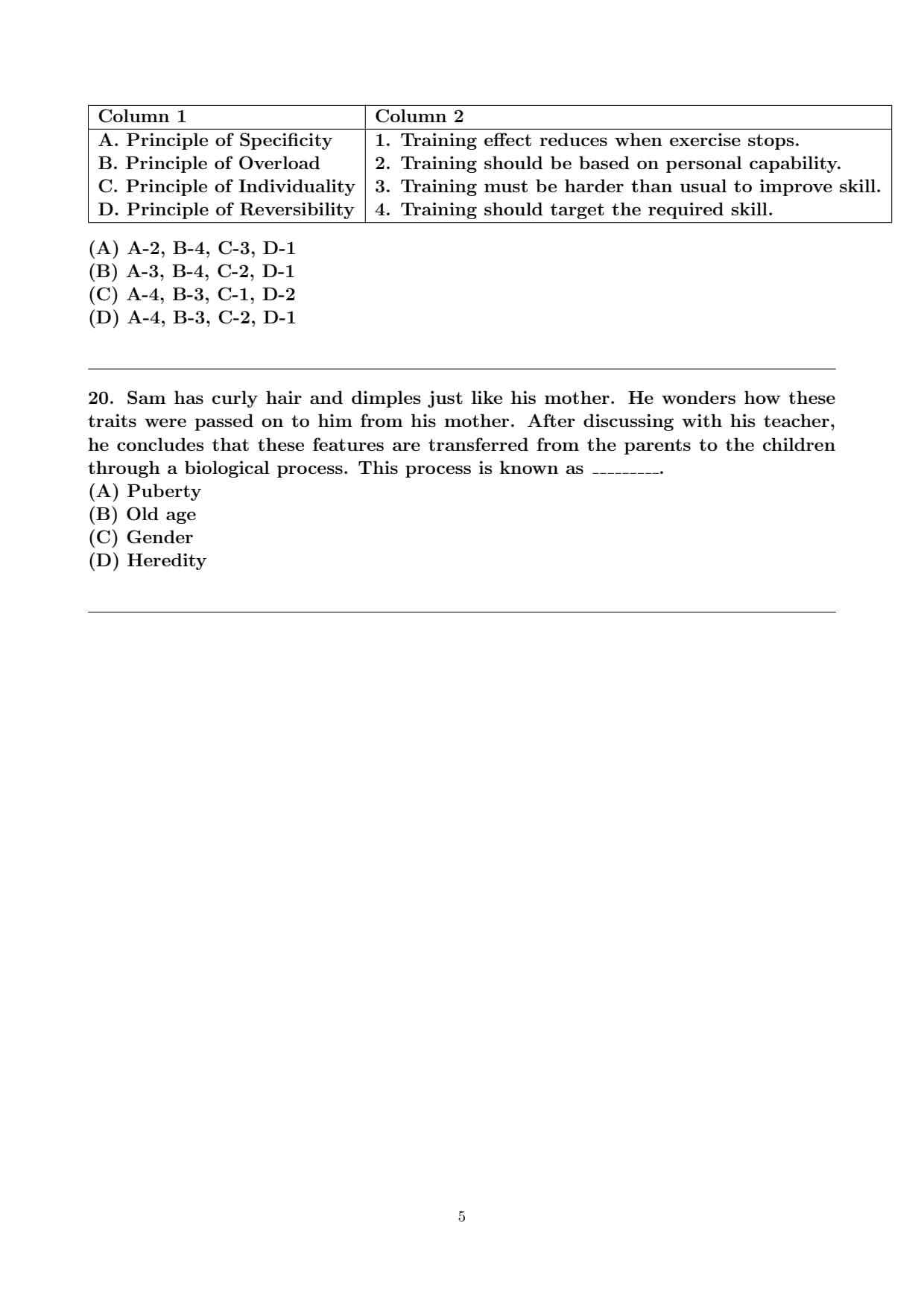
Match the following:
\begin{tabular{|l|l|
\hline
Column 1 & Column 2
\hline
A. Principle of Specificity & 1. Training effect reduces when exercise stops.
B. Principle of Overload & 2. Training should be based on personal capability.
C. Principle of Individuality & 3. Training must be harder than usual to improve skill.
D. Principle of Reversibility & 4. Training should target the required skill.
\hline
\end{tabular
View Solution
Concept:
Sports training follows certain principles that help athletes improve their performance efficiently.
Principle of Specificity: Training should focus on the particular skill or muscle group required for a specific sport.
Principle of Overload: For improvement, training must be harder than the usual level so that the body adapts to increased demands.
Principle of Individuality: Training programmes should be designed according to the individual's ability, capacity, and personal needs.
Principle of Reversibility: If training stops or decreases, the benefits gained from training gradually reduce.
Step 1: Matching Principle of Specificity.
Specificity means training should target the required skill. Therefore, A → 4.
Step 2: Matching Principle of Overload.
Overload means training must be harder than usual to improve performance. Hence, B → 3.
Step 3: Matching Principle of Individuality.
Individuality means training should be based on personal capability. Thus, C → 2.
Step 4: Matching Principle of Reversibility.
Reversibility means training effects reduce when exercise stops. Hence, D → 1.
Step 5: Final Matching.
\[ A-4,\; B-3,\; C-2,\; D-1 \] Quick Tip: Remember the principles easily: Specificity → Train the required skill. Overload → Train harder than usual. Individuality → Training depends on the individual. Reversibility → "Use it or lose it."
Sam has curly hair and dimples just like his mother. He wonders how these traits were passed on to him from his mother. After discussing with his teacher, he concludes that these features are transferred from the parents to the children through a biological process. This process is known as _________.
View Solution
Concept:
Heredity is the biological process through which physical and genetic traits are passed from parents to their offspring. These traits are transmitted through genes present in the chromosomes.
Examples of inherited traits include:
Hair type (curly or straight)
Eye colour
Dimples
Skin colour
Height tendency
Thus, similarities between parents and children occur because of heredity.
Step 1: Observing the traits mentioned in the question.
Sam has curly hair and dimples similar to his mother.
Step 2: Understanding the biological process involved.
These physical characteristics are passed from parents to children through genes.
Step 3: Identifying the correct term.
The biological process of transferring traits from parents to offspring is called heredity. Quick Tip: Heredity explains why children often resemble their parents in physical features such as hair type, eye colour, and facial characteristics.



Comments