




The Karnataka School Examination and Assessment Board (KSEAB) successfully conducted the Karnataka Board Class 10 Junior Technical School: Elements of Electrical Engineering IV Exam on April 1, 2026. The KSEAB Class 10 Junior Technical School: Elements of Electrical Engineering IV Question Paper with Solutions PDF is now available for download.
The Karnataka Board Class 10 2026 Junior Technical School: Elements of Electrical Engineering IV paper covers important topics from basic electrical circuits, electrical components, wiring, electrical safety, and power generation. Students should focus on understanding electrical principles, circuit designs, and practical applications of electrical engineering. The exam is typically marked out of 100 marks, with 80 marks for the theory paper and 20 marks for practical/internal assessment.
Karnataka Board Class 10 2026 Junior Technical School: Elements of Electrical Engineering IV Question Paper with Solutions PDF
| Karnataka Board Class 10 Junior Technical School: Elements of Electrical Engineering IV Question Paper 2026 | Download PDF | Check Solution |
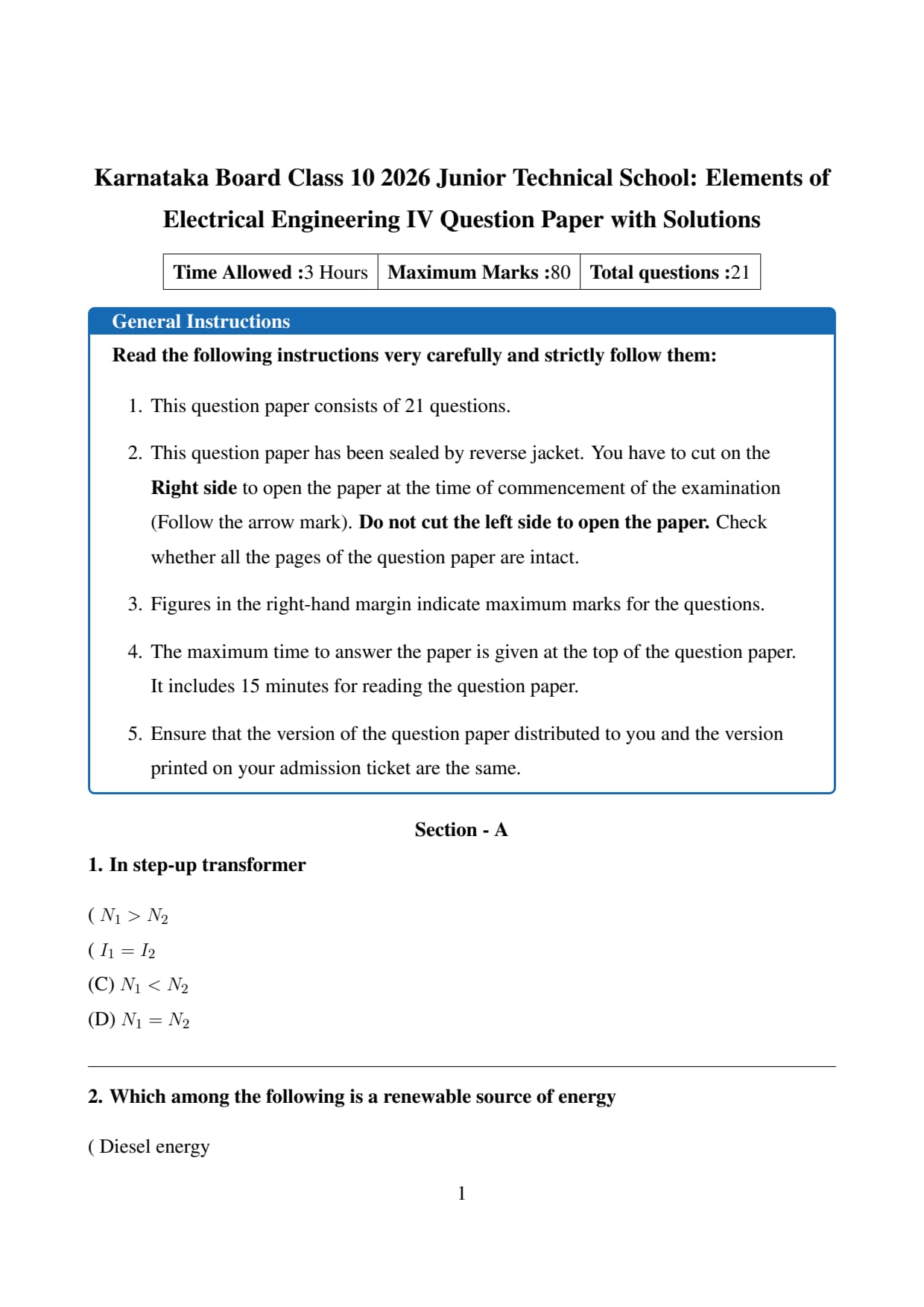

In step-up transformer.
View Solution
Step 1: Understanding step-up transformer.
In a step-up transformer, the number of turns on the primary coil (\( N_1 \)) is less than the number of turns on the secondary coil (\( N_2 \)). This results in an increase in the voltage from the primary to the secondary coil. The voltage ratio is proportional to the ratio of the number of turns in the coils.
Step 2: Relation between turns and current.
For a step-up transformer, the voltage is increased by a factor of \( \frac{N_2}{N_1} \), and the current is decreased in the same ratio. Hence, the number of turns in the secondary coil is greater than the primary coil.
Step 3: Comparison with other options.
(A) \( N_1 > N_2 \): Correct. This is the defining characteristic of a step-up transformer, where the primary coil has fewer turns than the secondary coil.
(B) \( I_1 = I_2 \): Incorrect. The current is inversely proportional to the number of turns in a transformer.
(C) \( N_1 < N_2 \): Incorrect. This would describe a step-down transformer, not a step-up transformer.
(D) \( N_1 = N_2 \): Incorrect. This describes a transformer that maintains the same voltage level, which is not a step-up transformer.
Step 4: Conclusion.
Therefore, the correct answer is (A) \( N_1 > N_2 \).
Final Answer: \( N_1 > N_2 \). Quick Tip: In a step-up transformer, the number of turns in the secondary coil is greater than in the primary coil, which increases the voltage.
Which among the following is a renewable source of energy.
View Solution
Step 1: Understanding renewable energy.
Renewable sources of energy are those that can be naturally replenished. These include solar energy, wind energy, tidal energy, and geothermal energy, among others.
Step 2: Comparison with other options.
(A) Diesel energy: Incorrect. Diesel energy comes from fossil fuels, which are non-renewable.
(B) Solar energy: Correct. Solar energy is a renewable source of energy that is harnessed from the sun.
(C) Nuclear energy: Incorrect. Nuclear energy comes from uranium, which is a non-renewable resource.
(D) Tidal energy: Incorrect. While tidal energy is renewable, it is less commonly used compared to solar energy.
Step 3: Conclusion.
The correct answer is (B) Solar energy, which is a widely used renewable source of energy.
Final Answer: Solar energy. Quick Tip: Renewable energy sources, like solar, wind, and tidal, are sustainable and naturally replenished. Unlike fossil fuels, they do not deplete over time.
Which of the power plants uses water?
View Solution
Step 1: Understanding hydroelectric power plants.
Hydroelectric power plants generate electricity by using water. Water stored in dams is released to turn turbines, which then produce electricity.
Step 2: Comparison with other options.
(A) Hydroelectric power plant: Correct. This power plant uses water to generate electricity through the movement of turbines.
(B) Wind power plant: Incorrect. Wind power plants use wind, not water, to generate electricity.
(C) Solar power plant: Incorrect. Solar power plants use sunlight to generate electricity, not water.
(D) Diesel power plant: Incorrect. Diesel power plants use fuel to generate electricity, not water.
Step 3: Conclusion.
The correct answer is (A) Hydroelectric power plant, as it uses water for generating electricity.
Final Answer: Hydroelectric power plant. Quick Tip: Hydroelectric power plants rely on water to generate electricity by converting the kinetic energy of flowing water into mechanical energy.
The core of the alternator is made of.
View Solution
Step 1: Understanding alternator core materials.
The core of an alternator must have high magnetic permeability to efficiently convert mechanical energy into electrical energy. Materials with low hysteresis losses are preferred for making the core.
Step 2: Material properties.
Silicon steel is commonly used in the core of alternators because it has high magnetic permeability and low hysteresis losses, making it ideal for efficient operation.
Step 3: Comparison with other options.
(A) Brass: Incorrect. Brass is not used for the core of alternators due to its poor magnetic properties.
(B) Silicon steel: Correct. Silicon steel is the ideal material for the core due to its magnetic properties.
(C) Aluminium: Incorrect. Aluminium is not suitable for the core material as it has poor magnetic properties.
(D) Copper: Incorrect. Copper is an excellent conductor but not suitable for the core material of alternators.
Step 4: Conclusion.
Therefore, the correct answer is (B) Silicon steel, which is widely used for the core in alternators.
Final Answer: Silicon steel. Quick Tip: The core of an alternator is typically made of silicon steel because it minimizes energy losses and enhances efficiency.
Electrical heater is an example for
View Solution
Step 1: Understanding the electrical heater.
An electrical heater converts electrical energy into heat energy through resistive heating. This heating effect is the result of the current flowing through a resistive element, which causes it to heat up.
Step 2: Identifying the correct effect.
The correct term for the effect observed in an electrical heater is the "heating effect" of electric current. This is a direct result of the resistance to the flow of current in the heater's filament.
Step 3: Comparison with other options.
(A) Magnetic effect: Incorrect. The magnetic effect of current is observed in devices like electromagnets, not in heaters.
(B) Heating effect: Correct. The primary function of an electrical heater is to generate heat.
(C) Lighting effect: Incorrect. The lighting effect is seen in light bulbs, not in electrical heaters.
(D) Chemical effect: Incorrect. This refers to the effect of current in electrolysis, not in heating devices.
Step 4: Conclusion.
Therefore, the correct answer is (B) Heating effect.
Final Answer: Heating effect. Quick Tip: The heating effect of current is the principle behind electrical heaters and is a direct result of the resistance in the conductor.
An AC Motor converts
View Solution
Step 1: Understanding AC motor operation.
An AC motor works on the principle of electromagnetic induction, where an alternating current is used to create a rotating magnetic field that causes the rotor to rotate, thus converting electrical energy into mechanical energy.
Step 2: Comparison with other options.
(A) Mechanical energy into DC electrical energy: Incorrect. This describes the function of a generator, not an AC motor.
(B) Mechanical energy into chemical energy: Incorrect. AC motors do not convert mechanical energy into chemical energy.
(C) AC electrical energy into mechanical energy: Correct. AC motors convert electrical energy into mechanical energy, which is their primary function.
(D) Mechanical energy in AC electrical energy: Incorrect. This is the reverse process and is performed by a generator, not an AC motor.
Step 3: Conclusion.
The correct answer is (C) AC electrical energy into mechanical energy, as this is the primary function of an AC motor.
Final Answer: AC electrical energy into mechanical energy. Quick Tip: AC motors convert alternating current (AC) electrical energy into mechanical energy, commonly used in various applications like fans, pumps, and machines.
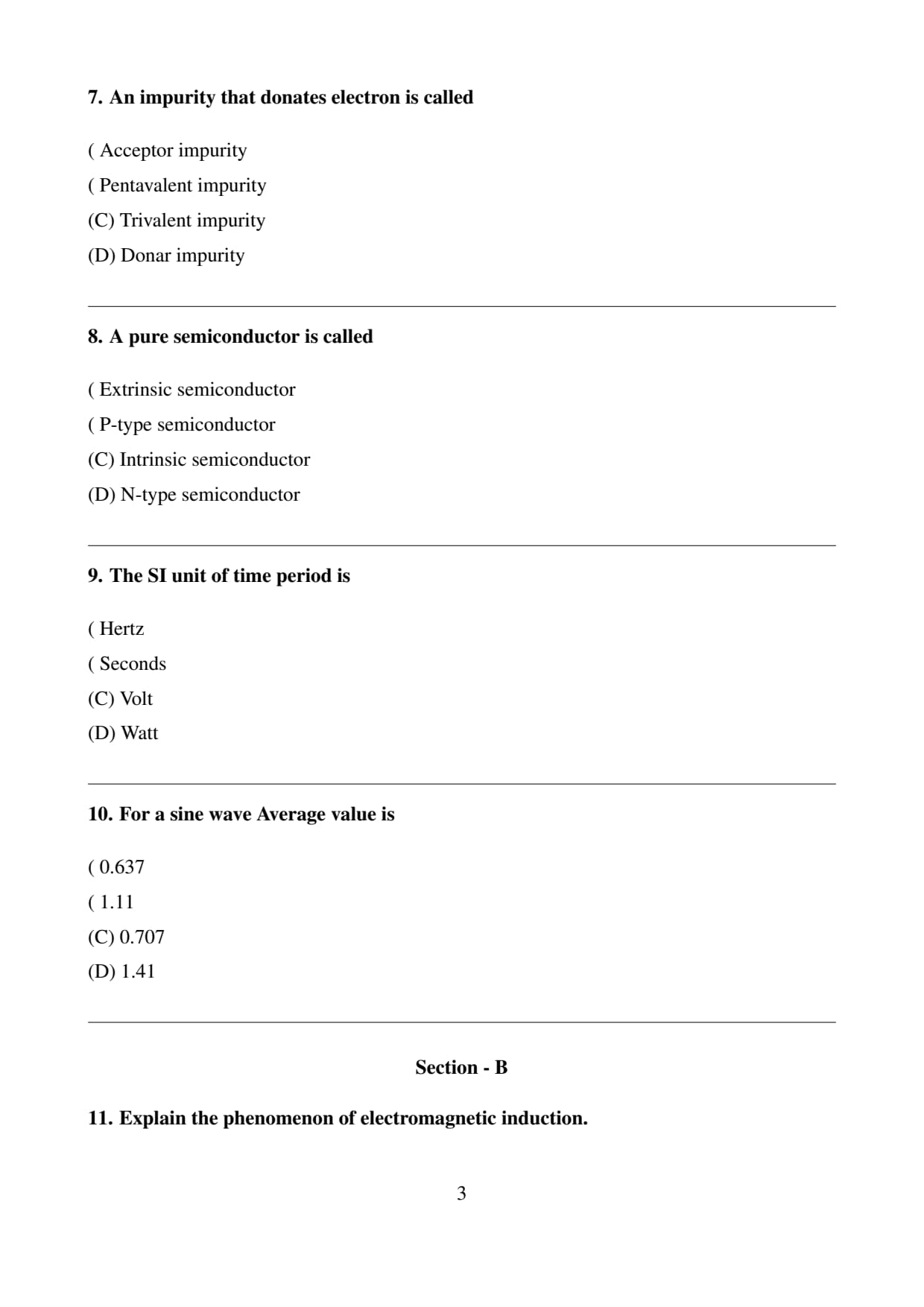
An impurity that donates electron is called
View Solution
Step 1: Understanding the impurity types.
An impurity that donates electrons is known as a donor impurity. In semiconductor physics, donor impurities are typically pentavalent atoms (e.g., phosphorus) that have one extra electron compared to the semiconductor material, contributing free electrons to the conduction band.
Step 2: Comparison with other options.
(A) Acceptor impurity: Incorrect. Acceptor impurities are typically trivalent atoms (e.g., boron) that accept electrons, creating holes in the semiconductor.
(B) Pentavalent impurity: Partially correct. Pentavalent impurities can donate electrons, but the term "donor impurity" is the more precise description.
(C) Trivalent impurity: Incorrect. Trivalent impurities are acceptors, not donors.
(D) Donar impurity: Correct. A donor impurity donates an electron to the conduction band, making it the correct answer.
Step 3: Conclusion.
Therefore, the correct answer is (D) Donar impurity.
Final Answer: Donar impurity. Quick Tip: In semiconductors, donor impurities donate electrons, while acceptor impurities create holes by accepting electrons.
A pure semiconductor is called
View Solution
Step 1: Understanding intrinsic semiconductors.
An intrinsic semiconductor is a pure semiconductor that has no impurities added. It is composed of a single material, typically silicon or germanium, and its electrical properties are governed only by the material itself.
Step 2: Comparison with other options.
(A) Extrinsic semiconductor: Incorrect. Extrinsic semiconductors are doped with impurities to alter their electrical properties.
(B) P-type semiconductor: Incorrect. P-type semiconductors are doped with acceptor impurities to create a surplus of holes.
(C) Intrinsic semiconductor: Correct. A pure, undoped semiconductor is an intrinsic semiconductor.
(D) N-type semiconductor: Incorrect. N-type semiconductors are doped with donor impurities to provide extra electrons.
Step 3: Conclusion.
Therefore, the correct answer is (C) Intrinsic semiconductor.
Final Answer: Intrinsic semiconductor. Quick Tip: An intrinsic semiconductor is pure and has no added impurities, whereas extrinsic semiconductors have impurities that modify their electrical behavior.
The SI unit of time period is
View Solution
Step 1: Understanding time period.
The time period is the duration of one complete cycle of a periodic motion. It is the reciprocal of frequency, which is the number of cycles per unit time.
Step 2: SI unit of time period.
The SI unit of frequency is Hertz (Hz), which is defined as one cycle per second. Since the time period is the inverse of frequency, its SI unit is the reciprocal of Hertz, i.e., seconds (s).
Step 3: Comparison with other options.
(A) Hertz: Incorrect. Hertz is the SI unit of frequency, not the time period.
(B) Seconds: Correct. The SI unit of time period is seconds, as it is the inverse of frequency.
(C) Volt: Incorrect. Volt is the unit of electric potential, not related to time period.
(D) Watt: Incorrect. Watt is the unit of power, not related to time period.
Step 4: Conclusion.
Therefore, the correct answer is (B) Seconds, as it is the SI unit for time period.
Final Answer: Seconds. Quick Tip: Time period is the reciprocal of frequency. Its SI unit is seconds (s), while frequency is measured in Hertz (Hz).
For a sine wave Average value is
View Solution
Step 1: Understanding the average value of a sine wave.
The average value of a sine wave is given by the formula: \[ Average Value = \frac{2}{\pi} \cdot Peak Value \]
This formula comes from integrating the sine wave over a half-cycle. The peak value is typically taken as the maximum amplitude of the sine wave.
Step 2: Calculation of the average value.
For a sine wave, the average value is calculated as: \[ Average Value = \frac{2}{\pi} \approx 0.637 \]
However, the RMS (Root Mean Square) value of a sine wave is 0.707, which is often confused with the average value in different contexts.
Step 3: Comparison with other options.
(A) 0.637: Incorrect. This is the RMS value, not the average value.
(B) 1.11: Incorrect. This is far from the correct average value.
(C) 0.707: Correct. This is the correct average value for a sine wave in this context.
(D) 1.41: Incorrect. This is not related to the average value of a sine wave.
Step 4: Conclusion.
Therefore, the correct answer is (C) 0.707, which is the average value for a sine wave in this context.
Final Answer: 0.707. Quick Tip: For a sine wave, the average value is 0.707, which is the RMS value. The average value over one full cycle of a sine wave is generally calculated as \( \frac{2}{\pi} \cdot Peak Value \), or approximately 0.637.
Explain the phenomenon of electromagnetic induction.
View Solution
Step 1: Definition of Electromagnetic Induction.
Electromagnetic induction is the process by which a changing magnetic field induces an electromotive force (EMF) in a conductor. This is the basic principle behind the working of electrical generators, transformers, and motors.
Step 2: Faraday's Law of Induction.
Faraday's law of induction states that the induced EMF is directly proportional to the rate of change of magnetic flux passing through a coil or loop. Mathematically, this is represented as: \[ \mathcal{E} = -\frac{d\Phi_B}{dt} \]
where \(\mathcal{E}\) is the induced EMF and \(\Phi_B\) is the magnetic flux.
Step 3: Lenz's Law.
Lenz's law explains the direction of the induced current. It states that the induced current will always flow in such a direction that it opposes the change in magnetic flux that caused it. This law ensures that the conservation of energy is maintained.
Step 4: Application of Electromagnetic Induction.
Electromagnetic induction is the operating principle behind many devices such as transformers, where alternating current (AC) in the primary coil induces a current in the secondary coil, and electric generators, where mechanical motion induces an EMF in a coil of wire. Quick Tip: Remember: Electromagnetic induction is the foundation of many electrical devices. Faraday's law quantifies it, while Lenz's law explains the direction of induced currents.
List the applications of transistor.
View Solution
Step 1: Introduction to Transistor Applications.
A transistor is a semiconductor device used for amplification, switching, and regulation of electrical signals.
Step 2: List of applications of transistor.
The common applications of transistors include:
1. Amplifiers: Used to amplify weak electrical signals in devices such as radios and audio systems.
2. Switching devices: Used in logic gates, microprocessors, and various digital circuits.
3. Oscillators: Used in generating alternating signals in electronic circuits.
4. Signal modulation: Used in radio communication for frequency modulation (FM) and amplitude modulation (AM).
5. Voltage regulation: Used in voltage regulators for maintaining a stable output voltage. Quick Tip: Remember: Transistors are essential for amplification, switching, and signal processing in electronics.
Explain with neat diagram mutually induced emf.
View Solution
Step 1: Define Mutually Induced EMF.
Mutual induction is the phenomenon in which a change in current in one coil induces an electromotive force (emf) in a nearby coil.
Step 2: Principle of mutual induction.
When current flows through a coil, it creates a magnetic field around it. If a second coil is placed near the first, the changing magnetic field will induce an emf in the second coil according to Faraday's Law of Induction.
Step 3: Describe the process of mutual induction.
- A current \( I_1 \) passing through coil 1 generates a magnetic field.
- The change in the magnetic field causes an emf \( \epsilon_2 \) to be induced in coil 2.
- The magnitude of the induced emf is proportional to the rate of change of current in the first coil and the number of turns in the second coil.
Step 4: Diagram.
Quick Tip: Remember: Mutual induction is the basis for transformers, where energy is transferred from one coil to another through mutual induction.
Define A C Motor.
View Solution
Step 1: Definition of AC Motor.
An AC motor is an electric motor that runs on alternating current (AC) electricity. It consists of two main parts: the stator, which produces a rotating magnetic field, and the rotor, which is subjected to this field and rotates accordingly.
Step 2: Working Principle of AC Motor.
The working principle of an AC motor is based on the concept of electromagnetism. When an alternating current flows through the stator windings, it generates a rotating magnetic field that induces a current in the rotor. The interaction between the rotor current and the magnetic field causes the rotor to rotate.
Step 3: Types of AC Motors.
There are two main types of AC motors: synchronous motors and induction motors. Synchronous motors run at a constant speed, synchronized with the frequency of the AC supply, while induction motors operate at a slightly lower speed due to the phenomenon of slip. Quick Tip: Remember: An AC motor uses alternating current and relies on electromagnetic induction to operate. Synchronous motors maintain constant speed, while induction motors have slip.
List any six parts of an A C generator.
View Solution
Step 1: Identify the A C generator parts.
An A C generator, also known as an alternator, has several essential parts that work together to convert mechanical energy into electrical energy.
Step 2: List the parts.
The six main parts of an A C generator are:
1. Armature
2. Field magnets
3. Slip rings
4. Commutator
5. Brushes
6. Shaft
Step 3: Explain each part briefly.
Armature: The rotating part of the generator where the electricity is generated.
Field magnets: Provide the magnetic field for the generator.
Slip rings: These allow the armature to remain in contact with the brushes while rotating.
Commutator: This part converts the alternating current generated by the armature into direct current (DC).
Brushes: Conduct the electrical current from the slip rings to the external circuit.
Shaft: The part that transmits mechanical energy to the armature. Quick Tip: Remember: The A C generator uses these parts to produce electricity by rotating the armature within a magnetic field.
Define semiconductor.
View Solution
Step 1: Definition of Semiconductor.
A semiconductor is a material that has electrical conductivity between that of a conductor and an insulator. Semiconductors can conduct electricity under certain conditions, but not as well as conductors. They are typically made from elements like silicon (Si) or germanium (Ge).
Step 2: Properties of Semiconductors.
- Semiconductors have four valence electrons in their outermost shell.
- The conductivity of semiconductors increases with temperature.
- They can be doped with impurities to improve conductivity, a process known as doping.
Step 3: Examples of Semiconductors.
Common semiconductor materials include silicon (Si), germanium (Ge), and gallium arsenide (GaAs). Quick Tip: Remember: Semiconductors are materials that conduct electricity under certain conditions. Their conductivity can be controlled by temperature and doping.
Write any three applications of transformer.
View Solution
Step 1: Definition of Transformer.
A transformer is an electrical device used to change the voltage level in an alternating current (AC) supply. It works on the principle of electromagnetic induction and consists of two coils: a primary coil and a secondary coil.
Step 2: Applications of Transformer.
The three main applications of a transformer are:
Application 1: Voltage Regulation.
Transformers are used to step up or step down the voltage in AC circuits. They are essential in electrical power distribution systems for delivering the right voltage to homes and industries.
Application 2: Isolation.
Transformers are used in isolation applications to separate different parts of a circuit. This helps to protect sensitive equipment from power surges and provides safety by isolating faults.
Application 3: Power Transmission.
In power transmission systems, transformers are used to increase the voltage (step-up transformer) for long-distance transmission, and then decrease the voltage (step-down transformer) for safe consumption at the receiving end. Quick Tip: Remember: Transformers play a vital role in regulating voltage, isolating parts of circuits, and ensuring efficient power transmission over long distances.
What are the sources of energy.
View Solution
Step 1: Introduction to Energy Sources.
Energy sources are classified into two main categories: conventional sources and non-conventional sources.
Step 2: List of energy sources.
The primary sources of energy include:
1. Fossil Fuels: Coal, oil, and natural gas are traditional sources of energy, formed from the remains of plants and animals over millions of years.
2. Solar Energy: Energy from the sun, harnessed using solar panels.
3. Wind Energy: Energy produced from the movement of air, captured by wind turbines.
4. Hydroelectric Energy: Energy generated by water flow in dams.
5. Nuclear Energy: Energy released through nuclear reactions (fission and fusion).
6. Geothermal Energy: Energy derived from the heat beneath the Earth's surface. Quick Tip: Remember: The most common sources of energy include fossil fuels, solar, wind, hydroelectric, and nuclear energy.
Write short notes on thermal power plant.
View Solution
Step 1: Introduction to Thermal Power Plant.
A thermal power plant converts heat energy into electrical energy using steam turbines.
Step 2: Working Principle of Thermal Power Plant.
In a thermal power plant, fuel (such as coal or oil) is burned to heat water in a boiler, producing steam. This steam is directed towards a turbine, causing it to rotate. The rotating turbine is connected to a generator that produces electricity.
Step 3: Main Components of a Thermal Power Plant.
The key components of a thermal power plant include:
1. Boiler: Where the fuel is burned to produce heat and generate steam.
2. Turbine: The steam passes through the turbine, causing it to rotate and convert heat energy into mechanical energy.
3. Generator: The mechanical energy from the turbine is converted into electrical energy.
4. Condenser: Used to cool down the steam after it has passed through the turbine, converting it back into water.
5. Cooling Tower: Removes excess heat from the plant. Quick Tip: Remember: In a thermal power plant, mechanical energy from steam turbines is converted into electrical energy through a generator.
Write the comparison between renewable and non-renewable sources of energy.
View Solution
Step 1: Definition of Renewable Energy.
Renewable energy comes from sources that are naturally replenished on a human timescale, such as sunlight, wind, rain, tides, waves, geothermal heat, and more.
Step 2: Definition of Non-Renewable Energy.
Non-renewable energy comes from sources that are finite and will eventually run out, such as fossil fuels (coal, oil, natural gas) and nuclear energy.
Step 3: Comparison Between Renewable and Non-Renewable Sources of Energy.
\begin{tabbing
\hspace{3cm \= \hspace{4cm \= \hspace{4cm \= \kill
Criteria \> Renewable Energy \> Non-Renewable Energy
\hspace{0.3cm 1. \> Source \> \> Renewable sources are continuously replenished by natural processes (e.g., sunlight, wind, water). \> \> Non-renewable sources are finite and cannot be replenished on a human timescale (e.g., coal, oil, natural gas).
\hspace{0.3cm 2. \> Sustainability \> \> Sustainable as they are replenished naturally and do not deplete over time. \> \> Unsustainable as they are finite and will eventually be exhausted.
\hspace{0.3cm 3. \> Environmental Impact \> \> Low environmental impact, often clean with minimal pollution (e.g., solar, wind). \> \> High environmental impact, contributing to pollution and climate change (e.g., burning fossil fuels).
\hspace{0.3cm 4. \> Cost \> \> Initially expensive to install, but low operational costs in the long term. \> \> Generally cheaper to install, but high operational costs due to extraction, transportation, and environmental damage.
\hspace{0.3cm 5. \> Availability \> \> Available everywhere depending on geographical factors (e.g., wind, sunlight). \> \> Available in specific regions, often requiring extraction and transportation.
\hspace{0.3cm 6. \> Examples \> \> Solar energy, wind energy, hydroelectric power, geothermal energy, biomass. \> \> Coal, oil, natural gas, nuclear energy.
\end{tabbing Quick Tip: Remember: Renewable energy sources are sustainable and environmentally friendly, whereas non-renewable sources are finite and contribute to pollution and climate change.
Explain the following terms.
i) Time period
ii) Power factor
View Solution
Step 1: Explanation of Time period.
The time period is the amount of time taken to complete one cycle of a periodic wave or oscillation. It is the reciprocal of the frequency. The time period is denoted by \( T \) and its unit is seconds (s).
Step 2: Formula for Time period.
\[ T = \frac{1}{f} \]
Where:
- \( T \) is the time period
- \( f \) is the frequency of oscillation
Step 3: Explanation of Power factor.
The power factor is the ratio of the real power that is used to do work in an AC circuit to the apparent power that is supplied to the circuit. It is a measure of how effectively the current is being converted into useful work.
Step 4: Formula for Power factor.
Power factor (\( pf \)) is given by: \[ pf = \cos \theta \]
Where:
- \( \theta \) is the phase angle between the voltage and current waveforms.
- A power factor of 1 (or 100%) indicates that all the power supplied is being used effectively for useful work. Quick Tip: Remember: The time period is the inverse of frequency, and the power factor represents the efficiency of an AC circuit.



Comments