




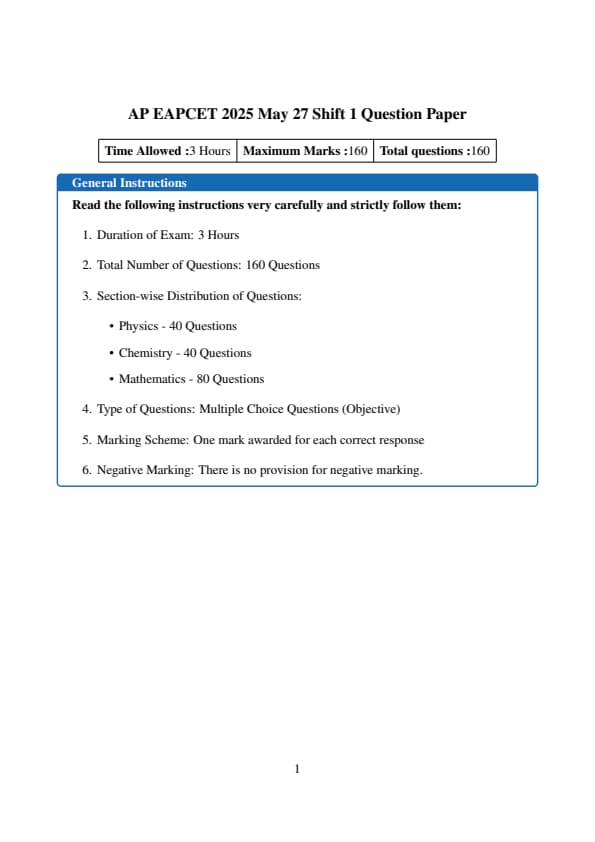
The AP EAMCET 2025 Engineering Exam for May 27, 2025, Shift 1 was conducted from 9:00 A.M. to 12:00 P.M., in more than 117 examination centres across Telangana and Andhra Pradesh.
The AP EAMCET 2025 was conducted in a CBT Mode, and the AP EAMCET Question Paper included 160 MCQs, covering 80 in Mathematics and 40 each in Physics and Chemistry. With one mark for each correct answer and no negative marking.
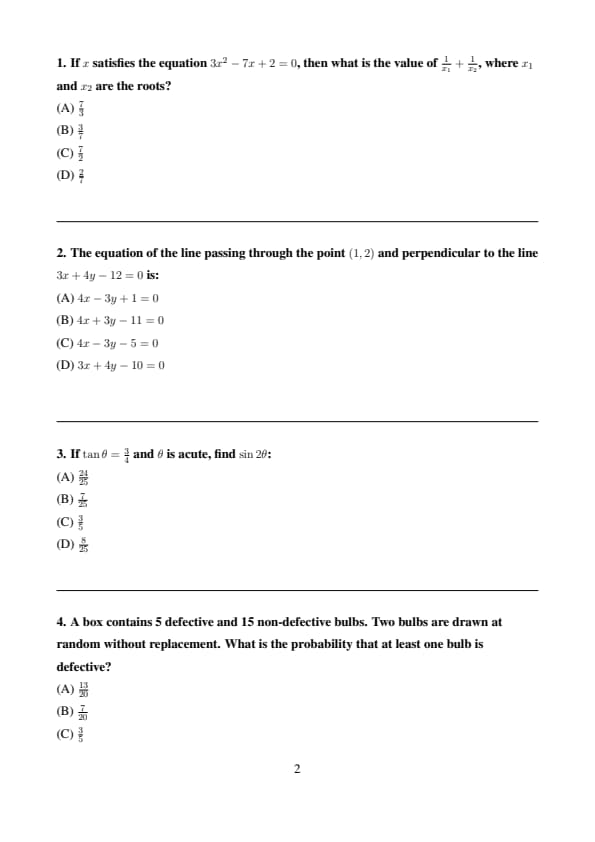
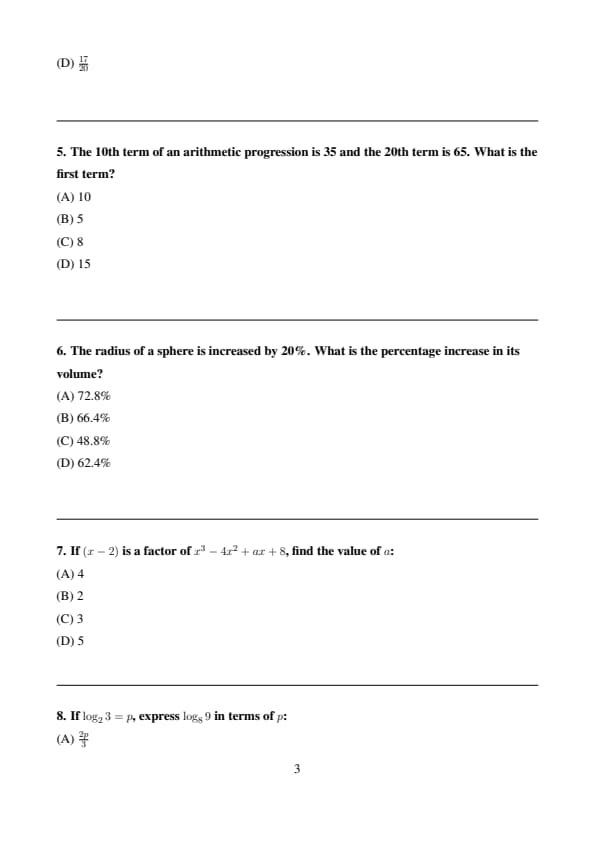
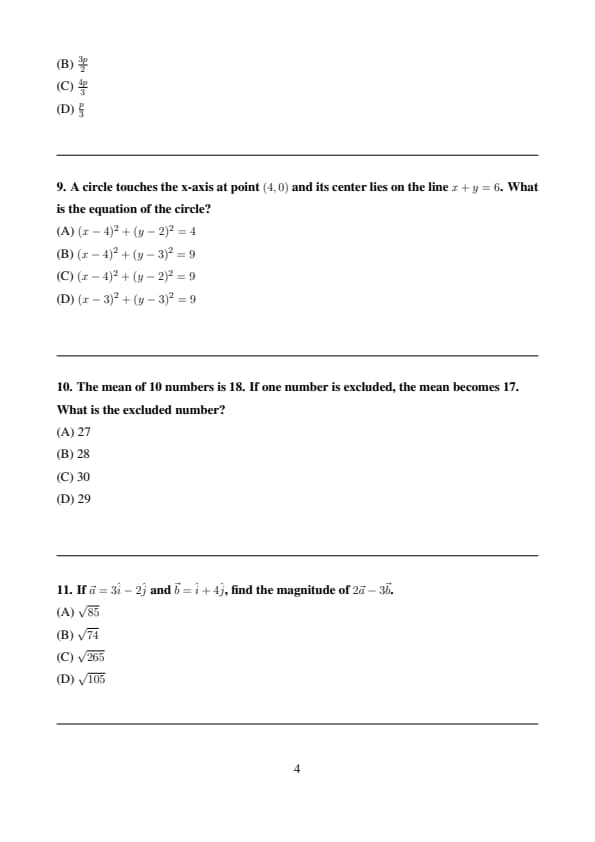
AP EAMCET 2025 Question Paper with Answer Key PDF May 27 Shift 1
| AP EAMCET 2025 May 27 Shift 1 Question Paper with Answer Key | Download PDF | Check Solutions |
If \( f : \mathbb{R} \to A \), defined by \( f(x) = \cos x + \sqrt{3} \sin x - 1 \), is an onto function, then \( A = \)
Let \( g(x) = 1 + x - \lfloor x \rfloor \) and \[ f(x) = \begin{cases} -1, & x < 0
0, & x = 0
1, & x > 0 \end{cases} \]
where \( \lfloor x \rfloor \) denotes the greatest integer less than or equal to \( x \). Then for all \( x \), \( f(g(x)) = \)
The remainder obtained when \( (2m + 1)^{2n} \), \( m, n \in \mathbb{N} \) is divided by 8 is
A value of \( \theta \) lying between \( 0 \) and \( \dfrac{\pi}{2} \) and satisfying
\[ \begin{vmatrix} 1 + \sin^2 \theta & \cos^2 \theta & 4\sin 4\theta
\sin^2 \theta & 1 + \cos^2 \theta & 4\sin 4\theta
\sin^2 \theta & \cos^2 \theta & 1 + 4\sin 4\theta \end{vmatrix} = 0 \]
is:
If the system of equations \( 2x + py + 6z = 8 \), \( x + 2y + qz = 5 \) and \( x + y + 3z = 4 \) has infinitely many solutions, then \( p = \)?
If \( x^a y^b = e^m, \quad x^c y^d = e^n \), and
\[ \Delta_1 = \begin{vmatrix} m & b
n & d
\end{vmatrix}, \quad \Delta_2 = \begin{vmatrix} a & m
c & n
\end{vmatrix}, \quad \Delta_3 = \begin{vmatrix} a & b
c & d
\end{vmatrix} \]
then the values of \( x \) and \( y \) respectively (where \( e \) is the base of the natural logarithm) are:
If \( z \) and \( \omega \) are two non-zero complex numbers such that \( |z\omega| = 1 \) and \[ \arg(z) - \arg(\omega) = \frac{\pi{2}, \]
then the value of \( \overline{z\omega \) is:
Let \( z \) satisfy \( |z| = 1, \ z = 1 - \overline{z} and \operatorname{Im}(z) > 0 \)
Then consider:
Statement-I : \( z \) is a real number
Statement-II : Principal argument of \( z \) is \( \dfrac{\pi}{3} \)
Then:
If \( \omega_1 \) and \( \omega_2 \) are two non-zero complex numbers and \( a, b \) are non-zero real numbers such that \[ |a\omega_1 + b\omega_2| = |a\omega_1 - b\omega_2|, \]
then \( \dfrac{\omega_1}{\omega_2} \) is:
If \( \alpha \) is the common root of the quadratic equations \( x^2 - 5x + 4a = 0 \) and \( x^2 - 2ax - 8 = 0 \), where \( a \in \mathbb{R} \), then the value of \( \alpha^4 - \alpha^3 + 68 \) is:
If \( \alpha, \beta \) are the roots of \( x^2 - 5x - 68 = 0 \) and \( \gamma, \delta \) are the roots of \( x^2 - 5\alpha x - 6\beta = 0 \), then \( \alpha + \beta + \gamma + \delta = \) ?
The equation \[ x^{\frac{3}{4}(\log_{x} x)^2 + \log_{x} x^{-\frac{5}{4}}} = \sqrt{2} \]
has
If \( \alpha, \beta, \gamma \) are the roots of the equation \[ x^3 + px^2 + qx + r = 0, \]
then \[ (\alpha + \beta)(\beta + \gamma)(\gamma + \alpha) =\ ? \]
An eight digit number divisible by 9 is to be formed using digits from 0 to 9 without repeating the digits. The number of ways in which this can be done is
\[ \sum_{r=1}^{15} r^2 \left( \frac{{}^{15}C_r}{{}^{15}C_{r-1}} \right) =\ ? \]
A string of letters is to be formed by using 4 letters from all the letters of the word “MATHEMATICS”. The number of ways this can be done such that two letters are of same kind and the other two are of different kind is
Evaluate the following expression: \[ \frac{1}{81^n} - \binom{2n}{1} \cdot \frac{10}{81^n} + \binom{2n}{2} \cdot \frac{10^2}{81^n} - \cdots + \frac{10^{2n}}{81^n} = ? \]
If \( x \) is a positive real number and the first negative term in the expansion of \[ (1 + x)^{27/5} is t_k, then k =\ ? \]
If \[ \frac{x^2}{(x^2 + 2)(x^4 - 1)} = \frac{A}{x^2 - 1} + \frac{B}{x^2 + 1} + \frac{C}{x^2 + 2}, then A + B - C =\ ? \]
If \[ \cos x + \sin x = \frac{1}{2} \quad and \quad 0 < x < \pi, then \tan x =\ ? \]
If \[ \sin \theta + 2 \cos \theta = 1 and \theta lies in the 4th quadrant (not on coordinate axes), then 7 \cos \theta + 6 \sin \theta = ? \]
If \( A \) and \( B \) are acute angles satisfying \[ 3\cos^2 A + 2\cos^2 B = 4 \quad and \quad \frac{3 \sin A}{\sin B} = \frac{2 \cos B}{\cos A}, \]
then \( A + 2B = \ ? \)
Statement-I: In the interval \( [0, 2\pi] \), the number of common solutions of the equations \[ 2\sin^2\theta - \cos 2\theta = 0 \quad and \quad 2\cos^2\theta - 3\sin\theta = 0 \]
is two.
Statement-II: The number of solutions of \[ 2\cos^2\theta - 3\sin\theta = 0 \]
in \( [0, \pi] \) is two.
The equation \[ \cos^{-1}(1 - x) - 2 \cos^{-1} x = \frac{\pi}{2} \]
has:
If \( \sinh^{-1}(2) + \sinh^{-1}(3) = \alpha \), then \( \sinh\alpha = \) ?
In \( \triangle ABC \), if A, B, C are in arithmetic progression, then \[ \sqrt{a^2 - ac + c^2} \cdot \cos\left(\frac{A - C}{2}\right) =\ ? \]
If in \( \triangle ABC \), \( B = 45^\circ \), \( a = 2(\sqrt{3} + 1) \) and area of \( \triangle ABC \) is \( 6 + 2\sqrt{3} \) sq. units, then the side \( b = \ ? \)
In \( \triangle ABC \), if \( \sin^2 B = \sin A \) and \( 2\cos^2 A = 3\cos^2 B \), then the triangle is:
If the position vectors of A, B, C, D are \( \vec{A} = \hat{i} + 2\hat{j} + 2\hat{k}, \vec{B} = 2\hat{i} - \hat{j}, \vec{C} = \hat{i} + \hat{j} + 3\hat{k}, \vec{D} = 4\hat{j} + 5\hat{k} \),
then the quadrilateral ABCD is a:
The set of all real values of \( c \) so that the angle between the vectors
\( \vec{a} = c\hat{i} - 6\hat{j} + 3\hat{k} \) and \( \vec{b} = x\hat{i} + 2\hat{j} + 2c\hat{k} \) is an obtuse angle for all real \( x \), is:
Let \( \vec{a} = 2\hat{i} + \hat{j} + 3\hat{k} \), \( \vec{b} = 3\hat{i} + 3\hat{j} + \hat{k} \), and \( \vec{c} = \hat{i} - 2\hat{j} + 3\hat{k} \) be three vectors. If \( \vec{r} \) is a vector such that \( \vec{r} \times \vec{a} = \vec{r} \times \vec{b} \) and \( \vec{r} \cdot \vec{c} = 18 \), then the magnitude of the orthogonal projection of \( 4\hat{i} + 3\hat{j} - \hat{k} \) on \( \vec{r} \) is:
If \( \vec{u}, \vec{v}, \vec{w} \) are non-coplanar vectors and \( p, q \) are real numbers, then the equality: \[ [3\vec{u} \quad p\vec{v} \quad p\vec{w}] - [p\vec{v} \quad \vec{w} \quad q\vec{u}] - [2\vec{w} \quad q\vec{v} \quad q\vec{u}] = 0 \]
holds for:
If \( \sum\limits_{i=1}^{9} (x_i - 5) = 9 \) and \( \sum\limits_{i=1}^{9} (x_i - 5)^2 = 45 \), then the standard deviation of the nine observations \( x_1, x_2, \ldots, x_9 \) is
Two students appeared simultaneously for an entrance exam. If the probability that the first student gets qualified in the exam is \( \frac{1}{4} \) and the probability that the second student gets qualified in the same exam is \( \frac{2}{5} \), then the probability that at least one of them gets qualified in that exam is
For three events \( A, B, \) and \( C \) of a sample space, if \[ P(exactly one of A or B occurs) = P(exactly one of B or C occurs) = P(exactly one of C or A occurs) = \frac{1}{4} \]
and the probability that all three events occur simultaneously is \( \frac{1}{16} \), then the probability that at least one of the events occurs is
A bag P contains 4 red and 5 black balls, another bag Q contains 3 red and 6 black balls. If one ball is drawn at random from bag P and two balls are drawn from bag Q, then the probability that out of the three balls drawn two are black and one is red, is
On every evening, a student either watches TV or reads a book. The probability of watching TV is \( \frac{4}{5} \). If he watches TV, the probability that he will fall asleep is \( \frac{3}{4} \), and it is \( \frac{1}{4} \) when he reads a book. If the student is found to be asleep on an evening, the probability that he watched the TV is:
Let \( X \) be the random variable taking values \( 1, 2, \dots, n \) for a fixed positive integer \( n \). If \( P(X = k) = \frac{1}{n} \) for \( 1 \leq k \leq n \), then the variance of \( X \) is:
A radar system can detect an enemy plane in one out of ten consecutive scans. The probability that it can detect an enemy plane at least twice in four consecutive scans is:
The locus of the third vertex of a right-angled triangle, the ends of whose hypotenuse are \( (1, 2) \) and \( (4, 5) \), is:
The coordinate axes are rotated about the origin in the counterclockwise direction through an angle \( 60^\circ \). If \( a \) and \( b \) are the intercepts made on the new axes by a straight line whose equation referred to the original axes is \( x + y = 1 \), then \( \dfrac{1}{a^2} + \dfrac{1}{b^2} = \, ? \)
The image of a point \( (2, -1) \) with respect to the line \( x - y + 1 = 0 \) is
If a straight line is at a distance of 10 units from the origin and the perpendicular drawn from the origin to it makes an angle \( \frac{\pi}{4} \) with the negative X-axis in the negative direction, then the equation of that line is
If one of the lines given by the pair of lines \( 3x^2 - 2y^2 + axy = 0 \) is making an angle \( 60^\circ \) with the x-axis, then \( a = \)
A straight line passing through the origin \( O \) meets the parallel lines \( 4x + 2y = 9 \) and \( 2x + y + 6 = 0 \) at the points \( P \) and \( Q \) respectively. Then the point \( O \) divides the line segment \( PQ \) in the ratio
A circle is drawn with its centre at the focus of the parabola \( y^2 = 2px \) such that it touches the directrix of the parabola. Then a point of intersection of the circle and the parabola is
A circle touches both the coordinate axes and the straight line \( L \equiv 4x + 3y - 6 = 0 \) in the first quadrant. If this circle lies below the line \( L = 0 \), then the equation of that circle is
If the smallest circle through the points of intersection of \( x^2 + y^2 = a^2 \) and \( x \cos \alpha + y \sin \alpha = p \), \( 0 < p < a \), is \[ x^2 + y^2 - a^2 + \lambda(x \cos \alpha + y \sin \alpha - p) = 0 \]
then \( \lambda = \)
If the lines \( 3x - 4y + 4 = 0 \) and \( 6x - 8y - 7 = 0 \) are the tangents to the same circle, then the area of that circle (in sq. units) is
Circles are drawn through the point \( (2, 0) \) to cut intercepts of length 5 units on the X-axis. If their centre lies in the first quadrant, then their equation is
If the locus of a point that divides a chord of slope 2 of the parabola \( y^2 = 4x \) internally in the ratio 1 : 2 is a parabola, then its vertex is
Assertion (A): The length of the latus rectum of an ellipse is 4. The focus and its corresponding directrix are respectively \( (1, -2) \) and the line \( 3x + 4y - 15 = 0 \). Then its eccentricity is \( \dfrac{1}{2} \).
Reason (R): Length of the perpendicular drawn from focus of an ellipse to its corresponding directrix is \( \dfrac{a(1 - e^2)}{e} \)
Then which one of the following is correct?
If the eccentricity of the hyperbola \[ \frac{x^2}{a^2} - \frac{y^2}{b^2} = 1 \]
passing through the point \( (4, 6) \) is 2, then the equation of the tangent to this hyperbola at (4, 6) is
A hyperbola passes through the point \( P(\sqrt{2}, \sqrt{3}) \) and has foci at \( (\pm 2, 0) \). Then the point that lies on the tangent drawn to this hyperbola at \( P \) is
The circumradius of the triangle formed by the points \( (2, -1, 1) \), \( (1, -3, -5) \), and \( (3, -4, -4) \) is
Let \( A(2, 3, 5), B(-1, 3, 2), C(\lambda, 5, \mu) \) be the vertices of \( \triangle ABC \). If the median through the vertex \( A \) is equally inclined to the coordinate axes, then
Equation of the plane passing through the origin and perpendicular to the planes \( x + 2y - z = 1 \) and \( 3x - 4y + z = 5 \) is
Evaluate the limit: \[ \lim_{x \to \frac{\pi}{4}} \frac{2\sqrt{2} - \left(\cos x + \sin x\right)^3}{1 - \sin 2x} \]
Let \([x]\) denote the greatest integer less than or equal to \(x\). Then \[ \lim_{x \to 2^+} \left( \frac{[x]^3}{3} - \left[ \frac{x^3}{3} \right] \right) \]
If the function \( f \) defined by \[ f(x) = \begin{cases} \dfrac{1 - \cos 4x}{x^2}, & x < 0
a, & x = 0
\dfrac{\sqrt{x}}{\sqrt{16 + \sqrt{x}} - 4}, & x > 0 \end{cases} \]
is continuous at \( x = 0 \), then \( a = \)
The domain of the derivative of the function \( f(x) = \dfrac{x}{1 + |x|} \) is
If \( x = \sqrt{2 \cosec ^{-1} t} \) and \( y = \sqrt{2 \sec^{-1} t} \), \( |t| \geq 1 \), then \( \dfrac{dy}{dx} = \)
If \( (a + \sqrt{2}b \cos x)(a - \sqrt{2}b \cos y) = a^2 - b^2 \), where \( a > b > 0 \), then at \( \left( \dfrac{\pi}{4}, \dfrac{\pi}{4} \right) \), \( \dfrac{dy}{dx} = \)
Consider the quadratic equation \( ax^2 + bx + c = 0 \), where \( 2a + 3b + 6c = 0 \) and let \[ g(x) = \frac{a x^3}{3} + \frac{b x^2}{2} + c x \]
Statement-I: The given quadratic equation \( ax^2 + bx + c = 0 \) has at least one root in \( (0, 1) \).
Statement-II: Rolle's theorem is applicable to \( g(x) \) on \( [0, 1] \).
Then:
The difference between the absolute maximum and absolute minimum values of the function \( f(x) = 2x^3 - 15x^2 + 36x - 30 \) on \( [-1, 4] \) is:
If \( f(x) = x e^{x(1-x)}, \, x \in \mathbb{R} \), then \( f(x) \) is:
The angle between the curves \( y^2 = x \) and \( x^2 = y \) at the point \( (1,1) \) is:
If \( \int \frac{5 \tan x}{\tan x - 2} \, dx = a x + b \log |\sin x - 2 \cos x| + c \), then \( a + b = \)
\( \int x \cos^{-1}\left(\frac{1-x^2}{1+x^2}\right) \, dx \, (x>0) = \)
\( \int \frac{dx}{(1+\sqrt{x}) \sqrt{x-x^2}} = \)
\( \int \sin^{-1}\left(\frac{x}{\sqrt{a+x}}\right) \, dx = \)
If \( \int \frac{x}{x \tan x + 1} \, dx = \log f(x) + k \), then \( f\left(\frac{\pi}{4}\right) = \)
Evaluate the definite integral: \[ \int_0^1 \frac{2x + 5}{x^2 + 3x + 2} \, dx = \]
The area (in sq. units) of the region given by \( R = \left\{ (x, y) : \dfrac{y^2}{2} \leq x \leq y + 4 \right\} \) is
Evaluate the integral: \[ \int_0^1 x^{5/2} (1 - x)^{3/2} \, dx = \]
Evaluate the limit: \[ \lim_{n \to \infty} \left[ \frac{1}{n^2} \sec^2 \frac{1}{n^2} + \frac{2}{n^2} \sec^2 \frac{4}{n^2} + \frac{3}{n^2} \sec^2 \frac{9}{n^2} + \cdots + \frac{1}{n^2} \sec^2 1 \right] = \]
The general solution of the differential equation \( \left(x \sin \frac{y}{x} \right) dy = \left( y \sin \frac{y}{x} - x \right) dx \) is
The general solution of the differential equation \( \cos(x + y) \, dy = dx \) is
If \( Ax^3 + Bxy = 4 \) (A and B are arbitrary constants) is the general solution of the differential equation \[ F(x)\frac{d^2y}{dx^2} + G(x)\frac{dy}{dx} - 2y = 0, \]
then \( F(1) + G(1) = \)
The physical quantity having the dimensions of the square root of the ratio of the kinetic energy and surface tension is
If the displacement \( s \) (in metre) of a moving particle in terms of time \( t \) (in second) is \( s = t^3 - 6t^2 + 18t + 9 \), then the minimum velocity attained by the particle is
If a force \( \vec{F} = (3\hat{i} + 2\hat{j} + 5\hat{k})~N \) acting on a body displaces it through \( \vec{d} = (2\hat{i} + 2\hat{j} + 1\hat{k})~m \), then the work done by the force on the body is
If two bodies A and B are projected with same velocity but with different angles \( \theta_1 \) and \( \theta_2 \) respectively with the horizontal such that both will have same range, then the ratio of times of flight of the bodies A and B is
The apparent weight of a girl of mass 30 kg when she is in a lift moving vertically upwards with an acceleration of \( 2~ms^{-2} \) is
(Acceleration due to gravity = \( 10~ms^{-2} \))
If a stone of mass \( 0.5~kg \) tied to one end of a wire is whirled in a circular path of radius \( 2~m \) with a speed \( 40~rev/min \) in a horizontal plane, then the tension in the wire is nearly
A body is projected vertically upwards with a velocity of \( 20~ms^{-1} \). If the potential energy of the body at a height of \( 5~m \) from the ground is \( 100~J \), then the kinetic energy of the body at a height of \( 10~m \) from the ground is
(Acceleration due to gravity \( g = 10~ms^{-2} \)
A body falls freely on to a hard horizontal surface. If the coefficient of restitution between the surface and the body is \( 0.8 \), then the ratio of the maximum height to which the body rises after second impact and the initial height of the body is
Two bodies of masses \( M \) and \( 4M \) initially at rest, start moving towards each other due to their mutual attraction. The velocity of their centre of mass when the first body attains a velocity \( v_0 \) is
The angular velocity of a body changes from \(6 \, rad/s\) to \(21 \, rad/s\) in a time of \(1.5 \, s\). If the moment of inertia of the body is \(100 \, g m^2\), then the rate of change of angular momentum of the body is
If the displacement of a particle executing simple harmonic motion is given by \( x = 0.5 \cos(125.6\,t) \), then the time period of oscillation of the particle is nearly
(Here \(x\) is displacement in metre and \(t\) is time in second)
The amplitude of a damped harmonic oscillator becomes 50% of its initial value in a time of 12 s. If the amplitude of the oscillator at a time of 36 s is \(x%\) of its initial amplitude, then the value of \(x\) is
The escape velocity of a body from a planet of mass \(M\) and radius \(R\) is 14 km/s. The escape velocity of the body from another planet having same mass and diameter \(8R\) (in km/s) is
The stress-strain graph of two wires A and B is shown in the figure. If \(Y_A\) and \(Y_B\) are Young’s moduli of materials of wires A and B respectively, then

If two soap bubbles each of radius \(2 \, cm\) combine in vacuum under isothermal conditions, then the radius of the new bubble formed is
A rectangular slab consists of two cubes of copper and brass of equal sides having thermal conductivities in the ratio \(4 : 1\). If the free face of brass is at \(0^\circ C\) and that of copper is at \(100^\circ C\), then the temperature of their interface is
The efficiency of a Carnot's heat engine is \( \frac{1}{3} \). If the temperature of the source is decreased by \(50^\circ C\) and the temperature of the sink is increased by \(25^\circ C\), the efficiency of the engine becomes \( \frac{3}{16} \). The initial temperature of the sink is
The change in internal energy of given mass of a gas, when its volume changes from \( V \) to \( 3V \) at constant pressure \( P \) is
(\( \gamma \) - Ratio of the specific heat capacities of the gas)
A monatomic gas at a pressure of 100 kPa expands adiabatically such that its final volume becomes 8 times its initial volume. If the work done during the process is 180 J, then the initial volume of the gas is
If a gaseous mixture consists of 3 moles of oxygen and 4 moles of argon at an absolute temperature \( T \), then the total internal energy of the mixture is
(Neglect vibrational modes and \( R \) is the universal gas constant)
A sound wave of frequency 500 Hz travels between two points X and Y separated by a distance of 600 m in a time of 2 s. The number of waves between the points X and Y are
A ray of light incidents at an angle of \(60^\circ\) on the first face of a prism. The angle of the prism is \(30^\circ\) and its second face is silvered. If the light ray inside the prism retraces its path after reflection from the second face, then the refractive index of the material of the prism is
In an experiment, two polaroids are arranged such that the intensity of the polarised light emerged from the second polaroid is 37.5% of the intensity of the unpolarised light incident on the first polaroid. Then the angle between the axes of the two polaroids is
If two particles A and B of charges \(1.6 \times 10^{-19}\,C\) and \(3.2 \times 10^{-19}\,C\) respectively are separated by a distance of 3 cm in air, then the magnitude of electrostatic force on particle A due to particle B is
If four charges \(+12\,nC, -20\,nC, +32\,nC\) and \(-15\,nC\) are arranged at the four vertices of a square of side \(\sqrt{2}\,m\), then the net electric potential at the centre of the square due to these four charges is
Four capacitors are connected as shown in the figure. If \( C_1, C_2, C_3 \) and \( C_4 \) are in the ratio \( 1:2:3:4 \), then the ratio of the charges on the capacitors \( C_2 \) and \( C_4 \) is

In the given circuit, the internal resistance of the cell is zero. If \( i_1 \) and \( i_2 \) are the readings of the ammeter when the key (K) is opened and closed respectively, then \( i_1 : i_2 = \)

In a meter bridge, the null point is located at 20 cm from the left end of the wire when resistances \( R \) and \( S \) are connected in the left and right gaps respectively. If the resistance \( S \) is shunted with \( 60\,\Omega \) resistance, the null point shifted by 5 cm, then the values of \( R \) and \( S \) are respectively:
If a wire of length \( L \) carrying a current \( i \) is bent in the shape of a semi-circular arc as shown in the figure, then the magnetic field at the centre of the arc is:

A galvanometer having 30 divisions has a current sensitivity of \(0.0625 \, \frac{div}{\mu A}\). If it is converted into a voltmeter to read a maximum of 6 V, then the resistance of that voltmeter is:
If the given figure shows the relation between magnetic field (B along y-axis) and magnetic intensity (H along x-axis) of a ferromagnetic material, then the point that represents coercivity of the material is:
%
A coil having 100 square loops each of side 10 cm is placed such that its plane is normal to a magnetic field, which is changing at a rate of \( 0.7 \ T s^{-1} \). The emf induced in the coil is
An AC source of internal resistance \( 10^3 \ \Omega \) is connected to a transformer. The ratio of the number of turns in the primary to the number of turns in the secondary to match the source to a load resistance of \( 10 \ \Omega \) is
If 11% of the power of a 200 W bulb is converted to visible radiation, then the intensity of the light at a distance of 100 cm from the bulb is
The de Broglie wavelength associated with an electron accelerated through a potential difference of \( \frac{200}{3} \ V \) is nearly
The ratio of the shortest wavelengths of Brackett and Balmer series of hydrogen atom is
If the binding energy per nucleon of deuteron (\( ^1\mathrm{H}^2 \)) is 1.15 MeV and an \(\alpha\)-particle has a binding energy of 7.1 MeV per nucleon, then the energy released per nucleon in the given reaction is \[ ^1\mathrm{H}^2 + ^1\mathrm{H}^2 \rightarrow ^2\mathrm{He}^4 + Q \]
In a transistor, if the collector current is 98% of emitter current, then the ratio of the base and collector currents is
In the given circuit, if \( A = 0 \), \( B = 1 \), and \( C = 1 \) are inputs, then the values of \( y_1 \) and \( y_2 \) are respectively

In amplitude modulation, if a message signal of 5 kHz is modulated by a carrier wave of frequency 900 kHz, then the frequencies of the side bands are
The wavelength of a particular electron transition for He\(^+\) is 100 nm. The wavelength (in \(\unicode{x212B}\)) of H atom for the same transition is
The energy of second Bohr orbit of hydrogen atom is \(-3.4 \, eV\). The energy of the fourth Bohr orbit of the He\(^+\) ion will be
Observe the following data.
\medskip
\begin{tabular{|c|c|c|c|c|
\hline
Ion & Q\textsuperscript{4+ & X\textsuperscript{b+ & Y\textsuperscript{c+ & Z\textsuperscript{d+
\hline
Radius (pm) & 53 & 66 & 40 & 100
\hline
\end{tabular
\medskip
Q\textsuperscript{4+, X\textsuperscript{b+, Y\textsuperscript{c+, Z\textsuperscript{d+ are respectively
Which of the following sets are correctly matched?
\medskip
% Table of Molecules
\begin{tabular{|c|c|c|
\hline
Molecule & Hybridization & Geometry
\hline
I. BrF\textsubscript{5 & sp\textsuperscript{3d\textsuperscript{2 & square pyramidal
II. XeF\textsubscript{6 & sp\textsuperscript{3d\textsuperscript{3 & Distorted octahedral
III. SF\textsubscript{4 & dsp\textsuperscript{2 & square planar
IV. PbCl\textsubscript{2 & sp & linear
\hline
\end{tabular
The order of dipole moments of H\textsubscript{2}O (A), CHCl\textsubscript{3} (B) and NH\textsubscript{3} (C) is
Identify the correct graph for an ideal gas
(\(y\)-axis = compressibility factor \(Z\); \(x\)-axis = pressure \(p\))
- (1)
![]()
- (2)
![]()
- (3)
![]()
- (4)
![]()


Identify the correct statements from the following.
Identify the correct statements about the following stoichiometric equation.
\[ aP_4 + bOH^- + CH_2O \rightarrow dPH_3 + eH_2PO_2^- \]
5 moles of a gas is allowed to pass through a series of changes as shown in the graph, in a cyclic process.
The processes \(C \rightarrow A\), \(B \rightarrow C\), and \(A \rightarrow B\) respectively are:
\[ (Volume = vertical axis, Temperature = horizontal axis) \]

1 mole of an ideal gas is allowed to expand isothermally and reversibly from 1L to 5L at 300 K. The change in enthalpy (in kJ) is
(R = 8.3 J K\(^{-1}\) mol\(^{-1}\))
Consider the following equilibrium reaction in gaseous state at T(K):
\[ A + 2B \rightleftharpoons 2C + D \]
The initial concentration of B is 1.5 times that of A. At equilibrium, the concentrations of A and B are equal. The equilibrium constant for the reaction is:
At T(K), \(K_{sp}\) of two ionic salts MX\(_2\) and MX is \(5 \times 10^{-13}\) and \(1.6 \times 10^{-11}\) respectively. The ratio of molar solubility of MX\(_2\) and MX is
Consider the following:
\medskip
Statement I: \quad \( \mathrm{H_2O_2} \) acts as an oxidising as well as reducing agent in both acidic and basic media.
Statement II: \quad 10V \( \mathrm{H_2O_2} \) sample means it contains 6% (w/v) \( \mathrm{H_2O_2} \)
Identify the correct statements from the following
\medskip
I. \quad All alkaline earth metals give hydrides on heating with hydrogen.
II. \quad Calcium hydroxide is used to purify sugar.
III. \quad \( \mathrm{BeCl_2} \) is a dimer in gaseous phase.
Select the correct statements from the following
A) \quad Aluminium liberates \( \mathrm{H_2} \) gas with dil.\( \mathrm{HCl} \) but not with aqueous \( \mathrm{NaOH} \).
B) \quad Formula of sodium metaborate is \( \mathrm{Na_3BO_3} \)
C) \quad Boric acid is a weak monobasic acid
D) \quad For thallium, +1 state is more stable than +3 state.
The number of amphoteric oxides from the following is
\(\mathrm{CO_2, GeO_2, SnO_2, PbO_2, CO, GeO, SnO, PbO}\)
Which of the following statements is not correct?
Consider the sets I, II and III. Identify the set(s) which is (are) correctly matched.
[I.] Staggered ethane > eclipsed ethane \dotfill torsional strain
[II.] 2,2-Dimethylbutane > 2-methylpentane \dotfill boiling point
[III.] cis-But-2-ene > trans-But-2-ene \dotfill dipole moment
What are B and C respectively in the following set of reactions?
\[ C (1,2-dibromopropane) \xrightarrow{Zn,\ \Delta} A \xrightarrow[(ii) NaNH_2]{(i) alc. KOH} B \xrightarrow{Lindlar Catalyst} C \]

- (1)
![]()
- (2)
![]()
- (3)
![]()
- (4)
![]()


The crystal system with edge lengths \( a \ne b \ne c \) and axial angles \( \alpha = \beta = \gamma = 90^\circ \) is 'x' and number of Bravais lattices for it is 'y'. x and y are
A solution is prepared by adding 124 g of ethylene glycol (molar mass = 62 g mol\(^{-1}\)) to \( x \) g of water to get a 10 m solution. What is the value of \( x \) (in g)?
The following graph is obtained for an ideal solution containing a non-volatile solute. \(x\)- and \(y\)-axes represent, respectively

Observe the following statements about dry cell:
For a reaction, the graph of \( \ln k \) (on y-axis) and \( 1/T \) (on x-axis) is a straight line with a slope \( -2 \times 10^4 K \). The activation energy of the reaction (in kJ mol\(^{-1}\)) is \((R = 8.3~J K^{-1} mol^{-1})\)
Match the following:
\begin{multicols{2
List-I (Reaction)
[A)] Hydrogenation of vegetable oils
[B)] Decomposition of potassium chlorate
[C)] Oxidation of SO\(_2\) in lead chamber process
[D)] Oxidation of ammonia in Ostwald’s process
\columnbreak
List-II (Catalyst)
[I.] Ni
[II.] MnO\(_2\)
[III.] Pt
[IV.] NO(g)
\end{multicols
The correct answer is:
The critical micelle concentration (CMC) of a soap solution is \( 5 \times 10^{-4} \, mol L^{-1} \). Identify the correct statements about this solution.
[I.] The micelle is stable if the soap solution concentration is \( 10^{-7} \, mol L^{-1} \)
[II.] The micelle is stable if the soap solution concentration is higher than \( 5 \times 10^{-4} \, mol L^{-1} \)
[III.] Micelles are also known as associated colloids.
The metal purified by Mond process is X. The number of unpaired electrons in X is
Complete hydrolysis of Xenon hexafluoride gives HF along with compound X. The hybridisation in X is
KMnO\(_4\) oxidises hydrogen sulphide in acidic medium. The number of moles of KMnO\(_4\) which react with one mole of hydrogen sulphide is
Identify the set which does not have ambidentate ligand(s).
The number of linear and crosslinked polymers in the following respectively are:
Novolac, Nylon 6,6, Bakelite, PVC, melamine
Which of the following represents the correct structure of \( \beta-D-(-)- \) Fructofuranose?
- (1)
![]()
- (2)
![]()
- (3)
![]()
- (4)
![]()


Which of the following statements is not correct for glucose?
The synthetic detergent used in toothpaste is of type X. Animal starch is Y.
X and Y respectively are
What are X and Y respectively in the following sets of reactions? (major product)
\[ \begin{aligned} I. & \quad \ce{CH3CH2CH2OH} \xrightarrow{\ce{PBr3}} X
II. & \quad \ce{CH3CH=CH2} \xrightarrow[(C6H5COO)2]{\ce{HBr}} Y \ (major) \end{aligned} \]

- (1)
![]()
- (2)
![]()
- (3)
![]()
- (4)
![]()


View Solution
Step 1: The reaction of \( \ce{CH3CH2CH2OH} \) with \( \ce{PBr3} \) gives \( \ce{CH3CH2CH2Br} \) — a substitution reaction replacing –OH with –Br.
Step 2: The reaction of propene (\( \ce{CH3CH=CH2} \)) with HBr in the presence of benzoyl peroxide (\( \ce{(C6H5COO)2} \)) proceeds via anti-Markovnikov addition due to free radical mechanism, yielding \( \ce{CH2BrCH2CH3} \) as major product.
Step 3: So, X is \( \ce{CH3CH2CH2Br} \) and Y is \( \ce{CH2BrCH2CH3} \), which corresponds to option (3). Quick Tip: Use \( \ce{PBr3} \) to convert alcohols to alkyl bromides.
HBr with peroxides follows anti-Markovnikov rule due to free radical addition.
Identify the two reactions A (I II) and B (I III) respectively in the following set of reactions.
\[ III \ \ce{<-[B]-} \ \ce{Cl-}–C_6H_4\ce{–COCH3} \quad \ce{<-[A]-} \ \ce{Cl-}–C_6H_4 \ \ce{->} \ II \]

An alcohol, X (C\(_5\)H\(_{12}\)O) in the presence of Cu/573K gives Y (C\(_5\)H\(_{10}\)). The reactants required for the preparation of X are
- (1)
![]()
- (2)
![]()
- (3)
![]()
- (4)
![]()


A carbonyl compound X (C\(_8\)H\(_8\)O) undergoes disproportionation with conc. KOH on heating. Product of X with Zn-Hg/HCl is Y and product of X with NaBH\(_4\) is Z. What are Y and Z respectively?
- (1)
![]()
- (2)
![]()
- (3)
![]()
- (4)
![]()


What is the major product Y in the following reaction sequence?
\[ \chemfig{Ph-CONH2} \xrightarrow[Pyridine, 70°C]{C\(_6\)H\(_5\)SO\(_2\)Cl} X \xrightarrow[(ii)\ \ce{Br2}, \ce{FeBr3}]{(i)\ \ce{H3O+}} Y \]

- (1)
![]()
- (2)
![]()
- (3)
![]()
- (4)
![]()


View Solution
Step 1: The given reaction involves **protection of an amide group** using benzene sulfonyl chloride in the presence of pyridine, forming a sulfonamide intermediate.
Step 2: On hydrolysis, the intermediate converts back to the **corresponding acid**, benzoic acid.
Step 3: The benzoic acid then undergoes **electrophilic aromatic substitution** with Br\(_2\)/FeBr\(_3\), and bromine substitutes the meta-position due to the electron-withdrawing effect of the carboxylic group.
Step 4: Therefore, the final product Y is **3-bromobenzoic acid**. Quick Tip: Carboxylic acid is a meta-directing group in electrophilic substitution; bromination with Br\(_2\)/FeBr\(_3\) adds Br at the meta position.
What are X and Y respectively in the following set of reactions?

- (1)
![]()
- (2)
![]()
- (3)
![]()
- (4)
![]()


AP EAMCET 2025 Paper Analysis
On behalf of APSCHE, JNTU Kakinada conducted the AP EAMCET 2025 Engineering exam in several shifts from May 21 to May 27, 2025.
There are 160 multiple-choice questions from mathematics (80), physics (40), and chemistry (40) in each paper.
May 21, 2025 – Paper Analysis
Shift 1 (9:00 AM – 12:00 PM)
| Subject | Expected Difficulty | Key Highlights |
|---|---|---|
| Mathematics | Moderate to Tough | It was Lengthy, Algebra & Calculus were dominant |
| Physics | Moderate | Conceptual questions from Mechanics |
| Chemistry | Easy | NCERT-based and more focused on Organic Chemistry |
Shift 2 (2:00 PM – 5:00 PM)
| Subject | Expected Difficulty | Key Highlights |
|---|---|---|
| Mathematics | Tough | It was Time-consuming with a major focus on Vectors & Coordinate Geo. |
| Physics | Moderate | Electricity & Magnetism-based questions |
| Chemistry | Easy to Moderate | Questions were Mostly direct and a few tricky numericals |
May 22, 2025 – Paper Analysis
Shift 1 (9:00 AM – 12:00 PM)
| Subject | Expected Difficulty | Key Highlights |
|---|---|---|
| Mathematics | Moderate | Integration & Probability were mainly included |
| Physics | Moderate | Thermodynamics & Laws of Motion |
| Chemistry | Easy | Organic and Surface Chemistry focused |
Shift 2 (2:00 PM – 5:00 PM)
| Subject | Expected Difficulty | Key Highlights |
|---|---|---|
| Mathematics | Moderate to Tough | Coordinate Geometry questions were tricky |
| Physics | Moderate | Covered Oscillations & Electrostatics |
| Chemistry | Easy | The NCERT theory-based topics were equally balanced |
May 23, 2025 – Paper Analysis
Shift 1 (9:00 AM – 12:00 PM)
| Subject | Expected Difficulty | Key Highlights |
|---|---|---|
| Mathematics | Tough | The exam was time-consuming, with some choices in the exam. |
| Physics | Moderate | Questions from Waves and Motion |
| Chemistry | Easy to Moderate | Straightforward questions and mostly NCERT-based |
Shift 2 (2:00 PM – 5:00 PM)
| Subject | Expected Difficulty | Key Highlights |
|---|---|---|
| Mathematics | Moderate | Calculus and Permutation-Combinations focused questions |
| Physics | Moderate | Application-based numericals |
| Chemistry | Easy | Focus on Inorganic Chemistry |
May 24, 2025 – Paper Analysis (Single Session Only)
| Subject | Expected Difficulty | Key Highlights |
|---|---|---|
| Mathematics | Moderate to Tough | Long calculations, topics from Algebra |
| Physics | Moderate | Mostly from Modern Physics and Mechanics |
| Chemistry | Easy | High-scoring and NCERT factual questions |
May 26, 2025 – Paper Analysis
Shift 1 (9:00 AM – 12:00 PM)
| Subject | Expected Difficulty | Key Highlights |
|---|---|---|
| Mathematics | Moderate | Vector Algebra & Matrices were more prominent |
| Physics | Moderate | Balanced paper with units & measurements included |
| Chemistry | Easy | Well-distributed topic coverage |
Shift 2 (2:00 PM – 5:00 PM)
| Subject | Expected Difficulty | Key Highlights |
|---|---|---|
| Mathematics | Tough | Lengthy integrals and sequences questions |
| Physics | Moderate | Emphasis on Thermodynamics |
| Chemistry | Easy to Moderate | Questions related to organic and tricky reaction-based questions |
May 27, 2025 – Paper Analysis (Expected)
Shift 1 (9:00 AM – 12:00 PM)
| Subject | Expected Difficulty | Key Highlights (Expected) |
| Mathematics | Moderate to Tough | Major focus on Algebra & Calculus |
| Physics | Moderate | Conceptual questions from Kinematics |
| Chemistry | Easy | NCERT-focused Organic and Coordination Comp. |



Comments