



Education Journalist | Study Abroad Strategy Lead | Updated On - Apr 18, 2026
Indian graduates who applied for Australia's Temporary Graduate visa (Subclass 485) after completing their degrees in late 2025 are still waiting — and many have already missed their intended work start dates. As of April 2026, 75% of 485 applications are taking 3–4 months to process, and 90% are taking up to 5–6 months, according to current data from registered migration agents and the Department of Home Affairs processing trends. For an Indian graduate who finished their degree in November 2025 and applied immediately, that means a decision as late as April–May 2026, with no right to work in the interim on a bridging visa in most cases.

What the 485 Processing Delay Actually Looks Like in 2026
The Australian Department of Home Affairs visa processing times page — updated monthly — does not publish a single fixed timeline for the 485. What migration agents and applicant tracking data confirm for April 2026 is a consistent pattern:
| Processing Benchmark | 2024 (typical) | April 2026 (current) |
|---|---|---|
| 50% of applications decided within | ~6–8 weeks | ~46 days (approx. 6–7 weeks) |
| 75% of applications decided within | ~10–12 weeks | 3–4 months |
| 90% of applications decided within | ~4–5 months | 5–6 months |
| Complex cases (health/character checks) | 6+ months | 8–13 months reported |
The median (50th percentile) has held relatively stable. The problem is the tail — the 75th and 90th percentile timelines have stretched significantly, meaning a large share of applicants are waiting far longer than the headline figure suggests. For Indian graduates, who are disproportionately represented in the 485 applicant pool and who often face additional health or character check requirements, the risk of falling into the longer tail is higher than average.
Also Read: Australia 485 Graduate Visa Fee Doubles to AUD 4,600 From March 2026
Why Processing Has Stretched — Three Compounding Causes
1. The fee doubling triggered a surge in early applications.
When the Australian government doubled the 485 fee from AUD 2,300 to AUD 4,600 (approximately ₹3.06 lakh at ₹66.44/AUD, April 18, 2026) effective March 1, 2026 — with no advance notice — thousands of graduates rushed to lodge applications before the deadline. The legislative instrument was registered on February 28 and came into effect the next day. The resulting surge in February 2026 applications created a backlog that is still working through the system in April 2026.
2. The 485 does not benefit from Australia's new fast-track system.
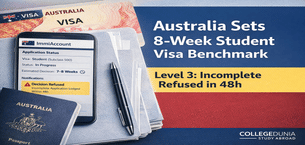
Australia introduced a standardised visa processing overhaul on March 25, 2026, cutting student visa (Subclass 500) processing to 2–4 weeks. The 485 is explicitly excluded from this fast-track. It remains on standard processing, which means the new system has improved timelines for incoming students but done nothing for graduates already waiting for their post-study work visa.
3. India's EL3 classification adds document verification layers.
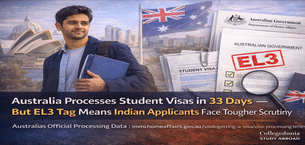
Since January 8, 2026, Australia moved India to Evidence Level 3 (EL3) — the highest-risk category for visa processing. While EL3 was introduced for student visa applications, the heightened scrutiny of Indian applicants' documents, health checks, and character assessments has carried over into 485 processing. Indian graduates whose health examinations or police clearances require additional review are disproportionately represented in the longer processing tail.
What Indian Graduates Lose While Waiting
The 485 processing delay is not just an administrative inconvenience. It has direct financial and career consequences for Indian graduates in Australia.
No right to work on a bridging visa in most cases. When a student visa expires and a 485 application is lodged, the applicant receives a Bridging Visa A (BVA). The BVA allows the applicant to remain in Australia lawfully — but it does not automatically grant work rights. Work rights on a BVA are only granted if the applicant's previous student visa included work rights. Most student visas do include 48 hours per fortnight of work rights during study — but graduates who have completed their course and whose student visa has expired may find their BVA work rights are limited or conditional.
Employer offers lapse. Many Indian graduates in Australia secure graduate employment offers that specify a start date. A 3–5 month processing delay means a graduate who received an offer in December 2025 expecting to start in February 2026 may still be waiting in April — and employers are not obligated to hold positions indefinitely. This is particularly acute in sectors with structured graduate intake cycles: accounting, engineering, IT consulting, and healthcare.
The cost of waiting has risen sharply. An Indian graduate waiting 5 months for a 485 decision in Sydney or Melbourne is paying approximately AUD 2,500–3,500 per month (₹1.66–2.32 lakh) in living costs — rent, food, transport — without the full-time income a 485 would enable. Over a 5-month wait, that is AUD 12,500–17,500 (₹8.3–11.6 lakh) in living costs on top of the AUD 4,600 visa fee already paid.
Also Read: Australia Rejects 40% of Indian Student Visa Applications in 2026 — Record High
Who Is Eligible — And the 6-Month Rule Most Indians Miss
Before addressing what to do, it is worth confirming eligibility — because the most common reason Indian graduates miss the 485 window is not processing delay but a missed lodgement deadline.
The 485 must be lodged within 6 months of receiving your final results notification — not 6 months from your graduation ceremony, not 6 months from your course end date. The clock starts from the date your institution officially notifies you of your final results. For most Australian universities, this is the date your results are published in the student portal, not the date of your graduation ceremony (which can be months later).
| Degree Type | 485 Stream | Duration | Age Cap |
|---|---|---|---|
| Bachelor's degree | Post-Higher Education Work | 2 years | 35 or under at lodgement |
| Master's by coursework | Post-Higher Education Work | 2 years | 35 or under at lodgement |
| Master's by research | Post-Higher Education Work | 3 years | 35 or under at lodgement |
| PhD / Doctorate | Post-Higher Education Work | 3 years | 35 or under at lodgement |
| Diploma / Associate Degree | Post-Vocational Education Work | 18 months | 35 or under at lodgement |
| Regional study (second 485) | Graduate Work stream | Up to 2 years | 35 or under at lodgement |
Also Read: PR in Australia: Process, Eligibility, Cost and Visa Types for Indian Students
What Indian Graduates Waiting for a 485 Decision Must Do Now
Lodge immediately after receiving final results — do not wait for graduation. The 6-month window starts from results notification. Every week of delay after results are published is a week lost from your lodgement window. If you are approaching the 6-month mark and have not yet lodged, this is urgent.
Ensure your health examination is complete and current before lodging. Health examinations for Australian visas are valid for 12 months. If your health exam has expired or is close to expiry, complete a new one before lodging your 485. An expired health exam is one of the most common causes of processing delays and requests for additional information — both of which push your application into the longer processing tail.
Obtain your Australian Federal Police (AFP) clearance before lodging. AFP clearances currently take 15 business days for standard processing. If you have lived in India or any other country for 12 months or more in the past 10 years, you will also need a police clearance from that country. Obtain all clearances before lodging — do not lodge and then wait for clearances, as this will delay your application significantly.
Check your BVA work rights immediately after your student visa expires. Log into VEVO (Visa Entitlement Verification Online) to confirm exactly what work rights your Bridging Visa A carries. Do not assume — the conditions vary based on your previous visa. If your BVA does not include work rights, you cannot work legally until your 485 is granted.
Communicate proactively with your employer. If you have a graduate employment offer with a fixed start date, contact your employer now and explain the processing timeline. Most large Australian employers — particularly in accounting, consulting, and technology — are familiar with 485 processing delays and have processes for deferring start dates. Do not wait until the start date passes to raise the issue.
Do not travel outside Australia while your 485 is pending without a Bridging Visa B. If you leave Australia while your 485 application is pending and you only hold a BVA, your BVA will cease and your 485 application may be affected. If you need to travel, apply for a Bridging Visa B before departing — it allows you to re-enter Australia while your 485 is still being processed.
Australia's Post-Study Work Visa Is Still Worth It — But the Maths Have Changed
The 485 remains one of the strongest post-study work pathways available to Indian graduates globally — 2–3 years of unrestricted work rights, no employer sponsorship required, and a direct pathway to Australian permanent residency through skilled migration streams. But the total cost of accessing it has changed materially in 2026.
In 2024, an Indian graduate paid AUD 1,810 for the 485 and waited 6–8 weeks. In April 2026, the same graduate pays AUD 4,600 (₹3.06 lakh) and waits up to 5–6 months. The visa itself has not changed. The post-study work rights are the same. But the financial and time cost of accessing those rights has more than doubled — and for Indian graduates already navigating a 40% student visa refusal rate and EL3 classification, the margin for error at every stage of the Australian study-to-work pipeline has narrowed significantly.















Comments