



Content Curator
Barium chloride is one of the most common water-soluble barium salts.
- The molecular or chemical formula for Barium Chloride is BaCl2.
- It is made up of barium cations (Ba2+) and chloride anions (Cl–).
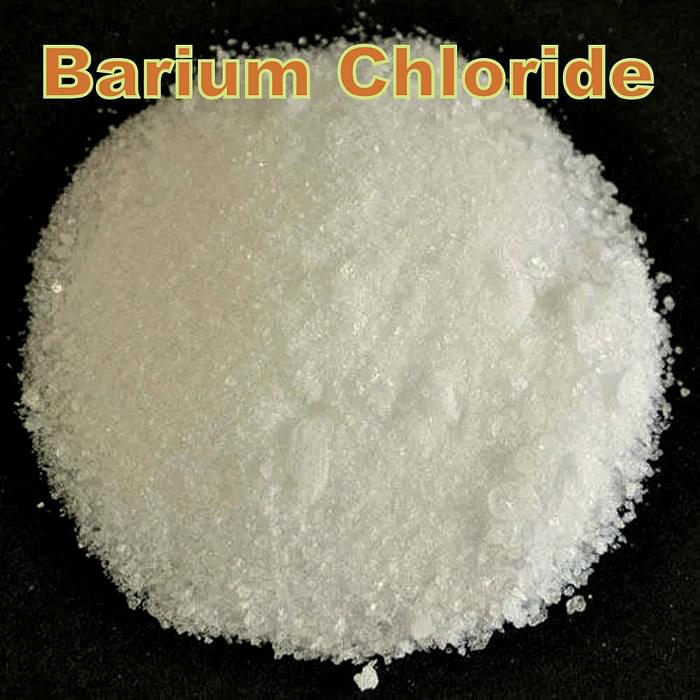
- It is a white-coloured solid and has no odour.
- It is toxic, like other barium salts, and gives a flame of yellow-green colour.
- It is also hygroscopic, forming the dihydrate BaCl₂(H₂O)₂ first
- It can be used in a variety of sectors, including testing sulphate ions in laboratories and purifying brine solution in the pigment manufacturing process.
| Table of Content |
Key Terms: Barium dichloride, Barium Chloride, Cations, Anions, Melting point, Boiling point, Chemical formula, Molar mass, Density
What is Barium Chloride (BaCl2)?
[Click Here for Sample Questions]
The inorganic salt barium chloride consists of barium cations (Ba2+) and chloride anions (Cl-).
- It is a white solid substance that is water soluble and gives a flame of slight yellow-green colour.
- It is also known as Barium Muriate or Barium dichloride.
- The chemical formula of Barium Chloride is BaCl2.
- It is also hygroscopic, changing to the colourless dihydrate BaCl2.H2O, which has a bitter salty taste.
- It is highly toxic in nature.
- It has limited use in the laboratory and industry.
- Wastewater treatment, and the manufacturing of PVC stabilisers, oil lubricants, barium chromate, and barium fluoride are all applications for barium chloride dihydrate.
Structure of Barium Chloride (BaCl2)
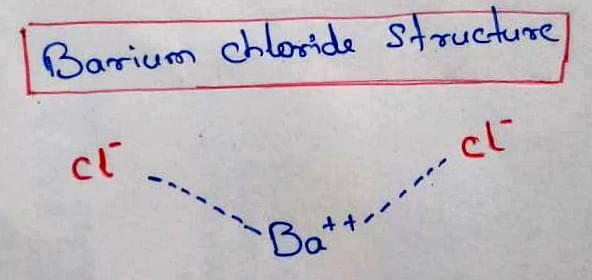
The chemical formula for barium chloride is BaCl2. One Barium cation (Ba2+) and one Chloride anion (Cl-) combine to make this salt.
Its chemical structure can be represented as follows, using common representations for organic compounds.
Also check:
| Related Concepts | ||
|---|---|---|
| Ammonium phosphate | Calcium Sulphate | Etard reaction |
| Chemical Tranquillisers | Barium Carbonate | Californium |
Properties of Barium Chloride
[Click Here for Sample Questions]
The following are the properties of Barium Chloride:
| Parameters | Value |
|---|---|
| Chemical or Molecular Formula | BaCl2 |
| Molecular Mass | 208.23 g/mol (anhydrous) |
| Density | 3.856 g/cm3 (anhydrous) |
| Appearance | White Solid |
| Odour | Odourless |
| Boiling Point | 1560 °C |
| Melting Point | 962 °C |
| Solubility in Water | 31.2 g/100 mL (0 °C) 35.8 g/100 mL (20 °C) 59.4 g/100 mL (100 °C) |
| Magnetic Susceptibility | -72.6 x 10⁻⁶ cm3/mol |
Other properties of Barium Chloride are
- Barium Chloride dissolves in water.
- When dissolved, it is found to split into chloride anions and barium cations.
- At 20°C, the solubility of Barium Chloride in water is approximately 358 grams per litre.
- However, the solubility of this combination in water varies with temperature.
- At 100°C, the solubility of barium chloride in water is 594 grams per litre.
- This chemical dissolves in methanol but is not soluble in ethanol.
- Anhydrous BaCl2 crystallizes in orthogonal crystals.
- The dihydrate formation of Barium Chloride, on the other hand, has a monoclinic crystal structure.
Preparation of Barium Chloride
[Click Here for Sample Questions]
In industries, Barium Chloride can be prepared using the following steps
Step 1:
First, barium sulfate and carbon are heated to high temperatures to make barium sulfide and carbon monoxide.
\(BaSO_4 + 4C\:\: \rightarrow \:\: BaS + 4CO\)
Step 2:
The barium sulfide then interacts with hydrogen chloride to produce barium chloride.
\(Bas + 2HCl \:\: \rightarrow \:\: BaCl_2 + H_2S\)
Uses of Barium Chloride
[Click Here for Sample Questions]
The following are the applications of Barium Chloride
- It is used to make oil lubricants, PVC stabilizers, barium chromate, and barium fluoride, among other things.
- It is utilized in the treatment of wastewater.
- It is used in tests for sulfate ions in laboratories.
- It is used in the purification process of heat treatment salts.
- It is used in caustic chlorine plants to purify brine (saline) solution.
- It is used in steel case hardening.
- It is used in the production of various barium salts.
- It is used in fireworks to provide a bright green colour.
Health Hazards Caused Due to Barium Chloride
[Click Here for Sample Questions]
Barium Chloride has limited usage, even in laboratories, due to its severe toxic effects.
- When in contact with barium chloride irritates the eyes, skin, and mucous membranes.
- If breathed, eaten, or absorbed through the skin, it can be fatal.
- The kidneys, cardiovascular system, and central nervous system can all be harmed by barium chloride toxicity.
- It is also a major hazard to aquatic life.
Also check:
| Relevant Topics | ||
|---|---|---|
| Lewis acids | Schottky Defect | Carboxylic Acids |
| Gatterman reaction | Reimer Tiemann reaction | Combined Gas Law |
Things To Remember
- Barium chloride is a water-soluble barium salt.
- When dissolved, it is found to split into chloride anions and barium cations.
- The chemical formula for Barium Chloride is BaCl2.
- It is odourless.
- Barium chloride is also known as Barium Muriate or Barium dichloride.
- Anhydrous BaCl2 crystallizes in orthogonal crystals.
- Barium Chloride is poisonous, like other barium salts, and gives a flame a yellow-green hue.
Previous Years Questions
- Chemical bond implies[KEAM]
- A lone pair of electrons in an atom implies[KEAM]
- The lattice energy of NaClNaCl is 788 kJmol. This means that 788kJ of energy is required[KEAM]
- The hybridization of oxygen atoms in H2O2H2O2 is[KEAM]
- The bond lengths and bond angles in the molecules of methane, ammonia and water are given below ….[KEAM]
- Which one of the following pairs consists of only paramagnetic species?[KEAM]
- Arrange the following ions in the order of decreasing X-0 bond length, where X is the central atom in SiO4−4,ClO−4,PO3−4,SO2−4
- Allyl cyanide molecule contains[KEAM]
- The carbon atoms in calcium carbide are held by[KEAM]
- NO+NO+ has bond order[KEAM]
- Identify the reaction in which monobasic and dibasic acids are formed...
- B2H6 reacts with (CH3)3N(CH3)3N to produce...[UPSEE 2019]
- Titration curve if a strong base is titrated with strong acid is...[UPSEE 2019]
- The pHpH of a 0.01MHCN0.01MHCN solution for which pKapKa is 44 is
- The conjugate acid of N−3N3− (Azide ion) is :
- If the pKa of acetic acid and pKbpKb of dimethylamine are 4.764.76 and 3.263.26 respectively, the pH of dimethyl ammonium acetate solution is
- The pH of boiling water is 6.4. This implies that boiling water is...[COMEDK UGET 2012]
- The pH of 0.01 M KOH is...[COMEDK UGET 2010]
- The indicator used in the titration of sodium carbonate and hydrochloric acid is..[COMEDK UGET 2010]
- The conjugate acid of NH−2 is...[COMEDK UGET 2012]
Sample Questions
Ques. Why BaCl2 is soluble in water? (1 Mark)
Ans. Barium Chloride (BaCl2) when dissolved in water dissociates into its ions, Ba2+ and 2Cl-, when dissolved. his makes it a soluble compound.
Ques. What are the Uses of Barium Chloride? (2 Marks)
Ans. Despite its low cost, barium chloride is only used in a few industries and laboratories. It is largely used in industry for the purification of brine solution in caustic chlorine facilities, as well as for steel hardening and the manufacturing of heat treatment salts. The toxicity of this chemical restricts its use.
Ques. What is the pH of Barium Chloride? (2 Marks)
Ans. Ba2+ (aqueous) ions and Cl- ions are produced when barium chloride (BaCl₂) dissolves in water and ionises. Cl- and Ba2+ do not hydrolyze because they are the anion and cation of a strong acid and a strong base, respectively (or react with water). As a result, no more OH- or H+ is created, and the solution is neutral (with a pH of 7).
Ques. Why should Barium Chloride be Acidified? (2 Marks)
Ans. If it's going to be used for a sulphate test, it needs to be acidified because both sulphates and sulphites generate a white precipitate when tested with BaCi. Because the PPT dissolves in acids in the case of sulfites, acid is given to the Baci before testing to avoid misunderstanding in the findings.
Ques. How is Barium Chloride formed? (2 Marks)
Ans. The chemical formula for barium chloride is BaCl₂, and its molar mass is 208.23 g mol⁻¹. One barium cation (Ba2+) and one chlorine anion combine to make this salt (Cl-). The dihydrate form of barium salt has a molar mass of 244.26 g mol⁻¹.
Ques. What are the oxidation numbers of Ba and Cl in BaCl₂? (2 Marks)
Ans. The barium cations and chloride anions form an ionic connection in barium chloride molecules. In this ionic salt, barium is a metal with an oxidation state of +2, whereas chlorine is a non-metal with an oxidation state of -1 in BaCl₂.
Ques. Why is barium chloride toxic? (2 Marks)
Ans. Humans are badly poisoned by BaCl₂, as are most other barium salts. When exposed to this substance, it can irritate the eyes, mucous membranes, and skin. If ingested or inhaled, barium chloride can be fatal. Barium chloride can affect the central nervous system, the cardiovascular system, and the kidneys.
Ques. State the properties of the aqueous solution of BaCl₂. (2 Marks)
Ans. Because they contain the cation of a strong base and the anion of a strong acid, aqueous solutions of barium chloride have a neutral pH. When barium sulphate is subjected to sulphates, it forms a white precipitate.
Ques. What is the procedure for producing Barium chloride industrially? (3 Marks)
Ans. A two-step procedure is used in the industrial manufacturing of barium chloride. At high temperatures, barium sulphate (typically in the form of the mineral barite) reacts with carbon to produce barium sulphide and carbon monoxide. The barium sulphide is then treated with hydrochloric acid to produce barium chloride and hydrogen sulphide.
Ques. What are the uses of Barium? (5 Marks)
Ans. (i) Barium is used in metallurgy, pyrotechnics, petroleum mining, and radiology.
(ii) It is also used as a deoxidizer in copper refining.
(iii) When barium alloy is mixed with nickel, it emits an electron, which is used in electron tubes and sparks plug electrodes.
(iv) It acts as a scavenger with oxygen and other gases.
(v) An isotope of barium is used as a source of gamma rays.
Ques. List five compounds of barium with their chemical formula. (3 Marks)
Ans. (i) Barium chloride → BaCl₂
(ii) Barium chromate → BaCrO₄
(iii) Barium oxide → BaO
(iv) Barium hydroxide → Ba(OH)₂
(v) Barium sulphate → BaSO₄
For Latest Updates on Upcoming Board Exams, Click Here: https://t.me/class_10_12_board_updates
Also Read:



Comments