



Education Journalist | Study Abroad Strategy Lead
Cellular Organization refers to the components of the cell and their arrangement inside it. Each component is called a cell organelle which performs specific functions essential for the cell. All the components present inside the cells function together, known as cellular organization. The different levels of the cellular organization are the nucleus, plasma membrane, vacuoles, vesicles, Golgi apparatus, mitochondrion, endoplasmic reticulum, ribosomes, lysosomes, and centriole.
| Table of Content |
Key Terms: Cellular Organization, Nucleus, Plasma Membrane, Mitochondrion, Ribosome, Endoplasmic Reticulum, Cells, Living Organisms
Levels of Cellular Organization
[Click Here for Sample Questions]
Cells have similarities in their features, irrespective of the type of cell. Different chores are taken care of by different parts of the body to keep itself running. Based on the organization of their cellular structures, all cells are divided into two: prokaryotic and eukaryotic. The cells exist in such a way that they often communicate with each other, exchange information, etc. The different levels of the cellular organization are the nucleus, plasma membrane, vacuoles, vesicles, Golgi apparatus, mitochondrion, endoplasmic reticulum, ribosomes, lysosomes, and centriole.
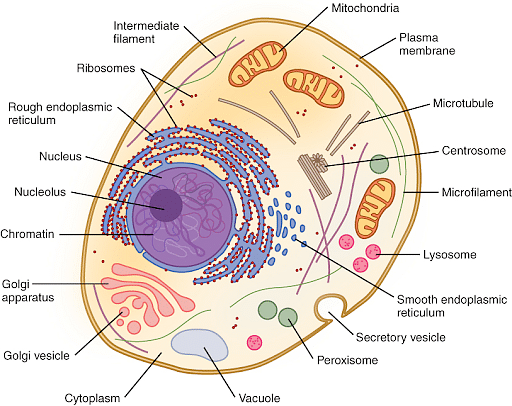
Cellular Organization
- Nucleus: Nucleus is defined as a double-membraned eukaryotic cell organelle that contains the genetic material. The nucleus is the component responsible for regulating almost all forms of cellular activities. The major purposes of the nucleus are to store the cell’s DNA, maintain its integrity and facilitate its transcription and replication.
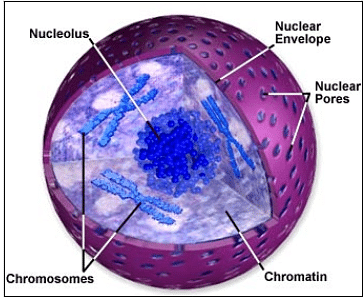
Nucleus
Read More: Eukaryotic Nucleus
- Plasma Membrane: Plasma membrane is also called the Cell membrane. It is the membrane that separates the interior of the cell from the exterior space. It is a flexible lipid bilayer that encircles and contains the cytoplasm of the cell. The plasma membrane’s function is to provide protection for the cell. It also provides a stable environment inside the cell.

Plasma Membrane
- Vacuoles: Vacuole is the membrane-bound organelle of the cell. Vacuoles are usually smaller in animals and help excrete waste, whereas, in plants, they help maintain water balance. The main functions of the vacuoles are to store water, nutrients, salts, minerals, proteins and pigments within the cell. Other functions include removal and storage of waste produced during autophagy; removal and storage of harmful foreign products so they don’t damage the cell.

Vacuole
- Vesicles: Vesicles are small structures within a cell that consists of a fluid enclosed by a lipid bilayer. They can absorb and demolish toxic substances and pathogens to prevent cell damage and infection. They can also fuse with the membrane of other cells to carry out a definite function, such as breaking down another cell. They help store and transport components such as proteins, enzymes, hormones and neurotransmitters.

Vesicles
- Golgi Apparatus: Golgi apparatus is also known as the Golgi complex, Golgi body or Golgi. It is capable of disassembly as well as reassembly. The main purpose of Golgi is the packaging and secretion of proteins. It functions as a factory in which the proteins received are further processed and sorted for transportation to the lysosomes, the cell membrane or secretion.

Golgi Apparatus
- Mitochondrion: Mitochondrion is called the ‘Powerhouse of the cell’. They help convert the energy we take from food into energy that the cells use. They are specialized structures which are unique to the cells of animals, plants as well as fungi. Its main function is to break down carbohydrates and fatty acids in order to generate energy. It also synthesizes proteins for its own use. Mitochondria work independently and execute the transcription of DNA to RNA and translation of RNA to amino acids.

Mitochondria
Read More: Difference Between DNA and RNA
- Endoplasmic Reticulum: Endoplasmic reticulum consists of 2 subunits- rough endoplasmic reticulum and smooth endoplasmic reticulum. The endoplasmic reticulum forms an interlinked network of flattened sacs that are membrane-enclosed in the rough endoplasmic reticulum and tubular structures in the smooth endoplasmic reticulum. They involve in certain common activities like the synthesis of certain lipids and cholesterol. SER is responsible for the metabolism of carbohydrates; production and secretion of steroid hormones; storage and release of calcium ions. On the other hand, RER is associated with the role of protein synthesis, protein folding and protein sorting.

Endoplasmic Reticulum
Read More: Difference Between Smooth and Rough Endoplasmic Reticulum
- Ribosome: Ribosome is a complex molecular machine that produces proteins from amino acids during a process called protein synthesis. Protein is essential for many cell activities. Ribosomes occur as both free particles as well as particles attached to the membranes of the endoplasmic reticulum in eukaryotic cells. Ribosomes have 2 main functions, decoding the message and formation of peptide bonds. It assembles amino acids to form proteins that are important to carry out cellular functions.

Ribosomes
Read More: Translation Protein Synthesis
- Lysosome: Lysosome can be defined as a membrane-bound cell organelle that contains digestive enzymes. They have the ability to break down almost all types of biomolecules. Lysosomes serve both to degrade material taken up from outside the cell and to digest disused components of the cell itself. Lysosomes respond against foreign substances such as bacteria, viruses and other antigens.

Lysosomes
- Centriole: Centrioles are paired barrel-shaped organelles located in the cytoplasm of animal cells near the nuclear envelope. Each centriole is composed of nine bundles of microtubules arranged in a ring. Though they play a vital role in the mitosis of animal cells, plant cells are able to reproduce without centrioles. The major function of the centriole is to help the cell division in animal cells. They also help in the shaping of the spindle fibres that separate the chromosomes during mitosis.

Centriole
Read More: MCQs on Chromosomes
Things to Remember
- Cells are the smallest unit of life and are too small to be seen without a microscope. They contain DNA and RNA.
- Cellular organization is the components of the cell and their arrangement inside it.
- The different levels of the cellular organization are the nucleus, plasma membrane, vacuoles, vesicles, Golgi apparatus, mitochondrion, Endoplasmic reticulum, ribosomes, lysosome, and centriole.
- The mitochondrion is called the powerhouse of the cell.
- Centrioles are the cell organelles that are present only in animal cells and not in plant cells.
Sample Questions
Ques. Differentiate between Rough Endoplasmic Reticulum and Smooth Endoplasmic Reticulum. (5 Marks)
Ans. The differences are as follows:
-
- Rough Endoplasmic Reticulum
- Ribosomes are attached to their surface.
- It is composed of cisternae and some tubules.
- RER synthesizes enzymes and proteins.
- Produces proteins.
- Present close to the cytoplasm
- Rough Endoplasmic Reticulum
- Smooth Endoplasmic Reticulum
-
- Ribosomes are not attached to their surface
- It is comprised of vesicles and tubules
- SER synthesizes glycogen, lipids and steroids
- Produces lipids and proteins
- Present close to the cell membrane
Ques. Why are mitochondria referred to as the powerhouse of the cell? (3 Marks)
Ans. Mitochondria are organelles inside the cells that are involved with the releasing of energy from food. It is answerable for extracting energy from food through cellular respiration. It is for this reason that mitochondria are stated as the powerhouse of the cell. They, not only aid in producing energy but store calcium, cell death as well as heat production.
Ques. What is the significance of the nucleus to a cell? (3 Marks)
Ans. Nucleus controls and regulates the activities of the cell i.e. the growth and metabolism of the cell. They also carry genes and structures that contain hereditary information. It acts as a control centre as it regulates the cell cycle and the cell dies without the presence of a nucleus. The nucleus mainly stores DNA, maintains integrity and facilitates its transcription and replication.
Ques. Why are animal vacuoles smaller than plant vacuoles? (3 Marks)
Ans. Animal cells do not have to store food, water, cell sap and minerals, whereas plant cells have to store food, water, cell sap and minerals. Hence, plant cells have larger vacuoles than animal cells. Plant cells store water and nutrients for survival purposes. Sometimes a single vacuole can take up most of the interior space of the cell.
Ques. What are Ribosomes made up of? (3 Marks)
Ans. Ribosomes are complex molecules made from ribosomal RNA molecules and proteins that form a factory for protein synthesis. The ribosomes are responsible for translating encoded messages from messenger RNA molecules to synthesize proteins from amino acids. Since ribosomes produce protein, without them cells would not be ready to function properly.
Ques. What cell type has many Golgi apparatus? (3 Marks)
Ans. Golgi apparatus is additionally known as the Golgi complex, Golgi body or Golgi. While many types of cells contain just one or several Golgi apparatus, plant cells can carry hundreds. The Golgi apparatus is in charge of transporting, modifying, and packaging proteins and lipids into vesicles for delivery to targeted destinations. Golgi consists of flat sacs known as cisternae.
Ques. What is the function of Centriole in a cell? (3 Marks)
Ans. The centriole is concerned with cell division and assists in the formation of spindle fibres that separate the chromosomes during the cell cycle. Centrioles play a significant role in organizing microtubules that serve as the cell's skeletal system. They also assist to determine the locations of the nucleus and other organelles within the cell.
Ques. What are vesicles used for? (3 Marks)
Ans. Vesicles are the basic tool used by the cell for organizing cellular substances. Vesicles are involved in metabolism, transport, floatability control, and enzyme storage. They also act as chemical process chambers. Vesicles are useful in the transportation of materials that an organism needs to survive and recycle waste materials. They also help in the absorption and destroying of toxic substances and pathogens to prevent cell damage and infection.
Ques. What is the smallest and the largest cell? (3 Marks)
Ans. Mycoplasms are the smallest living cells in the biological world. They have a minimal size of approximately 0.2 micrometres. The human egg also called the Ovum is the largest cell in the body, it has a diameter of about 0.1mm and a nerve cell is the longest cell within the human body.
Check-Out:




Comments