




The Odisha CHSE +2 exams were concluded successfully on 25th March, 2026. According to the Indian Express, around 4 lakh students appeared for Class 12 Odisha Board exams 2026 across 1364 centres in the state. The CHSE +2 results for all three streams: Arts, Science, and Commerce are expected in May 2026.
- The Council of Higher Secondary Education, Odisha, released the +2 admit cards on 19 December, 2025.
- The Odisha Class 12 Board exams were scheduled between February 18 and March 25, 2026.
- The board usually takes 50-55 days to publish the Odisha CHSE +2 results online.
- Students can check their marksheet with their registration/roll number and date of birth.
- The Odisha CHSE +2 result link will be available for download at chseodisha.nic.in.
Students who will fail or want to improve in one or two subjects can appear for the Odisha CHSE Improvement exam 2026. The official notification will be out after the announcement of the CHSE, Odisha plus two results 2026. The name-wise results will be available for download only through third-party websites like www.indiaresults.com.
| Direct Link to Download Odisha CHSE +2 Result 2026 (Available Soon) |
Also Check:
Key Summary
- The Class 12 Odisha Board Exams were scheduled between February 18 and March 25, 2026.
- The CHSE +2 results will be published online after the press conference, expected in the first week of May.
- Login credentials, including seat number/roll number and Mother’s first name, are required to download the Marks Memo.
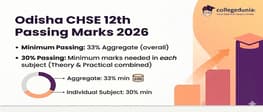
- The CHSE +2 exam will be a total of 600 marks. Students are required to secure an aggregate of 33% marks to pass the exam.
What is Odisha CHSE 2026 Exam?
The Council of Higher Secondary Education (CHSE), Odisha conducts Class 12th Board exams between February and March every year. Nearly 4 lakh students appear across the Arts, Science and Commerce streams.
- Last year, more than 3.9 lakh students appeared for the exam across 1000+ exam centres across the Odisha state.
- In 2025, the results were out on 21st May, showing the CHSE Odisha Class 12 pass percentage at 82.77%.
- Girls outperformed the boys with a pass percentage of 87.24%, whereas it was 77.88% for boys in the 2025 Odisha CHSE +2 results.
Odisha CHSE Exam 2026: Highlights
Given below are the key highlights of the Odisha CHSE Exam 2026:
| Particulars | Details |
|---|---|
| Exam Name | Odisha Higher Secondary Examination (HSE) |
| Exam Conducting Authority | Council of Higher Secondary Education (CHSE), Odisha |
| Frequency of Conduct | Once a Year |
| Exam Level | Intermediate |
| Streams Offered | Science, Commerce, Arts and Vocational |
| Mode of Exam | Offline |
| Exam Duration | 3 Hours |
| Eligibility | Students who have passed the class 11 exam with at least 33% of the total aggregate |
| Passing Marks | 33% of the total marks |
| Official Website | chseodisha. nic.in |
Odisha CHSE Exam Dates 2026 (Revised)
The dates for the Odisha CHSE +2 exam, after revision through the official notice, are provided below:
| Date | Stream(s) | Subjects / Details |
|---|---|---|
| February 18, 2026 | Science | MIL – (O) |
| February 19, 2026 | Vocational | BFC – History, BFC – Accountancy, BFC – Physics |
| February 20, 2026 | Arts, Commerce | MIL – (O) |
| February 21, 2026 | Science, Vocational | BFC – Political Science, BFC – Business Studies & Management (BSM), BFC – Chemistry |
| February 24, 2026 | Science | English – (E), Visual Art |
| February 25, 2026 | Arts/Science/Commerce | Tourism and Travel Management, Fashion Technology, Paramedical and Health Care, Office Management, Banking, Information Technology, Dairying, Horticulture, Electrical Domestic Appliances, MIL (Odia, Hindi, Bengali, Telugu, Urdu, Sanskrit), Alternative English |
| February 26, 2026 | Arts, Commerce | English – (E) |
| February 28, 2026 | Science, Vocational | Physics, BFC – Mathematics (M) |
| March 2, 2026 | Arts/Science | Geography |
| March 5, 2026 | Arts, Commerce | History (HIS), Business Studies & Management (BSM) |
| March 6, 2026 | Science, Vocational | Chemistry, English |
| March 7, 2026 | Arts/Science & Commerce | I.T. & I.TES Multi Skilling subjects (e.g., Food Processing, Tourism & Hospitality, Agriculture, Plumber, Automotive, Electronics & Hardware, Retail, Construction, Beauty & Wellness) |
| March 9, 2026 | Arts, Commerce | Political Science, Business Mathematics & Statistics |
| March 10, 2026 | Science, Vocational | Biology (Section-A Botany / Section-B Zoology), All Vocational Stream Trade Subjects (Paper-III) |
| March 11, 2026 (shifted) | Arts, Commerce, Science | Hindi, Bengali, Telugu, Urdu, Sanskrit, Alternative English → Revised to March 23, 2026 |
| March 12, 2026 | Arts | Indian Music, Psychology, Education |
| March 13, 2026 | Arts/Science, Arts Vocational | Mathematics, Home Science, BFC – Economics |
| March 14, 2026 | Arts/Science, Arts/Commerce | Economics, Personnel Management, Cost Accounting, Business Economics, Fundamentals of Management Accounting, Computer Application |
| March 16, 2026 | Arts/Science/Commerce, Science | Information Technology, Computer Science, Bio Technology, Electronics |
| March 17, 2026 | Arts, Arts/Science | Odia, Hindi, Bengali, Telugu, Urdu, Sanskrit/Elective Sanskrit |
| March 19, 2026 | Arts/Science, Arts Vocational | Statistics, Anthropology, Sociology, Biology |
| March 21, 2026 (shifted) | Arts, Commerce, Vocational | Logic, Accountancy, All Vocational Stream Trade Subjects (Paper-IV) → Revised to March 25, 2026 |
| March 23, 2026 | Various (revised slot) | Other MIL subjects (as per corrigendum) |
| March 25, 2026 | Various (revised slot) | Logic, Accountancy, Vocational Paper-IV (as per corrigendum); reserved dates for any adjustments |
Odisha CHSE Results 2026
Odisha CHSE results for Science, Commerce, and Arts are now available. Students can easily download Odisha CHSE 2026 results online by following the steps given below:
- First, log in to the official website Odisha Council of Higher Secondary Education (CHSE) - orissaresults.nic.in.
- Find the link to "CHSE Annual Exams Results 2026" as per your stream and then click on it.
- The result login window will open up.
- Enter your roll number and registration number as mentioned in the admit card carefully.
- Type the captcha as shown and click on the submit button.
- Your Odisha CHSE 2026 marksheet will be displayed on the screen. Click to download it in PDF format.
- Get a printout of the marksheet for future purposes.
Odisha CHSE Passing Criteria 2026
There are 6 subjects for the Odisha CHSE Exam 2026, including the compulsory and optional subjects. The maximum score in each subject is 100 marks, out of which the theory portion makes up to 70 marks, and 30 marks are assigned for practicals for science subjects.
The non-science subjects have exams for a total of 100 marks each. The passing marks criteria for the Odisha CHSE exam 2026 are as follows:
- Students have to score at least 30 marks in subjects without practicals, such as Language - Hindi, Odiaa, etc. and optional subjects - History, Geography, Political Science, etc., to pass these exams.
- Candidates must achieve 22.5 marks in the theory of those subjects with practicals (Science) and at least 10 marks in practicals out of 30.
- The overall aggregate percentage should be above 33%. If it is less than 33%, then that student is deemed to have failed the exam.
Odisha CHSE Grading System 2026
The grading system for the Odisha Plus 2 Exam 2026 is as follows:
| Marks obtained | Grade | Grade Point | Remarks |
|---|---|---|---|
| 91 – 100 | A1 | 10 | Outstanding |
| 81 – 90 | A2 | 9 | Excellent |
| 71 – 80 | B1 | 8 | Very good |
| 61 – 70 | B2 | 7 | Good |
| 51 – 60 | C1 | 6 | Average |
| 41 – 50 | C2 | 5 | Fair |
| 33 – 40 | D | 4 | Satisfactory |
| 21 – 32 | E1 | C | Needs improvement |
| 00 – 20 | E2 | C | Needs improvement |
Odisha CHSE Exam 2026: Revaluation
After the Odisha CHSE 2026 results declaration, some students may be unsure about their obtained marks. They might feel that they deserve more or that there is a mistake in the correction of their papers.
For this, the Odisha board provides a revaluation facility for students to apply for revaluation of their answer sheets for satisfaction. However, some points should be kept in mind before enrolling for the Odisha CHSE 2026 revaluation process.
- There is a specific time period to apply for revaluation. The Odisha board releases the application date for revaluation after the announcement of the plus two results.
- Students have to submit a fee of INR 200 per subject paper for revaluation. Theory and practical exams of a single subject will be considered as two separate papers while applying for rechecking or revaluation.
- Revaluation may result in a decrease or increase, or no change in the marks obtained in the exam.
Odisha CHSE Supplementary Exam 2026
Students who are unable to qualify Odisha CHSE 2026 exams have to appear for the supplementary exams. The Council of Higher Secondary Education, Odisha, will announce the supplementary exam notification after the declaration of regular results.
- Candidates who are unsatisfied with their exam results can also appear for this exam.
- The registration for the Odisha CHSE supplementary exam will start in June 2026, and the exams will be conducted tentatively in July 2026.
- The application form for supplementary exams will be provided by the school, or else it will be made available on the official website of the board online.
- Students who wish to appear for the supplementary exams must submit the application form at their respective schools before the last date to avoid any penalties.
Odisha CHSE Registration 2025-26
The registration process for Odisha CHSE Exams 2026 is conducted offline under the supervision of the respective school authorities for the regular students. Students are required to submit the Odisha CHSE 2026 application form before the deadline to avoid paying the fine fees.
The ex-regular students can fill out the application forms online as per the instructions of the council. Some important key points to remember during the Odisha CHSE registration process are as follows:
- Fill in all the credentials diligently, as they will appear on the CHSE admit card of the student.
- After submitting the application form, no changes can be made.
- The information on the application form must match the information on the former class 11's registration card.
- Candidates must pay the registration fees of INR 520 to their respective schools on time.
- In case of delay in the submission of the application form, a fine of INR 100 will be charged per person as the first late fee, and a fine of INR 450 will be charged as the second late fee.
- Students must select their subjects carefully,y as no alterations will be allowed after submitting.
- If candidates can not get an admit card after the completion of the registration process, they should contact their school department.
Steps to Register for Odisha CHSE Exam 2026
The steps to apply for online registration of the Odisha CHSE Exam 2026 are given below:
- Log in to the official website of the Odisha board- https://chseodisha.nic.in/
- Look for the 'Application Form CHSE 2026' on the home page.
- A form application page will be displayed on the screen.
- Fill in the credentials as asked carefully, as no alterations will be allowed afterwards.
- Attach the documents as required. Make the payment of the registration fee through your desired mode of payment online.
- Click on the "Submit" button for completion of the process.
Documents Required for Odisha CHSE Registration 2026
The documents required for the Odisha CHSE 2026 registration process are as follows-
- Birth Certificate
- A recent passport-size photograph of the candidate with the date of birth written on it.
- Secondary School Mark Sheet
- The first Registration Card, which was issued in class 11
- Aadhar Card
Note: For Instant Exam, you need to submit a self-attested xerox copy of the downloaded AHS 2026 marksheet, and one recent passport-sized photograph.
Odisha CHSE Exam Pattern 2025-26
The Odisha CHSE exam 2026 will be held in offline mode, and each subject will have a maximum of 100 marks. The theory portion will carry up to 70 marks, while the practicals are worth 30 marks.
- The subjects which do not have a practical syllabus will have a 100-mark paper.
- The Odisha CHSE question paper is divided into several sections with all types of questions ranging from MCQs, short answer types, and long answer types.
- The mark's weightage is assigned according to the length of the answer required, which goes from 1 to 5 marks.
| Stream | Subjects | Theory | Practical | Duration |
|---|---|---|---|---|
| Language | English/ Hindi/ Odia/ Sanskrit/ Telugu, etc | 100 | - | 3 hours |
| Science | Botany Zoology Physics Chemistry | 70 | 30 | 3 hours |
| Mathematics | 100 | - | 3 hours | |
| Commerce | Business Studies, Statistics, Accounting, Business Mathematics, Computer Applications, | 100 | - | 3 hours |
| Arts | History, Political science, Economics, education | 100 | - | 3 hours |
The exam pattern, according to the type of questions, remains the same for almost every subject. However, there is a difference between the non-science and science papers, and it is demonstrated and discussed below.
Odisha CHSE 2026 Marking Scheme for Non-Science Subjects
Odisha Plus 2 Exam 2026 for non-science subjects is conducted for a total of 100 marks. The marking scheme of Odisha CHSE non-science subjects is as follows:
| Group | Type of Question | No. Of questions | Marks (each) | Total marks |
|---|---|---|---|---|
| A | Multiple-choice question, one-word answer type questions | 1515 | 11 | 30 |
| B | Very short answer type question Short answer type question | 116 | 23 | 40 |
| C | Long answer type questions | 4 | 7½ | 30 |
| Overall | - | - | - | 100 |
Odisha CHSE 2026 Marking Scheme for Science Subjects
The Odisha CHSE Exam 2026 for science subjects is conducted for a total of 70 marks. The marking scheme of Odisha CHSE science subjects is as follows:
| Group | Type of Question | No. Of questions | Marks (each) | Total marks |
|---|---|---|---|---|
| A | Multiple-choice question, one-word answer type questions | 10 10 | 1 1 | 20 |
| B | Short answer type questions, Medium answer type questions | 10 3 | 2 3 | 29 |
| C | Long answer type questions | 3 | 7 | 21 |
| Overall | - | - | - | 70 |
Odisha CHSE 2026 Marking Scheme for Practicals
Odisha CHSE 2026 practicals for the science stream are conducted for a total of 30 marks. The marking scheme of Odisha plus 2 practicals is as follows:
| Type of Questions | Marks |
|---|---|
| Test 1 MCQ | 6 |
| Test 2 MCQ | 6 |
| Test 3 MCQ | 6 |
| Test 4 descriptive | 6 |
| Test 5 descriptive | 6 |
| Total | 30 |
Odisha CHSE Syllabus 2025-26
Odisha CHSE Syllabus 2026 is perfectly designed to prepare students for higher studies. It includes all the fundamental aspects of each subject so as to build a strong foundation of knowledge for students, which will also help them in choosing the right stream. The latest Odisha CHSE 2026 syllabus for the session 2025-26 is discussed below, subject-wise.
Odisha CHSE English Syllabus 2026
Given below is the Odisha CHSE 2026 syllabus for the English subject:
| Units | Topics/ Chapters |
|---|---|
| Prose |
|
| Poetry |
|
| Non-detailed study |
|
| Writing Skills |
|
| Grammar |
|
Odisha CHSE Chemistry Syllabus 2026
Given below is the Odisha CHSE 2026 syllabus for the Chemistry subject:
| Chapters | Topics |
|---|---|
| Solid State | Classification of solids based on different binding forces – Amorphous and crystalline solids, Unit cell in two-dimensional and three-dimensional lattices, calculation of density of unit cell, Packing in solids, packing efficiency, voids, number of atoms per unit cell in a cubic unit cell. Point defects, electrical and magnetic properties. Band theory of metals, conductors, semiconductors and insulators and n & p-type semiconductors. |
| Solutions | Types of solutions, expression of concentration of solutions of solids in liquids, the solubility of gases in liquids, solid solutions, and colligative properties. Relative lowering of vapour pressure, Raoult’s law, the elevation of boiling point, depression of freezing point, osmotic pressure, determination of molecular masses using colligative properties, abnormal molar mass, van’t Hoff factor |
| Electrochemistry | Redox reactions, electrolytes and non-electrolyte conductors, conductance in electrolytic solutions, Specific and molar conductivity, the variation of conductivity with concentration, Kohlrausch’s Law, electrolytes and laws of electrolysis. Dry cell electrolytic cells and Galvanic cells, lead accumulator, EMF of a cell, standard electrode potential, Nernst equation and its application to chemical cells, the relation between Gibbs free energy change and EMF of a cell, fuel cells, corrosion. |
| Chemical Kinetics | Rate of a reaction, factors affecting the rate of reaction, Order and molecularity of a reaction, rate law and specific rate constant, integrated rate equations and half-life, Concept of collision theory. Activation energy, Arrhenius equation. |
| Surface Chemistry | Adsorption - physisorption and chemisorption, factors affecting the adsorption of gases on solids, and catalysts. homogeneous and heterogeneous activity and selectivity. True solutions, colloids and suspensions. properties of colloids: Tyndall effect, Brownian movement, electrophoresis, and coagulation. Emulsion- types of emulsions. |
| General Principles and Processes of Isolation of Elements | Principles and methods of extraction. concentration, oxidation, reduction. electrolytic method and refining, zone refining, occurrence and principles of extraction of aluminium, copper, zinc and iron. |
| p - Block Elements | Group 15, Group 17 and Group 18 Elements- General introduction, electronic configuration, occurrence, properties, classification, preparation of different compounds and their use. |
| d and f Block Elements | General introduction, electronic configuration, occurrence and characteristics of transition metals, General trends in properties of the first-row transition metals - metallic character, ionisation enthalpy, oxidation states, ionic radii, colour, catalytic property, magnetic properties, interstitial compounds, alloy formation, preparation and properties of K2CrO7 and KMnO |
| Coordination Compounds | Coordination compounds - Introduction, ligands, coordination number, colour, magnetic properties and shapes. IUPAC nomenclature of mononuclear coordination compounds. Bonding, Werner’s theory. VBT and CFT- structure and stereoisomerism. Importance of coordination compounds. |
| Haloalkanes and Haloarenes | Pptical rotation. Haloarenes- Nature of C - X bond, substitution reactions. Uses and environmental effects of dichloromethane, trichloromethane, tetrachloromethane, iodoform, freons, DDT, and BHC. Haloalkanes- Nomenclature, nature of C-X bond, physical and chemical properties, mechanism of substitution |
| Organic Compounds Containing Nitrogen | Nomenclature classification, structure, methods of preparation, physical and chemical properties, Uses, identification of primary, secondary and tertiary amines. Diazonium salt |
| Polymers | Classification- polymerisation, co-polymerisation, some important polymers- polythene, nylon, polyester, bakelite, rubber. Biodegradable and non-biodegradable polymers. |
| Chemistry in Everyday Life | Chemicals in Medicines- Analgesics, tranquillizers antiseptics, disinfectants, antimicrobials, antifertility, drugs, antibiotics, antacids, antihistamines. Chemical in Food- Preservatives, artificial sweetening agents, elementary idea of antioxidant,s Cleansing agents- Soap and detergents, cleansing action |
Odisha CHSE Physics Syllabus 2026
Given below is the Odisha CHSE 2026 syllabus for the Physics subject:
| Chapters | Topics |
|---|---|
| Electric Charges and Fields | Electric charge and its quantisation, conservation of charge, Coulomb’s law, the force between two point charges, superposition principle, etc. |
| Electrostatic Potential and Capacitance | Electric potential, potential difference, potential due to a dipole, potential due to a system of charges, Equipotential surfaces, electrical potential energy, Conductors, insulators, free charges and bound charges inside a conductor, capacitors and capacitance, combination of capacitors in series and parallel, energised in a capacitor, etc. |
| Magnetic Effect of Current and Magnetism | Moving charges and magnetism: Concept of the magnetic field, Oersted's experiment, Biot-Savart law, Ampere’s law and its application, Straight and toroidal solenoid, Cyclotron. Force on a current-carrying conductor in a uniform magnetic field, the force between two parallel current-carrying conductors, the torque experienced by a current loop, the moving coil galvanometer, and the conversion of current from an ammeter and a voltmeter |
| Magnetism and Matter | Current loop as a magnetic dipole and its magnetic dipole moment, magnetic dipole moment of a revolving electron, magnetic field intensity due to a magnetic dipole, torque on a magnetic dipole, bar magnet as an equivalent solenoid, magnetic field lines, etc. |
| Electromagnetic Induction and Alternating Current | Electromagnetic induction, Faraday’s laws of electromagnetic induction, induced EMF and current, Lenz’s Law, Eddy currents, self and mutual induction. Alternating Current Alternating currents, peak and RMS value of alternating current, LC oscillation, LCR series circuit, resonance, power in AC circuits, wattles current, A.C. generator and transformer, etc. |
| Electromagnetic Waves | The basic idea of displacement current, the characteristics of electromagnetic waves, and their transverse nature. Electromagnetic spectrum and its uses. |
| Optics | Ray optics and optical instruments, Reflection of light, spherical mirrors, mirror formula, lateral and longitudinal magnification. total internal reflection and its applications, optical fibre, Refraction at spherical surfaces. lens formula, lens makers' formula, magnification, power of lenses, two thin lenses in contact, etc. Scattering of light The blue colour of the sk,y and reddish appearance of the sun at sunset and sunrise, Optical instruments: microscopes and telescopes |
| Wave Optics | Wavefront, Huygen’s principle, reflection and refraction of plane waves, proof of laws of reflection and refraction using Huygen’s principle, Interference, Young’s double-slit experiment, resolving power of microscope and astronomical telescope, polarization, Brewster’s law, uses of plane-polarized light and polaroids, etc |
| Atoms and Nuclei | Ato: Ms Rutherford’s model of an atom, Bohr model, energy levels, and hydrogen spectrum. Nuclei Atomic nucleus, nature of nuclear force, the binding energy per nucleon, nuclear fission, fusion, Radioactivity, alpha, beta and gamma particles, radioactive decay law, half-life and decay constant. |
| Semiconductor Electronics | Energy bands in conductors, semiconductors and insulators, p-type, n-type semiconductors, semiconductor diode, V-I characteristics, diode, etc. Special-purpose p-n junction diodes, Zener diodes as a voltage regulator, etc. Junction transistor, transistor action, Logic gates (OR, AND, NOT, NAND, and NOR), the basic idea of analogue and digital signals, etc. |
| Communication System | Elements of a communication system, bandwidth of signals, bandwidth of transmission medium, propagation of electromagnetic waves in the atmosphere, sky and space wave propagation, satellite communication, modulation, a basic idea about the internet, mobile telephony and GPS. |
Odisha CHSE Biology Syllabus 2026
Given below is the Odisha CHSE 2026 syllabus for the Biology subject:
| Chapters | Topics |
|---|---|
| Reproduction | Reproduction in organisms. Reproduction, Modes of reproduction Sexual reproduction in flowering plants Flower structure, Development of male and female gametophytes, Pollination-types, Double fertilisation, Development of endosperm and embryo, Development of seed and formation of fruit, Significance of seed and fruit formation, etc. Human Reproduction: Male and female reproductive systems, Gametogenesis, Menstrual cycle, Fertilisation, embryo development, Pregnancy and placenta formation,n etc. Reproductive health: Need for reproductive health and prevention of sexually transmitted diseases, Birth control, Infertility and assisted reproductive technologies, etc. |
| Genetics and Evolution | Heredity and Variation:n Mendelian Inheritance, Pleiotropy, Elementary idea of polygenic inheritance, Chromosome theory of inheritance, linkage and crossing over, er etc. Sex determination in humans, birds, and honey bees, Sex-linked inheritance, Mendelian disorders in humans, Thalassemia, Chromosomal disorders in humans. Molecular Basis of Inheritance: Structure of DNA and RNA, DNA packaging; DNA replication, Gene expression and regulation- Lac Operon, human genome project; DNA fingerprinting. Evolution Origin of life, Darwinism, Modern Synthetic Theory of Evolution, Mechanism of evolution, Natural Selection with examples, types of natural selection, Hardy-Weinberg’s principle, Adaptive Radiation, Human evolution, etc |
| Biology and Human Welfare | Health and Disease- Pathogens; parasites causing human diseases, Basic concepts of immunology- vaccines; Cancer, HIV and AIDS, Adolescence, drug and alcohol abuse. Improvement in food production Microbes in human welfare- In household food processing, industrial production, sewage treatment, energy generation and as biocontrol agents and biofertilizers. |
| Biotechnology and Its Applications | Principles and process of Biotechnology Genetic engineering (Recombinant DNA technology) Application of Biotechnology in health and agriculture Human insulin and vaccine production, gene therapy, Genetically modified organisms- Bt crops, Transgenic Animals, Biosafety issues- Biopiracy and patents |
| Ecology and Environment | Organisms and environment- Habitat and niche, Population and ecological adaptations, interactions-mutualism, competition, predation, parasitism, Population attributes, etc. Biodiversity and its conservation - Concept of Biodiversity, Importance of Biodiversity. conservation; Hotspots, endangered organisms, extinction, Red Data Book. Biosphere reserves, National parks and Sanctuaries |
Odisha CHSE Maths Syllabus 2026
Given below is the Odisha CHSE 2026 syllabus for the Maths subject:
| Chapters | Topics |
|---|---|
| Relations and Functions | Relations and Functions: reflexive, symmetric, transitive and equivalence relations, composite functions, the inverse of a function. Binary operations, etc. Inverse Trigonometric Functions: Definition, range, domain, Graphs of inverse trigonometric functions. Elementary properties of inverse trigonometric functions, etc. Linear Programming Introduction, different types of linear programming (L.P.) problems, graphical method of solution for problems in two variables, feasible and infeasible regions, feasible and infeasible solutions, optimal feasible solutions, etc. |
| Algebra | Matrices Concept, notation, order, equality, types of matrices, operations on matrices, Addition and multiplication,d multiplication with a scalar, Non-commutativity of multiplication of matrices, the concept of elementary row and column operations, Invertible matrices and proof of the uniqueness of inverse. Determinants: The determinant of a square matrix, properties of determinants, applications of determinants in finding the area of a triangle, Adjoint and inverse of a square matrix, solving systems of linear equations in two or three variables, etc. Probability,y Conditional probability, multiplication theorem on probability, total probability, Bayes ’ theorem, Random variable, mean and variance of a random variable, Bernoulli trials and Binomial distribution. |
| Differential Calculus | Continuity and Differentiability: the derivative of composite functions, derivatives of inverse trigonometric functions, derivative of implicit functions, Concept of exponential and logarithmic functions. The derivative of functions expressed in parametric forms. Second-order derivatives, etc. Applications of Derivatives:s Rate of change of bodies, increasing and decreasing functions, tangents and normals, maxima and minima, use of derivatives in approximation |
| Integral Calculus | Integrals, Integration as an inverse process of differentiation, Integration by substitution, by partial fractions and by parts, Evaluation of simple integrals, Fundamental Theorem of Calculus. Applications of the Integrals: Applications in finding the area under simple curves, Area between curves. Differential Equations Definition, order and degree, Formation of differential equations whose general solution is given, solutions of homogeneous differential equations of the first order and first degree,e etc. |
| Vectors and Three-Dimensional Geometry | Vectors, Vectors and scalars, Types of vectors, multiplication of a vector by a scalar, position vector of a point dividing a line segment in a given ratio, products of vectors. Three - dimensional Geometry Direction cosines and direction ratios of a line joining two points, Cartesian equation and vector equation of a line, types of lines, the shortest distance between two lines, Cartesian and vector equation of a plane, Angle between three- dimensional elements |
Odisha CHSE Environmental Education Syllabus 2026
Given below is the Odisha CHSE 2026 syllabus for the Environmental Education subject:
| Unit /Chapter | Topics |
|---|---|
| Environment: Components |
|
| Natural Resources |
|
| Environmental Pollution |
|
| Environmental Management |
|
| Environmental Laws |
|
| Road Safety |
|
Also Check: Odisha CHSE Syllabus 2026
Odisha CHSE Admit Card 2026
Odisha CHSE Admit Card 2026 will be made available in the regional and divisional offices of CHSE Odisha 30 days before the actual exam. The board has directed the school authorities to match the details of roll number slips with the student data in the school and report any errors that are found.
- Once this process is over, the principal of every private or public school under the CHSE Odisha Board will issue and distribute the original admit card to the eligible candidates who are to appear in the coming plus 2 exams of 2026.
- The school is wholly responsible for the distribution of the Odisha CHSE 2026 admit card in offline mode.
- However, students who registered privately can download their admit card directly from the official website.
- In case a regular student loses his/her admit card, they can get another copy of their admit card online.
- However, the online admit card links are posted 10-15 days before the actual exam.
Steps to Download Odisha CHSE Admit Card 2026
Given below are the steps to download the admit cards for the Odisha Plus 2 exam 2026:
- Browse the Odisha CHSE official website (https://chseodisha.nic.in/).
- Now, find the latest notifications section in the bottom left corner of the home page.
- Scroll and look for the 'Download Plus Two Admit Card for 2026' link.
- Choose the respective link for the stream of the student.
- Enter the credentials as asked, such as name, school code, district, registration number, etc.
- Click on the Submit option.
- The Odisha CHSE 2026 admit card will be displayed with the candidate’s photograph and other details. Tap on the download in PDF format option.
- Get a printout of the same for future purposes and keep it secure with you until exams are over.
Also Check: Odisha CHSE Admit Cards
Odisha CHSE 2026 Exam Day Guidelines
The Odisha CHSE 2026 admit card will contain some guidelines that all students have to follow during the exam. Violation of these instructions may lead to problems for the student appearing for the exam.
- Each student must arrive at the exam centre 30 minutes before the exam starts.
- All students must be required to carry their own required stationery, water bottles, etc.
- It is mandatory to bring the Odisha plus 2 admit card for every exam. Without it, the student will not be allowed to enter the exam hall.
- Students are not allowed to talk with each other after getting the question paper, and any such improper behaviour will be condemned.
- No gadgets such as mobile phones, calculators, smart watches, etc. are allowed in the exam hall.
- If a person is found engaging in any sort of malpractice, strict action will be taken against them. They might be expelled from the hall, and their paper will be cancelled.
Odisha CHSE Sample Papers 2026
The board has provided sample papers for the Odisha CHSE Exam 2026 to make the students familiar with the exam pattern. Students should check out the subject-wise sample papers given below and understand the paper pattern.
| Subject | Sample Papers |
|---|---|
| Maths | Check Here |
| Physics | Check Here |
| Biology | Check Here |
| Political Science | Check Here |
| History | Check Here |
| Economics | Check Here |
Odisha CHSE Exam 2026: Reference Books
Here are some recommended popular reference books which will aid in the Odisha CHSE 2026 preparation:
| Subject | Popular Reference Books |
|---|---|
| English |
|
| Maths |
|
| Physics |
|
| Chemistry |
|
| Biology | Fundamentals of Biology by Oswal Publications |
Odisha CHSE Exam 2026: Preparation Tips
Students must follow the given preparation tips to ace the Odisha CHSE Exam 2026:
- Start your preparation from the commencement of the session by understanding concepts thoroughly and listening to the teacher attentively. Write down short notes and review what you're taught frequently.
- Recognise the important sections of chapters and organise your notes with diagrams, bullets and flowcharts to make them handy for revision. Review these notes every once in a while.
- Use different methods of memorisation such as flashcards, blurting, spaced repetition, etc. Find which way of learning suits you best and apply it to efficiently recall study material.
- Discuss topics with your friends and have interactive and interesting study sessions with your tutors. Make studying a fun task so that you won't get overwhelmed and unmotivated.
- Minimising any kind of possible distraction is essential for effective learning. Reduce your screen time, organise and clean your study space, and try to create a productive environment.
- It is substantial to create a balance between your academic aspirations and personal life. You don't have to neglect self-care to achieve good grades. Rather, those who take good care of themselves and stay healthy are likely to learn and retain better,r which in turn helps them to achieve better results.
- Finish your syllabus on time, practice sample papers and previous year's papers, and take mock tests. It'll boost your preparation and help you to develop time management skills, which are essential to ace these exams.
FAQs
Ques: When will Odisha CHSE +2 results 2026 be out?
Ans: The Council of Higher Secondary Education will release the CHSE +2 result 2026 soon. Based on past trends, students can expect the results in the first week of May 2026. Last year, the CHSE +2 results were out on 21st May, 2025.
Ques: How to check Odisha +2 results?
Ans: The Odisha +2 results for 2026 will be available online at the official website, chseodisha.nic.in. Students can check their marks memo by entering their roll number and date of birth.
Ques: What details will be mentioned on the CHSE Odisha +2 result 2026?
Ans: The following details will be mentioned on the CHSE Odisha +2 results 2026:
- Student’s Name
- Roll Number
- Registration Number
- Subject-wise Marks
- Qualifying Status
- Stream (Arts/Commerce/Science)
- Total Marks
- Division/Grade
Ques: Is the CHSE Odisha +2 exam 500 or 600 marks?
Ans: The total marks for the Odisha CHSE +2 exams 2026 will be 600. Students are required to secure an aggregate of 33% marks across all subjects to pass the Class 12 Odisha Board exams.
 (7).jpeg?h=112&w=263&mode=stretch)
.png?h=112&w=263&mode=stretch)
.png?h=112&w=263&mode=stretch)
.png?h=112&w=263&mode=stretch)






Comments
Found 6 Comments
The exam for the academic session 2026 has not been conducted yet. You can download the previous year question papers.
Maharana Pratap, the celebrated Rajput king of Mewar, passed away on 19 January 1597 at the age of 56 in Chavand, his capital at the time. Injuries from a hunting accident caused his death. Even after his passing, he remained a symbol of courage, independence, and resistance against the Mughal Empire.
You can download the CHSE Odisha Sample Papers: Download Free PDF. The sample papers are an important resource for students preparing for the board exams. Solving these papers will help students get a clear understanding of the Odisha 12th exam pattern and marks weightage for different topics.
To download the +2 2nd year History previous year question papers 2021 from the Odisha CHSE board, visit the official website www.chseodisha.nic.in. On the homepage, go to the “Examinations” or “Question Papers” section. Select “+2 Arts” and then choose “History.” Look for the year 2021 question paper link and download the PDF file directly for reference and practice.
To officially download the CHSE Odisha +2 (Class 12) second year Chemistry question paper, visit the Council of Higher Secondary Education, Odisha official sites such as chseodisha.nic.in or the state education question papers page (Sikhya Jyoti portal), where previous year PDFs are posted for all subjects including Chemistry
How I will get admission in Revenshaw university
Using the official SAMS website, you can submit an online application for admission to Ravenshaw University. While PG students must take the Odisha State Higher Education Council's (OSHEC) CPET test in order to be considered for final admission, UG students are selected based on their performance in Class 12. The university recognises OJEE exam results for final admission to the MCA programme.