



Female hormones refers to the hormones that are specially dedicated to the female body functions and growth chracteristics. Major female specific hormones plays role in development of sex and femine traits. These hormenes are termed as sex hormones of female.
- The two major female sex hormones are estrogen and progesterone.
- Females also produce and need a small amount of testosterone, though it is considered a male hormone.
- Estrogen plays a pivotal role in reproductive and sexual development including puberty, menstruation, pregnancy, menopause, and so on.
| Table of Content |
Keyterms: Hormones, Estrogen, Progesterone, Testosterone, Puberty, Menstruation, Pregnancy, Menopause, Endocrine glands, Proteins, Sex hormones
Learn More About: ADH Hormone
What are Hormones?
[Click Here for Sample Questions]
Hormones are macromolecules that are in charge of governing and regulating the actions of specific cells and organs. Endocrine glands, which are ductless glands, release these hormones.
- Hormones are proteins or steroids that act as messengers in the body, maintaining internal balance and keeping the human body in a condition of homeostasis.
- These chemicals (Hormones) circulate throughout the body in unison with the circulation.
- In simple words, Hormones are chemical messengers that are released directly into the bloodstream, where they are carried to organs and tissues throughout the body to perform their tasks.
- Hormones come in a variety of forms that affect various physiological functions and activities.
- Development and growth are two examples where hormones have important role.
- Numerous hormones are synthesized by the respective glands and conduct a vast array of activities for a variety of objectives.
What are Female Hormones?
[Click Here for Previous Year Questions]
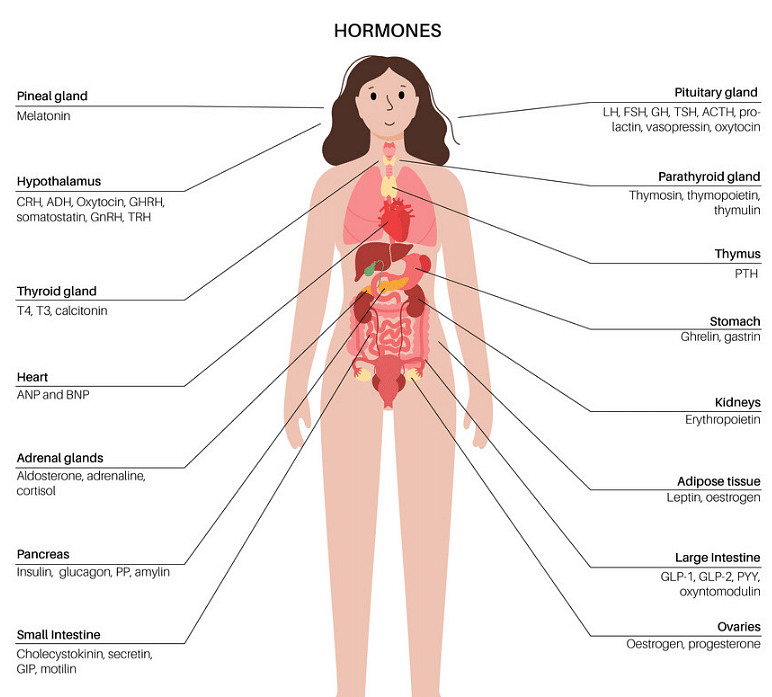
Females body produce and release a variety of hormones that are secreted by the endocrine system glands. Female hormones, estrogen, and progesterone are produced for the purpose of influencing a woman's reproductive health and are hence referred to as female hormones.
- Aside from this, testosterone hormones, which are commonly regarded as male hormones, are also generated in very tiny levels by the ovaries (female reproductive organ).
- Female sex hormones are another name for them.
- Female sex hormones, often known as sex steroids, are essential for sexual development, reproduction, and overall health.
- Sex hormone levels fluctuate over time, but the most noticeable variations occur during puberty, pregnancy, and menopause.
- Hormones have several crucial impacts on women's health due to their involvement infertility and the fact that female hormones are more prominent in women than males.
Learn More About:
Types of Female Hormones
[Click Here for Sample Questions]
Some Important Female Hormones and their functions are mentioned below:
Estrogen
The most well-known female sex hormone is estrogen. This sex hormone is generated in the adrenal glands, ovaries.
- Its primary purpose is to aid in breast development throughout puberty, to aid in the formation of the uterine lining during the menstrual cycle, and to preserve bone health by cooperating with vitamin D, calcium, and minerals.
- A little quantity of estrogen is also found in a man's body.
A blood test can be used to evaluate estrogen levels. While it varies from person to person, the following are considered typical ranges in picograms per milliliter (pg/mL):
- Premenopausal adult female: 15-350 pg/mL
- Postmenopausal adult female: 10 pg/mL
- 10-40 pg/mL in adult males
- Throughout the menstrual cycle, levels will fluctuate dramatically.
Progesterone
Progesterone, like estrogen, is generated in the adrenal glands and the ovaries. The progesterone hormone is active throughout the second part of the cycle.
- It creates the uterine lining, which allows the eggs to be implanted following ovulation.
- Progesterone production in women begins to decline after menopause, according to experts.
- Low progesterone levels may be the cause of symptoms such as mood changes, irritability, sadness, weight gain, osteoporosis, and other joint problems.
- When progesterone levels are low, estrogen takes over as the predominant sex hormone, resulting in estrogen dominance. Progesterone levels are determined via blood testing. Normal levels range from 0.1 to 0.3 ng/ml at adolescence to 290 ng/ml during the third trimester.

Testosterone
Testosterone is commonly thought to be a masculine hormone, however just as a tiny amount of estrogen is produced in males, a small amount of testosterone is produced in women.
- Other hormones, including DHEA and DHEA-S, help to produce testosterone.
- Testosterone levels are determined through blood testing.
- The normal range is 15 to 70 ng/dl.
DHEA- Dehydroepiandrosterone
Dehydroepiandrosterone (DHEA) is a steroid hormone that is also generated in the adrenal glands. Testosterone performs similar functions in women as it does in men, although to a lesser extent.
- It boasts a woman's energy level, bones, libido, and sexual response to stimulation in females.
- According to studies and surveys, women with higher levels of testosterone are more likely to choose a career with higher risks, particularly economic risks.

HCG- Human Chorionic Gonadotrophin
Human chorionic gonadotrophin is yet another hormone that is spontaneously generated in women. HCG is made in the cells that make up the placenta at the time of pregnancy.
- This hormone is found in both urine and blood tests for pregnancy.
- Studies show that the levels of HCG double every third day and reduce after the 12th week of pregnancy.
- HCG's purpose in pregnancy is to sustain the creation of progesterone, which keeps the body warm and the uterine lining in place.

Changes in Hormonal Roles with Time
[Click Here for Previous Year Questions]
Female sex hormones play an important role in a variety of bodily functions. However, as you leave childhood and enter puberty, your hormonal needs change dramatically.
- They also vary significantly if a female become pregnant, give birth, or breastfeeding.
- They continue to change as woman approach menopause.
- These changes are both natural and to be expected. Some of the changes are discussed below during different life phases:
Puberty
The pituitary gland produces luteinizing hormone (LH) and follicle-stimulating hormone (FSH). Puberty causes an increase in production, which boosts the sex hormones, particularly estrogen. This rise in female sex hormones causes:
- The growth of breasts
- The development of pubic and armpit hair
- A surge in total growth
- A rise in body fat, particularly in the hips and thighs
- Maturation of the ovaries, uterus, and vaginal canal
- The beginning of the menstrual period

Menstruation
The first menstrual cycle (menarche) occurs two to three years following the development of the breasts. Again, everyone is different, but most girls have their first period between the ages of 10 and 16. The different stages of Menstruation are:
- The follicular stage
The uterus thickens every month in preparation for a fertilized egg. When no fertilized egg is present, estrogen and progesterone levels remain low. Your uterus will shed its lining as a result of this. The first day of your cycle, or the follicular phase, is the day you begin to bleed.
- The Ovulatory stage
The ovulatory phase follows. LH causes the follicle to break and the egg to be released. This stage lasts between 16 and 32 hours. Fertilization can take place only for around 12 hours after the egg has left the ovary.
- The luteal Stage
After ovulation, the luteal phase begins. The ruptured follicle closes and progesterone production rises. This prepares the uterus to receive a fertilized egg. If this does not occur, estrogen and progesterone levels fall again, and the cycle begins again.

(Note: The menstrual cycle lasts around 25 to 36 days. Bleeding usually lasts 3 to 7 days. However, this, too, varies greatly. For the first several years, your cycle may be extremely erratic. It can also change depending on your age or whether you take hormonal contraception)
Pregnancy
The increase in progesterone during the luteal phase of your cycle prepares your uterus to receive a fertilized egg.
- To support an embryo, the uterine walls thicken and fill with nutrients and other fluids.
- Progesterone thickens the cervix to keep germs and sperm out of the uterus.
- Estrogen levels are also greater, which contributes to the thickening of the uterine lining.
- Both hormones aid in the dilation of the milk ducts of the breast.
- Human chorionic gonadotropin hormone is produced as soon as fertilization occurs (hCG).
- This is the hormone that is detected in urine and is used to screen for pregnancy.
- It also increases the synthesis of estrogen and progesterone, delaying menstruation and assisting in the maintenance of the pregnancy.
Also Read: Embryology
Menopause
Women's ovaries lose sensitivity to FSH and LH when they reach their mid-40s to mid-50s. Menstrual cycles grow less frequently and eventually cease; this is referred to as menopause. There are still eggs and prospective follicles on the ovaries, but they will not generate a viable egg to be released until stimulated by FSH and LH. As a result, they are unable to produce children.

Menopause symptoms include hot flashes, excessive sweating, headaches, hair loss, muscular discomfort, vaginal dryness, sleeplessness, depression, weight gain, and mood changes.
Also Read:
Things to Remember
- Female hormones are the macromolecules that are responsible for growth and development of female body.
- GnRH produced by the hypothalamus, stimulates the ovaries to generate estradiol and progesterone.
- FSH supports the growth and maturation of follicles on the ovaries, which house and feed developing eggs; in turn, the follicle produces inhibin, which suppresses FSH synthesis.
- Progesterone promotes the development of the uterine endometrium in preparation for pregnancy.
- The female reproductive system components, together with a pair of mammary glands, are structurally and functionally linked to assist the processes of ovulation, fertilization, pregnancy, delivery, and child care.
- Hormones in female body undergose fluctuation during different phases of their life.
- Any female hormone imbalances or malfuncions can lead to hindered growth and development as well as to diisease like thyroid.
Previous Year Questions
- Sertoli cells are regulated by the pituitary hormone known as….[NEET 2006]
- After ovulation Graafian follicle regresses into...[NEET 1999]
- Bartholin's are situated….[NEET 2003]
- Blastopore is….[NEET 1992]
- Capacitation occurs in….[NEET 2017]
- Capacitation refers to changes in the….[NEET 2015]
- Coelom derived from blastocoel is known as….[NEET 1994]
- During cleavage, what is true about cells?….[NEET 1991]
- Ectopic pregnancies are referred to as...[NEET 2015]
- Egg is liberated from ovary in….[NEET 1989]
- Eye lens is formed from….[NEET 1992]
- Extrusion of second polar body from egg nucleus occurs….[NEET 1993]
- Gonads develop from embryonic…..[NEET 1990]
- If for some reason, the vasa efferentia in the human reproductive system get blocked, the gametes will not be transported from… [NEET 2011]
- About which day in a normal human menstrual cycle does rapid secretion of LHLH (popularly called LHLH surge) normally occurs?...[NEET 2011]
- Which of the following hormones is not a secretion product of human placenta?...[NEET 2004]
- Foetal ejection reflex in human female is induced by….[NEET 2009]
- Which one of the following is the correct matching of the events occurring during menstrual cycle?….[NEET 2009]
- Hormones secreted by the placenta to maintain pregnancy are….[NEET 2018]
- The difference between spermiogenesis and spermiation is….[NEET 2018]
Sample Questions
Ques: What is hormonal Imbalance? (2 marks)
Ans: Hormonal imbalances occur when the bloodstream contains too much or too little of a hormone. This may lead to serious health issues.
Ques: What Causes Hormonal Imbalance? (3 marks)
Ans: Thyroid problems, stress, and eating disorders are the most common causes of hormonal abnormalities. Irregular cycles, poor sex drive, unexplained weight gain, and mood changes are some of the symptoms. Hormones, which are produced by the endocrine system, serve as messengers throughout your body.
Ques: Are women medically allowed to consume Hormonal Contraceptives while breastfeeding? (3 marks)
Ans: While nursing, hormonal techniques are a viable choice, but not all of them are appropriate: items containing estrogen should be avoided since this hormone might interfere with milk supply. Progestin, on the other hand, is a possibility, particularly for those with "local" effects such as hormonal intrauterine devices (IUS). Breast milk volume and content are unaffected. Other contraceptive alternatives for breastfeeding women include three-monthly injections, progestin-only tablets, and hormonal implants. For further information, see your doctor or healthcare professional.
Ques: Why is the Thyroid important? (4 marks)
Ans: Thyroid hormones are required for the generation of energy in all cells of the body. Many of the issues that women face have thyroid consequences. many women have estrogen dominance symptoms and estrogen inhibits normal thyroid function, the majority of women have an underactive thyroid. Women might endure mood swings, sadness, hair loss, and even difficulties reducing weight as they age, despite a balanced diet and exercise. Adding to the complication is the fact that an underactive thyroid can be associated with an abnormal estrogen-to-progesterone ratio; the two disorders frequently coexist.
Ques: What is the role of the adrenal glands in the stress response? (4 marks)
Ans: Through the production of different hormones, the adrenal glands control stress, blood pressure, and blood mineral concentration. Because the adrenal function is the least known of the three components of the HPA axis, it stands to reason that adrenal insufficiency is the least acknowledged factor to why individuals feel exhausted.
The adrenal glands are in charge of manufacturing around 30 distinct corticosteroids, which are steroids and hormones. Cortisol, aldosterone, and adrenal androgens are the most significant corticosteroids (sex hormones).
Ques: What is Induced Menopause? (4 marks)
Ans: Menstrual cycles that end as a result of surgical removal of the ovaries, chemotherapy or radiation damage to the ovaries, or the use of other drugs to purposefully induce menopause as part of the treatment of certain disorders are referred to as induced menopause. Women who have had induced menopause have hot flashes, vaginal dryness, difficulty sleeping, and other menopausal symptoms, but without the gradual onset of natural menopause. Seek the assistance of a trained menopause practitioner to help you through the numerous choices for induced menopause.
Ques: What exactly is hormone replacement therapy (HRT)? (3 marks)
Ans: The phrase "hormone replacement treatment," or HRT, refers to the hormones estrogen and/or progesterone that are taken on a daily basis to stabilize and raise the hormone levels of a menopausal woman. It's useful to be aware of all the various alternatives, which range from tablets to patches, lotions, and vaginal rings.
Ques: What is meant by estrogen hormone? How does it vary from person to person? (4 marks)
Ans: The most well-known female sex hormone is estrogen. This sex hormone is generated in the adrenal glands, ovaries, and adipose tissue, Its primary function is to help breast development throughout puberty, to aid in the formation of the uterine lining during the menstrual cycle, and to preserve bone health
It varies from person to person, the following are considered typical ranges in picograms per milliliter (pg/mL):
- Premenopausal adult female: 15-350 pg/mL
- Postmenopausal adult female: 10 pg/mL
- 10-40 pg/mL in adult males
- Throughout the menstrual cycle, levels will fluctuate dramatically.
Ques: Describe how the changing levels of FSH, LH, and progesterone during the menstrual cycle induce changes in the ovary and the uterus in human females? (Foreign 2011)
Ans: The menstrual cycle in human females is under hormonal control in the ways given below:
(i) Follicular or proliferative phase is under the control of FSH from the anterior pituitary.
(ii) The follicular cells of the mature follicle secrete estrogens and this controls the growth and maintenance of the secondary sex organs like the uterus, Fallopian tube, etc.
(iii) Around the mid-cycle or 14th day, FSH and LH reach their peak level. The peak level of LH surge causes the rupture of the Graafian follicle and at the same time vrelease of the ovum (ovulation).
(iv) LH causes the rest of the parts of the Graafian follicle to transform into corpus luteum.
(v) Corpus luteum secretes large quantity of progesterone in the luteal phase. For the growth and maintenance of endometrium of uterus for implantation progesterone is required.
(vi) In the absence of fertilization, the high levels of progesterone exert negative feedback on the pituitary. Thereby this stops the secretion of LH and corpus luteum degenerates that leads to menstruation.
Ques: Explain why the ovarian and uterine events that occur at the time of a menstrual cycle in a human female under the influence of pituitary and ovarian hormones, respectively. (Delhi 2014)
Ans: In female primates, the cycle of events starting from one menstruation till next is called menstrual cycle. It includes four phases which is regulated by both pituitary and ovarian hormones and this affects ovaries and uterus, respectively.
The events occurring in a menstrual cycle are as follows:
| Menstrual phase (from 3-5 days in a 28 day cycle) | Initiated by reduced secretion of LH and progesterone and estrogen. The endometrium breaks down and blood along with unfertilised ovum comprises menstrual flow. |
| Follicular phase (from 6-13th day in a 28 day cycle) | The FSH secreted by anterior pituitary stimulates ovarian follicale to secret estrogens which stimulate proliferation of uterine walls due to which endometrium gets thickened. |
| Ovulatory phase (14th day in 28 day cycle) | Pituitary hormones LH and FSH reach the highest level in middle of the cycle. LH causes the rest of the parts of the Graafian follicle to transform into corpus luteum. |
| Luteal or secretory phase (from 15-28 days in a 28 day cycle) | The pituitary hormone LH stimulates the remaining cells of the ovarian follicle to transform into corpus luteum. Corpus luteum secretes large quantity of progesterone in the luteal phase. For the growth and maintenance of endometrium of uterus for implantation progesterone is required. In the absence of fertilization, the high levels of progesterone exert negative feedback on the pituitary. Thereby this stops the secretion of LH and corpus luteum degenerates that leads to menstruation. |
For Latest Updates on Upcoming Board Exams, Click Here:https://t.me/class_10_12_board_updates
Do Check Out:




Comments