



Education Journalist | Study Abroad Strategy Lead
Scrotum is a part of the male reproductive system in mammals and human beings. It is found outside the abdominal cavity. It is a thin sac-like structure with two compartments of testes. Its outside location provides a favourable temperature for sperm production. It is an adaptation for warm-blooded animals like human beings. It has the function of producing sperms and testosterone hormones. Scrotum is both an endocrine and exocrine gland.
| Table of Content |
Key Takeaways: Scrotum, testicle, testes, epididymis, spermatic cord. Vas deferens, seminiferous tubules, cremaster muscle.
Scrotum
[Click Here for Sample Questions]
Scrotum is the main part of the male reproductive system in mammals. It is a thin sac-like structure situated outside the abdominal cavity. It has two compartments with testes in each part. It is both an exocrine and an endocrine gland. As an exocrine gland, it produces sperms. As an endocrine gland, it produces a male sex hormone called testosterone. Its main purpose is to provide low temperature to testes for easy production of sperms.
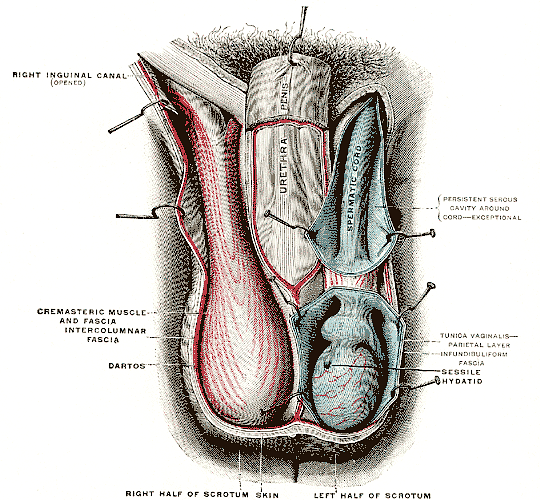
Scrotum
Also Read:
| Related Articles | ||
|---|---|---|
| Auxins | Gibberellins | Pituitary Gland |
| Thyroid Gland | Endocrine Gland | Pineal Gland |
| Luteinizing Hormone | Gonads | Growth Hormone |
Internal Structure of Scrotum
[Click Here for Sample Questions]
The outermost layer of the scrotum is the skin. It consists of more melanin pigments, many sebaceous or oil-producing glands and sweat glands with hair follicles. The hair is thicker than that of the other parts of the body. The scrotal wall is lined with smooth muscles called dartos fascia. The middle ridge between the two compartments of the scrotum is called raphe. The internal extension of the raphe is called the septum. The scrotal compartments consist of pairs of testes, epididymis, spermatic cords, and cremaster muscles.
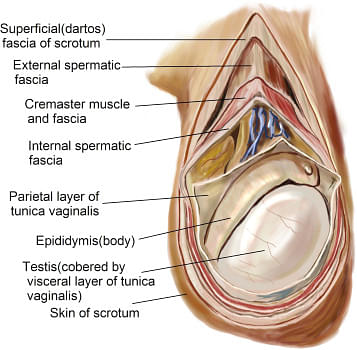
Internal structure of scrotum
Testicle (Testes)
[Click Here for Sample Questions]
It is a pea-shaped structure in each compartment of the scrotum. It is both an exocrine and an endocrine gland. As an exocrine gland, it produces sperms. As an endocrine gland, it produces a male sex hormone called testosterone. It is secreted with the help of the hypothalamus and pituitary gland. Testicles consist of sporogenous tissue inside seminiferous tubules. Here sperms are produced by spermatogenesis.
Epididymis
[Click Here for Sample Questions]
Sperms enter epididymis. It is a tightly coiled tube from the testicle. It stores all sperms formed in seminiferous tubules for 60 - 80 days till they mature. Epididymis keeps sperm alive with fluid substances secreted from the testicle.

Sperm Diagram
Also Read: Amino acid
Spermatic Cord (Vas deferens)
[Click Here for Sample Questions]
Each spermatic cord contains blood vessels, lymph vessels and lymph ducts. It is also called vas deferens. It transports sperm from the epididymis to the ejaculatory duct.
Cremaster Muscle
[Click Here for Sample Questions]
The muscle surrounding the testicle and spermatic cord is called the cremaster muscle. It moves to and fro the testicle to maintain the ideal temperature (low temperature) for sperm production. This is the reason why the scrotum hangs lower in hot conditions and closer to the body in cold conditions.
Functions of Scrotum
[Click Here for Sample Questions]
- Scrotum protects fragile testes from shocks and injuries.
- It keeps the testes at a lower temperature than that of the main body. It contracts and relaxes as per the surrounding temperature.
- The Muscle tone of the human scrotum is weak and relaxed in older men. In the case of boars, rats and stallions, it is always kept firm against the body.
Also Read:
Things to Remember
- Scrotum is the main part of the male reproductive system in mammals.
- Scrotum is both an exocrine and an endocrine gland.
- As an exocrine gland, it produces sperms. As an endocrine gland, it produces a male sex hormone called testosterone.
- Scrotum’s main purpose is to provide low temperature to testes for easy production of sperms.
- Testosterone is secreted with the help of the hypothalamus and pituitary gland.
- The epididymis is a tightly coiled tube from the testicle. It stores all sperms that formed in the seminiferous tubule.
- The muscle surrounding the testicle and spermatic cord is called the cremaster muscle.
Sample Questions
Ques 1:What is scrotum? (2 marks)
Ans: Scrotum is the main part of the male reproductive system in mammals. It is a thin sac-like structure situated outside the abdominal cavity.
Ques 2: Why is testis called an exo-endocrine gland? What are its functions? (2 marks)
Ans: Testes are both an exocrine and an endocrine gland. As an exocrine gland, it produces sperms. As an endocrine gland, it produces a male sex hormone called testosterone.
Ques 3:What is the chief purpose of the scrotum? (2 marks)
Ans: Its main purpose is to provide low temperature to testes for easy production of sperms. Sperms are produced at 3 degrees low temperature than the main body
Ques 4: What is a scrotal compartment? What are its parts (2 marks)
Ans: The scrotum is divided into two chambers called scrotal compartment. The scrotal compartments consist of pairs of testes, epididymis, spermatic cords, and cremaster muscles.
Ques 5: Where are testes located? Write briefly about testes? (3 marks)
Ans: Testes are located in scrotal compartments below the abdominal cavity, outside the body. Testis is a pea-shaped structure in each compartment of the scrotum. It is both an exocrine and an endocrine gland. As an exocrine gland, it produces sperms. As an endocrine gland, it produces a male sex hormone called testosterone. Testicles consist of sporogenous tissue inside seminiferous tubules. Here sperms are produced by spermatogenesis.
Ques 6: Where are sperms produced? Where are they nurtured till maturity (2 marks)
Ans: Sperms are produced in seminiferous tissue of testis. Sperms enter epididymis. It is a tightly coiled tube from the testicle. It stores all sperms formed in seminiferous tubules for 60 - 80 days till they mature. Epididymis keeps sperm alive with fluid substances secreted from the testicle.
Ques 7:What are the special muscles that contract and relax the scrotum to keep ideal temperature? (2 marks)
Ans: The muscle surrounding the testicle and spermatic cord is called the cremaster muscle. It moves to and fro the testicle to maintain the ideal temperature (low temperature) for sperm production. This is the reason why the scrotum hangs lower in hot conditions and closer to the body in cold conditions.
Ques 8: Draw a neat labeled diagram of scrotum? Write its functions (3 marks)
Ans:

Internal structure of scrotum
For Latest Updates on Upcoming Board Exams, Click Here: https://t.me/class_10_12_board_updates
Check-Out:




Comments