



Content Curator
Hypothalamus is a small but crucial part of the brain's centre. It is located between the pituitary gland and the thalamus in the brain and plays a critical function in hormone synthesis as well as helping to trigger a variety of important bodily processes. In this article, we discuss the definition, structure, function of the hypothalamus in depth.
| Table of Content |
Keyterms: Brain, Pituitary gland, Thalamus, Hormone, Forebrain, Nuclei, Cell, Neurosecretory cell, Neurohormones
Read More: Thermoregulation
What is a Hypothalamus?
[Click Here for Sample Questions]
Hypothalamus is the most primitive component of the diencephalon or forebrain, and it controls a vast range of bodily activities. It comprises nuclei, which are groupings of neurosecretory cells that generate hormones. The pituitary gland’s synthesis and secretion are controlled by these hormones.
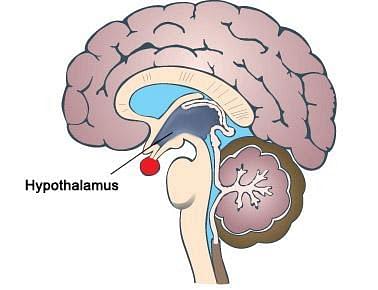
Hypothalamus
Pituitary gland activity is heavily influenced by the hypothalamus. The hypothalamus secretes neurohormones when it receives a signal from the neurological system, which starts and halt the secretion of pituitary hormones.
Read More: Neural Control and Coordination
Structure of Hypothalamus
[Click Here for Previous Year Questions]
The hypothalamus is divided into three sections:
- Middle region
- Posterior region
- Anterior Region
Anterior Region
The supraoptic area is another name for the anterior region. It maintains the circadian rhythm and controls body temperature.

Supraoptic Area
The hypothalamus has multiple tiny nuclei. Supraoptic and paraventricular nuclei are two of the most important nuclei. Hormone secretion is aided by the nuclei in this region. The anterior part of the hypothalamus secretes the following hormones:
- Corticotropin-releasing hormone (CRH) is a hormone that releases corticotropin
- Thyrotropin-releasing hormone (TRH) is a hormone that releases thyrotropin
- GnRH (gonadotropin-releasing hormone) is a hormone that releases gonado
- Oxytocin
- Vasopressin
- Somatostatin
Middle Region
The middle or the tuberal region is made up of arcuate and ventromedial nuclei.
The hunger is controlled by the ventromedial nuclei, whereas the arcuate nuclei secrete the growth hormone, which is responsible for the body's growth and development.

Tuberal Region
Posterior Region
The mammillary region is another name for this area. The posterior hypothalamus nucleus and mammillary nuclei are two of the most important nuclei.
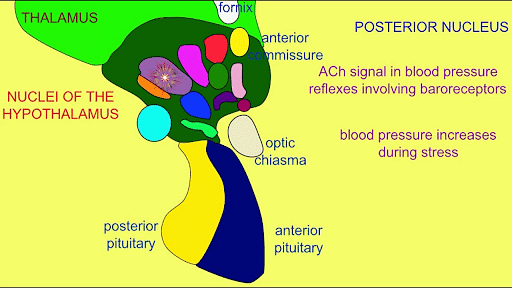
Posterior Region
Shivering and sweat blocking are caused by the posterior hypothalamus nuclei, which regulates body temperature. The mammillary nuclei, on the other hand, are thought to play a role in memory
Read More: Conduction of Nerve Impulse
Functions of Hypothalamus
[Click Here for Sample Questions]
The hypothalamus is a key component of the endocrine system. Despite its tiny size, the hypothalamus plays a vital role in a variety of processes. Some of the functions of the hypothalamus are as follows.
- The endocrine and neurological systems are linked by it.
- It releases and inhibits hormones, which regulate the synthesis of other hormones in the body.

Functions of Hypothalamus
Hypothalamus also keeps your body in a state of homeostasis, or internal equilibrium. The hypothalamus does this by assisting in the stimulation or inhibition of several of your body's critical activities, including:
- Blood pressure and heart rate
- Temperature of the body
- Thirst, as well as fluid and electrolyte balance
- Appetite and body mass index
- Stomach and intestinal glandular secretions
- Substances that alter the pituitary gland's ability to release hormones are produced.
- Cycles of sleep
- Sexual behaviour
- Emotional responses control
Read More: Pineal Gland
Hormones of Hypothalamus
[Click Here for Previous Year Questions]
Hormones are chemical messengers that are secreted directly into the bloodstream, from where they are carried to the body's organs and tissues to perform their activities. Hormones affect different areas of physiological functioning and processes.

Hormones of Hypothalamus
Hormones are produced by two types of nerve cells in the hypothalamus. The hormones produced by one set are sent down the pituitary stalk to the posterior lobe of the pituitary gland, where they are immediately released into the bloodstream.
The other set of nerve cells creates stimulating and inhibitory hormones that travel down through the pia mater to the anterior lobe of the pituitary gland via a network of blood arteries.
The hypothalamus secretes the following primary hormones:
Anti-Diuretic hormone (ADH): This hormone causes the kidneys to absorb more water into the bloodstream.
Corticotropin-releasing hormone (CRH): It stimulates the adrenal glands to release corticosteroids, which assist control metabolism and immunological response, by sending a message to the anterior pituitary gland.

Hypothalamus Hormone Functions
Gonadotropin-releasing hormone (GnRH): It stimulates the anterior pituitary to secrete follicle-stimulating hormone (FSH) and luteinizing hormone (LH), which work together to keep the ovaries and testes in good working order.
GHRH (growth hormone-releasing hormone) or GHIH (growth hormone-inhibiting hormone) (also known as somatostatin) stimulates the anterior pituitary to release growth hormone (GH); GHIH has the opposite effect. GH is necessary for youngsters to maintain healthy body composition. It promotes healthy bone and muscle mass in adults and influences fat distribution.
Growth hormones are also influenced by the brain. It tells the pituitary gland whether or not to increase or reduce their presence in the body, which is important for both growing children and fully formed adults.

Hormones of Hypothalamus
Oxytocin: It is involved in several functions, including orgasm, trust, body temperature, sleep cycles, and the production of breast milk.
PRH (prolactin-releasing hormone) or prolactin-inhibiting hormone (PIH) (also known as dopamine): It stimulates breast milk production by causing the anterior pituitary to produce prolactin.
Thyrotropin-releasing hormone (TRH): TRH stimulates the release of thyroid-stimulating hormone (TSH). TSH stimulates the release of thyroid hormones, which regulates metabolism, energy, and growth and development.
Also Read:
Disorders
[Click Here for Sample Questions]
Hypothalamic illness is a disease or ailment caused due to any dysfunction in the hypothalamus. One of the most prevalent causes of hypothalamic dysfunction is a head injury that affects the hypothalamus.
Appetite and sleep disorders are examples of hypothalamic diseases, but because the hypothalamus affects so many different aspects of the endocrine system, it can be difficult to determine whether the root cause of hypothalamic disorders is caused by another organ.
Things to Remember
- The hypothalamus is a small portion of the brain found in vertebrates. It is located beneath or below the thalamus. The anatomical link between the neurological and endocrine systems is provided by it.
- Like the rest of the brain, the hypothalamus is made up of interconnected neurons that are sustained by a plentiful supply of blood.
- The anterior, middle and posterior parts of the hypothalamus are the three primary areas of the hypothalamus' structure.
- The hypothalamus is a key component of the endocrine system. One of the hypothalamus' key roles is to maintain homeostasis or to keep the human body in a steady, continuous state.
- The hypothalamus reacts to a range of internal and external signals, including body temperature, appetite, feelings of fullness after eating, blood pressure, and hormone levels in the circulation.
- Corticotropin-releasing hormone, dopamine, growth hormone-releasing hormone, somatostatin, gonadotropin-releasing hormone, and thyrotrophin-releasing hormone are all hormones generated in the hypothalamus.
- Head trauma, brain tumours, infection, surgery, radiation, and considerable weight loss can all impact hypothalamic function. A loss of hypothalamic control can cause problems with energy balance and thermoregulation, as well as disorganised body rhythms (insomnia) and pituitary deficiency symptoms.
Read More: Difference between Cell Membrane and Plasma Membrane
Previous Year Questions
- Injury to vagus nerve in human is not likely to affect...[NEET 2004]
- A gymnast is able to balance his body upside down even in the total darkness because of..[NEET 2015]
- Bowman's glands are located in the...[NEET 2007]
- Function of iris is to...[NEET 1993]
- Good vision depends on adequate intake of carotene rich food : Select the best option from the following statements...[NEET 2017]
- Injury localized to the hypothalamus would most likely disrupt...[NEET 2014]
- Iris is part of...[NEET 1993]
- Myelin sheath is produced by….[NEET 2017]
- Receptor sites for neurotransmitters are present on :…..[NEET 2017]
- A diagram showing axon terminal and synapse is given. Identify correctly at least two of A-D...[NEET 2013]
Sample Questions
Ques. What is the role of the hypothalamus? [2 marks]
Ans. The hypothalamus is involved in different daily activities like eating or drinking, in the control of the body's temperature and energy maintenance, and in the process of memorizing and in stress control. It also modulates the endocrine system through its connections with the pituitary gland
Ques. Where is the hypothalamus situated? [2 marks]
Ans. The hypothalamus is located on the undersurface of the brain. It lies just below the thalamus and above the pituitary gland, to which it is attached by a stalk.
Ques. What does the hypothalamus do in animals? [2 marks]
Ans. All humans and many animals have a hypothalamus. The hypothalamus does many things, but two of its most important jobs are to maintain homeostasis and to control certain hormones. Homeostasis is very important to all animals, including humans.
Ques. What are the major functions of the hypothalamus? [3 marks]
Ans. While the hypothalamus is very small, the hypothalamus plays a crucial role in many important functions, including:
- Releasing hormones.
- Regulating body temperature.
- Maintaining daily physiological cycles.
- Controlling appetite.
- Managing of sexual behaviour.
Ques. What emotions does the hypothalamus control? [2 marks]
Ans. The hypothalamus also plays an important role in emotion. The lateral parts of the hypothalamus are involved in emotions such as pleasure and rage, while the median part is associated with aversion, displeasure, and a tendency to uncontrollable and loud laughing.
Ques. What cells are found in the hypothalamus? Write about them in detail. [5 marks]
Ans. There are two sets of nerve cells in the hypothalamus that produce hormones. One set sends the hormones they produce down through the pituitary stalk to the posterior lobe of the pituitary gland where these hormones are released directly into the bloodstream. These hormones are anti-diuretic hormone and oxytocin. The anti-diuretic hormone causes water reabsorption at the kidneys and oxytocin stimulates contraction of the uterus in childbirth and is important in breastfeeding.
The other set of nerve cells produces stimulating and inhibiting hormones that reach the anterior lobe of the pituitary gland via a network of blood vessels that run down through the pituitary stalk. These regulate the production of hormones that control the gonads, thyroid gland' data-content='1456' >thyroid gland and adrenal cortex, as well as the production of growth hormone, which regulates growth, and prolactin, which is essential for milk production. The hormones produced in the hypothalamus are corticotropin-releasing hormone, dopamine, growth hormone-releasing hormone, somatostatin, gonadotropin-releasing hormone and thyrotrophin-releasing hormone.
Ques. What is oxytocin? Where is it produced? How is oxytocin controlled? [5 marks]
Ans. Oxytocin is produced in the hypothalamus and is secreted into the bloodstream by the posterior pituitary gland. Secretion depends on the electrical activity of neurons in the hypothalamus – it is released into the blood when these cells are excited.
The two main actions of oxytocin in the body are contraction of the womb (uterus) during childbirth and lactation. Oxytocin stimulates the uterine muscles to contract and also increases the production of prostaglandins, which increase the contractions further.
Oxytocin production and secretion are controlled by a positive feedback mechanism where the release of the hormone causes an action that stimulates more of its own release. There is also positive feedback involved in the milk-ejection reflex. Stimulation of the nipple during breastfeeding leads to increased oxytocin production and secretion into the blood, which then causes milk to be let down into the breast. The positive feedback cycle is maintained until the baby stops suckling. The production of oxytocin during childbirth is also self-limiting; the release of the hormone is stopped once the baby is delivered.
Ques. What causes the hypothalamus to malfunction? [2 marks]
Ans. There are many causes of hypothalamic dysfunction. The most common are surgery, traumatic brain injury, tumours, and radiation. Other causes include Nutrition problems, such as eating disorders (anorexia), extreme weight loss.
Do Check-Out:




Comments