



Content Curator
There are various types of reflex actions that are caused due to various reasons. These are a vital constituent of our nervous system that control all our involuntary actions and are extremely important to protect our sense organs and other body parts. You must have wondered why do we blink whenever someone blows into our eyes, or why do we take away our hand whenever it touches something hot. These are all examples of reflex actions that our body goes through. In this chapter, we shall study all about reflex actions, their types and their important roles in our body.
| Table of Content |
Key Terms : Reflex action, receptor, sensory nerve, interneuron, stimuli
What is Reflex Action?
[Click Here for Sample Questions]
Sometimes our bodies or parts of our body go through involuntary movements as a result of a particular stimulus. These involuntary movements are not performed consciously, as our bodies undergo these reactions as a result of some action.
These involuntary actions are known as reflex actions. In other words, reflex action can be defined as the entire process of an involuntary response to peripheral nerve stimulation, that is, a response without any thought or conscious effort that involves a part of the central nervous system.
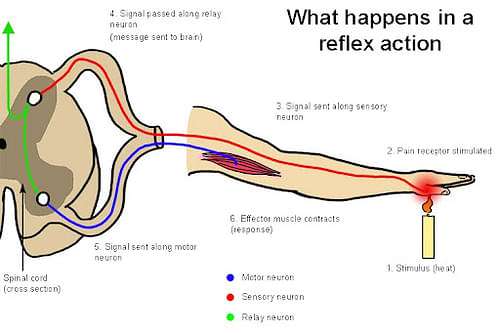
What Happens in a Reflex Action?
A good example of reflex action would be the constriction of pupils when light is flashed on the eyes. This is called the pupillary light reflex, where light is the stimulus. As the lights are flashed, the brain receives impulses via the optic nerve, and the response is sent to the pupillary musculature through automatic nerves that supply the eye.
Reflexes are significant because they protect our body parts, especially the sense organs. They protect us from sudden stimuli in the environment that might be harmful to us. Reflex actions thus take care of the survival of organisms.
Read More:
| Related Topics | ||
|---|---|---|
| Nervous System Definition | Types of Receptors | difference between cerebellum and cerebrum |
| Conduction of Nerve Impulse | Peripheral Neural System | An Overview on Autonomic Neural System |
Reflex Action and Reflex Arc
[Click Here for Previous Years Questions]
The neural pathway that controls reflexes and acts on an impulse way before it reaches the brain is called the reflex arc. There are two types of reflex arcs. They are:
- Autonomic Reflex Arc that affects the functioning of inner organs.
- Somatic Reflex Arc that affects the functioning of muscles.

Reflex Action and Reflex Arc
The reflex pathway or the reflex arc is composed of five primary components. These are:
- Receptor– It receives information and assists in generating impulses
- Sensory Nerve– Its function is to carry information from the receptor to the interneurons present in the spinal cord
- Interneuron– Processing of information and generating effective responses is done here
- Motor Nerve– It carries the processed information from the spinal cord to the effector
- Effector Organ– This is an organ in the body that receives the information from effector neurons and conducts the appropriate response or reflex action.
Also read: Medulla Oblongata
Classification of Reflex Action
[Click Here for Sample Questions]
Reflex actions are classified based on a number of factors like type, degree of complexity, function, development, and response. Some of these classifications are tabulated below:
| Parameters | Description |
|---|---|
| Type and Function | These include reflex actions that move skeletal muscles, for example, flexor, locomotor, stat kinetic, extensor. Some are involved in movement of internal organs like excretory, secretory glands, digestive organs and cardiovascular movements. |
| Degree of Complexity | Reflex actions are also categorized on the neuron or nerve organization with the reflex arcs. For example, monosynaptic or monosegmental reflexes which involve only one segment of the nervous system, and multisynaptic or intersegmental reflexes involving multiple segments of the nervous system. |
| Muscular Influence | Reflex actions often have excitatory or inhibitory action on muscles and body organs. For example, in the case of the heartbeat, the excitatory reflex caused by the sympathetic nerve can cause an increase of heartbeat, while the inhibitory action of the vagus nerve can cause a decrease in heartbeat or even make it stop. |
Common Types of Reflexes
[Click Here for Previous Years Questions]
Some common reflexes that our body undergoes every day are as follows:
- Accommodation Reflex: This is the most common type of reflex that occurs in the eye. It makes the pupil, lens, and vergence accommodate according to change in light or vision. The change is brought by ciliary muscles in the eyes.
- Acoustic Reflex: This occurs in the ear, due to contraction of the stapedius and tensor tympani muscles in response to high decibel sounds.
- Pupillary Light Reflex: As the name suggests, this occurs in pupils of the eyes were pupils of both eyes contract when light is flashed near the eyes. The light acts as the stimulus which produces impulses. These reach the brain via the optic nerve and the response is by autonomic nerves to the pupillary musculature in the eyes.
- Ankle Jerk Reflex: Jerking of the ankle is a very common reflex. This reflex action helps in maintaining body balance and posture. Doctors even test the knee jerk reflex by hitting a hammer on the knee. Lack of this reflex may indicate peripheral nerve disease or receptor damage.
- Biceps Reflex: This reflex occurs as a jerk in the forearm when the biceps brachii tendon is struck with the tendon hammer. Bicep reflex is significant as it helps to detect other reflexes and locate neurological diseases.
- Blushing: This refers to the reddening of the face out of shame, embarrassment, fear, or other emotions. This happens due to psychological reasons which lead to blood rushing to the face and turning the cheeks or ears red.
- Cough Reflex: When dust or some foreign object enters the trachea or respiratory tract, the cough receptor produces cough which helps in removing the foreign particles from the tract before they reach the lungs.
- Corneal Reflex: This refers to the blinking of both eyes when some dust or foreign materials accidentally touch or enter our eyes. The testing of this reflex may get reduced when contact lenses are used.
- Sneeze: Sneeze occurs when there is irritation of nasal mucosa in the nose tract. It helps in getting rid of foreign particles or dirt within the nostrils.
Read More:
| Chapter Related Topics | ||
|---|---|---|
| Nerve Impulse | Synapse | Receptors |
| Hypothalamus | Corpora Quadrigemina | Pons |
Importance of Reflex Actions
[Click Here for Sample Questions]
Reflex actions form a very significant part of our nervous system. Their presence keeps our bodies safer and adapted to sudden changes in our surroundings. These spontaneous, automatic and quick responses to internal and external stimuli help in protecting our sense organs and all other body parts from any damage.
Reflex actions help in sensing problems immediately and react quickly before the involvement of the spinal cord or the brain. As a result, they are extremely efficient and absolutely essential for all organisms to survive. Working of all reflexes is also a sign that the nervous system is working effectively. Any deficiency or lack of reflex may indicate a vital nervous problem that may have grown in the body.
Also read: eye diseases
Things to Remember
[Click Here for Previous Years Questions]
- A reflex action is a quick involuntary response to a sudden change in the environment called stimuli.
- The path in which a reflex action travels is called the reflex arc. The reflex arc is of two types- Autonomic and Somatic.
- The components of the reflex arc are receptor, sensory neuron, interneuron, motor neuron, and effector organ.
- Reflexes are classified in various categories like type, function, degree of complexity and muscular influence.
- Some common types of reflex actions are accommodation reflex, pupillary reflex, acoustic reflex, ankle jerk reflex, biceps reflex, cough reflex, blushing, sneezing and corneal reflex.
- Reflex actions are a very significant part of our nervous system as they protect our body from any damage by sudden external and internal stimuli.
Also read: Difference between neurosis and psychosis
Previous Years Questions
- Motor neuron of a reflex arc carries impulse….[CUCET 2006]
- Nerve impulse is generated when nerve cell….[CUCET 2006]
- Aqueduct of Sylvius is found between….[COMEDK UGET 2007]
- In ear the membranous labyrinth is filled with fluid called….[CUCET 2009]
- The capacity to differentiate colours lies in…..[CUCET 2009]
- It is present in rod cells and useful in night vision...[GUJCET 2007]
- In which of the following only cone cells are found...[GUJCET 2006]
- Structurally, what are olfactory nerve cells...[GUJCET 2008]
- Which of the following is correct for lens focussing while...[GUJCET 2008]
- How many pairs of spinal nerves are found in humans...[GUJCET 2006]
- Myelin sheath is produced by...[NEET 2017]
- Receptor sites for neurotransmitters are...[NEET 2017]
- Injury to vagus nerve in human is not likely to..[NEET 2004]
- A gymnast is able to balance his body upside down...[NEET 2015]
- Bowman's glands are located in the...[NEET 2007]
Sample Questions
Ques. Reflex action is a part of which body part? (1 Mark)
Ans. Reflex actions are part of the nervous system. The primary organs of the nervous system involved in reflex actions are the spinal cord, sensory neuron, motor neuron, and the brain.
Ques. What is the primary controller of reflexes? (1 Mark)
Ans. The primary controller of reflex actions is the spinal cord. It connects the brain with the spinal nerves that carry the messages and responses to our body parts.
Ques. Can sweating be considered a reflex action? (1 Mark)
Ans. Sweating is not primarily a reflex action. Sweating occurs due to change in surrounding or body temperature. However, sometimes we sweat due to excessive fear or tension and during these instances, sweating can be considered as an example of sudomotor axon reflex.
Ques. Is swallowing food a reflex action? (1 Mark)
Ans. Swallowing of food occurs due to peristalsis, which is involuntary movements of circular and longitudinal muscles along the food pipe and the digestive tract. It is therefore an example of reflex action.
Ques. What is the fastest reflex in a human body? (1 Mark)
Ans. The fastest reflex recorded in a human body is within the jaw muscle also called the masseter muscle. The fastest possible conscious human reactions are around 0.15 s, but most are around 0.2 s. Unconscious, or reflex, actions are much faster, around 0.08 s because the signal doesn't have to go via the brain.
Ques. Can reflex actions ever be voluntary? (2 Marks)
Ans. No, reflex actions are meant to be involuntary and done without consciousness. However, it is important to remember that all reflex actions are involuntary but all involuntary actions are not reflex actions.
Voluntary actions involve conscious thought (thinking time). Reflex actions do not involve conscious thought (thinking time) and happen very quickly to avoid unnecessary damage to the body. One example of this is rapidly removing your hand from a hot plate before it gets burned.
Ques. What is the function of receptor cells in a reflex arc? (3 Marks)
Ans. Receptor cells convert one form of energy into electrical impulses and pass them onto the nerve cells that in turn reach the brain and formulates a reflex action.
Receptor in the skin detects a stimulus (the change in temperature). Sensory neuron sends electrical impulses to a relay neuron, which is located in the spinal cord of the CNS. Relay neurons connect sensory neurons to motor neurons. Motor neurons send electrical impulses to an effector.
Ques. Can reflex actions remain absent in a human body? (3 Marks)
Ans. Reflex actions are naturally given in all human bodies to protect us from sudden changes in environment or foreign material to enter our body. The absence of reflex actions may indicate neurological diseases and should be treated immediately.
A reflex can be decreased or absent if there is a problem with the nerve supply. To test your reflexes, your doctor will use a rubber hammer to tap firmly on the tendon. If certain reflexes are decreased or absent, it will show what nerve might be compressed. Not all nerve roots have a reflex associated with them.
Ques. What are the nerve cells involved in reflex actions called? (4 Marks)
Ans. The nerve cells that carry electrical impulses and generate reflex actions are called neurons. Most reflex arcs involve only three neurons. The stimulus, such as a needle stick, stimulates the pain receptors of the skin, which initiate an impulse in a sensory neuron. This travels to the spinal cord where it passes, by means of a synapse, to a connecting neuron called the relay neuron situated in the spinal cord.
The relay neuron in turn makes a synapse with one or more motor neurons that transmit the impulse to the muscles of the limb causing them to contract and pull away from the sharp object. Reflexes do not require involvement of the brain, although in some cases the brain can prevent reflex action.
Do Check Out:



Comments